Manchester City Council’s Executive Member for the Environment, on over £30k a year, is STILL not trying to rally Manchester to cope with climate change. This despite a basic admission that the “carbon budget” launched with great fanfare and self-congratulation in late 2018 is blown to hell.
Well, eight months on, exactly the same questions have been asked again. The answers have been received just now. And they are exactly the same.
Has she held any emergency summits with fellow Executive Members and/or members of the Council’s SMT? If so, on what dates, who attended, what were the outcomes. If not, why not, and are any planned?
Response: There are no records of meetings entitled ’emergency summits’ held with fellow Executive Members and/or members of the Council’s SMT. None are currently planned.
Has she held any emergency summits with businesses leaders? If so, on what dates, who attended, what were the outcomes? If not, why not, and are any planned?
Response: There are no records of the Executive Member for the Environment holding meetings entitled ’emergency summits’ held with business leaders. None are currently planned.
Has she held any emergency summits with faith leaders? If so, on what dates, who attended, what were the outcomes? If not, why not, and are any planned?
Response: There are no records of the Executive Member for the Environment holding meetings entitled ’emergency summits’ held with faith leaders. None are currently planned.
Has she held any emergency summits with community leaders? If so, on what dates, who attended, what were the outcomes? If not, why not, and are any planned?
Response: There are no records of the Executive Member for the Environment holding meetings entitled ’emergency summits’ held with community leaders. None are currently planned.
Has she held any emergency summits with members of the Climate Change “Partnership” under the banner of the Partnership. If so, on what dates, who attended, what were the outcomes. If not, why not, and are any planned?
Response: There are no records of the Executive member the Executive Member for the Environment holding meetings entitled ’emergency summits’ held with members of the Climate Change “Partnership” under the banner of the Partnership. None are currently planned.
Has she asked the Partnership to display the existence of climate change and the need to take urgent local action on their websites? If so, when did she ask this and what were the replies. If not, why not, and does she ever intend to do so.
Response: There are no records of the Executive Member for the Environment asking the Partnership to display the existence of climate change and the need to take urgent local action on their websites.
So there are further questions, which aren’t – sadly – FOIA-able. These include
why on earth did this person TAKE the job if she isn’t going to DO anything?
why do the few Labour councillors who actually give a shit about the future of the city not get up on their hindlegs? (that one is easy, tbh – to send a message to your hindlegs you need a spine…)
why is “civil society” in Manchester not up on its hindlegs about this (also easy to answer, tbf)
First up – congratulations to the new Green Party councillor in Woodhouse Park, Astrid Johnson.
You can read more about her and the election result on the Greens website.
Second up – congratulations to the team around her. The sheer amount of work required to get this result is beyond the imagination of folks not heavily involved.
Third up – and only quickly because
a) nobody reads this site
b) I have a job I should be doing
c) I don’t even freaking LIVE in Manchester anymore, some “what next/what else” thoughts (because, you know, my opinion is so sought after).
What next?
In the short term, I hope the Greens
a) make it impossible for the Labour Party to keep both their councillors off Environment and Climate Change Scrutiny Committee. The only way to do this is to start flagging it as an issue now, to raise the cost to Labour of keeping them both off. Making appeals to Labour’s moral compass is a mug’s game.
b) I hope the Greens also do a better job than they have done in the last year of updating their website with blog posts (pro-tip – a well-constructed press release can easily be converted into a blog post, if you get the structure right). I hope this leads to them doing more “political education” work, that’s mostly not being done by anyone very well in Manchester.
[But to be clear – scrutinising the Council is not something that should be left to the Greens, or any political party. It’s the work for other organisations too, unless they think that social change comes from cheerleading a couple of Labour Party councillors who claim to be trying to change the system from within.]
I hope the Greens figure out some way of working with the two Liberal Democrats around scrutinising the Council. They might even be able to cover as many as four of the six scrutiny committees, between them.
Longer-term
Presumably the Greens will be targetting Woodhouse Park for their third seat at next year’s elections. Will Eddy Newman even be defending the seat for Labour? Who knows. I hope they can sustain their upward momentum, and morale, and expand their influence.
What else?
More generally, let’s not get carried away – this is still a Labour Party with 92 of the 96 seats. They control all the committees. They have a largely supine officer class that looks the other way when elected politicians do things dodgily and flagrantly. The officers know which side their bread is buttered on… Meanwhile, presumably the civil war within Manchester Labour Party continues to rage (and may explain why they couldn’t get rid of the man they all love to hate – John Leech – simply didn’t have enough boots on the ground?)
Manchester is still a de facto (but not, obviously, de jure) one party state. Labour seems to have suffered no discernible electoral damage in Chorlton Park or Old Moat, where a protest vote against the Hough End Fields decision seems to be conspicuously absent.
In a one-party state, the “rules” are different. Getting anything done that isn’t in the perceived self-interest of those running the show becomes, well, I think today’s euphemism is “challenging”…
Meanwhile, the carbon dioxide accumulates, the government passes laws criminalising protest and the issue attention cycle has moved on from climate change. We face a mind-boggling cost-of-living crisis with all that that entails around ever-deeper immiseration and cruelty towards the most vulnerable in society.
What is to be done?
The tasks – maintaining, at the group level, morale, sanity, absorptive capacity, capacity to act – remain the same, even as the circumstances in which people of good faith try to operate become ever harder.
We won’t get there with stale old brain-dead meetings where you are told about how awful everything is for three hours and then exhorted to “build the movement” by clapped-out grifters and hustlers. Trust me on this.
Anyway, good luck (and, barring maybe one post next week) goodbye.
Meanwhile, all our yestedays have lighted fools the way to dusty death.
Here we are, in the aftermath of another wasted wave of climate “activism”. What has been built? What has been learnt? What will endure. “Nowt”, as they say up north.
“As to the future, I’m reluctant to guess. The movement, so-called, has developed no self-sustaining organizational forms or clear intellectual vision that expresses the understanding, or even the mood of the vast number of mostly young people who feel themselves to be part of it or at least drawn to its fringes.”
Yeah, there’s a couple of Freedom of Information Act request answers that reveal Manchester City Council to be (checks notes) … as incompetent and dishonest on climate change as it has been for the last 30 years.
But given that nobody in Manchester seems to be doing any of the bread and butter work around holding them to account, exposing their lies, in ways that ordinary people might engage with, why should I bother? So, a straight-up repost instead –
First thing to say is that it isn’t the people on the sharp end of climate change who have been indulging in fantasy. They are not to blame for this. They did what they could, they did not “allow” this, they were simply outspent, outfought, outmanoeuvred.
The small island states knew that rising sea levels (from from melting ice and straight-forward thermal expansion – warm water takes up more space) would doom them.
Since then (actually since 1988, in Toronto and Hamburg) they have been pleading with “developed” (a euphemism for ‘successfully extractive’) nations to take climate change seriously, to reduce emissions.
The rich nations’ governments have blathered. They have offshored production and taken the credit. They have diverted everyone into emissions trading (lawyers and bankers get rich), or talked about technological solutions (full disclosure – I think carbon capture and storage for a small number of processes is probably not a bad idea), without ever delivering, without ever creating and implementing policies that would even reduce the acceleration in the trajectory of man-made emissions (they needed to reduce in absolute terms – they have gone up by 60% since 1990).
The corporations and their lobby organisations have done brilliantly in slowing, or stopping, or diverting climate action. And they have been endlessly exposed, named and shamed by journalists and academics (waves at Oreskes, Conway, Brulle, Stokes etc). And still they keep on, with new versions of predatory delay. Why change a ‘winning’ game?
Western consumers and “citizens” never realised what was actually at stake, or thought it was anything to do with them. In the countries of the world where there was freedom of speech, assembly and information, where you didn’t get thrown in jail or worse for telling the truth about what our Lords and Masters were doing… there was, basically, silence, punctuated every few years by noisy and short-lived protest. Nobody knows how to build the stamina for a long sprint through the institutions (sorry Rudi, your sacrifice was in vain. I am glad you’re not hear to see it. You too, Bert).
I think we are finally on the cusp of a bunch of “serious” and “grown up” people coming out and saying what the scientists I trust (waves at Kevin) have been saying for years – that “our” chances of keeping warming below 2 degrees are now vanishingly small.
We (rich people, comparatively) in the West, did not act. We lived in worlds of fantasy and distraction, of festival, and delusion. Other people – people of colour – died, but we thought that would never happen to us, because we are white, we speak English, we are, what’s the word, “civilised.” If the situation were all that serious, our leaders would do something. The technology would be our salvation.
That narrative? That narrative is gasping, doing its Cheyne-Stokes respirations.
What comes next?
I don’t know.
Fear, slow panic as we realise the slow violence we dished out has consequences? Millennarian manias?
Yes, social “capital” will be required, but at what scale? The scale of a town, a city, a nation? What do we DO?
And all those species we are killing.
Godammit.
What does it mean for Manchester?
If individuals cannot form and sustain organisations capable of consistent, meaningful and radical action, combining with other groups, learning from them, sharing skills, knowledge, morale, then NOTHING WILL CHANGE.
There is no magical sky god who will wave a wand and make it all okay. There just isn’t.
Labour will go on lying, and most people will be soothed by those lies.
The Greens will continue to chip away at Labour’s electoral lead – on current trajectories they will have enough councillors to chair one scrutiny committee in 2035 or so. They will have control of the council in 2060 or thereabouts. Maybe by then they will have updated their website.
And the people of Manchester? And the other species who call that territory home? Doomed to unmitigated misery, of floods, heatwaves, mayhem and death.
First off, you should read this fine blog post by my former colleague and still-friend Calum McFarlane on the Climate Emergency Manchester website (yes, I submitted the FOIA).
Right, this.
Do we in the bubble, with our private and public spats (they are fun, aren’t they), ever understand how “ordinary people” think about when they think about social movements and activism?
Does much of what we do resonate?
What messages do we send when our “organisations” go up like a rocket and then come crashing down like a stick?
I think we send a message that is something like this. “The only kind of action you will get credibility points for is the really high-arrest risk stuff. Oh, and if you get involved in a group, it will probably go up like a rocket and come down like a stick.”
I looked at the Twitter accounts of three groups that claimed to be All That about Manchester activism.
Greater Manchester Climate Action Network – last Tweet was in November 2019
Youth Climate Strike – last tweet was November 2021, promising to be back in two weeeks
The woefully misnamed “COP26CoalitionMcr” hasn’t tweeted anything (not even a retweet) since June.
None of these organisations even bothered to put up a tweet saying “actually, we’re dead, but the issue isn’t, so please try x or y or z.”
Meanwhile, XR Manchester never seems to tweet about anything it is doing (is it doing anything?) or even about the greenwashing shitshow that is Manchester City Council
The last blog on their website? That would be in May… 2021.
Meanwhile, I am still, for the lulz, on the email lists for various XR fractions. The whole of XR North has precisely one person on the comms team.
The message we send is “come get nicked. But the groups will wink out of existence like a fist when you open your palm.”
And we wonder why nobody gets involved for the long-haul.
Two developments in Manchester over the last week have me hurling an unsolicited and unwelcome grenade from afar (well, three – a very kind message from a Mcr stalwart). Don’t read on if you are of a nervous disposition. As well as this being #OldFartClimateAdvice and #UnsolicitedAdvice, this is also written in the spirit of #NoPrisoners and #NFLTG. If you are going to tell me WHY I am wrong, please do respond. If you are just going to hurl ad hominems, save the electrons and your/my time – it’s way later than we think.
First the “developments”
Second what Manchester City Council/Labour Party are likely to do next.
Third, what the members of the Manchester “environmental advocacy network” can/should do about that and more broadly.
Finally, some final reflections.
1. The Developments
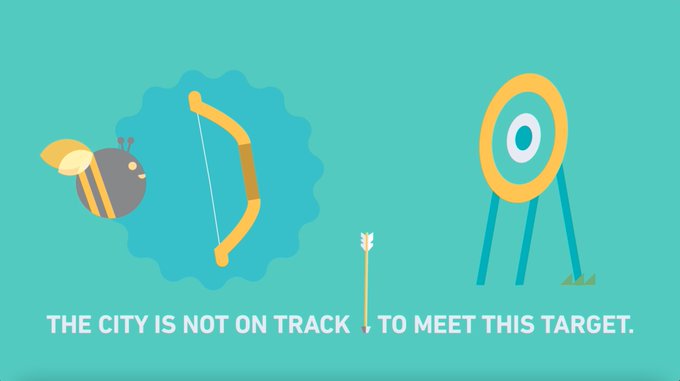
Development One – Manchester City Council/Climate Change Agency is finally beginning to admit what your average amoeba has known for years (so, will have come as a surprise to most Labour Councillors, and most of the Executive) there is not a snowball’s chance in hell of Manchester staying within its 15 million tonne carbon budget. That 15 million tonne budget, established in 2018, was supposed to last the whole century. In the past 3 years – as per multiple blog posts/reports in MCFly/CEM – we’ve been burning 2 Million Tonnes a year. So, over half the entire century budget gone in four years. That’s next-level failure, even for this Council.
So, the Manchester Climate Change “Agency” – whose top official is a council bureaucrat on £60k because three separate national job searches could not find anyone else – is putting out moronic graphics like this one.
Development Two – Climate Emergency Manchester (full disclosure: I co-founded it and was in the core group until last November, when I began to consciously uncouple myself from Manchester) has gone public about its evident frustrations with the performance of Manchester Green Party. See the blogpost Will the Manchester Green Party be an effective Official Opposition? by my friend and former colleague Robbie Watt.
So far, no official response from MGP. Three options
a) they will simply not reply (either because they judge it easier/safer to pretend it hasn’t been said, or because they won’t be able to get their act together to offer a reply).
b) they will say some variation of “why don’t you middle-class wankers keep you’re stoopid opinions to yourselves? We Have Three Councillors.”
c) they will actually actively engage and try to figure out how to be play the role that Friends of the Earth should have been playing (except since about 2009 it has been, on climate, a wholly-owned subsidiary of the Council) or, more recently, Extinction Rebellion Manchester, till it fizzled out into utter irrelevance [does it even exist anymore?]) – namely, acting as a galvanising, connecting force among the diverse groups in Manchester, fighting on different issues and different local battles, to create a vibrant and sustained radical counterweight to the neoliberal poison that Labour Group serves up.
2. What Manchester City Council will do next
This is based on almost 15 years of close and pained observation/engagement and archival research going back to the late 1980s, when “The Greenhouse Effect” became something the Council had to pretend to give a damn about.
You have to understand with these brittle narcissists – who have long-lived in a self-designed echo chamber, but seethe with resentment and jealousy at those who can still see and say the truth – that NOTHING is EVER their fault. Mistakes were made, but never ever by them.
a) burnish their own credentials. They are already brazenly trying to frame themselves as “brave” for having made a big headline-grabbing promise back in 2018. God forbid anyone should expect them to actually take actions to meet that promise. What are you, some sort of nutter who hates the Labour Party? [Btw, this dynamic is EXACTLY the same as Boris Johnson promising to ‘level up’. He knew it would play well, and he knew that he was never going to do the things that needed doing to make that empty shiny promise into reality.] They will go on and on about how far-sighted they were, how bold and how deserving of applause they are. They will roll out various brain-dead flunkies to repeat the line.
b) shift the focus.
This falls into two parts.
i) They will try to shift the blame onto others, especially central government. (To a lesser extent – they toyed with it last year – they will blame other organisations in Manchester for not having reduced emissions at the rate the Council has. This is tricky though, because some organisations might push back, and others will point to the Council’s actually quite shoddy performance).
ii) They will try to shift the debate onto OTHER issues – biodiversity (let’s not mention Hough End Fields though!) or “public” space like Mayfield (it won’t be public. It will be more private space that superficially seems public). Or a momentary uptick in recycling rates.
They may – though I doubt it –
3) come out swinging against their public critics. They will attack the Greens and Lib Dems, obvs, but that goes without saying. They might push back against CEM and other groups. But on the whole, they have just enough braincells to know what the Streisand Effect is. Occasionally claim “nonsense”, but nothing more.
4) to co-opt critics. But they don’t have the skills or credibility for that, I think. I mean, they will find some clueless zombies for photo-ops, there are always those. But beyond that? Yeah, nah.
3. Opposing what? Proposing what?
So, the tedious ‘what is to be done?’ question.
For. The. Love. Of. God. CARPE. ALL. OF. THE. DIEMS. Have you looked at the forecasts for the weather, for food/fuel prices, for the horsemen of the apocalypse? What are you doing dicking around with futile information-deficit model-based maundering and tedious endless meetings? Get out there and enjoy your last good weeks/months, dammit. Whatever that is- whether it is reading books, skydiving, going to orgies, gigs or theatre or whatever. As long as it is consenting adults, for the love of god, get busy.
But if you will insist, here is some unsolicited advice.
a) NAME WHAT THE COUNCIL IS DOING.
Name the self-burnishing bullshit. Name the blame-shifting. Name the distraction techniques. Do it with twice as much mockery and sarcasm as you think they deserve, because you are massively underestimating what these poltroons actually should get. Bile and vitriol? – yes, but sparingly.
and explain it, in the context of their actual agenda – a) maintenance of their own power/comfort, b) the ‘inward investment’ model that has serve them and some others so well.
b) NAME THE CYCLE
It isn’t hard.
1) Manchester Labour ignore green issues 2) Local activists protest 3) OTHER places make promises 4) Mcr Labour make promises, takes credit 5) No actual ACTION follows 6) Local activists raise this 7) Mcrr Labour blames everyone but itself. 1) Mcr Labour ignore green issues…
Here CEM could have simply raided its back catalogue for a perfect image: the one with the cycle of protest, promise, protest that was produced for it by Marc Roberts. The same one I can’t find on their website.
c) INCREASE YOUR – AND OTHERS – CAPACITY TO ACT.
For the love of god, Manchester Green Party, sort out your useless bloody website. You know, the one that THREE MONTHS AFTER THE ELECTIONS IS STILL TALKING ABOUT THEM IN THE FUTURE TENSE. If you put out a press release, it is the work of five minutes to turn it into a blog post. But I bet you are barely putting out press releases even, are you?
For the love of god, everyone, FOIAs.
So, now that @mcrclimate is trying to blameshift about the budget blowout, and pretend this isn't all the fault of @ManCityCouncil (effectively) @McrLabour, let's remember what a FOIA revealed about the Executive Member for Environment's total inactionhttps://t.co/0tkCHT0dgo
And then you can put out a press release saying “we’ve asked these questions.” And the day before the responses come back, another press release about this. And once you’ve digested the Council’s responses, another one saying “Council failing/lying/lying about failing”. And then one about the infernal review that you have requested. This really is not rocket science.
Blogs that explain what is coming up in the next weeks/month, that are well-structured and explain the bigger picture
There are people out there who are scared about climate, want to take action. Most of them won’t, when it comes to it (because, well, humans), but surely it is the job of “activists” to build actual links with individuals and groups, so their work in explaining the Council and its bullshit is only normally rather than abnormally futile?
e) BE PROPOSITIONAL AS WELL AS OPPOSITIONAL
Though, to be honest, I don’t see much hope of compelling “visions” of the future. But CEM – and to some extent Steady State Manchester – have a whole lot of concrete propositions of things that could be done NOW to make life marginally less terrible.
4. Final “thoughts”
Is this my last blog post about Manchester and its catastrophic failure on climate? Probably. I was going to do one about what fourteen years of ‘activism’ had taught me. It was too depressing, and nobody was going to read it, or act on it, so FTN.
BTW, most of that “its” belongs to the Council, but it isn’t as if the environmentalists – liberal or ‘radical’ – have exactly covered themselves in glory. Endless self-serving self-regarding smugosphere shite, over and over and over again, virtue signalling and failure with not a skerrick of learning to be found. Endless boom and bust bullshit.
Interestingly, the “independent” panel had a person who was found (by others) to be tweeting out support for Labour candidates in Stockport’s local elections…. Ooops. And the panel’s findings? Oh, they involved a massive cut for the Liberal Democrat group on Manchester Council. What are the odds, eh?
So, one of the questions was this
7. Given the evidence that one of the panel members was tweeting support for Labour, will the City Solicitor be revisiting the panel’s findings? If not, why not?
Response: This information is not held by Manchester City Council.
So I wrote back
Dear Ms Ledden,
thank you for your response to this FOIA, which even contained some actual replies.
I request a proper reply to question 7.
The response that the “information is not held by Manchester City Council” does not amount to a competent evasion
Your reply can be as simple as “of course I won’t”.
Thank you
Doctor Marc Hudson
And I got back
Dear Dr Hudson,
Your question 7 was “Given the evidence that one of the panel members was tweeting support for Labour, will the City Solicitor be revisiting the panel’s findings? If not, why not?
My response to this question was: “This information is not held by Manchester City Council.”
You have subsequently asked: “I request a proper reply to question 7. The response that the “information is not held by Manchester City Council” does not amount to a competent evasion. Your reply can be as simple as “of course I won’t”.
In response to this request for clarification of my response I would advise you that the Freedom of Information Act requires public bodies to communicate to requesters information it holds unless one of the exemptions in the Act applies. The Act does not impose any duty on a public body to provide answers to questions if the information is not already recorded. In this case the City Solicitor has not recorded whether she will be revisiting the panel’s findings and so the answer to the question you have posed is “This information is not held by Manchester City Council.”
Yours sincerely,
Peter Hassett
Senior Solicitor
Manchester City Council
Normally I am not speechless, but, on this occasion…
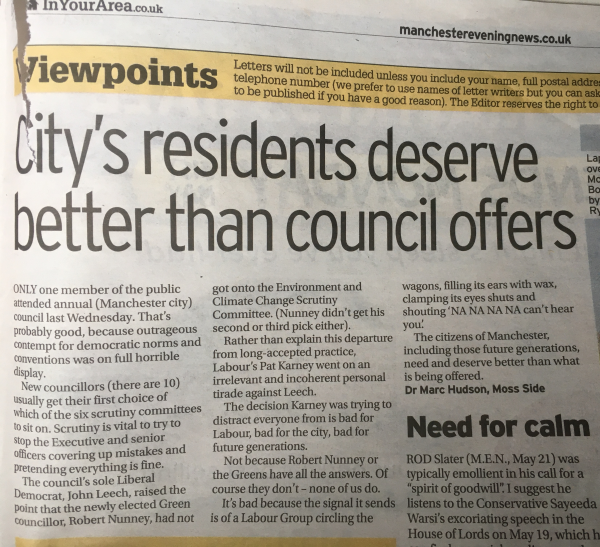
In May, Manchester Labour has cut the money available to councillors in the opposition, making the necessary work of scrutiny that much harder. See Manchester Evening News story here)
Now, a Freedom of Information Act request has forced the Council to admit that the “independent” panel made up of three people, one of whom was busy Tweeting pro-Labour statements before the local elections DID in fact talk to John Leech, Liberal Democrat councillor.
But it took no minutes.
4. Did the Panellists speak to Councillor John Leech?
Response: Yes
5. What NOTES did they make of their conversation. (please provide)
Response: This information is not held by Manchester City Council.
6. If they did NOT take minutes, why not?
Response: This information is not held by Manchester City Council.
So, were they playing on their phones? Cyber-canvassing for Labour? Why are they so incompetent?
Can anyone appeal about Manchester Labour’s appalling behaviour and decision to cut funding to opposition parties?
No.
8. What appeals process exists for members – or members of the public who are wearily sickened but unsurprised by this latest grotesque sham – to use?
Response: The decision to accept the recommendations made by the IRP was taken by Full Council in its meeting held on 18 May 2022. There is no appeals process.
Read the rest of the Freedom of Information Act request below.
But first, this.
For the sake of clarity – I am not now and have never been a member of the Liberal Democrats. Or the Greens. Or ANY political party. I used to be a fan of Labour, and I would vote for a left-wing Labour government in a heartbeat. But what we have in Manchester is – despite occasionally flowery-rhetoric and hand-wringing – a vicious cabal of greedy, stupid neoliberals.
All those Labour councillors who tut-tut, and keep quiet about this, while “disagreeing”? You are EVERY bit as complicit in this as those Tory MPs who voted in favour of Boris Johnson in the Vote of No Confidence last week. This assault on demoracy is YOUR fault. You enable the goons at the top, through your silence.
1. Who appointed the panel? Named individual please.
Response: Fiona Ledden, City Solicitor, Manchester City Council
2. How did he (or rather “she”) choose? What efforts did she make to ensure that the panellists were in fact, not, ooh, party political hacks who tweeted about Stockport Labour party. For example? Was there a long-list that was drawn up? If so, by who? How were people – perhaps too independently-minded – winnowed out?
Response: Fiona Ledden made the appointments to the Panel based upon the format used in previous IRP reviews. In the previous review Declan Hall, a former lecturer at the Institute of Local Government, the University of Birmingham, currently an independent consultant who specialises in Members Allowances and support was appointed as Chair. The other two members were the Chief Executive of GM Chamber of Commerce and the Regional Manager UNISON North West. Fiona Ledden made the same appointments of current incumbents to those named posts for this IRP review. No longlist was drawn up. The requirement for the IRP, and its membership, is that it be independent of the Council. There is no requirement for the members of the IRP to be apolitical or to have no political ties or views.
3. What were the terms of reference for the panel? I am particularly interested in knowing if it was pointed out to them that Manchester is unusual among all local authorities in the UK as having – and having had had – a massive preponderance of one political party in charge. Or if this lovely fact was ignored.
Response: I attach a copy of the Panel’s terms of reference. [see here]
and this one
7. Given the evidence that one of the panel members was tweeting support for Labour, will the City Solicitor be revisiting the panel’s findings? If not, why not?
Response: This information is not held by Manchester City Council.
(that is a”no”, but the City Solicitor is unwilling to simply come out and say so.)
Manchester Labour do not want scrutiny. They will do everything they can – including reducing the cash their elected opponents get – to minimise the eyes and mouths raised against them.
If Manchester Labour were competent, this might not be the disaster it is. But the city is massively behind on its carbon emissions cuts, and the “leadership” of the council is either too idle or too stupid to do anything about that. Instead, just more blandishments, more patting selves on the back, more ritualised nothingness (it’s almost as if they are climate activists, eh?)
The reporting should have been titled “”Manchester Labour attacks democracy… again.”
Because that is what this is, regardless of what you think of John Leech and Alan Good (the Liberal Democrats) and the two achingly-silent Green councillors.
At the foot of this post is the FOIA I have submitted. But meanwhile, you’re probably thinking “what IS he going on about. Labour won the election, they can do what they like, right?”
What IS democracy?
You can look at this like Donald Trump – as a power grab where if you have the power, you twist and abuse norms to get what you want and to keep it. That is, essentially, how Manchester Labour have seen things, and seem set to continue to do.
Or you can look at democracy as more than just elections, and “formal” structures, and see it as ALSO a set of norms, customs, behaviours that allows dissident voices to be heard, so that better outcomes are reached.
This is what Manchester Labour does NOT do. See here-
That FOIA
Dear Sir/Madam,
re: so-called “Independent Remuneration Tribunal.
I am writing to request information about the recent entirely neutral and not-at-all petulant and nasty action by the Council.
Better be more specific, because that does not narrow it down.
I write concerning the Review of Members’ Allowances presented to Full Council on 18 May 2022.
1.3 “The members of the IRP were appointed, and requested to commence a review of MCC’s Members’ allowances scheme in September 2021. “
That is a bravura use of the passive voice – well done!
1 Who appointed the panel? Named individual please.
2. How did he (or rather “she”) choose? What efforts did she make to ensure that the panellists were in fact, not, ooh, party political hacks who tweeted about Stockport Labour party. For example? Was there a long-list that was drawn up? If so, by who? How were people – perhaps too independently-minded – winnowed out?
3. What were the terms of reference for the panel? I am particularly interested in knowing if it was pointed out to them that Manchester is unusual among all local authorities in the UK as having – and having had had – a massive preponderance of one political party in charge. Or if this lovely fact was ignored.
4. Did the Panellists speak to Councillor John Leech?
5. What NOTES did they make of their conversation. (please provide)
6. If they did NOT take minutes, why not?
7. Given the evidence that one of the panel members was tweeting support for Labour, will the City Solicitor be revisiting the panel’s findings? If not, why not?
8. What appeals process exists for members – or members of the public who are wearily sickened but unsurprised by this latest grotesque sham – to use?
Thanks so much in advance!!
Please consider this a request under the Freedom of Information Act 2000
Dr Marc Hudson
What is to be done?
Oh, the usual. But not gonna happen, so no point enumerating it.
There will be more pointless meetings, and more craven fan-boi-ing of a party that has not been progressive for a very long time,, and more raging narcissists wanting eveyone to applaud them as they try to “change the system from within”. Carpe the diems. And FOIAs, obvs.
Footnotes
(1) This is one of their favourite words – allows them to wash their hands and say “we are only following suggestions.”
Am getting exceptionally and excitingly bored of natural scientists telling us how doomed we all because of how evil oil companies are, or how unaware the mass of the public are without simultaneously reflecting on the failure of the groups that they championed/championed them.
Am sick of hearing stuck records and banal “epiphanies” about the failures of the information deficit model (no, really? wow, I never knew) or how filling kids’ heads with information isn’t the way forward.
Am mostly sick of people doing all this – filling up everyone’s bandwidth – while having no answer to the “okay, so what do we do DIFFERENTLY?” question.
It is a nice grift – you get to signal your virtue, your wisdom, your concern. You can point at the predictable bad guys (and for the avoidance of doubt OF COURSE THERE ARE BAD GUYS DOING BAD THINGS, BUT FFS WE HAVE KNOWN ABOUT THESE ASSHATS FOR THREE DECADES AND YET WE PERSIST IN THE SMUGOSPHERE AND THE EMOTACYCLE).,
Meanwhile, you don’t have to confront the “good guys” (the NGOs, so-called “blockadia” with the brutal facts of their failure, of their more than three decade long failure to confront the forces destroying the possibility of human civilisation (“I think it would be a good idea”) on earth.
You don’t have to name the shitty rituals that stabilise ineffective “resistance”, that feed into predictable boom-and-bust patterns, that throw up a few movement “stars” while killing everything else.
You don’t have to risk access to speaking gigs, you don’t have to risk convenient friendships, you don’t have to actually risk ANYTHING.
It’s a grift, basically.
What we need is lifters – people who will lift our eyes from our feet, from defeat, so we see what we have done badly. We need people with the vision and the guts to call out the failure, to diagnose it, to demonstrate that other ways of doing things are possible. Requires guts, vision, integrity. Not going to happen while grifters can still get their good guy/gal tokens from the old “cat should wear a bell” grift. It just isn’t.
Most of all we need a time machine, so we can have a do-over of the last three and a half decades.
I submitted a Freedom of Information Act request to our lords and masters at the Council back in December 2021 and finally got answers to in February and hadn’t been bothered to put on line. Here’s the previous post about this topic.
Read it and weep.
1. Was there any minuted discussion within The City Council – between officers, between officers and Executive Members, between Executive Members – of the any legal liability arising from what is advertised on the displays, as per the December 17th tweet by Chris. If so, please provide copies of those discussions/discussion documents Officers discussed the parameters of what would be displayed on the CIP units at the Overview and Scrutiny Ethical Procurement Sub Committee on Thursday 21st February 2019 the minutes for this meeting are available on the council website
2. Was there any minuted discussion (same groups) of the morality, aside from legal responsibility, of encouraging further consumption/consumerism during a climate emergency? If so, please provide copies of those discussions/discussion documents As above.
3. During the negotiations with JC Decaux, did the Council propose to have any veto over what could be displayed? If so, a) please provide a copy of what MCC proposed and The specification stated that all advertising must comply with the code of practice of the Advertising standards authority, in addition to this the following conditions were included:
a. not infringe on any trademark, copyright or patent rights of another company;
b. not relate to films which have not been granted permission for public exhibition or which do not show the British Board of Film Classification certificate;
c. not be in advocacy of, or opposition to any politically, environmentally or socially controversial subjects or issues;
d. not relate to a political party or parties or a political cause/not refer to indecency or obscenity or use obscene or distasteful language;
f. not depict direct or immediate violence to anyone shown in the advertisement;
g. not depict men, women or children in a sexual manner or displays nude or semi-nude figures in an overtly sexual context;
h. not promote the availability of adult or sexually orientated entertainment materials or establishments;
i. not promote food or beverage products that are classed ‘less healthy’ based on the Food Standards Agency ‘Nutrient Profiling Model’
j. not promote tobacco products and e-cigarettes or related products
k. not promote weapons, gambling or illegal drugs;
l. not promote financial organisations and loan advancers with punitive interest rates, ‘cash for gold’ or similar pawn broker type agents;
m. not contain negative references to Manchester City Council Services or those services provided or regulated by the Authority, or organisations associated with the Authority
n. not adversely affect in any way the interests of the site owner
b) what was JC Decaux’s response? (just summarise it, since that reply is probably covered by commercial confidentiality, innit? JCDecaux agreed the above terms
4. When is the contract up for renewal? The contract is for 10 years with an option to extend up to 5 years. The contract Start date is 1 August 2021
5. Is further pollution of public space to be scrutinised by any scrutiny committee, ever? If so, which one will it be? Nothing is scheduled at this time
6. Oh, and what risk assessments were conducted about distracting drivers, further light pollution for wild life and cluttering pavements to the detriment of the mobility of pedestrians and wheelchair users? Please provide copies. All sites were assessed based on the visual amenity and Highways safety as part of the planning approval, each site was approved on this basis. Therefore, no individual risk assessments were undertaken
Our "leaders" are going to keep making empty promises. It makes them feel good. It gets the activists to act like zombie kittens. If you want to have some self-respect and perhaps make a difference (actual facts may vary), then find a functioning group that cares about your skills and knowledge - what you have, what you want.
One useful group might be www.climateemergencymanchester.net - you can email them on contact@climateemergencymanchester.net




 manchester climate monthly