
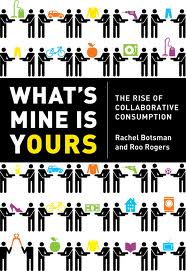
 Book Review: What’s Mine is Yours – How Collaborative Consumption is changing the way we live
by Rachel Botsman and Roo Rogers,
Harper Collins 2011
When I picked up this book by chance, I thought it would be useful as back-up research, if only to find useful and insightful examples of co-ownership and co-operation in action.
The truth is that it turned out to be a very easy to read page-turner, with a lot more to say than the title ever suggested and all in all an excellent introduction to the subject for anyone and with a real interest in promoting intelligent consumption.
The book is divided into three parts, discussing first the evolution of consumerism and related behaviour: how the pressures of social norms, marketing and easy credits lead us to permanent dissatisfaction and pushed over-consumption. Then follows a very comprehensive exposé of the rise and momentum of the collaborative consumption movement (see below); and finally, a part on impact , which dealt with cradle to cradle design and community as a brand -although that was the weakest part to me as it felt a little repetitive.
Collaborative consumption was divided into:
-Product Service Systems: with the change in mind-set from “me” to “we”, away from the ownership of “stuff” such as cars, accessories or equipment in favour of rental of the service these items render. The authors draw attention to the potential of idling objects in our cupboards and garages (which get used once a month or a year!) as money-making and community-building assets.
– Redistribution Markets: which stem from the re-use of pre-owned items both from businesses and individuals (think Freecycle, Ebay and Craigslist)
– Collaborative Lifestyles: knowledge, skills and time in exchange for either a parallel local currency or other services in your community.
As the internet plays a large role in this collaboration, (you are defined by what online groups you adhere to these days), it is fair to say that the organization of these networks couldn’t have happened on such a scale and so quickly without modern technology.
Mobile apps, easy to use websites, real-time checks matching demand and offer, honest peer-to-peer reviews etc everything is organized, paired and agreed online. However, sharing and renting are not new ideas- it is only the size, speed and organization which are different now. Today’s collaboration still depends on community with trust at its heart but without a large choice and availability, the critical mass (ie. volume required to make it work) would not be achieved and nothing would happen at all.
Altogether, although sometimes the book felt like a long advertisement opportunity for all the sites and businesses involved in renting, sharing, hiring, re-using, collaborating
etc, it did manage to convince the reader of the increasing volume and variety (and business opportunities!) of the collaborative consumption movement. Did you know
about Landshare which connects growers with land and garden owners? Or Airbnb
where you can arrange to stay in someone’s spare room anywhere? Many more were quoted in the book, but there’s one temple of collaborative consumption you’ll know and
have used for ever. And that’s where I recommend you go and borrow a copy of this book…
Laurence Menhinick


 manchester climate monthly