
Manchester-based chef Jules Bagnoli reports on a presentation by Indian activist Vandana Shiva.
 Unlike ten year old Martha Payne burying her head into Dad’s checked shirt, Vandana Shiva was unfazed by her seat-standing welcome ovation at the red circus tent home of MAD3 food symposium on the Refshaleøen in Copenhagen from 25-26 August. Displaying bravado fitting neatly to its theme of ‘Guts’, Vandana punched hard at big businesses, seed stealing and Monsanto, putting food salvation very much in the uncountable hands of the world’s indigenous farmers.
An oddly rock star welcome at this alpha male chef blowout opened with hardly a Hindu-friendly scene of butcher Dario ‘no dish without death’ Cecchini, theatrically removing that theme in visceral form from a still warm pig while reciting Dante.
Organised by the ‘world’s best restaurant’ Noma, the symposium of 600 food ‘freedom fighters’ mixed stellar chefs, bloggers, foragers, ‘roach coach’ social innovators and frankly, people like myself who felt bemused and surprised to be queuing for lunch with global food heroes. The contradictions of feeding opposite ends of income wasn’t lost on MC and chef superstar organiser Rene Redzepi, who neatly used his ‘soft power’ to protect the biodiversity underpinning his dishes using up to 276 often wild ingredients.
Chefs surprised by new-found environmentalism certainly signed up after Prof Jason Box frightened the life out of us with Greenland’s melt, his twitter feed @DarkSnow dispensing cheffy frivolity and becoming a shorthand call for urgent action. On a beyond eclectic bill featuring fermentation revivalist Sandor Katz, living plantation slave Michael Twitty or Australian foraging activist Josh Whiteland (who opened his ‘set’ on drums and dige), this was a home crowd for Shiva.
Reminding (or teaching for some) the significance of the location in environmental campaigns, with the landmark Copenhagen address, Vandana added that she’d had her own personal history of guts campaigning against industrial farming after the Bhopal disaster in 1984 which left, by her statistics, 30,000 dead, convincing her of the failure of the green revolution.
With every second Indian child hungry, 70% of dahl and pulses imported, 17m tonnes of rice and grain wasted annually, she saw nothing to change her mind since. In a fluid, unhalting, level-eyed address, Vandana moved on to an greater threat to the creation and diversity of life itself – seed theft.
Vandana stated that we eat mainly 2 and trade in only 8 edible 8,500 plant species. Of these commercial crops, only 10% went into the food chain, the rest becomes animal feed or biofuel – an inefficient 75% destruction of the world’s biodiversity to feed 30% of our population.
GM Golden Rice was evidence of ‘science’s blind stupidity’, adding low-dosage vitamins to a monoculture crop while killing ‘weeds’ such as amaranth or coriander which were naturally rich in those very nutrients. India’s other great natural storehouse, its 500 varieties of banana, the ‘fruit of life’ were being similarly sidelined by big business. Under-reported or buried studies of animals feeding on GM crops reported ‘leaky gut’ syndrome, where the stomach lining became perforated, and soil fertility loss as microbes essential for ruminant digestion were stripped, preventing food being digested.
With 72% of the world’s food currently being grown by small farmers, not global agribusinesses, the only way to feed a future population of 8 billion was a ‘properly evolved indigenous agriculture with conserved diversity’.
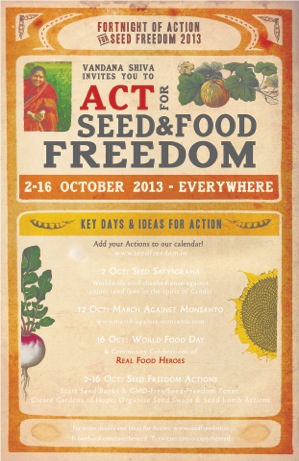
Inviting chefs to support seed diversity, she proclaimed a World Farmers Day and her orange sari disappeared into a Danish grey crowd to a longer and louder ovation than her first.
P.S. Same time next week we proudly publish another piece by Jules “Dark Snow in Copenhagen.”
P.P.S. Jules flew to Copenhagen and back.
P.P.P.S Marc Hudson flew to Australia in 2010 and then as far back as Shanghai in 2011.


 manchester climate monthly