
It seems it is both too early and too late for us to do much to prepare for what James Kunstler calls The Long Emergency — the gradual collapse, over the coming decades, of our global economic/political, energy/resource and ecological/climate systems. These systems are so complex and so interrelated, and the number of variables affecting them so vast, that it’s impossible to predict what crises will hit, where or when. All we know is that we’ve created a perfect storm, and that the systems that comprise our amazing but unsustainable and teetering civilization are soon going to fail on a scale unseen since the last great extinction of life on Earth.
So what, we ‘collapsniks’ are continually asked, should we do?
The answer, of course, depends on your point of view. If you’re a salvationist (a member of the groups on the right side of the chart above) you’re probably not a regular reader here, and you’re probably going to invest in whatever form of salvation you believe will save civilization from collapse. If you’re a transitionist, a deep green activist, a communitarian/neotribalist or an existentialist, or one of the growing number of humanists who are now doubting that a great upswell in globally coordinated human collective effort will be enough to stave off economic collapse, resource exhaustion and runaway climate change, you’re more likely to be working on projects that support those specific worldviews — creating local renewable energy systems, blockading the Tar Sands and its pipeline tentacles, starting an ecovillage, or helping Occupy block foreclosures, for example. If you’re like me, you find yourself moving between these ‘camps’ and thinking about all of these types of projects.
These are all worthy projects, but they each depend on a certain level of faith that the enormous effort, and in some cases risk, entailed in them will be justified by the result. Or they depend on a somewhat perverse but perfectly human and understandable belief that “we can’t just do nothing”.
Are there some “common denominator” projects, I wondered, that all of us leaning to the left side of the chart above can agree upon as worthwhile, and work on together? Projects that will have been worth doing even if we are preposterously wrong about the severity of crises awaiting us in the next ten or twenty or thirty years?
I think there are four such ‘projects’. I’ve written about them on my blog, and in my articles for SHIFT Magazine, and I’m now starting to talk about them at public events because they seem to resonate with a lot of people. This will be my first attempt to explore them in a bit more detail. Here are the four projects:
1. Relearning essential skills. We have become utterly dependent on centralized economic, health and education systems, global supply chains, expensive specialists, corporate employers, manufacturers, repairers, agents and intermediaries. As systems continue to collapse, and as we start to create alternative community-based systems to replace them, we’re going to have to relearn many capacities, skills (hard and soft) and practices that our ancestors took for granted.
I’ve distilled an earlier long list of essential capacities and practices down to these 21 categories:
- Acceptance, acknowledgement, self-acceptance, appreciation, gratitude, letting go, letting come, humility
- Adapting, shifting, agility
- Analysis, researching, differentiating, synthesis, foresight
- Attention, listening, sensing, intuition, presence, self-awareness, authenticity, vulnerability
- Caring, empathy, healing, nurturing, honouring, self-caring
- Collaboration, building-upon
- Collective self-sufficiency: to make/provide/manage our own food, clothing, shelter, water, energy, resources, tools, livelihood, infrastructure, health, education, art, recreation, stories
- Connecting with people and place, partner-finding
- Conversation, articulation, invitation, story-telling, naming, clarification, eliciting, translation, visualizing, non-verbal communication
- Creative thinking, connecting ideas, curiosity, improvisation, foresight, pattern recognition
- Critical thinking, questioning, provoking
- Exemplifying, modelling, demonstrating, mentoring
- Facilitation, consensus-making, holding space, patience, perspective
- Generosity, offering, sufficiency, modesty, biomimicry, non-possessiveness
- Imagination, invention (quite different from ‘creativity’ above)
- Knowledge: appreciation of history, culture, nature, human nature, local ecology
- Playfulness, humour, releasing tension, celebration
- Reflection, contemplation
- Self-directed learning
- Self-management, self-control, self-knowledge, self-awareness, intention
- Taking responsibility
|
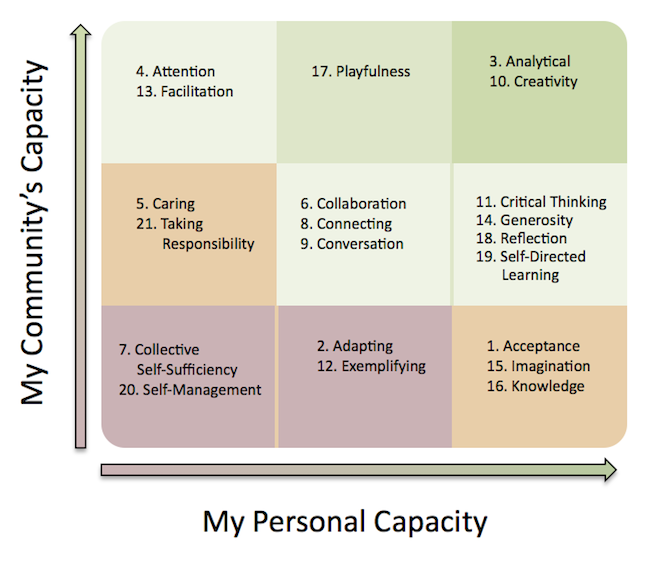
It’s not essential that everyone in a community have all these skills, but the more present they are in community members, the more resilient the community will be in challenging times. I rated myself, and my community of 3800 people, on each of these categories of capacities, and came up with the following:

So my focus now is on improving my capacities and practices in the left column of this chart. I think it’s too early to be trying to get others in my community to do likewise, and to start developing and improving collective capacities — there’s not yet a sense of urgency to do so, and besides, I have no idea whether, when these crises hit, I will still be living where I am now, nor who will be living in my community with me. At the same time, I suspect the bottom row of this chart (the missing essential capacities of communities collectively) is pretty consistent from community to community. I’m not sure what to do with this knowledge at this point, but it’s useful to know your vulnerabilities nevertheless.
There’s nothing magic or scientific about the above list, which is probably incomplete in any case. The important thing, I think, is to take stock, and to decide what will be most useful to learn, and practice, to be liberated from dependence on civilization when it no longer serves us, and to be of service to those in your community who will urgently need these capacities as it falls.
2. Learning to create and build community
 My late friend Joe Bageant famously said “Community is born of necessity”. Efforts of idealists to build ecovillages and model intentional communities have been, with some remarkable exceptions, pretty unsuccessful. I think that is because the situation for many of us in affluent nations is not yet bad enough to force us to create community with the people who are here, rather than the people we imagine we’d like to live with. That includes living in community with some people (who happen to be neighbours) who we really don’t like at all. There is not yet the “necessity” to create the kind of communities that will enable us to weather collapse.
Nevertheless, some interesting things are happening already. The homeless in our own countries, the displaced, and the billions living in makeshift ‘unofficial’ homes in struggling nations’ slums are showing us how to build community, because for them the necessity is indisputable. We can learn a great deal from visiting with them and studying them, about what works and what doesn’t when centralized systems no longer serve us.
The endless recession that began in 2008 has also jump-started the Sharing Economy, as hundreds of millions who once owned, or aspired to own, their own homes and cars and other ‘stuff’, have shifted their mindset to renting, borrowing, and gifting to/from others in their community. That mindset will serve us well as we move from isolated ‘private’ homes full of ‘private’ property on ‘private’ land to a more communal, sustainable style of life.
The Syracuse Cultural Workers poster at left provides some more essential ideas on building community, things that you can practice right now, no matter how fractured your community is.
One form of community-based living that is thriving is co-housing. Under this model, people own their own home unit and share in a much larger common area that provides a shared large-event kitchen and eating area (for potlucks), guest bedrooms, workshops, kids’ play areas, hot tubs etc. This means individual homes can be much smaller while the co-housing community still provides all the amenities of a much larger home.
Two organizations that provide lots of information on how to create more sustainable communities are the Fellowship of Intentional Communities and the Global Ecovillage Network.
Another initiative that helps people trying to establish stronger communities is the network of Resilience Circles. While this group was originally designed to help people struggling with unemployment and basic security needs in their communities, it has a complete, well-thought-out facilitator’s guide for establishing local circles, and has recently begun to work with the Transition Network.
There’s a simple first step: Invite all of the people in your immediate neighbourhood to a potluck. That may mean finding out who they are, first. No agenda, no exclusions. Just start, and see what happens.
In the introduction to his new compendium Communities That Abide, long-time student of collapse Dmitry Orlov tells the story of a flock of birds that nested in a dead tree and then, after it was cut down by a thoughtless neighbour, quickly regrouped and established themselves in another. His three essential qualities of a sustainable community: Self-sufficiency, the ability to self-organize and recover in the face of crisis, and mobility (not being tied to any one place). I don’t know many communities today that have these qualities. The birds can show us the way.
3. Living an exemplary, self-aware, purposeful, joyful life as a model for others
It’s one thing to tell people what they “should” do to prepare for collapse. But I’ve always found “show, don’t tell” to be useful advice if you want to bring about real learning, engagement and change.
So what does it mean to be a model? I think an important precondition is self-knowledge. A good model is someone who is authentic, transparent, vulnerable and honest, rather than a poseur pretending to be what s/he wishes to be but is not. You can only pretend for so long before the mask falls and your audience feels they’ve been had. Being a model, I think, more than anything else, means knowing and being who you really are. We are all, I believe, doing our best, and what will help us most is seeing others candidly and articulately talking about their struggles and their anxieties, as well as their successes and joys. Despite the image of the term ‘model’ — of ‘perfect’ representations of beauty on raised catwalks or pedestals — I think models, to be of any use (other than selling us stuff we don’t need) have to be accessible, caring, and real. In science, in art, in any field other than fashion, a model is as true a representation as possible of some reality.
And a model must be of use. We should be able to pick up things from ‘playing’ with a model that are interesting and useful in our own lives. I’m not talking about leadership, but rather setting an example, not to be followed or emulated, but adapted by each observer to their own circumstances.
I describe myself as a “joyful pessimist” and I try to model that, to show that it’s not oxymoronic. I’m not a very good model, but I’ve learned that not being very good at it can be useful to others as well. My honesty about my failure to be truly present, my paradoxical love and fear of the wild, my moments of self-doubt, I have been told, all have helped others to see that their struggles are not unique, that it’s OK to fail, that “self-improvement” is a fool’s goal. My blogging, which has progressed and become less aimless since I began it over 11 years ago, has also become less popular as it’s come to offer fewer easy answers and more difficult questions. What it offers of value, I’m told, is a contextual reassurance to people that they’re not crazy, that the thoughts and feelings they have that they are uncomfortable talking with others about, because no one else is talking about these scary things, are perfectly rational, understandable, and appreciated: It’s OK: You’re not alone. It’s an essential part of the imperfect, evolving model of me.
The people who I see as my models are not charismatic, but they do have several qualities that I try to practice and learn from. They’re very aware to what’s happening, and self-aware. They’re pragmatic and unpretentious. They’re humble but happy, not martyrs for their cause. They’re articulate, each in his or her own way, both intellectually and emotionally. They do things locally to make others’ lives easier, more joyful, less of a struggle. They are generous — they give without the expectation of reciprocity or recognition, and they sometimes give even when they’d rather not. They don’t dwell on the past or the future, but don’t pretend not be be affected by what has happened or what might be to come. They perform what Adam Gopnik calls “a thousand small sanities” and carry themselves with what Richard Holloway calls “an attitude of contemplative gratitude”.
Perhaps the best way to figure out how you can be a model for others is to ask others what they value in you, and what they value in other people they admire and have learned from, and then figure out how you can be “nobody-but-yourself” in a way that still exemplifies as many as possible of those qualities and values.
4. Healing ourselves and helping to heal others
We all have to heal from the trauma that parents, teachers, adults, peers, employers, co-workers, lovers and friends have inflicted, to some extent, on each of us, mostly unintentionally — they were damaged and didn’t know better, and so were we. Our civilization culture’s chronic stresses have taken their toll on all of us, and the healing will be for all of us a lifetime’s work.
On top of the damage this culture has already done to us, physically and emotionally, we are now struggling as well with the fear, the dread, the guilt and the grief that comes from realizing what we have done to this planet, with the best of intentions, and what we’re going to face as a consequence.
We have a lot of healing to do, and we can’t do it alone. And the task is far beyond depending on ‘professional’ healers.
James Truong has written a chapter on “resilient health care” in the aforementioned book Communities That Abide that describes what we as individuals and communities can do to heal ourselves and others, both to supplement what ‘professionals’ do and to replace them when centralized health care infrastructure and systems collapse (caveat: James is not a big fan of alternative medicine, and IMO dismissive of some forms of ‘modern’ psychological suffering). Some of the key means to more self-sufficient, community-based health care are, he suggests:
- A healthy diet, hydration, hygiene, exercise and lifestyle and other illness/accident prevention actions
- Adequate rest, freedom from stress, social interaction, meaningful work and recreation
- Learning to self-diagnose and self-treat non-critical acute (e.g. minor injuries) and chronic conditions
- Democratizing knowledge of how to treat critical acute conditions through self-directed learning, so that every community has broad lay skills in health care (and being aware that the people in our community, people we care about and who care about us, are the most important part of our ‘first aid kit’)
- Shifting to a mindset of taking personal responsibility for and experiential learning about our own health
- Maintaining community toolsets of supplies, medications and equipment that can help us self-treat many illness and accident conditions (and frequent use of their contents, hopefully mostly in non-critical cases, to familiarize us thoroughly with their use)
- Realizing that some acute illness and accident conditions, even those that may seem innocuous, may not practically be treatable at all in a sustainable health care system, and coming to grips with the limits of what any sane health care system can reasonably offer
The chapter, and another in the same book by another Canadian doctor, Peter Gray, focus principally on physical illness and accidents. What about psychological illness, both acute and chronic?
Just as many of us are moving (either out of necessity or out of a desire to be less dependent on unsustainable centralized health care systems) to self-managed, alternative and peer- and community-based physical health care models, so we are moving to more peer- and community-based psychological health care. Many in the ‘alternative’ culture have adopted programs like NVC and Co-Counselling to help each other cope with grief, depression, trauma, stress and other emotional challenges. Even skeptics of such programs appreciate that we have a responsibility to be more aware of effective ways of coping with the emotional damage we all, to some extent, suffer from, as part of our self-care practices and as a means of strengthening relationships with others and being of more value and support to them.
We can benefit from learning to self-monitor, self-diagnose, and self-manage both our physical and emotional health, and support others in our community to do likewise, to wean ourselves off dependence on an increasingly dysfunctional health care system, so that we can manage without it when it is no longer there.
~~~~~
I wish I’d known about these options when I worked, for the better part of a year, on a large government emergency preparedness project a few years ago. The sentiment then was that we couldn’t depend on citizens to do anything to prepare for or cope with crises like pandemics or earthquakes; citizens, they said, were too preoccupied and disorganized, so governments would have to take charge and tell them what to do. If you’ve ever had to scramble for an emergency first-aid kit, a fire extinguisher, or a back-up generator, you’ll know how well ‘just in case’ tools and processes work if you’re not familiar and practiced using them. I knew then that such top-down projects were doomed to fail, but didn’t know what might work better. Now I do. We have to do it for ourselves.
There is perhaps a fifth type of activity we can all undertake to prepare for crisis and collapse: supporting radical activists who are fighting the systems’ most grievous and dangerous activities — the Tar Sands, fracking, coal extraction, offshore and arctic drilling, pipelines and tankers, nuclear reactors, foreclosures, the plundering of the third world, corporatist corruption, ever-growing inequality, and more — hopefully mitigating the degree of suffering our inevitably collapsing economy will cause, or the rapidity and extent of now-unstoppable runaway climate change. They are doing this work, mostly, without expectation of significant success, undermining these systems even as they crumble. We don’t have to join them on the front lines, or in the prisons and hospitals many of them will spend time in fighting this good fight — we can support and help them by providing them with information, funding, asylum, legal and moral support, and safe harbour. We owe them no less.
Re-skill, build community, exemplify, heal, and help undermine. Those of us who know, and care, about our teetering civilization and what its collapse is leading us to, should at least be able to agree on these common actions. These are things we can do, ways we can be, no matter what we face in the decades ahead.

 Thurs 3rd July, 7.30pm



 manchester climate monthly