Off-topic: “Corporate responses to #climate”, interview with #academics

Two academics, one based in the UK and the other in Australia, have just had a rather excellent article called “Creative self-destruction: corporate responses to climate change as political myths” published in the journal Environmental Politics.  Here’s an interview with the Ozzie, Christopher Wright.

1) Who are you and how did you come to be co-writing the articles that you have?

I am a Professor of Organisational Studies at The University of Sydney Business School and have been researching the role of management and corporations in capitalism for over 25 years. I’ve been personally interested in climate change since the early 2000s and about ten years ago I ran into a new group of ‘sustainability managers’ in some of the large businesses I was studying. I was fascinated by these individuals’ often personal concern with environmental and social issues and the apparent tensions with organisational objectives (maximising shareholder value, promoting consumption and economic growth). So with my colleague Professor Daniel Nyberg, I started a research project focused on how major corporations are responding to climate change. From there the project grew and has become my key research focus. Daniel and I have published quite a number of articles on this topic, exploring issues of emotion, identity, justification and compromise and we are currently writing a book for Cambridge University Press – which brings together our ideas on this subject. There’s links to this research on my blog Climate People & Organizations.

2) In your article “Creative self-destruction: corporate responses to climate change as political myths” you say “myths of corporate environmentalism, corporate citizenship and corporate omnipotence absorb and adapt the critique of corporate capitalism while enabling ever more imaginative ways of exploiting nature.” Some readers will say “yeah, of course”, others will say “er, what are you talking about? Give me concrete examples!” How would you respond to the latter group?

So in this article we were interested in the disconnect between the very clear science of a climate crisis as the outcome of ever increasing greenhouse gas emissions and the obfuscation and denial within the political and business discourse of climate change. What we think is often missed here is how social concern and critique about climate change and consumption is absorbed by businesses and government and reinvented as a further justification for business as usual. We used the concept of ‘political myth’ as a conceptual framing for this, particularly how business corporations produce convincing narratives that justify the continuation of a process we characterise as ‘creative self-destruction’. Here the criticism of corporations contributing to climate change is absorbed and then adapted such that it serves to reinforce their legitimacy in climate politics.

For instance, criticism of business for environmental harm has led to the promotion of business as leaders in responding to climate change through their marketing and development of ‘green’ products and services, and their promotion of the valuation of nature as a commodity. These political myths reinforce the central role of the corporation and the market as the only viable response to climate change. We see this in the way in which unconventional gas has been framed now as a bridge fuel to lower emissions, or how biofuels and carbon offsetting are viable responses to our escalating greenhouse gas emissions.

3) These “myths” – which you define as “particular narratives that answer a need for significance” – are they like the necessary lie that Plato talks about – the “noble lie” to maintain social harmony?

Yes they are. We actually draw on Chiara Bottici’s reworking of political myth in her book The Philosophy of Political Myth. She defines political myths as ‘the work on a common narrative by which members of a social group (or society)…make significance of their experience and deeds’.” (2007: 133). In our case corporations make use of the political myths of corporate environmentalism, corporate citizenship and corporate omnipotence to promote their significance and actions in ways that support their legitimacy in climate politics.

4) What – in plain English- are “alternative imaginaries”?

The hegemonic nature of neoliberal thinking in our ‘market society’ makes it often difficult to identify alternative visions to the market-oriented business agenda we encounter every day. However, in regard to climate change other imaginaries might include a challenge to unending economic growth through de-growth or the work of people like Tim Jackson who have been trying to envisage an economy based on ‘steady-state growth’; in short a more sustainable economy. Similarly, Bill McKibben’s work with 350.org in imagining a divestment out of fossil fuel stocks is very much an alternative to the assumption that we will always rely on fossil fuels and presents an alternative view where we have to leave 80 per cent of known fossil fuel reserves in the ground. Another imaginary would be the work many are engaged in regarding a potential zero-emissions economy based upon a massive roll out of renewable energy (solar, wind, tidal, wave, geothermal). Another imaginary would be around reducing our reliance on global supply chains and hyperconsumption by promoting local communities. Finally, I guess there are the darker imaginaries – conceptualising collapse such as the Dark Mountain project!

5) You mention corporate omnipotence – don’t disasters such as the BP Deep Horizon oil spill and so on undercut that? Or would you argue that the gold-fish memory of our media and politicians means that it’s all a bit “Groundhog Day”? As you say (p 217) “the global catastrophe is only temporarily ‘real’; after each new extreme weather event, the political debate reverts to ‘normality’. And if you are arguing the latter, then “what is to be done?”

Well yes, I think we are arguing the latter perspective. Moments of environmental and economic crisis like Deepwater Horizon or the flooding of New York City after Superstorm Sandy momentarily capture our attention but are then soon forgotten in the realpolitik of ‘business as usual’. Perhaps we will soon experience a climate event of such magnitude that it truly shakes us out of sleep. However, I’m not sure of this anymore – we seem to be becoming acclimatised to increasingly extreme weather events (much like the boiling frog metaphor that is commonly referenced in climate change debate). So in the last few weeks we have heard the collapse of the West Antarctic sheet is now ‘unstoppable’, yet there is a collective shrug of the shoulders and it’s back to the daily grind.

In terms of what to do, the best path is probably to keep challenging the assumptions that the media, business and governments promote. Emphasise the alternative imaginaries in this space and frame the message around the need for change in ways that resonate for different audiences (for instance the geopolitical risk framing seems to work pretty well for the security community at the moment!).

6) Further on corporate omnipotence – isn’t it a subset of a wider “will to power”, and urge to control and dominate nature that stretches back well before the Soviet Union and its disastrous strategies, all the way back to Francis Bacon and the New Atlantis (I’m thinking here of the feminist critiques of technology and technocracy)

Well yes, there is a broader dynamic in human history in mastery over nature. What sets the last 200 plus years apart is the dynamism of industrial capitalism based on cheap fossil fuels (coal, oil and gas). It was the decision to go down this path that has set in train the rapid economic growth we have seen over the twentieth century and the escalating growth in GHG emissions which underpin the climate crisis. In particular, I was recently taken by the study by Richard Heede which found that over two-thirds of humanity’s greenhouse gas emissions since 1750 had originated from just 90 ‘carbon major entities’ and over half of these emissions had occurred since 1986! That’s the power of global corporate capitalism in changing our atmosphere in a relatively short period of decades.

7) Was it a conscious decision not to cite Gramsci and his notion of “hegemony” (there is an almost reference to him on page 219). If it was a conscious decision, what was the reasoning?

No this wasn’t conscious. We and others (particularly David Levy) have used Gramsci’s ideas in critiques of corporate responses to climate change in other papers. For instance, we have previously explored how corporations seek to incorporate citizens within their political activities around this issue (e.g. lobbying and campaigning against carbon emissions regulation). A Gramscian perspective is particularly useful in highlighting the ‘war of positions’ that is occurring in climate politics, and indeed between business sectors on this issue (e.g. witness the division between the fossil fuel industries and reinsurance and clean tech companies).

8) Are you familiar with the work of Alex Carey and his book “Taking the Risk Out of Democracy: Corporate Propaganda versus Freedom and Liberty”. If so, what do you think of it?

I’m not familiar with this specific book, but know of Alex Carey’s earlier critiques of ‘quality of work life’ initiatives. There is of course a broader tradition of political economy which critiques corporate power going back to J.K.Galbraith, Baran and Sweezy, Noam Chomsky and more recently management scholars such as Stephen Barley. I think their depictions of corporate capture of political and economic agendas are entirely accurate. I guess climate change really brings a lot of this broader critique of corporate capitalism into sharper relief, in that our economic system is now consuming our species’ life-support systems.

9) Can you describe the underlying research on which the article is based – how did you do it, why did you do it, who paid for it, what was surprising to you. What else are you going to do with the data-set?

Yes, as outlined above, the study has evolved over the last eight years or so from an investigation of individual managers in ‘sustainability’ roles and their activities and responses to climate change, into a more general critical analysis of the role of business in the climate crisis. We received Australian Research Council funding for 3 years to develop this research and it is primarily qualitative, based on interview and corporate documentation from around 25 major companies across a range of industries such as resources and mining, energy, transport, manufacturing, financial and professional services and retail. These included some of the world’s biggest multinational corporations and gave us insight into not only local Australian developments, but also a global corporate terrain. Within this we conducted 5 detailed organisational case studies business responses to climate change. These included: a leading energy producer which was supplementing fossil-fuel generation with renewable energy sources; a large insurer that was measuring the financial risks of extreme weather events; a major bank which was factoring in a ‘price on carbon’ in its lending to corporate clients; a global manufacturer which was reinventing itself as a ‘green’ company producing more efficient industrial equipment and renewable energy technologies; and a global media company that had embarked on a major eco-efficiency drive to become ‘carbon neutral’.

10) What next? Are you going to look at the work and effectiveness of people who are trying to challenge the legitimacy/stranglehold of the myths of corporate environmentalism, citizenship and omnipotence, such as the “culture jamming” proposed by “Adbusters” and so on? Is arch satire and playful detournment an adequate solution to our dilemmas?

Well we’ve written 8 articles exploring different aspects of business engagement with climate change to date. These include studies of managers’ identities and emotions in response to climate change, the role of the ‘corporate citizen’, different orders of worth used in justifying corporate actions and inactions on climate change, the corruption of the environment in favour of the market, and how the discourse of risk is constructed by business in responding to climate change (for those interested, these articles can be downloaded from my blog) . Daniel and I are currently working on a book that brings all this research together around the theme of ‘creative self destruction’. We hope to have this finished by the end of the year and hopefully out in print next year.

Posted in academia, Business | 12 Comments

Upcoming Event: People’s Environmental Scrutiny Committee #Manchester Mon 7th July

Do you want to see Manchester preparing properly for the threats of climate change?
Do you want to meet other people who are doing useful things in their own neck of the woods?

Manchester City Council, now totally dominated by one party (Labour) has been, at best, flubbing on climate change for years.  That’s extremely unlikely to change, given how even the smallest promises are considered breakable, unless there is regular external scrutiny.  Thus, a “People’s Environmental Scrutiny Committee” – where we learn, share and spread the skills needed to keep tabs the Council, while meanwhile (and more importantly), swap ideas, knowledge and skills for local action.

More details to follow, but for now, here’s a date for your diary then – Monday 7th July from 7pm.

At the Manchester Social Centre, Subrosa, 27 Lloyd St South, Moss Side.

P.S. By one of those odd coincidences that the universe throws up, the PESC meeting is the the night before the Neighbourhoods Scrutiny Committee of the City Council “scrutinises” the latest report about the Council’s “Annual” “Carbon” “Reduction” “Plan” (sic).

Posted in #mcrclimateplan, Upcoming Events, volunteer opportunity | Leave a comment

#Manchester Carbon Coop AGM Mon 30th June – all welcome!!

You can turn up on the night, join and vote. They’re keen to get new folks on-board…

Carbon Co-op AGM – 2014

7-9pm, Monday 30th June 2014

Society for the Reduction of Carbon (Trading as Carbon Co-op)
Notice of Annual General Meeting
7-9pm, Monday 30th June 2014
at Mad Lab, 36-40 Edge Street, Manchester

Hear all about Carbon Co-op’s recent work including the Community Green Deal Retrofit Programme, Eco-home Lab, open eco-home events, quiz the board and contribute to future plans.

  • Light refreshments available.
  • The event is accessible for the mobility impaired and wheel chair users.

Attendance is free, RSVP here: http://carboncoopAGM2014.eventbrite.com

You don’t have to be a member to attend but if you would like to join you can do so here: http://carbon.coop/user/register …only members can vote.

AGENDA
1. Members present and apologies
2. Minutes of last meeting
3. Report on the year
3. Presentation of accounts
4. Election of accountants
6. Board Election
7. Future Plans

DISCUSSION AT THE AGM
We will have the opportunity for small group discussion as part of the AGM, to suggest a discussion topic please email: info@carbon.coop

JOIN THE CARBON CO-OP BOARD
We’re looking for members to join the Carbon Co-op board and contribute to the running and governance of the organisation.

If you would like to stand for election to the board at the next Carbon Co-op AGM please send 100-150 words to info@carbon.coop outlining relevant experience and why you want to join the board by MIDDAY, FRIDAY 27TH JUNE 2014. This information will be circulated to members ahead of the AGM.

Posted in Energy, Upcoming Events | Leave a comment

Broken #climate promise by #Manchester Council’s Executive member for the Environment

The promise was simple, and cheap.
The promise was not made in haste.
The promise was repeated.
The promise… has, of course… been broken.

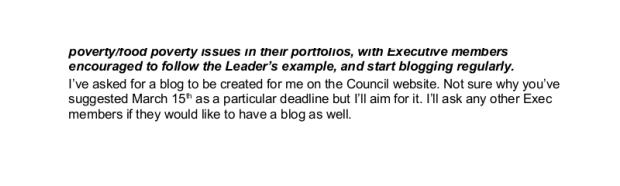
A month after receiving an Open Letter from Manchester citizens offering to help take climate action, Councillor Kate Chappell wrote the following;

chappellblogquote

“I’ve asked for a blog to be created for me on the Council website. Not sure why you’ve suggested March 15th as particular deadline, but I’ll aim for it. I’ll ask any other Exec members if they would like to have a blog as well.”

She missed that deadline, but that’s okay, these things happen. During a video interview on 8th April she was asked about the blog. You can see the section below (it starts at 6 mins 40)

“I am trying to resolve some.. um.. some resourcing requirements within the Council to deliver that. But it’s taking a bit of time because it’s not a top priority amongst all the things that are on my desk and other people’s desks to get the blog up and running. But I recognise that it would be a good thing to do and it’s on the list…”

Asked last week, 3 months after the promised start date, she was asked where things were up to. Came the reply – “no blog.”

Why it matters
Some will say “so what?” That’s fine. If they are happy with politicians routinely breaking simple promises, they will have nothing but joy these coming years.
Other people will wonder how citizens are supposed to trust a single word now that such a simple promise can be blithely cast aside.
This is the latest missed opportunity for a Council that claims it understands the need for doing things differently. A blog could have created a new link – and two-way communication channel -for a city that has “Single Party Control” (or, if you like, is a “One Party State”).
This is a Jump the Shark moment, as far as I’m concerned. If Councillor Chappell is so happy to take the kudos that comes from “listening”, and making promises, but cares so little for her credibility in the eyes of those beyond the charmed circle of the Town Hall and its outposts, then there’s really not much more to say, is there? Why should MCFly waste people’s time and take up Internet bandwidth by dutifully reporting her speeches and promises? Anyone?

Why this has happened
No official statement has been made. Logically, there are three possibilities. In order of escalating horror –
1) The Executive (the 9 other “top” councillors) put the kibosh on it. Unlikely (Richard Leese has a blog, after all) and they’ve been doing a certain amount of hand-wringing about doing things differently. Also, my impression is that individual Executive members have a certain amount of autonomy.
2) The Labour Group (the 94 other councillors) put the kibosh on it. Unlikely. I’ve not heard whispers to this effect, and Councillor Chappell is extremely popular (having won the ballot to become Executive Member for the Environment with a stonking majority).
3) Finally, and most sinister and alarming – the unelected officers have squashed the promised blog. In this scenario some Humphrey Appleby-type has raised eyebrows often enough that Councillor Chappell has simply backed down, perhaps in the promise of co-operation on some other “bigger” projects. Well, you know, public servant. The clue is in the name; not public “master” – public servant.

What you are “supposed” to do
Don’t die in a ditch”, say people who are prone to giving advice. In this city you are supposed to smile when the Labour Party and their mafia kick you in the teeth. You are supposed to say “thank you, please kick me some more. I will forget last year’s broken promises. What are this year’s lines that I should be believing and parroting?”
There are lots of individuals and groups who do this (they know who they are). They think it’s better to be ‘inside the tent.’ They think access equates to influence.
Yeah, that’s really working out so well.

MCFly has never been willing (or indeed able) to play that game. For a little while, there seemed to be some hope that – with a new Executive Member for the Environment and a new Chair of the Steering Group – there might be a better way of doing things, that Manchester might pull out of its tail-spin.
Other people may still have that hope. At MCFly? Not so much.

What you can do
1) Write to Councillor Kate Chappell (cllr.k.chappell@manchester.gov.uk) and
a) tell her what you think of her decision to break her (repeated) promise on this, and
b) ask her for a full explanation of why this has happened.

2) Save the date. Monday 7th July, 7pm to 8.30pm. Details to follow.

Posted in #mcrclimateplan, Democratic deficit, Manchester City Council | Leave a comment

Book Review: “Power Failure” #Australia #climate #policy debacle

This post is not about Manchester. It’s about a government that made bold promises about its climate action, then delivered a sorta reasonable policy, but totally failed to implement it or defend it from the forces of apathy and darkness.  This is obviously totally foreign to our fair city…

Power Failure: The Inside Story of Climate Politics under Rudd and Gillard
Power-FailurePhilip Chubb
2014 Black Inc 284 pages + endnotes and index

Laws are like sausages; it doesn’t pay to look too closely at how they are made.

However, if you want to rubber-neck at the catastrophe that was Australian climate “policy-making” between 2007 (when Labor came to power touting climate as “the greatest moral challenge of our generation”) and 2013 when it was booted out, after a year of not even mentioning the subject, then this fine book is for you. Just wear a helmet, so when you (repeatedly) bang your head against a wall in frustration, you’re still able to turn the pages.

The author, Philip Chubb, is a respected and experienced print and TV journalist, and it shows. Inspired to write the book because of his experiences during the “Black Saturday” bushfires of 2009, he interviewed 75 key figures (including senior bureaucrats and ministerial aides – of the politicians only Labor; he either couldn’t or didn’t bother interviewing the Liberals and Nationals).

He tells the tale well, chronologically. Nobody emerges unscathed, but his most withering assessments are reserved for Kevin Rudd, who centralised policy-making to such an extent that a) nobody could check the schemes for plausibility or “land-mines” and b) nobody felt ‘ownership’ or was able to explain/defend the first, aborted, scheme. (Chubb uses the work on political leadership styles of fellow Monash University academic James Walter to good effect.) Rudd also seems to have believed the hype preceding the 2009 Copenhagen conference, and cast himself as Saviour of the World. That didn’t, of course, end prettily.

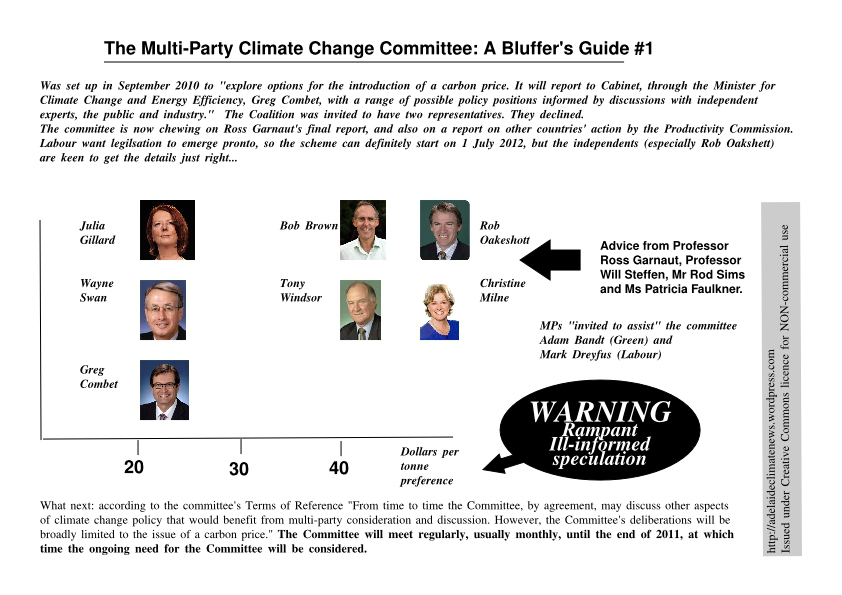
The second half of the book covers Julia Gillard’s tenure, from 2010 to 2013, during which time the Carbon Pollution Reduction Scheme was painfully, bloodily, created and passed (the new Australian Prime Minister, Tony “Climate change is crap” Abbott, is about to introduce legislation to repeal this). Chubb clearly has more sympathy for Gillard, whom he paints as a skilled but flawed leader and negotiator. The strongest – and most depressing – sections revolve around the period in mpccc-bluffers-guide-page1early 2011, when the “Multi-Party Climate Change Committee” hashed out an agreement acceptable to Labor, the Greens (at each others’ throats) and several Independents who held the balance of power. Meanwhile, the media reported and participated in a vicious, unrelenting programme of distortion, fear-mongering and (occasionally misognynistic) character assassination by the Liberal Party and assorted hangers-on. I was in Australia at the time, and it struck me – and far more knowledgeable commentators – as an unprecedentedly coarse moment in the national “discussion”. The attacks were also, as Chubb shows, very effective.

Gillard had been determined to bring in the scheme a year before she had to face the polls, to put the lie to the claims of denialist-politicians and “compensation”-hungry industry that the sky would fall because of a carbon tax. By the time the scheme started, on schedule, in July 2012, Labor had given up even trying to defend their orphan law. The sky didn’t fall, of course – all the hysterical claims of economic doom were shown to be false. Nobody, however, was paying attention, and the media in Australia didn’t point out the falsity – unsurprisingly, since they’d been vociferously peddling the scares in the first place.

While the book is well-written, and scrupulous in not creating a saint or martyr out of Julia Gillard, it’s not perfect. There are signs of haste – the misused “dispassionate” (p216), “dervies” (p. 274) instead of derives, and, frustratingly the opening pages have been removed from chapter 11, but the footnotes not renumbered.

More importantly, Chubb is largely silent on the reasons climate skepticism found such fertile ground in Australia (beyond the “biological cringe,” post-ecological thinking and, specifically, a continuation of the culture wars which had occupied the 1990s, with battles over how the history of Aboriginal-White settler contact (a euphemism if ever there were one!) should be told.

Chubb also could have given a little more historical context. Australians were early to understand climate change. In 1988 conferences were held simultaneously in 10 cities in Australia, linked by satellite. The late Stephen Schneider gave a presentation, seen by thousands, of the peril we face. How is it Australians have come to allow their politicians to be so cowardly? Part of the answer is supplied by academic/activists like Sharon Beder.

This book should read be read by all Australians who want to understand how climate policy has been mismanaged recently. (If they want gruesome accounts of earlier mismanagement, they should try Hamilton 2001, Hamilton 2007, Pearse 2007 and Pearse 2009). It should be read by policy-makers so that they don’t end up screwing up in quite the same way next time (if indeed there is one), and by activists.

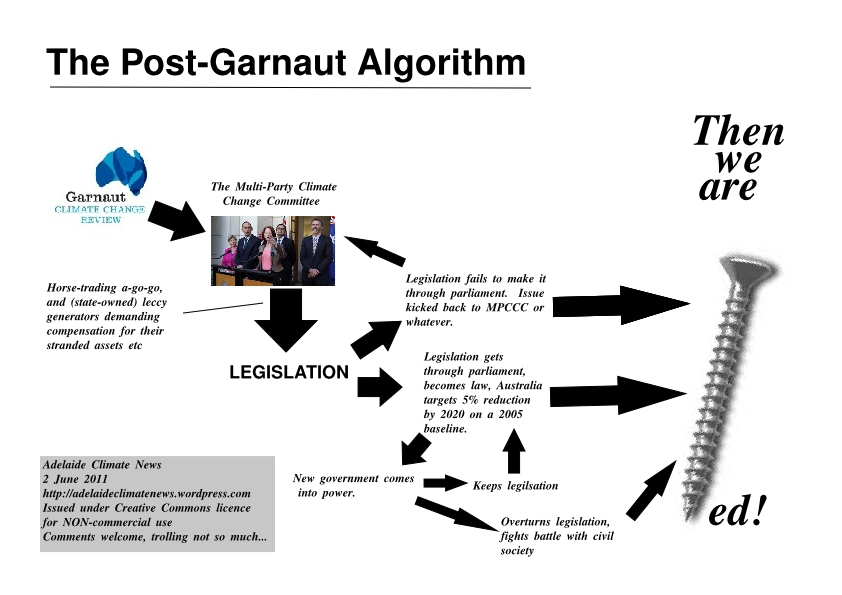
Few people, however, will like it; not Labor (old wounds), the Liberals (exposed as poltroons), the Greens (Chubb reckons they got no more in 2011 than they’d have got in 2009, when they voted against Rudd’s CPRS), the social movement types (Chubb is gently scathing on the “Say Yes” campaign mid-2011. The only person Chubb seems to rate highly is economist Ross Garnaut, who fought a valiant if ultimately unsuccessful battle against the notion of giving huge “compensation” to coal-miners and power companies. They emerged from the 2011 process as the clear winners, with predictable windfall profits.

postgarnaut-algorithm-page11

The next Federal elections are due in 2016, after the next big international climate debacle in Paris (November 2015). It’s hard to imagine the Australian Labor Party wanting – or being able even if they did want – to go anywhere near climate policy with the proverbial ten foot pole. Given the enormous carbon footprints of Australians, and, worse, the well-advanced plans to expand coal exports (to China, India and Japan especially – see Pearse, McKnight and Burton’s excellent “Big Coal”), this is just one more tragedy in the unfolding ecological debacle that is homo sapiens carbonicus.

Marc Hudson
mcmonthly@gmail.com

See also
Recent interview with the author

The myth of “carbon leakage” by Ben Eltham (2008)

Posted in Book Review | Leave a comment

Bat watch in #Chorlton, Thurs 19th June #Manchester

Bats!!! Not mice with wings, bats!!

batnightandsurvey19june

Posted in Biodiversity, Upcoming Events | Leave a comment

6 things Michael Mann wants you to know about the science of #climate change. Read this, #Manchester :P

Michael “Hockey Stick guy” Mann is a very bright and hard-as-nails climate scientist.  He’s been on the receiving end of smears, legal threats, emails hacking and death threats.  This is how the species treats its scientists these days. #stoopidsuicidalspecies

Read on for a really really good piece, published on an American site billmoyers.com

Posted in education, International | Leave a comment

#Manchester #climate report you can now download. 52 pages of glossy drivel

Was it worth the wait? Of course it wasn’t.

Despite the “honesty” (Was there a choice? Was there really any way to spin the last five wasted years as any ‘success’?) of admitting things are hopelessly behind schedule, the Manchester A Certain Future “report” ignores the starkest realities (two “implementation plans” instead of the one thousand aimed for, 1000 carbon literate citizens instead of one million, promised elections cancelled etc etc) and is silent on why things have been so hopelessly mismanaged.  And in the absence of identifying that, how can anyone have confidence things will be different in the future?

Of course, there are upbeat pictures of beehives and all that malarkey.  Great.

At the end, we are told this –

The Steering Group has also identified the need to look at how it invites, receives, takes
action on and responds to feedback. The MACF website is currently being updated
to include an area to welcome comments, ideas, suggestions and offers of assistance,
facilitate the sharing of information and to promote action.

[Incredible!! It has taken them FOUR YEARS to get to this??  What on EARTH have they been DOING???]

In addition, a number of locally hosted, focused events will be taking place on a regular basis.
The first of these events is expected to be in September 2014 and is currently intended
to cover: what actions do the Steering Group need to deliver to support and enable the
delivery of MACF; and what should MACF 2015-20 cover, building on the findings of the
2014 Annual Report and progress to date.

Oh, and the report isn’t available on the manchesterclimate.com website yet.

It is available on “ontheplatform“, that infamously embarrassing boosterist pravda, which doesn’t allow comments. That’s the commitment to democracy you’d expect of people who dabbled in Stalinism in their youth.

It’s also here.

Posted in Democratic deficit, Steering Group | 2 Comments

Growing Fruit & Veg – 1 day intro course, #Gorton, #Manchester 28th June

Growing Fruit and Veg a One Day Intro

growingfruitandvegdebdaleComing Soon at Debdale Eco-Centre

Growing Fruit & Veg
A One Day Intro

SATURDAY, 28TH JUNE 10:00AM TO 4:00PM

at: Debdale Eco Centre in Debdale Park, 1075 Hyde Road, Gorton, Manchester
M18 7LJ

Costs £30.00 – this includes training,
all resources and refreshments.

Concession £5.00 for those on benefits.

For further information and to book now, please contact Marva Lashley on 0161 220 9199

or email: marva@debdale-ecocentre.org.uk

(hat-tip to MERCi.)

Posted in capacity building, Food, Upcoming Events | Leave a comment

#Manchester #Steering Group Inaugural General Meeting (repost)

The Manchester “Stakeholder Steering Group” on climate change has refused to release its first annual report, ahead of its Inaugural General Meeting. Martyn Cowsill, a renewable energy businessman, has been rebuffed in his request to see the report, which will only be released at the meeting, to be held on Tuesday 10th June at Manchester Town Hall.

On Friday 16th May he wrote to the secretariat

“I am told that Gavin will be presenting the first Progress Report. I am guessing that this will be a substantial document which we, the attendees, could do with reading before we get to the event. “Any chance you could send it out in advance?”

The reply came thus

“The AGM will provide the opportunity for Gavin and the Steering Group to launch the M:ACF Annual Report and for a discussion on progress to date, as well as discussing the steps the Steering Group and the City will need to take on this important issue over the next 12 months and beyond… We recognise that some attendees would be keen to see the report in advance but after much debate the Steering Group have agreed that the report will not be released until the event itself, in order to encourage better attendance on the day, and to make as big an impact as possible. (emphasis added by MCFly)
“Once the report is in the public domain we will be seeking feedback from the widest group of Stakeholders possible, and also trying to enlist as many people as possible in support of these important issues and actions.
We hope you will be able to attend and look forward to seeing you on the 10th June.

[MCFly says – maybe if they were worried about better attendance they could have, um, advertised it more than 26 days in advance, and used, um, you know, social media? And really, they think people are going to come to be the first to grab a report, as if this were the latest One Direction album? Seriously? This is just brittle control-freakery. No change there then.]

There was then a further exchange, with Mr Cowsill, who wrote a blistering account of the 2013 “Conference” (which MCFly editors Marc Hudson and Arwa Aburawa were banned from attending), making the following points.

Well it won’t be much of a debate if we’re not allowed to read the report before the debate. How could anyone possibly make any sensible contribution to a debate without having digested the report’s contents?

It seems to me that there is no real will to engage in discussion at all. The Steering Group is not democratically elected, their meetings are held ‘in camera’, there are no SMART objectives anywhere to be seen in any ‘plan’ / ‘action’ documents I have seen – I don’t see any point in attending.

As part of a further email exchange he wrote

[The AGM’s] intention was to have a discussion. If we are supposed, instead, to listen to just the SG’s view of the report, then take it away to read at our leisure with no idea of when the discussion will take place, then there is no prospect of discussion at all. Yes, you might tempt more people to attend, but to what real purpose? What is the point in having those people together in the same room if it is just to listen to a one-sided, self-congratulatory report? What real good does that do? Will it convince those attending that the SG’s definition of success is a flag of convenience under which MACF will avoid criticism?

I have read the ‘plan’. It is not a plan as any business-minded person would understand, but rather a nebulous, aspirational set of ideas. Saying we are going to reduce CO2 emissions by 42%, or whatever, without saying how this is going to be done, by whom and in what stages, is a bit like saying: “We are determined that there should be daylight tomorrow.” And, lo, there is daylight the following day and that’s all down to us!
….

“A greater level of transparency”? Please explain how that will be achieved from here on. Withholding publication of the report is not any thinking person’s idea of transparency.

“How we are actually doing”? Sure, we achieved daylight again today, but the companies, individuals and organisations who have actually done something to reduce CO2 emissions etc are doing it for reasons other than the exhortations of MACF. When I went along to the three year ‘refresh’ meeting, I was greeted with disbelief when I said I had never heard of MACF. The attitude was: “But we’ve been around for three years, surely you must have heard of us.” Ask yourself the question “Does the existence of MACF actually mean anything or make any difference at all to the people of Manchester?” If it didn’t exist, would CO2 emission reduction continue at the same pace? You already know the answer.

MACF ought to be doing more to make a difference. The ‘plan’ needs to be stripped down and re-built with SMART objectives. Only then will the wider public sit up and take it seriously.

MCFly says:
Talk is cheap. The simple fact is this: even Manchester City Council releases its reports before its meetings. (In a supreme act of irony, the Neighbourhoods Scrutiny Committee should be hearing – in the same building and immediately before this event – about how lousy the Council’s own performance has been in the last year. And that report will be available for inspection a week in advance). Sure, the Steering Group will argue that it is not a statutory body, has no legal obligation blah-de-blah de blah. Tosh.
How do you show people you care about transparency, accountability and meaningful dialogue? By making it easier rather than harder, by allowing people to digest what is going to be discussed and come equipped. To include people who can’t be there (4pm on a week day. Would you book annual leave? There was a time I would have. No more.)
I for one won’t be there. Even if I could be, I think I’ve probably had enough of soul-destroying blandishments and promises of “lessons learnt,” a brighter future, and “seeking feedback from the widest group of Stakeholders possible, and also trying to enlist as many people as possible in support of these important issues and actions.” (Like the last 4 years? God help us).
All done by and for middle-class white people. Attendance merely lends legitimacy to a fundamentally illegitimate process, which should be abandoned.


[This above was first published on MCFly a few weeks back. Nowt has changed.  The point bears repeating – if you want a genuine dialogue, you allow people to have sight of the thing you want discussed. Anything short of that reveals that what is actually wanted is more spin and news-management.  Will we ever learn?  That question is rhetorical.]

Posted in Democratic deficit, Steering Group | Tagged , | Leave a comment