Local democracy Pickled – Incinerator in #Trafford gets go-ahead #Manchester #pollution #debacle

from a press release..
 
TRAFFORD LOSE HIGH COURT BATTLE: INCINERATOR TO PROCEED
 
Today in the High Court, Manchester, a Judge agreed with the Secretary of State for Communities and Local Government, who granted planning permission for the Barton Renewable Energy Plant, also known as the Davyhulme Incinerator. The case was a legal challenge made by Trafford Council against Mr Pickles’ decision of last May to uphold the planning inspector’s recommendation from a Public Inquiry held in November 2012.
 
Below is a statement by the Breathe Clean Air Group:
 
Today is a backward step for democracy and localism. The local communities and the local Council could not have shouted any louder that this was the wrong technology in the wrong location. The decision should have been a firm ‘NO’.
 
Today’s decision is also a leap in an entirely different direction to those of us who want a clean, green environment that safeguards the health of our communities. We are deeply disappointed that generating money has been prioritised over ensuring everyone’s air quality is safe and legal. We thank Trafford and its Councillors for standing alongside us to take this case to the High Court. We are encouraged that they have started to take the issue of air quality so seriously.
 
The reality of today’s decision means that an incinerator almost as tall as the Chill Factore will be built opposite the stadium of Salford Reds and Sale Sharks Rugby Clubs and only 500m from the nearest homes. It will be a smiling assassin. The site is partially located in an Air Quality Management Area, where plans should be in place to reduce air pollution for public safety, not add to it. A low chimney will emit pollution containing Arsenic, Dioxins, Nitrogen Dioxide, nanoparticles and many many more dangerous pollutants into the air around the stadium, local houses, schools, parks, allotments, the Trafford Centre and various sports facilities at Trafford Quays. The short height of this chimney will mean the pollutants will remain more concentrated in the local area.
 
This situation could have been entirely avoided. Alternative technologies exist for creating energy, as Peel well know (they are already developing and using alternatives at other sites across the UK). There is absolutely no need for this dirty incinerator here amongst our community. We do not understand how this proposal has been allowed to get so far.  
 
We have been let down by both the Environment Agency and the Planning system, which both seem stacked in the favour of the developer.  The Environment Agency has never refused an incinerator permit, even when the local air pollution is at illegally high levels. They admitted to us in a response to a Freedom of information request that they do not undertake unannounced emissions testing, which means we have everything to fear from a polluting incinerator that essentially will monitor itself.  
 
The Breathe Clean Air Group will not rest here though. The air quality in Trafford is already over the legal limits. We have made an official complaint to the European Commission that several readings are 50% over the legal limits for Nitrogen Dioxide. The European Commission responded to us this week and also publicly announced that it has launched legal proceedings against the UK for unsafe, illegal Nitrogen Dioxide levels in 16 areas, including here in Greater Manchester. The UK faces fines of up to £300m a year, which demonstrates just how serious this issue is. 

Today’s decision just digs us further into this deep, dirty hole and the Breathe Clean Air Group will continue the fight to climb out of it.

JOIN US, LIKE US, FOLLOW US!
 
Like our Facebook Page: www.facebook.com/BCAGtrafford
Join our Facebook Group: www.facebook.com/groups/BCAGtrafford/
Follow us on Twitter: @BCAGtrafford
Join the Twitter Conversation: #StopBREP
Visit our Website: www.BreatheCleanAirGroup.co.uk
Posted in Campaign Update, Energy, press release journalism | Leave a comment

#Manchester has 32 wards. All should have ward plans. Only 9 do. People gonna have to do it for themselves…

The story so far: Manchester citizens recently offered to help their (cough cough) Council achieve nine specific actions on climate change. One of those was;

7) Ensure that the ward plans of all 32 wards (and Strategic Regeneration Frameworks) include concrete actions and SMART goals around both the reduction of carbon dioxide emissions and the risks that Manchester’s citizens will face due to floods, heat-waves and the like.
(The ward plans are one excellent way that individual councillors could re-engage with citizens who want to make their area greener and more prepared for the sometimes unexpected changes to come.)

The Council didn’t exactly leap with joy at the offer, and now we have another reason why;
They only have 9 even nearly “up-to-date” plans. And they aren’t even answering straightforward questions about these, who the ward co-ordinators are, and how people can get involved in improving the plans.

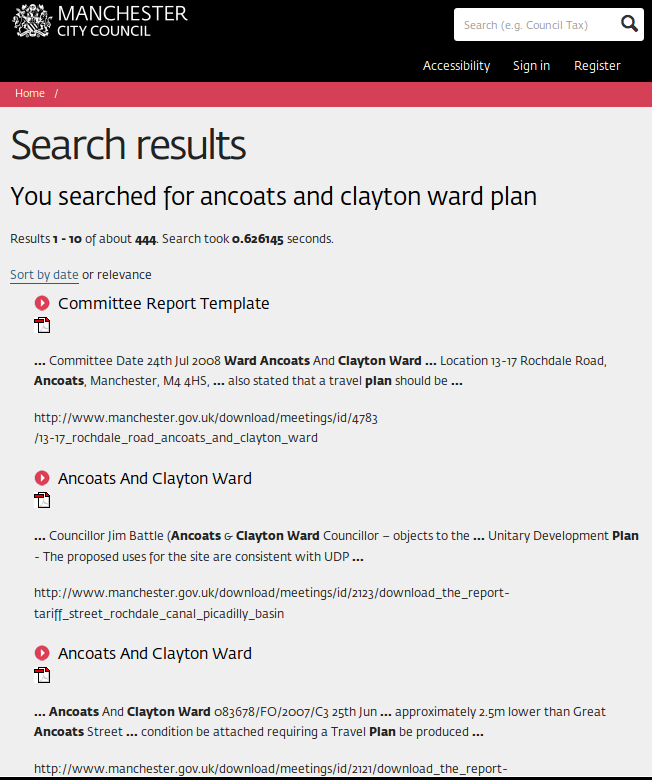
It’s not just the poorer bits (as you’d think if you started alphabetically, looking at Ancoats and Clayton, or Bradford.)
ancoatsandclaytonwardplansearch
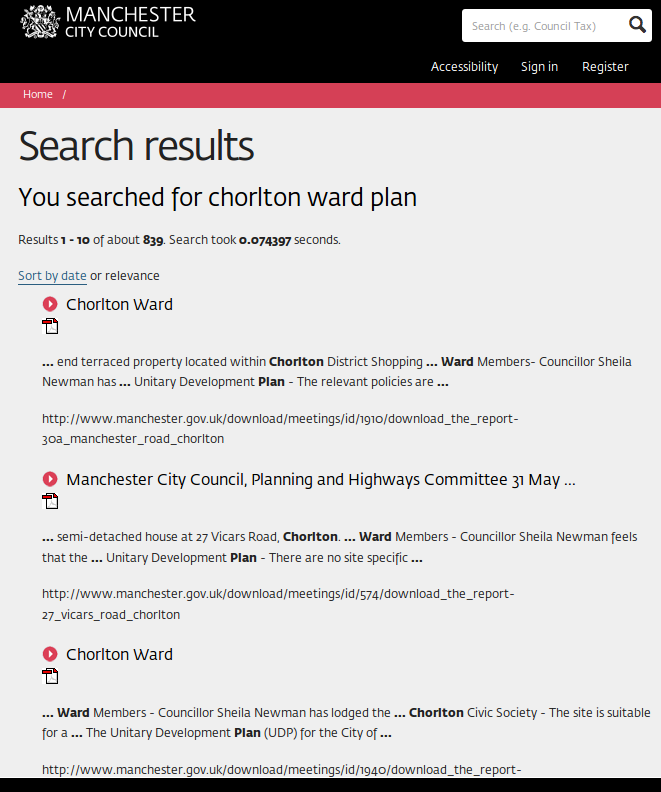
Chorlton is also without a plan. Both the Didsburies too…
chorltonwardplan

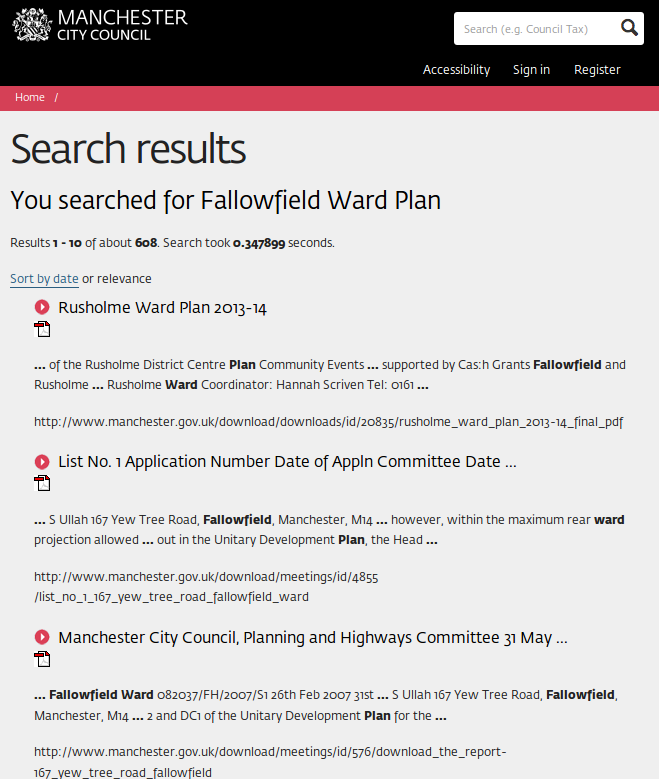
fallowfieldwardplanfindsrusholme

It will entertain some that a search on Fallowfield Ward Plan throws up… Rusholme.


Just fyi, the lucky nine wards are Ardwick (n.b. a “local” plan), Baguley, Brooklands, Higher Blackley (n.b. an “East Local” plan), Hulme, Longsight, Moss Side, Northendenmanchester wards list with links to ward plans, and Rusholme,

A week ago MCFly sent this email to the Executive Member (Cllr Nigel Murphy) responsible for Ward Co-ordination, his assistant Exec (Cllr Bev Craig) and the Exec for the Environment (Cllr Kate Chappell).

Dear Councillor Murphy,

I am writing to you because one of the responsibilities listed on the relevant Council website page is “ward co-ordination.”

On Saturday I did a web search on the City Council’s website using all 32 ward names and the words “ward plan”.

For the 32 wards, I could find only 9 (at most) ward plans, and all of these seem to be for the period 2013/4.  The document I created is attached.

Can you tell me
a) if the other ward plans exist, and if so, where I can find them?
b) are there ward plans for the year 2014/5 in development?
c) if the ward plan system is in fact being abandoned or is delayed, (as seems to be the case)  could you point me to any prior announcement of this by the Council?
d) if there is no prior announcement, could you please provide a statement as to why the ward system is being abandoned.

Finally, if people in Manchester are interested in getting involved in helping create a ward plan for their ward, who should they contact? Is it their councillors?  Is there a a central email address for ward co-ordinators, or a list of co-ordinators for the 32 different wards?

Many thanks in advance for your reply to all these questions!

Marc Hudson

It will doubtless shock readers to learn that there has been reply yet…

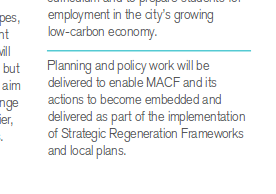
And for the benefit of any (i.e. all) readers of MCFly who haven’t read the so-called “refresh” of Manchester A Certain Future, conducted in dismal desperation back in 2012, here’s a bit about “local” (they mean ward) plans –

wardplansinmacfrefresh


So, some other work for the Steering Group to progress

MCFly says: What we are witnessing is the final gutting of the local state. It’s in full retreat after decades of attacks from both “neo-liberalism” and Westminster’s control-freakery.  If you want some excellent context on this, try Adam Ramsay’s recent piece on Open Democracy, “On Brighton Beach: austerity, alienation and the battle for democracy.”

So, it’s simple; If the citizens of Manchester end up being even vaguely ready for the enormous challenges that lie ahead, it won’t be because of the Council. Hopefully not in spite of. But certainly not because of….

If you are still reading, you clearly have the stamina needed for the job.  We are meeting on Tuesday 25th February at the Friends Meeting House, to make practical plans around this – and other – issues.  If you want to be involved but can’t/couldn’t be there, please email mcmonthly@gmail.com

UPDATE 25th February:
Received this today –
MCC15402 – Re: Questions re: status of ward plans and ward co-ordination
Marc

Thank you for your e mail. I will look into your queries and get back to you with a full reply as soon as possible.

Many thanks

Cllr Nigel Murphy
Labour Member for Hulme Ward
Executive Member for Housing and Regeneration
Tel: 0161 234 3350 (Internal only 800 3350)

Posted in Climate Change Action Plan, Democratic deficit, Manchester City Council | 2 Comments

Meaningless BBC drivel in responding to #climate complaint. How do they sleep?

Last Sunday the BBC Radio 4 programme “the Westminster Hour” had a ‘discussion’ about climate change.  The presenter casually said words to the effect “of course, there’s a lot of debate/uncertainty about this”.  This, of course, is nonsense, but sadly typical of arts graduates (I speak as one).

I complained – here’s the screengrab.  Below it find the “response” from them.  Condescending* drivel and clearly nonsense, and (deliberately?) missing the point – I wasn’t complaining about the UKIP guy who was on. I was complaining about the BBC anchordroid and her factual inaccuracy.  How do they sleep? What will they tell their children?

mybbccomplaintabtfeb16


Dear Mr Hudson

Reference CAS-2575282-0T62VL

Thank you for contacting us regarding ‘The Westminster Hour’ broadcast on 16 February.

I understand that you were left angered at remarks made by Carolyn Quinn regarding the issue of climate change.

Although I recognise your concerns, I can assure you that we are committed to impartial and balanced coverage when it comes to this issue.

There is broad scientific agreement on the issue of climate change and we reflect this accordingly; however, we do aim to ensure that we also offer time to the dissenting voices. [This of course (deliberately?} misses the point.  I was NOT objecting to the presence of the UKIP guy, but the factually incorrect statement by the presenter!]

Flagship BBC programmes such as Newsnight, Today and our network news bulletins on BBC One have all included contributions from those who challenge the general scientific consensus recently and we will continue to offer time to such views on occasion

You might be interested in the views of former Newsnight editor, Peter Barron, who explored this issue in an online posting at our Editors’ Blog and explained some of the editorial issues it throws up:

http://www.bbc.co.uk/blogs/theeditors/2007/02/how_green_should_we_be.html

Again I appreciate that this is something you feel strongly about and to that end I’d like to assure you that I’ve registered your concerns on our audience log. This is a daily report of audience feedback that’s made available to many BBC staff, including members of the BBC Executive Board, programme makers, channel controllers and other senior managers.

The audience logs are seen as important documents that can help shape decisions about future programming and content.

Thank you once again for taking the trouble to share your views with us.

Kind Regards

Richard Carey

BBC Complaints

www.bbc.co.uk/complaints


* True, they are repaying like with like.

Posted in Off Topic | 4 Comments

9 day workshop in Devon: “Sustaining Resistance, Empowering Renewal:Tools for Effective and Sustainable Activism”

Nowt to do with MCFly , just passing it along in the spirit of sharing…

Sustaining Resistance, Empowering Renewal:Tools for Effective and Sustainable Activism

A 9 day residential workshop in rural Devon, 17th-26th June 2014

This workshop offers personal and collective tools to make our activism more effective. It offers space to reflect and analyse, helping us to stay in it for the long haul, create personal sustainability and bring continuity to our movement building. The workshop aims to help us stay inspired, nourished, empowered and creative. It aims to help ensure the collective dimensions of our activism exemplify the values we struggle for.

The workshop will use ecological/systems thinking, radical analysis and participatory learning methods to help explore our activism and how we can create strong social movements. It offers practical methods for engaging in the inner work that underpins effective social change work. The workshop venue, on the edge of Dartmoor, provides ideal conditions for reflection, healing and renewal.

The course is offered by the ecodharma collective (www.ecodharma.com) and Seeds for Change (www.seedsforchange.org.uk). Bursaries may be available. Places are limited.

Application deadline 3rd March 2014. For more information or an application form please call 01865 403 134 or email kathryn@seedsforchange.org.uk


Posted in Campaign Update | Leave a comment

Professor Corinne Le Quere on the responsibility of climate scientists, gender, denialists and Paris 2015…

Professor Corinne Le Quere, Director of Tyndall Centre for Climate Change Research, was recently the subject of a typically accurate and helpful article in the Daily Telegraph. Her reply was superb. It inspired MCFly to send off a request for an email interview. And here, a few days ahead of Professor Le Quere’s free seminar in Manchester (Thurs 27th February), are her answers.

Professor-Corinne-Le-Quere-Tyndall-Centre-Climate-Change-Research1) Doubtless you have been on the receiving end of denialist sneers and smears before. Was responding to the blog post on the Telegraph website something that you had to weigh up as to whether it was worth your time and energy? Why was it important to do so in this case, rather than obeying the dictum “don’t feed the trolls”?
I had to respond to the blog post on The Telegraph because it was a direct attack on me. I was astonished to see that the blog had already received over 1500 comments after 12 hours. It beats me why that blog generated so much interest, but it was begging a response.

2) Tell us a little bit more about your current work. What research are you undertaking? What sorts of “public engagement” are you doing?
In the past 20 years I have worked mainly on the carbon cycle [wikipedia] from the perspective of the natural environment. I looked particularly at how the carbon emitted in the atmosphere is absorbed by the oceans, and how this ocean carbon ’sink’ is influenced by climate change in return. This work has led me to look at the carbon cycle in its entirety, and I became more and more interested in understanding the drivers of carbon emissions. I currently focus on the drivers of carbon emissions in China. With colleagues at the Tyndall Centre, we are trying to estimate when and at what level China’s emissions are going to peak. The dynamics of emissions growth and peak in large regions of the world is controlled by population, wealth, and the available fuel source. Within identical constraints, countries go through energetic transitions at different pace. I’m working on understanding these differences, and trying to see what can trigger accelerated transitions. Historical data in Europe and in US states show a progression with countries or states that are ‘leaders’ in terms of emissions dynamics, and countries or states that are ‘followers’. Climate mitigation policies might be more effective if they recognised what positions countries are in, and if they were targeted to accelerate the process of having leaders lead and followers follow.

I spend perhaps a quarter of my time engaging with various communities about climate change. Much of this is spent trying to provide information needed to support climate policy-makers in the UK and abroad. For example, I worked last year to design the Global Carbon Atlas (globalcarbonatlas.org), which provides access to carbon emissions for all the countries in the world since 1960, with additional information on recent trends. Countries can even compare themselves to others, which we love to do. In the UK, we like to know how we do compared to Germany and to the EU, and the Atlas provides the tool to do just this. I also co-lead an effort to publish annual updates of the Global Carbon Budget, which provides up-to-date information on global emissions and other carbon trends. Finally, I was an author of the new assessment report of the Intergovernmental Panel on Climate Change. Researchers at the Tyndall Centre for Climate Change Research are generally very engaged in sharing the outcome of their research with policy-makers and the public, check out our twitter feed (@TyndallCentre). We find this very rewarding, and in return it helps focus our research towards what is important for society.

3) Recently Professor Kevin Anderson told Manchester Climate Monthly that he considers silence by climate scientists to be advocacy for the status quo. Do you agree with him or not (even though we like him very much, you’re allowed not to agree!!)
I do think the role of climate scientist in 2014 goes beyond doing good science, but also includes an element of communicating knowledge to society. The findings of climate science have huge implications for the way we use energy and live our lives. It is essential to make the effort to get out of our research bubble and speak up.

4) Science is a pretty “male” profession, though improving. Does it matter?
It matters a lot for the communication of climate science that this research field is dominated by men scientists. The thing about communication is that by and large, people relate best to people that look just like them. Thus it is great when a common message is carried by people of all ages, race, religion, and also gender. If it is always middle age men that conveys the information on climate change, the reach of the information is not as wide.

5) Asking you to look into your crystal ball; What sorts of things will the climate science community – nationally and globally – regret not having done – by the time COP 25 rolls around in Paris in November/December 2015?
We’re not good at translating what we know about climate change into what it means for people here and now, and what are the costs and risks. The uncertainties are higher as we go from global climate projections to regional projections, but nevertheless we have already quite a lot of knowledge and I feel we could make more efforts to make it accessible, and that would make a difference. We could also make more efforts to listen to the concerns of people and try and develop solutions to address them. For example, there is some opposition to wind farms, yet wind energy is an important part of the solutions for low carbon energy production in the UK. Another example is the role of climate change for floods in the UK. We have information to provide on this issue, it is not clear-cut and thus it is difficult to communicate, but it is important that the public is aware of the state of understanding on topics of concern. In general, scientist must be much more prepared to speak to the press about what they know about climate change. This is not something we have learned to do as part of our training historically. There has been much progress on this in the last few years, but I think this is the one single thing that scientists need to do before COP25: speak about what you know about climate change, on all occasions, to different people, on and on, up and clear.

Posted in academia, Upcoming Events | 1 Comment

#Manchester Town Hall Extension lights still blazing. What to DO about #climate? Citizens must choose, and do…

Posted in Climate Change Action Plan, Democratic deficit, Manchester City Council | 6 Comments

Polar Bear Facepalm on #shale and its “low-carbon” credentials…

polarbearshalegasboomerangIt is the US shale boom that is killing gas-fired power in Europe. As American generators switched to plentiful domestic shale gas, US coal went in search of a new market – and flooded into Europe. Suddenly it became far more profitable for European utilities to generate electricity from cheap US coal than from gas.

“Power down”
Guy Chazan Financial Times 20th Feb 2014, page 11

Posted in Energy, Polar Bear Facepalm | 2 Comments

Upcoming Event: “Recent trends in C02 emissions” (or “How doomed are we, how soon?”) #Manchester Thurs 27th #Tyndall

You’re spoilt next week. After Tuesday 25th’s “Climate Action in Manchester – where next?” meeting, on the Thursday there will be an important free meeting at the University of Manchester. Professor Corinne Le Quéré will look at how much carbon we as a species have been putting up into the atmosphere recently (as opposed to how much we hoped we would/promised we would), and where that is going. For added larfs she’ll also look at what China’s emissions are going to look like over the next few years, and What It All Means.
This should be very good indeed. Bring tissues, and programme the Samaritans’ phone number into your mobiles’ speed-dial.
Professor-Corinne-Le-Quere-Tyndall-Centre-Climate-Change-Research
Recent trends in CO2 emissions and sinks and their implications for global
climate projections
Professor Corinne Le Quéré, Director of the Tyndall Centre for Climate Change
Research
Date: Thursday 27th February, 4.00pm
Venue: C1, George Begg Building, Sackville Street, University of Manchester

Abstract
CO2 emissions from burning fossil fuels have increased by 2.7% per year on average over the past decade, and are now 61% above 1990 levels, the reference year for the Kyoto Protocol. Recent emissions followed the most carbon-intensive emissions scenario considered by the Intergovernmental Panel on Climate Change (IPCC) in their recent report, leading to 3.2-5.4 degrees of warming above pre-industrial temperatures. This presentation will review recent trends in CO2 emissions and their partitioning in the environment. It will present short-term projections of emissions for China and the
world, and discuss the implications of cumulative emissions for global climate change.

Biography
Corinne Le Quéré is Professor of Climate Change Science and Policy at the University of East Anglia and Director of the Tyndall Centre for Climate Change Research. She conducts research on the interactions between climate change and the carbon cycle, focussing on recent trends in emissions and sinks, their drivers and persistence over decades to century. Prof Le Quéré was author of the 3rd, 4th and 5th (ongoing) Assessments of the IPCC, and co-leads the annual publication of Global Carbon Budgets by the Global Carbon Project. She holds a B.Sc. in physics from University of Montréal and a Ph.D. in oceanography from University Pierre et Marie Curie.

Posted in Uncategorized | Leave a comment

Letter in #Manchester Evening News abt #climate meeting next Tues, 25th February

The Manchester Evening News has published* a letter sent in by MCFly reader Justin Hellings about climate change, Manchester and the meeting next Tuesday evening at the Friends Meeting House (6 Mount St, behind the Town Hall)

justinhellingslettertomen19feb2014

* Weds 19th Feb

Posted in Uncategorized | 1 Comment

#Manchester citizens answer 3 questions – 007 Safia Griffin #3qthurs

This week, Safia Griffin is the person answering the usual three questions. If you come to the Climate Action in Manchester – where next? meeting on Tues 25th February (6.30pm onwards, come when you can – Friends Meeting House), you too can answer these questions (if you want!).

1. “Who are you?”  (Name, where you live, and – if you want to say – what you “do”)
2. “What does Manchester need to become more sustainable?”
3. “What knowledge and skills do you want to acquire in 2014?”

Why this? Because we need to celebrate what is happening, imagine what could happen and also connect people who have skills with people who want them.  #movementbuilding.

So, watch out. If I see you before you see me, and I’ve got my video camera handy (I will), you might be in the frame…

* And an optional 4. –  “Anything else you’d like to say?”

Posted in 3 question Thursday | Leave a comment