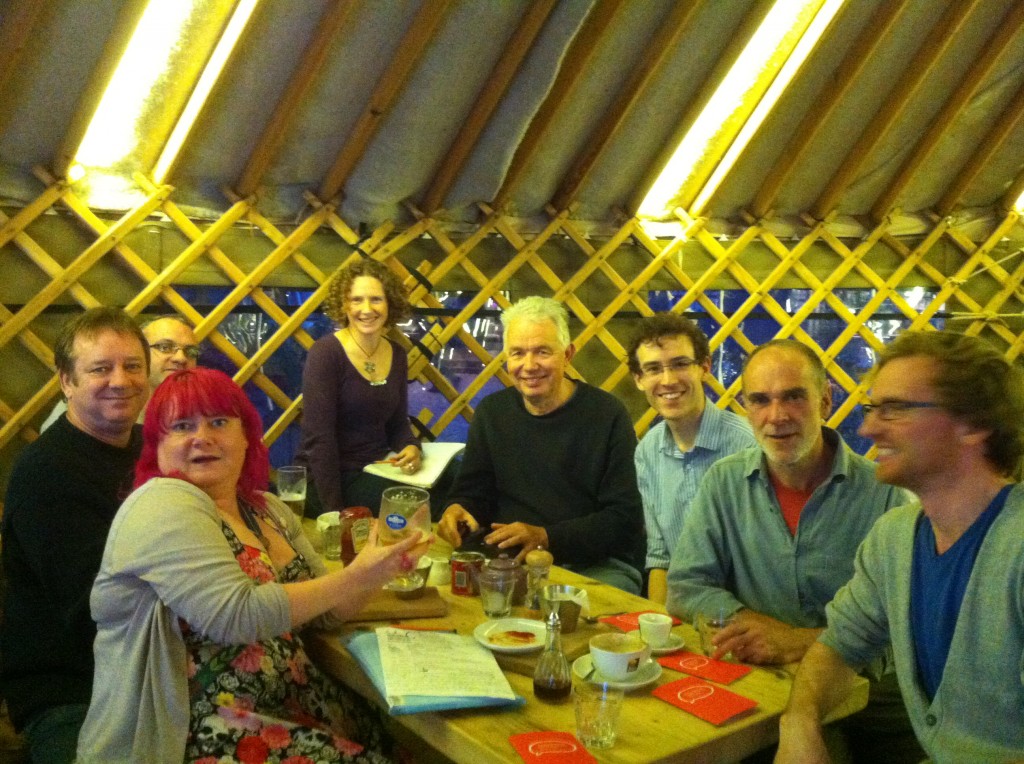
Upcoming Event: “Cities and Climate Change: Resilience and Responding to the Urban Challenge” #Manchester Thurs 12th Dec

Mobilising who for what,eh?
KET5AGENDACitiesandClimateChangeManchester

It’s just wonderful that they have asked Steady State Manchester, Friends of the Earth, Manchester Climate Monthly and  the people who put together the “Call to Real Action” that actually forced the Council to do the Manchester Climate Change Action Plan in a stakeholderly way to give presentations and  to be present and respond.

It’s just wonderful that they have scheduled a session that looks at why the wheels have come off – why the Climate Change Action Plan has only 220 signatories (target 1000), why after 4 years only 2 implementation plans have even been written, why the City Council has had to hire consultants to create its own 3 year plan, why the adaptation agenda crashed to a halt in 2011 etc etc etc.

If they hadn’t invited the outsiders and also scheduled that session, then cynics might have thought that this was just another box-ticking exercise so a bunch of bureaucrats could mutually- powerpoint a bunch of academics with a token business person or so and then allow everyone to convince themselves that they are actually helping this city prepare for the coming horrorshows.

Posted in academia, Adaptation | Leave a comment

Event Report: “Ways of Seeing Climate Change”

MCFly reader Ann Onymous tells us what she thought of a recent exercise in Science Communication.

It’s taken me a while to think about how best to write up the recent ‘Ways of Seeing Climate Change Event’ that was held as part of the Manchester Science Festival. I hope this shows just how thought-provoking it was.

A collaboration between Invisible Dust, an arts commissioning organisation, and The University of Manchester, the event promised to bring together artists and scientists to explore climate change.

Dame Nancy Rothwell’s opening talk called it “an experimental event”. Whilst no established scientist would dare to assert that climate change isn’t happening, Rothwell used her vantage point as President and Vice-chancellor of The University of Manchester to wonder how on earth our universities can take fairly normal people and train them up to speak “gobbledy-gook”. The implication being that the reason that the climate change message is not getting through is because of the inability of scientists to clearly communicate what is going on in a way that the average member of Joe Public can understand. The purpose of this event was to encourage greater collaborations with the artistic community who are much more skilled in communication.

On the whole the structure of the day went beyond an average symposium. Short talks were interspersed with a range of activities that were designed to encourage artists and scientists to talk to one another, through speed-dating for example.

There were a number of evocative performances. Notably, Ellie Harrison’s “Anti-Capitalist Aerobics” livened up the normal post-lunch snooze through having a keep-fit class that had the wider message of the constant need to burn more energy in order to consume; a not-so-subtle, but nevertheless a well-observed critique of capitalism.

But there should be some notes of caution sounded. Many of those representing the artistic community took issue with this new role as the hand maiden of science. The art world is not necessarily well-equipped with the tools to communicate science: artists have their own independence and critical stance which they want to maintain.

Some pointed out that the art world similarly has its own language which does not always resonate with the public. Others critically drew attention to the Siemens Group’s sponsoring of the event. Reflecting on Grayson Perry’s observations during his Reith lectures on BBC Radio 4, it was asked whether art can be construed as a tool for capitalism and whether it has to look at its own practices – namely, the carbon footprint involved in the making of certain art works – before it can be used to communicate climate change to the public.

So, what’s the conclusion here? I’ve been musing long and hard on what the nature of the relationship between the arts and sciences should be. Clearly, there is something in the ability of art to communicate and inspire: the Arts Council England estimates that 51 per cent of adults visited a museum and art gallery in 2011/12: figures that are at their highest level since records began

Yet, perhaps what this event should signal is the beginnings of a discussion on how artists and climate change scientists should work together and perhaps forge new practices through collaboration and conversations between two disparate communities. Moreover, one body of people were glaringly conspicuous in their absence: the policy makers. So perhaps the next discussion is how new art and science practices can make the decision makers face up to the uncomfortable truths raised by people like Kevin Anderson and Alice Bows, Ellie Harrison and Adam Chodzko.

See more at: http://invisibledust.com/project/ways-of-seeing-climate-change/#sthash.N8MTRrF8.dpuf
Arts Council England. 2010. Achieving Great Art for Everyone: A Strategic Framework for the Arts. www.artscouncil.org.uk/media/uploads/achieving_great_art_for_everyone.pdf
Ellie Harrison. 2013. ‘Anti-Capitalist Aerobics’. Video soon to be available at: http://www.ellieharrison.com/index.php?pagecolor=6&pageId=menu-exhibitions
Adam Chodzko. 2013. Rising. Description available at: http://www.greatnorthrunculture.org/aboutcommission?commid=65

Posted in academia, Event reports | 1 Comment

Hey, #Manchester – A Must Read article about #Anthropocene, #climate, #collapse

This article,”Learning How to Die in the Anthropocene“,  by a guy who was in the US Army as it went into Baghdad, is a genuine “must-read.”  It doesn’t say much that many of us don’t already know, but it is beautifully written, full of genuinely useful links.

This bit was droll –

Geological time scales, civilizational collapse and species extinction give rise to profound problems that humanities scholars and academic philosophers, with their taste for fine-grained analysis, esoteric debates and archival marginalia, might seem remarkably ill suited to address. After all, how will thinking about Kant help us trap carbon dioxide? Can arguments between object-oriented ontology and historical materialism protect honeybees from colony collapse disorder? Are ancient Greek philosophers, medieval theologians, and contemporary metaphysicians going to keep Bangladesh from being inundated by rising oceans?

And this bit is savagely beautiful

Across the world today, our actions testify to our belief that we can go on like this forever, burning oil, poisoning the seas, killing off other species, pumping carbon into the air, ignoring the ominous silence of our coal mine canaries in favor of the unending robotic tweets of our new digital imaginarium. Yet the reality of global climate change is going to keep intruding on our fantasies of perpetual growth, permanent innovation and endless energy, just as the reality of mortality shocks our casual faith in permanence.

For “robotic tweets” here in Manchester just substitute “boostering blog posts about China-Manchester ties”  (maybe we should call it the China Syndrome?)

Marc Hudson

PS I do believe there is an expression they use in the killing game – “FUBAR“…

PPS Thanks to Canadian Sam, as ever, for steering me to it.

PPS A slick youtube video called “Welcome to the Anthropocene

PPS An old and not slick video. “The Anthropocene in a digital minute.”

Posted in academia, Adaptation | Tagged , | 1 Comment

Crosspost: Cyclists and pedestrians as ‘hazards’ for motorists. #wordlturnedupsidedown #takecaregtrmcr

Corking blogpost from Mad Cycle Lanes of Manchester. If only Labour politicians read it!

#TAKECAREGTRMCR

There is a whole road safety industry out there that seems to treat people who walk and cycle as vermin to be removed from the road. The latest incarnation of this in the local area is the campaign from the Greater Manchester Casualty Reduction Partnership.

The attitude towards people like us can be seen in this line advising drivers:-

You might think you know the roads but every day new hazards appear; road works, pedestrians and cyclists so make sure you pay attention.

So the Greater Manchester Casualty Reduction Partnership regard pedestrians and cyclists as “hazards” alongside roadworks. To them we are no different from traffic cones or holes in the road!

The whole approach is to push blame towards the victims and young drivers, rather than enforcing road traffic law and reducing traffic speed and levels.

Worst of all is the advice for “cyclists”

Remember that cycle lanes are there to help you and when you need to make sure you share the road.

Don’t go unseen make sure your wearing high visibility clothing and always wear a helmet.

Cycle lanes are there to help you? Not round here they aren’t, most of the cycle lanes in Manchester are CRAP!

Many are even downright dangerous.

As for Hi-Viz and Helmets, they are both causes for concern and may actually be counterproductive. The case for Hi-Viz is demolished by the Road Danger Reduction Forum as yet more victim blaming, and the case against cycle helmets has always been clear, as collated by the Bicycle Helmet Research Foundation.

Of course neither are a legal requirement on our roads and promoting either of them actually discourages people from cycling, with all the consequent health risks of inactivity.

This campaign is doing nothing to improve the safety on our roads. We desperately need better road traffic law enforcement in Greater Manchester. Every day I walk down Deansgate I see drivers openly flouting the law and endangering lives… Here a bus goes straight through a red, long after the other direction has gone green.

It is time to properly enforce road traffic law and take the dangerous drivers off the roads, not blame their victims.

Posted in Democratic deficit, Transport | 1 Comment

#Chortlon community wildlife garden Sat Dec 7th #biodiversity #Manchester

Chorlton readers (and MCFly has one or two!) please share this in your networks!!

Chorlton Methodist Church have a patch of unused land which they are planning to turn into a community wildlife garden, see their webpage at:

http://www.chorltonmethodistchurch.org.uk/the-garden

Hulme Community Garden Centre are putting together a design with a plan for the site and the Wildlife Trust are offering to help as well.  The church are applying for funding to help with the project and are looking to people and organisations locally to provide support for the project.

They are looking for volunteers to help reclaim the land and to start creating the garden.  Initial volunteer days are:

Saturday 7th Dec – clearing the plot of weeds and brambles, trimming the hedge.
Saturday 1st Feb – removing existing fence, erecting new fence and gates.

Both sessions will be between 10am and midday.

All welcome – there will be a range of activities to keep everybody occupied and tea and coffee will be on hand to warm people up in cold weather.

If you are coming and can bring any tools to help with the work – that would be much appreciated.  Bring suitable clothing, footwear and gloves.

There will be additional dates next year, if you are unable to join in on these dates but would like to know about future dates, please let Dave Gallimore know so that he can send further details as the dates are set. chorltonmethodist@googlemail.com

We will also be joining in with the garden volunteers to help people identify the existing wildlife that can be found and also any more wildlife that is attracted into the garden.  The intention is that there will be a number of events and workshops through the year looking at things like mammals, bats, flowers, bees, butterflies etc.

If you would like any more information or are able to help, let Dave Gallimore at the church know or just turn up on the day to join in.

See you soon.

Matt

Matt Holker
Biodiversity Community Engagement Officer
From Grey to Green Project
E-mail: matthew.holker@tameside.gov.uk
Telephone: 0161 342 2109
Mobile: 07870 872 814

GREATER MANCHESTER ECOLOGY UNIT
COUNCIL OFFICES
WELLINGTON ROAD
ASHTON-UNDER-LYNE OL6 6DL

Posted in Upcoming Events, volunteer opportunity | Tagged | Leave a comment

Fuelling #Manchester and a Community Energy Strategy

Via an email;

Fuelling Manchester are inviting people and organisations to get involved in the creation of a Greater Manchester Community Energy Strategy.

Bristol-Energy-Co-op-Yurt-1024x764Jonathan Atkinson, one of the founders of Carbon Co-op and the Fuelling Manchester network, recently visited Bristol (writing this blog post) concluding one of the success factors in establishing a thriving Community Energy sector in Bristol has been the Bristol Energy Network (similar to Fuelling Manchester) and their recently published Bristol Community Energy Strategy.

Fuelling Manchester would like to replicate that here and believe a strategy would provide confidence, an identity and a vision for the sector, as well as helping to strengthen arguments to funders, policy makers and the general public.

As a Community Energy network, Fuelling Manchester want the people involved in activity on the ground to help write a strong definition for what ‘Community Energy’ encompasses, ensuring the wider social, environmental and economic benefits are locked in from the start.

Before the end of 2013, they’ll be consulting on a definition for community energy, in the first quarter of 2014 they’ll be seeking to get people along to an event to help write the strategy.

If you’re interested in getting involved, they’re looking for individuals and organisations from community energy projects (in development, new or established) or a voluntary sector organisation delivering energy projects, please email Fuelling Manchester via info@communityrenewables.org.uk

…linked to this we have the next Fuelling Manchester coming up:

Winter social; 19th December Trackside Bury

We’ll be celebrating another eventful year in community energy at the next Fuelling Manchester:

5.30-8.30pm, Thursday 19th December
Trackside Bar, Bolton Street Station Bolton St, Bury BL9 0EY

http://www.eastlancsrailway.org.uk/food-drink/the-trackside/

As always there will be no agenda it’s simply an opportunity to meet like minded people involved in the Community Energy sector.

Who: for anyone involved in community renewable projects, including: hydro co-operatives; bio-mass and woodland management enterprises; retrofit and energy efficiency projects and solar energy collectives. Past attendees include Torrs Hydro, Biomass Energy Co-operative, Greater Manchester Tree Station, MERCi,Saddleworth Hydro, Stockport Hydro, CoRE, Co-operative Enterprise Hub and many more!

To book: there’s no formal need to book but it helps us know who is coming and how large a table to reserve, so if you are coming let us know via info@communityrenewables.org.uk or tweet us @carboncoop

Posted in Energy, Upcoming Events | Leave a comment

Short Story Contest runner-up “Skin” by Dan Carpenter #Manchester #climate

The balcony garden quakes; tiny brown leaves fall from branches. The final charcoaled piece of shipflesh falls from the sky, a fiery planet-sized ball of skin and meat. From behind glass in their living room, they watch as it disintegrates silently over Manchester. An infinite number of black meteor flakes spilling across the red morning.
They look over at the last of the melted black dots as they fall ashen against the windows of the Beetham tower.

There had been a party outside of the city in the Irwell basintown a week before. Glittering fireworks had shot into the air, exploding green and red. There had been music, real live music and the smoked barbeque scent had risen up into the tenement flats. Somewhere, they had thought, a Skinship had found something and was coming home. He never thought it was anything other than impossible. A Skinship coming back was as good a bet as snow. But he knew that no-one threw a party like the basintowns.
Those who lived in the basintown had dreamed of the day it landed, crushing down somewhere out in the Windermere desert and crawling its way towards home, guided by unfathomable signals and algorithms. The presses: those single page A4 bulletins that wisped their way across the floor of the city in high winds, and lay piled next to stations and factory entrances on other, calmer days, had headlines proclaiming ‘It Returns!’ and called the Skinship ‘saviour’ and ‘messiah’.

The two of them had waited until the sun had settled and wandered down to the basintown. They had been before, on one of those god-awful tourist trap guided walks, outskirting the shacks and houses, crossing the wider, main strip of the Peterloo way and into the markets. Never seeing more than what the guide wanted them to. The quaint façade of the place. This time though, they ignored whatever advice had drifted in from newspapers and feeds and went straight in. They followed the noise of crowds, the dim off and on yellow orange of the bonfires until they reached the central square. She kept close to him, squeezed his hand and looked around. He took it all in, strode around exuding confidence, stopping at stalls and picking up foodstuffs as though he knew what they were. But as they walked he would turn his head and check behind them. There were what, a dozen or so murders a week? Gangs vying for territory and arson attacks burning whole tranches of housing down. He’d seen the videos and read the articles. Insurance scams, back-alley deals. The basintowns were a mire of criminal activity which excited and frightened him in equal measure. So he was disappointed that it didn’t feel like that kind of a place that night. People laughed and danced. Grinning stallholders held out sample goods. Some people had made Skinship paper lanterns, and children huddled down in the dust flicking lighters and letting the lanterns rise and rise.
“Find safe worlds!” one of the children yelled.
“Come back soon!” another.
They picked up two plastic glasses of some dirty liquid the basintowner on the stall called gin, and sipped it whilst they watched more fireworks. It tasted the way petrol stunk.
As they drank, she leant in close to him and asked him quietly, “How old would she be? I’ve forgotten.” He didn’t answer. Somewhere else, it was still so obvious, but he liked it being somewhere else.
Someone had told him once that the Irwell basintown stretched right up along the side of the city, winding and twisting until it met Merseytown somewhere south. Hundreds of thousands of people lived here. Houses latched on to other houses, ramshackle shacks meandered atop carefully constructed sheds. The sturdier of homes, concrete breezeblock palaces, had new structures thrown on top. He looked around and saw little dots of fires burning in the distance. He imagined for a moment, what it would be like to be a Skinship, to have spent so long in space, only to return. Space giving way to atmosphere and cloud and then the lights of cities and the cold night black of towns and villages and there, somewhere far below, hundreds of little yellow fires, guiding the way like landing beacons. Would someone be waiting for him?
She gripped his hand from behind and rested her head on his shoulder, “What are you looking at?” she asked him. In front of them a small procession danced along to the beat of an unseen instrument, a few cheers rose up and the procession raised their hands to the sky. He could feel it, that will, that want for something to come down and save everyone. He had never felt it before, but there in that crowd more than anything he wanted to see the Skinships, wanted them to land and come to the city and take them away from everything. An old man wandered past, a stupid smile spread across his face, half masked by a long grey beard. He was wearing just a sandwich board which had at one point read, ‘The End Times are Here’, but now in thick black paint simply said, ‘He is Returned’.
He could still taste the gin, harsh against the back of his throat and when he swallowed he coughed, painfully. He blinked, and when he did the parade stretched and contorted, faces fell slack and tongues lolled out along the floor like a carpet. People stared at him, and they wouldn’t stop staring and so he shut his eyes and held his arms up, aiming for space.
“Are you alright?” her voice, somewhere distant.
“I have to go,” he said, “I think she’s out there somewhere.”
He tried to stand, but she held his shoulder, “Sit down,” she furrowed her brow and he watched it dipped below her nose and vibrate along a wavelength, “You don’t look well.”
A young couple walked past them, each step reverberating and echoing their image across his line of sight. One of them held a sparkler and swam it through the air, spelling out incomprehensible words for him. They stopped and kissed in the centre of the crowd, then looked up and their faces looked happier than he had ever been. He felt guilty then, sick and cynical for being there.
“Are you alright? Is everything okay?” she squeezed his knee, trying to make eye contact. He tried to say that everything was fine, and that it would be alright, but it came out as a jumble of words which didn’t make sense. “Hold on,” she said, “I’ll get you some water.” She disappeared into the bustling mess of people and he sat still on the chair, trying desperately to stay focussed. His eyes wandered. His head began to throb.
He tried standing: harder than he remembered, he fell twice before composing himself properly and standing upright. He made his way down one of the thin sidestreets, ducking underneath clotheslines and bracing himself against walls to avoid open windows. He took too many turns to remember where he’d come from: a left, a right and then another, and another.

When he stopped wandering he looked up properly and found himself further from the party. In the distance the crowd could still be heard, but they were like an echo. He was in a wider space, a courtyard almost. An old man tottered about, back and forth carrying boxes, crates, and bags. He was placing them in the centre of the yard.
“What are you doing?” he asked the old man.
“I am taking all of my possessions and piling them up here.” He explained it as though it was the most normal thing. “When it gets high enough I can climb up and welcome them, and they’ll see that I’ve done the most. They will pick me first.”
“Do you need help?” he found himself saying. The old man nodded and passed him an armful of photo frames, the pictures twitching static. He took them to the foot of the pile, staring up at what it was made of: chairs, bed posts, clothing, plates and cutlery, children’s toys. He clambered on a chair which acted as an initial step up, then onto the top of a toybox. He reached up, grasping for a handhold and found a set of hangers, jutting out from the next level. Tugging on them jostled them loose and some slipped from the pile and fell a few feet to the ground. He regained his balance and felt his way up the pile, he brushed past a stuffed bear, the warmth of the fur and the coldness of its black eyes. He pulled on the edge of a large television and, when it didn’t move, he pulled himself up to the top of it. Above that, a coffee table precariously moved left to right, metronomic. It didn’t look sturdy but still he hoisted himself up and stood, higher than the rooftops of the huts and tents, surveying the basintown. He placed the frames carefully on top of the pile and looked down as the old man went back to his pile to retrieve some more of his belongings.
He looked up and there were the stars, simple and brilliant.
When she’d died a priest had come to the flat. What was it that he had said? Your daughter. He hadn’t ever thought of her as his daughter. He had never had the time. Your daughter is up there now. He knew the priest hadn’t meant it literally and he didn’t mean the stars, but he couldn’t help himself. He wondered briefly if the Skinships were grown with mouths, with voices. When he looked up he felt as though he was a little bit closer to her. Standing there on top of someone else’s things, crushing the life out of them, he reached higher and higher and somewhere amongst the stars he thought he saw one of them, a Skinship with her face and her body and her mind and she was coming back.

Daniel Carpenter has had his words on Metazen, Rainy City Stories and was featured in the National Flash Fiction anthology Jawbreakers alongside Ali Smith and Ian Rankin. He co-runs Bad Language and is new writing editor for the Blank Media Collective. His stories have been described as “serendipitous”.

Posted in Uncategorized | 4 Comments

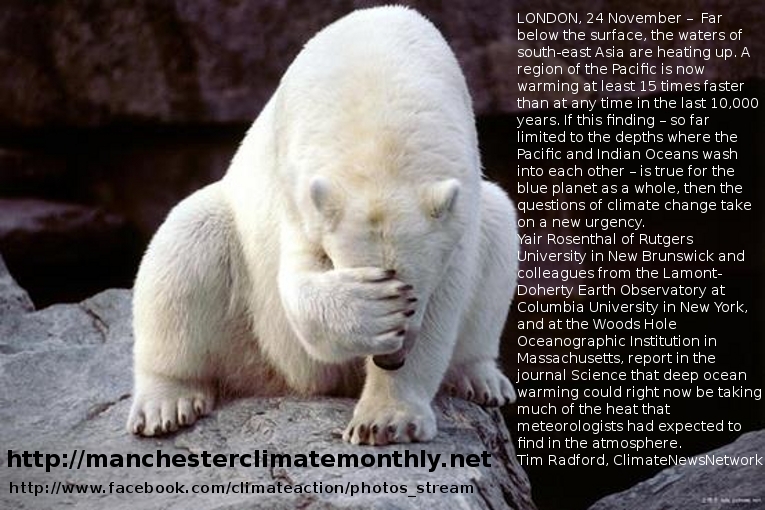
Polar Bear Facepalm: “Global warming stopped”? Clock the *oceans*, you denialist clowns…

I know, I know, don’t feed the trolls. They are immune to evidence, rationality etc, and a lot of what they do is attention-seeking behaviour.  Don’t expect them to play by anything approaching Enlightenment rules…

polarbearoceansheating

Posted in Uncategorized | 1 Comment

Short Story Contest runner-up “Choice” by Sarah Jasmon #Manchester #climate

Choice by Sarah Jasmon. The other runner-up story – “Skin” by Dan Carpenter – will be published tomorrow.

And on the hill there is a white city, and within her walls all will be safe. Except Manchester isn’t on a hill. No matter. If you go up on a roof of a redbrick terrace, out where the nights are as sharp with danger as razor blades, you can see across the plain to where the city centre sits, surrounded by her curving wall.  Because Manchester was ahead of the game, guided by the voice of Flores. 
Flores, the man who lit the fire of the North, lifting packed stadia to unified states of frenzy with his rhetoric; becoming the unstoppable force of the decade. The man of the people, the evangelist of change, the one who turned about the fortunes of Manchester and now lives behind the vast enclosing walls of her centre, his hand controlling the country’s media, his vision bulldozing through the wreckage of the country outside. 
Even before the government of the day realised that they had left it too late, Flores had begun his pitch. And as the water began to rise around the spires of London, the men of influence forgot their distaste for the places of the North, and made their move towards the hills. Flores gathered power  with the ease of a monkey picking at fleas. Inside those walls, which breathe inwards like the sides of a giant cooling tower, you can stroll down Deansgate, cool yourself at the fountain of St Ann, and then make your way to the Cathedral for a moment of thankfulness. It is as if the outside isn’t happening. 
For those on the outside, though… 

The insect shed is quiet, the solar-induced warmth alive with tiny increments of movement. Many thousands of legs, incessant jaws. I stand for a moment to watch the gently shifting mass behind the nearest glass wall. It is one of the ways we show our difference, by producing our own food. This room full of tanks, and the hand feeding, the sieving and preparation, the way we serve the end result in a natural form, with no pretending that it’s other than it is: this is the important stuff. Rafe once said it was the natural conclusion to allotments and slow food and keeping a few chickens. I think of the industrial plants writhing with the tonnes of miniature life needed to support their slogans. Keeping it cheap. Keeping it real. I hold my palm against the glass and imagine I can feel the movement on the other side.

I hear the heavy plastic curtain over the door being pushed aside, and Rafe comes to stand next to me. I don’t look at him.

‘Everything under control in here?

He is good at this, finding a neutral subject after upset, making it possible to feel normal.

‘Yes,’ I hear myself saying.

The man arrived last night whilst we were eating. I can picture it as clearly as if the moment had been captured in paint. Thirteen of us around the table, candles lighting our faces from beneath. He is framed in the doorway, his arms braced against the jambs. His forehead rests on the upward slant of one dirt-caked bicep. It would be in the style of Ford Madox Brown, or possibly Millais. The title, ‘The Unexpected Visitor’. You used to be able to see paintings like this in real life. Now they are behind the Wall, accessible only to those who hold an official pass. Who follow the official line.

Our visitor was gone before morning. We pass them on, these men and women whom we are not allowed to call refugees, up to the areas of Scotland where there is space enough for them to settle. A hard life, but preferable to the floating camps on the south coast, on the bite of water that lies between the Quantocks and the Chilterns. He had time to rest, eat, to bring us up to date with the latest conditions.

I can feel Rafe’s body heat as he moves behind me. I don’t want him to touch me, and he must sense this, because he stops, and I hear the rasp of his nails rubbing against his beard instead. I focus on the scraping talk of the locusts. We must go out and collect more balsam, I think. A calming thought, a normal, everyday plan. Himalayan balsam. But this in turn makes me remember Rafe leaning in to me, whispering the other names, the Kiss-me-on-the-Mountains names. I picture the man’s face from last night, the hollows, the bones, the bruises.

It was after the visitor had gone that the arguments had begun. There are those among us who want to join with the more radical of the protesters. There is a swell building, a head of steam. It is time, some of them say, to move on from our stated position. We have done what we can here, now our duty lies in supporting the movement towards action. When the united people gather, we should be there too.

But our life here is based on the absence of conflict. There is enough of that outside, and we are here to be different, to raise a voice against the senseless noise.  Rafe has been our bedrock: Rafe, the outcast; Rafe, once the biggest cog in Flores’ architecture of a new world; Rafe, who turned his back on the Wall. But we have heard too many of these stories. I have tried not to listen to the others, have tried to have faith, but last night, something gave.

The man told us the usual stories. Beatings. Hunger. Men taken to work on the new flood basins. Children sent to the euphemistic Homelands. Those with power sit on the high ground and kick at the hands reaching up towards them. As this one escapee was led off to start on the next stage of his journey, I closed my eyes and a vision began to play out against the flickering darkness of my eyelids. It was jerky, a memory of newsreel: the white walls of the city rose and onto them was projected a pageant of the camps. Like mediaeval demons, the guards pitching howling refugees into a dark pit. Over and again, the forks rise, the bodies fly. Limbs tangle, water rises.

I haven’t slept. I stand in this quiet place, my eyes fully adjusted to the dimness of the light, and I know that I cannot change my decision.

‘I agree with the others.’ My voice does not waver even though I am shaking with the scope of my betrayal. I mustn’t look at Rafe. My eyes feel the scratching weariness of tears and sleeplessness, but I know I have to do this. And Rafe turns from me and becomes the absence of heat.

And I run towards the Wall as lightning flickers from the eastern sky, turning the landscape into a stop motion nightmare. I trip on boulders and taste blood in my mouth. No matter how fast I run, the Wall seems to stay at the same distance ahead. But I keep running, and around me others are running also, a creeping mass converging on the centre. Because all we have is the weight of our bodies, to throw against the Wall. We will use them to protest in front of the world that Flores is wrong. I go over once more and my face catches on the corner of a brick. My tongue snags the chipped edge of a tooth and I feel tears coming. For a moment I lie there and feel the weight of Rafe’s sadness pressing me into the ground. It is not enough to keep saying no, I tell him again. I’m so sorry, I say. And I get up and keep going on.

Sarah Jasmon lives on a boat on the Leeds/Liverpool canal. She writes all sorts, from web copy and magazine articles to short stories and interviews with authors. Her debut novel, The Summer of Secrets, will be published by Transworld in 2014. You can find out more at http://www.sarahjasmon.com.

Posted in Uncategorized | Leave a comment

Richard Leese on how #Airport City will secure the prosperity of #Manchester. Uh-huh

From Our Glorious Leader’s blog

Where in the World

Last week Manchester Airport Group announced that DHL had signed up as the first tenant in Airport City, the first of what I expect to be many such announcements. The key to this of course is international trade. The Greater Manchester Strategy (GMS) has identified internationalisation, increased trade with other countries, and increased investment from them, as a key priority. The evidence that underpins the GMS shows that companies that trade internationally are in general more productive and more profitable than those that don’t, and that GM is underperforming in this area. We can’t increase international trade for Manchester unless we promote the city internationally and build relationships with other places. We can’t do that everywhere so we have to focus and one of the places we are focussing on is China. That’s why last week the Lord Mayor was in our friendship city Wuhan, and Deputy Leader Bernard Priest was in Beijing.

It’s actually quite rare for elected members to be involved in visits like these but sometimes it’s appropriate. A few weeks ago I spent a day and a half in Beijing (and going to China for a night is hardly a junket) for the launch of the Manchester-China Forum and the announcement that Beijing Construction and Engineering Group were to be a joint venture partner in the development of Airport City. Couldn’t we have just issued a press release? Well we could but that would have done nothing to help build the so important relationships necessary to make deals like this work. It’s also extremely unlikely that a press release would have generated the 433 UK and 462 China pieces of coverage that actually came out of the launch and announcement with an advertising equivalent value of £8.5m and an audience of 4.7billion people.

This entry was posted by leadersblog@manchester.gov.uk on 26/11/2013.

Me, I’ve left a comment. Feel free yourselves – on his site preferably.

Where in the world can you find a rhetoric-reality gap to beat all contenders, when it comes to climate change? In Manchester, that’s where. We have a wonderful Climate Change Action Plan, written by stakeholders (the process for that inspired by/borrowed from a certain Call to Real Action). There were supposed to be one thousand endorsers. In the end it got 220ish. There were supposed to be a thousand implementation plans. There were two. And the council’s one so hopeless that they had to play fast and loose with the truth to claim a 7% reduction last year, when in fact their own emissions went UP. Meanwhile, the obsession with China grows. In thirty years time, our children will look back in horror and disbelief at the abrogation of leadership.
Really really staggering.

See also the Steady State Manchester viewpoint on OGL’s blog post.

Posted in Climate Change Action Plan, Manchester Airport, Manchester City Council | Leave a comment