Richard Leese giving the welcome address at the “Investing in Nature” seminar yesterday. More on this perfect example of “ecological modernisation” soon…
One point – at 8.21 he makes reference to a Green and Blue Infrastructure plan for Manchester. This is the same plan that, as reported in MCFly, has been delayed again and again. At Full Council in July SRL told the Liberal Democrats that it was going to a scrutiny committee the “next week”. And then it was going to go to Exec … in July, in September… and now “by the end of the year aim to have in place.” It’s this sort of slippage (as bad as the Greater Manchester Climate Change Strategy Implementation Plan) in plans, let alone actions, that fills close observers with dread.
This video, 3.35mins of me talking, should have had more of an explanatory introduction. Next one will! Comments v. welcome! Script (more or less) below.
What is adaptive governance?
The standard model of governance is that some smart people at the centre gather in information. That takes time.
They analyse it, that takes time.
And send out their proposals, that takes time,
Which are then implemented that takes time.
That has worked fine – for some – if today is like yesterday, and tomorrow is like today.
But hasn’t the weather been funny? And won’t those “1 in a hundred years” events start happening every 4 or 5.
What if everything is changing faster than the “smart” people at the centre can understand, let alone “adapt” to?
So adaptive governance is about shortening the time from gathering information to implementing proposals. And it’s about the people closest to the problems being able to come up with ideas of how to fix them and being, well, listened to by the oh-so-clever Big Brains in t’centre.
Why won’t the powerful like “adaptive governance”?
It points out that they don’t have all the answers
It would demand that they share the powers they currently have
to define reality
to define what counts as a problem
to define what counts as a possible solution
if you want to get all Gramsci, it would undercut their hegemony
Why should you care?
If you think our Lords and Masters are doing a fine old job.
If you haven’t noticed that carbon dioxide emissions are 40% higher than when we started “taking action” on climate change in the 1990s..
If you haven’t clocked the pending ecological debacle around biodiversity collapse, soil loss, ocean acification
Then go ahead and do nothing. You’ll be happy. For a while.
How do we get this wonderful “adaptive governance” thing then?
Anyone who tells you they have a perfect blueprint has, obviously, missed the point a bit.
I have no recipe, but I have some ingredients.
Engaged citizens – that means bureaucrats and politicians who tell the truth and don’t witch-hunt and demonise whistleblowers.
Growing social movements – that means organisers who don’t bore potential allies to death with top-down meetings and sterile marches and rallies.
Persistence, stamina, tenacity, resourceful learning – adaptive groups, that create sustained pressure that keeps building, organisations that keep doing things, people that keep learning lessons from the last time and doing it better the next time.”
But it’s late, it’s so late. In the words of one prominent climate scientist, it’s later than you think.
You have until this Friday, 27th, to submit an application. Not to us at MCFly, but to the folks at Carbon Coop –
Job advert: Freelance Whole House Assessor positions
i) Summary: In order to meet demand, URBED require a freelance a household energy assessor to deliver Carbon Co-op’s Whole House Assessments using URBED’s bespoke, Whole House Assessment Method.
URBED are seeking to engage an assessor to deliver Whole House assessments and create reports. At least to begin with assessors will be engaged on a freelance basis with bookings made 2-3 weeks in advance.
Payment: £150 per assessment
ii) Background
URBED
An employee-owned co-operative with 11 staff and associates, comprising planners, architects, an economist and a sustainability expert, URBED are one of the UK’s leading authorities on whole house retrofit having delivered three of the top five performing homes in TSB’s Retrofit for the Future programme. In 2012, URBED developed a Whole House Assessment method in order to assist residents in understanding their home’s energy performance and providing a retrofit action plan to meet 2050 performance standards.
Carbon Co-op
A member-owned community benefit society that exists to assist householders in retrofitting their homes to 2050 standards. Carbon Co-op brokers access to expert technical expertise whilst encouraging peer learning amongst its householder members. Having commissioned the whole house assessment method, Carbon Co-op is now working with URBED to deliver a programme of 13 whole house owner occupier retrofits around Greater Manchester as part of a DECC-funded Green Deal pilot.
The assessment requires a household visit of around 1-2 hours with detailed measurements being taken and a short resident questionnaire carried out. Data is fed into an energy performance model with a series of measures proscribed by URBED’s retrofit experts in order to bring the home down to 2050 performance targets of 17kg CO2/m2/year.
Whole House Assessment reports are presented to householders shortly after assessments are carried out. Householders have a number of options on how to use these, including using Carbon Co-op’s Whole House Retrofit service. URBED intend to use the data collected during house visits to create Green Deal Assessment reports meaning if the householder so wishes they may choose to use Green Deal finance or providers.
Both URBED and Carbon Coop believe in continuous improvement. The tool is still in development and will continue to be revised and improved to respond to feedback from both assessors and householders. At present the assessment is mainly spreadsheet-based, however its development into a web-based tool is planned. Whilst at this stage the number of assessments commissioned is estimated to be around 4-8 per month.
iii) Qualifications
Essential
Undergraduate Qualification in Built Environment (building surveying, architecture, engineering), or equivalent demonstrable experience in industry.
Desirable
Green Deal Assessor accreditation
Domestic Energy Assessor accreditation
Chartered status, or working towards RICS chartered status (building surveyors only).
Academic qualification in a built environment discipline that demonstrates good understanding of building physics
Academic qualification in a built environment discipline that demonstrates good understanding of building services
iv) Skills and experience
Essential
Experience of energy assessment tools: SAP (full version),
Experience of carrying out accurate measured surveys of existing buildings
Experience of use of spreadsheets for data input and management
Good basic arithmetic and mathematical skills – to be able to check for errors and assumptions in spreadsheet tools.
Desirable
Good understanding of Green Deal/household energy assessment policy and regulatory environment
Experience of other energy assessment tools: GDA, PHPP, BREDEM
Understanding of U-values and condensation risk calculations.
Understanding of construction sector
Understanding of building physics and the hygrothermal performance of different materials
Understanding of building services – heating, hot water and ventilation systems.
Experience of working as part of an inter-disciplinary team
Experience of working within set systems and processes
Experience of developing tools databases and information management, particularly in relation to construction.
Experience of customer-facing roles, in particular dealing with ‘consumer’ clients.
v) Person specification
Essential
Excellent attention to detail: for the accuracy and efficiency of the work you will need to collect lots of pieces of data with few or no mistakes
Efficient use of time: bearing in mind attention to detail, we need someone who can work efficiently and effectively, without cutting corners, but without spending excessive amounts of time checking and re-checking measurements
Good with people, good communicator: you will be in peoples’ homes, explaining elements of your work to them and to be polite and considerate at all times.
Able to work with others in a team
Desirable
Flexible: as much as possible we will programme assessments in to regular work hours but we need someone who is flexible in their availability. Also, though we will attempt to book a consistent number of assessments each week it maybe that some weeks are busier than others and some times of year are busier than others.
Feedback: You need to be able to deliver the method as designed but also input in to its future development, providing feedback on the method and tools and conveying any issues raised by householders, so that you can contribute to its future development and use.
vi) To apply
If you are interested in applying for the position send a copy of your CV along with a covering letter to Lavinia Leader at info@urbed.coop.
Please include the following reference code: WHOLE HOUSE ASSESSOR {email subject}. No emails should be no larger than 8MB. Alternatively, post your application to: Lavinia Leader, URBED, 5th Floor, 10 Little Lever Street, Manchester M1 1HR
Closing Date for Application
The closing date for applications is 5.00pm on Friday 27th September 2013.
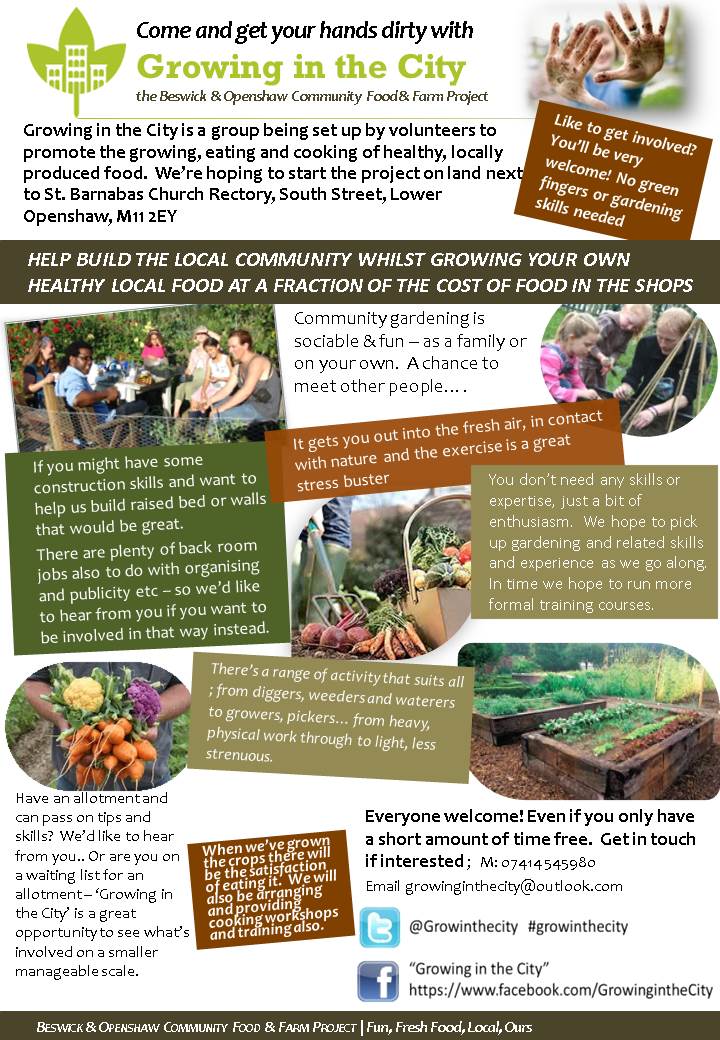
Following agreement with the “landlord” last Friday, we have just set a date to begin ground clearing and preparing the site of our “Grow Your Own” scheme in East Manchester.
This will be on Sunday 3rd November between 11am and 4pm.
I would be very grateful if you could pass on to your contacts and anyone likely to be interested in the project/joining in.
Please share on Facebook, Twitter, email etc.
To keep both workers and the activity fuelled and motivated we are planning to have lots of Cake, Hot food, Tea/Coffee etc..Toffee apples and treacle treats for kids (and adults !!).
It should be a fun day regardless of weather and numbers!! ALL are WELCOME
We are looking for confirmation of attendees where possible.
I can be reached through twitter, Facebook, sms etc as below.
We are also looking for ANY support/assistance re hire/loan/costs of
· Tools/equipment to cut back bramble, nettles and weeds etc and start digging out roots,
· Skip(s) and bins – to remove rubbish/bricks and non-recyclable waste
· Refreshments/food as well as cooking/warming of food etc.
· ….and finally advertising the event.
Any contributions re above list appreciate – please let me know details so I may co-ordinate resources etc.
In meantime if you want more information please contact me.
Many thanks and regards
Clive
Clive Hamilton | Project Leader
growinginthecity@outlook.com
In July the Annual Carbon Reduction Plan of Manchester City Council got a bit of a mauling. Maybe that explains why, months later, it still hasn’t gone to the Executive? Marc Hudson explains.
On Wednesday July 17th this year climate change and democracy collided in Manchester Town Hall. The Council wanted to assert that it had reduced its own emissions by 7% (it had aimed for 10%). During a “scrutiny committee” (a bunch of councillors who gather to keep tabs on what is happening), it was forced to admit was that emissions had actually gone up by 1.8%, with the claimed reduction being entirely due to the fact that emissions from traffic lights had become the responsibility of a different body.
There has been a second sharp rise that the Council probably doesn’t want you to know about as well – in the days taken for a Plan to move from committee to Executive. In previous years the Council’s Annual Reduction Plan has gone from the scrutiny committee to the very next available “Executive” meeting to be signed off (the Executive is made up of 9 (8 for the moment) top councillors who do the day-to-day running of the Council. This year, the contested and bloodied Carbon Plan has appeared at neither of the July or September Executive meetings. The earliest it can appear is on Wednesday October 23rd, after the Executive has gained a new Deputy Leader.
Two weeks ago we contacted the relevant officers at the Council, asking for an explanation as to why the Annual Carbon Plan had not been sent to Executive, where members of the Consultative Panel might ask some searching and damaging questions about it. Silence.
“Successful protests in Balcombe, Sussex have brought the fracking issue centre stage. Now it’s our turn- Igas are starting to drill at Barton Moss, near Eccles , in October. They will drill for 8-10 weeks to see if there is potential to extract coal bed methane and shale gas. The environmental damage of fracking-such as pollution of ground water-is bad enough; burning the gas would also make it impossible to meet the UK targets on reducing CO2 emissions and so increase the danger of catastrophic climate change.
“No Dash for Gas and the local campaign group (Say no to Fracking on Barton Moss) have set up this meeting supported by CaCC, Friends of the Earth and other groups.
“Come to the meeting to learn more and be part of the campaign to stop Igas : Fracking and Barton Moss”
Thursday 26th September 7-9 pm
Friends Meeting House
13 The Polygon
Wellington Rd
Eccles
M30 0DS (near Eccles tram, and junction of M602 and Eccles Old Rd)
Please contact me if you can help with leafletting the local area or if you need help getting to the meeting
thanks judy.paskell@gmail.com
Our "leaders" are going to keep making empty promises. It makes them feel good. It gets the activists to act like zombie kittens. If you want to have some self-respect and perhaps make a difference (actual facts may vary), then find a functioning group that cares about your skills and knowledge - what you have, what you want.
One useful group might be www.climateemergencymanchester.net - you can email them on contact@climateemergencymanchester.net





 manchester climate monthly