
Hello!
This Sunday, 23rd June, there is “Manchester Day” activities in the city centre. Folks from Climate Emergency Manchester (including MCFly editor Marc Hudson) will be out and about collecting signatures. (Read this account and another one about what that is like – it’s fun, not scary). Please get in touch via climateemergencymanchester@gmail.com if you want to come do an hour or so of collecting. “Training”, clipboard, signature sheets and pens provided.
Two more things. Tomorrow – Weds 19th June, at 1pm, Climate Emergency Manchester will meet at the Waterhouse Pub for a chat and a plot. at 2pm we will attend the Neigbhourhoods and Environment Scrutiny Committee Meeting, in the Town Hall extension Why? Because we need to know how the policies proposes are then implemented and scrutinised. It’s not sexy, it’s not exciting, but it is absolutely crucial.
Finally (!), on Thursday 20th at 1pm, there’s this interesting seminar .
‘Buildings as Power Plants: The role of buildings as active components in our future energy networks’ by Dr Sara Walker, on Thursday 20th June (room C21, Pariser Building, Sackville Street) at 1.00pm.
Using a campus building as a case study, we considered the potential for the building to offer flexibility to the local electricity network by reducing import from the network at the point of connection.
The first stage of research was a building load audit, and building energy model. This enabled the researchers to understand which loads had flexibility based on the user need being serviced, and the modelled response of the building if that load was to be controlled in a way to offer flexibility. The research has identified that, over 24 hours, on average the building can offer between 14% and 46% electrical demand reduction. We then looked at the network response to that flexibility, as well as the potential market value. Local network markets for flexibility do not currently exist, but based on national markets a revenue of £20,000/year was estimated, 14% of the annual energy bill.
Speaker bio
Dr Sara Walker is Director of Infrastructure Research at the School of Engineering, Newcastle University. She is interested in the active role of the urban environment and buildings in the energy sector, particularly low-energy and low-carbon buildings, building-scale renewables, small scale energy storage, and electric vehicle charging/discharging load profiles.
The seminar will take place in room C21, in the Pariser Building on Sackville Street– number 12 on the map herehttp://www.manchester.ac.uk/discover/maps/interactive-map/?id=9

 I grew up in Doncaster, I had some brilliant teachers at secondary school that made me realise just what a difference education can make – it does sound corny! I really wanted to give others the opportunities I had, I trained as a teacher in London, worked in Doncaster for a few years before heading back to London. I’ve now been Head Teacher at Castle Carrock School for four fabulous years! A tiny school where I also teacher a brilliant Y5/y6 Class. The best bits in teaching are so numerous – after all you are watching children learn and grow every day. We’ve done some amazing things here at school – from Skype lessons with the International Space Station to growing our own food in the school garden – every day is different.
 On Saturday June 15th, from 11.30am there’s a meeting in Northenden on the topic “What can we do about the climate emergency here n Manchester?” It’s free and there’s no need to book. The format will involve a very short introduction, then getting into groups to figure out questions, find out what knowledge and skills are already in the room, and also make practical suggestions (short and medium term) about what could be done locally (in Northenden, South Manchester and across Manchester) to create a low carbon culture, and to create the kinds of cultural, political and economic pressures for rapid and socially just change. It will be more fun than it sounds, and you will DEFINITELY meet lots of like-minded people.
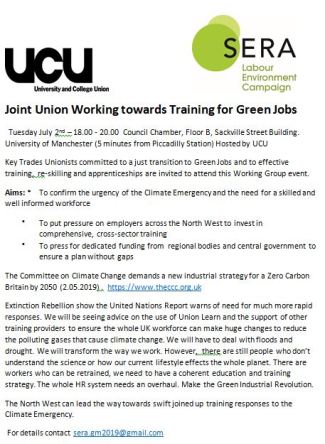 Joint Union Working towards Training for Green Jobs
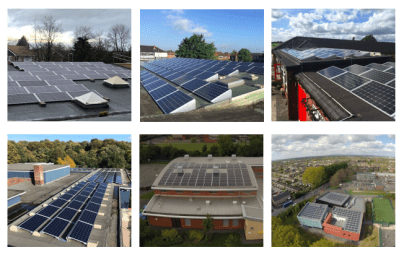 Since 2016, we’ve installed solar arrays at five primary schools in Salford – Broadoak, Fiddlers Lane, Irlam, Peel Hall and Primrose Hill – and a community centre called The Fuse in Partington (see photo).


 manchester climate monthly