On 23rd October I wrote to informationcompliance@manchester.gov.uk
Dear Sir/Madam,
I read this story in the Grauniad with alarm. It concerns bin lorry drivers selfishly deciding to put food on their families’ tables by taking higher paid jobs delivering food and the like. Taking back control of their finances and all that. Now, I know the Council is inordinately proud of its electric lorries, with names like Leesey-McLeeseface and so on, but to the best of my knowledge self-driving lorries are still a glint in Elon Musk’s eye. They not yet, as the young people used to say “a thing”, yet.
So, naturlich, some questions arise.
[My questions are in bold, the answers from the council in plain text]
1. Does the Council employ any bin lorry drivers directly? If so, how many, and what steps – if any – is the Council taking to encourage them to stick around. No, the Council does not employ any bin drivers directly.
2. If, as I suspect, the Council does NOT employ any bin lorry drivers, and they all got TUPEd over to Biffa when the service was privatised (turns out it isn’t just Tories who privatise, eh?), then
a) how many drivers does Biffa employ to do bin collections in Manchester City Council’s area (rough count is fine) This information is not held by the Council.
b) is the council aware of any action taken by Biffa to keep these drivers from taking better paid jobs, as per the Grauniad Biffa are working to retain their existing drivers and are actively looking for new drivers to fill any vacancies.
c) Has the relevant Executive Member had any discussions – either proactively or initiated by Biffa – about this? If so, when, who started it, and what has been the outcome, thus far, of discussions. The relevant Executive Member sits on the strategic board with Biffa where operational issues like this are discussed as and when they arise.
3. What contingency plans does Manchester City Council have in place for a crisis with bin collections in December/January? Should I be panic-buying 4XL hazmat suits and rodent traps? Biffa are contractually obliged to provide certain services in the area covered by Manchester City Council. They have contingency plans in place including the use of agency drivers, the use of drivers from other parts of the business and if it came to this, the prioritisation of putrescible waste collection. Manchester City Council is in regular contact with Biffa to assess the current situation, forecast potential disruption and put arrangements in place. Please keep an eye on our website for the latest information. See https://secure.manchester.gov.uk/info/500362/covid-19/8030/covid-19_bins_rubbish_and_recycling
It was my friend’s fault (1). She was the reason I even went to this god-awful event, which was even god-awfuller than I thought it would be.
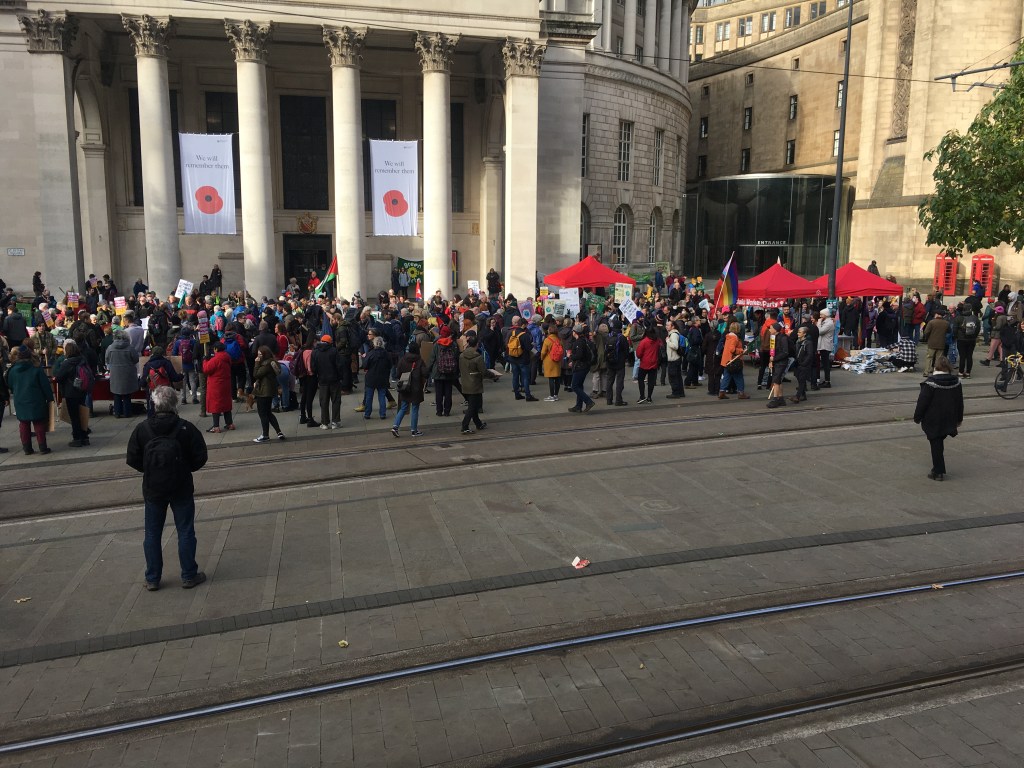
Several hundred people (four hundred? maybe five hundred?) gathered and were told things they either already knew, didn’t need to know, or speeches they probably largely didn’t agree with. The local situation, with Manchester or even Greater Manchester, was not touched on by any speaker that I listened to (2). These people, overwhelmingly white (3) with many of them grey (as in, 50 plus) milled around, wisely not really listening to the speeches.
There were more banners for the Revolutionary Communist Party than XR, which seems to have “finally” (in less than three years) given up the ghost.
After almost an hour of this, they went for a “march” before coming back – in reduced numbers (150?) – to hear yet more speeches about the need to build a movement. These speeches were being delivered to the backs of dedicated activists who had heard enough, and didn’t feel the need to get wet listening to the same worthy words people have been spouting on climate change for 30 years.
I sat on the steps of the cenotaph in the rain and didn’t cry, because I knew this was coming. It’s why, until the day before, I wasn’t going to come. Two and a half years ago, the school strikes drew thousands. Today there were at most 500. On a day when COP was in the news, after weeks/months of exhortation, and with lots of different groups invited to give speeches in the hope their supporters/members would turn up. On Friday the 5th, the “school strike” drew 50 people, tops, and very very few students among them. Check this picture.
What happened to all those people, all their concern, all their energy and hope? How could the existing organisations be so very shit at helping those individuals convert short-term fear/panic into long-term involvement in meaningful and sustainable action?
All this was predicted, this failure. At least some of this failure was avoidable. But avoiding failure requires acknowledging the past as something that might be repeated. It requires just a smattering of strategic nous, of humility, of willingness to innovate. But innovating is apparently something only governments and corporations have to do. The perfect social movements don’t need to give up on soothing and stupid rituals, of offering up attendees as ego-fodder to a small group of speakers who have nothing to say, but whose presence allows the organisers of the event to feel like they’re ticking the right boxes, and Being Important.
Innovation might unsettle the incumbency, and we cannot be having that, now can we?
What next for the “COP26 Coalition” in Manchester?
There is, hilariously, no meeting planned for people to learn what happened at the COP, and to meet with other people to discuss what needs doing locally. That, surely, was a kind of no-brainer for organising so you could tell people who came to the rally about it. They may try to organise one, but Christmas is coming, and we are probably looking at another lockdown in any case. If it gets pushed to January, well….
More generally, these so-called “coalitions” are usually short-lived and can only agree on the most basic repertoires (marches and rallies chief among them). There is a huge amount of work needed to manage all the disparate groups and their needs. Most organisers of such “coalitions” don’t even know that this IS work, or understand what it would entail, so won’t even try to do it They tend not to have the skills, in any case
So the coalitions fracture, as member groups defect or even wink out of existence. The “coalition” staggers on for a short time, with one or two of the larger groups maintaining the fiction that there is still a coalition because it suits their political or psychological needs to pretend. Sooner or later another issue comes along, the kaleidoscope is shaken and a new colourful pattern is stared at for a while.
More broadly, the climate issue may well largely lose what little salience it has. COP26 will end in a battle over “failure” vs “success.” if the former view prevails, people will say “no point getting involved, which is hard anyway, because that was our last chance to save the world” and if “Success” people will be influenced by the enormous amounts of corporate propaganda about net zero this, reducing emissions that that they will think that by changing their shopping habits all will be well and so “there is no need to get involved.”
Meanwhile, there is an enormous amount of work that needs doing. The only group in Manchester consistently trying to hold Manchester City Council to account across the whole range of climate issues (beyond geographically specific areas) is Climate Emergency Manchester, which I am no longer a member of, but wish every success. If you’re interested in trying to do something local, beyond the smugosphere, beyond the emotacycle, then get in touch with them on contact@climateemergencymanchester.net
Footnotes
What’s the point of being a white middle-class man in the patriarchy if I can’t blame my own failings and mistakes on a woman?
The organisers seemed not to want to name local names, because the local names are people they get along with, and derive benefits from a cosy relationship with. Mmm, feel the power of the brave social movement organisers!!
This is NOT a criticism of people of colour not turning up. Why should they? Almost everything they’ve heard about the environment movement, from the media and from those few poc who’ve tried to engage, would have given them the (largely correct) impression that their concerns and realities would not be acknowledged or understood. Ditto for class.
SUNDAY – Despite proclamations that the era of injustice would be over after small gatherings of climate activists yesterday, an investigation has revealed that injustice has in fact continued, and may even be worsening. This newspaper has spoken to various ordinary humans, and one doomed animal, to uncover their viewpoints, which cast doubt on the likelihood of success of the well-meaning protests groups which have become a feature of modern life.
The recent protests, co-ordinated by a new and temporary group of small groups calling itself the “COP26 Coalition” held poorly attended demonstrations in some of the remaining public spaces in a handful of cities across the world, to coincide with the 26th annual climate conference of the United Nations..
Despite the stated intention that the “era of injustice” would be over following such a spectacle, an investigation by this newspaper has found little evidence of a profound and long-lasting transition away from exploitative social and economic relations, nor in fact a diminution in the decades-long escalation of environmental and inter-species institutional violence.
Approached for comment while working in a degrading, alienating and dangerous unskilled light-manufacturing job John Smith (not real name – would lose job if identified) was non-committal.
“Yeah, I heard about that march thing, and kinda sorta was thinking I might go. Or watch it on livestream But I’m having to pull double shifts because my rent went up and fuel bills are crazy right now. And my car, which is the only way to get to this shit job, broke down, so there’s that. But, you know, I hope they’re right and all this injustice shit is over soon. Then maybe someone can ask my supervisor to stop busting my balls, shorting my wages and giving all the sweetest slots to that chick he wants to fuck. But look, gotta get back to it, you know.”
Meanwhile, in Delhi, a displaced farmer Vijay Shiva (not his real name), whose land was confiscated by the local well-connected plutocrat when he fell impossibly behind on debt payments for fertilizer and pesticide had seen no improvement in either his nutritional status, his three children’s educational prospects, nor the quality of the air after the sparsely-attended protests.
”My family farmed the land for generations. But we cannot compete with the megacorporations who own the government, who change the rules to suit themselves and who dump all the costs of production on the poor and on the future. Those of us who do not commit suicide in despair try to survive, but every year they find new ways to steal from us, even our hope and dignity. But I hope the nice rich people feel good now that they have had their rally.”
In a slaughterhouse outside a major Australian city, a pig called Wilbur (not his real name) about to be killed was dismissive. “We have heard this so many times. If they’re so convinced that their big international meetings will lead to change, how do they explain the number 26? Humans only care about control, luxury, stealing everything they can. They have no interest in justice, not for other species, not even for future generations of their own. Now if you’ll excuse me, I have an appointment with a stun gun and then a blade, so I can be someone’s ham sandwich next Tuesday. Fuck you all very much.”
The organisers of the rally insisted that gathering a small number of people together to listen to predictable speeches while being rained on was in fact a strategic masterstroke, and a crucial and unprecedented first step in building an irresistible, non-co-optable or repressible intergenerational movement that would overturn a trajectory of increasing extractivism that began hundreds – nay, thousands – of years ago and had intensified dramatically since the Great Acceleration of the 1960s, before being solidified via neoliberal and algorithmic surveillant technologies since the 1970s.
“We’re pretty sure that the next rally will be a bit bigger, and we will be able to sell more newspapers and distribute more flyers to one another. After that, the sky’s the limit” said a spokesman for one of the groups, declining to give his name in case his public sector job came under threat.
The perpetrators, and enablers of most of this justice, the transnational capitalist class, could not be reached for comment at the time of publication.
After 25 (1) years of one guy in charge, Manchester City Council has a new Leader. Many (2) people have asked my incredibly informed opinion on what it does/might mean for climate policy in this city, so I’ve put fingers to keyboard. Think of this as a sequel to a February post about the end of Leese.
The TL:DR is this – the best horse to bet on is called “More of the same.” This is for both personal and, more structural reasons. Meanwhile, Manchester has blown 40 per cent of its carbon budget for the 21st century in the last three years, and nobody in power gives the smallest of shits.
In the rest of this piece I will toggle (okay, dodge) between these two, while also talking about “the agency problem” (there are two of them) and conclude with the obligatory but ultimately pointless “what is to be done/what could be done.”
Introduction
There’s a song by – oh the irony – the Pretenders called Hymn to Her.(3) The lyrics are apposite –
And she will always carry on Something is lost But something is found They will keep on speaking her name Somethings change Some stay the same
Same. On climate policy implementation, my money is on “some stay the same.”
The personal is political
Have a read of the post-election stenography by Confidentials about Bev Craig. It has nothing from her on climate.
It’s just NOT her “thing”. That’s allowed, of course, but let’s no be one of the pretenders who say it doesn’t matter.. When she was chair of Health Scrutiny Committee, an effort was made to get the Committee to look at the health implications of climate change. It failed. She did not use her power as chair to get it onto the agenda.
Sure, she will say the “right” and encouraging things to some councillors, and to some (Labour party-affiliated) activists. But more than this? I will believe it if I see it.
Why does this matter? Because in hierarchies, ambitious people take cues about what is important from their bosses. They try to make their bosses happy. If their bosses don’t care, they tend not to care- there’s no career-mileage in it. The personal is political.
The Political is personal
Mostly though – and this will not be popular, and will be derided as “ad hominem x 94,” the broader problem is not the new Leader (and remember, it was very nearly someone else) and what she does or does not prioritise.. The problem is the entrenched culture of the Labour Group and the Council employees the leaders have hired and promoted over the last (checks notes) several thousand years.
In the Council there is – with a few honorable exceptions – a culture of bluster, of brightsiding and gaslighting, of picking favourites (people who know how to cover things up, how to suppress bad news), of blameshifting onto individuals and onto “others”. It’s clear in scrutiny committee meetings especially, when rather than telling the unvarnished truth in reports or oral presentations, the senior officers and Executive members pretend everything is fine. Councillors interested in the basic facts are stonewalled and then quietly warned they are not helping their careers/position.
The culture in the Labour Group is the problem – Marcia Hutchinson’s open letter about the behaviour of the whips (still causing ructions, apparently) is a rare glimpse into the toxic morass of bullying and intimidation.
These are not fruitful grounds for the kinds of honest, searching and dynamic thinking about the status quo and ‘what next’ that Manchester needs, and perhaps – perhaps – deserves.
Follow the Money
Above all of this personality-based, “culture”-based horror sits the basic fact that Manchester has, since 1987, pursued a policy of “keep Central Government happy so they will send public investment our way and also that will mean we are more likely to pick up lots of private sector inward investment, especially international.”
The Marxist intellectuals reading this will go “yeah yeah, blah blah David Harvey, spatial fix.”
The ecologically minded intellectuals reading this will go “yeah yeah, blah blah While Jonas and Gibbs Sustainability Fix.”
That model “worked” very well for sections of Manchester. Manchester has beaten other Northern cities in the inward investment game, using sport, “culture” and an insanely stable political system to attract all sorts (libel laws are a thing, so I won’t name names). You see it in the property speculation, in the conspicuous consumption, etc etc. Go a couple of miles out of the city centre, and you see a different picture of Manchester’s “success”. Geographers will write you theses about spatial inequalities. Sociologists invent words that mean post-industrial disease.
The arrival of a new leader, after 25 years, changes this wounded strategy not one iota.
Brexit may have made it all more problematic, and the Tory shitshow generally even more problematic, but all the indications are that “the Council” doesn’t know any different, and doesn’t care to.
Again, remember, these people have been successful on their own terms, are unlikely to reflect. These people have also been through a hell of a five years – first Brexit, then the pandemic.
So, we’re more than half done. Let’s talk about “the agency problem” (4). There are two of these.
The Agency Problem (1)
The Manchester Climate Change “Agency” – actually a community interest company, not a statutory body – was set up in 2015 after the abject failure of the “Stakeholder Steering Group” which had run from 2010 to 2015 and achieved half of nothing.
The “Agency” has – after 3 national bids – finally appointed a new director. From within Manchester City Council itself. So, lots of fresh thinking there then.
It is advertising now for a deputy director (god, why) and has, like the steering group before it, achieved half of nothing.
Every six months or so it grudgingly turns up at a scrutiny committee meeting and blathers.
This year, it couldn’t even be bothered to hold a public AGM. This might have something to do with the fact that 40 per cent of the city’s carbon budget for the entire 21st century has been blown in the last 3 years alone.
The “Agency” has subcontracted out some “community engagement” work, and this is – from what I’ve heard – going terribly. Low low numbers at meetings (2 organisers, 2 residents, anyone) and generally meaningless drivel.
Meanwhile, the Climate Change “Partnership” has recently welcomed Manchester Airports Group into the fold. And guess what – suddenly any talk of reducing the growth of Manchester Airport Group is off the table. How very very odd.
A real Council Leader, who wanted to lead, who wanted to get something done, would boot the Airports Group out (yeah, like that is going to happen) and overhaul the Partnership, forcing it to be more than a figleaf. Not gonna happen.
The Agency Problem (2)
Over the last 3 years, with climate (relatively) high on the public agenda climate groups in Manchester have failed to meaningfully recruit and retain new members. They have failed to co-ordinate, they have failed to innovate. If they were not able to do these things with a throughput of new people, how likely is it they will succeed when other issues – food shortages, energy prices, evictions “etc” occupy the media and public attention?
Without co-ordinated, innovative, growing groups, who is going to put pressure on the leader, the Labour Group, the Labour Party more generally, the Council?
What is to be done?
What would need to change for there to be change? Well, everything. A non-complete list would look like this.
Bev Craig would have to have many sleepless nights about the carbon budget blow out and what it will mean for her tenure (presumably she wants to be in the job ten years?). She would need to have some sort of epiphany, some sort of Damascene conversion
The Labour Group (the 90 however many it is) of councillors would need to grow a brain and a spine and fall out of love with being whipped. Most of them seem to love it. They like the comfort of licking a boot, either having become habituated to the taste, or else they fantasise about one day being the goon actually wearing the boot.
The Manchester Labour Party would have to have a Damascene conversion and realise that “blame the Tories” is excellent and accurate at a national level, but does not help achieve the things that need to be achieved (some of which can be achieved) at a local level. They would have to start selecting candidates who give a shit, or insisting that sitting councillors do their job of holding the Executive to account. Hmmm, good luck with that.
We’d need a central government that matched all the wonderful words about net zero and industrial decarbonisation and levelling up with some coherent narratives and, gasp, actions. Having a look at recent pieces in the Grauniad (Simon Jenkins, the response to Johnson’s conference speech) this is not a safe horse to bet on.
Enduring activist cultures of the smugosphere and emotacycle would have to be acknowledged and combatted, with the identification and cultivation of councillors who give a shit, while also massively strengthening citizen scrutiny of the Council/Agency/Partnership escalating failure.
The problem is not the individuals per se, or rather, the problem is the individuals en masse. The solution is counter power outside the Labour Group and indeed the Labour Party that forces them to behave. Building that counter power is the work of years, and with the partial exception of CEM and now the Green Party (sort of), that work is not, as far as I can see, being done.
What is likely to happen
Craig will pat various Labour-affiliated activists on the head and they will roll over. And she will have a year long honeymoon in general, where she can say “these things take time.”
The carbon budget concept will be abandoned, with blame pinned on central government. This will happen quietly, with much less fanfare than the announcement of the budget in 2018. Absolutely nothing will be learned.
Councillors who give a shit about climate change will burn out, give up.
Climate action groups will struggle after the farce that unfolds at Glasgow – they are already falling apart/under enormous stress. Either the event will be perceived by the public as a “success” in which case nobody will feel motivated to get involved, or it will be perceived as a failure, in which case nobody will feel motivated to get involved. The tactical/repertoire exhaustion will continue and many will simply wink out of existence, as they did in 2009-10.
I started this with a hopeful song. There’s another on “a change is gonna come – “ But maybe it won’t,. Maybe rather than Cooked, we are cooked.
Footnotes
(1) Minus that short break in 2010 which Is not spoken of in polite company
(2) Okay, as per the number of the footnote itself, two.
(3) We’ve already seen some truly embarrassing sycophantic tweets which are hymns to her, of course (crawling is an Olympic sport, here in Manchester).
(4) This is a little in-joke on my part. “The agency problem” is what beard-stroking Leninists trot out when they are laughing at liberals and progressives who are extolling the beauty of a better world via – probably – state regulation. “Ah yes,” Vladimir Staliniski says from the back row of the meeting hall” “But who is going to make this happen?” (Vladimir’s answer is his groupuscule, once it seizes state power).
Disclaimer: What follows are the personal views of Marc Hudson. They should not be taken as representing the view of Climate Emergency Manchester collectively or any of its other core group members.
I went to the Manchester climate “strike” today. There were maybe 140 people present (excluding cops and Metrolink people nervous ever since a blockage way back in 2019). These numbers are a distinct decrease on previous strikes, and I will be honest, the event was every bit as depressing and dispiriting as I thought it would be (for reasons explained below). Here we are, weeks from a well-publicised COP, with the planet on fire and… the Manchester climate “movement” (such a beast does not in fact exist) can muster 140 people. The signs are not good, are they?
So, here’s 11 more theses about where we are, what might still be done. Any comments (above and beyond “you’re a knob and I don’t like you”) would be welcome.
Thesis One: We have been here before, though who knows if we will be here again
For those of us with grey hair and memories, it’s déjà vu all over again. People gathering in St Peter’s Square to protest government inaction on climate change. Placards, speeches. There have been several big waves of public agitation about environmental matters (1970-1972, 1988-1992, 2006-2009). There has been another wave, from 2018 to well, now, but we seem to be near the tail end. History doesn’t repeat though (she rhymes). The climate issue won’t disappear the way it did in 2010, for various reasons.
If we do not know this history, and think about what it might mean, then we are very likely to repeat it.
Thesis Two: COVID is an excuse, and not a very good one
When I spoke to people today about the smallness of the demo, they kept bringing up COVID. But look, there are ALWAYS competing issues/barriers to climate activism. That’s the nature of the beast. What have groups actually done to use the time to build capacity, to build networks, to learn new skills, to embed new folks? The group I am part of, Climate Emergency Manchester, has shown that it IS possible to get stuff done (we forced Manchester City Council to rename one of its scrutiny committees, we produced student guides to climate, we did other stuff. Are we perfect? Absolutely not. But we showed that it was possible, during COVID, to build capacity.)
I am not trying to ignore the enormous financial and emotional stresses COVID has caused. But they are pretty mild compared to what we all know is coming (soon). If we can’t cope with COVID, what makes us think we can cope with the more hellacious disruptions to come?
Thesis Three: When we demonstrate badly, we demonstrate … our weakness
The “strike” (actually a rally) today had about 140 people on it (I counted, a couple of times). That’s far FAR smaller than previous such strike/rallies. What does that demonstrate to others, to us?
To politicians, it demonstrates our weakness, the fragility of public agitation.
To each other it demonstrates that many people who were involved, at whatever level, two years ago, are no longer bothering to show up. It demonstrates our weakness
To new folks, it demonstrates that the “movement” is tiny.
To the police and security services we demonstrate that they are going to need better pretexts than us for their next bid for a bigger budget and permission to do more spycops style infiltration
Thesis Four: We should not give bad faith glib politicians free publicity, even if it seems to suit our short-term needs
I just don’t think we should give politicians free platforms to look like they are doing something/listening, on the frankly cynical view that the politician’s presence will mean additional media coverage. It is an own goal for an organisation, if not necessarily an own goal for some individuals.
Thesis Five: If we don’t innovate, we will get the same returns, only they will be diminishing returns
To return to the numbers. OF COURSE people stop coming after a while. They come to one of these things, hear some bad speeches through an inadequate sound system. What they do hear is stuff they already know, don’t understand or can’t use. They mill around and/or go for a jaunt around the city. After the third time of this, what normal person would fall out of bed for another one? So, the numbers of new people coming in do not make up for the loss of others, and numbers shrink, demonstrating weakness (see above)
Thesis Six: Our feelings are not an end in themselves
Several people tried to justify the existence/importance of the event on the basis that it “creates community” or “makes people feel less alone.”
Let’s take those in turn. Even if you were to accept the first proposition, it’s a very weak and fragile kinda community. Many people come to these events and leave without having spoken meaningfully to anyone they didn’t already know. And the community shrinks over time.
On the “less alone” front. Sure, morale matters. But if the only/main way the “movement” has developed to make people feel less alone is a monthly/quarterly milling around, then the “movement” is a) weak b) doomed.
And our feelings only matter if they make it possible for us to do MORE and to do it BETTER. When we prioritise our feelings over trying to achieve real goals, we are simply wallowing in our own privilege.
Thesis Seven: Even getting people to admit that innovation is possible is difficult – you will get strawmanned
Every time I tried to point out that rallies aren’t working, haven’t worked, I was met with “but we have to do something” – as if I was advocating doing nothing. It’s exhausting, and I no longer have ANY patience (or compassion?) for this whatsoever. I bluntly pointed out to someone that they were setting up a strawman rather than engage. To their credit, they saw the point.
We constantly demand that politicians, governments, bureaucracies and corporations change radically, but as soon as someone suggests that the activists need to change some of their comforting rituals, the tawdry defence mechanisms are deployed…
Thesis Eight: Innovation is possible, but painful and may well fail
On a banal level, if you have people for an hour, rather than have all of them listen to a consecutive series of frankly inaudible and/or indifferent speeches, you are basically turning everyone into ego-fodder for the benefit of the speakers.
Instead you could say “it’s really important that we create cross-fertilization, cross-connections. So for the next ten minutes, go stand next to the sign that is closest to where you’ve come from (and have signs for the ten boroughs of GM) and introduce yourselves to folks you don’t know. Then we will have a speech or two. Then we will redivide into issues you care about – aviation, wildlife, education, food, transport, whatever.
Will this work? Not the first time, probably. A whole bunch of people (mostly the old) will resent that the comforting/zero-effort-in-exchange-for-good-person-for-having-turned-up tokens are being withheld. But over time, you could – if you were willing not to allow your mates to turn everyone into ego-fodder – change the expectations of rallies and they would become useful ways for a thicker and thicker set of interconnections and sense of genuine community and not-aloneness to come into existence.
Won’t happen though.
Thesis Nine: Change of personnel means there is the potential for institutional change, but only the potential
On Manchester City Council – something I alluded to in my “good news/bad news” speech. We get a new leader, after 25 years. There is at least the POTENTIAL for change, with a new personality imposing their will, to some extent. For various reasons I am intensely sceptical that the potential is very great. BUT there will be zero change if we wait for it to be lead by the new leader. Only if individuals and groups act strategically, with determination, flair and persistence will even the smallest thing change, for even the smallest amount of time. It’s not impossible, but given the current strength of the “movement” it’s damned unlikely.
Thesis Ten: There is a post-Glasgow shitstorm coming
According to one particularly ludicrous millenarian poster I’ve seen, after COP26 “Injustice is over.” There are still people who seem to think there will be a magic resolution/revolution. It just isn’t going to happen. COP26 will be some shade of shit-coloured shitshow. Afterwards, people will feel deflated, and embarrassed that they even had any hopes. Many, looking at the shrinking demonstrations (did I mention that already) and the non-functional or massively dysfunctional groups, will give up. That will have knock on effects. This will be happening at a time when the material costs of Brexit (and other events) are becoming ever more real. Fuel poverty, evictions, food shortages, “etc”.
Thesis Eleven: The point is to change it, to be better in the game.
It doesn’t have to be like this. Or rather, it didn’t. The mess we are in, as a “movement” is down to a series of choices – what we chose to focus on, what we chose to ignore. What we chose not to do. Yes, it’s tough, yes COVID, yes other horrors.
Our current trajectory is dreadful. The likelihood is that we as a “movement” will fail, and that even if we succeeded, it would look like several shades of failure. But if we don’t innovate, if we persist with these soothing rituals, then we are certainly screwed, as are the generations of humans and other animals to come. No pressure, then…
Today the latest “we are all doomed” climate report comes out. It is the latest in a long long (see below) line of such reports. Climate activists will want to believe that this, at last will “wake up” everyone, from the sheeple to the world leaders who are supposed to be meeting in Glasgow in November. “Surely,” they think to themselves, “THIS time, the message will get through.”
Yeah, sure.
Below are eleven theses on these sorts of reports, the state of the climate “movement” and a quarter-hearted attempt at addressing the ‘what is to be done’ question (perhaps best framed as ‘what was to be done?’ or ‘what could have been done?’.)
This rant stared out as a blog for Climate Emergency Manchester, but it gets a little ripe, a little beyond the “cynical but not TOO cynical” boundaries of what that small organisation is about, so even the usual disclaimer of “Marc Hudson, writing in a personal capacity” would probably not render it publishable there.
First Warning: contains hackneyed references to Groundhog Day, The Bourne Ultimatum and forced references to song lyrics, only some of which are linked.
Second warning: nothing you’ve not already read, if you’ve read much of me: I’m all outa love.
The Past (is always knocking incessant, trying to break through, into the present)
Thesis One: Groundhog Day again and again and again.
While there had been individual scientists speculating about carbon dioxide build-up, it wasn’t really until the mid-late 1950s that the topic got any sustained consideration. It then took until 1988 for the issue to properly break through onto the international agenda. Since the First Assessment Report of the Intergovernmental (that word matters) Panel on Climate Change, in August 1990, some things have been constant/sharpening
The scientific judgement that putting enormous quantities of heat-trapping gases into the atmosphere (as a by-product of burning oil, coal and gas) was going to … trap more heat. Nothing in any of the subsequent reports (2nd in 1995/6; 3rd in 2000/1, 4th in 2007, 5th in 2013) has changed this basic judgement
The effort put in by those who are making loads of money/gaining loads of power from burning oil, coal and gas into confusing everyone, and slowing progress towards doing anything that would cut into their profits. The campaigns of delay, distraction, derailing, demoralisation have been PHENOMENALLY successful (I did a PhD on this, about Australia). But you don’t wanna read it. This short piece for the Conversation a while back may be enough for you though. IPCC: the dirty tricks climate scientists faced in three decades since first report
The social movements, the one historical actor that might have been able to combat the capture of states, the capture of political parties, the capture of the media and the sclerosis of the unions, have failed fundamentally and comprehensively, for lack of imagination, courage, resources, and personnel. While they were always going to be outnumbered and outgunned, they’ve also shot themselves in the foot so many times, by pursuing a model of constant mobilisation instead of movement-building. They don’t have a leg to stand on.
Btw, it Phil Connors had NOT learnt from previous experience, well, the movie would have been a tragedy. Kinda like what we are living through.
Thesis two: You can learn from history but still be condemned to repeat it.
Santayana was right, as was Baldwin (“not everything that can be faced can be changed…”). However, that doesn’t mean the truth alone will set you free (2). This isn’t about tactics, it’s not even about strategy, it’s about logistics (see DeLanda, War in the Age of Intelligent Machines, etc). And the good guys are getting their asses kicked.
The Present
Thesis three: The media will not tell you the truth
Not because George Soros has implanted everyone with COVID-y microchips, or because the Bill Gates’ 5G mind-control waves, or (personal favourite Jewish Space Lasers, or any such. Just read Herman and Chomsky’s Manufacturing Consent, and Chomsky’s Necessary Illusions: Thought Control in Democratic Societies. Also the MediaLens stuff. This is structural, institutional. Sure, there are bad faith actors, botnets, troll farms, (on this, Ben Elton’s Identity Crisis is not terrible, btw) etc. But this is not a “conspiracy”. It’s all relatively well-understood, and relatively easily understandable.
I listened to an entirely intelligent interviewer on Radio National this morning, interviewing an entirely intelligent, hard-working and sincere scientist. Maybe after I switched off near the end (my blood pressure couldn’t take it) they mentioned the thirty years of policy failure, of enacted inertia, but you know, somehow I kinda doubt it. We live in a perpetual present, where every morning the song on the radio is “I got you, babe.” Time to pay the fucking rent.
If you want to have any idea what is going on, you’re gonna have to do some work. Guardian articles don’t count as work. This work is… work. And many hands – the right hands – might make light(er) work. Study circles could be a thing, but won’t be, because they’re too much like hard work…
Thesis four: The Clues are in the names (3) and the numbers
Anyway, three things here.
InterGOVERNMENTAL Panel on Climate Change
In the mid-1980s the US Department of State, under George Schulz, felt it had been bounced into signing onto an international treaty around ozone-depleting chemicals (CFCs) because of the strength of independent scientific advice. They could see the same thing might play out with climate change and greenhouse gases, and took the right steps to make sure that instead of an international panel on climate change, we got an intergovernmental one. The summaries for policy-makers (the only things that get read, that “matter” are therefore subject to control, can be watered down.
This is NOT a critique of the countless scientists who work with diligence and professionalism to produce the best information. It’s simply to say, as they say in The Wire, “The Game is rigged, y’all.”
SIXTH Assessment Report
As above this is the IPCC’s SIXTH assessment report. Do you really think this matters? Do you really think that anyone is going to move from their position? They know which side their bread is buttered on. They would have to admit that they’d been wrong on the most important issue of all human time. Do you really think that any of our current political class (or any previous political class, for that matter) have the intellectual and emotional courage to do such a thing? Really? And that goes from the loftiest tosser striding the international stage down to the most “humble” councillor. Not gonna happen, old chap.
COP 26
As I’ve written elsewhere, the clue is in the name, twice. The November festivities will be a grotesque farce, as were the ones in Paris, Copenhagen, Kyoto and Rio.
Thesis five: The climate models are right, the information deficit model is wrong.
The climate models have gotten better (they were not, despite what the denialists want you to believe, at all bad to begin with). They are getting better at regional stuff. They’re calibrated better. But they can still be wrong, still not ‘get’ so-called “non-linear” events (ask me another time about the bias hidden in the term ‘non-linear’). Meanwhile, the “information deficit model” that dominates climate campaigning persists. Why? Because it offers those middle-class people who dominate climate campaigning the soothing sense of being in school (something they by and large liked) only, this time, now, they are the teacher, handing out demerits and detentions. They are the person who knows, filling the heads of others. Sure, it doesn’t “work” to build the movement that they keep flapping their jaws about, but that’s a minor consideration. What matters, right here, right now, is that they can turn attendees into an audience and then into ego-fodder. Nom nom nom.
[See here about the emotional dynamics of ego-fodder].
Thesis six: What two cartoonists and the Swedish dude said.
Lindqvist – “You already know enough. So do I. It is not knowledge we lack. What is missing is the courage to understand what we know and to draw conclusions” from “Exterminate All the Brutes”: One Man’s Odyssey into the Heart of Darkness and the Origins of European Genocide”. We also lack the courage to innovate beyond the stale formats which give us sustenance and succour. So it goes.
The Future (I’ve seen the future baby, it is murder)
Thesis seven: Here comes the age of consequences
The atmospheric build-up of carbon dioxide and methane will, pretty soon, accelerate. (This is just a hunch/educated guess. No, I’m not going all Guy fucking Macpherson on you. I am pointing out that human emissions of greenhouse gases have always been relatively minor as a part of the overall release (a fact pointed to with delight by the denialists) but that is not necessarily going to hold for much longer, because
emissions will climb sharply in the economic growth to follow the COVID lockdowns and downturns (all that pent up demand)
sinks will fail (oceans and stuff already at about as much as they can absorb – you can’t dry a floor with a soaking wet towel)
some sinks (looking at you, Amazon) will become proper sources – you don’t need to disasturbate about clathrate triggers to see that as a thing.
All this means that, as far as the heat-trapping gases in the atmosphere go, you ain’t seen nuttin’ yet.
It means, I suspect, that matters will be taken out of our hands. The time to slam on the brakes was BEFORE the bus went off the cliff.
Thesis eight: Young ‘uns, “You have no idea what you are into here.”
I think about my parents, and myself, and I think we’re all going to be dead before the shit properly properly hits the fan (while not denying that the shit IS hitting the fan, has been hitting the fan for many other species, and many other – mostly people of colour – members of our own species. It’s not as if everything was peachy-keen before 1988).
I think about young people, who want to believe they’ve got long rich lives ahead of them, with a stable climate system underneath it. And I think of that line near the beginning of the Bourne Ultimatum, where Bourne tells a journalist “you have no idea what you are into here.”
The intergenerational injustice (leaving aside intragenerational justice, and interspecies justice – as if that were ever a thing – is staggering).
Thesis nine: As other neoliberal cities fixated on the spatial fix, Manchester will continue on its merry way, at least in the short-term.
Manchester City Council will successfully create the impression of a rainbow coalition of concerned citizens and proactive council/councillors, with various motherhood and apple pie promises, some carefully chosen photogenic moppets and muppets-who-should-know-better (See previous rant about how this strategy will “work” here). Desperate terrified people will hold hands, sing kumbaya, get beyond Glasgow and then it will all just die off in the hands of fundamentally useless consultants who wouldn’t know a viable community programme if it bit them on their fat white asses. The Labour Group will continue to bow down before its gerontocratic leadership, conflating loyalty to party with loyalty to the city and its citizens present and future. At some point there will be a change in personnel, but not in what passes for “thought” at the top.
The activists will engage in various ritualistic behaviours that they have done so many many times before, rituals that have soothed them while/by signalling their virtue. Engaging in these rituals has never and will not on this occasion appreciably increase the capacity to act of either themselves and their own “organisations” or – worse – anyone else’s capacity to act. They will then proclaim themselves exhausted/burnout, but will resurrect themselves the next opportunity for virtue signalling. The emotacycle will continue, with its subroutines of ego-foddering. The smugosphere needs that sense of momentum. Get on the bus, or go under the wheels. Those are the choices…
Thesis ten: This rant will sink without trace, rather like the IPCC reports
Predictable responses to this will be threefold.
“Snooze. More disasturbation. It’s not that bad.”
My reply: Fine, whatever you need to tell yourself. Have a nice Anthropocene.
“You’re saying ‘give up’, and you should check your white male middle-class privilege.”
My reply: Yeah, whatevs. I am saying that if we keep doing what we have been doing, chances are we are going to get the same appalling ‘result.’ Rather than engage with that, you’re finding, as you so often do, the easy way out that renders you virtuous and everyone else wrong. Funny thing is, you and I both want a different outcome from what we’ve been getting for the last 33 years on climate campaigning, but I am the only one saying we have to think about doing things DIFFERENTLY. You’re just wanting more meetings of the mice at which they all agree the cat should wear a bell. One more push/rebellion/march/camp and we will be there, comrade! I can’t be bothered to hide my contempt for that, and now you’re all butt-hurt about it.
“You never say what else should be done.”
My reply: yes, I do. And I have also tried to DO what else should be done. But you choose not to see, not to engage, because it would threaten your cosy grift.
Thesis eleven: What is was to be done? (“Scientists and activists have always complained about the world. The point is was to change it”.)
Tl:dr – Gee, maybe we could innovate. Still gonna lose, obvs, but at least then we could hold our heads up.
Cocker Protocol and in the leftover time, auditing current skills, knowledge, relationships and situation
Cocker Protocol and in the leftover time, developing/enacting a plan to build skills, knowledge and relationships of your group so it is fit for purpose (this includes emotional resilience)
Cocker Protocol and in the leftover time, developing/enacting a plan to connect with and work with other groups that have built their skills, knowledge and relationships so that they have become fit for purpose
Cocker Protocol and in the leftover time, refusing to collude in the broader bullshit of information deficit model, of ego-foddering and other pathologies (public meeting syndrome etc), the emotacycle, the smugosphere. Sadly, refusing to collude basically means having to demonstrate that things can be done differently and I am not sure I can be bothered anymore. So it goes.
Cocker Protocol and… (checks notes)… that’s it. It’s turtles and the Cocker Protocol all the way down.
Footnotes
(1) Maybe not. Don’t know if can be particularly bothered.
(2) Fun fact – I remember the novelisation of Doctor Who and the Terror of the Zygons (the book was called Doctor Who and the Loch Ness Monster) which I read when I was, boff, eight or possibly nine). The Doctor learns of the “baddies’” plan and is happy, while his companion, Sarah then points out that there’s a gap between knowing what your opponent is planning and actually being able to stop them. I know, I know, I should get help. Shouldn’t we all.
(3) I remember being in the States in 1991 when Clarence Thomas was being nominated to the Supreme Court, and someone (I think not me, but it might have been) said that the clue was in the name.
It will work. What Manchester City Council is planning to do about its climate problem in the coming months will work.
If you’re surprised at that statement, well, keep reading.
It will NOT work to surface the failures around the creation of a low carbon culture (promised in 2009 for the year 2020.)
It will NOT work to get us anywhere near the carbon budget that was set with great fanfare in late 2018, and are missing.
It will NOT work to put some (any) oomph into all those actions the Council was supposed to be doing around the unanimous “Climate Emergency Declaration” of July 2019. (see Climate Emergency Manchester’s various ‘Hung Drawn and Quarterly reports)/
It will NOT be work to create a broad, diverse, radical movement of citizens willing and able to work with and beyond the council to force it and other organisations to work for the greater good, for future generations.
All these are things are needed, but none of them is on the agenda of the organisers. It’s not their skill set, it’s not their interest, or in their interests as they perceive them.
But this series of events will work…
It will work to distract newly-concerned citizens from past awkward failures, budget blow outs, broken promises, and stop them from understanding what is actually going on, or making real connections with anyone.
It will work to soak up the time, energy and hope of individuals and groups in the dangerous lead up to Glasgow, where people might be curious and asking “so, have we got this under any kind of control?”
It will work to produce yet another glossy document full of vague motherhood-and-apple-pie promises, illustrated with childish cartoons, disingenuous pie-charts and carefully curated photos that give the image of ethnically diverse action.
The Potemkin Village of climate action, something this Council excels at.
Some of the people behind this latest farce know the history. They are choosing to ignore it, to refuse to learn from it. They are determined to keep us in an endless loop of promising, promising.
And others, sniffing proximity to “power” or sham relevance, will go along with it, because they lack self-respect, because they are so desperate to suck on the hopium pipe again.
These events will serve as the perfect excuse not to hold an actual stakeholder conference (see below) or even look at the failure (again) to meet the carbon budget targets.
“We’re focussed on the future.” “Glasgow is so important.” “Must come together.”“Need to avoid negativity.”
Organisations like Tyndall are still lending their (fading) credibility to shams like this. What will they do when Manchester follows Liverpool and starts sniffing around Negative Emissions Technologies to make the numbers add up? Will they have the spine to pull the plug on the mutually beneficial relationship, which is ostensibly about “effectiveness.” On that, see this –
Oh, and this is NOT the first community event. Even setting aside all the now-forgotten work around the Manchester Environment Forum (1991-1994), the Manchester Global Forum and the Local Agenda 21 process (1994-1997) there was, in November 2010 the first Manchester Stakeholder Conference. That would be 12 years ago (see Manchester Mule).
This was supposed to hold an annual day-long conference so that new connections could be made, progress (or lack of it) assessed. There were supposed to be annual elections to the Stakeholder Steering Group.
The group was so fucking inept, so laughably “led” that it couldn’t even stage a conference in 2011, the crucial year to maintain some momentum. Half-witted half-day “conferences” – laughably poorly designed and executed – were staged in 2012 and 2013. The farce was unilaterally killed off in 2014. The “Stakeholder Steering Group” was then killed off and replaced by the enormously expensive and useless Climate Change “Agency” (not actually an agency) in 2015.
We are just so fucked.
We are just so incapable of creating a broad-based resistance to the spin, the lies, the direct contradictions to the very conditions of our future selves’ survival. We will be cursed bitterly by the young of today and tomorrow, when they figure out that this was not a problem of information, or access. It isn’t. It’s a problem of courage (intellectual, emotional, political) and intelligence to act on what is patently obvious. These horrors – the pending ecological debacle, and our willingness to collude in doing nothing about it – are the two principal reasons I had a vasectomy in 2004.
1. From 2016 to 2020, when NCP controlled the car parks, was there any attempt by Manchester City Council to stop them widening their bays. If so, please provide correspondence
2. Control of car parking is now back in-house. Does Manchester City Council have any policy in place around not widening any more bays to encourage,sorry, “accommodate” ever-larger vehicles.
Please consider this a request under the Freedom of Information Act 2000
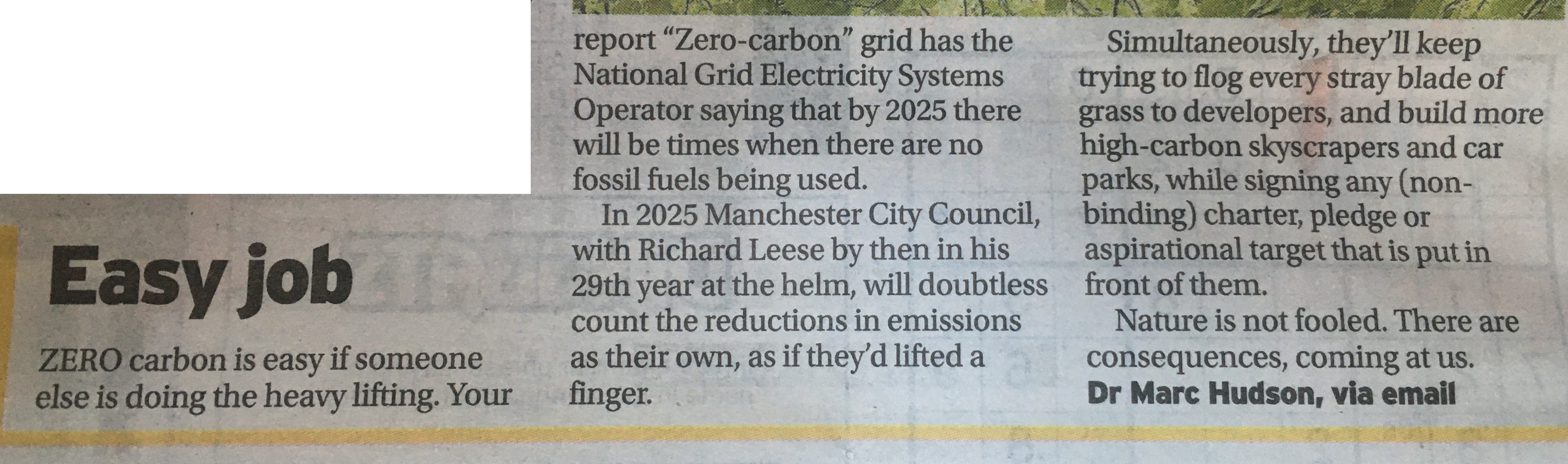
ZERO carbon is easy if someone else is doing the heavy lifting. Your report “Zero-carbon” grid (M.E.N. 15th June) has the National Grid Electricity Systems Operator saying that by 2025 there will be times when there are no fossil fuels being used.
In 2025 Manchester City Council, with Richard Leese by then in his 29th year at the helm, will doubtless count the reductions in emissions as their own, as if they’d lifted a finger.
Simultaneously,, they’ll keep trying to flog every stray blade of grass to developers, and build more high-carbon skyscrapers and car parks, while signing any (non-binding) charter, pledge or aspirational target that is put in front of them.
Nature is not fooled. There are consequences, coming at us.
My friend and colleague Chloe Jeffries has written a customarily brilliant blog post on the CEM website that explains what is not being discussed. but doesn’t actually answer the question “Why is there so little mention of the climate emergency in Manchester’s scrutiny committee work programmes?”
So I, in a personal capacity, (not as a core group member of CEM), am I’m going to offer an answer to the why question.
I think there are three words, hubris, obedience, and what links them is … fear.
Before we get there though, the first thing is to distinguish between the Council as a whole and those who actually run it. There are 96 Councillors, duly elected and a senior management team. It’s not as if they held a secret meeting, exhaustively mulled over the question “how should we respond to popular pressure for more scrutiny of climate decision-making and action?” and came to a reasoned and democratic decision to ignore it. That’s not how this works. What you have is a (very) small number of people who are currently able to exercise a veto against proposals for more scrutiny (and action) (1).
To understand what I’m talking about, you have to understand that in Manchester since 1996, we have one individual, Richard Leese who has been in charge and basically uncontested throughout (bar having to step aside briefly in 2010). Leese’s vision and modus operandi rule, and he is surrounded with flunkies and toadies, eyeing the chalice and circling the wagons (several metaphors were harmed in production of this blog post).
And his entire business model, if you want to call it that, is based on business, big business. It is not based on small and medium enterprises, it is based on attracting big business.
There has been, since 1990 a constant stream of sustainability and climate pronouncements, pledges, aspirational goals. But climate “policy” exists in Manchester insofar – and only insofar – as it’s part of the international marketing strategy. Above all else, Manchester must be “fit” for inward investment. Academics call this the “sustainability fix.”
Hubris
The hubris comes from Leese’s belief that like King Canute, he can hold back the tide. And you know what, he probably can, either for another few months, or even God help us for another four years (2). Leese’s actions indicate someone who believes that popular agitation for scrutiny and action don’t matter. It seems that he believes that he will suffer no reputational or more importantly, electoral consequences for continuing to do what he has done for the last 10-12 years, which is to bullshit, in the words of Hayley Stevenson..
And you know, he’s probably right. He’s an astute politician. He’s probably right. He should be wrong. If we lived in a better world he would be. You and I don’t live in that world.
Obedience
There are 95 other councillors: 1 Green, 1 Lib Dem and… 93 other Labour councillors, most of whom signed the emergency declaration in July 2019 (a handful were elected later). And most of those have since then, barely lifted a finger. And even those who have done something have not been treating this as an emergency.
And emergency is when you act like a scalded cat: nobody is acting like a scalded cat. So what are the different reasons? Could it be that some of them are really not bright enough to understand what the word emergency is? It has, maybe, too too many syllables for them?
Others are ambitious and know that if they step out of line, Richard will squash them like a bug. He’s done it before. And even now, in the (deep?) twilight of his career, he has that power.
And in between, you’ve got the ones who are well-meaning but feel now it’s not the right time, or they feel some visceral, weird, visceral loyalty to the tribe.
The reasons vary, but obedience is the final common pathway, as they say in the pathology business…
Cowards flinch, traitors sneer…
Fear
Besides the career-fear of the councillors (few of whom want to be known as awkward squad/disloyal/overly free-thinking), I think the fear is of what the legacy will be. If the assessment starts now, if people start looking at the actual carbon reductions (the Council’s are down to austerity, the city’s – such as they are – are due to the demise of coal as a power source), then not only might the Manchester model come under challenge, but the legacy will be tarnished. Those who created the conditions for the property boom, the prosperity for a few, don’t want to be remembered as the people who did nothing but spin on climate change. They do not want to be cursed by future generations. They want to keep writing the happy narrative.
No one’s willing to stand up to Richard and say, “mate, you’re yesterday’s man. Time to go.” Those with the powerful enough voice to do it are waiting for someone else to say it, because they know that – as per Heseltine – he who wields the knife seldom wears the crown.
So the impasse continues
Blatantly deliberate, deliberately blatant
The decision to prevent ANY scrutiny of climate needs to be seen in the broader context. It needs to be seen as another example of the (ab)use of absolute power. It’s a sequel (body count higher, deaths more elaborate) to Robert Nunney (new Green Councillor) being kept not just from Environment and Climate Scrutiny Committee, but his next two committees choices as well.
This is the same thing, a willingness to be brazen, to block everything that would add to scrutiny and dissident voices. In fact, it’s more than just brazen, it’s gleeful, revelling in power (while/perhaps because knowing it is much nearer its end than its beginning). It’s the equivalent of saying “yeah, of course we are screwing you. Because we can. Don’t like it? Get/stay used to it. Bwahahahahaha.”
My impression is that even if the work programmes of the Scrutiny Committees had been discussed in public (as they should have been), this would still be the case…
What is to be done?
While this horrific, contemptuous and contemptible veto is enraging, it’s also a sign to those that have worked so hard on getting better scrutiny (waves at CEM colleagues and allies) that they can be encouraged, even flattered. Those in charge are having to exercise this power nakedly now, because they know any concessions, any half-measures will weaken them further. Gone are the days of accommodation – they don’t feel safe enough to offer any olive branches any more… That’s something.
Elsewhere I’ve tried to talk about how we need to de-personalise this, to see it not as a case of one individual, but an ideology, folk wisdom now baked into the party and the bureaucracy. Despite everything I’ve done above…
We need to depersonalise this.
We need to think of this in terms of motivations rather than individual failings (though they are manifold and manifest). And the motivation is to protect a particular ideology, order of business (in every sense) and track record from scrutiny or challenge.
We need to think of this as a currently-successful veto being exercised by a small number of people. The motivations for that veto will persist, even when the personnel change, because the new personnel will be largely/equally wedded to the business-as-usual model.
What do we do? What we’ve always done: tell the truth, not because it will set us free. Not because it matters but because it’s the right thing.
But we have to do some serious stratgesing about raising the cost of exercising the veto, weakening the power of those who exercise the veto and strengthening (broadening, deepening) the size of the coalition(s) that understand the veto, its reasons, its weaknesses.
This is more than information-deficit model. This is more than tugging at the sleeves of a few councillors and begging them to be bolder or louder.
I do have some specific practical and implementable (I think) proposals for the coming months (and years), but I want to discuss them with folks first…
Meanwhile, remember –
There are veto actors.
They are protecting (as they see it) their power and their legacy.
The motivations for the veto are not hard to understand
These motivations will persist.
We need to act smart.
Footnote
(1) In some ways Manchester is like Australia – a large amount of agitation for better climate/environment policy, but a small self-interested group able to block any meaningful action. Fun times.
(2) Leese is up for re-election next year as a councillor in Crumpsall. So we might know in September, if he’s intending to stand down (but that would render him a lame duck). But of course, he could always call a last-minute resignation the day before election candidates are announced. This would not endear him to his Labour colleagues, of course… Alternatively, he may in fact, stand for reelection and serve (at least) another four years, or resign a year or two in. Speculation is as easy as it is pointless.
Our "leaders" are going to keep making empty promises. It makes them feel good. It gets the activists to act like zombie kittens. If you want to have some self-respect and perhaps make a difference (actual facts may vary), then find a functioning group that cares about your skills and knowledge - what you have, what you want.
One useful group might be www.climateemergencymanchester.net - you can email them on contact@climateemergencymanchester.net








 manchester climate monthly