Human emissions level off… So, no need to worry about #climate change?

Marc Hudson tries to put the “global human-caused carbon emissions not going up” news into context.

I don’t know if there are people out there who, on hearing from the International Energy Agency that for the first time outside of a recession, the amount of carbon dioxide we’ve tipped into the atmosphere (from burning fossil fuels for transport, electricity, heating) has ‘stalled’ and thought “our climate worries are over!”

Probably there are. Humans have limited cognitive capacity, and are always looking for rationalisations to allow them to keep doing what they’ve been doing.  And climate change leads itself both to rationalisations and misunderstanding of scales and speeds.

Great+Acceleration+2015+igbp+src+low+resLet’s take human emissions.  They’ve been growing dramatically over the last few decades, especially since the Great Acceleration of the 1950s, when everything started to grow dramatically.  In 1988 the scientific warnings of the previous 15 years or so burst onto the public stage. Since then our emissions have gone up and up pretty relentlessly, in a global perspective.  We built new infrastructure, we didn’t create and/or export the low carbon technologies for energy production, and that’s basically all that matters. Every year we pumped more carbon into the atmosphere than the previous year, unless there was a global recession (which means less economic activity, less energy use, less coal/oil/gas being burned).

But human emissions – a relatively small part of overall emissions from ‘natural’ causeskeelingcurvelions breathe out c02, trees die and decompose etc –  are only of interest, I would argue, because they increase the atmospheric concentration of carbon dioxide.   That is currently at the 400 parts per million (ppm) mark, up from 280 in 1780.  The possible ‘safe’ level is 350 ppm, thus the name for the organisation 350.org.

If you want to stop worrying about climate change, you can’t just look at human emissions, you have to look at concentrations.  And a ‘flat’ level of human emissions – especially at 2013-4 levels doesn’t lead to a stable amount of atmospheric C02.  It leads to increases, because the amount we produce is higher than what the planet absorbs from the atmosphere into a) vegetation (plants draw C02 out of the atmosphere and use it as building blocks for their growth, which is a pretty neat trick) and b) the oceans (but the oceans can only absorb so much, and the act of absorbing C02 is making the water more acidic (actually, “less alkaline”), with devastating consequences for anything that makes shells out of calcium, and anything that eats anything that makes shells out of calcium, and anything that…. well, it’s a web. You get the picture, I hope. Btw, those “carbon sinks” are weakening.

Higher atmospheric concentrations of C02 leads to more energy being trapped in the atmosphere (if you’re in bed under two thick duvets, you are going to get warmer than under 1 thick duvet. The analogy isn’t perfect, but it’ll do for now.)  And higher temperatures mean more extreme weather events, higher global temperatures (especially and sooner at the poles), and very probably more crop failures “etc”.

Look, if people want to grasp at straws, they will.  Death row inmates always hope for the last minute phone call from the governor granting clemency.  It usually doesn’t come.  People turn away from climate change not because those silly environmentalists have got their “messaging wrong” (If one more person says ‘MLK said “I have a dream” not “I have a nightmare’ I am going to explode).  People turn away because climate change is a terrifying and imminent nemesis about which we can no longer do very much. If we’d started properly in 1988 we’d have had some chance, perhaps even a quite good one.  Now?  Um….   If you need to believe that one year’s flat emissions is a harbinger of salvation, you go right ahead.

The metaphor:

The car has been accelerating towards the cliff for some time now. No matter what the pleas of the passengers, the driver has had his foot clamped down on the accelerator. Really the car should be slowing, giving itself time to turn. Faster and faster the car goes. But wait, “good news”!! For whatever reason (the fuel mix, the hand that a passenger has put out the window in order to change the car’s aerodynamics, something else), now the car isn’t going faster. It’s merely heading towards the cliff at the same fearsome speed it was going at a minute ago. So that’s much better…
Posted in Campaign Update, education, Energy, inspire, Signs of the Pending Ecological Debacle, Unsolicited advice | Leave a comment

Photo Competition on “Sustainability, Infrastructures and Social Change” #Manchester £100 first prize

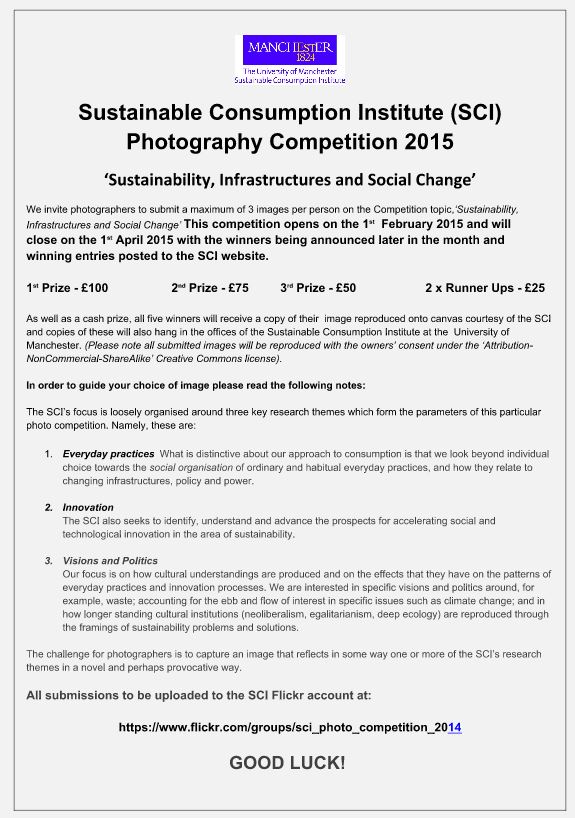
Sustainable Consumption Institute (SCI) Photography Competition 2015

sciphotocompetition‘Sustainability, Infrastructures and Social Change’

We invite photographers to submit a maximum of 3 images per person on the Competition topic,‘Sustainability, Infrastructures and Social Change’ This competition opens on the 1st February 2015 and will close on the 30th April 2015 with the winners being announced later in the month and winning entries posted to the SCI website.

1st Prize – £100 2nd Prize – £75 3rd Prize – £50 2 x Runner Ups – £25

As well as a cash prize, all five winners will receive a copy of their image reproduced onto canvas courtesy of the SCI and copies of these will also hang in the offices of the Sustainable Consumption Institute at the University of Manchester. (Please note all submitted images will be reproduced with the owners’ consent under the ‘Attribution NonCommercial-ShareAlike’ Creative Commons license).

In order to guide your choice of image please read the following notes:

The SCI’s focus is loosely organised around three key research themes which form the parameters of this particular photo competition. Namely, these are:

1. Everyday practices What is distinctive about our approach to consumption is that we look beyond individual choice towards the social organisation of ordinary and habitual everyday practices, and how they relate to changing infrastructures, policy and power.

2. Innovation

The SCI also seeks to identify, understand and advance the prospects for accelerating social and technological innovation in the area of sustainability.

3. Visions and Politics

Our focus is on how cultural understandings are produced and on the effects that they have on the patterns of everyday practices and innovation processes. We are interested in specific visions and politics around, for example, waste; accounting for the ebb and flow of interest in specific issues such as climate change; and in how longer standing cultural institutions (neoliberalism, egalitarianism, deep ecology) are reproduced through the framings of sustainability problems and solutions.

The challenge for photographers is to capture an image that reflects in some way one or more of the SCI’s research themes in a novel and perhaps provocative way.

All submissions to be uploaded to the SCI Flickr account at:

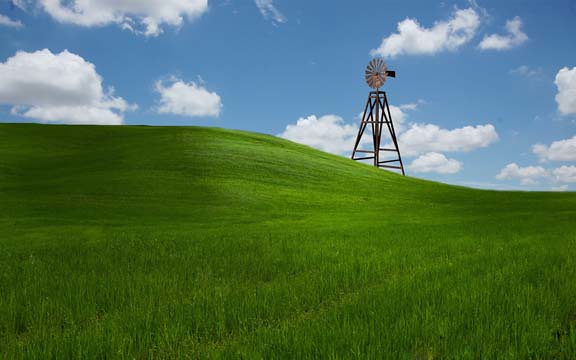
grass and windmill
Posted in academia, Competitions | Leave a comment

#Manchester academic on Global Science and the responsibility of intellectuals (video)

originally posted here.

Who knows what about how the world works (on a geophysical level?) How do they find it out and what should “we” do with that knowledge? These were some of the questions that Professor Noel Castree grappled with (successfully!) yesterday afternoon at a seminar entitled “Changing while standing still? Global change scientists and the politics of planetary stewardship.”

Here are the videos I took – first the lecture itself

Then the Q and A (the reason it blacks out when questioners are asking questions is that I wanted the best sound quality but I didn’t have permission to film folks – ergo lens cover as a kludge.)

He explained where terms like the “Anthropocene” (humans as accidental/deliberate planet-shapers [Which began in 1610, apparently]) have come from, and the rhetoric/reality of “tipping points.”  He name-checked the big academic collaborations (IGBP IHDP etc) that have been beavering away for 30 years)

He questioned the nature of the academic cultures and conventions that we labour within/under, and pointed to experiments with different ways of knowing and expressing (in genuine collaboration with peoples usually on the receiving and sharp end of the Western Gaze…)

Of course, by no means all academics are intellectuals (or vice versa) but another “NC” – Noam Chomsky -has an injunction that seems relevant; it is the responsibility of intellectuals to expose lies and tell the truth.

The lies exposed here would presumably (I am projecting/importing my own beliefs) be that
a) it is impossible to have infinite growth on a finite planet
b) it is impossible (forget ‘immoral’) to make other people/species/generations continue to pay the price for our own actions

The thorny question is surely of the audience to which the academics wish to speak truth. Speaking truth to “power” doesn’t seem to have done much good. The politicians ‘know’ that we are at or ‘beyond the limits’ (after all, the very first climate conference in the series that will have its 21st meeting in Paris was chaired by… Angela Merkel COP 1, (Berlin, 1995)

So who should academics be giving the benefit of their analysis? Business? Well, okay…. Social movements? They haven’t got a great track record so far. They are not, I opine here, the historical actor, at least in the UK. Maybe it’s not possible to be a public intellectual in a country where the “public” has retreated, where civil society is so brittle and thin.

Maybe all that is left to us is keep our eyes open as the debris piles skyward?

What was particularly good
a) A highly organised and fluently delivered presentation with the right amount of supporting evidence
b) He said he was going to speak for 50 minutes and he spoke for… 46! Nobody needed to drag him off the stage with a comedy hook. This, for a high status male academic, should not be notable or praise-worthy, but is.

What could have been better
The gender balance of the questions (and for the record, the male writer of this blog post asked a question that was later described as ‘academic’). There’s a really simple way to create a higher likelihood of questions from women and ‘other minorities’ (cough cough) that is not,imho, patronising or tokenistic. This (from the end of here)

“This tendency – of the sharp-elbowed/(over)-confident men (such as the author of this post, who asked the first question) needs to be dealt with the level of structure and habit, rather than individual self-abnegation. I dream of a world where chairs routinely say “before we go straight into a q and a, which will be dominated by the usual suspects, please turn to the person next to you/behind you and spend two minutes swapping names and impressions of the event. If you have a question, seek affirmation of it, and help in honing it. We’ll then have a show of hands, and I am going to prioritise gender and racial equity.” It’s a little thing, but it might be part of making a difference. #justsaying”

hm3-q-and-as

Oh, and since Australian Prime Minister Tony “remote communities is a subsidised lifestyle choice”  Abbott was mentioned, this cartoon from the wonderful David Pope has to get a run –
popeonremotecommmunities

Posted in academia, University of Manchester | Tagged , , | Leave a comment

Upcoming Event: Climate Comedy this Saturday, 14th March…

angelsonfire“Wonderful new technologies are coming on stream to help us create a new post-fossil fuel world. But the scientists are now unanimous. If we trigger global warming, to which we’re now very close, all this will go to naught. Our children will have terrible lives on a trashed planet.

“Let’s make the great effort and move beyond fossil fuels and create that better world for them. But we have to do it now.

NOW! NOW! NOW!

Climate Through Comedy. Support Angels on Fire at Gullivers, Oldham St Sat. March 14th 1-2 pm. Satire, songs, sketches, poems, climate information and discussion. £2

Posted in Upcoming Events | Leave a comment

Will Economy Scrutiny Committee stand up to elite contempt? #democracy #inaction in #Manchester

Tomorrow morning at 10am an important moment in Manchester’s environmental future will be decided, by the action – or inaction – of “backbench” councillors. Members of the Economy Scrutiny Committee, meeting in the Town Hall,can decide to insist that the Council’s Executive starts to take account of the environmental impacts of council decisions in every report.  Or they can decide that this key recommendation – and they themselves- can be safely ignored.

The explanation: every-so-often a “sub group” (also known as a “task and finish group”) of councillors gets together to examine a problem. It might be “drainage”, it might be “homelessness” or “Council communications.”  These groups meets 3 or 4 times, then report back to scrutiny committee(s). Recommendations are agreed, and the officers  then have to produce ‘implementation plans’ for the recommendations.

Eighteen months ago an “Environmental Sustainability Subgroup” was formed. Its last meeting was in January 2014. It came up with 17 recommendations. These were agreed by the Neighbourhoods and Economy Scrutiny Committees in March 2014. Officers were asked to go away and come up with a plan for turning the recommendations into reality.

In June they returned. And Economy Scrutiny members said “not good enough. Do it again.”

In September they returned again. And Economy Scrutiny members said “STILL not good enough. Do it again.”

This was EXTRAORDINARY. This stuff just does not happen in Manchester. One of the big bones of contention for the Economy Scrutiny Committee members was that the last recommendation, “that all Executive reports include consideration of the impact the decision has on the environment” had not been dealt with. The “plan” in September was the same unsatisfactory sentence as in June – “The recommendation is under consideration by Executive Members .”

Economy Scrutiny committee members asked why no Executive Member was present to give an explanation.  They were angry.

So were some citizens, who wrote an independent implementation plan for the 17 recommendations and tried to present it in October. They  were, of course, ignored (this is Manchester.) A cobbled-together rehash of the September “plan” was waved through by the Economy Scrutiny Committee instead.

And now we are here, in March 2015, a full year after the 17 recommendations were made. After three separate “implementation plans” have been put forward to the Economy Scrutiny Committee, it’s now time, apparently, for a “progress report.”

Ignore the other 16 items. Let’s focus on the one that would actually make a difference, that would actually force the decision makers of this city to acknowledge their decisions have real environmental consequences.

What is there under the “Progress to date by end- February 2015 ” column for recommendation 17. Really, do you have to ask?

recommendation

Will the members of the Economy Scrutiny Committee accept this blatant disregard for democracy, for their time and effort?  Will the chair of the Environmental Sustainability Subgroup for all but its last meeting, now the Executive Member for the Environment have an explanation that satisfies the committee?

Time will tell.

You can watch it live here.

Posted in Democratic deficit | Leave a comment

Manchester Council abolishes Environmental Strategy Team, takes 6 weeks to issue statement

Manchester City Council is abolishing its Environmental Strategy Team. On January 26th we asked for a statement from the council about this, specifically

“who will be overseeing the Council’s various environmental strategies such  as
a) the Biodiversity Action Plan, which expires in 2016.  Will there be another one?
b) the new “Green and Blue Strategy” – who will oversee that?
and, of course
c) the Low Carbon Plan with its 2020 targets.
Who will be producing reports that are presented to Scrutiny Committees and who will be producing the Quarterly progress reports on the Council’s Carbon Reduction Plan 2014-17”

On March 9th, a mere six weeks later, we received this;

Responsibility for coordinating the Council’s action on climate change and environmental strategy sits with the Policy, Partnerships and Research Service as has been the case since 2013. Over the last 2 years new functions have been incorporated with the Service and we are now looking to ensure that they are best aligned to support the Council’s priorities. Climate change and environmental strategy remain a Council priority and in addition we will be looking to provide more dedicated support for city wide Climate Change action lead by MACF.(2)

Rather like almost all Council communications on climate change – be they reports, press releases or responses to Freedom of Information Act requests – it is
a) overdue
b) evasive and fails to answer basic questions
c) full of vague blandishments and promises

This is how the Council thinks it will build credibility and trust.

Footnotes

(1) When the Council abolished the role of “Director of Environmental Strategy” in February 2013, we asked for a statement and got something remarkably similar

“much of the work we now do is either becoming more integrated with other areas of city policy or focused further afield, working with our colleague authorities across Greater Manchester to address the challenges and opportunities of climate change across the city region.”

It’s almost as if someone just sits there and cuts and pastes these ridiculous statements.

(2) That would be “Manchester A Certain Future” the group that has managed the magical task of becoming even MORE useless and even MORE invisible in the last 18 months.  Bravo!!

Posted in Climate Change Action Plan | Leave a comment

#Manchester Council to “scrutinise” #climate “action” “plan” tomorrow

Manchester Climate Monthly’s new reporter “A. Green” looks ahead to the meeting of the Neighbourhoods Scrutiny Committee (2pm Tuesday 10th March, Manchester Town Hall).

Tomorrow, the Neighbourhoods scrutiny committee of Manchester City Council will be discussing the report “Manchester City Council Climate Change Action Plan 2015/16 to 2017/18.” This report [already delayed by a month, Ed] contains a progress review of the targets set out in the council’s Climate Change Action Plan, describing which of these targets it is meeting and which it isn’t meeting.
Here are some of the goals which the report highlights that the council has failed to meet to date:

  • Goal: 60 Councillors undertaken carbon literacy training by end of 2014 Result: 25 to date.
  • Goal: report from the Food Board delivered by March 2015 Result: A report from the Food Board has been deferred to post-elections [when?] to allow for other priority items to be considered.
  • Goal: Deliver a programme of LED replacement of street lighting, 14/15 Replace 10% of residential units and all traffic route/city centre units Result: “Programme changed to commence delivery in 2015/16.”
  • Goal: Measure and monitor those members that have given up car ownership Result “Limited progress made regarding this action due to data not being captured specifically for Manchester.”

Looking at these failed targets does make me feel despondent and worried about the council’s ability to meet its ambitious and necessary targets to reduce C02 emissions. Many of the targets so far which have not been met seem very trivial (e.g. monitoring car ownership has had limited progress due to it not being done). However, there are larger targets a few short years away which are much more ambitious and it will remain to be seen if the lack of meeting the trivial targets will be followed by not meeting the more substantial targets in the years to come.

Posted in Climate Change Action Plan | Leave a comment

Climate Change – the way ahead? (beyond #Manchester)

Marc Hudson on the current state of play in the United Kingdom. From the march last Saturday, to a historical digression, to Industry and Government to Paris.

There was a climate march in London on the weekend, that the organisers said they were hoping would be the biggest ever in the UK. (For the record, it would therefore have to be bigger than the 50 to 60 thousand march in December 2009, before the Copenhagen climate talks. To get that number took all the big NGOs all year to the exclusion of pretty much everything else).

Their hopes were, predictably enough, dashed.

My rule of thumb is to double the police estimate and half the organisers’ estimate.  This tends to leave a narrow (and accurate?) band.

So, for this march we have the Daily Mail (a proxy for the police) using Press Association info, as saying 5000 and “Socialist Resistance” (insert Voltaire-about-the-Holy-Roman-Empire gag here) saying 25,000. So, somewhere from 10,000 to 12,500, probably.

climatemarchnumbersgame-page001

This tallies more or less with the “More than 15,000 protesters gathered in London on Saturday for a climate change march, which is to end with a rally outside Parliament.” (note the mixed tenses, which suggests the estimate is a very early – and perhaps exuberant – one)

Whoever wrote the headline “Tens of Thousands Take to the Streets of London Demanding Action on Climate Change” (Devlin, K. (2015) needs some remedial maths, basically.

Misplaced concreteness aside, the crucial thing is this – marches don’t build social movements. If they did, we would not be in this mess. We would have continued after December 2009 with a bigger and bigger social movement on climate change, wouldn’t we? We would have vibrant and threatening-to-the-powers-that-be social movements, bending the emissions curve down (and not just because we exported our factories).  We don’t.

Why? Because Marches. Don’t. Build. Social. Movements. But they do keep organisers busy and motivated, and the newspaper sellers happy. So that’s alright then.

Historical digression: Unstoppable green movements every 20 years

The first, mid-late 60s, upsurge, came thanks to raised awareness from books like Rachel Carson’s “Silent Spring,” local environmental concerns, (rivers catching fire, the 1969 Santa Barbara oil spill), and perhaps some folks getting sick of being lied to about Vietnam and beaten up by cops, and finding something less ‘hot’ to protest. Once legislation was passed (Clean Air Act), and institutions (like the Environmental Protection Agency) founded, the heat went out of the issue

The late 80s surge came on the back of Amazon deforestation and ozone hole discovery, and the novelty for most people (climate change had been a very specialist concern, but not completely unknown) of the climate threat as announced in period June – November 1988. Once the legislation (UNFCCC, 1992) was past, the heat went out of the issue

The latest surge came almost 20 years later. In the period 2006/7 there was a flurry of activity –the launch of the EU Emissions Trading Scheme, Al Gore’s “An Inconvenient Truth”, The Stern Review, the Climate Camps started, the Fourth Assessment Report of the IPCC, the first climate change election (Australia 2007) the “Bali Roadmap” for a global deal in Copenhagen in 2009.” It all disappeared like a fist when you open your palm in 2010.

So, we have three fairly distinct surges, roughly twenty years apart (enough time for a new generation to come up, not cynical about the possibilities of change in situations of ‘agentic deadlock‘). Each ends with legislation/failed efforts that fix the problem. And is followed by a lull when only the (fool?)hardy continue to agitate.

My suspicion, hopefully totally wrong, is that we are in the early stages of another lull. Of course history doesn’t repeat (though she rhymes), and perhaps the next few years will see a huge upsurge in concern and activity. But disasters and rapid warming (as predicted by Michael Mann, who has had a look at the Pacific Decadal Oscillation and doesn’t like what he sees) don’t automatically lead to political upsurges.

And remember, so far social movements on environment have only “succeeded” in creating legislation and formal institutions. They have not caused the same cultural shifts that we have seen around black civil rights, women’s liberation, gay rights (of course, those movements are partial as well, with many adherents justifiably depressed about the speed and direction of change).

(On community energy and the barriers it faces, see recent blog “Distributing power: Can the UK transition to a 50% distributed, low carbon electricity system?” by my colleague, Dr Victoria Johnson.)

Social movements are probably not the historical actor…

Industry

I am not a close observer, but seems to me only the off shore wind industry is gaining much traction in the much vaunted ‘green economy’. For other sectors the low carbon agenda seems to have just been tossed in the ‘too hard/not currently relevant to our customers’ basket. I hope I am wrong and that someone points out vibrant R and D etc.

There doesn’t seem to be the sort of public (either social movement/reputational risk/regulatory) pressure on them to bring new products to market and to disrupt their existing supply chains. And in the absence of pressure, you get (very) incremental changes, not radical ones…

They are not the historical actor.

Government

Not much to say here that isn’t obvious. Despite the (long forgotten and slightly embarrassing) promises of ‘greenest government ever’, it lacks motivation, momentum, credibility and capacity. This last one is crucial. Say we have Prime Minister Miliband in two months, governing with the support of three bolshy Green MPs. So what? The state – both national and even more obviously local – has been progressively hollowed out, its capacity to act strangled.

There is no trust in its constancy (Solar Feed-in-Tariffs), its ability to deliver without debacle (Green Deal and now Smart Meters.)

They are not the historical actor.

What is to be done?

At this point I’m supposed to mouth some pieties about Gramsci’s “optimism of the will”, or point to positive noises from Beijing ahead of Paris. Failing that, I’m supposed to say “batten down the hatches”. But that is a metaphor that works for storms which pass, not ones that grow and grow, propelling us irresistibly into the future to which our eyes are turned, while the pile of debris before us grows skyward.

Marc Hudson

See also

Of marches, emotathons and social movements

Screw Paris. No, seriously, screw Paris. A rant on #climate and the endtimes

Posted in Unsolicited advice | 2 Comments

Of marches, #emotathons and social movements #climate

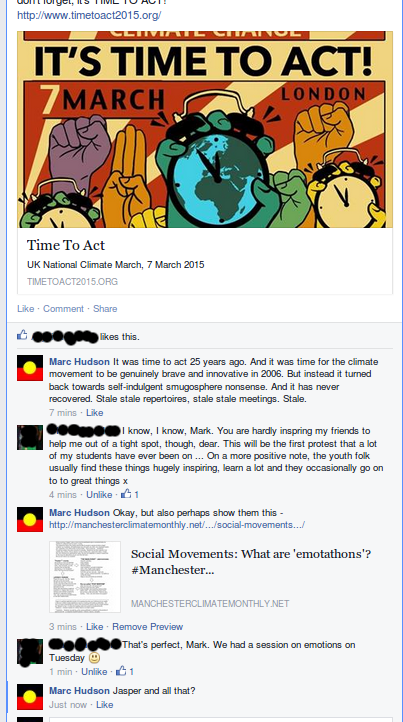
There’s a march happening today in London, on climate change. There was a time I’d have gone, “on principle.”  Now, pretty much on principle, I won’t.  Here’s why;

timetoact

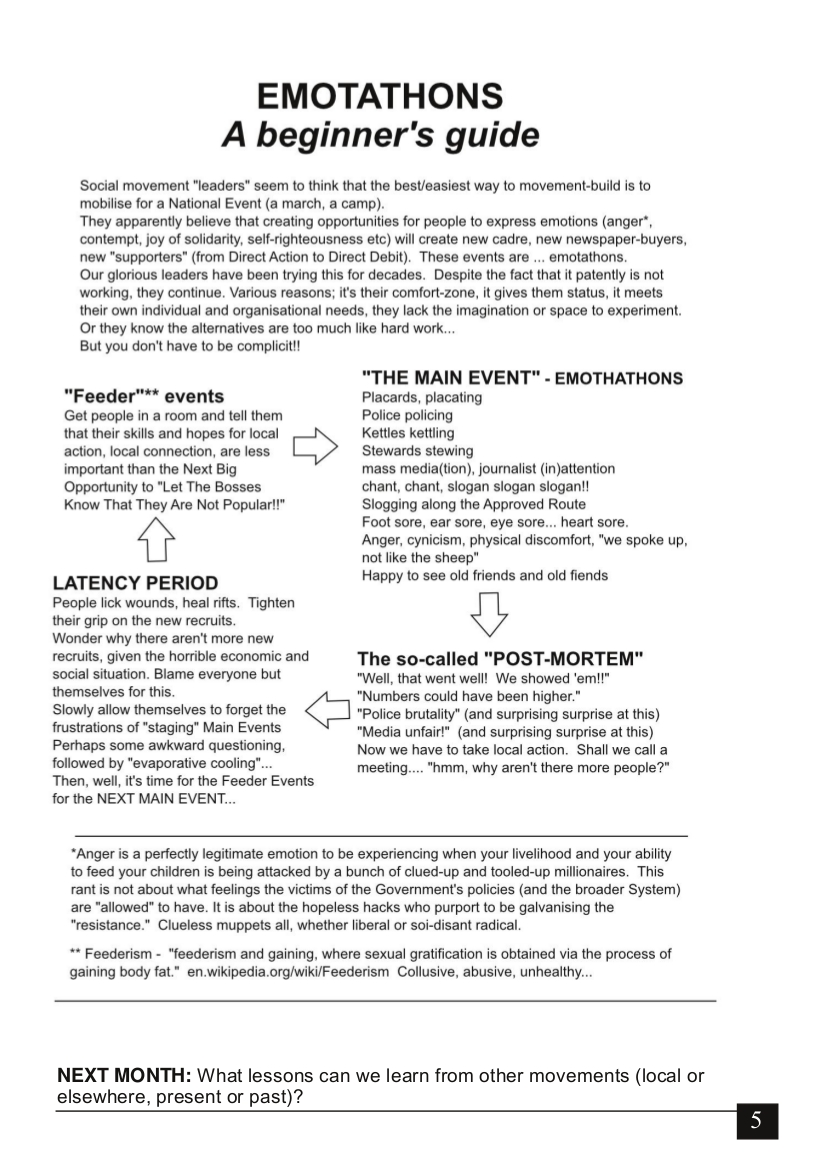
And emotathons?

mcmonthly August 2013page5

Oh, and screw Paris.

Posted in capacity building, inspire, Signs of the Pending Ecological Debacle, Unsolicited advice | 1 Comment

Upcoming event: Global change scientists and the politics of planetary stewardship #Manchester Weds 11th March

Geography_Research_Seminar_Noel_CastreeWednesday 11th March (location, HBS room 1.69/1.70, starting at 4pm):
* Prof. Noel Castree (Department of Geography, SEED, University of
Manchester)
* Changing while standing still? Global change scientists and the politics
of planetary stewardship
* Chaired by Sarah Marie Hall

Abstract:
Initiated by geoscientists, the growing debate about the Anthropocene,
‘planetary boundaries’ and global ‘tipping points’ is a significant
opportunity for geographers to reconfigure two things: one is the internal
relationships among their discipline’s many and varied perspectives
(topical, philosophical and methodological) on the real; the other the
discipline’s actual and perceived contributions to important issues in the
wider society.

Yet, without concerted effort and struggle, the opportunity is likely to
be used in a ‘safe’ and rather predictable way by only a sub-set of
human-environment geographers. The socio-environmental challenges of a
post-Holocene world invite old narratives about Geography’s holistic
intellectual contributions to be reprised in the present. These narratives
speak well to many geoscientists, social scientists, and decision-makers
outside Geography. But they risk perpetuating an emaciated conception of
reality wherein Earth systems and social systems are seen as knowable and
manageable if the ‘right’ ensemble of expertise is achieved. I argue that
we need to get out from under the shadow of these long-standing
narratives. Using suggestive examples, I make the case for forms of
inquiry across the human-physical ‘divide’ that eschew ontological
monism and which serve to reveal the many legitimate cognitive, moral and
aesthetic framings of Earth present and future. Geography is unusual in
that the potential for these forms of inquiry to become normalised is high
compared to other subjects. This potential will only be taken advantage of
if certain human-environment geographers unaccustomed to engaging the
world of geoscience and environmental policy change their modus operandi.

Biography: http://en.wikipedia.org/wiki/Noel_Castree

Posted in academia, University of Manchester, Upcoming Events | Tagged | Leave a comment