#Manchester City Council promises new Local Nature Reserve. Breaks promise.

In July 2013 Manchester City Council released  a “climate change action(sic) plan.”  It included this item –

4.57  The designation of one new Local Nature Reserve and one new Site of Biological Importance.

In 2014 the council refused to release a report on what it had and had not achieved.  So citizens used the Freedom of Information Act, repeatedly.  And…

Question:  With regard to 4.57 of the Council’s Annual Carbon Reduction Plan 2013-14, please supply the names and locations of any local nature reserves that have been designated in the period July 2013 to 2014, and please supply the names and locations of any Sites of Biological Importance that have been designated in the period July 2013 to July 2014

Answer from MCC : “Park Wood in Peel Hall Wythenshawe was recognised by MCC as an SBI in Manchester between July 2013 and July 2014.”

Posted in Biodiversity, Manchester City Council | Leave a comment

Council fails to complete its low carbon #climate plans, dodges question

Manchester City Council used to make its climate promises in July. In 2013 it promised, among many other things, there would be a “refresh of Low Carbon Plans, both top-down, at a Directorate level, and bottom-up, from an individual team level.”   Sounds great, doesn’t it. And is also a tacit admission that things haven’t gone well (why else would a ‘refresh’ be needed?)

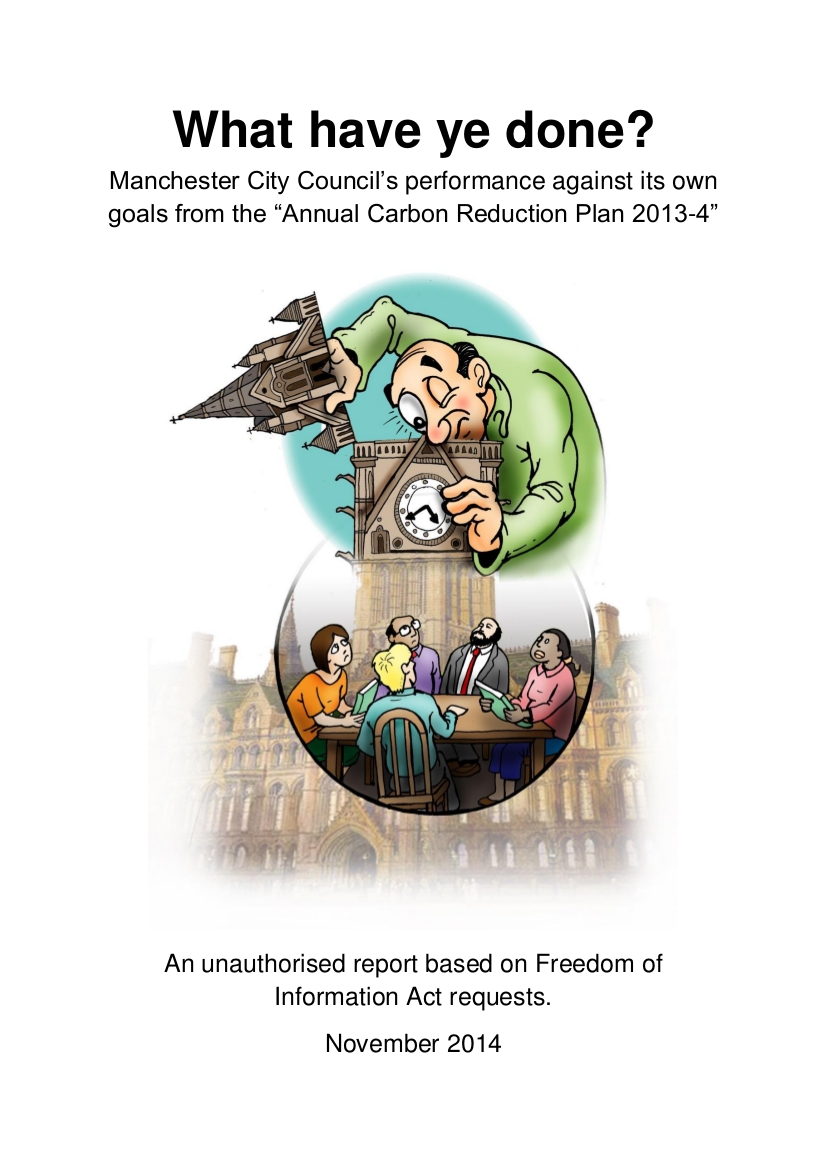
The council whathaveyedoneinfamously DIDN’T report in July 2014 about this promise, and 60 or so others. Citizens then submitted Freedom of Information Act requests and a report “What Have Ye Done?” was produced, which showed that on many promises the council hadn’t even collected the data to see if it was on target, and on many others it had simply not done what it said it would (5 events during Climate Week 2014, for example.)

A follow-up series of questions has been asked about a few remaining items. After the usual bureaucratic delay, answers were received.  Below is indicative of the style of the Council’s answers.

“8. With regard to 4.78 of the Council’s Annual Carbon Reduction Plan 2013-14, was there “a refresh of Low Carbon Plans, both top-down, at a Directorate level, and bottom-up, from an individual team level.”  If not, why not.  If so, where can they be found on the Council’s website.

Directorate and Service level plans will include actions to reduce carbon emissions where relevant. As part of the Council’s roll out of Carbon Literacy training to staff some teams developed group as well as individual actions.”

The rule/habit seems to be

a) avoid admitting, where possible, that actions have not, in fact, taken place,
b) make vague promises about future action.

And this is how the Council intends to build the credibility and learning that it will need to help us all cope with the horrors to come.  How do the people responsible for this, and the people who could change it, sleep?  How?

Posted in Democratic deficit, Manchester City Council | Leave a comment

#Manchester Scrutiny Week – On #climate – why flog a brain-dead horse?

So below you will find a list of the agendas of the so-called “Scrutiny” committees of Manchester City Council.  These committees, made up of ‘back-bench’ councillors (all Labour, of course) are supposed to keep tabs on Manchester City Council’s executive (the 9 member group made up of councillors) and top bureaucrats.  They largely don’t. They act either as a cringe-worthy rubber-stamp or a toothless watchdog.  Thanks to careerism, complacency and contempt-from-above, they are a hollow simulacrum of what democracy and accountability are supposed to be about. This has had, and will continue to have, awful consequences for the people of Manchester, and for future generations.

Specifically on climate change, we have a series of broken promises, so-called “consultations” where the claim that “hundreds” of people have been consulted turns out to be flat wrong.  We have a target of getting 60 of the 96 councillors carbon literate in 2014 versus an achievement of… 23.  We have endless good ideas put forward by the less powerful simply ignored, probably because if the Council had to start listening to other people’s good ideas, they’d quickly lose their ability to keep awkward truths off the agenda. And that might spoil the nice ‘open for Business’ story.   Will it get better or worse with DevoManc?  Well, given the habits of thought and action of BOTH our political class and the so-called oppositional activists, it will get much much worse. Before it gets… worse.

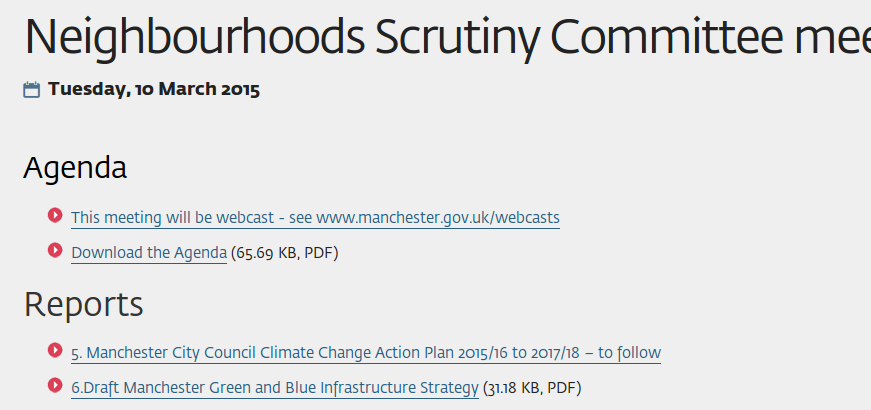
neighbourhoodsagendaThere was a time Manchester Climate Monthly would have closely reported on the Council’s climate plans.   Below are some simple facts that explains why we won’t bother any more.  (And we wouldn’t be able to, anyway, because even after it is legally obliged to put up the report it has, as of 0925 on Thursday 5th March, STILL NOT PUT UP THE PLAN!!!  (And the £30k non-consulted Green Infrastructure Plan is still “draft”!!!)) [Update March 5th, 12.11. I sent this post to the (ir)Relevant Authorities. And, as if by magic, the plan is now up.  Who says democracy doesn’t work…]

a) Moving to a “3 year plan” with annual updates was supposed to streamline things. Well, the report on 2014-5 was supposed to be presented in February. But it’s happening in March. This sort of thing will become routine, now that the Environmental Strategy Team is being abolished

b) Quarterly progress reports were promised in February 2014. They have not happened. When an emissions statement prised out of the Council in November last year showed that the Council’s emissions are going up not down, the response of the Neighbourhoods “Scrutiny” Committee, was … utter silence.

c) The Executive Member for the Environment said she would set up a blog to keep people informed. She hasn’t done that.

The list could go on and on and on. Basically,

a) Taking these empty words seriously lends them credibility and dignity they have never earned

b) the Council has not the desire or the ability to deliver on its existing promises.  There is no point monitoring those promises, and certainly no point in trying to get it to make new ones. Why flog a brain-dead horse?


Tuesday 10th March

Young People and Children’s

10am The Scrutiny Committee Room, Level 2, Town Hall Extension

Agenda

Reports

Neighbourhoods

2pm The Scrutiny Committee Room, Level 2, Town Hall Extension

Agenda

Reports

Wednesday 11th March

Economy

10am The Scrutiny Committee Room, Level 2, Town Hall Extension

Agenda

Reports

Communities

2pm The Scrutiny Committee Room, Level 2, Town Hall Extension

Agenda

Reports

Thursday 12th March

Finance

10am The Scrutiny Committee Room, Level 2, Town Hall Extension

Agenda

Reports

Health

2pm The Scrutiny Committee Room, Level 2, Town Hall Extension

Agenda

Reports

Posted in Democratic deficit, Manchester City Council | 2 Comments

Video of Prof Matthew Paterson’s “Cultural Politics of #Climate” seminar in #Manchester

Professor Matthew Paterson gave a seminar on “the Cultural Politics” of Climate Change at the University of Manchester. See also this interview conducted via email before the event.
This was part of the Sustainable Consumption Institute‘s external seminar series.

Here is the video (which was static, while the speaker was not!)

And here is the Q and A

Posted in academia, youtubes | Tagged , | Leave a comment

“How long have we got” – an attempt at an answer

So this appeared on a facebook thread –

I feel cheated.
I adapted my lifestyle to make it as low carbon as I could. I voted for parties who would take action on climate change. I even directly campaigned against polluters.
And now the methane gas fields in Serbia are thawing. I was told this is the point of no return.
Does anyone know how quickly we will see things go catastrophically bad? And what does that look like?

and I replied

There are multiple overlapping points of no return – the Arctic death spiral (with albedo loss as a positive feedback loop), the loss of the Amazon etc. Anyone who tells you when it will go catastrophically bad is mistaken. There are better scenarios for HOW (agricultural collapse, war, pandemics etc). In terms of how quickly – it could slowly ratchet out over 20 to 50 years, or it could all go tits up in the space of one to four, with overlapping and mutually reinforcing crap. Remember, it’s not the biophysical processes on their own that matter, but the impact they have on human physical and psychological/economic/military/political infrastructures.
If you’d told someone in Vienna in early 1914 that 5 years on the Austro-Hungarian and Ottoman empires would be gone and the commies in charge of formerly-Tsarist Russia, they would have had trouble believing you. In terms of speed. Well, also think Western Europe in 1346 and 1351. About a third of the population dead.
Most of all, remember that what matters is not just the physical processes, but the sense of hopelessness and despair that will soon be upon us, when the scientists shrug their shoulders and say “defo 4 degrees by 2050”. Who will save for a pension? Who will slog for years to become a neurosurgeon etc?

Posted in capacity building, education | 3 Comments

Upcoming Event: Education for Sustainability Forum/Networking event, Fri 27th Feb

“Just to remind folk that the Greater Manchester ESD Forum is holding a hustings on education for sustainability this Friday 27th Feb, 2.30 – 5pm at Bridge 5 Mill. The Conservatives, Labour and the Greens are coming, so bring your questions, ideas, a Lib Dem maybe, some patience and a sprinkling of good humour to sooth the tensions of political debate! The session is also a big networking opportunity so be prepared to inform everyone of you and your organisation’s plans for the new financial year. Looking forward to seeing you there.”

Posted in Upcoming Events | Leave a comment

Steady State #Manchester on that “Future Cities Farce… sorry FORUM”

There was a truly diabolical wrist-slasher of an event at the beginning of last week called a “Future Cities Forum”. It was the kind of forum where seven white people (six men and one woman) stand at the front and tell you their ‘wisdom’, followed by ‘questions’ from the floor. Nobody was so rude as to mention Manchester’s utter failure to hit any of its self-proclaimed targets on emissions reductions or the creation of a ‘low carbon culture.’ That kind of forum. MCFly blogged it, for the lulz. Here below is a blog about the same (non-)event by Steady State Manchester.

A new approach for our cities?

IMG_3595

I attended a two hour seminar on Future Climate organised by the North West Climate Change Partnership It was a rather depressing affair since it seems quite clear that we are rushing headlong towards a climate catastrophe and all the speakers could really do was map the dimensions of our collective global failure to avert it, with an excess of giant powerpoint data slides.

Perhaps the most coherent of the presentations was from Jon Lovell who (rather surprisingly?) works for Deloitte, one of the big accountancy/consultancy firms. I’m going to pick up from his last point which was that a “new paradigm” is needed for the “urban-globalisation nexus”.

What Jon was referring to was the well documented urban trend towards living in cities, and the growth of the population of those cities, many of them truly enormous. The map of the growth to come (much of it in Asia) was but one of the alarming pictures presented.

In the last week it has again become clear that a 2 degree rise in global temperature is pretty much a certainty, and something that will be upon us within 20 years. The trend will continue because the predatory economy continues to snatch hydrocarbons from the ground and pump out polluting greenhouse gases. The optimism of the renewables lobby, the circular economy people, and the green growth Mafia is belied by a sober analysis of the dematerialisation problem: the only solution is to reduce energy use radically, and quickly. Renewables and recycling have their part to play, but the need for a complete paradigm shift is inescapable. Meanwhile, the allegedly 14th most sustainable city, Manchester (yes we are in trouble globally!), continues with its aviation dependency, and its obsession with China’s growth, as if that will secure a liveable future for our citizens, or respond to the massive social deprivation of the city’s neighbourhoods. The contradiction was noted in passing by Jon.

But what would a paradigm shift look like?

We have set that out in some detail in our interventions In Place of Growth and The Viable Economy. We are not alone, and groups like Localise West Midlands, and the more strategic Transition Towns groups, are presenting similar arguments. But are we tinkering at the edges when what’s needed is a massive shift in the way we live, and with little time to make it? With each day that passes, carbon emissions accumulate in the atmosphere, and they’ll be there for very many years to come.

Some of the best thinking on the paradigm shift is coming from the Degrowth movement and their recent book Degrowth: A Vocabulary for a New Era explains this in a series of short essays, a kind of keywords for ecological, social and economic justice. Degrowth rejects the illusion of growth – effectively changing the conversation , while at the same time (unlike North American Steady State Economics, which which it has an affinity) re-politicising the public debate that has been captured, colonised by economic rationalism (efficiency, productivity, growth….). It is both a scholarly discipline with its academic economists and social scientists, but it is also a social movement that connects to people’s grass-roots responses to the economic and ecological crisis.

Degrowth looks very much like the new paradigm that we need to respond to the urban-globalisation nexus. It doesn’t have all the answers, but then what approach does? It is our best bet, as a dynamic and evolving approach to finding a path through the increasingly stony terrain ahead of us.

Mark H Burton

Steady State Manchester collective

Posted in Event reports | Leave a comment

#Manchester Council gives MMU £13k for carbon literacy training – with no contract!

Manchester City Council has given a “contract” worth £12,900 for carbon literacy training … without going to the bother of a written contract!!  Against a target of 60 councillors ‘carbon literate’ by the end of 2014, the actual number was… 23.

Responding to a Freedom of Information Act request from Manchester Climate Monthly, the council stated

In your request you asked for the following information:

 “I am requesting a copy of the contract between MMU and the Council  for the delivery of carbon literacy training.”

I can confirm that the Council do not hold the information you have requested.  We followed our standard procurement procedures. Our contract procurement rules do not require the Council to have formal a written contract for services procured under £30,000.
(emphasis added, word order jumble in original)

MCFly has sent the following Freedom of Information Act Request.

Thank you for the reply to Request for Information – Reference Number: NBH/9T9FEE (contract with MMU for delivery of carbon literacy training)

I find myself mildly surprised that the Council has spent £13,000 pounds without agreeing precisely what it will get for its (as in the public’s) money. Perhaps the confusion lies in the term ‘contract’ which may have some specific legal standing of which I was previously unaware.

Consulting my mental Roget’s, I’ve come up with the phrase ‘agreement to deliver services’. This would include performance parameters, dates by which time services would be delivered, ‘break clauses’ for what would happen if performance were not satisfactory. That sort of thing.

On that basis, please regard the following questions as under the Freedom of Information Act 2000.

  • Was there a formal tender process for the carbon literacy training ‘agreement to deliver services’?
  • If so, when was this process undertaken, and which other organisations bid for the ‘agreement to deliver services’ besides the “contracted” organisation, MMU.
  • If there was not a formal tender process, who (which officers and members) decided that the Council would award almost 13 thousand pounds to MMU?
  • I am requesting the internal correspondence relating to this matter, and the correspondence between the Council and MMU related to the awarding of the ‘agreement to deliver services’.
  • I am requesting the communications (including but not limited to the minutes of meetings and emails) between the Council and MMU with relation to the delivery of the actions related to this 13 thousand pound ‘agreement to deliver services’ from the 1st December 2014 to the present.

MCFly says:

Wow. After all these years, I continue to be surprised by the behaviour and ‘performance’ of this Council.  Given the hard times the Council has fallen upon, it’s willing to dish out £13,000 without anything in writing? For real?

Posted in Democratic deficit, Manchester City Council | Tagged | 3 Comments

#Manchester Council’s feeble spin machine splutters and coughs on #climate

Manchester City Council set a target (after being prodded by activists) of 60 of its 96 Councillors being “carbon literate” by the end of 2014. They awarded a £13k contract to Manchester Metropolitan University to deliver this training (which was also aimed at council employees)

And the outcome?  Do I hear 60?  50?  40?  Going once, going twice… 23. Fifty of the 96 councillors had by December 31st done neither the online nor the face-to-face component.  We asked for names, and were ignored.  That’s “democracy.”

And the report about the successes and failures of carbon literacy?  Didn’t happen.

So, we asked the Press team for a statement about the missed targets.  It’s printed below in full. It’s the sort of thing that would make the North Korean Propagandists Association blush and squirm with shame.

Cllr Kate Chappell, Manchester City Council’s executive member for the environment, said: “This is a unique and high quality package which has been developed specifically for the City Council, and I’m glad that so many members have taken time out of their busy schedules to complete the full day’s training required and to learn more about how they can work with residents and partners to help people live more environmentally friendly, low carbon lifestyles.

“Many of those members who have completed the training will now begin working in their communities to pass on the lessons they have learned to residents.”

Two things

a) this is why MCFly rarely bothers to seek comment from the Council.  It always takes weeks, and it is never worth the wait

b) why do they persist in shredding the shreds of their credibility?  Who do they think they are fooling?  Really?

Posted in Climate Change Action Plan, Democratic deficit, Manchester City Council | Leave a comment

Interview with Professor Matthew Paterson, ahead of “cultural politics of #climate”, Thurs 19th Feb

On Thursday 19th February, from 2pm, Professor Matthew Paterson is giving a seminar at University of Manchester on the Cultural Politics of Climate Change. It is open to members of the public.  It will be held in Room 10.05 Harold Hankins building  (above the Precinct).  Ahead of that, Professor Paterson has kindly answered some questions from MCFly.
patersonCould you tell us a little about your PhD research, which looked at the events and manoeuvres surrounding the early days of the international negotiations on climate change action
I was interested in exploring the different ways we might explain these negotiations, from classical approaches to international politics “realism vs liberal institutionalism” to political economy approaches based on Marxism, to newer approaches (within IR) based on poststructuralism in particular. I’ve always been a “theory as toolkit” person, not really convinced that in the social sciences we can arrive at the “one true” theoretical approach, or strictly “test” theories, so the aim was really to see what each approach might tell us about the dynamics of the negotiations. That said, I did end up arguing that we need to understand them in terms of (a) the political economic forces (corporate power, globalisation, neoliberalism, etc) and (b) the processes of constructing identities and thus interests that are ongoing and in many ways radically called into question by climate change, which produce novel and sometimes surprising forms of identity and political alliances. In the early FCCC negotiations, and I think in many ways still today, many state decision-makers don’t really know what their “interests” are in relation to climate change – they are a complex mix of pressure from vested energy interests, senses of what voters will punish them for (which could be high energy prices, but could be repeated floods or storms if they are connected to climate change in the popular imagination), desire to create new sources of economic growth (carbon markets, renewable energy, etc), confusion about how to think about the relationship between short-term action and its long term effects, and so on.
What are your thoughts/expectations for the Paris negotiations at the end of this year – do you think it will be some sort of lowest common denominator deal?
Yes, is the short answer. Perhaps a qualified yes. In Kyoto, we effectively started with a lowest common denominator where industrialised countries said what their target would be, and then there was a bit of looking each other in the face late in the day, which produced in effect some countries (the US, Canada, for example) making their targets more ambitious than they had been, in return for other countries (the EU, notably) accepting the carbon markets that the US had led the push for. I think we’ll get something similar to this out of the “intended nationally determined contributions” process that is underway at the moment in the run-up to Paris. Some countries will make their targets a little stronger as they’re forced to look others in the face. Who will blink is not clear – but for example Canada has an election scheduled for 6 weeks prior to Paris – so a shift in that country, currently competing with Australia for the dubious distinction of worst performing industrialised country, could be interesting in terms of shifting the dynamic a little.
To me the key thing is how successfully negotiators manage to do joined-up thinking about how the FCCC relates to a whole host of ‘transnational climate change governance’ initiatives that we explored in our book on the subject (http://www.cambridge.org/gb/academic/subjects/earth-and-environmental-science/environmental-policy-economics-and-law/transnational-climate-change-governance). If they could work out how FCCC rules or initiatives would stimulate better activity in this field there could be all sorts of interesting developments I think. They have already started to realise the potential, and have a database now on what they call “international cooperative initiatives”, but they could be more strategic in how they attempt to use them to stimulate investment and innovation in various contexts.
You’re giving a talk about the “cultural politics” of climate change on Thursday.  What do you mean by that phrase, and (as briefly as you like!) what will you be saying on Thursday?
I use the term principally to refer to (a) the governance and (b) the contestation over the subjectivities associated with daily practices that produce carbon emissions. So two parts of the meaning of politics are involved – the question of authority and governing, and the question of conflict. The main idea is to use this to explore sites at which either people or organisations are attempting self-consciously to govern subjectivities in a low-carbon direction, or where pre-existing affective attachments to particular practices generate political conflict and resistance against attempts to shift to low-carbon practices. A good example of the former is the attempt to frame people’s relationship to climate change via a dieting metaphor, as in the notion of ‘carbon dieting’. A good example of the latter is when cities, especially but not only in the north american context where sprawl is a key part of the problem, attempt to increase urban density to generate shifts to public transport, cycling, etc., which generates lots of micro-conflicts over infill development. I’ll talk about both of these examples on Thursday.
Are there things that academics could do to make their (climate change) work more accessible/directly relevant to “civil society” and social movements. What are the barriers?
I admit I don’t think I’ve been as good at this as I’d like to be. So I hesitate to pronounce on the subject. It seems to me the people who do it best are those who do it ‘from the inside’ – being involved in campaigns, etc., doing participant observation, etc. This gives them the ability to talk more effectively across the two languages of academia and activism.
Anything else you’d like to say
Looking forward to meeting you and the talk on Thursday!
Posted in academia, Upcoming Events | Tagged | 1 Comment