We are encouraged to think about systemic problems as ones of individual choice, good/bad behaviour.
In part that is just how we are “wired”. We can see individuals, we can witness threatening behaviours. The structures and landscapes on which these behaviours happen, are encouraged, shaped etc, are much harder to see.
So, racism is reduced to bad manners or ignorance, instead of what is it, a systemic effort to extract value and subjugate.
In part though, it’s a deliberate effort by our Lords and Masters to prevent what is being done being named as that, to prevent us thinking “systemically”, “holistically” or in “joined-up” ways (whatever the buzzword du jour is – I admit I’ve stopped keeping track).
I’m minded of this because I had a conversation recently with someone whom I have a lot of respect for. We however, find each other quite frustrating.
The nub (or one of the nubs?) is this. This person knows many councillors better than I do, has long experience with them. This person I think thinks that what matters most is who the individuals on a committee are.
I think that who is on the committee matters, (I am not, despite doubts to the contrary, a complete moron), but what matters more is the structure and especially the remit.
And this comes back to how big the remit is. And the remit of the old Environment committee, AND the new one is too big.
Climate Emergency Manchester fought the good fight for a dedicated climate committee, so that proper time and energy could be devoted to climate change. What we got, instead, because of council cowardice and unwillingness to be scrutinised, unwillingness to have difficult conversations with “partners” was the lightest possible rebranding of an existing committee (see this letter).
It doesn’t matter how individually “good” the councillors are, how determined they are, how dutiful and diligent they are, if the agenda is packed with a whole lot of OTHER items such as fly-tipping, pot holes, waste and recycling etc. Those ARE important issues, and councillors get the majority of their complaints about these.
But time and energy are finite, and nothing has been solved by the Council’s cynical rebranding. An enormous amount of dispiriting work awaits climate activists in Manchester.
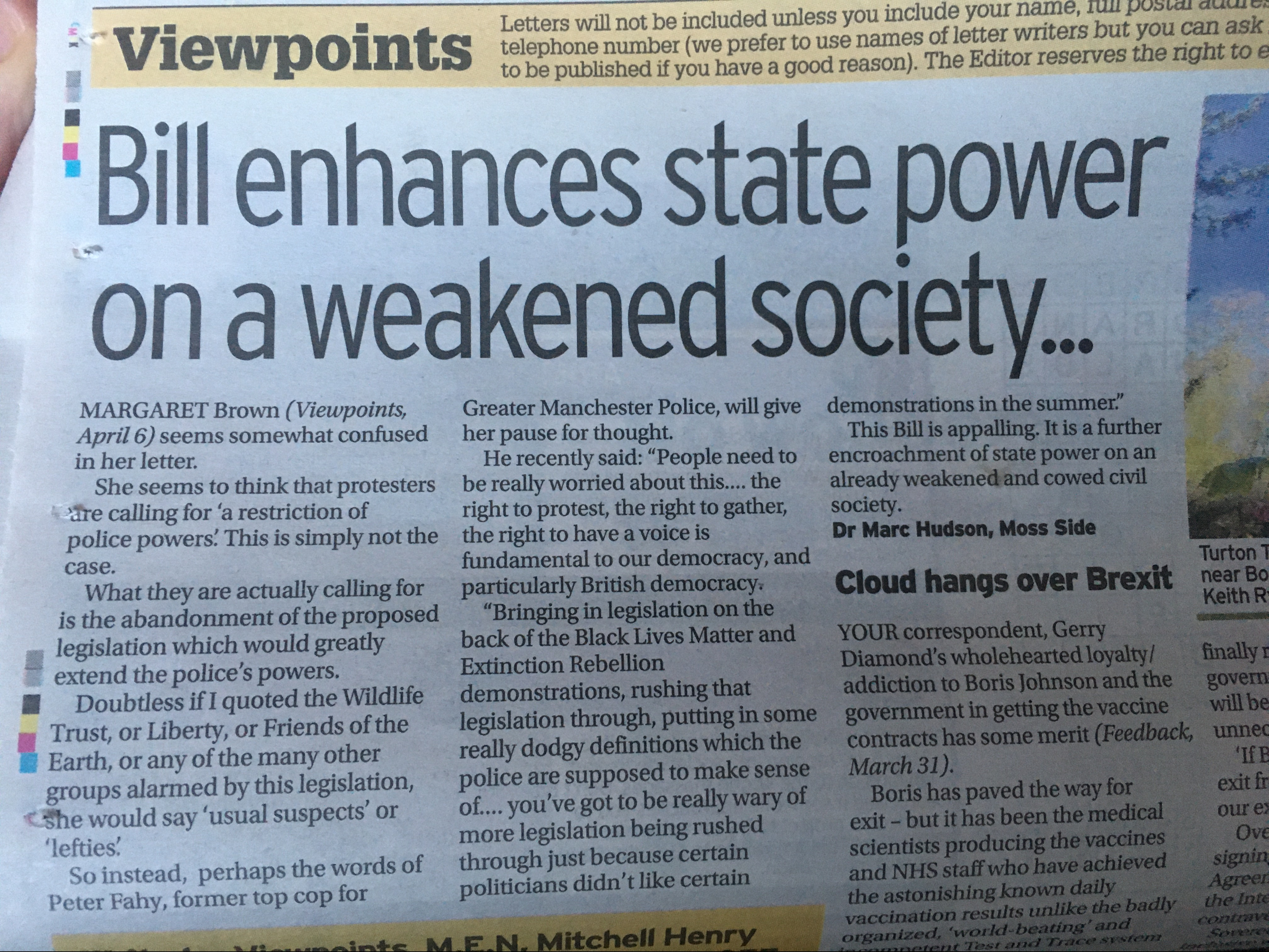
Margaret Brown (Viewpoints, 6 April) seems somewhat confused in her letter.
She seems to think that protestors are calling for “a restriction of police powers”. This is simply not the case.
What they are actually calling for is the abandonment of the proposed legislation which would greatly extend the police’s powers.
Doubtless if I quoted the Wildlife Trust, or Liberty, or Friends of the Earth, or any of the many other groups alarmed by this legislation, she would say “usual suspects” or “lefites.” So instead, perhaps the words of Peter Fahy, former top cop for Greater Manchester Police will give her pause for thought.
He recently said”“People need to be really worried about this…. the right to protest, the right to gather, the right to have a voice is fundamental to our democracy, and particularly British democracy. Bringing in legislation on the back of the Black Lives Matter and Extinction Rebellion demonstrations, rushing that legislation through, putting in some really dodgy definitions which the police are supposed to make sense of…. you’ve got to be really wary of more legislation being rushed through just because certain politicians didn’t like certain demonstrations in the summer.”
This Bill is appalling. It is a further encroachment of state power on an already weakened and cowed civil society.
Manchester City Council has failed, for the second time in as many years, to find someone to lead the community interest company it grandly calls a climate change “Agency”
As reported here in February 2020, Manchester City Council failed to find a suitable candidate despite a national advertising campaign in late 2019 and into early 2020.
So late last year they re-advertised. And then had to extend the deadline.
In March 2021 we were told that there had in fact been interviews for the job (and on the panel – the Executive Member for the Environment, the Deputy Chief Executive of Manchester City Council the head of “Creative Concern” the head of MACC) and that someone had been offered the job.
Everything would be announced. Oh yes. Everything would be just fine.
We were somewhat surprised by the deafening silence, around this, so we asked “what’s up?”
And we were told
“The Director role was offered to the preferred candidate and they were expected to start in the role in mid April. During the final stages of pre-employment checks the candidate made the decision to decline the offer. A new process will now be developed to readvertise and fill the role.”
Gosh, it’s great that climate change isn’t, you know, an emergency or anything.
And it’s great that the Council is so very very competent.
This blog post tries to answer two key questions – what is going on, and what do “we” do next. It’s published on Manchester Climate Monthly because it reflects only the views of Marc Hudson, one member of the core group of CEM. (1)
What is going on? Why?
For over a year Climate Emergency Manchester has been trying to get Manchester City Council to take climate change seriously, as more than just a cynical photo op.
CEM set up a petition on the Council’s horrendously clunky website (btw petitions on sites like change.org or avaaz, while easier to sign, have precisely zero legal standing).
CEM wanted the Council to match its fine words (e.g. a unanimous declaration of a climate emergency back in July 2019) with regular scrutiny of climate change. Up till now, the climate issue has been discussed – haphazardly – once or twice a year, and usually with a flurry of confusing and diverting statistics and graphs.
Despite a pandemic, CEM managed to get around 1700 signatures – a load on the awful Council website, which seems designed to actively discourage people – and another load from socially-distanced collecting.
The Council, predictably, is ignoring this and going for the smallest possible action, a tokenistic re-branding of existing scrutiny arrangements. The 98 per cent of the city’s emissions that are not the Council’s own emissions will continue to be ignored. Of course they will.
This leads to the obvious question of why is this so?
In my view, it’s as they say in the movies – “follow the money.” NOT in the sense of brown envelopes changing hands, classic Stephen Seagall corruption. No, it’s about the “friendly to inward investment at all costs” atmosphere that Manchester City Council has, under the 25 year tenure of Richard Leese, spent creating. Academics call it the spatial fix, or the sustainability fix.
A scrutiny committee empowered to look closely at what was and was not being done – by the city – would spoil that.
Look a this from Richard Leese’s view point. Why would he want to create a venue where the Council leaderships friends, their mates, might be exposed to scrutiny?
A climate emergency scrutiny committee would create an official venue where all of those awkward questions which Manchester has been dodging for the last 30 years would be on the table. (2)
What they’re afraid of is it in a year’s time, if the committee does its job, then the green sheen, the light green paint will be stripped off a whole bunch of organisations. And they will turn around to the Council and say “Why did you let this happen? Why did you give these activists and malcontents an official venue in which to expose us? These are not the actions of a friend, Richard.”
So he’s gambling, that he can re-brand existing arrangements: adding the words climate change (but not climate emergency) to the title of a scrutiny committee is somehow adequate. He’s gambling that the Council can keep telling the same old story about how wonderful it is, and can keep lulling people to sleep with tales of its own emissions reductions (which are mostly down to austerity and partial grid decarbonisation.)
Meanwhile, there just are not enough councillors who fulfil the two crucial criteria you need for climate action
a) you genuinely understand what is at stake/what is going wrong.
b) you care enough about the city and its future – more than you do your party loyalty or your career – that you are going to try to get together with other councillors and citizens and insist that the Council actually do the things it could and should have done ten years ago.
There are simply not enough councillors who meet both of those criteria.
What do “we” have to do next (you, me, next week, next month)
There’s a few things
Decline their invitation to despair
That’s what this re-branding is. It’s an attempt to demoralise us, to say “you can’t fight City Hall. Our resistance is stronger than your campaigning. Now do go away you poisonous little oiks.”
2. Expect their nonsense
Once the committee is created (i..e the existing set up essentially rebranded) they will say
“We’ve done this, you should be grateful, matters are now in hand.” They’re already trying to claim it was their idea all along. They’re already spinning out the nonsense about Glasgow and Manchester as a “leading city”.
Understand that if you step back, the “ambition” will disappear
We have seen what happens when there is a die-back of citizen activism. The ambition dies. We have seen what previous re-brandings achieve (nothing).
We got constitutional change. Is it big enough? Of course it bloody isn’t. Could we have done more? Maybe, at the margins. But CEM and its allied collected a load of signatures in a pandemic. We did the best advocacy we coil in the circumstances. We learnt a lot. We did not cook ourselves: we are stronger rather than weaker now. We should take a moment to thank each other (CEM is doing that).
4. Use the local elections
Make sure real specific individual commitments are made by candidates (some of whom will become councillors) are made during the election campaign running up to Thursday 6th May
5. Be able to persist
Make sure we – collectively – can keep going. That we have the skills, knowledge, relationships and morale to keep going, effectively, strategically.
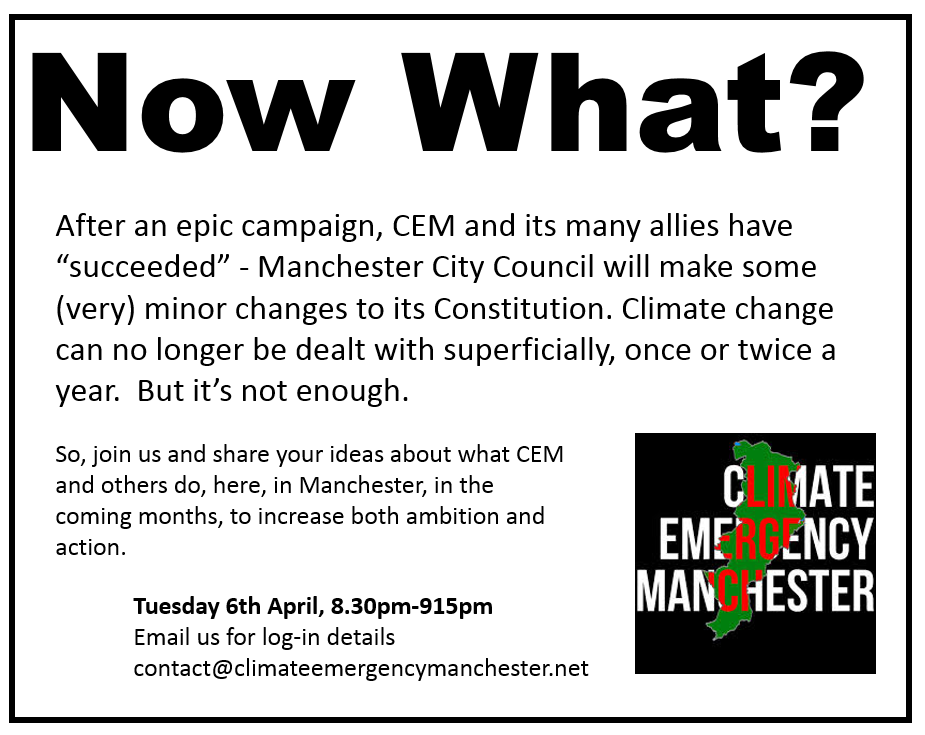
Climate Emergency Manchester has its Monthly Meeting on Tuesday 6th April from 8.30pm. It’s an opportunity for you to meet other people, compare notes, propose action. Email contact@climateemergencymanchester.net
Date for your diary – Climate Hustings – Monday 19th April,7.45pm
Footnotes
The other members of the core group may or may not agree with the contents of this post.
There are various books (e.g. City of Revolution, Detonation,) that study the process of Manchester getting in city council, getting into bed and saying “we love business”. It predates the 1996 bomb, it actually goes back to the Hulme Development Agency and Heseltine and all the rest of it. But it’s 30 years of protecting business. and picking fights only with central government or with other local authorities.
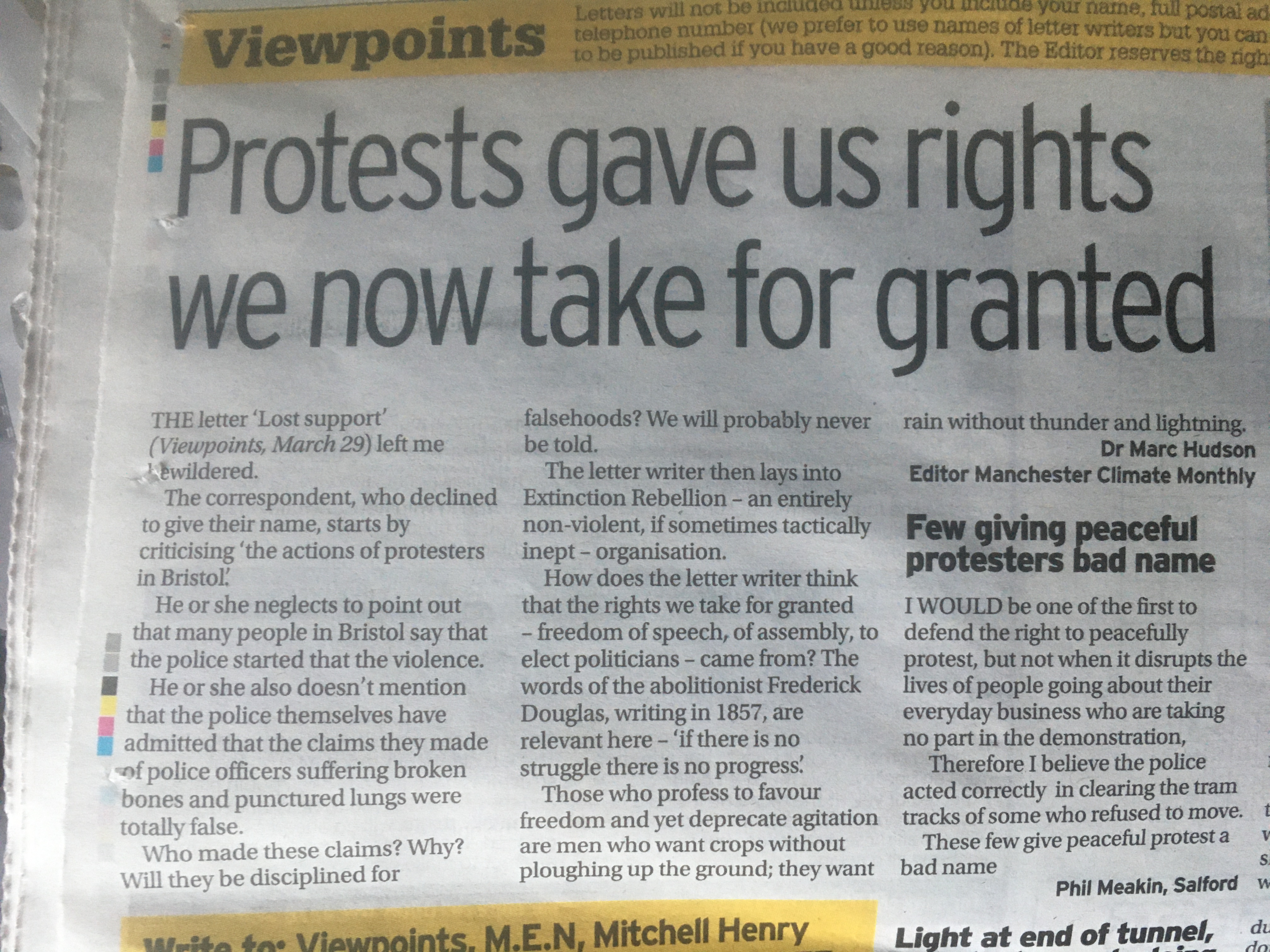
The letter (“Lost support” Viewpoints 29 March) left me bewildered. The correspondent, who declined to give their name, starts by criticising “the actions of protestors in Bristol.” He or she neglects to point out that many people in Bristol say that the police started that the violence. He or she also doesn’t mention that the police themselves have admitted that the claims they made of police officers suffering broken bones and punctured lungs were totally false. (Who made these claims? Why? Will they be disciplined for falsehoods? we will probably never be told).
The letter writer then lays into Extinction Rebellion – an entirely non-violent, if sometimes tactically inept – organisation.How does the letter writer think that the rights we take for granted – freedom of speech, of assembly, to elect politicians – came from?
The words of the abolitionist Frederick Douglas, writing in 1857, are relevant here – “If there is no struggle there is no progress. Those who profess to favor freedom and yet deprecate agitation are men who want crops without plowing up the ground; they want rain without thunder and lightning. They want the ocean without the awful roar of its many waters.”
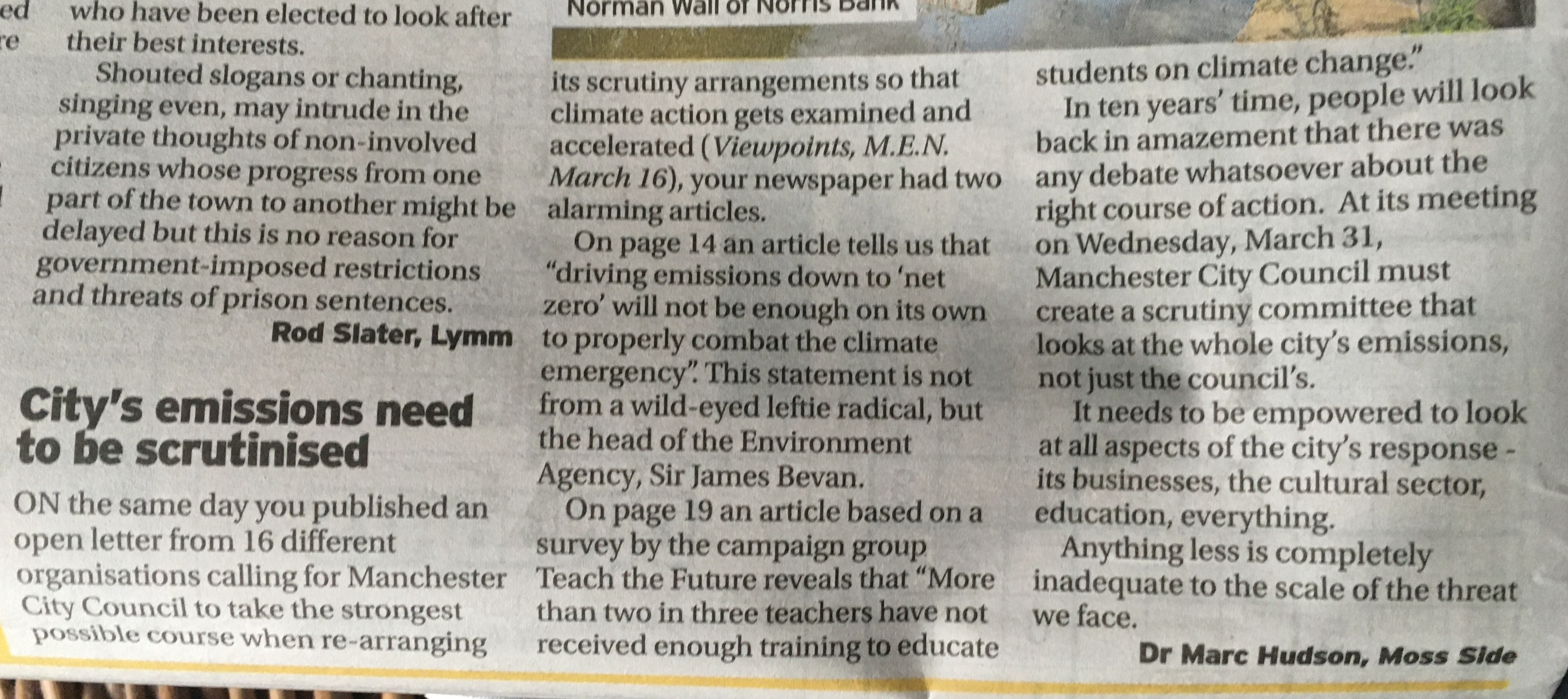
On the same day you published an open letter from 16 different organisations calling for Manchester City Council to take the strongest possible course when re-arranging its scrutiny arrangements so that climate action gets examined and accelerated (Viewpoints, M.E.N. 16 March), your newspaper had two alarming articles.
On page 14 an article tells us that “driving emissions down to ‘net zero’ will not be enough on its own to properly combat the climate emergency”. This statement is not from a wild-eyed leftie radical, but the head of the Environment Agency, Sir James Bevan.
On page 19 an article based on a survey by the campaign group Teach the Future reveals that “More than two in three teachers have not received enough training to educate students on climate change.”
In ten years time, people will look back in amazement that there was any debate whatsoever about the right course of action. At its meeting on Wednesday 31st March, Manchester City Council must create a scrutiny committee that looks at the whole city’s emissions, not just the council’s.
It needs to be empowered to look at all aspects of the city’s response – its businesses, the cultural sector, education, everything. Anything less is completely inadequate to the scale of the threat we face.
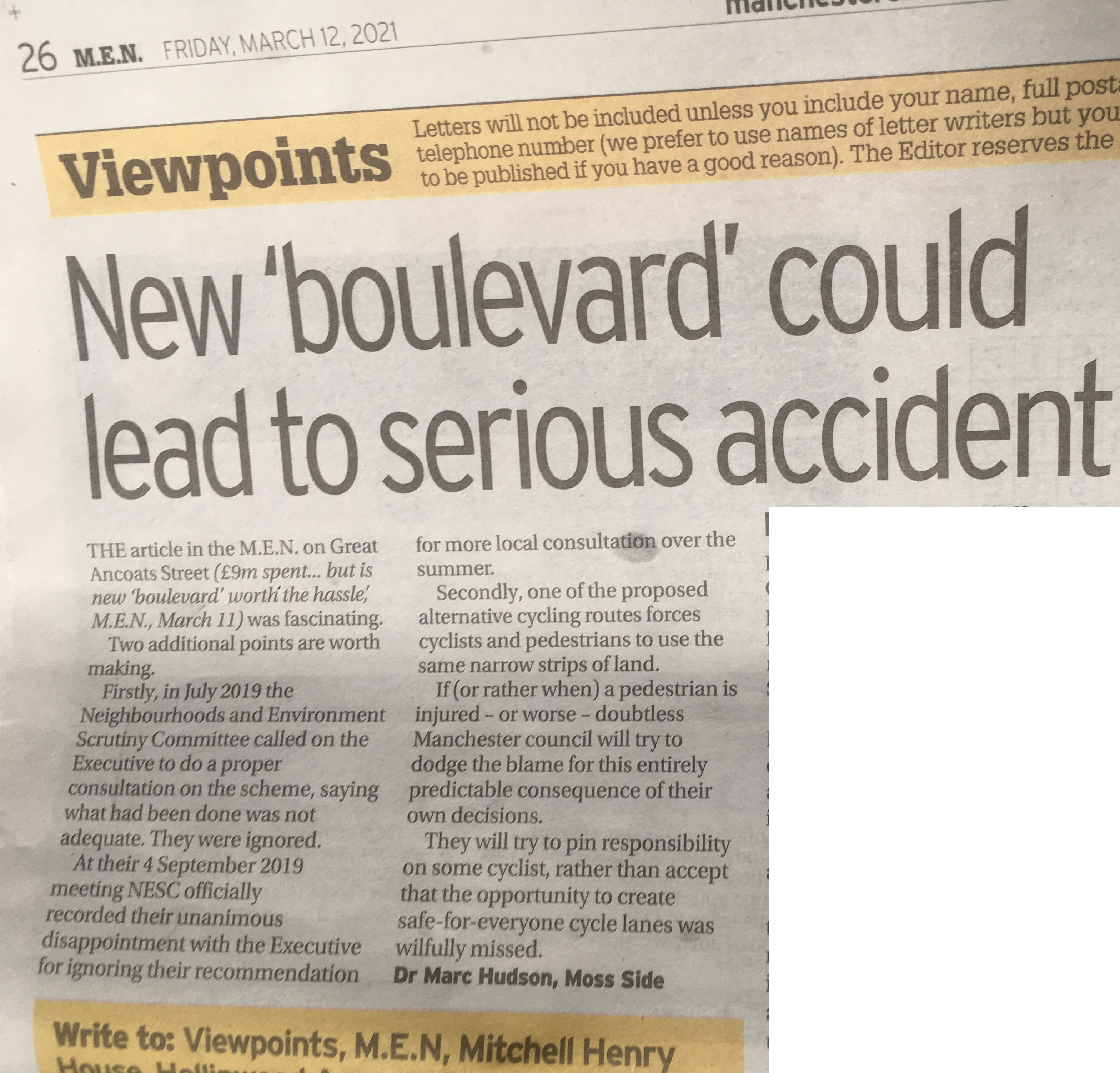
Your article on Great Ancoats St (“£9m spent… but is new ‘boulevard’ worth the hassle’, M.E.N., 10 March) was fascinating. Two additional points are worth making.
Firstly, in July 2019 the Neighbourhoods and Environment Scrutiny Committee called on the Executive to do a proper consultation on the scheme, saying what had been done was not adequate. They were ignored. At their 4 September 2019 meeting NESC officially recorded their unanimous disappointment with the Executive for ignoring their recommendation for more local consultation over the summer.
Secondly, one of the proposed alternative cycling routes forces cyclists and pedestrians to use the same narrow strips of land. If (or rather when) a pedestrian is injured or worse, doubtless Manchester City Council will try to dodge the blame for this entirely predictable consequence of their own decisions. They will try to pin responsibility on some cyclist, rather than accept that the opportunity to create safe-for-everyone cycle lanes was wilfully missed.
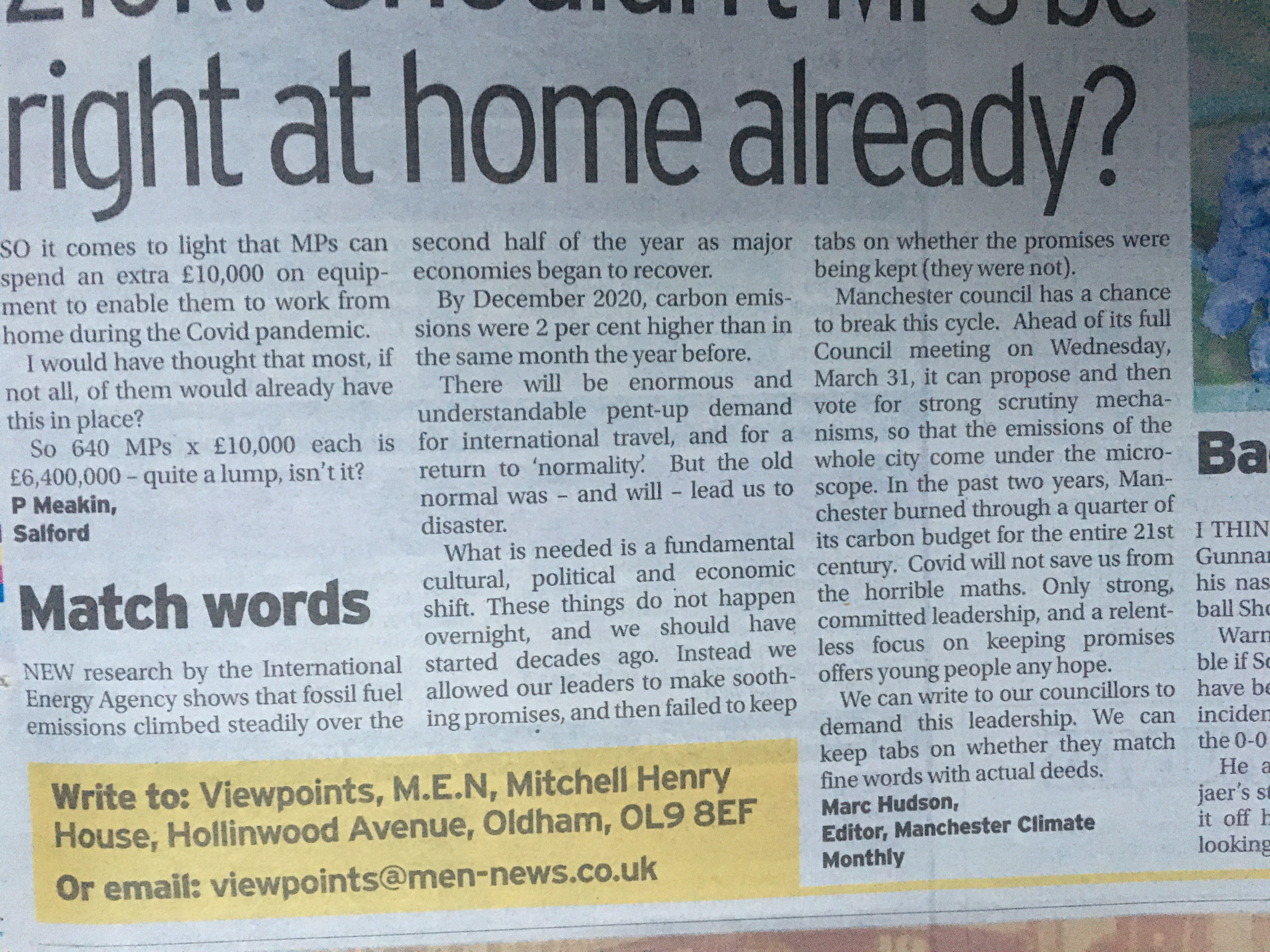
New research by the International Energy Agency shows that fossil fuel emissions climbed steadily over the second half of the year as major economies began to recover.
By December 2020, carbon emissions were 2% higher than in the same month the year before. There will be enormous and understandable pent-up demand for international travel, and for a return to “normality”. But the old normal was – and will – lead us to disaster.
What is needed is a fundamental cultural, political and economic shift. These things do not happen overnight, and we should have started decades ago. Instead we allowed our leaders to make soothing promises, and then failed to keep tabs on whether the promises were being kept (they were not).
Manchester City Council has a chance to break this cycle. Ahead of its full Council meeting on Wednesday 31st March, it can propose and then vote for strong scrutiny mechanisms, so that the emissions of the whole city come under the microscope. In the last two years, Manchester burned through a quarter of its carbon budget for the entire twenty first century. Covid will not save us from the horrible maths. Only strong, committed leadership, and a relentless focus on keeping promises offers young people any hope for a decent adulthood.
We can write to our councillors to demand this leadership. We can keep tabs on whether they match fine words with actual deeds.
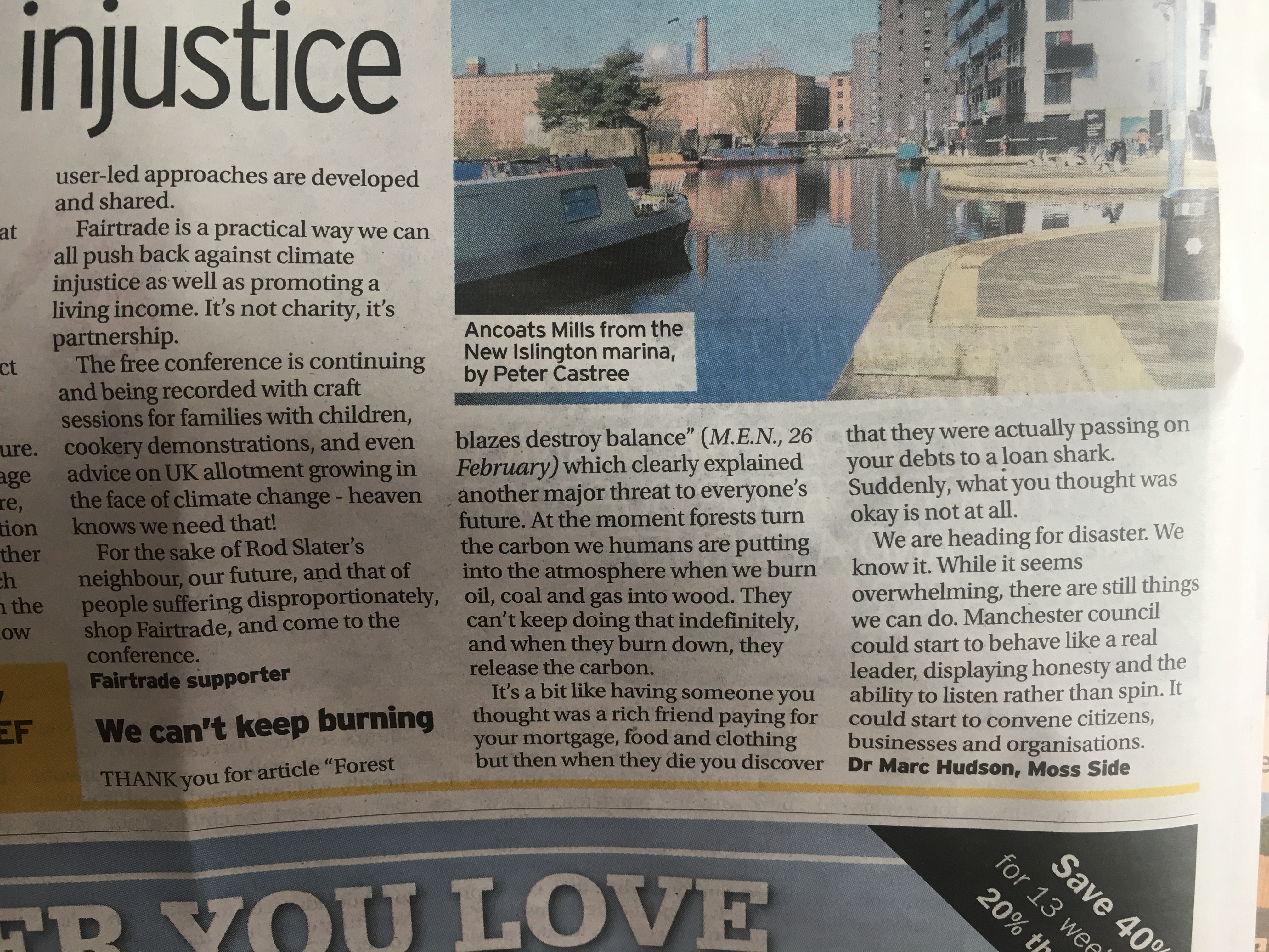
Thank you for article “Forest blazes destroy balance” (M.E.N., 26 February) which clearly explained another major threat to everyone’s future.
At the moment forests turn the carbon we humans are putting into the atmosphere when we burn oil, coal and gas into wood. They can’t keep doing that indefinitely, and when they burn down, they release the carbon.It’s a bit like having someone you thought was a rich friend paying for your mortgage, food and clothing but then when they die you discover that they were were actually passing on your debts to a loan shark. Suddenly, what you thought was okay is not at all.
We are heading for disaster. We know it. While it seems overwhelming, there are still things we can do. Manchester City Council could start to behave like a real leader, displaying honesty and the ability to listen rather than spin. It could start to convene citizens, businesses and organisations.
b) fired off a letter to the MEN. They published it (and another good ‘un)
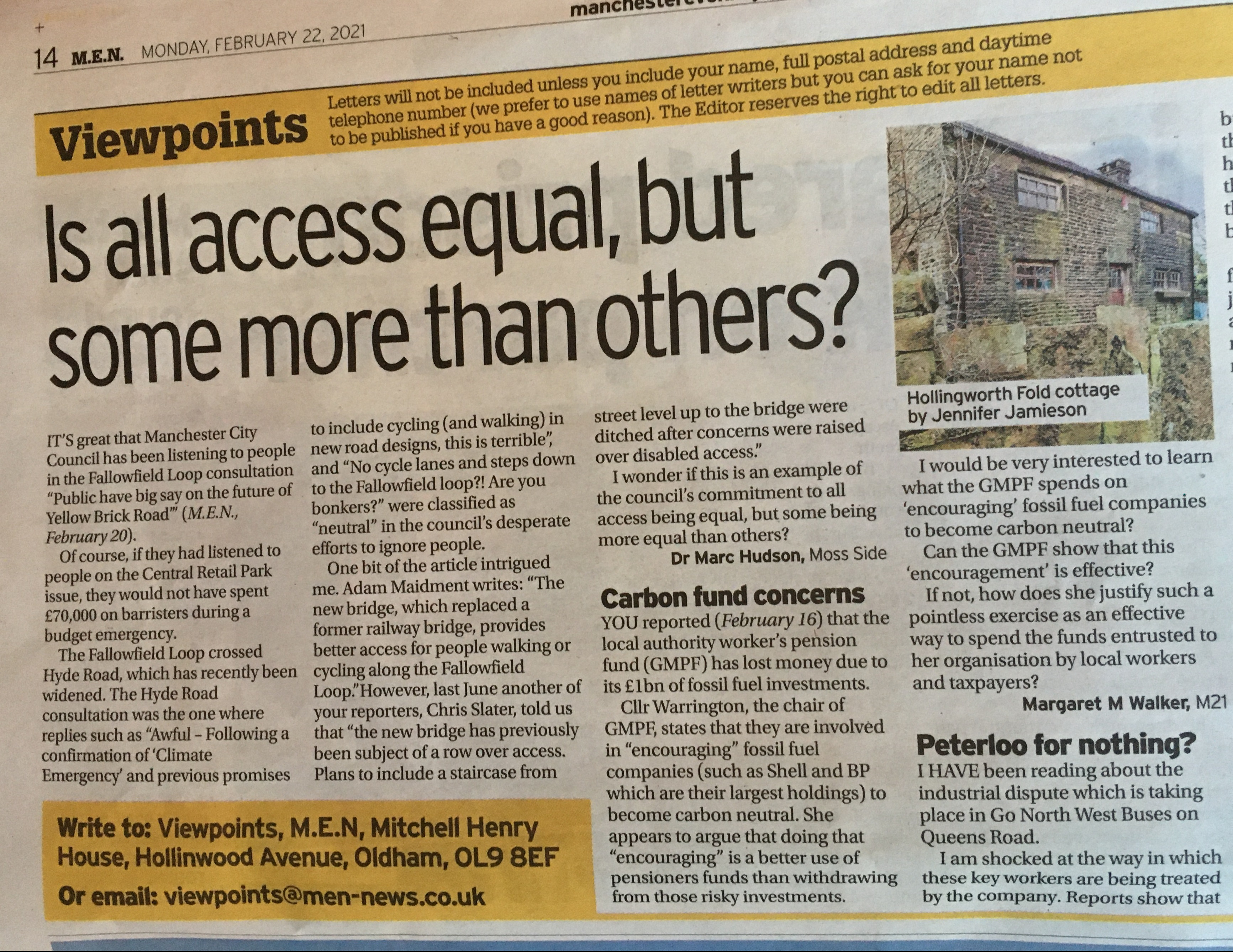
Letter in MEN, Monday 22nd February 2021
It’s great that Manchester City Council has been listening to people in the Fallowfield Loop consultation (“Public have big say on the future of ‘Yellow Brick Road'”, M.E.N., 20 February).
One bit of the article intrigued me. Adam Maidment writes “The new bridge, which replaced a former railway bridge, provides better access for people walking or cycling along the Fallowfield Loop.
However, last June another of your reporters, Chris Slater, told us that “The new bridge has previously been subject of a row over access. Plans to include a staircase from street level up to the bridge were ditched after concerns were raised over disabled access.”
I wonder if this is an example of the Council’s commitment to all access being equal, but some being more equal than others?
Our "leaders" are going to keep making empty promises. It makes them feel good. It gets the activists to act like zombie kittens. If you want to have some self-respect and perhaps make a difference (actual facts may vary), then find a functioning group that cares about your skills and knowledge - what you have, what you want.
One useful group might be www.climateemergencymanchester.net - you can email them on contact@climateemergencymanchester.net



 manchester climate monthly