After the election: Consequences and implications for #Manchester #climate policy

What can we know, what is to be done? Another hot-take, but specifically on Manchester climate action.

With the usual disclaimers (1), there are a few things we can confidently say about the large Conservative/”Brexit” win (for what the Conservative Party now is, see this by Peter Oborne) at yesterday’s general election.

At a personal level, for activists, this will be very demoralising.  The impact on activists of XR and youth strikers will be profound: it is an overused term, but “devastating blow” is about right. Most will have thought a minority Corbyn government would be a possibility, and at least some elements of the ‘Green Industrial Revolution’ (2) might come into existence.  More on that in the ‘what is to be done’ (WITBD) section.

It will also be massively demoralising for councillors (esp the left wing ones), who are Labour and spent many hours/days in marginal constituencies trying to get a different result.  Those councillors, and the new candidates standing in wards across the city (Hulme and Whalley Range among them) will know that over the coming five years, they will be overwhelmed with more case work as the remaining vestiges of the post-World War 2 welfare state are hacked to buggery.  That has implications for activists trying to get climate change up the agenda and keep it there – more on that in the WITBD section. 

A little bit of the outcome here depends on what the newly energised Momentum-y types do. Will they engage meaningfully and in the long-term on local authority action? Will that energy go to the immediate issues of housing, homelessness, and – I can’t believe I am writing this about one of the richest countries in the world – hunger.  Hunger ffs.

Overall, “backbench” councillors, activists etc will almost certainly have less mental, emotional and actual time/bandwidth for issues that central government really ought to be leading on

The “leadership” of Manchester City Council on climate issues (and the quote marks are well earned)  will have a baked in “blame central government” defence for five years (and they’ve been using it for ten already).  And let’s face it – the Johnson government is likely to continue cutting funding to unfriendly local authorities, meaning they have to cut all the ‘nice to haves’.  The funding the Council gets from its 35.5% share in the Airport (45 million quid per annum) will loom ever more important.  More broadly, the City Council is hardly agile or inventive at the best of times. These are not the best of times.  And asides the funding issue, don’t even think about the economic consequences of a hard Brexit… (3)

The local authority elections next May will probably be dominated by Brexit and its fall out, with the elections basically a proxy for national dilemmas. Activists need to try at least to make climate policy and the failure to actually act on the climate emergency declaration as an issue, in as many of the 32 wards as possible.  However, it’s unclear that the political landscape – 93 Labour Councillors versus 3 Lib Dems – will change significantly…

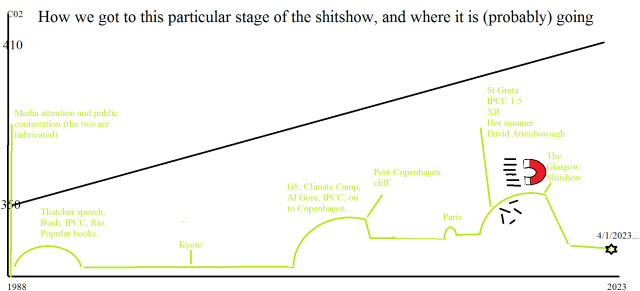
At a national level, although Johnson was able to avoid all climate discussions (remember the ice-sculpture) he will neither be able to nor in fact want to in the coming year.  The UK government bid to host the COP26 conference (9-20 November 2020) precisely to maintain (the illusion of) its diplomatic power post-Brexit.

Whether he likes to or not, Johnson will have to big up the climate issue (but see footnote 1). So, the COP, to be held in Glasgow will loom EXTRA large. Government will want to talk about it, the big NGOs will see it as an opportunity to keep climate on the agenda, and the activists, at a loss for something else to do, will probably oblige by turning out. But it won’t be Santiago…  Focusing on Glasgow will continue, imo, to be a mistake.

glasgow shitshowglasgow shitshow

Fine, so, those are my predictions and most of them are probably wrong. Who cares. More importantly –


What is to be done?

  • We, as people terrified of the coming climate shitstorm (4) are going to have a serious job of work to do to look after ourselves and each other. We need to start talking about and doing  collective mental health, collective “resilience.” This, done right, is both prefigurative and necessary.
  • Simultaneously we need to be aware of the danger of retreating into fugue state- apathy, despair, religious millennarianism, magical thinking- and support each other away from those.
  • Groups are going to need to collaborate and co-ordinate better, sharing knowledge and skills, especially around holding decent meetings, retaining new members and sustaining morale.
  • As ever, we need to get beyond the ghettos (of place – the Hulme, Chorlton, Didsbury triangle) and people who vote think, dress, speak etc the way we do. Not with missionary zeal, but in collaboration.
  • Learn from history so that we’re less likely to repeat it. We have been here before. The history of failure on climate and environment policy goes back before 2018, 2009, to the mid-1990s. Same patterns and some of the same people.
  • Continue to insist that democratically elected local politicians do what they can and put good ideas in front of them in formats they are likely to be able to cope with (given the enormous strains on their time and attention thanks to the butchering of the welfare state and the immiseration of so many).
  • The need for accurate information, radical policy proposals which are simultaneously achievable is greater than ever
  • Did I mention looking after our mental health?

The final word on this goes to   @PriyamvadaGopal In two tweets last night, she pointed out

We are not going to win this election by election. This is going to take long, patient, varied work & global alliances. We’ll have to do our best to throw our bodies between vulnerable groups & immediate attack from this regimes,while commencing, as many already have, the slow patient long-term work of making truth & facts fashionable again, finding ways to disseminate them & get them their due DESPITE a fawning media landscape populated by thugs, fantasists & billionaires.

Footnotes

(1) Wtf does anyone know? Srsly. I thought Miliband was going to be Prime Minister right up until Cameron got a stonking majority. Yesterday I was thinking maybe a 20 seat Tory majority. Nostradamus I ain’t. 

(2) Yes, it was Keynesianism with an IPCC spraypaint, predicated on growth etc etc.  But still..

(3) Will Labour at a national level tack away from ambitious policy proposals like Green New Deal (2) – who knows?

(4) And the shitstorms feed off each other.  And people of colour have been living the shitstorm for a long time. As have the other species we ‘share’ this planet with.

Marc Hudson

in his editor of Manchester Climate Monthly capacity
 

Posted in Manchester City Council, Unsolicited advice | 1 Comment

Shock news!! #Manchester City Council upholds complaint against member, officer, on filming.

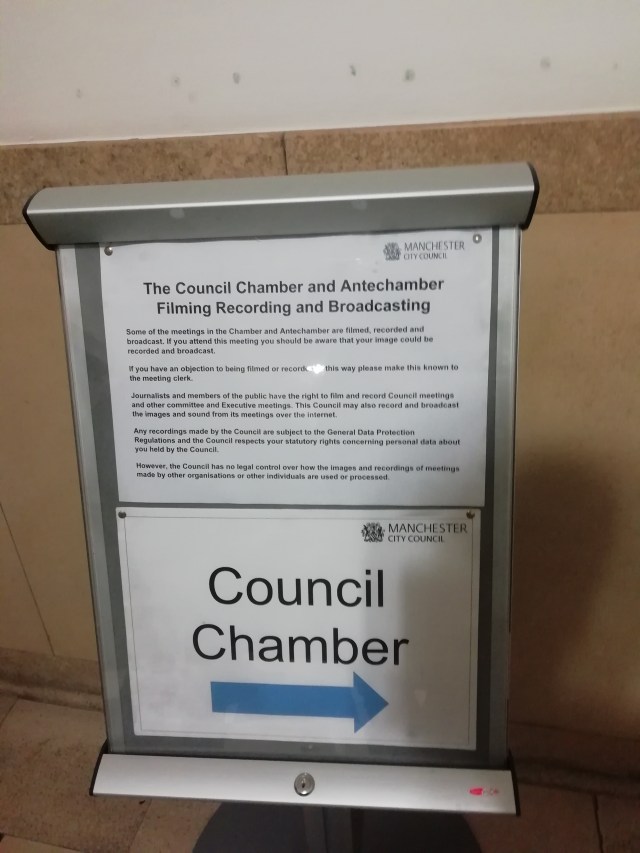
Manchester City Council has upheld a complaint about the behaviour of the Chair of Planning and Highways Committee and a senior officer.  At the October 2019 meeting of the Planning Committee, its chair, Councillor Basil Curley (Labour, Charleston)  and a senior officer, Julie Roscoe, both made statements to the assembled public about who was allowed to film what which were simply incorrect.  That has now been acknowledged by Eddie Smith, the (outgoing) Strategic Director for the  Growth & Development directorate (2), who handled the complaint.  Further, he has stated that he will ensure that

“All current Elected Members of the Council will be written to reminding them of the Openness of Local Government Bodies Regulations 2014 and the definition of “Reporting” as stated above. Familiarisation with the Openness of Local Government Bodies Regulations 2014 will be enshrined in to our Member Training Programme for new Elected Members;”

“The City Solicitor will write to all senior officers within the Council’s Senior Leadership Group (circa 130 staff) reminding them of the Openness of Local Government Bodies Regulations 2014 and the definition of “Reporting” as stated above;”

filming permision


The October 2019 meeting of the Planning Committee was particularly well-attended, because the vote on the Great Ancoats St Retail Park car park was held.  One member of the committee, Councillor John Flanagan (Labour, Miles Platting and Newton Heath), alerted the Chair to the existence of many children – brought by their parents – to the meeting. This led to a series of factually incorrect statements being made by the Chair, and further factually incorrect statements being made by an officer (Julie Roscoe) as to who could film what with what permission. (You can watch the whole sorry thing here).

The editor of Manchester Climate Monthly, upon checking who could film what, submitted a Freedom of Information Act request asking what training was offered to chairs and officers and what sanctions were in place and whether any remedial training was being discussed.  The answers was none, none and nope.

Only then was a complaint about the member and officer submitted.

On this occasion (but not on another – watch this space), there seems to be some outcome – even if the member and officer are not disciplined (which is not particularly interesting in this case, imo) – there will, finally be some sort of commitment to reminding members and officers that citizens have rights,  and are not sheep.


Footnotes

(1) Manchester City Council is made up of 96 elected members (currently 93 Labour, 3 Lib Dem), and has 6000 staff, including a “Senior Leadership Group” of around 130 staff. There are six scrutiny committees, which are there to keep tabs on what the 10 member Executive and senior officers do. These are made up of “back bench” councillors. There are also regulatory committees, which make decisions on planning applications, licensing applications and so on. Planning is one of these. It meets in public. AND YOU CAN FILM THE DAMN MEETINGS WITHOUT ASKING ANYONE’S PERMISSION.  AND I THINK YOU SHOULD, ON GENERAL PRINCIPLES.

(2) Manchester City Council has seven directorates (think of them as a bit like “Departments” at the Westminster level, though the analogy is shaky). They are core (not city solicitor), core – city solicitor, adult services, children’s services, population and well-being, growth and development and our personal favourite – Neighbourhoods.
The heads of each of these seven, along with the chief exec, make up the “Strategic Management Team”.

Fun fact:  Until very recently, and after prolonged FOIAing and chivvying, these eight had not done their carbon literacy training.  They have now, but a couple of the top bods are leaving, so it will be entertaining to see if/when the new bods do their training… I feel a FOIA coming on….

Posted in Manchester City Council, Planning and Highways Committee | 1 Comment

Manchester City Council and #climate – flying staff to Edinburgh and Exeter after declaring “climate emergency” @XR_MCR

Extinction Rebellion Manchester are doing a protest about air quality on Great Ancoats St.

The City Council has released the usual nonsense about how concerned they are about climate change and how a climate subgroup has been set up (after significant resistance from the Council’s leadership, though they don’t mention that).

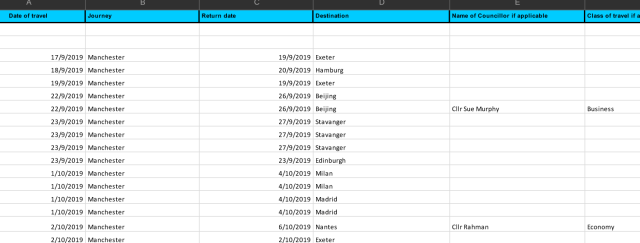
Yeah, look.  Since declaring a climate emergency in July 2019  the City Council has continued flying its staff to such hard to reach places as … Exeter and Edinburgh.

screenshot flying

(the list goes on, btw)

Because, you know, leadership.


Btw – we know this not because the Council is being even minimally honest and transparent, but because of the Freedom of Information Act 2000.

Posted in Manchester City Council | Leave a comment

5 questions to #Manchester #climate groups – Kindling Trust is first up… @kindlingtrust

Manchester Climate Monthly is asking various groups the same questions-

1. When was your group founded? What does it do/how does it do it?
2. What have been the group’s major successes and failures over the last year or so?
3. If people got involved in your group, what sorts of things would they find themselves doing?
4. What has your group got planned (and how might it contribute to maintaining morale and momentum in the climate movement in Manchester)
5. What would you like to see the “climate movement in Manchester” do more generally, both to maintain morale and momentum, but also to increase its effectiveness?

These seem to be somewhat important questions, and the answers will help everyone think through what happens (or doesn’t happen) next…

First up, Kindling Trust-
kindling
here’s their website.


1. When was your group founded? What does it do/how does it do it?

We were founded over ten years ago. We are a food sovereignty organisation focused on enterprising solutions which revolutionise whole food systems; from paying local organic farmers fairly, to supporting new growers, to volunteering on local farms, to supplying businesses with organic veg, and even running a veg box scheme.

We run various projects and enterprises along the food supply chain. We’ve set up a food network, Feeding Manchester, which connects consumers with eco-friendly businesses, events and workshops so that people are more connected with their food supply. We also facilitate Land Army trips to our farms for volunteers wanting to farm, grow and learn about organic food.

Beyond this, we have set up two co-operative enterprises; Manchester Veg People, which connects organic growers with businesses, and Veg Box People which distributes locally grown, organic veg to individuals and families across Manchester.

Our Farmstart program we run trains people to be commercial organic growers, supporting and guiding them to set up their own organic growing business when they finish. We also host graduates on our farms where possible.

But our focus this Autumn has been on establishing an agro-ecological farm for Greater Manchester, where we can demonstrate how sustainable farms on the outskirts of cities can help feed large urban populations healthily, whilst reducing our collective carbon emissions.

2. What have been the group’s major successes and failures over the last year or so?

The group’s major success has been Woodbank Community Food Hub in Stockport. The site has been used to train Farmstarters, host Land Army trips and community drop-in sessions, and to kickstart our ‘More than Medicine’ social-prescription courses. The hub is so successful that our sister co-op organisations even use it as a supplier.

We have hosted numerous events where individuals, either referred by a third-party service or dropping in, have helped plant, grow, harvest and cook the fruit and veg produced there. The Community Food Hub demonstrates our vision for food sovereignty in the future; commercial growers, merchants, locals and volunteers all working together in an organic food system.

Unfortunately, establishing successful referral systems with GP surgeries in Stockport has been more challenging than anticipated. The GP surgeries and healthcare professionals who we have engaged with have been supportive of our work, but this is yet to translate into a regular flow of referrals. We know that the busy nature of GP surgeries is one of the barriers to this, and we are currently reviewing our progress to look at how we can address this and increase the number of referrals to our project.

3. If people got involved in your group, what sorts of things would they find themselves doing?

We have a number of ways for people to get involved in the group’s work, and we always welcome extra hands! There are plenty of Land Army volunteering days to get stuck into; you’ll get the chance to help our Farmstarters out, learn about organic growing, and get an amazing meal made from the produce on-site, as well as tea and biscuits throughout the day! We also have workshops being hosted at Woodbank, you just book ahead for these on the website.

If you wanted to get involved in a slightly more formal capacity, you could organise a corporate volunteer day for your organisation to take part in, it really is an engaging and fun way of demonstrating corporate social responsibility. Similarly, we are always in need of volunteers at our Bridge 5 Mill office in Ancoats. Whether you’re a graphic designer, administration assistant, spreadsheet guru or copy writer, we welcome your support!

4. What has your group got planned (and how might it contribute to maintaining morale and momentum in the climate movement in Manchester)

The group is at a really pivotal stage right now, and we have a team working very hard on our Kindling Community Farm project. We are going to create a 200-acre, organic agroforestry farm which is integrated with, and actively supports, local social enterprises, change makers and activists. We are going to use the land in a way that supports biodiversity, local ecology and local communities, as well as build centres for social enterprises to work out of, and for activist organisations to use for events and workshops. We hope to maintain morale and momentum for the climate movement in Manchester by demonstrating how food and social systems can, and need to, integrate with one another for a sustainable future. The plans for the next few months are highly focused on securing funding for the farm, sharing our vision with our supporters, and getting ready to launch our Community Shares campaign, more information see our latest E bulletin:

https://kindling.org.uk/civicrm/mailing/view?reset=1&id=461&fbclid=IwAR3yfuykQlROgHF3HNtg2V2p7S7z1TNwu1Qs4OjSK5cqCBQF61McMKoZC1k

5. What would you like to see the “climate movement in Manchester” do more generally, both to maintain morale and momentum, but also to increase its effectiveness?

We think the most important thing for the climate movement in Manchester right now is collaboration. There are plenty of amazing organisations tackling the climate crisis in numerous ways, we just need to work together more now than ever! Morale is certainly being boosted by the abundance of community-led groups placing food sovereignty at the core of their projects, alongside the weekly climate strikes from activist school kids in Manchester, the ever-increasing Extinction Rebellion membership, and charities and social enterprises hosting numerous events, workshops and talks on how to tackle the climate crisis together. But we do think that in order to maintain momentum and increase effectiveness, we need to get non-activists on board with our movement too. We need to collaborate more with small local businesses, community groups and residents to make being climate-conscious as easy and accessible as possible, as well as with each other to share best practice and resources. We are really excited for the future of the climate movement in Manchester!

Posted in 5 questions | Leave a comment

Communication breakdown on the #climate emergency? Seems like…

In a little over a month’s time, Climate Emergency Manchester (1) will be releasing a report about what action the City Council has taken in the by-then six months since declaring a climate emergency. One focus will be on how much communicating about climate change various Big Fish have been doing.

In the meantime, the 8 page report “Communications Service Plan – Review” going to Resources and Governance Scrutiny Committee (2) makes for depressing reading, if you believe – to use the old ACT-Up slogan “Silence = Death.”

It starts so promisingly, with an “Environmental Impact Assessment”.

env impact tokenistic comms review

But… that’s it for mentions of “climate” or “climate change” or even “climate emergency.”  An opening soothing statement followed by nowt? Say  it isn’t so….

So, there are (1.)5 ” four areas of focus for communications for 19/20. Each area has
improvement projects that will support the successful delivery of the plan for
the organisation. They are:

  • Integrated working
  • Digital delivery
  • Participation and engagement
  • Service organisation and governance
  • The freaking climate emergency.”

Yeah, we inserted that last one.

Still, it’s not all bad news. Thanks to EU action the Council has achieved an ENORMOUS reduction in some electrons being whizzed around –

(3.9) “The changes brought about by GDPR and the removal of non-compliant data
meant the reduction in the reach of the Council’s e-bulletin went from over
100,000 to less than 5,000.”

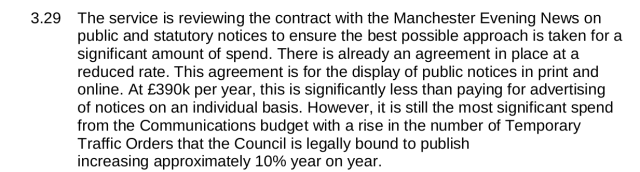
And it is fun to learn the following.

390k a year

But, um, climate emergency, anyone? WTAF, as the young people used to say, back in 2009 or so?

Hopefully the Resources and Governance Scrutiny committee members will ask for a report about climate comms?  Watch this space…

Footnotes

(1) Climate Emergency Manchester was established in March 2019. The editor of Manchester Climate Monthly, Marc Hudson, is one of the core group members.

(2)  There are six scrutiny committees. They are made up of “back-bench” councillors and their ostensible job is to keep tabs on what is and is not being done by the Executive and the officers. The scrutiny committees meet about ten times a year (2 hrs ish per meeting), in public. You’re able to attend and if you live in Manchester you can ask to speak on particular agenda items. Our advice is – never go alone, especially if it is your first time. You WILL lose the will to live. The scrutiny committee meetings are live streamed these days (the subject of past and future FoIAs).
The six scrutiny committees are –
Resources and Governance, Health, Communities and Equalities, Neighbourhoods and Environment, Economy, Children and Young Peopl

Posted in Manchester City Council | Leave a comment

Er, if you want better consultations, perhaps consult the consultees? #Manchester

Manchester City Council has set up a new group of officers to look at improving consultations. So far, they have …  no plans to ask citizens on the receiving end of consultations what they think. That’s the way things are done in Our (sic) Manchester – “differently.”

A 16 page report on the City Council’s approach to consultations is  going to Resources and Governance Scrutiny Committee (1) tomorrow. It proclaims that a

“new officer Co-production and Consultation Group (CPCG) group was established in October 2019 with representatives from across the Council. The group will consider how to use co-production techniques where appropriate, and how to apply an Our Manchester approach to consultation and engagement activities.”

That’s great. The world needs more officer groups, after all, complementing the existing teams which already stretch across all the council’s directorates (2) . What’s that, you say – shouldn’t they be talking to the residents and citizens who might not be overwhelmingly claque-y and supportive of existing consultation methods? Well, there are very firm and specific commitments to do just that. Oh yes. You just have to read between these lines….

5.4 The role of external partners and organisations in this group is being considered taking into account how their time can be best used in the design and shaping of any guidance and toolkits, and how their expertise can influence

In case you missed it,here it is again.  (And who is allowed to be an external partner and organisation might get quite amusing – not so many of the awkward squad, we reckon…)

role of external partners

Overall, the report lists a series of *eight) up-beat examples of “good” consultations, where nothing major went tits up.  It is typically vague on specifics (numbers of replies to various consultations) and carefully keeps clear of some spectacularly bad recent consultations – clock this masterful example of Sir Humphrey-speak-

“Other examples are not included in the scope of this paper as they have been recently considered by other Scrutiny Committees, for example Neighbourhoods Scrutiny have recently looked at the approach to consultation in Highways.”

The report, which unleashes new TLAs onto the world (CEF – Campaigning Engagement Framework) will be discussed by councillors tomorrow morning in the Town Hall Annexe, from 10am. Members of the pubic are welcome, don’t need to book, CAN film, and so on. The meeting can be watched on livestream if y ou can’t make it down in the flesh.

Footnotes

(1) There are six scrutiny committees. They are made up of “back-bench” councillors and their ostensible job is to keep tabs on what is and is not being done by the Executive and the officers. The scrutiny committees meet about ten times a year (2 hrs ish per meeting), in public. You’re able to attend and if you live in Manchester you can ask to speak on particular agenda items. Our advice is – never go alone, especially if it is your first time. You WILL lose the will to live. The scrutiny committee meetings are live streamed these days (the subject of past and future FoIAs).
The six scrutiny committees are –
Resources and Governance, Health, Communities and Equalities, Neighbourhoods and Environment, Economy, Children and Young People

(2) There are seven directorates (think of them as a bit like “Departments” at the Westminster level, though the analogy is shaky). They are core (not city solicitor), core – city solicitor, adult services, children’s services, population and well-being, growth and development and our personal favourite – Neighbourhoods.
The heads of each of these seven, along with the chief exec, make up the “Strategic Management Team”. Fun fact:  Until very recently, and after prolonged FOIAing and chivvying, these eight had not done their carbon literacy training.  They have now, but a couple of the top bods are leaving, so it will be entertaining to see if/when the new bods do their training… I feel a FOIA coming on….

Posted in Uncategorized | Leave a comment

Oops – Manchester Climate Monthly gets it wrong – apology to Council, published in Evening News

Manchester Climate Monthly has published many a shocking scandal – based on replies to Freedom of Information Act requests.  The way it works (normally) is this.

a) Council makes a claim/promise
b) MCFly sighs/rolls eyes, and submits a Freedom of Information Act request

Then, 20 working days later
c) The Council admits it is either wrong in its claim or behind/WAY behind in keeping its promise
d) MCFLy writes a  blog and sends a letter to the Manchester Evening News, which often publishes

Then
e) nothing at all changes because this Council is beyond shaming.

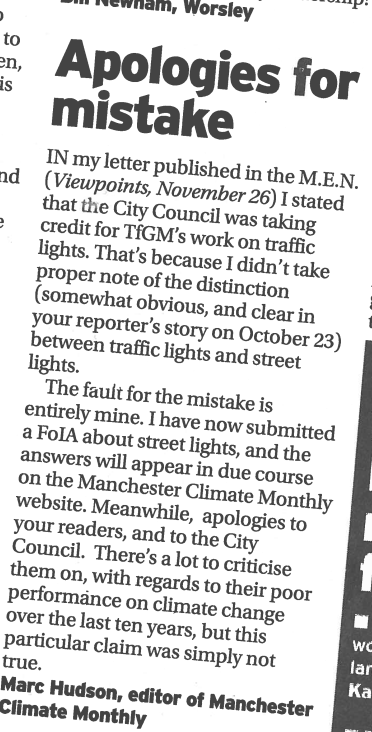
That’s NORMALLY how it works, has worked, will work.  But on this occasion…. on this occasion I (Marc Hudson, editor of MCFly) screwed up.  Yes the FOIA went in.  Lots of good questions in there. But traffic lights are not street lights.  Thanks to Jayne on Facebook for pointing this out, and thanks to the Manchester Evening News for speedily printing my retraction/apology.  Lesson learned! #attentiontodetail

men thurs nov 28

Posted in Letters to the MEN, Manchester City Council | Leave a comment

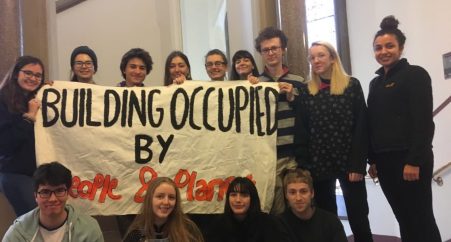
Interview with the People & Planet occupiers! #Manchester #divestment

Earlier this week students at University of Manchester ended a week-long occupation of the Vice-Chancellor’s building. Their action had forced the University to bring forward a review of its investment in a number of fossil fuel companies. That’s a potential victory, what happens next will be crucial. Here the occupiers answer questions about the past, present and future of the campaign, and the help they are looking for in the coming weeks and months.

1. How long has the campaign for divestment been going on at University of Manchester? Before this, has the University promised to take action/do reviews? If so, what came of them?
peopleandplanetoccupationThe Fossil Free campaign is run by the People & Planet society and has been ongoing at the University of Manchester for eight years. In 2016, when the campaign was in its fifth year, the University reviewed its Socially Responsible Investment (SRI) policy. Members of the campaign at the time suspect that this review would have resulted in full divestment from fossil fuels had certain members of the board of governors not voted against this, due to personal involvement with fossil fuel companies (including Shell and BP.) Currently, none of the board of governors have any personal ties to anything in which the University invests, and the current committee think there is little chance of such an attempt being blocked again. Our hope is therefore that when the next review happens in January, divestment will occur as a result. This upcoming review was brought forward a year as a result of negotiations between Fossil Free and the University during our occupation.

2. What’s been happening in the campaign in the last year or so and what made you think that an occupation was the best/only way forward?
In the second half of the last academic year, we escalated our campaign using non-violent direct action tactics. We realised the need for direct action when a petition that collected over 1000 student and staff signatures was dismissed by the University and our lobbying efforts ignored. In February we interrupted a board of governors meeting and read out arguments for divestment to the governors. This gave us brief contact with one of the governors who offered us advice going forward, but who also told us many in the meeting dismissed our concerns. Following the public release of the arguments, we continued campaigning until the end of the semester. When we received no response from the University, we staged a one day occupation of the John Owens building, in the corridor outside Vice-Chancellor Nancy Rothwell’s office. This resulted in a brief conversation with Registrar Patrick Hackett, in which our concerns were once again dismissed.

Entering into this current academic year, we always considered another occupation to be the only way forward, as we knew we couldn’t continue to be ignored if we stayed long enough and brought significant disruption to the University. The People & Planet national day of action also happened to fall on the 19th November, which seemed like the perfect opportunity for us to try again. We targeted the same building but made sure we had toilet access as this is what made us have to leave after only 24 hours last time.

Before the occupation we had a recruitment period for new members, built connections to other societies and climate organisations, and released an open letter to the University warning them of action if they did not respond to our demands. We also hosted events and talks throughout the semester, to ensure people knew the science and reasons behind what we were asking for.

3. Tell us a bit about the occupation – was it longer than you expected? How did you keep up morale? What did the solidarity gathering on Monday mean for you?
The occupation was both longer and shorter than we expected. There was a period on Tuesday morning during which we were unsure if we were going to get in at all. Security were unexpectedly on the front door- we are still unsure whether this is because they caught wind of our plans, or because Nancy Rothwell was having a meeting at this time. Security presence meant we had to sneak in through the back (which we had prepared for but was much harder to execute.) Once we were inside, the relief was almost tangible. We set our bags down in the corridor next to the finance boardroom and begun hanging banners up. We got lucky when a group of people walked past and opened the door to the finance boardroom, letting it close behind them, allowing us to slip through the gap before the door fully closed. Security tried to stop us once they realised our intention to also move into the boardroom, but we edged our way in, and the staff inside were made to leave. Looking back, the stroke of luck that allowed us to occupy the finance boardroom was essential to the sustainability of our occupation, without it we wouldn’t have lasted half as long. The finance boardroom gave us a space to ourselves. More importantly, it had a soft carpet to sleep on.

The attention we were getting on social media helped us keep up morale a lot as we were able to see all of the support that the occupation had. During the day the boardroom would be silent save for the sound of typing as everyone was busy doing coursework (two members even had dissertations to write) but during the evenings we would play music, and towards the end of the week we started having group meals sat around the floor. We also played boardgames that we’d brought with us, did yoga out in the corridor, and attempted acrobatics when things got a little dull.

This isn’t to say the act of occupying wasn’t extremely stressful, because it definitely was. We all needed time out occasionally (which we managed by taking shifts sitting in the corridor guarding the door to the boardroom and toilet.) The hardest part was not being able to properly retreat from what was happening- you couldn’t go outside to get some fresh air or walk to another part of the building to stretch your legs. It was very confining. Having a good support network amongst ourselves, looking out for each other, and seeing all the support we were receiving online definitely played a major role in boosting morale.

Out of all the support we received over the week, the UCU solidarity gathering on Monday was definitely the biggest. There were hundreds of striking staff members in the Old Quad outside John Owens, having come down to support us after their march around the pickets. Myself and a few others were moved to tears. A number of us were able to spot some of our own lecturers within the crowd, which made the experience all the more emotional.

Throughout the week we also received visits from Lillia, the ten year old Fridays for Future activist, Zamzam Ibrahim, president of the NUS, and Afzal Khan, the Labour MP for Manchester Gorton.

4. Crucially, what next? What is it that you are hoping to achieve in the coming weeks and months – what skills and knowledge would the group like to have at a higher level/more broadly shared? How can people – whether undergrads, post-grads, alumni, staff or ‘ordinary people of Manchester’ – support you/get involved?
We recently had an occupation debrief to discuss how we were feeling after the action and what the next steps of the campaign will be. We’ve discussed three key aims that we hope to achieve over the next few months. First of all we feel it is important to communicate our aims and promote the campaign across the student and staff body, as there have been so many new developments since the start of the semester. We hope to do this by hosting more public events and launching a rally for our campaign at the beginning of next semester, which will track the campaign progress so far and help people get involved. Secondly, we feel it is important to maintain pressure on the University so they know we will be holding them to account over what was agreed in our negotiations. We will continue to lobby and protest outside finance meetings, as well as continuing to have a presence at University events. Finally, we aim to connect with other divestment campaigns to strengthen our networks, and put forward a combined divestment strategy ahead of the SRI policy review.

In the immediate future, a few of us are going to the People & Planet regional gathering to connect with other Fossil Free university campaigns and participate in skill-shares across the North-west region. We also have plans to put on a series of workshops for new members who are interested in joining, linking the divestment movement to the wider goal of climate justice.

For anyone wanting to get involved with or support our campaign, follow us on social media or shoot us an e-mail! We have weekly meetings every Wednesday at 2pm, in LG3 of the University of Manchester Student’s Union, but you don’t have to attend meetings to get involved or support the campaign. Look out for details about our rally, likely to be early February!

Facebook: Fossil Free University of Manchester
Twitter: @PeopleUom
Instagram: @peopleandplanetuom
E-mail: peopleandplanetmcr@gmail.com

5. Anything else you would like to say.
We’d like to give our deepest thanks to anyone who supported our occupation over the last week. As mentioned, it wasn’t easy, but knowing the amount of support behind us enabled us to keep going. Thank you if you have supported this occupation in any way, whether anonymously or openly, in person or online, as an individual or as a collective.

Posted in Campaign Update, Divestment, University of Manchester | Leave a comment

Manchester City Council’s Weds 27 November meeting & #climate change: 4 scenes from a circus, 6 footnotes

An excruciatingly long meeting of Full Council (1) happened yesterday. Marc Hudson, editor of Manchester Climate Monthly, sat through it so you don’t have to. Climate change came up repeatedly, and there are four (2) key points to be briefly (sic) covered.

One function of council is for a morale boost/spin-stiffen to backbench councillors. So, a presentation is organised about an issue du jour (I once sat through an HS2 advert. That was fun). Yesterday Pete Bradshaw, the sustainabilty bod at Manchester City Football Club was along, to give an interesting talk about the impressive things (and I am NOT being sarky) the club has been doing on, for example, single use plastics, and PET plastics, and its lighting (switching to LEDs) (see update below). Bradshaw was careful not to make sweeping claims, and talked a lot less (i.e. not at all) about the club’s carbon dioxide emissions from flights and those of its supporters. He spoke not at all, for example, about how the club flew players to Brighton and back in a night this May,

plane sailing for citys champions.png


and no councillor had the temerity (or knowledge?) to mention it.  (And to head of any fans who may feel aggrieved – I am sure the Reds are worse, and we’re ALL of us hypocrites).

In the Q and A to him there was a prepared question from the Executive Member for the Environment inviting Bradshaw to talk about good businesses (making pledges, taking part in the ‘Manchester Climate Change Board’ (3)). This is clearly part of a narrative that the the “leadership” of the  Council is trying to build – “we the council are doing our bit. Blame business if it isn’t.” The problem with this is that a)  as a whole business in Manchester has never been interested in climate change and the environment, going back to the mid-90s and Local Agenda 21 and b) Manchester City Council has not, over the last ten years,  used its muscle to get them interested (4).  Generally business only gets involved in the horrorshow messiness of environment policymaking (as opposed to staff-tree-planting etc) if one of two conditions apply

a) the government is about to wave a big regulatory stick

b) there’s loads of grants (taxpayers’ money) that can be hoovered up and called research and development.

Neither of those conditions have ever really applied in Manchester (4 again).

That presentation/Q and A was followed by a VERY interesting short presentation by a senior officer on the council’s work on added social value. More on that another time.

The one almost-saving grace of full Council is the questions to the Executive. These can come from friendlies (i.e. Labour backbenchers) and are known in the civilised parts of the world as ‘Dorothy Dixers.’ A classic Dorothy Dixer yesterday came from Chorlton Park councillor Eve Holt (who had seconded July’s climate emergency declaration, which was in itself based on an earlier effort by her to get a declaration up. This was before other core cities had declared climate emergencies, and when Manchester’s bosses were still determined to block. Ah, fun times)

At 1 hour 39 minutes(here’s the video) she asked Exec Member Gavin Bridges (Children’s Services – schools, etc) what his department was up to. The (unashamedly scripted) answer did have a certain about entirely predictable wilful blindness about Manchester Labour’s failure these last ten years, (and entirely justified blaming of austerity and the Coalition/Conservative governments since 2010. )

There were various useful nuggets – a follow-up youth climate conference is happening, after July’s effort (btw, in the 2009 Climate Action Plan, there were supposed to be regular youth conferences. Those never happened) Okay, so this wasn’t the cut and thrust of parliamentary debate, but at least, for once, useful info was released (and information on climate change by Manchester City Council has often tightly controlled and bottlenecked, which is a sign of stupidity and panic. But I digress)

Useful info was NOT on display in our last two examples. Skipping out of chronological order –

the leader of the Liberal Democrats, John Leech (Didsbury West) asked Richard Leese (leader of the council since 1996) about the practice of fuel-tankering – airlines carrying extra fuel to save money when flying to airports where fuel is more expensive, but with a cost of extra carbon dioxide emissions because fuel weighs a lot. Leech wanted to know whether Leese had raised the issue with the top bods at Manchester Airport Group (fun fact – Manchester City Council own 35.5 percent of MAG, and gets 45 million quid a year in dividend, which goes someway to plugging the enormous budget holes created by Coalition/Conservative governments).

Leese could have gone “yeah, I saw that report too and it sucks, so I got on the dog and bone right away.”

But nope, that would be too sensible, not partisan enough. Instead there was the usual ‘yeah but no but, well what have YOU been doing?” stuff that fills voters, if they’re watching (and tbh they aren’t) with anger and exasperation (5)

This came after though, one of the most contemptible things I have seen in full Council, or any other meeting of Manchester City Council over the last ten years (and that is saying something).

If you’ve eaten recently, don’t watch from 1 hour 49 minutes and 10 seconds, where Councillor Richard Kilpatrick (Liberal Democrat, Didsbury West) asks the Executive Member for the Environment a very straightforward question (one he’s asked, at greater length, before).

The question was this

“After the climate change emergency motion was passed by full council [in July], on what date did the Executive Member for the Environment commission the work by the Tyndall Centre on the viability of moving the target date for zero carbon target to 2030?”

Rather than give the kind of simple factual answer that Bridges had given, or the Executive Member for Finance (Carl Olerhead) had given earlier, Angeliki Stogia (Labour, Whalley Range) just ineptly and incoherently slagged off the Liberal Democrats and said ‘Labour is great’ to the horror and disbelief – if body language is anything to go by – of a sizeable number of Labour councillors.

The Lord Mayor asked Kilpatrick if he has a supplementary. So he (sensibly enough) asked exactly the same question. Stogia then slagged off the Didsbury West ward plan (8) while Still. Not. Answering. A. Very. Very. Straightforward. Question.

All this was so tawdry and indeed pitiful that you felt unclean just watching it, let alone enraged. Not even the most hardened partisan Labour hack could watch it without wincing: if Boris Johnson had done put in such a transparently shoddy and infantile performance, even he might have blushed. I am not exaggerating.

This, this is the leadership displayed on climate change? What damage is being done to the Council’s credibility? What ruins will be left when – sooner or later – some other councillor has to take over the Environment portfolio?

Footnotes

(1) Manchester City Council is made up of 96 councillors. 93 of them are Labour 3 of them Liberal Democrats. This meas nothing ever comes close to not being nodded through at full council, which meets 6 or so times a year and is largely for show. The only one where it’s a bit tense is after the elections, in late May/early June. That’s when the various posts (chair of this, exec for that) are up for grabs. Decisions get made by the 10 member executive, which meets more frequently. But more of this another time.

(2) In the failed second amendment (see here), climate was mentioned in both the “proposer” and “seconder” speeches, which presumably had been written and agreed by a committee (small c). So, Labour at least realises the current electoral salience of the end of civilisation. That’s “progress”, isn’t it?

(3) Another opaque and unaccountable stab-vest/quango. Nobody now mentions it, but the stakeholder steering group for climate action was supposed to have some members elected at the annual day-long stakeholder conference. Elections were never held, and the day-long conference was abolished in 2014. This is Manchester, we do things the same as any other scared and unaccountable council here.

(4) Since the “economic growth/inward investment at all cost” mob defeated the Labour greenies in 1995, there has been no credible stick-waving. And there’s no money. So, various people try to set up talk-fests (100 Months club), and the Council has its various Environmental Business Pledges, but they die fairly quickly. The Council said it was going to get 1000 organisations (inc businesses) to both endorse the 2009 Climate Action Plan (aka Manchester a Cretin Future), but only got 220 or so, and clearly didn’t care and didn’t have the stomach to use its power and influence to more strongly encourage business. Softly softly all the way. So, it’s a bit rich for them now to complain business isn’t involved, when the council never used its leadership position when it mattered. Have I digressed?

(5) All the hand-wringing by our Lords and Masters about low voter turnout, distrust and ‘apathy’, but they never take a look in the mirror, or hold their mates to account for pathetic partisan thuggery.

(6) Oh, let’s not even TALK about Whalley Range, the ward the editor of MCFly lives in. I will dig out the FOIA reply from July, I think….

Update – from facebook soon after posting this –  “I have a friend who lives near the stadium. She is delighted with all the investment MCFC have put into the area and she says most of her neighbours are too.”

Posted in Manchester City Council | Leave a comment

Not #climate: of Santa Claus, #Manchester City Council and tawdry rake-stepping

Manchester City Council’s full council meetings, which happen about 6 times a year, or so (1) are generally a circus, and a second-rate one (2).  Maybe it was ever thus, but the recent total dominance of the council by the Labour Party (3)  has not helped it become a beacon of reasoned debate.  Today was no exception.

There was the usual opening plea for reasoned and dignified debate. This was literally nodded through.  And – in the time allotted to a presentation by Manchester City football club about its sustainability actions – then forgotten.

Because then, when it came time for the sole motion….

Let’s back up a moment.  If one party dominates so entirely, then what is full Council for?  Well, obvs they have a legal obligation to meet, even if it’s show business. But what it has meant is that Council comes to serve three purposes

  • propagandising and stiffening the spines of councillors who may be wondering if things are on track. That’s what today’s aforementioned Manchester City presentation was about.  Councillors can now say to worried residents “I sw a very useful and inspiring presentation about sustainability. The COuncil and its allies are doing a good job’. It’s akin to glossy  in-house magazines in corporate world. Not there to inform, but to soothe.
  • public speaking practice for councillors new and old (and some of the new ones are old-hands, while some of the old ones are… well, moving swiftly on
  • the passing of headline-grabbing and patronage/pandering motions, which usually have an  “also, Liberal Democrats are awful human beings” amendment or some such.

Which brings us back to the sole motion today .

It started life as a simple “20 years of the Christmas Markets: how cool is that? How cool are we?”  So far, so standard. Councillor Pat Karney proposed it. Councillor Luthfur Rahman seconded it, in six words (there is a God).

While Karney was proposing the motion, he took note of the movements of the leader of the opposition, Cllr John Leech. Leech had gone up to talk to the City Councillor.  Karney was amused and mocking  “we’re all wondering why Councillor Leech is so agitated and irritated…” and then pretending Leech wanted to start the Xmas markets in September.

Karney was stepping on a rake. Again.

via GIPHY

Leech was (I presume) actually pointing out to the City Solicitor that the second amendment to the motion was out of order.

And so she later declared, saying it had nowt to do with the original motion.

It was, in fact, an electioneering stunt, the standard (and fwiw accurate/I agree with it) denunciation of the Tories record these last ten years.

But thanks to Leech’s “agitation and irritation”, the amendment was not put to a vote.  (Thanks to Our Glorious Leader’s pursuit, the speaker and seconder of the motion still got to have their says (both of which, interestingly, included reference to climate change. More on that later).)

Do amendments to motions get ruled out of order often? We consulted someone who knows about these things, and they told us nope, it’s quite rare indeed. As often as the closing of Deansgate by climate extremists, perhaps, to choose an example at random…
You can see the whole thing here (at 45 minutes in) https://manchester.public-i.tv/core/portal/webcast_interactive/393655

Footnote

(1) it may be more – it certainly feels like it)

(2) Have a read of Colin Thubron’s wonderful novel ‘Falling’

(3) 93 of the 96 Councillors are Labour. Three are Liberal Democrats.  There may be some change after next May. Watch this space.

Posted in Manchester City Council | Leave a comment