BREAKING: Target review for #Manchester WILL take place, albeit late…

In July 2019 Manchester City Council unanimously voted to declare a climate emergency.  The original motion committed the Council to “Continue working with partners across Manchester and GMCA to deliver the 2038 target, and determine if an earlier target can be possible, through a transparent and open review.”

A Liberal Democrat amendment “Explore the possibility of introducing a 2030 target in line with the IPCC report and request that a report on its viability be brought back to the Executive before the end of the year.” was accepted, also unanimously.

Since then, there’s been a lot of murkiness and confusion about what would be done by when.  See this failed attempt at a non-answer, for example. As MCFly reported recently, there will be a report to Executive (and that meeting has been pushed back because of the General Election).

It seems the review IS happening, albeit delayed.  According to the website of the Manchester Climate Change “Agency” (actually a community interest company funded by Manchester City Council)

http://www.manchesterclimate.com/plan

Updating Our Targets – December 2019

During December 2019 to February 2020, the Tyndall Centre are undertaking a review of Manchester’s targets to ensure we have up to date commitments in relation to the latest science and the Paris Agreement’s 1.5oC target. The scope of this review is:

  • Direct CO2 emissions: updating the targets we set in 2018 (as above)
  • Indirect / consumption-based CO2 emissions: to recomend the objectives and targets we should adopt to address emissions from the products, materials and services that we use here in Manchester but which are produced / originate outside the city e.g. electronics, furniture, clothing, construction materials, vehicles (their manufacturing), and others.
  • Aviation emissions from Manchester Airport: to recommend the objectives and targets we need for managing aviation emissions from Manchester Airport, in the context of the Paris Agreement and as part of wider national and international action.

The brief will be available to download by end-November 2019.

Today is the 27th November. Will the brief be available to download in seven minutes, seven hours, or seventy two? Watch this space…

And how “open and transparent” the review is remains to be seen.  Seriously, watch this space.

It was closer to seven minutes.  The five page document is now up here.

Dates for your diary-
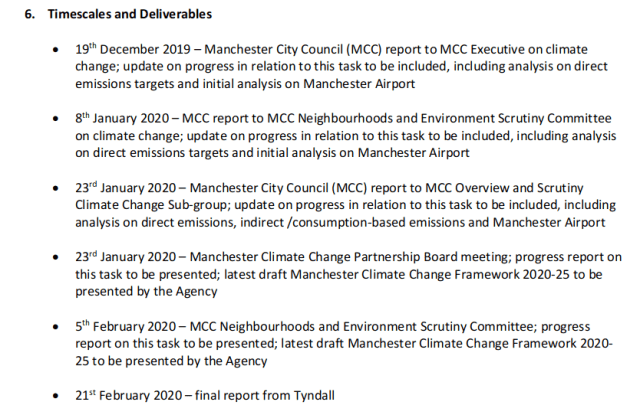
dates for your diary


Posted in Uncategorized | 1 Comment

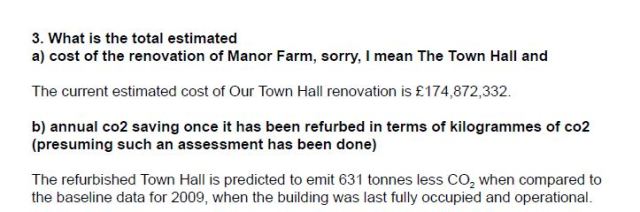
Refurbing Manor Farm- #Manchester Council spends £174m to save 631 tonnes of C02 annually

We (1) here at Manchester Climate Monthly towers are not philistines. We do not believe that, as did the planners in 1945, that you should flatten the centres of British cities for the benefit of the almighty motor car.

Castle Grayskul… sorry, Manor Far… sorry, the Town Hall is a crucial part of our heritage.  Where else could Hollywood film its Houses of Parliament interiors, after all?

But it does stick in the craw a little bit when those long-term (35 years, anyone?) residents of CG/MF/Town Hall try to say that the Town Hall refurbishment will save significant amounts of carbon dioxide

Given that it will cost (at least) £175 million, you would have kind of hoped for an annual saving of more than… 631 tonnes of C02.  That’s probably merely a hundred round trip flights to Pakistan, to choose a destination entirely at random.

cost versus refurb


Footnotes

(1) That would be the royal (but Meghan, not Andy) we.  As in me, (Dr) Marc Hudson.

Posted in Manchester City Council | Leave a comment

RETRACTION: @ManCityCouncil boasts of #climate action- but it was actually Transport for Greater Manchester’s efforts…

MCFly (i.e. editor Marc Hudson) has stuffed up.  Traffic lights and street lights are not the same thing. A FOIA about Salix and STREET lights has been submitted. Have sent this letter to MEN.

In my letter (published in today’s MEN) I stated that the City Council was taking credit for TfGM’s work on traffic lights.  That’s because I didn’t take proper note of the distinction (somewhat obvious, and clear in your reporter’s story on 23 October) between traffic lights and street lights.
The fault for the mistake is entirely mine. I have now submitted a FoIA about street lights, and the answers will appear in due course on the Manchester Climate Monthly website.  Meanwhile,  apologies to your readers, and to the City Council.  There’s a lot to criticise them on,with regards to their poor performance on climate change over the last ten years,  but this particular claim was simply not true. 
Marc Hudson

editor of Manchester Climate Monthly


Another day, another inaccurate PR effort by Manchester City Council: a Freedom of Information Act request reveals that work they lumped into their Big Number Boast was actually that of… TfGM

Last month,  the Manchester Evening News ran a story under the headline ” Manchester council is spending £69 million reducing its carbon footprint – here’s what’s being done”.

Climate Emergency Manchester sent the MEN a letter about the shonkiness of the claims in the article- and, to their credit, they published it.

And now, the plot thickens.  On the subject of LED lighting (and see here for some historical context about just. how. long. this. has. taken.) the MEN article said this-

More than 56,000 street lights are being changed for low energy LED replacements at a cost of £32.8million over the next three years. Around 45,000 have been replaced so far and the council said this has also been funded through prudential borrowing. It is understood the council has worked with Salix Finance, a company that specialises in providing loans to the public sector to improve energy efficiency, reduce carbon emissions and lower energy bills, on funding this scheme.

Great. So Manchester Climate Monthly submitted a FOIA. Questions in bold, answers in italics.

4. How much has Salix Finance received in consultancy fees, payments etc (so, ALL money to them in connection with the LED traffic lights replacement)
The Council is not carrying out an LED traffic light replacement scheme. Traffic signalling in Manchester is managed and maintained by Transport for Greater Manchester.

5. What is the total estimated
a) cost of the traffic light replacement scheme from beginning to end (a number of 32 million was quoted in the article, but that is just for 3 years)
Please see above response (question 4)
b) annual Co2 saving from switching to LEDs, in terms of kilos of Co2 per annum
Please see above response (question 4)

This, by the way, is NOT the first time the City Council has banked so-called emissions reductions from traffic lights. All the way back in 2013 Manchester Climate Monthly published a story with the self-explanatory headline-

#Manchester C02 “7% reduction” illusory; down to traffic lights moving to TfGM’s books #beyondthecarbonbudget.

Leopards and their spots, eh?

So what do we learn?  That the PR department of Manchester City Council seems to be extremely flexible (or desperate? or both?) in its understanding of
a) what counts as their spend
b) how stupid the voters are.

We can only hope that the Zero Carbon Coordination Group does not see fit to allow such tosh to be peddled.

Oh, and by the way, grok this, the first question in the FOIA.

sixty nine million bullshits

Posted in Manchester City Council | Leave a comment

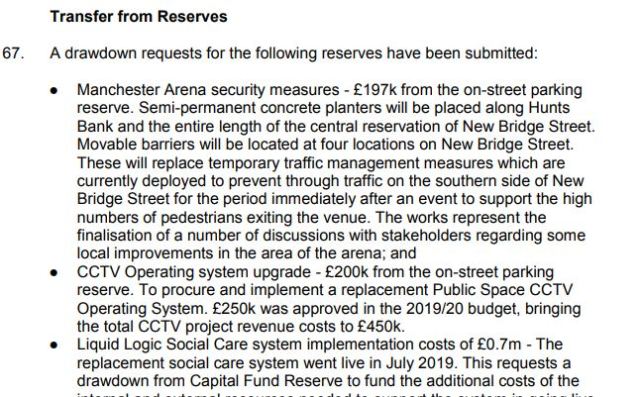
Climate #Emergency in #Manchester – but NO discussions about using financial reserves. Dosh for CCTV, though…

Manchester City Council has had precisely no discussions about dipping into its financial reserves to deal with the Climate Emergency it declared in July 2019.  A Freedom of Information Act (1)  request made by Manchester Climate Monthly can reveal that although the council is sitting on significant reserves, and although no money has been set aside or sought for dealing with our climate emergency, there have been no discussions about accessing these reserves.

Here’s the relevant bits of the FOIA

The Council financial reserves are reported at the end of the financial year in the annual audited accounts. The position as at the 31 March 2019 for the year 2018/19 were as follows:

Reserve £000
General Unearmarked Reserves 22,045
Housing Revenue Account Un-earmarked Reserves 104,451
Earmarked Reserves* 496,074
Total Usable Reserves 600,525

* Earmarked reserves are set aside for specific capital and revenue purposes

Manchester City Council’s 2018/19 Annual Accounts can be found on the following link where you will find a full breakdown of reserve balances as at 31 March 2019.  Please see Annual Accounts Note 44: Usable Reserves.

as for who decides, well –

Governance around the Council’s use of reserves is robustly detailed in Manchester City Council’s Constitution, under Part 5: Financial Regulations, Chapter 2: Accountancy, Maintenance of Reserves and Provisions (pages 21–38).  This explains the approval process and the level of authorisation applied to Chief Officers and Heads of Service, the Deputy Chief Executive and City Treasurer, the Executive and Full Council. The Constitution is published on the Council’s website and available on the link below:

And crucially, we asked for “Copies of all discussions since 11 July 2018 initiated by and /or involving the Executive Member for the Environment about use of reserves for the climate emergency.”

Councillor Angeliki Stogia, Executive Member for Environment, Planning and Transport, has confirmed she does not hold any records of any discussions since 11 July 2018 initiated by and / or involving her office on use of reserves for climate change.

But hey, guess what – there’s no money for the climate emergency, but there are HUNDREDS OF THOUSANDS for concrete bollards and CCTV. This screengrab below is from a report  – Global Revenue Budget Monitoring Report to the end of August 2019 – to Executive in October 2019 (thanks to the officer replying, very comprehensively, to the FOIA!)

draw down on reserves

So, yes, you should not dip into ‘rainy-day’ funds unless it is a rainy day.

And yes, this appalling government has starved local authorities of funding (continuing a process going on since 1987).  But if a climate emergency is not a rainy day, what is?

Watch this space.


Footnotes

(1) A Freedom of Information Act request can be made by anyone (you have to provide your name and address) to public bodies (councils, hospitals, universities). It is free to do so. The more specific you are in your request, the more likely (or “less unlikely”) you are to get an answer.  As soon as Climate Emergency Manchester’s post about ‘how to write a FoIA is up, this paragraph will link to it!

Posted in climate emergency, Manchester City Council | Leave a comment

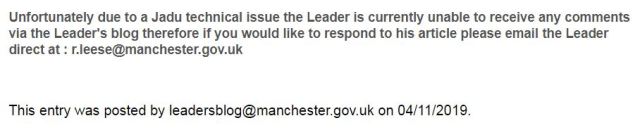
The Leader’s Blog – the plot… thins? Comments remain non-existent. #Manchester #democracy

In October the chap who has been leader of Manchester City Council for 23 – yes, twenty three – years, wrote a blog post called “How Green is My City.”  Yes, “his” city.  No achingly-revealing Freudian slip there, whatsoever….

It contains various ra…  comments about “carping” (some of us call it democracy and scrutiny), and such sensible statements as “Parked cars are zero emissions.”   The Meteor (alternative newspaper) has run an interesting series based on responses to this blog post’s claim that the Council is interested in working with citizens’ groups.

In response to the blog, and the lack of comments, Manchester Climate Monthly wrote an open letter “Are you okay, hun”) and submitted a Freedom of Information Act request with various requests about the post, the comments (or rather, lack of them) and the viewing stats..  We got a strangely speedy reply.  So we submitted another FoIA

What is the *usual* protocol for FOIAs to be dealt with – is there a policy for the information not to be supplied for 20 working days (this seems, after all, to be my experience)

Once a request for information is received the request gets logged centrally on the system the Council uses for processing requests and then gets allocated to the department who hold the information. The department will gather the information requested and will then respond to a request as soon as soon as possible. The length of time it takes a department to respond will often depend on how complex the request is. There is no policy for the information not to be supplied for 20 working days.

 Was FoIA  ITC/BH6D6H dealt with differently? Please supply the internal correspondence that pertains to this. I am particularly interested in any instructions – verbal or written, by any politically elected members, or senior officers – to expedite the matter.

I can confirm that request ITC/BH6D6H was not dealt with differently to any other request. As this was processed like all requests no internal correspondence exists.

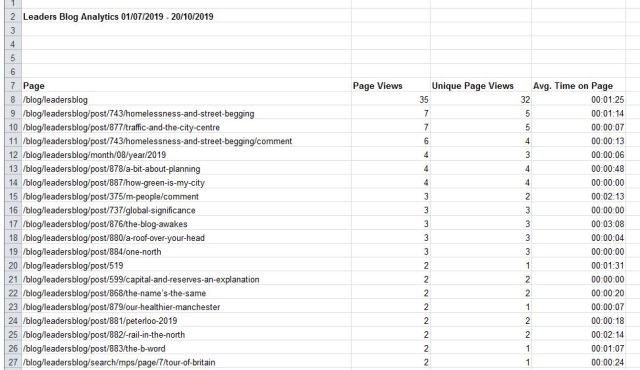
The viewing stats seem REMARKABLY low – could you please check? I know for a fact that a bunch of people looked at the now notorious (some have said other, less kind words) blog ‘How Green is My (sic – it’s 550,000 people’s) City’.

I have checked with the department who provided the information and they have confirmed the figures are correct. They noted that historically – this page hasn’t ever had particularly high figures. This could – in part – be explained by people’s personal browser settings.

So, here is a screengrab of the viewing stats I was sent.

lear blog


And meanwhile, the glorious leader has not blogged since the 4th November (but perhaps purdah?)  And the comments section is still not fixed.

if you want to talk to King Lear
Watch this space.

Posted in Manchester City Council | Leave a comment

Sustainable Consumption Institute Festival – 5th December. Tickets available

SH-Final-PRINT-VERSIONA festival of ideas at the University of Manchester’s Sustainable Consumption Institute is set to lay down a marker for sustainability research in the next decade.

The event on Thursday 5th December will draw together findings from the Institute’s research over the past 10 years, and launch their new agenda for the coming decade. The event will be open to policy makers, business leaders, researchers, and activists, as well as the general public.

The full line up for the Festival  can be found on the Sustainable Consumption Institute website

Here’s where to go to register for your free ticket.

It will feature guest speakers from all aspects of the sustainable consumption conversation. In addition to SCI academics, speakers include Corin Bell, the Founder and Director of the social enterprise Open Kitchen MCR which takes food that would otherwise go to waste and uses it to cater at conferences and events. Corin is also the Lead for the Plastic Free Greater Manchester Campaign for Mayor Andy Burnham and Greater Manchester Combined Authority.

Also speaking are Nissa Shahid, an urban planner at the London-based Future Cities Catapult, and Martine Postma, a Dutch environmentalist and former journalist who pioneered the concept of Repair Cafés, where people come together to learn how to repair the objects they would otherwise throw away.

The event will take place in the new lecture theatre of the AMBS, and the programme offers several opportunities to discuss ideas as well as to network during a break and reception to follow. The reception is being catered by Open Kitchen MCR and attendees will have a chance to sample products from sustainable local businesses including Beer Nouveau, Stitched Up doing upcycled products, Sodada doing kombucha, as well as participate in a raffle  for a bag of organic and locally-source vegetables from Veg Box People.

The event has been led by Dr Sherilyn MacGregor, Reader in Environmental Politics at the Sustainable Consumption Institute, who pointed out that the research agenda is driven by the twin challenges of growing social inequalities and a rapidly worsening climate crisis. “There are significant socio-economic barriers to the uptake of sustainable practices, products and services, and our research aims to tackle these barriers head on, alongside issues such as urban transport, meat consumption, and plastics”, she added.

Today, the SCI is a key contributor to the University of Manchester’s aim to excel in research that combines the insight of different academic disciplines such as sociology, human geography and urban studies, business and management studies, environmental politics, social movement and innovation studies as a basis for research that illuminates the ways in which consumption practices play a key role in shaping societal responses to questions of sustainable development.


Full disclosure

Marc Hudson, editor of Manchester Climate Monthly, did a funded-PhD at the SCI between 2014 and 2018, and is currently employed by the SCI.

Posted in University of Manchester, Upcoming Events | Leave a comment

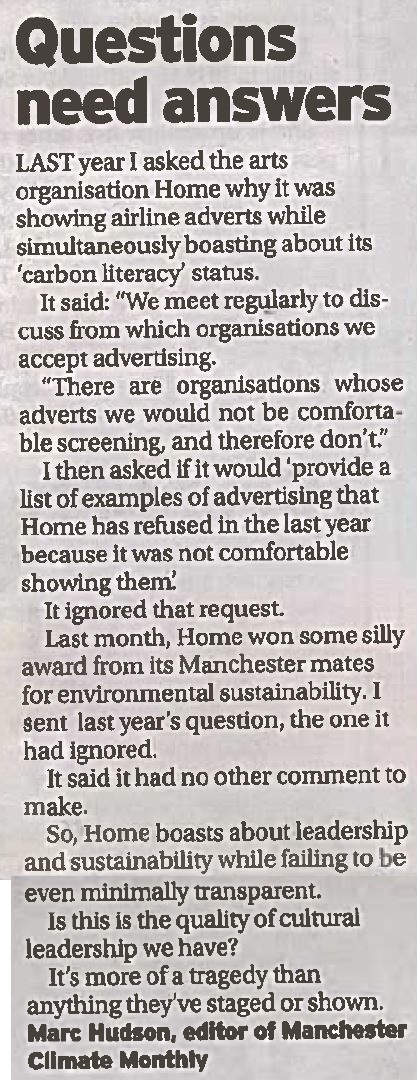
Congrats @Home_Mcr bosses- poster children for #Manchester #greenwash at its most egregious

Let’s all give a big round of applause and a vote of thanks to the bosses of HOME, Manchester arts cinema etc.  In one easy move they’ve managed to-

  1. Shred the (admittedly limited) credibility of the Manchester Culture Awards
  2. Shred their own credibility
  3. Demoralise staff within the organisation who are trying to turn green words into deeds

How did they achieve this triumphant triptych?

By collecting an award about their environmental sustainability while simultaneously shilling for the aviation industry (among others).

By ignoring the fact ….

Actually, grok this letter in today’s Manchester Evening News – it does the job.

home letter 2019 11 19 pt1


Right, where were we? Oh, by ignoring the fact that there have been long-running and successful campaigns to stop BP and Shell from laundering their reputations via the arts (see here, here and here), the managers of HOME seem incapable of reading the writing on the wall and getting ahead of – or even alongside-  the curve (1). Perhaps they assume that Manchester isn’t London, and nobody in the desolate north gives a damn about hypocrisy and greenwash?  They may be right, we shall see.

In the meantime, remember the following-

  • There ARE people on the staff at HOME who understand what greenwash is, what hypocrisy is, and how refusing adverts from specific companies is not “censorship” (really, that line has been used).
  • There ARE people on the staff at HOME who will be dismayed at this.  So, if you are at HOME and you want to make your feelings clear (or you are deciding not to go to HOME until they drop the fossil-fuel shilling), then keep your comments to staff clear, concise and compassionate.
  • The greenwash is not limited to HOME. One of its funders, Manchester City Council, has a far more horrific record. Of late, they’ve started boasting about a so-called 48% reduction in their own emissions since 2010, hoping that nobody will notice or mention that this is down to Tory austerity leading to staffing levels going down from 10k to 6k, services being cut to the bone and buildings being flogged off.


Footnotes

(1) Not the Keeling Curve – sadly, we’re gonna ride that sucker to Armageddon.

Posted in Low Carbon Culture, Manchester City Council | Leave a comment

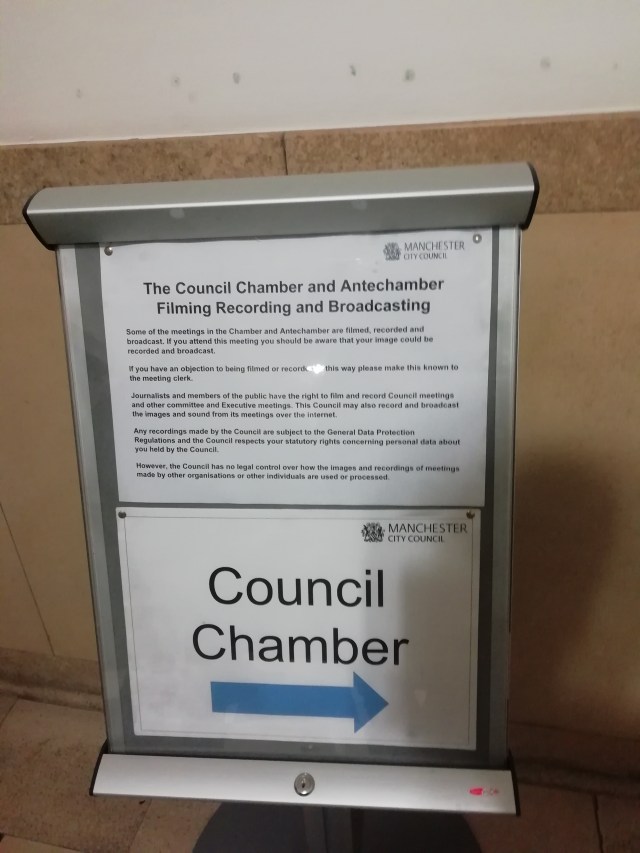
Filming #Manchester Council meetings IS allowed, despite what you are told.

The tl:dr – chairs of committees and senior officers of Manchester City Council receive NO training in the rights of citizens to film meetings.  If they make claims about filming that mean citizens are misinformed of their rights, there is zero sanction.  This is the democracy we live in.


There were two scandals at last month’s Planning Committee meeting of Manchester City Council, but only one of them got any coverage.  That’s understandable, given that it involved the approval of a car park next to a school (and induced demand while we are allegedly in a climate emergency).

The second scandal was this: both the chair of the committee (an elected member) and the senior officer (employee) of the Council made a sequence of statements about who could film what when and with permission. This was in response to a member of the planning committee, an experienced Councillor, raising the question of filming.

Watch the whole sorry display here

https://manchester.public-i.tv/core/portal/webcast_interactive/447816, under the fifth item).

It was an awful, demoralising display, even by the standards of this council.  For the benefit of any libel lawyers who may have wandered in, I am NOT stating, or even insinuating, that the chair or the officer were knowingly misleading the public.  But it is indisputable that they were guilty of ignorance, of not knowing what the Council’s actual policy on filming is.

It is this-

filming permision


And so I submitted a Freedom of Information about what training chairs and officers receive.  And what happens if they give information which is not accurate. Read the answers and weep.

1a) What training do chairs of committees (be they scrutiny, planning, whatever) receive about the actual rules concerning filming of council meetings?
The Council does not hold any information that records the training of the chairs of committees in the rules concerning the filming of meetings. If there has been such training, we have no record of it.
1b) What training do members of the strategic management team receive about the actual rules concerning filming of council meetings? 
The Council does not hold any information on the training of the strategic management team in the rules concerning the filming of meetings. If there has been such training, we have no record of it.
2a). What sanctions are in place for chairs who do not inform members of the public about the actual (as opposed to preferred/imagined) rules are about filming. 
The Council’s policy on procedures are explained on this page of the website.
2b). What sanctions are in place for members of the strategic management team who do not inform members of the public about the actual (as opposed to preferred/imagined) rules are about filming? 
A copy of the Council’s Disciplnary Policy is attached, were it considered to be a matter that required formalor informal disciplany action to apply a sanction.
3) Given that at the Planning Committee meeting on 17th October showed a remarkable ignorance of the actual rules about filming by the Chair of the committee and a member of the strategic management team, has remedial training in the Council’s rules been considered? If so, by who? When and how will it be implemented (so, for example, if an email has been circulated, please provide a copy). 
The Council does not hold any information on whether remedial training in the Council’s rules has been considered.
If no remedial training has been considered, are we to infer that the Council is perfectly happy for incorrect information to be circulated and left uncorrected? 
This is not a request for information so no response is possible I’m afraid.
4) Will there be a public apology to the members of the public who were given rampantly incorrect information about their rights at the meeting on the 17th October
The Council does not hold any information on future intentions in relation to the matter you are asking about.
Posted in Manchester City Council | Leave a comment

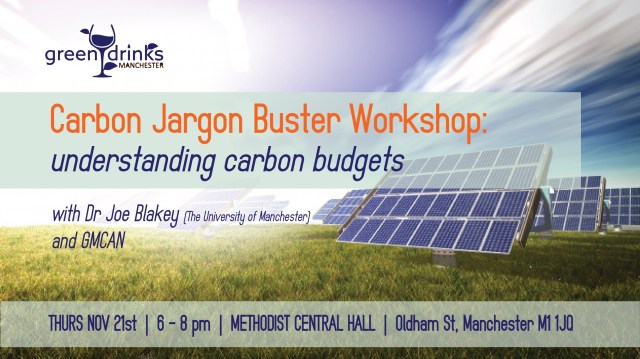
Upcoming Event: Climate Jargon Buster Green Drinks, Thurs 21st, #Manchester

On Thursday 21st November, the next “Green Drinks” will be held at the Methodist Hall on Oldham St, central Manchester. Details on the poster here. No need to book, just turn up. It’s a session about the jargon around climate change, with Dr Joe Blakey (1)  There’s an interview with him below…
IMG_6217.jpg

Who are you?
I am a Lecturer in Geography at The University of Manchester. I’m a Political Geographer and I’m interested in decarbonisation politics and the ways in which how we count carbon shapes this.

What’s the most annoying/misleading bit of climate jargon, that misleads people the most
My biggest bugbear is not stating what ‘zero carbon’ refers to. In most city plans and government publications it refers to our goal of zero carbon energy and transport systems. It typically does not capture how we might reduce our influence in carbon intensive activities elsewhere (e.g. through our investment, consumption, aviation, shipping). In a globalised and interconnected world this is imperative and we should not gloss over the wider implications of our actions.

What is the second most annoying/misleading bit of climate jargon?
Carbon reduction dates, such as the UK’s ambition to reach zero carbon (in terms of our energy consumption and point source emissions) by 2050. The crucial thing to consider is the total amount of carbon emitted as a whole between now and the end of the century (cumulative emissions). We need to keep this as low as possible and the date when we go zero carbon is only part of that complex puzzle. The problem is in much debate we tend to only talk about the zero carbon date.

There’s all these different numbers floating about with regards to Manchester’s record on climate change – 41 per cent of this, 48 per cent of that. Is there a simpler way of thinking about how much carbon we have spent, how much we have left if we are to be fair to the rest of the people on this planet, let alone all the other species?
The Tyndall Centre have said that Manchester is only allowed to emit 15 million tonnes of CO2 (directly, or from our energy consumption) between 2018-2100 to play our ‘fair’ part in keeping temperature increases below 2 degrees against pre-industrial levels. We used around 2 million tonnes of this last year alone. Thinking in tonnes allows us to see how much we’ve got left and how fast it’s running out!

A similar picture can be seen at a Greater Manchester level too, where there is a budget of 71 million tonnes of CO2 (directly, or from our energy consumption) that it must not exceed between 2018-2100.

In short – we need to think in tonnes and think about spending these tonnes of carbon very wisely indeed!


Footnote

(1) Full disclosure – Dr Blakey is a good friend of the editor of this website.

.


Posted in Upcoming Events | Tagged , | Leave a comment

Prof Kevin Anderson on #climate, Cohen and what is to be done… #Manchester

Before you watch this footage of Professor Kevin Anderson (filmed in WonkyCam), please fill in this very short survey from Climate Emergency Manchester (1).  You can do it anonymously…

Prof Kevin Anderson, of University of Manchester’s Tyndall Centre was in typically robust, take-no-prisoners, call-a-spade-a-spade form as he spoke to a room of young and old at the University today.  Here are the three videos, covering the talk and (some of) the Q and A.

First part

Second part

Third part (inc Q and A)

Footnotes
(1) I (Marc Hudson, am editor of Manchester Climate Monthly. I am also one of the five core group members of Climate Emergency Manchester
 

Posted in youtubes | Tagged | 1 Comment