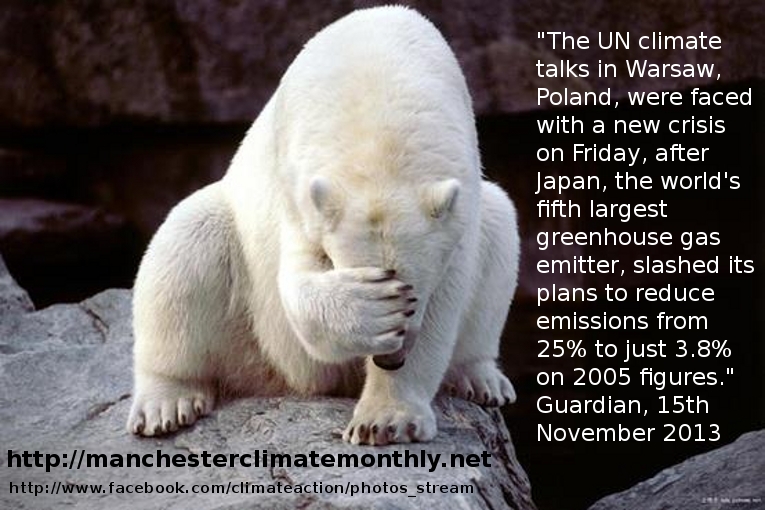
Polar Bear Facepalm: Japanese back-pedalling on #climate goals

Thank goodness that the British are showing the Way Forward on climate change, not like Johnny Foreigner… No, wait…

polarbearjapanbacktracksinwarsaw

Posted in Uncategorized | Leave a comment

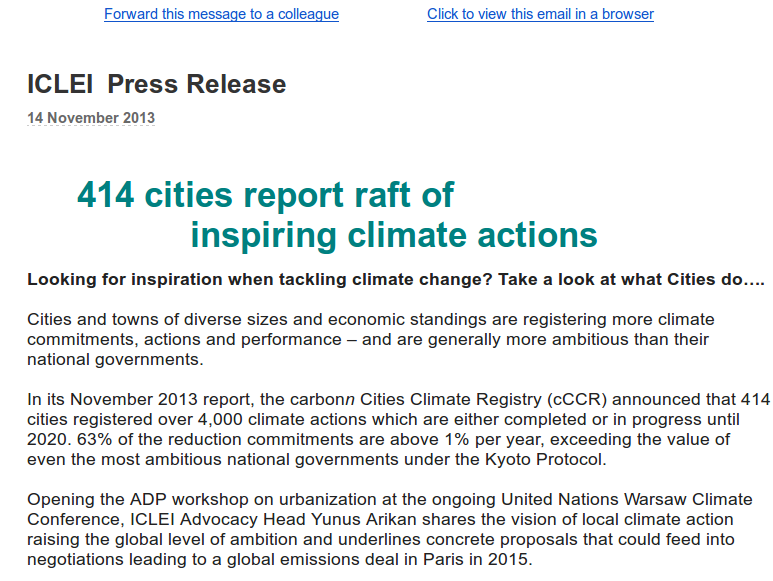
“414 cities report raft of inspiring climate actions” not #Manchester though…

ICLEI “is the leading local authorities network addressing sustainable development. Since 2010, it has been operating the cCCR, the world’s largest database of local climate action through the voluntary reporting pursuant to political commitments (i.e. signatories of Mexico City Pact), capacity building efforts at the national level (i.e. Japan Registry, PACMUN Project in Mexico and Urban-LEDS Project in Brazil, India, Indonesia, S. Africa), and by creating incentives (i.e. WWF Earth Hour City Challenge implemented in 15 countries).”

icleipressrelease

See if you can see Manchester on this map…

http://relaunch.citiesclimateregistry.org/data/

Posted in Uncategorized | 3 Comments

Film Showing: “Trashed” in Urmston, Fri 22nd Nov – Breathe Clean Air Group & #Manchester Film Coop

There’s only 150 tickets, so you are advised to book via tickets@breathecleanairgroup.co.uk

trashed

Posted in Upcoming Events | Leave a comment

Good News Saturday: TreeStation gets Santander dosh, Stockport sustainable food dosh

Santander Award
“TreeStation has won a £20,000 Santander Social Enterprise Development Award to help us develop our biomass business. The money is being used to make improvements to the big biomass chipper and to engineer a better power unit. This is a huge boost to the business and helps us to deal with our most pressing issue, which is to increase sales of biomass woodchip.”

And from the Kindling website

The Kindling Trust is delighted to announce that our bid to make Stockport part of the UK-wide Sustainable Food Cities Network has been successful. Stockport is one of only six places across the country to be selected for the project and will receive a share of the £1m funding. The funding will allow Kindling to employ a full time project worker who will work closely with the community and the council to revolutionise the chain of local food production, distribution and consumption.

The award will support our partnership with Stockport Council and and enable both organisations to move towards our goals of using healthy and sustainable food to address some of today’s most pressing social, economic and environmental problems including obesity, food poverty and climate change.

The national project will allow different areas to learn from each other and work together to make healthy and sustainable food a defining characteristic of their town or city.

Councillor Stuart Bodsworth, Stockport Council’s Executive Member for Communities and Sustainability, said: “Being selected to be part of this pioneering new project is a real boost for the town and will help us to play our part in transforming food culture.

“The Sustainable Food Cities programme is about using food to improve people’s health and wellbeing, creating new businesses and jobs and reducing our impact on the environment. Food is not only at the heart of some of today’s most pressing social, economic and environmental problems including obesity, food poverty and climate change but it is also a key part of the solution.”

Chris Walsh of the Kindling Trust added: “Everyone at Kindling is thrilled to be bringing the Sustainable Food Cities funding to this area. The people of Stockport and their council have already shown fantastic energy and enthusiasm in supporting us. We want to revolutionise the local food supply and make Stockport an example to other towns and cities across the country.”

The Sustainable Food Cities Network is an alliance of public, private and third sector organisations using food as a vehicle for driving positive changes. The Network helps people and places to share challenges, explore practical solutions and develop best practice in all aspects of sustainable food.

Tom Andrews, national programme manager of Sustainable Food Cities said:

“We had amazing applications from cities across the UK and the competition was incredibly strong, but in the end the selection panel felt that Stockport had a particularly inspiring vision of how they would make healthy and sustainable food a defining characteristic of their city and the commitment to make it happen.

“We are really looking forward to working with Stockport over the next three years to show just what can be achieved when individuals and organisations from every sector work together to transform their city’s food culture.”

For more information about Sustainable Food Cities visit http://www.sustainablefoodcities.org

Posted in Uncategorized | Leave a comment

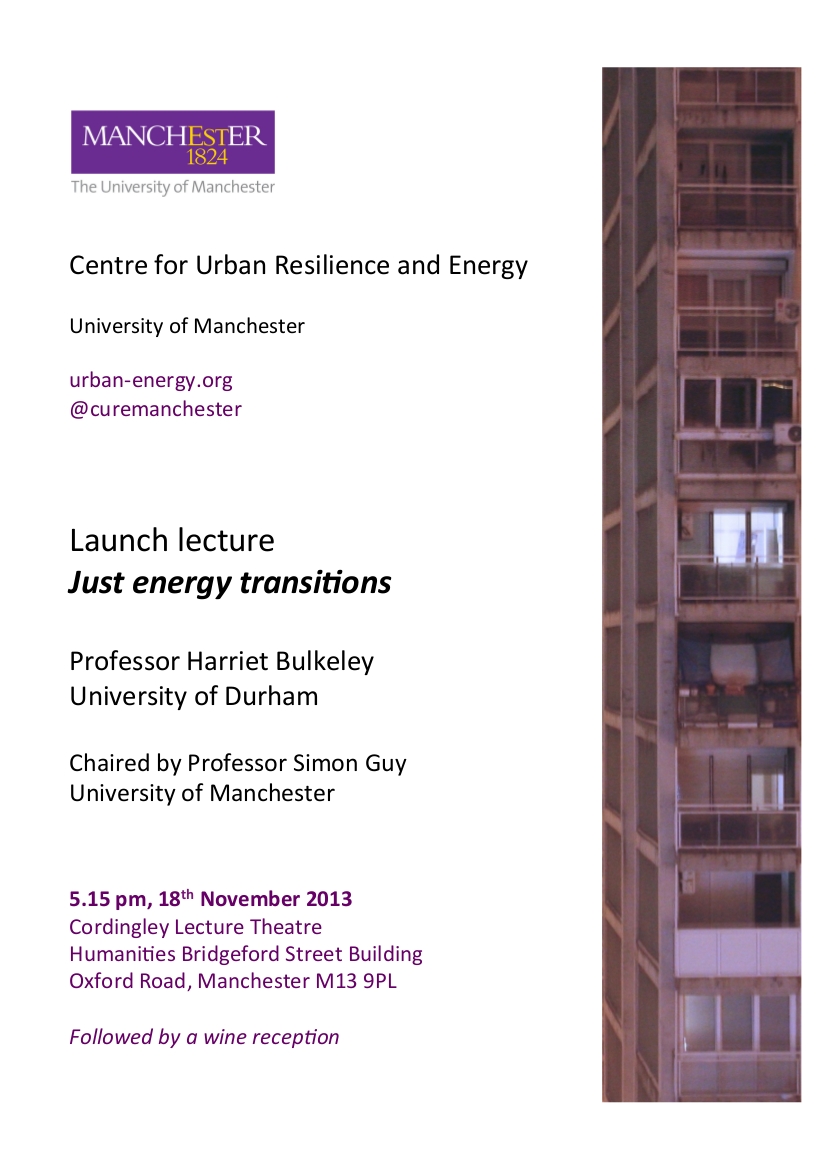
#Manchester Centre for Urban Resilience and Energy: A CURE for all our ills?

curelaunchflyerOn Monday 18th November the University of Manchester’s Centre for Urban Regional Ecology becomes the Centre for Urban Resilience and Energy. There’s a launch event and all

Ahead of that, we’ve put some questions to its co-director Joe Ravetz…

1) Name changes and rebrandings are usually a sign that something has gone wrong…  what went wrong with the centre for urban and regional ecology?
The concept of urban & regional ecology (as in “CURE1”) will continue as a fascinating and essential line of enquiry, for anyone who is interested in the possibility that humankind could inhabit this one planet without wrecking it.

But these things have a kind of life cycle, not only in the ideas and research results, but in the people who bring them to life. CURE1 was originated in 1999 by John Handley, former director of the world’s first Groundwork Trust, and Joe Ravetz, author of ‘City-Region 2020: integrated planning for a sustainable environment’. John retired in 2010 (although very active on other fronts), and Joe has since developed a next generation of theory and practice as in ‘Urban 3.0 – creative synergy and shared intelligence for the one planet century’ (Earthscan, 2014)

So it was very timely that Stefan Bouzarovski arrived in time to be the incoming director of the Centre for Urban Resilience and Energy (“CURE2”) – whose agenda of resilience, vulnerability, transitions, social learning, institutional analysis etc, fits very well with the current wave of thinking both in Manchester and generally.

2) What will the new CURE do that the old CURE didn’t?
CURE2 has a specific focus on energy poverty and vulnerability in housing, which is at the moment very topical and controversial. This has both a technical strand, and a political / ethical edge, which I think is essential in these days of austerity (for some) and the emerging internal contradictions of the system.

Other CURE-type programs will continue, such as climate adaptation and climate mitigation, public participation, spatial development etc. These are increasingly oriented towards the above agendas of transitions, resilience, institutional change, social intelligence etc. There is also much greater awareness of social media and communications, as on the website.

3) How will the people (present and future) of Manchester benefit from the new CURE?
As you know most academic work is basically aimed at the world stage. But CURE has always formed very strong collaborations with its context, whether that is Manchester, GM, the Northwest, UK or EU. We expect positive interactions between research and policy in each of the areas above.

4) How will we know in a year’s time that the new CURE is making the planned impact?
We are aiming at a series of open events, and so the results in late 2014 should be there to see and discuss.

5) Desert Island Disks time; The Cure or the Smiths?
CURE is an open-ended word & the right lyrics are out there somewhere

6) Anything else you’d like to say?
Watch this space…

Posted in academia | Leave a comment

#Trafford – Highways Agency admits motorway pollution 50% above regulations

Press Release –

Members of Trafford’s Breathe Clean Air Group attended a public consultation on the future of the M60 motorway between junctions 8 at Sale and 20 at Rochdale, held at a local Leisure Centre on Friday 8th November. The proposals concerned improving motorway travel by converting the hard shoulder to an extra traffic lane.

“The Agency admitted that nitrogen dioxide air pollution caused by traffic fumes was already 50 percent above the regulated maximum,” said Pete Kilvert, Chairman of the group, “and we understand that they will be scrapping plans to install the extra lane between junction 8 at Sale and 18 at the M66 junction near Prestwich. It seems that limiting the speed of vehicles along this already busy section is the answer to controlling exhaust emissions pollution”.

The Breathe Clean Air Group has been campaigning to improve air quality for over three years since the announcement to build the Barton Renewable Energy Plant. Trafford Council rejected the plant, but a public Inquiry in November last year ruled in favour of the incinerator plant. Now Trafford Council has appealed against that ruling. Emissions from the incinerator will pollute Trafford, Salford and Manchester.

“The major polluter in this area is the motorway,” said Pete Kilvert, “but any additional air pollution is taking us in the wrong direction. Proposed developments such as the waste incinerator and the Coal Bed Methane extraction plant (Fracking) on the south bank of the Manchester Ship Canal, will not only add extra nitrogen dioxide to the motorway pollution, but other nasties as well, such as heavy metals, Particulate Matter, dioxins and benzene, all of which can cause cancer.

The Breathe Clean Air Group is concerned about the five Trafford schools and several Salford schools that are within yards of the motorway and in the fall-out zone of the proposed waste incinerator and fracking plant. It is well known that children’s lungs and immune systems are not fully developed and are susceptible to air pollution. Children exercise more, and breathe in more than adults. Any air pollution that settles on the school playing areas will be kicked up and breathed in.

“That is why we must reduce air pollution,” added Mr Kilvert, “to protect the next generation as well as the current population”.


If you want to get involved in BCAG – here’s their website. And their email info@breathecleanairgroup.co.uk.

Posted in press release journalism | Tagged | 1 Comment

Upcoming Forum: “Is #Manchester a Sustainable Food City?” Mon 25th Nov

foodfuturesFood Futures Forum
25th November 2013
9.30am – 12.30pm
Mechanics Institute
Princess Street, Manchester M1 6DD

Is Manchester a Sustainable Food City?

Dear all,

Everyone is welcome to attend the next Food Futures Forum.

The Forum is an opportunity to meet others with an interest in the food agenda in Manchester, share ideas, develop collaborative work and shape priorities for food work in the city. The focus of the forum will be on making Manchester a sustainable food city by identifying what actions will have the greatest health, social, environmental and economic benefits for Manchester people and wider society.

Speakers will be:

Tom Andrews, Director of Sustainable Food Cities Programme will provide us with inspirational examples of what could be achieved in Manchester.

Mike Berners-Lee, Director of Small World Consulting will be presenting the findings from ‘Sustainable Food in Manchester’ – a study commissioned by Manchester City Council to inform Food Futures and Manchester:A Certain Future strategies.

The Forum is free and open to anyone, however places are limited and filling up fast so please register as soon as possible if you haven’t already done so.

Please email Lindsay Laidlaw l.laidlaw@manchester.gov.uk to register.

We look forward to seeing you on 25th

Regards

Christine

Christine Raiswell
Programme Manager – Food Futures
Public Health Manchester
Manchester City Council
Tel: (external) 0161 234 4268
Tel: (Internal) 800 4268
Fax: 0161 274 7006
Email: c.raiswell@manchester.gov.uk
http://www.manchester.gov.uk/health/jhu
http://www.foodfutures.info

Posted in Food, Manchester City Council, Upcoming Events | 1 Comment

Polar Bear Facepalm: Warsaw talks attended by office juniors

From the Grauniadpolarbearwarsawministers.

Posted in Polar Bear Facepalm | Leave a comment

Event Report: “Fossil Free Europe” in Birmingham #climate @350

MCFly writer Claire Woolley reports on the “Fossil Fre”e European Tour event at the University of Birmingham 31st October 2013.

spectacularclimesThis autumn, the Fossil Free campaign travelled to Berlin, Amsterdam, Edinburgh, Birmingham and London to inform and inspire anyone concerned with climate change and the moral implications of educational institutions funding fossil fuel industries. As a prominent climate author and co-founder of 350.org, Bill McKibben led proceedings, accompanied by a wide range of students, activists, faith campaigners and other speakers.

The Birmingham leg of the tour was hosted by the University of Birmingham and organised by the University’s People and Planet Society. This ‘lecture’ began in a way nothing like an average lecture, with the ground-breaking artist Filastine performing their refreshingly unique brand of protest music. Far from the likes of Billy Bragg and his singer-songwriter contemporaries, Filastine’s work employs a range of unconventional instruments (even a shopping trolley at one point) to create powerful, ominous music. Reinforced by visuals showing dark, grainy scenes of oil extraction, environmental degradation and the resulting abject poverty, the effect was to create a strong enough sense of doom to unsettle even the most fervent climate change sceptic.

Bill McKibben began his talk by outlining a number of recent events which exemplify the real-world impacts of climate change, including America’s record droughts in 2012, floods across England in the same year and the warmest May on record that summer. McKibben’s charisma and light-hearted anecdotes lifted the atmosphere in the room somewhat before drawing focus to more serious business; in particular the business of numbers. In his article Global Warming’s Terrifying New Math, McKibben outlines three important numbers:

  1. 2°C , the increase in temperature at which world leaders and scientists are almost universally agreed that catastrophic changes will be experienced
  2. 565 gigatonnes, the limit of additional carbon dioxide which can be added to the atmosphere without causing an increase in temperature above the agreed 2oC
  3. 2,795 gigatons, the volume of carbon dioxide ‘locked away’ in known fossil fuel reserves. That is, 5 times more than the decided 565gt limit

After illustrating and discussing the significance of these numbers (with a little help from beer-related visuals), McKibben moved on to discuss the significance of our universities in this issue. UK universities collectively have £5bn invested in fossil fuel companies, equating to £2000 per student, with Cambridge, Oxford and Edinburgh being among the largest investors.

On to the good news; McKibben told the audience the story of the divestment campaign in South Africa (which helped progression toward the ending of apartheid), and the rapid spreading of the Fossil Free movement in the United States during the year since its genesis. In this time, over 40 US institutions, comprised largely of universities and churches, have responded to the call to withdraw their funds from damaging activities.

On this decidedly promising note, Giles Goddard (Canon of St. John’s, Waterloo and associate of Operation Noah) took to the stage to discuss the issues of climate change within the Church. Goddard spoke eloquently about issues of economic morality within the Church, including his own church investing in Fairtrade and cutting funding to certain construction companies guilty of selling their machinery to be used for demolishing residential areas in Gaza. He went on to describe the Church’s involvement in fossil fuel industries as “funding the opposite of creation” and urged those of any or no faith to call for disinvestment as a means of keeping that excess 2,230 gigatonnes of CO2 in the ground.

Goddard was followed by Alice Swift, a student of the University of Birmingham and an active member of the People and Planet society. Swift spoke of her time spent with those in some of the poorest parts of the world who are suffering as a result of actions of more developed nations. Swift discussed the People and Planet society’s objections to their institution’s chosen destination of funds and called for the withdrawal of funds from damaging activities, which was met with a keen round of applause.

The event ended on a positive, inspiring note with McKibben wrapping up proceedings before some short thanks from People and Planet organisers. Filastine took to the stage to play the audience out, most of whom stayed behind to sign various petitions, purchase Fossil Free merchandise or talk about getting involved.

The Fossil Free tour culminated on 1st November in London, on the opening night of the Shared Planet weekend, a weekend filled with debates, workshops and skill-shares. This is one of many future events intended to inspire and empower those of all ages and backgrounds to demand better from their authorities (whoever they may be) and to ensure their own money is not being spent on activities which promise to damage all of our futures.

To find out more about Fossil Free and get involved, visit gofossilfree.org

Posted in Campaign Update, Event reports | Leave a comment

Fracking Camp at Barton Moss. #Manchester #Eccles. Public meeting. Thurs 21st Nov

This just landed in our email box.

“The fight against fracking in Greater Manchester is an important battle in the war against CO2 emitting fossil fuels and it is hotting up. A camp has been established near the site where Igas are planning to drill an exploratory well. It is at a layby just north of Barton Moss Secure Care Unit, Barton Moss Rd, Eccles, Manchester M30 7RL  (this is near Junction 11 of M60, right turn off Liverpool Rd on way to Irlam, signposted for heliport.)”

There are already at least three campers there, more expected shortly. They need:
visitors!

and any of following if you can:
blankets
extra duvets or sleeping bags
jumpers
thermals
socks
jackets/fleeces
hot home cooked food and any other food including cake
foam for lining tents
old truck tyres
pallets
wood for fire
plastic garden chair
placards with suitable slogans

Also there’s a meeting of the campaign against fracking at Barton Moss :
next Thursday, 21st November, 7-9pm
at Friends Meeting House, Eccles
13 The Polygon
Wellington Rd
Eccles
M30 0DS

Please come along for an update on Igas’s plans, the campaign (eg two local meetings will have been held by then) and to get involved if you can.

Posted in Campaign Update | Leave a comment