Exchange for Change: “skills share” held, lessons learnt

Exactly a month ago Manchester Climate Monthly tried to hold a skill-share.

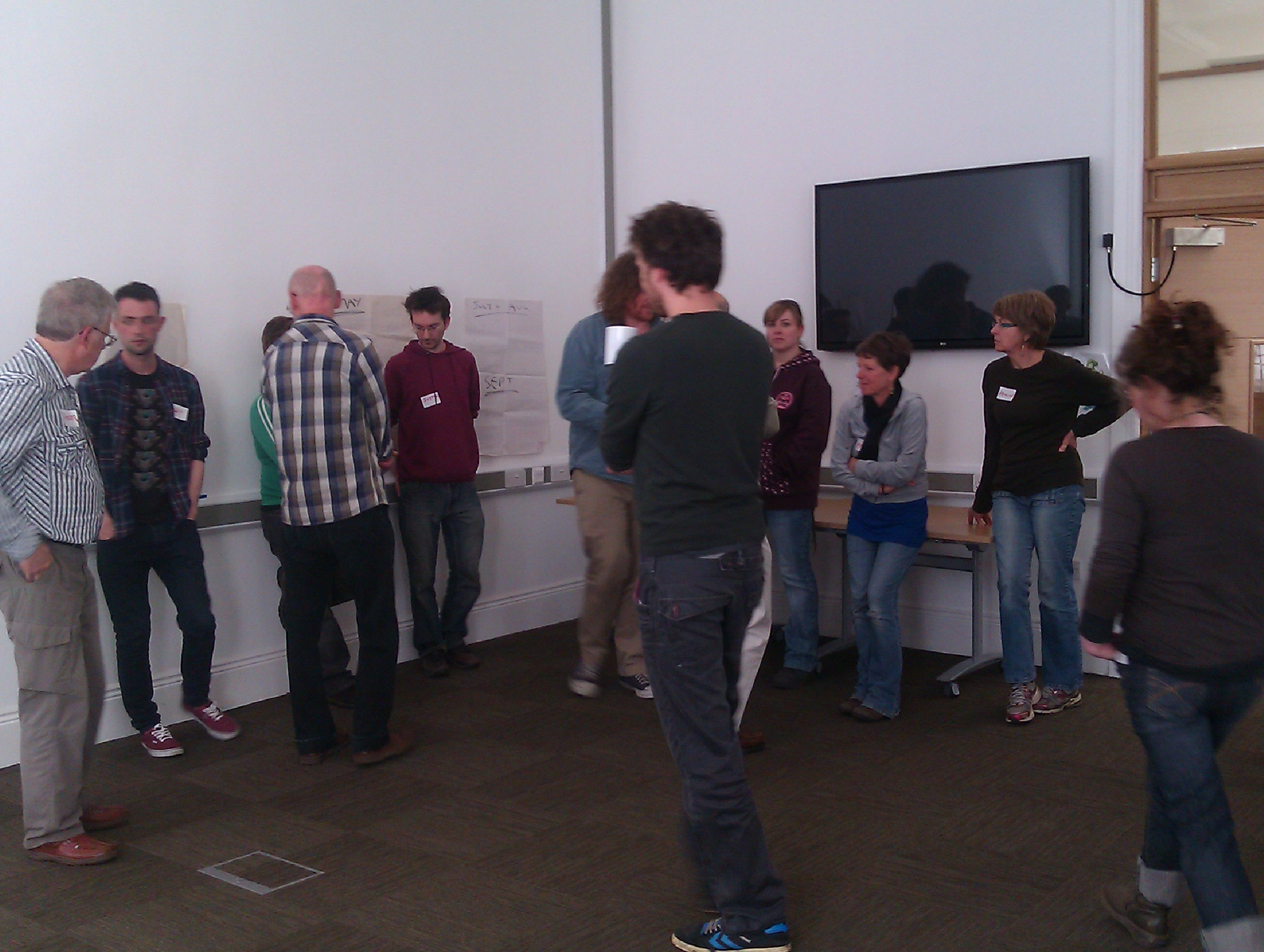
exchangeforchangeThe (15) people who came seemed to enjoy themselves a lot, and made new connections. But overall, the numbers were too low (1) for it to have achieved what it could have (which was to get a toe-hold for the “activist skills and knowledge” framework into the consciousnesses of individuals and groups.

Here are the type-ups from small group discussion that various people very kindly sent in almost immediately. Below them are the types-ups that I only now could face doing.

How to get out of the ghetto or “stop preaching to the converted.”
Approach diverse groups
Make a concerted effort to list as many groups as you can think of.
Use diverse media – not “one size fits all”
email / leaflets / posters / social media
make it fun and interesting
people like different ways of being informed
use language appropriate to different groups
Be interactive
engage people in different ways – people learn in different ways
make it fun!
Provide a welcoming atmosphere
Welcome every individual!
Make people aware that they have not walked in to a clique
Provide very simple ways to get involved – This helps overcome the “don’t have time” barrier
Find a way of valuing people’s opinion that they can appreciate and respond to – Saying, “I value your opinion,” is not enough.
Allow people to feel ownership
Find people in the community who can engage their peers
Find a way to make space for people in their own environment – The closer to home, the less effort or reason is required to attend.
Offer solutions

  • Make them practical
  • Make them ground up
  • Make them easily applied
  • Make sure the solutions show visible effects quickly enough to enthuse and encourage people.

That last bit reminds me of common advice for new programming teams: Start with an easy-win that requires just enough effort so that people need to work together. Then do something that is challenging enough to make the team feel tested and that you are sure is possible.

How to sustain momentum
1) use what you have – personal interest in particular topics or expertise.
2) Go to other’s meetings. Go to people rather than get people to come to you. Go to events that aren’t specifically about the environment, but related: e.g. health events.
3) Have a good reason to meet and hold events.
4) How you you get feedback and evaluate an event – act on what you are told.
5) Think about follow up, set targets for what each attendee is going to do afterwards. Ask about progress.
6) Don’t set a topic to be too broad or the aspiration too vague or in the future.
7) Have regular meetings, tell people when the next on is. Continue a discussion rather than have one-offs.
8) Structure is important – but make it work in the background. events should feel natural and spontaneous.
9) Different people communicate and take on-board things in different ways. Have a mix of techniques for sharing information.
10) Think about location and time of events to e.g. convenient and accessible for the type of people you want to attract.

Here’ what people wrote on the various flip-charts dotted around the room…

I want (to be able to)
calm communications
food growing
fund-raising
community engagement/outreach/pre/media
welcoming/attractive to newbies
collaborative working
speaking truth/positively
communicate
motivate
network/create links
organise events
able to communicate at all levels
empathise
self-preservation/burnout avoidance
meme warfare
project management
establish connections and develop understanding
articulate clearly what our organisation does and why
communicate fluently and calmly
speak French fluently
knowledge of environmental creative ideas

I can
facilitate
build websites
sing
organise high profile events for communities
writing
rhetoric
philosophy/aesthetics debate
write pretty good business plans

Activists in Manchester should
Get drunk more often together
Keep their websites up to date
Not use the word “should” because it’s tension-provoking
Reach out
Support each other
Yes support each other more

Gaps in my knowledge
Local economic figures and opportunities – x 2
Greater Manchester politics – x 2
Amount of embedded energy in consumer products
food growing
Administration
Getting answers (concrete ones) from Manchester City Council

I want training in
Communicating calmly with people who don’t hold my opinions, beliefs and knowledge
Social media
Animation
Funding
[Someone has written – “I might feel like offering a short-term group of attaining calm!]

Calendar
June
25th Fuelling Manchester #6
28th AfSL recruiting 6 local project managers (volunteer)
End of June for applications. Receive £600 free training in community project planning
30th An economy for the 99% – organised by Climate Survivors and the Alliance for Jobs and Climate

July and August
Eco-house in Chorlton open
Shop/community space open to rent
13th July Feeding Manchester
28th Matt Rowe leaving

Sept
Moss Side Community Allotment open day – date to be confirmed

Marc Hudson
mcmonthly@gmail.com

Footnotes
(1) The numbers were low because, for various reasons – MCFly had not plugged the event as regularly and religiously as you need to in order to make things happen.  That’s lesson number one.  Lesson number two is, I think, that without specific skills being offered (“come learn how to write a press release/do basic bike maintenance/deal with denialists” then folks think it will be all too general and airy-fairy for them to bother with.

Posted in Event reports | Leave a comment

#Manchester #climate nuggets 27th May 2013

Hi all,

congrats to the Envirolution crew for organising a fun and relaxed event in Platt Fields yesterday. (and  a special shout out to the meteorological liaison officers who ensures such good weather!)

Wanna flex your creative muscles, and maybe win £200?   Here’s the details of our short story contest all sorted.  Two thousand words (in English) on the subject “Manchester (UK) in a warmer world.”

 Arwa Aburawa and Marc Hudson

Coming up this week

Tuesday 28th, 6pm to 8pm “A Sustainable Future for Manchester” “in conversation” series. Food with Pam Warhurst, Incredible Edible Manchester Museum, Oxford Rd. Free. See here for details http://events.manchester.ac.uk/event/event:q8r-hcrtq73c-c5o4cm/a-sustainable-future-for-manchester

Weds 29, 6pm Cafe Scientifique: Frogs, people and ferns – how to save the rainforest and its contents Professor Richard Preziosi
Conserving the rainforest as a whole, the animals and plants that live there, and the livelihoods of indigenous peoples needs to be approached as a whole. Find out about one unlikely researcher’s attempt to do this in the jungles of Ecuador and the laboratories of Manchester.
Kro Bar, Oxford Road

Friday 31st Critical Mass bike ride. Starts at Manchester Central Library, 6pm

Stories you may have missed on the MCFly website

Things to read while the algae grows on your fur:

The Discontent of Our Winter – Are reliable seasons gone for good?

Posted in Uncategorized | Leave a comment

Polar Bear Facepalm: Presidential promises since 1988… #tarsands #obama #climate #toast

Elizabeth Kolbert is the author of the awesome “Field Notes from a Catastrophe”Her article on Obama’s impending decision on allowing a tar sands pipeline to be built is short and bittersweet and essential reading.

polarbearkolberttarsands

Mauna Loa is the observatory in Hawaii where – far from point sources of carbon that would cause bad sampling – the boffins have been charting the increase in atmospheric carbon dioxide since 1958. Species be crazy. What can you do?

Posted in Energy, Polar Bear Facepalm, Signs of the Pending Ecological Debacle | Tagged | Leave a comment

Monthly Journal Overview May 2013 #Manchester #climate #academia

MoJO May 2013

compiled by Claire Woolley

This month, our selected articles look at how we use energy in our home, as well as wider international discussions on energy security, political policy, and the responsibility of producers. A little closer to home, one article in European Planning Studies explores the role of individuals in urban governance in Liverpool.

Antipode (Vol. 45, Issue 3, 2013)

Participation”, white privilege and environmental justice: understanding environmentalism among Hispanics in Toronto

Gibson-Wood, H.; Wakefield, S.

http://onlinelibrary.wiley.com/doi/10.1111/j.1467-8330.2012.01019.x/abstract

The environmental justice movement has highlighted not only the unequal distribution of environmental hazards across lines of race and class, but also the white, middle-class nature of some environmentalisms, and broader patterns of marginalization underlying people’s opportunities to participate or not. There is a significant body of work discussing Hispanic environmental justice activism in the US, but not in Canada. This paper draws on interviews with representatives of organizations working on environmental initiatives within the Hispanic population of Toronto, Canada to explore definitions of and approaches to environmentalism(s) and community engagement. Four interrelated “mechanisms of exclusion” are identified in this case study—economic marginalization; (in)accessibility of typical avenues of participation; narrow definitions of “environmentalism” among environmental organizations; and the perceived whiteness of the environmental movement. Taken together, these mechanisms were perceived as limiting factors to environmental activism in Toronto’s Hispanic population. We conclude that the unique context of Toronto’s Hispanic community, including contested definitions of “community” itself, presents both challenges and opportunities for a more inclusive environmentalism, and argue for the value of “recognition” and “environmental racialization” frameworks in understanding environmental injustice in Canada”

Capitalism Nature Socialism (Vol. 24, Issue 1, 2013)

Appropriate technocracies? Green capitalist discourses and post capitalist desires

Goldstein, J.

http://www.tandfonline.com/doi/full/10.1080/10455752.2012.759253#.UZJDmrUsng8

With each passing day, the accumulating evidence of our near certain ecosystemic decline becomes harder and harder to ignore. Coupled with a profoundly inertial response to these trends, capitalist societies are proving themselves to be thoroughly incapable of preventing our collective self-annihilation.

All of the earnest, well-intentioned sentiment, all of the scientific alarm, all of the expressed desire*and will*to make the world a better place, amounts to very little, very late. While we may see traces, as Erik Swyngedouw argues, of a post-political condition where apocalypse is endlessly forestalled, presented as something we can still avoid through techno-managerial control, James McCarthy reminds us that for many people on this planet, the apocalypse has already arrived.”

Climatic change (Online preview, May 2013)

If climate action becomes urgent: the importance of response times for various climate strategies

Van Vuuren, D.P.; Stehfest, E.

http://link.springer.com/article/10.1007/s10584-013-0769-5

Most deliberations on climate policy are based on a mitigation response that assumes a gradually increasing reduction over time. However, situations may occur where a more urgent response is needed. A key question for climate policy in general, but even more in the case a rapid response is needed, is: what are the characteristic response times of the response options, such as rapid mitigation or solar radiation management (SRM)? This paper explores this issue, which has not received a lot of attention yet, by looking into the role of both societal and physical response times. For mitigation, technological and economic inertia clearly limit reduction rates with considerable uncertainty corresponding to political inertia and societies’ ability to organize rapid mitigation action at what costs. The paper looks into a rapid emission reductions of 4–6 % annually. Reduction rates at the top end of this range (up to 6 %) could effectively reduce climate change, but only with a noticeable delay. Temperatures could be above those in the year of policy introduction for more than 70 years, with unknown consequences of overshoot. A strategy based on SRM is shown to have much shorter response times (up to decades), but introduces an important element of risk, such as ocean acidification and the risk of extreme temperature shifts in case action is halted. Above all, the paper highlights the role of response times in designing effective policy strategies implying that a better understanding of these crucial factors is required”

Cities (Vol. 32, Issue 1, 2013)

Triple exposure: regulatory, climatic and political drivers of water management changes in the city of Los Angeles

Hughes, S.; Pincetl, S.; Boone, C.

http://www.sciencedirect.com/science/article/pii/S0264275113000255

The city of Los Angeles has undergone a significant change in its approach to water management and service delivery in the last 30 years. These changes include a shift to local water resource development and more collaborative decision making. Drawing from ideas in the transitions and policy change literatures, we develop an exposure-based framework for explaining major change. We hypothesize that major change in the relationship between cities and the environment is driven by exposure to reinforcing climatic, regulatory and political shifts. Interviews with decision makers, managers, NGOs and academics are used to demonstrate how this triple exposure has led to major change in water management in Los Angeles in the last thirty years. While the changes are significant, there are remaining financial, political and institutional barriers to achieving the city’s goals of greater water independence and collaborative decision making


Environmental Politics (Vol. 22, Issue 3, 2013)

Climate change ethics, rights and policies: an introduction

Barry, J.; Mol, A.P.J.; Zito, A.R.

http://www.tandfonline.com/doi/full/10.1080/09644016.2013.788861#.UZJI_rUsng8

Climate change continues to dominate academic work within green/ environmental politics. Indeed, there appears to be almost an inverse relationship between the lack of political leadership on tackling climate change and the growth in ever more sophisticated academic analyses of this complex and multifaceted problem. There is an increasing disjunction between the growth in our knowledge and understanding of the ethical, political, economic, sociological, cultural, and psychological aspects of climate change and the lack of political achievement in putting in place clear and binding targets, an agreed decarbonisation roadmap, and associated regulatory and policy instruments with enforcement. This gap might be taken as evidence that we do not need more reports on climate change. To quote that most unlikely of green politicians, Arnold Schwarzenegger, former Governor of California: ‘The debate is over. We know the science. We see the threat. And we know that the time for action is now’

(California Energy Commission 2007, p. 1). This special issue focuses on a variety of ways in which climate change is conceptualised in normative political and ethical theory, and addressed in policy and regulations

Environment and Planning B (Vol. 40, Issue 2, 2013)

A household tine-use and energy-consumption model with multiple behavioural interactions and zero consumption

Yu, B.; Zhang, J.; Fujiwara, A.

http://www.envplan.com/abstract.cgi?id=b38213

This study develops a new household resource allocation model, which incorporates multiple interactions (including the interaction between time use and energy consumption, the interactivity interaction, the inter-end-use interaction, and the intrahousehold interaction) based on multilinear utility functions and endogenously represents zero consumption for both time and energy within the group decision-making modeling framework. This may be the first model in literature to jointly accommodate all these behavioral mechanisms in a unified and consistent modeling framework, especially in the context of time use and energy consumption. The model is estimated using data collected in a household survey in Beijing in 2010. Estimation results reveal that: (1) synergic effects are observed with respect to in-home time use and energy consumption, out-of-home time use across varied activities, and in-home energy consumption from different end uses; (2) competitive relationships are detected between in-home time use and out-of-home energy consumption, out-of-home time use and in-home energy consumption, in-home and out-of-home energy consumption, and time use. These not only support the joint representation for time use and energy consumption behavior but also for the energy consumption behavior of in-home end uses and out-of-home vehicles. Additionally, it is found that the intrahousehold interaction does exist.”

Environment and Planning C (Vol. 31, Issue 1, 2013)

Mainstreaming climate policy: the case of climate adaptation and implementation of EU water policy

Brouwer, S.; Rayner, T.; Huitema, D.

http://www.envplan.com/abstract.cgi?id=c11134

Despite the fact that mainstreaming of climate change into existing EU sectoral policies is a key aim, empirical knowledge of how it works in practice remains scarce. With this paper we explore the degree to which climate considerations are taken into account in the implementation of one of the most influential pieces of European water legislation, the Water Framework Directive and, more importantly, we assess possible explanations for the geographical variability in levels of mainstreaming observed. Our empirical research is based on an analysis of both EU and local policy documents, as well as more than forty in-depth interviews, and shows that, for various reasons, the degree of mainstreaming that has taken place differs widely. We conclude that timely incentives and clear guidance will be necessary to ensure progress is made by all, but that a residual fear that the adaptation agenda is open to abuse by those seeking to rationalise failures to fully implement the Water Framework Directive has put a brake on the mainstreaming agenda”


European Planning Studies (Vol. 21, Issue 4, 2013)

Conceptualising the role of key individuals in urban governance: cases from the economic region of Liverpool, UK

Cocks, M.

http://www.tandfonline.com/doi/full/10.1080/09654313.2012.722955#.UZJLx7Usng8

This paper argues that the role of key individuals in the governance of urban regeneration is often overlooked in empirical studies and theorizations, despite it often being an important causal factor in urban change. The paper provides a “starter” conceptualization of this phenomenon through combining Weber’s [(1947) The Theory of Social and Economic Organization—Translated by A.M. Henderson and Talcott Parsons (London: Collier Macmillan Publishers)] conceptualizations of authority and Kim, Dansereau and Kim’s [(2002) Extending the concept of charismatic leadership: An illustration using Bass’ (1990) categories, in: B. J. Avolio & F. J. Yammarino (Eds) Transformational and Charismatic Leadership: The Road Ahead, Vol. 2, pp. 143–172 (Amsterdam: JAI-Elsevier Science)] typologies of leadership. Detailed research into the economic regeneration of Liverpool, UK, between 1978 and 2008 is drawn upon and a series of key individuals highlighted which played important roles in governance and policy outcomes. It is argued that, whilst the action of individual agents should not be isolated from wider structures and institutional settings, it is often necessary to consider their activities more substantially if a deeper understanding of the causalities behind urban and economic change is to be gained


Global Environmental Change (Vol. 23, Issue 3, 2013)

Understanding attitudes toward energy security: results of a cross-national survey

Knox-Hayes, J.; Brown, M.A.; Sovacool, B.K.; Wang, Y.

http://www.sciencedirect.com/science/article/pii/S0959378013000228

Energy security is embedded in a complex system encompassing factors that constitute the social environment in which individuals are immersed. Everything from education, to access to resources to policy and cultural values of particular places affects perceptions and experiences of energy security. This article examines the types of energy security challenges that nations face and characterizes the policy responses that are often used to address these challenges. Drawing from a survey of energy consumers in Brazil, China, Germany, India, Kazakhstan, Japan, Papua New Guinea, Saudi Arabia, Singapore, and the United States, we conduct a cross-national comparison of energy security attitudes as well as analyze each country’s energy resources, consumption characteristics and energy policies. Through multivariate regression analysis and case studies we find that socio-demographic and regional characteristics affect attitudes towards energy security. Specifically, we find a strong relationship between level of reliance on oil imports and level of concern for a variety of energy security characteristics including availability, affordability and equity. Our results reaffirm the importance of gender and age in shaping perceptions of security, but also extend existing literature by elucidating the impacts of country energy portfolios and policies in shaping climate and security perceptions. Level of development, reliance on oil, and strong energy efficiency policies all affect individuals’ sense of energy security. In sum, we find that energy security is a highly context-dependent condition that is best understood from a nuanced and multi-dimensional perspective.”


International Journal of Greenhouse Gas Control (Vol. 16, Issue 1, 2013)

Life cycle assessment of carbon capture and storage in power generation and industry in Europe

Volkart, K.; Bauer, C.; Boulet, C.

http://www.sciencedirect.com/science/article/pii/S1750583613001230

To prevent serious negative effects of climate change, greenhouse gas (GHG) emission reductions are required on global level and at large scale. One option is Carbon Capture and Storage (CCS) which aims to capture carbon dioxide (CO2) emissions from power generation and industry and store it permanently in geologic structures. For a comprehensive comparative assessment of the environmental performance of CCS technologies life cycle assessment (LCA) is required. This study provides a systematic comparison of LCA-based environmental performances of fossil and wood power plants as well as cement production in Europe for 2025 and 2050 with and without CCS. The implementation of CCS leads to life cycle GHG emission reductions of 68–92% for fossil power generation and 39–78% for cement production whilst to negative ones for wood power generation. There are trade-offs with respect to environmental and human health impacts due to direct (e.g. air emissions) and indirect (e.g. coal mining) impacts of the increase in fuel use and additional processes and materials necessary for CCS. Cement plants are suitable point sources for the implementation of CCS. Here the energy supply for the CO2 capture and compression is decisive for the environmental impacts, what indicates benefits of system integration


Journal of Industrial Ecology (Vol. 17, Issue 2, 2013)

Extended producer responsibility: national, international and practical perspectives

Lifset, R.; Atasu, A.; Tojo, N.

http://onlinelibrary.wiley.com/doi/10.1111/jiec.12022/abstract

When extended producer responsibility (EPR) emerged in Sweden and Germany in the early 1990s, it was seen as a policy strategy that could realize several desirable and interrelated goals: creating incentives for eco-design of packages and products, leveraging private sector expertise to achieve public goals, internalizing the costs of waste management into product prices, and shifting the financial burden of waste management from municipalities and taxpayers to firms and consumers. Implicitly it also held the promise of increased funding for recycling infrastructure and a policy mechanism that could be selfadjusting. The research in this issue provides insights into how and why EPR has evolved into its current form and how it might evolve further to achieve the goals its proponents have espoused.”

Local Environment: The International Journal of Justice and Sustainability (Vol. 18, Issue 4, 2013)

Status, stigma and energy practices in the home

Hards, S.K.

http://www.tandfonline.com/doi/full/10.1080/13549839.2012.748731#.UZJOT7Usng8

Domestic energy practices are a topical policy issue, with implications for climate change, energy security and fuel poverty. Accordingly, a growing body of literature examines ways of promoting energy conservation and generation by individuals. However, there has been relatively little discussion of how status and stigma are implicated in these practices, and may act as facilitators or barriers to “behaviour change”. To help address this gap, this article draws both on existing literature and a new UK-based study of people who are attempting to live sustainable lives, to provide insights into how domestic energy practices may be status-enhancing or stigmatising, and how these risks and opportunities can be managed. While energy practices are often understood as “inconspicuous”, it is argued here that in some circumstances individuals may actively manage the visibility of their energy practices. The discussion considers these findings with regard to social power relations, and identifies issues warranting further exploration within the emerging research agenda on energy and equity.

Transactions of the Institute of British Geographers (Vol. 38, Issue 2, 2013)

Mobile ‘green’ design knowledge: institutions, bricolage and the relational production of embedded sustainable building designs

Faulconbridge, J.

http://onlinelibrary.wiley.com/doi/10.1111/j.1475-5661.2012.00523.x/abstract

Buildings are responsible for on average 43 per cent of anthropogenic carbon dioxide emissions, a figure that can rise to 70 per cent in cities. Consequently, ‘green’ building design has been focused on in efforts to reduce environmental degradation and change. It has been suggested, however, that collective learning and the mobilisation of knowledge between spatially dispersed communities are urgently needed, in particular to overcome what are often portrayed as knowledge deficits in relation to green design. The remit of this paper is to outline a framework for analysing the geographically heterogeneous impacts of attempts to mobilise green design knowledges. Drawing on economic geographical analyses of knowledge mobility, the paper reveals how regulative, normative and cultural-cognitive institutional contexts render green building design knowledges situated and place-specific. But it is also shown that bricolage – the bringing together of multiple mobile knowledges to produce new embedded green design knowledges – can overcome some of the problems faced. In particular, the analysis developed in the paper reveals: first, the role of multiple topological connections to metrically near and far but institutionally proximate places in providing diverse knowledges that can be folded together into place-specific solutions, and hence the need to conceptualise knowledge mobility as involving plural geographies of flow from multiple cities in the global north and south; second, the way economic geographers can contribute to debates about transitions to sustainability and situated sustainable building design through institutional analyses of the topologies of knowledge mobility, thus widening the relevance of their work to debates about the environment and climate change”

Posted in academia, MoJO | Leave a comment

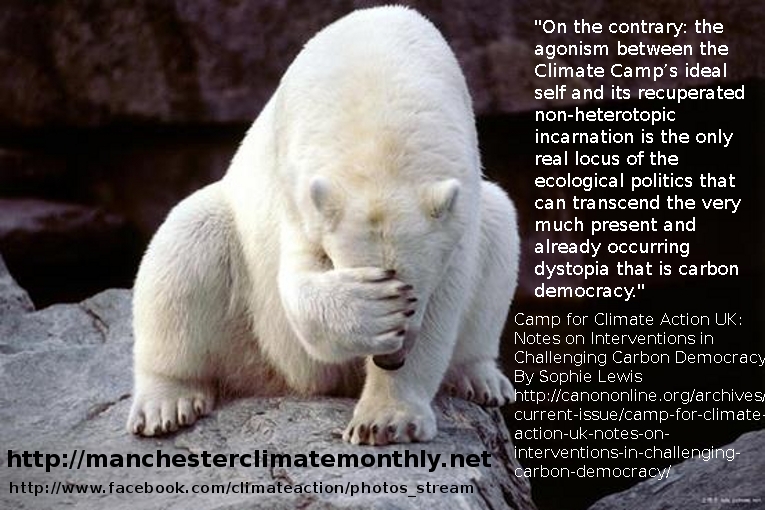
Polar Bear Facepalm: (“analysis” of) Climate Camp #epicfail

polarbearclimatecampSpeechless, really.

“I acknowledge the significance of post-Hardin literature on the commons whole-heartedly, but place myself in opposition to such literalizing interpretations of CfCA’s anti-authoritarian ecology, discerning in fears about the commons a certain 21st-century Hobbesianism that the mere experience of self-organized management of common-pool resources too easily dispels.”

and

“In addition, they reasserted a difference between natural and political components of self and being that lags behind the emergent ironizing and blasphemous cyborgian faith that — at times — lifted Climate Campers and may lift the Climate Justice Collective, up and out of the stew of mythic socializing dualities.”

and… well, it really does go on for paragraph after paragraph like this.  Has to be read to be dis-believed….

Posted in Polar Bear Facepalm | Tagged , , , , , , , , , , | 2 Comments

Want to grow food in Didsbury or Withington? #manchester #didsburydinners

The award-winning Amanda Woodvine of Didsbury Dinners has some good news…

New landshare plots in Didsbury and Withington

Looking to grow your own fruit and veg in Didsbury or Withington? Didsbury Dinners has been hard at work to find you two new landshare plots.

    Withington

Sunny plot for up to 4 growers to share near Minehead Community Resource Centre in Withington. Initial 2 year agreement over the land. Accessible 8am to 7pm, Monday to Sunday. Flexible landowner and access to outside water tap and shed (at own risk).

    East Didsbury

This spacious plot is within walking distance of the Parrs Wood complex in East Didsbury. There is an initial 6 month agreement over the land, subject to monthly review thereafter. Growers will have access to the landowner’s tools and can leave items in an on-site shed (at their own risk). Preferred gardening times: weekends, 8.30am to 10am and 4pm to 7pm. Would suit up to 4 growers.

Rent is free of charge to paid-up supporters of Didsbury Dinners (84p per month/£10 per year) and there are no hidden costs.

For more information about either plot please email grow@didsburydinners.com

Posted in Food | Leave a comment

Interview with Paul Monaghan, (Co-op CSR head for 18 years, now “uptheethics.com”) #climate #csr

Paul Monaghan (@PaulJMonaghan and uptheethics.com) talks past, present and future with MCFly co-editor Marc Hudson.

Hd and Shoulders cropped 2012You were at The Co-operative for 18 years. What are you – and what do you think people at The Co-operative should be – proudest of from those times?
The Co-operative is at its best when it champions issues ahead of the curve. As far back as 1998, The Co-operative Bank said it would not lend to or finance fossil fuel extraction or processing.

It funded research and championed public policy intervention way ahead of most campaigning groups – around Tar Sands, Shale Gas, neonic pesticides. It funded Tyndall to do the first ever [overview] work on shale, and for that information to enter the public discourse. Today, it’s championing the global poverty agenda and making sure it doesn’t get lost in the rapid climate of little England/localism. 

I’d also like to think that I’ve left The Co-operative in rude health as far as CSR and sustainability go. By hook and crook I built up one the best resourced corporate social responsibility teams out there – some forty five people and over £10million of annual budget. They also have the essentials of strong foundations and robust architecture: namely, world class sustainability accounting, auditing and reporting and a leading edge revolving three-year Ethical Operating Plan.

A cynic would say “yes, but what about the investment in Manchester Airport?”
My answer would be that many people in The Co-op were and are uncomfortable, but don’t let the perfect get in the way of the good. There were a lot of heated discussions about those connections.

What challenges are there for banks/investors around the low carbon economy?
How do we get hold of the billions and billions that are needed to fund the transition. There are wonderful businesses that are doing their bit. For example, The Co-op’s one billion of lending for renewables, and its new head office that will secure the highest ever BREEAM rating. However, as a society, we need to find ways to open up the money in pension funds if we’ve any chance to unlock the necessary investment.

So, crystal ball time; it’s 2020 and we are looking back on a successful transition towards a low carbon economy. What happened in 2013 and 2014 to make it turn out so well?

The Energy Bill of 2013 will determine how serious the UK is about climate change for the next two decades. A well-constructed bill will unlocks finance and creates a revolution in community-owned schemes. Or it could go horribly wrong, with continued growth in gas and shales, which would be a disaster.


Is it too late for individuals and groups to lobby on the Energy Bill?

No, it’s not. Readers can support Friends of the Earth’s 2030 decarbonisation targetThey can also support The Co-ops call for more support for community renewables. One of the more interesting developments, towards the end of the year, is the “Energy Bill Revolution Campaign”, set up by “Taskforce UK.”
It’s trying to create momentum to tackle fuel poverty. It wants revenues from the carbon floor price
and the EU Emissions Trading Scheme – in the region of £4bn – to be ring-fenced to obliterate fuel poverty. Fuel poverty affects 1 in 5 people at present, and it will be 1 in three if nothing is done about it.

195 MPs have already signed the Early Day Motion, but  it needs 270 by the end of the autumn. If we don’t tackle fuel poverty it allows opponents of renewables to set up a false choice: green energy or warm pensioners. Just the other day I heard the CEO of a small energy company claiming that “wind turbines are killing old people”

Transform UK isn’t just the usual suspects like Co-op Energy and Friends of the Earth, there’s also Age UK, Barnardo’s and a host of other organisations.

Now that you’ve left The Co-operative, are you slumped in front of Jeremy Kyle eating day-old pizza or do you have more productive outlets for your time and energy?
As enticing as that sounds, my days will be spent doing much the same thing as I’ve been doing – but I’ll be working with a wider range of businesses via my new Up the Ethics enterprise.

The ‘business case’ for CSR will never be strong enough to support an isolated business in its competition against the unscrupulous. The progressive vanguard reaches a point where it can advance no further in its market without rendering itself uncompetitive. That is, unless the bar for what is the allowable lowest common denominator in society is raised. With the base reset, so is the bar of aspiration.

The last thirty years have seen a hollowing out of Government across the world – together with a parallel reluctance of legislators to legislate. In order to plug this hole in societal governance, business is called on to work voluntarily and collectively to solve problems (even though this could see them prosecuted for acting like a cartel), with many politicians reduced to the role of mere award presenters. There is absolutely no way this approach can get us close to the sustainable society we know only to well we need to create. The next waves of CSR and sustainability heroes need to be (will be!) out and out campaigners. They will be brave, articulate and hark back to the great UK Victorian interventionists; the likes of Robert Owen, John Cadbury and William Lever. More significantly, they will act as a tipping point in the battle for a more sustainable economy. They will champion the Granny State – although Granny will need to be chemically enhanced with new-found powers of scientific literacy and evidence-based policy making!

Posted in Business, Manchester Airport | Tagged , | 2 Comments

Video: Professor Kevin Anderson talks to #Manchester Economy Scrutiny Committee #climate #mcc

The Economy Scrutiny Committee of Manchester City Council yesterday heard from Professor Kevin Anderson about climate change and its impacts. His presentation was followed by a vigorous question and answer session.

The meeting, which was attended by over 20 members of the public, also heard from Mark Burton of Steady State Manchester on specific policies the City Council could start to implement and Mark Atherton of the Greater Manchester Combined Authority.

Here are the first three of five videos of Professor Anderson’s talk. (Apologies for wonkycam!). The final two will be posted on this page this evening.

The Committee, chaired by Cllr Joanne Green (Harpurhey) is made up of councillors from many of Manchester’s 32 wards. Its areas of interest include “economic growth, strategic transport, employment and skills development, tourism, the voluntary sector and the regeneration of neighbourhoods.”

An account of the meeting has already been published at Steady State Manchester, and MCFly’s account will appear imminently.

Marc Hudson

Posted in Manchester City Council, youtubes | Tagged , | Leave a comment

Cartoon; Cat’s on the Internet #climate

Marc Roberts, the genius cartoonist who draws up a storm for Manchester Climate Monthly, has started a new strip.  It’s called “Cat’s on the Internet.”

No website yet, but you can follow the adventures of the cat (called Delilah) on his facebook feed.

Here’s the latest;

catsontheinternetextremeclimate

Disclaimer: The other Marc in “Marcs” is MCFly co-editor Marc Hudson, who provides intermittent text-ideas and (a/im)moral support to Mr Roberts.

Posted in hustings | Tagged , | 1 Comment

#Manchester City Council: A rather good rubbish meeting #Neighbourhoodsscrutiny #mcc

Councillors from wards across Manchester grilled Nigel Murphy, the Executive Member for the Environment, at a sometimes fiery meeting of the “Neighbourhoods Scrutiny Committee” yesterday. Marc Hudson reports.

The most controversial topic, at a meeting that looked at 20mph speed limits and BelleVue Sports Village, was the thorny question of the City’s Waste and Recycling efforts. (see meeting agenda, and links to reports, here.)
In an hour-long discussion peppered with sarcasm, the occasional partisan snipe and even insinuations that figures were being massaged/manipulated, councillors fired questions at Nigel Murphy, who readers of MCFly will know well (1) and two officers. The councillors, from wards across the city (2), were particularly exercised about a very gradual move towards smaller black bins and a proposal (and it is only a proposed proposal) to introduce a “closed lid” policy for the collection of bins.

The Executive Member and his officers re-iterated that the significant progress had been made in the last two and a half years, with a subtext that many of the successful innovations had been pooh-poohed by members of the Committee when first proposed.

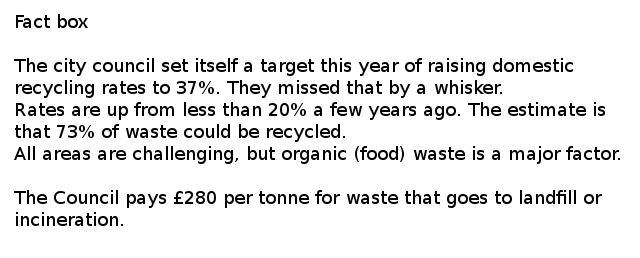
recyclingfactboxSean McGonigle, Assistant Chief Executive for Neighbourhood Strategy and Delivery told the committee “When we came here two and a half years ago to discuss the changes to the system and fortnightly collection, we met lots of scepticism. We explained that the waste levy would hit us. We HAVE reduced waste and increased recycling. Inevitably there have bee issues. Different parts of city have different challenges. It works well in some places, poorly in others. We have to continue to deal with those. It’s got to be about residents taking greater responsibility. We are still not in position where recycling is at a proper level.”

The main changes that are proposed involve a gradual phasing in of smaller black bins where appropriate, and various schemes to increase recycling rates. The point was made that there is no “one size fits all” solution for a city like Manchester, where types of housing vary widely across (and within) wards.

Councillors were, to say the least, sceptical, with opinions ranging from cautiously optimistic to outright derision. Cllr Carmine Grimshaw (Miles Platting and Newton Heath)spoke for several councillors, including Cllr Lanchbury (Blackley) when he cast doubt on the wisdom of reducing black bin size. Speaking of his own experience, as a keen (over-keen according to his children) recycler, he fills his 240L black bin every two weeks, and does not see how the proposed 180L replacement (these will be rolled out to new estates and as replacements, NOT substituting for the present bins automatically) will be viable.

Cllr Afia Kamal (Gorton North) wondered why the report used Stockport and Trafford as examples of smaller black bins helping to drive up recycling rates when these are both more affluent areas. Executive Member Murphy explained that these are the two GM local authorities that have moved in that direction (and have higher recycling rates), conceded the general point about affluence but also mentioned that parts of Stockport (Offerton, Edgely) and areas around Old Trafford are comparable to Manchester wards.

Similarly, Cllr Fran Shone (Northenden) picked up on the fact that while a survey around recycling had been done in Chortlon, Withington and Didsbury, a pilot scheme was to be conducted in Moss Side and Burnage – very different areas.

Virtually every councillor who spoke expressed severe reservations about the proposal “closed lid” policy, with Councillors Loughman (Ancoats and Clayton) and Longsden (Bradford) leading the charge. Officers replied that any proposal for this – which would result in only bins that were not “overfull” being collected would have to come to Neighbourhoods. For such a proposal to pass through, this reporter had the feeling that the fabled locked ammunition box marked “inducements and incriminating photos” would have to be un-padlocked and its contents discreetly distributed in a veritable carnival of largesse and threats.

Councillor Murphy received an invite to visit an estate in Gorton North from one of its local councillor John Hughes. He and the relevant officer took up the offer. MCFly will be skulking nearby with a telephoto lens, to get photos for this website.

Councillor Murphy also received an offer of help from Cllr Shaukat Ali (Cheetham) to identify mosques, temples and other religious institutions which could help create better communication around waste and recycling, and accepted with alacrity.

The report was only for “noting” and has now gone forward to Executive. The officers committed to various measures, including, as per request of Cllr Lanchbury, to send out the “frequently asked questions” document that has been created and also to ensure that in future reports on waste and recycling that there is a statistical break-down of fly-tipping per ward. As well as following up offers of help and invitation, Executive Member Murphy was going to make the available figures on city centre recycling available, especially to Councillor Carl Austin (Burnage), since these had been left off the appendix at the back of the report.

At some point in the summer the Council will have to decide whether to extend its existing contract for waste collection, or put it out to tender. The proposal will have to come back to Neighbourhoods Scrutiny on its way to Executive. Expect more fireworks.

MCFly says:
Rubbish collection is one of the few things that every councillor will have an opinion (or three) about. It is far and away the major issue that they are approached about by members of the public. So it was unsurprising that all but one of the councillors present spoke. And although the discussion was occasionally heated, and not everyone listened to everyone all the time, this is what democracy looks like. It is not always “dignified” (or, to use a more accurate term “stage-managed”.)

The headlines are this: recycling has gone up in Manchester. Has it gone up as fast as it could? Probably not, no. Does it, potentially, have a LOT further to go? Yes. Does either the Executive Member responsible or his officers deny any of this? No. Are they taking what seem to me (3) reasonable steps to move things along within the constraints they face? Yes (4). Are councillors justifiably nervous about where things are going? Yes.

Perhaps the most disappointing thing was not what the Councillors or officers did or said, but that they did it in front of a somewhat less-than-packed (5) public gallery. If we want a nimble and radical Council, then we are going to need to keep very close tabs on what they are – and aren’t – doing. (6) Recycling is something that people are passionate about, and that charities and social enterprises bang on about relentlessly. But on an important day to show elected representatives how much they care, and what else might be doable… silence. The question remains, for this publication and for other groups, of how to make Scrutiny Committee meetings (among other things), an enticing prospect. Answers on a postcard to the usual address please.

Marc Hudson
mcmonthly@gmail.com

Footnotes
(1) We’re hoping to get an interview with him at some point.
(2) There were apologies from Cllrs Kevin Peel and Cllr Daniel Gillard
(3) And let’s face it, I am not known as the biggest cheerleader that the Executive of Manchester City Council has ever had. Maybe second or third.
(4) Yes – but I reserve the right to suggest sharp sticks that people can poke them with.
(5) Total attendance – one.
(6) The previous meeting of the Neighbourhoods Scrutiny Committee had about 40 or 50 people, it’s true – to protest the libraries closures.  But that’s, sadly, a reactive one-off…

Posted in Democratic deficit, Manchester City Council, recycling | Tagged , , | 1 Comment