#Manchester City Council #scrutiny; not just #climate change #scrutinyweek

Manchester City Council has a 9-member “executive.” Every 5 weeks or so they appear before committees of “back-bench” councillors and are quizzed about how things are going on a host of different issues. In theory, they can be faced with curly questions and forensic investigation of what they do. The reality tends to be a bit more sedate, and even stage-managed. For now at least….

The meetings are open to the public (no need to book or ask permission), and all happen in Manchester Town Hall (Committee Room 11, ground floor. Wheelchair accessible)

scrutinycommitteesmay2013-page001Of particular note this time round –
An update on the City’s Waste and Recycling efforts and also progress towards 20mph speed limits on residential roads at the Neighbourhoods Scrutiny Committee (Tuesday 2pm)
Professor Kevin Anderson on steady-state economics and climate change at the Economy Scrutiny Committee meeting on Wednesday (Steady State Manchester and Manchester Climate Monthly are inviting members of the public to meet at the Waterhouse pub from 9am).
The Health Scrutiny Committee hears responses to the Mid-Staffordshire Hospitals report from North Central and South Manchester hospitals, hopefully showing what plans are in place to make sure such horrors never happen here…

btw – There are six different committees – Young People and Children (meets Tuesday 10am), Neighbourhoods (meets Tuesday 2pm), Economy (Weds 10am), Communities (2pm), Finance (Thurs 10am) and Health (2pm).

The accompanying graphic, produced by MCFly, shows some of the issues the committees could – if they wished – investigate.  Future generations (however many there may be) will be staggered that they didn’t.  But the unborn are, famously, too indolent to vote.

Posted in Democratic deficit, Manchester City Council | Leave a comment

#Manchester #climate nuggets 20th May 2013

Hi all,

in unexpected and massively-upsetting news, the co-editors of Manchester Monthly have not been short-listed for the job of chair of the “Steering” “Group”  (one blog post on its site in the last 6 months, and even that full of ‘inaccuracies’ – bravo!!) We had thought that having been explicitly banned from attending the “stakeholder conference” on the say-so of one individual was punishment enough, and that after our tremendously honest job application we would be welcomed back into the fold. Sadly, it was not to be. Next time, perhaps…

Wanna flex your creative muscles, and maybe win £200?   Here’s the details of our short story contest all sorted.  Two thousand words (in English) on the subject “Manchester (UK) in a warmer world.”

 Arwa Aburawa and Marc Hudson

Coming up this week

Monday 20th 4pm to 6pm “The UK government should increase support for bioenergy. Discuss …” University Place Lecture Theatre A (3.102) Details.

Tuesday 21st, 2pm  Update on City Council’s Waste and Recycling efforts to the Neighbourhoods Scrutiny Committee, Manchester Town Hall, Albert Square.  All can attend, no booking needed.

Tuesday 21st, 6pm to 8pm “A Sustainable Future for Manchester” “in conversation” series. Biodiversity with Matthew Holker, Greater Manchester Ecology Unit Manchester Museum, Oxford Rd. Free. See here for details http://events.manchester.ac.uk/event/event:q8r-hcrtq73c-c5o4cm/a-sustainable-future-for-manchester

Weds May 22nd 10am Economy Scrutiny Committee meeting of Manchester City Council.  Professor Kevin Anderson speaking on Steady State Economics.  Committee Room 11, Manchester Town Hall. NO NEED TO BOOK/ASK PERMISSION. JUST. TURN. UP.

Weds May 22nd, 4pm To EV or not to EV Choices and trade-offs on the path to a
decarbonised transport sector. C1, George Begg Building, Sackville Street, University of Manchester

Dr. Jillian Anable, Centre for Transport Research, The University of
Aberdeen
Many different carbon plans, climate change reviews, and transport and
energy White Papers over the past decade or so have proposed more or
less similar packages of policies to ensure the transport sector
‘pulls its weight’ in climate change policy in the UK. These have
emphasised developments in vehicle technology and fuels and associated
fiscal incentivisation, with relatively little attention given to the
management and reduction of travel demand. In recent years, however,
the attention given to the ‘technical fix’ has intensified as most of
the policy effort and expectation has been increasingly placed on
projections of plug-in electric vehicle uptake.

This talk will suggest that the recent focus on electric vehicle
technology could result in more carbon emissions over the long run. It
will review current proposals and projections for the uptake of these
vehicles in the UK and elsewhere. By drawing on recent work for the
Energy Technologies Institute and the Committee on Climate Change,
including research on the psychology of vehicle choice, it will offer
an understanding of the real role that electric vehicles are likely to
play in future patterns of mobility and car ownership. By reviewing
the recent policy direction and evidence on potential EV uptake, it
will pose and attempt to answer the question: have EVs damaged
transport and climate change policy?

Thursday May 23rd, 10.00-21.30* Manchester City Council Environmental Strategy Programme Board meeting.Room 1.10 One First Street Open to the public? I’m sorry, you must have mistaken this Local Authority for one that is genuinely interested in transparency and democratic engagement!
(*PRESUMABLY A TYP0 IN THE JULY 2012 MINUTES FOR “12.30.” Unless they re going to pull an 11 and a half our meeting to catch up on all the work they haven’t been doing?


Stories you may have missed on the MCFly website

Local news

The campaigners against the Barton Renewables Energy Plant in Trafford say the fight is not over (London over-ruled all the locals, in a fine display of Pickles-localism).

A cycling consultation starts imminently, with the headline-grabbing notion of making Oxford Road all Dutch. More soon.

Nationally, lots of advisers are fleeing the Department for Energy and Climate Change. Rats, ship, much?

Posted in Weekly bulletins | 3 Comments

Upcoming Event: Bioenergy debate in #Manchester Mon 20th May #tyndall

Monday 20th May 2013
4pm to 6pm
University Place Lecture Theatre A (3.102)

The question for panellists is:
“The UK government should increase support for bioenergy.  Discuss …”

Bioenergy is set to play a major role in meeting the UK’s renewable energy targets.  It can deliver greenhouse gas reductions in the power, heat and transport sectors and biomass can also be used as a feedstock for renewable chemical production.  Uptake is being encouraged by a range of government policy initiatives, but progress in deployment to deliver much-needed greenhouse gas reductions has been slow and the sustainability of many feedstocks has come under intense scrutiny.

This debate brings together panellists from academia, business and other stakeholders to discuss whether or not the UK should increase its support for bioenergy.  There is an urgent need to increase renewable energy deployment to reduce greenhouse gas emissions and many mature bioenergy technologies could contribute to that, but there has been only limited commercial success to date. So is increased policy support needed? 

Unsustainable biomass production could increase greenhouse gas emissions rather than reduce them, so perhaps support should be limited or more targeted.

In addition concerns have been raised about the wider environmental, social and economic impacts of biomass production, so is UK policy exacerbating these?

There is also only a finite amount of biomass available and incentivizing one use risks there being insufficient left for other key areas.  Perhaps biomass should be reserved for aviation or chemical production, where there are few alternative; perhaps it is more important to get substantial near term greenhouse gas reductions by increasing the UK’s biomass power generation capacity; or perhaps we should be focusing efforts on the longer term “prize” of negative emissions from biomass electricity with carbon capture and storage.

A range of speakers will give their perspective and there will be opportunity for questions, discussion and debate.  Please join us for what promises to be a fascinating and wide ranging discussion.

Our panellists will be:

Kevin Anderson and Patricia Thornley from the Tyndall Centre for Climate Change Research
Gerry Newton-Cross from the Energy Technologies Institute
Kenneth Richter from Friends of the Earth
Paul Willson from PB Power

All are welcome, so please feel free to circulate this information to your contacts.

Note: This part of a series of events funded under the EPSRC ‘Biobridges’ project at University of Manchester, led by Professor Kevin Anderson.

Posted in academia, Energy, Upcoming Events | 1 Comment

Video: Didsbury Food Trail 2012 – Barlow Moor Road community garden.

From here.

<p><a href=”http://vimeo.com/50164249″>Didsbury Food Trail 2012 – Barlow Moor Road community garden.</a> from <a href=”http://vimeo.com/didsburydinners”>Didsbury Dinners</a> on <a href=”http://vimeo.com”>Vimeo</a&gt;.</p>

Posted in Campaign Update, Food | Tagged | Leave a comment

Book Review: Beacons – Stories for our not so distant future

beaconsThere are 21 stories in ‘Beacons’, one of which is a graphic short story, with contributions from the UK’s greatest short story writers. There’s a story with a time machine, one with a Scottish chief, one about suicide-inducing TV presenters, Marco Polo, about children, death, unfulfilled love and loads more about people navigating a quickly shifting landscape where the norm is no more. Here’s what you need to know about Beacons (in a format inspired by the short stories):

1. You need to read more stuff by Adam Marek, David Constantine, Liz Jenson and A.L.Kennedy. Holly Howitt and Jem Poster were pretty good too.

2. There are only two, maybe 3, stories which are duds which isn’t bad considering there are 21 stories in the collection.

3. The editor has done a great job. It also seems that all the writers all have taken the theme seriously and thought hard about the issue of climate change before putting pen to paper/hand to keyboard(?).

4. I have been informed by a reliable friend that my criticism that most of the authors mention the weather is unfair as this collection is about climate change.

5. I love short stories and also happen to know the editor Gregory Norminton so I might be a tad biased. But only a tad.

6. Helen Simpson, who has written a great short story collection on climate change titled ‘In Flight Entertainment’, is missing from the collection. Maybe she was all out of climate stories. Who knows.

7. All the stories are new commissions. No reprints, no nothing – all in all, you get your money’s worth.

8. The editor decided to put together the book to support the Stop Climate Chaos Coalition back in 2007. The collection has been a long time coming but I think the final product was worth the wait.

9. It’s only £8.99/ $14.99.

10. If want to read another great collection of environmentally inspired stories after you’ve read this collection, you could do worse than to read Verso’s ‘I’m With The Bears’.
Arwa Aburawa
(A version of this review was published at GreenProphet.com)

Posted in Uncategorized | Leave a comment

#Trafford Breathe Clean Air Group on the Barton Renewable Plant go-ahead #pressrelease

FRIGHTENING PROSPECT OF HARMFUL AIR POLLUTION
Today’s announcement, that the Barton Renewable Energy Plant is to go ahead, is a devastating blow to the people of Trafford, Salford and Manchester. The historic and unprecedented level of local opposition, including from local residents, doctors, businesses, MPs, Salford Council and all of Trafford’s Councillors, has been swept aside to make way for an outdated, dirty incinerator.
It is ironic that the decision made by our locally elected Councillors, who understand the local issues and represent the local community, has been overturned by the Secretary of State for Communities and Local Government, whose remit includes supporting local Councils. The decision ignores all the specific circumstances that make Davyhulme a completely unsuitable place for this plant. Instead the Government’s National Strategy has been prioritised. With its inadequate technology and short chimney stack, this incinerator will burn contaminated wood and plastics, creating air pollution that can lead to serious health impacts and premature death.
In our opinion, the original reasons on which Trafford’s entire Planning Committee unanimously rejected the plant, are still entirely valid: there is a body of credible evidence suggesting that this plant will cause harm and people may therefore leave the area.
The local air pollution is already of grave concern and as such, the Breathe Clean Air Group has made an official complaint to the European Commission. Adding a huge amount of additional pollution from this incinerator is irresponsible.
There are cleaner alternatives for creating energy from waste, such as plasma gasification, but today’s decision means that local residents will be stuck with a dirty, polluting process for at least 25 years. We believe the careless nature of this decision will be evidenced in years to come as the impact on health becomes reality.
Stay in touch and up to date!
Like our Facebook Page: https://www.facebook.com/BCAGtrafford
Follow us on Twitter: @BCAGtrafford
Visit our Website: www.BreatheCleanAirGroup.co.uk
Posted in Democratic deficit, Energy | Tagged , | 1 Comment

Interview with John Broderick, Tyndall Research Fellow #shale #gdp #activists and #academics

????????We caught up with research fellow John Broderick from the Tyndall Centre to talk shale gas, what activist can realistically gain from academics and why the GDP model is deeply flawed.

Do you think that we have gone past the point of no return in terms of dangerous climate change?
First off, I think you can interpret “point of no return” in one of two ways. One is that we have already put enough GHGs in the atmosphere to cause a dangerous (however defined) amount of climate change or soon will because of the inertia in the way we have set up infrastructure, our society and economy. The second interpretation is that the amount of GHGs in the atmosphere has started off a series of positive feedbacks in the climate system, (e.g. melting of polar sea-ice reducing the reflection of heat back into space, that lead to faster and faster warming) that we are unable to halt. In the first sense, if we take dangerous as 1.5 degrees warming, as many least developed countries and small island states have argued, then I think yes, we probably have committed them to a dangerous amount of climate change, even if we act with urgency. Avoiding two degrees of warming is arguably out of reach unless we, globally, undertake radical changes in the way we use energy and land. In the second sense, I’m not sure, you’d better ask a climate scientist not an emissions analyst… but I suspect that we would not know that we’d gone past the “point of no return” in this sense until it’s too late, given uncertainty in our models and the time lags in different parts of the climate system.

What is so problematic about the use of shale gas?
From a climate change perspective, there are three major issues with shale gas; i) it is essentially just like any other source of gas – when you burn it you get a lot of CO2, ii) there’s lots more of it and iii) it’s dispersed geographically, not concentrated in particular regions. As the Oxford Economist and gas advocate Dieter Helm has stated, we have more than enough fossil fuel to fry the planet. The promise of shale gas is that we have even more.

What can activist get from academics?
Hopefully, honest answers to their questions. I get the impression that activists feel academics should “speak the truth to power” but I think this has to be qualified with a realistic set of expectations. Firstly, academics aren’t employed as activists, and so they’re not trained, resourced and rewarded as such. Although there’s increasingly the expectation that they push for “impact” from their work, there’s only so many hours in the day and typically teaching and research are prioritised over outreach of various sorts… I think both activists and academics need to be wary of implicitly assuming that knowledge presented will lead to a particular course of action, either from public or private decision makers or everyday people. The “information deficit model” has taken a lot of flak in social science and there are good reasons why the changes we need to make in society to stabilise the climate won’t happen spontaneously even in an enlightened society.

You have written about the need to “recast economics around long term social well-being rather than short term financial gain.” Could you elaborate, what that economic shift would require?

Many of the decisions that are made by governments, public bodies and private companies are justified on the basis of their increasing GDP or turning a profit. However, in choosing to make decisions on that financial basis there are assumptions about what counts and what doesn’t count. There’s a few things that I believe we should change about this. One of the most import assumptions is that future costs and benefits are discounted at a rate of between 3 and 15% per year. Now, the economy doesn’t have to function like that. We could consider things and justify them over longer periods of time, and that might lead to quite different conclusions, not least that we would invest more and consume less. Another important change, would be to not only think of the economy purely in financial terms, i.e. accounted for in dollars and cents, but to keep account of the material flows and social goods that it delivers, i.e. how much fresh water we pollute and how many people are well nourished and well educated.
:: See https://manchesterclimatemonthly.net/interviews/

Posted in Uncategorized | Leave a comment

University of #Manchester on BP money: “Social responsibility one of the 3 core goals for the University” #climate #monbiot

On Tuesday political commentator George Monbiot mentioned the University of Manchester in an article about fossil fuel companies sponsoring energy research at Universities.  He wrote out that “in 1998, the vice-chancellors of the UK’s universities decided that they would no longer take money for cancer research from tobacco firms. Over the past few days, I have asked the Shell Professor of Earth Sciences at Oxford, the university itself and the umbrella body Universities UK to explain the ethical difference between taking tobacco money for cancer research and taking fossil fuel money for energy research. None of these great heads, despite my repeated attempts to engage them, were prepared even to attempt an answer.”

On Thursday morning MCFly contacted the U of M, asking “can the University – in the shape of its press office, or the chair of BP-funded “International Centre for Advanced Materials – “explain the ethical difference between taking tobacco money for cancer research and taking fossil fuel money for energy research”?”

Later the same day we got a reply. Here it is in full;

Professor Colin Bailey, Vice President and Dean of the Faculty of Engineering and Physical Sciences, said: “To meet the needs of a global society it is important to provide affordable, secure and reliable sources of energy with the minimum possible impact on the environment.  The University educates our students, and carries out leading research, in all aspects of energy supply and demand, including renewables, nuclear and hydrocarbons.  We work closely with a number of international energy companies including organising and supporting student placements.  The work with BP will be looking at the use of advanced materials across the entire energy sector (including work on renewables) with a paramount regard for the impact on the environment.  Social responsibility is one of the three core goals for the University and we are committed to using our expertise and knowledge to find solutions to the major challenges of the 21st century, of which energy is one, and by producing graduates who exercise social leadership and responsibility.”

MCFly says:  This is, of course, a reply rather than an answer to the question raised. When large institutions, public or private, are asked for information (or to justify their [in]actions), they tend to do one of two things.  They either ignore the request altogether (a method often used by Manchester City Council, for example), or they reply to a different question and then consider the matter closed.

Still and all, the University did reply, and very promptly (same day!).  Some readers may think this isn’t worth much, but we here at MCFly Towers think it’s an encouraging start.(1)

Disclaimer:  MCFly co-editors Arwa Aburawa and Marc Hudson would like to point out that they have lived lives of exemplary moral purity, and have never once ridden in any vehicle that was powered by the stuff that companies like BP dig up and sell on.  And if we did we regretted it.  So that’s alright then.

Footnote
(1) One editor is a graduate of U of M and the other is toying with the idea of doing a PhD there. Make of this what you will.

Posted in academia, Energy | Tagged , | 1 Comment

Something for the Weekend 17 May 2013 #Manchester #Climate

what’s orange and sounds like a parrot?
A carrot

And this weekend…

Sat 18th, 7.30pm Green Kumbh Yatra at Gita Bhavan Hindu Temple, 231 Withington Rd.

And if you know any jokes of the high standard we’ve used so far, please submit ’em.

Posted in Something for the Weekend | 1 Comment

#Manchester City Council to examine #climate and #steadystate economics Weds May 22nd #climatescrutiny

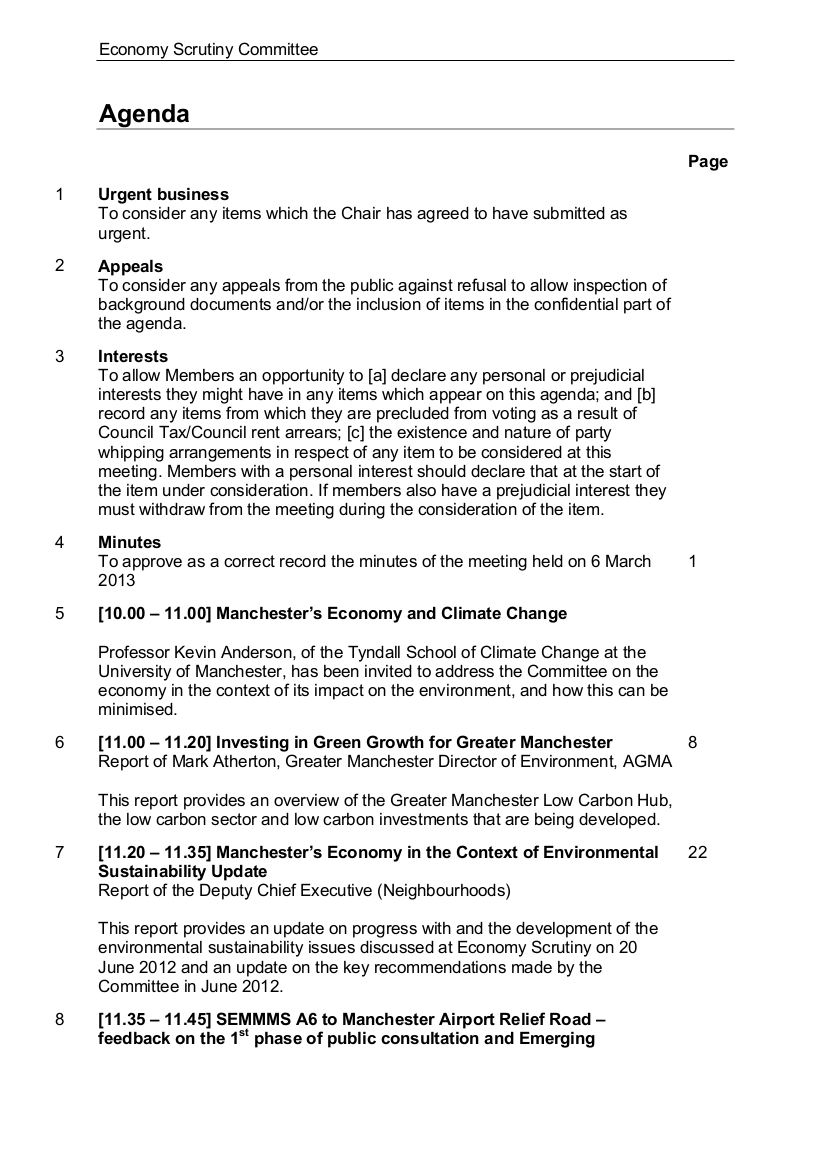
On Wednesday May 22nd, the Economy Scrutiny Committee of Manchester City Council will hear from climate expert Professor Kevin Anderson of the Tyndall Centre, as well as from local campaigners advocating for a steady state economy.

Economy_Agenda_May_2013The meeting takes place at Manchester Town Hall, Albert Square.  It is free to attend, with no need to book. It starts promptly at 10am, in Committee Room 11 (ask at the reception desk – it’s on the ground floor, and wheelchair accessible!)  Local activists are inviting people to attend a very informal pre-meeting to learn more about the issues and to meet like-minded folks. It’s at the Waterhouse Pub, 67-71 Princess St, from 9am.

As well as Steady State, there are other green issues on the agenda;

Hat-tip to the officer in Scrutiny Support who very promptly fixed a broken link on the MCC website so that this agenda and papers were accessible.
Disclaimer: MCFly co-editor Arwa Aburawa is a member of the Steady State Manchester collective.

Posted in Manchester City Council, Steady State Manchester, Upcoming Events | Tagged , | Leave a comment