Some MCFly readers will already have signed the petition calling on Manchester City Council to change course on its Ancoats St plans, and actually, you know, have cycle lanes. Below is an interview with Nick Hubble, who set up the petition…
1. In a nutshell, what is your campaign trying to achieve? Is it the case that Manchester City Council is proposing to remove the existing cycle lanes on Great Ancoats St? What is their justification? Is it plausible/implausible?
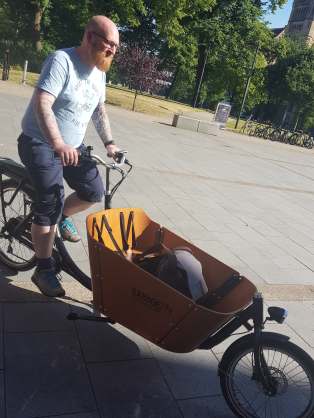 NH: We want Manchester City Council (MCC) to halt work on Great Ancoats Street until it has properly catered for cycling along that key route. In 2017 MCC signed up to Chris Boardman’s Made to Move strategy, point 5 of which states: “Ensure all upcoming public realm and infrastructure investments, alongside all related policy programmes, have walking and cycling integrated at the development stage”, a commitment they are patently failing to honour with this work. Instead of adding properly safe bike lanes, they are actually removing the (albeit half-baked) cycling provision that’s already there. Imagine taking bike lanes away from a key route in 2019. Councillor Jon-Connor Lyons was quoted as saying the finished road would be ‘a European-style welcome to Manchester’, which is pure wishful thinking: a European approach to this road would have prioritised walking and cycling, even at the cost of a traffic lane or two. Projects like this that insist on the dominance of motorised traffic are a relic of the 1960s and have no place in a forward-looking, sustainably minded 21st century city.
2. How does this decision fit with the GM agenda of improving cycling provision (Bee Lines etc)
NH: The way MCC are using the Bee Network to justify this scheme is disturbing. As already mentioned, the thinking behind the Bee Network is supposed to pervade all thinking around urban transport, placing walking and cycling at the very heart of all infrastructure investments. However, what we are seeing instead is MCC using the fact that this isn’t officially part of the Bee Network to justify eradicating cycling here. “We’re using Bee Network money to build you a route through the Northern Quarter, and another through Ancoats”, they say, with the implication that we should be satisfied with that and leave Great Ancoats Street to the grown-ups in cars. We disagree that this should be a binary choice: cycling shouldn’t only be safe on a small number of routes prescribed by the council, it should be safe everywhere. As Ancoats grows, demand for safe cycling provision on Great Ancoats Street will increase, whether from residents, people who work in the growing number of offices there, and indeed delivery workers, who are increasingly using bikes for the last mile. In short: the Bee Network is supposed to inspire best practice across the board, and not excuse sub-par schemes if Chris Boardman isn’t paying.
3. You’ve set up a petition on change.org. Once people have signed this, what else would you like them to do?
NH: They are invited to join us on the evening of Wednesday 26 June at Stevenson Square from 5:30, where we will be holding a ride and stride across Great Ancoats Street and a rally in Ancoats (https://www.facebook.com/events/431509381027856/). Whether you walk, cycle or just want to see a cleaner, healthier, less polluted and congested Manchester, then please come and show MCC what strength of feeling there is around this issue. If you’re on Twitter, tweet @ManCityCouncil to let them know what you think, write to your councillor – and once we’ve sorted this, stay vigilant of any “upgrade” to road infrastructure that doesn’t have walking and cycling at its heart. We’ve shown here how willing people are to mobilise around this cause, so let’s keep the pressure on and make sure our councils don’t get away with this kind of dismissive approach to active travel any more.
4. In your opinion, what three things are there that campaigners who want better cycling and walking provision in Manchester should be campaigning for? What groups can people get involved in that you think will use their talents and energy well?
NH: As well as demanding safe cycling provision on Great Ancoats Street, our petition has four additional asks. One is for MCC to honour its commitment to Made to Move, the others are:
• To commit at least 10% of its permanent transport budget to active travel (if walking and cycling are to be truly prioritised as forms of transport, they need to be funded in same way as other modes);
• To commit to Bee-Network-standard provision for walking and cycling in all infrastructure investments, no matter what the funding stream (there are currently no binding standards requiring walking and cycling to be of any given quality, or even exist at all as we’re seeing here, and that needs to urgently change);
• To account for the true cost of motor use to society, and the true benefit of active travel, when taking transport investment decisions (that is to say, to account for the huge cost of motoring in terms of adverse impacts on the environment, on health etc. as well as looking at economic factors, which significantly tips the scales in favour of prioritising walking and cycling).
In terms of groups to get involved in, WalkRide Greater Manchester campaigns on the specific agenda of inculcating Bee Network-style thinking across all decisions related not only to transport, but neighbourhoods, schools, places we live. Other groups have overlapping agendas, such as the Ramblers, Living Streets, and more broadly movements such as the student climate strikes and Extinction Rebellion look at the bigger picture of the urgent need to decarbonise our lifestyles. There is plenty going on and hopefully an angle that everyone can find appealing.
5. Oh, by the way, who are you?
NH: My name is Nick Hubble. I’m a bike-rider, walking/cycling activist and blogger. My writings around various aspects of cycling can be found at nickhubble.bike and I’m on Twitter as @pootlers.
6. Anything else you’d like to say?
NH: Just to round up: the campaign around Great Ancoats Street has a more symbolic aspect alongside its specific focus. This is a discussion around what our cities our for, the philosophy of the places we inhabit. Is Manchester a thoroughfare to drive through and perhaps store your car in while you’re otherwise occupied, or should it be a space that its people can savour and enjoy and feel comfortable and welcome in? Places around Europe and beyond are increasingly subscribing to the latter view, reshaping their urban spaces around people and not vehicles, and if Manchester doesn’t quickly get with the picture, we’ll be left behind.


 prominent Manchester environment groups, ironically, but that’s another story). The motion, proposed by Councillor Annette Wright (Hulme) and seconded by Councillor Eve Francis Holt (Chorlton) is not perfect, but then what is? The motion is not bad at all, and offers a much overdue return to specific and meaningful thought on climate change.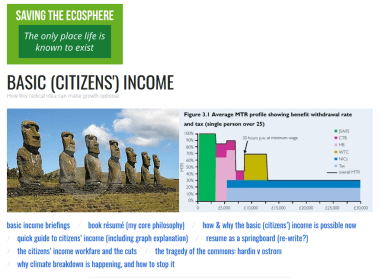
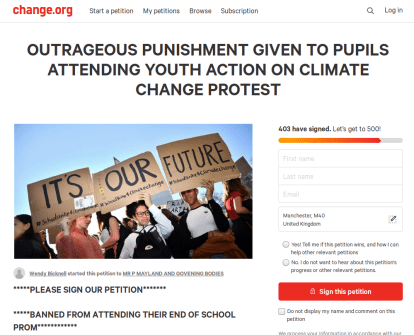 An injury against one is an injury against all. If you give even the smallest of damns about climate change,
 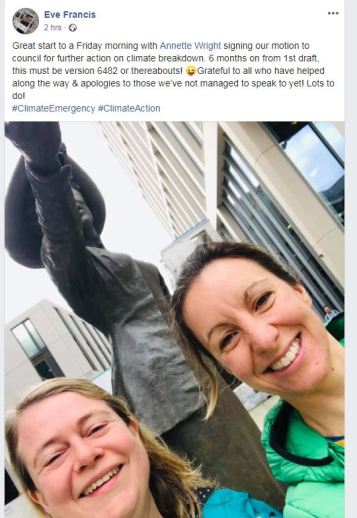 The motion is being put forward by two backbench councillors, Eve Francis and Annette Wright. The final text of the motion will be released at the latest by Wednesday 3rd July (hopefully sooner).


 manchester climate monthly