
Manchester Climate; weekly nuggets

Hi all,

What does a resilient community look like? Are you ready to do what’s needed?, asks Dave Pollard. Could you live in Sustainable Student Housing? What happened at the aviation meeting in Moscow? What’s the best social media strategy of all time? What happened at the Climate Question Time last Thursday? What’s coming up this week? Read on – all will be revealed in this week’s climate bulletin, rebranded…

Oh, and you are all welcome to join us at the Friends Meeting House next Monday night. From 7 to 8 there’s a discussion of “The Handmaid’s Tale” by Margaret Atwood, but from 8 to 9 we’re having general mingling and networking, followed by a trip to a nearby pub (alcoholic drinks will NOT be compulsory…)

Please encourage your climate-concerned friends to take out a (free!!) subscription to the blog/newsletter – via our subscribe page.
If they need convincing, here’s a 40 second video explaining the top ten reasons folks should subscribe
And follow us on twitter (@mcr_climate).

Coming up this week

Tues 28, 5 to 6pm‘Energy Politics in Belarus – hug me dearly, hug me close…’ – A Talk with Michael Martin
Manchester Environmental Students Society, Rm 4 of U of M Students’ Union
Tues 28, 6.30 to 9pm Net Tuesday “Free monthly gatherings for social changemakers and web innovators to network, socialise and share ideas about how nonprofits and social benefit organisations can use the social web for social change.” MadLab, Northern Quarter

Wed 29 Feb, 6.45 for 7pm until 9pm Friends of the Earth climate subgroup meeting, Green Fish Resource Centre, 46-50 Oldham Street, Manchester M4 1LE
Latest climate subgroup meeting, at which we’ll be dialling into a teleconference to find out the latest on the national Final Demand campaign and planning next steps on our work to promote Manchester: A Certain Future to local businesses. For more information, please contact Ali on 07786 090520.
Thurs 1 March, 7pm Manchester Climate Action meeting about a demo in Central London on Thurs 3 May. At the latest OK Cafe, which is at the Gamecock Pub, Hulme.

MCFly stories you may have missed

Event Report: Ecocities, adapatation and the Beach Boys
Event Report: Climate Change Question Time
Stakeholder Conference Programme Announced
Food glorious food (co-operative)

Delay versus delivery: Greater Manchester’s Climate Change Strategy
If the answer is ‘plant more trees,’ you’re asking the wrong question

Lessons we like to believe we’ve learnt this week
Volunteers inspire. Even more volunteers will probably be even more inspiring…

Grab the money and run
Manchester Veg People jobs

Jobs that need doing!
Could someone trawl twitter for groups MCFly could follow?
Could someone audit MCFly to see how much we are writing about people who don’t happen to be white males?

Local and Regional News
Feb 21 Insider reports “Biomass business Imperative Energy has been awarded investment from the North West Fund for Energy and Environmental. The company, which has moved to Sandbach in Cheshire following the investment, provides bioenergy solutions to industrial, commercial and public sectors across the UK. The investment is set to be put towards the company’s plans to build biomass and CHP plants across the region. The company will also be expanding its team and recruiting an additional 30 members of staff…..”

Feb 23 Manchester Green Party launched its manifesto. According to the blog of Party Secretary David Mottram – “Adrian Ramsay, deputy leader of the Green Party, today (23rd February) launched Manchester Green Party’s manifesto for City Council elections on 3rd May. The manifesto titled Green, Left, Local invites ‘disillusioned Labour and Liberal Democrat voters in the city to vote for local Green candidates’….  The manifesto identifies four priority areas – jobs, housing, children & young people, and transport – and describes the local election campaign as taking place against a background of job losses and public service cuts. ‘There is an alternative’, it says. ‘The Green Party proposes a Green New Deal to generate jobs, build a sustainable low carbon economy, protect the environment and create more equal opportunities and rewards for everyone.’ The Green Party offers a programme focused on the local economy, environment and equality.”

Reading and Watching

New web-magazine on resilience launched this week. GetResilient.com, a new web-magazine dedicated to sharing articles and insights on resilience, was launched today [23/02/12].
The site launches with 9 articles, including a guest article from ‘Walk Out, Walk On’ author, Deborah Frieze, who argues for a transition from efficiency to resilience. Guest contribution articles will be an on going feature. GetResilient.com publishes articles on resilience in relation to 6 topics: Food; Energy; Transport; Communities; Biodiversity; and Cities. The site aims to bridge the gap between the academic discourse on resilience and policymakers and the wider public. GetResilient.com hopes to raise the profile of resilience thinking as an approach to tackle some of the world’s greatest challenges.

Excellent “Energy Saving Trust” blog post on the dangers of the ‘rebound effect

Grist on the US/Saudi/Chinese/other countries attempt to gut the European aviation emissions scheme…And here’s the declaration that came out of that meeting

Resilient Communities and how to start them by Robert Paterson

Not ready to do what’s needed? asks Dave Pollard
Posted in Weekly bulletins | Leave a comment

Event Report: Ecocities, adaptation and the Beach Boys…

Marc Hudson, co-editor of MCFly, went to a presentation about adaptation to climate change, and came away thinking we all have a lot of work to do.

Ecocities is a “joint initiative between the School of Environment and Development at the University of Manchester and commercial property company Bruntwood.” Set up in 2009, the idea is that an ‘adaptation blueprint’ will be produced for Greater Manchester. That blueprint is now overdue, [the final conference was delayed at short notice] but doubtless something will emerge. Hopefully its launch (pencilled in for May, invite only) will be better publicised and attended than Saturday’s effort.

The powerpoint presentation – which we hope to be able to link to soon – outlined the causes of climate change and the consequences for Greater Manchester. “The future” said the lead presenter, “is already here.” in the form of floods, summer storms and the like. Essentially we will get warmer drier summers and warmer wetter winters.
The presentation was followed by a useful Q and A with the audience, which was small enough for everyone to ask whatever questions they wanted.

However, the format of this event – as with the Thursday night Question Time event at which I found out about the event – was not unproblematic. Both events (and many others MCFly finds itself at) appear to have been based on the “information deficit” model. By that I mean there seems to be an assumption that the audience is an empty vessel waiting to be filled with facts by the people at t’front of the room and another assumption that the main reason people are not taking action is a lack of information. I think both of these assumptions are demonstrably false, but maybe that’s just me. Wouldn’t it be nice, though, to see Ecocities – and others – challenging these assumptions in the format of their events.

It would also be nice to see Ecocities advertising its events more thoroughly, (there appears to have been no social media effort even aimed at Friends of the Earth, Environment Network for Manchester etc) because – now that any realistic hopes of global mitigation are dead – adaptation and resilience is going to be the name of the game. And Joe and Jane Public need to be aware of what’s going on, because this is not an agenda – I hope we can all agree – that is going to be sorted out by business and government on their own.

It would be very nice to see Ecocities putting health warnings on their comfortingly precise estimates about ‘winter rainfall could be up to 25% higher by…. peak temperatures could be over 34 degrees”. What kind of health warning? Oh, something like “All our predictions are based on an old estimate of how much carbon dioxide the species would pump into the atmosphere. That estimate now turns out to be somewhat low. Therefore, there is a small but significant chance that we will see bigger changes quicker than what we’ve written here. So it goes.” The Vonnegut reference at the end would be optional.

It would be even nicer to see explicit acknowledgement that there are going to be impacts from beyond Greater Manchester (refugees, water shortages, food shortages, potential civil unrest, energy prices spikes, global depression [both economic and psychological] etc etc)

And it would be especially nice to see ideas being propounded about some of the adaptive governance changes that are required, instead of endless pretty pictures of sustainable urban drainage systems. I’ve looked – as suggested – through the list of documents in the library (over 30 of them, apparently). With one “exception” – which I will blog about soon – there’s nothing in there that touches on how individuals and communities can start to revivify civil society in order to deal – with “adaptive leadership”, “collaborative leadership” etc – with a crisis that is going to need more than technical fixes. But maybe I am looking in the wrong places for these sorts of answers?

Posted in Adaptation, Event reports | Tagged , | Leave a comment

Event Report: Climate Question Time #2

MCFly writer Laurence Menhinick went to the Manchester Museum’s “Climate Change Question Time” on Thurs 23 February and came away with more questions and her hopes hanging by a thread…

Having attended an earlier edition of Climate Change Question Time at the Manchester Museum, I was very pleased to see that event repeated yesterday- at least this time I had the time to prepare a good question… but more on that later.
I really welcome such public event as the more exposure climate change issues get the better. The speakers were, as with the previous event, all authorities in varying environmental fields: Kevin Anderson, Professor of energy and climate change at The University of Manchester and Deputy Director of the Tyndall Centre for Climate Change Research; Jason Kirby, physical geographer from Liverpool John Moores University; Jonathan Gregory, climate scientist from Reading University; Celine Gemond-Duret, of the Centre for Sustainable Development at the University of Central Lancashire and marine physicist Professor John Huthnance of the National Oceanography Centre.

The questions asked by the audience were varied to say the least, reflecting both concern and a worry from the public (from “will London be flooded?” to “how can we mitigate?” and “what is the British “view” on climate change?” I must point out here that the aim of the event is to educate the non-specialist public, and therefore general points were made and repeated : gravity of the situation, proven facts relating to sea rise, global mean temperature projections, risks to food supplies and water shortages and aspects of climate modelling etc..

A few interesting points were made:

Despite being on course to follow the worst projections ( +4 ºC to +6ºC GMT rise) there is still hope we can make a difference
Kyoto’s first deadline being 2012, there is international consensus to carry it over another 5 years and agree to another binding agreement following that.
The impacts of climate change will be very varied and spread out in time.
The notion of a “point of no return” is unhelpful since it wants to refer to a specific date or measurement whereas some effects of climate change are permanent some are not: the ice sheet will not reform without another ice age whereas sea ice could “come back” as it were.
The excuses for inaction are wearing thin: demanding more studies, more certainties, more science is just not good enough since evidence is already available and the timescale from cause to effect is short
Scientists also have a role in conveying information to the layman: the notions of scientific “uncertainty” and “error” do not mean what the public thinks and it leads to a general feeling that science is wrong and doesn’t know.

The role of media coverage (from news to Hollywood doomsday films) was discussed at length– first to mention that (in the UK at least) there was no reliable mass media coverage of the issues, especially since the weight given to sceptics was disproportionate; adding to the fact that epic doomsday films ( re-writing facts and laws of physics in one stroke) blur the distance between fiction and reality and numb people’s perception of what they should really be paying attention to. Marc Hudson of MCFly pointed out that what mattered mostly was the role of the political leaders in implementing action based on the research [Ed: this paper is the one I was banging on about] and he asked what specific actions Manchester and Mancunians should be taking to prepare for and pre-empt those consequences, to which the panel answered (sort of, well… erm..):
public perception is usually biased towards what their political leaders do,
people should realise that they will be affected too and their everyday action is making a difference
we should try to make the public engage socially in the discussion including at local government level
Reparation to poorer countries which will be hit first due to our inaction must take place
The supremacy of GDP as a political measure of worth must be challenged.

But it was interesting that there was also disagreement between panellists on various issues relating to people behaviour and catalysts for change, the role of technology fixes or the role of the economy in fixing the problem. I must say at this point that being currently pursuing my own agenda into changing people behaviour, I jumped in with my consciously prepared question mentioned earlier.

In a nutshell, I wanted to know if members of the panel had managed to influence the people they knew: did their friends reduce their carbon footprints? What was the best argument to make the changes happen? Well, I am sorry to say the answer from one side of the table came down on me like a ton of bricks: we are here to inform not to influence people, it is not for us to tell people what to do. I was shocked enough to take the microphone back and challenge that attitude, because to me if the scientists who know the science inside out, gravely shaking their heads at the utmost seriousness of the matter, are not making the effort themselves and actively trying to encourage others to change, who are the “they” and “we” in their discourse?? Who is it down to then??? (commitment anyone???) Luckily Prof. Anderson strongly disagreed with the answer I was given. He strongly believes that there must be leadership by example, and he was aware for instance that his team at Tyndall have made significant changes to their behaviour of their own accord. Change actually starts with “me”, and the scientific community has a duty to lead the way publicly. I was reassured somehow that I wasn’t alone in making an effort (indeed another lady in the audience explained she was following a simple low-impact “no meat, no car, no flying” life) but I nevertheless noticed that no-one else on the panel wanted to comment. By then it was getting late and I had to go, having just enough time to answer a couple of hand-up polls to the audience by Mr. Anderson, (Marc having started earlier by asking how many people in the audience had engaged their local political representative about climate change issues – and was impressed that quite a few hands were raised-). Prof Anderson polled the audience’s intention in changing the world around them by engaging with their friends and family directly about the issues. I was pleased to see close to half the audience raising their hands. Maybe people’s behaviour is changing after all….

Laurence Menhinick

Posted in Event reports | Tagged , , , | 2 Comments

“Something for the Weekend?” #2

Not much climate-y going on this weekend that we’re aware of here at MCFly towers… Do join us at the Friends Meeting House, Mount St, on Monday 5th March for a chat first about Margaret Atwood’s “A Handmaid’s Tale” and from 8pm onwards about anything and everything…

Here’s the joke; What do you call a woman who sits at her kitchen table setting fire to her IOUs?

Bernadette…  (It’s the way we tell ’em.)

And here’s the events –

Tomorrow (Saturday 25th) you can go tree planting in Chorlton “Trees for Cities and Red Rose Forest are looking for volunteers to help create a new area of community woodland in Chorlton from 10am to 2pm (meet at Newbrook Avenue, M21 7PT):”

(though you might want to read this first)

Also on Saturday, at 2.30pm at the Manchester Museum the Ecocities people (who cancelled their conference at very short notice) are having a free presentation called “Weather wise: using past weather impacts to plan for the future.”
Come and meet the EcoCities researchers who will speak a bit more about their research, why it’s important and what you can do. There will be plenty of time to ask questions on any aspect of their work on the changing climate, historic impacts and adapting ‘whatever the weather’.

Posted in Something for the Weekend | Tagged , , | Leave a comment

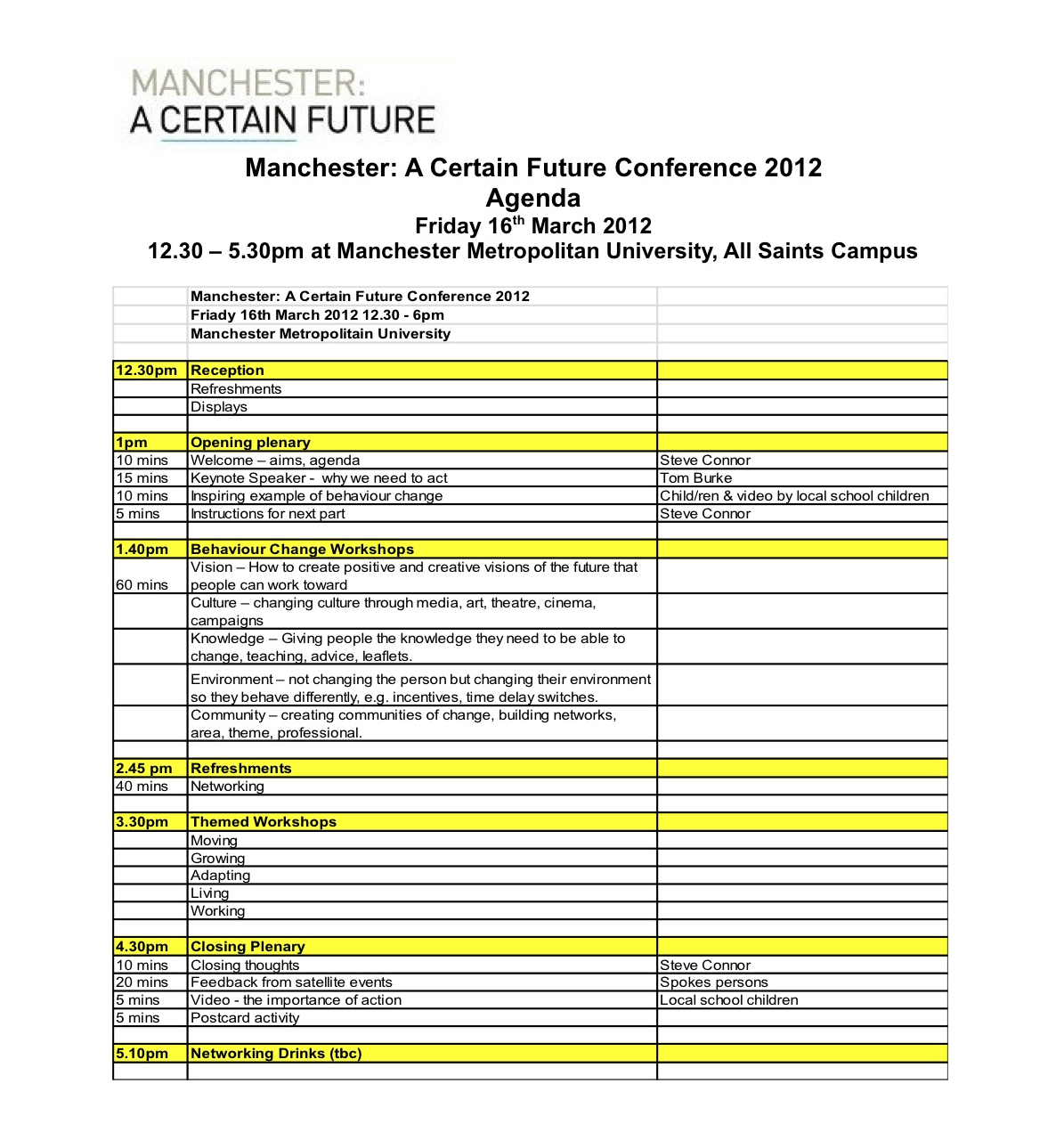
Stakeholder Conference Programme Announced

Not long left now till Manchester’s climate change action plan stakeholder conference. It’s been quite a wait (from the last annual conference in 2010) but if you were lucky enough to snap up tickets, you can now take a sneak peek at their programme for the day. Some details still need to be confirmed but the major outline of the event is now clear.

Each of the workshops will have a note taker, these will then be collated and the summaries posted on the website. The details will then be given over to the sub-groups of the steering group to help inform their work over the next 12 months. Within any luck these suggestions will meet with more of a response than our Open Letter to the Steering Group got.

The keynote speaker is Tom Burke, who is founding Director of E3G, and a Visiting Professor at Imperial and University Colleges, London. Burke previously served as Executive Director of Friends of the Earth and was made a CBE for his services to the environment in 1997.

All tickets sold out in the first two weeks and there are already 16 people on the waiting list. As the stakeholder conference is part of Climate Week, there will be satellite events to attend if you can’t make it along to the conference. These include events by Friends of the Earth, Groundwork, MERCi, Business in the Community, Red Rose Forest, Action for Sustainable Living, Sustainable Food Group, Chorlton Refurb, the Biospheric Foundation and GreenSpirit Greater Manchester. More details of these will be on the manchesterclimate.com website soon we’ve been told.

As we reported earlier, there will not be elections to the Steering Group. Late last year the Group unilaterally altered its own Terms of Reference to avoid the expense and apparent ‘difficulty’ of having a democratic component to its make-up.

Arwa Aburawa
mcmonthly@gmail.com

See also: The Steering Group: Our Final Word

Posted in Climate Change Action Plan, Democratic deficit | Tagged , , , | 1 Comment

Food glorious food (co-operative)

Students are not exactly known for their love of great cuisine. If they had a motto for their food purchasing decisions it would probably be ‘the cheaper the food, the bigger the beer budget’ (not that I would know). But rather than encouraging students to head off to the nearest McD’s, a food co-op has been launched at the University of Manchester. It aims to help students buy quality ethical food on the cheap.

Supported by People & Planet and Manchester Young Greens, with the significant input by University of Manchester student Dan Hart, the project already has over 80 paying members, and close to 200 members overall. That’s not bad, considering they only officially launched February 7th. Continue reading

Posted in Food | Tagged | Leave a comment

Delays vs. Delivery: Greater Manchester’s Climate Change Strategy

Delivery of Greater Manchester’s Climate Change plans still on schedule despite three month delay for its approval, insist officials

In July 2011 the Association of Greater Manchester Authorities agreed a Climate Change strategy with ambitious 2020 carbon reduction targets. Officers working under the Environment Commission were tasked with writing an implementation plan to turn those aspirations into reality.That plan, originally due in March of this year, will decide on the priorities for the period between 2012 to 2015 and determine ways to help cut the region’s emissions by 48% by 2020. The plan needed to facilitate the ‘rapid transition to a low carbon economy’ and embed carbon literacy in the region’s organisations, lifestyles and behaviours.

The original deadline for this implementation plan was late March, when it was to be approved by the Greater Manchester Combined Authority & AGMA Executive Board. MCFly can now confirm that the plan won’t be up for final approval until June 29th 2012 – three months later. Continue reading

Posted in AGMA, GM Climate Strategy | Tagged , | Leave a comment

If the answer is “more trees, please” then you’re asking the wrong question…

Is planting trees always and everywhere a Good Thing? MCFly’s biodiveristy reporter Dave Bishop takes a critical look.

Recently, several people contacted me to let me know that there is soon to be a tree planting event near to where I live. I think that they were a bit surprised when I told them that I wasn’t interested and, in fact, am generally opposed to tree planting. I think they Continue reading

Posted in Biodiversity | Tagged , | 6 Comments

Grant alert: “Co-operative Community Energy Challenge”

Cheerfully cut and pasted from a press release –

The Centre for Sustainable Energy is working with The Co-operative to deliver a new initiative called the Co-operative Community Energy Challenge, which forms an integral new element of The Co-operative’s Clean Energy Revolution campaign.

The Community Energy Challenge will provide 12-18 months of enterprise development, mentoring, technical advice and community facilitation for six to eight communities, enabling them to initiate co-operative renewable energy projects at a significant scale (e.g. valued at £1m to £3m and/or rated in excess of 500kW). As well as providing expert support, CSE can spend money on your behalf for any initial costs needed to get your project moving. See www.cse.org.uk/coopenergychallenge for more details on how to apply.

This support is being managed by CSE on behalf of The Co-operative. It builds on our PlanLoCaL programme and resources (see http://www.planlocal.org.uk) and aims to bring the selected community projects from across the UK to a state of readiness for further support and investment from The Co-operative Enterprise Hub and The Co-operative Bank.

There is a two-stage competitive application process for groups to become part of the Community Energy Challenge. Expressions of Interest need to have been received by 29 February 2012. Following this, successful groups will be offered support to complete a full bid. Lack of technical know-how should not be a barrier and communities with ambition are encouraged to apply at all stages of their project development.

Posted in Competitions, Energy | Tagged | Leave a comment

MCFly Climate Bulletin #14, Feb 20 2012

Hi all,

Please encourage your climate-concerned friends to take out a (free!!) subscription to the blog/newsletter – via our subscribe page.
If they need convincing, here’s a 40 second video explaining the top ten reasons folks should subscribe
And follow us on twitter (@mcr_climate).

Coming up this week
Mon 20 Feb, 7.30pm Campaign against Climate Change meeting at the Friends Meeting House, Mount St “to distribute leaflets and discuss further publicity for the fracking meeting; and to plan activities around the Caravan for a Million Climate Jobs in May”

Tues 21 Feb, 2pm to 4pm Community Microgeneration Workshop
Learn all the basics about renewable generation technologies suitable for your community. From wind and solar to biomass and hydro, get the low down on the technology and how it might be harnessed for your benefit. Free workshop for community groups or individuals looking to set up a group.
This workshop is being run by Jonathan Atkinson of Carbon Co-op for MERCi’s Eco Hub project. For more info on the Carbon Co-op see: http://www.carbon.coop/

Tuesday, 21st Feb from 5pm to 6pm – “Climate Science and why it has become irrelevant”  Does the Climate science matter anymore? Everyone who wants to deny the reality of climate change has found ways to do so. For those of us in the real (and warming) world, the ever-more dire warnings about the long-term consequences of what we are doing now does not spur us to real action. So what, if not climate science, will persuade and galvanise individuals and organisations? I [Marc Hudson, MCFly co-editor] don’t know, but I have some suspicions I’d like to share, and want to hear other people’s answers! Room 4, University of Manchester Students’ Union, Steve Biko Building, Oxford Road, M13 9PR (Yes, MCFly is plugging events its editors speak at. Bad form)

Weds 22 Feb 4pm, Geography seminar ‘Urban foresight for territorial governance: exploring the European synergy city’: Joe Ravetz (University of Manchester) Hanson Room, Humanities Bridgeford Street

Thurs 23 Feb, 2 to 4pm Save Energy, Save Money
This free workshop will look at how you can save money on your bills by reducing the amount of energy you use. We will look at simple and cheap ways to insulate your home and keep it draft free, and top tips on saving money from using your electrical equipment. You will also get information on where you can get further advice, support and grants. This workshop is being run by the Sustaining Change team for MERCi’s Eco Hub project. For more info on Sustaining Change see: http://www.merci.org.uk

Thursday 23rd February Adrian Ramsey, deputy leader of the National Green Party, will be speaking to Manchester Young Greens and launching the party’s Manchester manifesto for the City Council elections.  Friends Meeting House, from 3pmish

Thu 23 Feb Manchester Friends of the Earth Meeting
On the last Thursday of each month, come along to the Green Fish Resource Centre on Oldham Street (next to Mint Lounge) to get stuck into doing actions on each of our campaign areas. Our regular campaign groups meet at 6.30pm for transport and at 7pm for climate change and food. Contact colette@manchesterfoe.org.uk for more information. 46-50 Oldham St, Manchester, M4 1LE, UK

Thurs Feb 23, 8pm Planning meeting for the 2012 Chorlton Big Green festival upstairs at St Clement’s Church. Please come along if you’re interested or contact them here if you want to be involved but can’t make it this time.

Thurs 23 Feb 6-8pm Climate change question time at The Manchester Museum. Your chance to pose questions to experts about climate change & sustainability in a Manchester & global context. With experts from the University of Manchester and other leading research centres and taking place in the Museum’s Living Worlds gallery. You can send your questions in advance to museum@manchester.ac.uk or bring them along on the night.
The panel includes Kevin Anderson, professor of energy and climate change at the University of Manchester and deputy director of the Tyndall Centre for Climate Change Research; Jason Kirby, physical geographer from Liverpool John Moores University; Jonathan Gregory, climate scientist from Reading University; Celine Gemond-Duret, of the Centre for Sustainable Development at the University of Central Lancashire and marine physicist Professor John Huthnance.
Price: Book on 0161 275 2648, free, adults

Thurs 23 Feb, 8pm Greenpeace meeting, Ape and Apple Pub (upstairs) John Dalton St (City Centre)
MCFly stories you may have missed
Let’s go to (En)Works
A Local Nature Partnership for Manchester? Maybe…

Lessons we like to believe we’ve learnt this week
Got an event? Publicise, publicise, publicise. Then publicise some more.

Grab the money and run
Manchester Veg People jobs
Free household energy surveys!

Jobs that need doing!
Could someone trawl twitter for groups MCFly could follow?
Could someone audit MCFly to see how much we are writing about people who don’t happen to be white males?

Local and Regional News
Tues 14 Insider reports that “GreenGen has appointed a new director as it seeks to expand the business. The Blackpool-based green energy company has appointed former Spice managing director Chris Lee as director. The company said it plans to expand across the renewable energy sector and wants to become a market leader…. GreenGen’s companies include Farmgen, Local Green Energy and SolarGen Plus. Farmgen is set to roll out its anaerobic digestion technology nationwide in 2012.

The Greater Manchester Climate Change Strategy was launched with a certain amount of fanfare last year. The implementation plan was due to be agreed in March, but that has now been pushed back till the end of June. MCFly will find out more…

Global News
Canadian government gagging scientists? Surely not

A big “we don’t want to pay the EU’s carbon levy on aviation fuels” meeting is happening in Moscow on Tuesday 21st, with the US, India and China as the lead angry folks. “A discussion paper prepared for the meeting, and seen by the Financial Times, shows the group will consider 11 retaliatory measures against the EU’s move to include all big airlines in its emissions trading system.”

Reading and Watching
Analysis of the state of the solar power industry by Manchester-based folks.

Merrick on violence and Climate Camp – essential reading, IMHO

Merrick again, on the Kyoto Protocol

According to the Monthly Review, Obama is ignoring the worsening climate crisis

Excellent post on the Britsh Cycling Federation and the City Council

A new survey aims to raise the profile of your views on the environment. Many older people are keen environmental activists. Yet people in later life feel their views on the environment are sidelined. The Greener Wiser Manifesto, written by a taskforce of older people, said they wanted a much greater role in decision making about the environment and issues that affect their communities.

There’s No Tomorrow – 34 minute film about resource depletion and the impossibility of infinite growth

Fever – award-winning film about indigenous peoples and the impacts of climate change

China is building renewable energy capacity faster than anyone, according to an article in Foreign Affairs

And finally…
Climate change is Alvin chipmunks genetic diversity. Actually, that’s not accurate at all, I just couldn’t resist the Alvin/’alvin pun. See here –

Climate-induced range contraction drives genetic erosion in an alpine mammal

Emily M. Rubidge,James L. Patton,Marisa Lim,A. Cole Burton, Justin S. Brashares& Craig Moritz

Nature Climate Change (2012)
doi:10.1038/nclimate1415

Published online 19 February 2012

Increasing documentation of changes in the distribution of species provides evidence of climate change impacts1, yet surprisingly little empirical work has endeavoured to quantify how such recent and rapid changes impact genetic diversity2. Here we compare modern and historical specimens spanning a century to quantify the population genetic effects of a climate-driven elevational range contraction in the alpine chipmunk, Tamias alpinus, in Yosemite National Park, USA. Previous work showed that T. alpinus responded to warming in the park by retracting its lower elevational limit upslope by more than 500 m, whereas the closely related chipmunk T. speciosus remained stable3, 4. Consistent with a reduced and more fragmented range, we found a decline in overall genetic diversity and increased genetic subdivision in T. alpinus. In contrast, there were no significant genetic changes in T. speciosus over the same time period. This study demonstrates genetic erosion accompanying a climate-induced range reduction and points to decreasing size and increasing fragmentation of montane populations as a result of global warming.

Posted in Weekly bulletins | Leave a comment