MCFly climate bulletin #5, Dec 5 2011

Hi all,

who’s up for some fun? If you’re available on a week-day morning, we have something educational and entertaining in mind. Contact us at mcmonthly@gmail.com for more details!

The first Manchester Climate Monthly (dead tree format) hits the streets on January 2nd, 2012. Please encourage your climate-concerned friends to take out a (free!!) subscription – via our subscribe page.
Here’s a 40 second video explaining the top ten reasons folks should subscribe
And follow us on twitter (@mcr_climate).

Training Opportunities
The Yale Center for Environmental Law & Policy, in partnership with World Resources Institute and Environmental Defense Fund, present:
Government, Civil Society or Business: Where is Leadership in Tackling Climate Change in the UK?December 8th, 2011 | 12PM – 1PM EST
Speaker: Mr. Peter Madden, Chief Executive of Forum for the Future
REGISTER HERE: https://yaleenvirocenter.webex.com/yaleenvirocenter/onstage/g.php?t=a&d=669744038

Local and Regional News

Nov 25 The top bods at GMCA (“AGMA” to anyone who’s been away for a year burning carbon) signs off on the Greater Manchester Energy Plan.  Of which more soon…

Nov 28 “Protesters have claimed a victory after the Royal Bank of Scotland pulled out of a major sponsorship deal with the UK’s largest campaign to combat climate change. RBS will not be sponsoring Climate Week in March 2012, a government and industry-backed effort to reduce greenhouse gas emissions.” (Guardian) That’d be the same Climate Week in which Manchester might just see its next “Annual” Stakeholder Conference on climate change. If the steering group changes its behaviour…

Nov 29 Dr Alice Bows of Manchester Tyndall gave a presentation to the House of Commons Energy and Climate Change select committee. Meanwhile, George Osborne cackles, twirls his moustache and ties the planet to the railway tracks

Nov 30 A £54m “Cross City Bus Scheme” is announced. It “will see the banning of cars from the section of Oxford Road between Grosvenor Street and Hathersage Road, which takes in Manchester’s two universities and major hospital complex.” (BBC Manchester article)

Dec 1  The Guardian Northerner reports that “Eight activists from the climate action network Rising Tide [have] scrambled up the machinery operated by Cuadrilla Resources at Hesketh Bank near Preston with hammocks and supplies.” [Disclosure – MCFly co-editor Arwa Aburawa has written for the Northerner)

Dec 1 Budget proposals were unveiled by the UK’s first Green-led council, opening an unprecedented three-month long period of public scrutiny before the budget is set in February 2012. (from this press release)

Dec 1 A new road to the airport is announced. That’ll help.
It ‘will go from the M56/Manchester Airport across to the A6 just south of Hazel Grove. A middle section currently exists, between Bramhall and Heald Green. About 10km of dual carriageway will be built, which is forecast to contribute to the creation of 11,000 new jobs, bringing in £58m a year by 2021.
‘Cheadle Liberal Democrat MP Mark Hunter said: “This is a real victory for all our community and a great day for all those who were beginning to doubt if they would ever see progress on this much needed scheme.”‘ From NW Business Insider.
Dec 2  The North West Business Insider reports that “Expression of interest documents for potential funding or development partners will go out in the New Year for Manchester’s proposed £600m Airport City development. According to a round table of business leaders convened by Insider, Airport City, which has obtained enterprise zone status, is a project of national significance.”

Dec 2 A government inspector nixed plans for a waste-transfer depot in Monton, with residents taking hope that a £70m waste incinerator plant will also be refused. For more info, see Green Lane Campaign Group

Dec 3 Carbon Coop missed out on £100,000 to launch its “People’s Republic of Energy”

Dec 3 “A few hundred” climate protestors take part in a march on the House of Commons. Two years ago approximately 60,000 took part. Last year the number was roughly 1,000.

According to the Energy Savings Trust newsletter

“The Association of Greater Manchester Authorities has been
awarded £3.6m to set up a network of 300 plug in charging points across the region to encourage motorists to change to driving electric cars. As part of the package there will also be six charging stations, known as Pod Centres that will enable people to buy electric vehicles including cars, vans, scooters and bikes. The centres will allow for drivers to lease, hire and
charge electric vehicles, as well as being able to join an electric car club.”

National and International
Durban climate talks plod on. Is anyone outside the echochamber paying attention? See live blogging here

Campaigning tools
UKICP are pleased to announce the launch of the AdaptME Toolkit. This toolkit responds to a growing demand for practical support in evaluating adaptation progress and performance, and enhances Step 5 of the UKCIP Adaptation Wizard (Monitor and Review). It draws upon outputs from workshops with stakeholders from the Adaptation and Monitoring & Evaluation communities, a review of key literature, and experience of adaptation and evaluation practice.

The current format of AdaptME is a short report, however UKCIP will be working to develop more interactive web-based version of the toolkit in the coming months. If you have any comments, queries or ideas in relation to the AdaptME Toolkit please do get touch.

The AdaptME Toolkit can be downloaded from the UKCIP website.

Reading
MERCi gets a website makeover!

A Friends of the Earther talks about the Core Strategy consultation

Guardian Nov 30 Inside politics – Green policies get the blue rinse

Slowing motorists down best way to encourage cycling – DfT report

Boffins at Leeds University and Euromed Management School in Marseille, France have read a bunch of corporate social responsibility reports and found some of them to be … bollocks and greenwash. See Guardian story here.

Controlling Climate Change, by Dr. Bert Metz and published by Cambridge University Press, provides an unbiased and comprehensive discussion of what can be done to solve the problem of man-made climate change. It gives an in-depth overview of issues, useful for both students and professionals, while using a minimum of technical jargon, and is accessible to non-specialised readers as well as those involved in climate change policy.

Scary Science
Nature Climate Change | Correspondence
Rapid growth in CO2 emissions after the 2008–2009 global financial crisis

Glen P. Peters, Gregg Marland,Corinne Le Quéré, Thomas Boden, Josep G. Canadell & Michael R. Raupach

Nature Climate Change (2011)
doi:10.1038/nclimate1332

Published online 04 December 2011

To the Editor

Global carbon dioxide emissions from fossil-fuel combustion and cement production grew 5.9% in 2010, surpassed 9 Pg of carbon (Pg C) for the first time, and more than offset the 1.4% decrease in 2009. The impact of the 2008–2009 global financial crisis (GFC) on emissions has been short-lived owing to strong emissions growth in emerging economies, a return to emissions growth in developed economies, and an increase in the fossil-fuel intensity of the world economy (continues)

And this from Tyndall on the same topic. We break 10 petatonnes!!
Posted in Weekly bulletins | Leave a comment

Event Report: Greening the Green Deal

How do you solve a problem like .. leaky buildings? Most of the houses and offices we will be living in the year 2050 – when our carbon emissions are supposed to be 80% lower– are already built. But how to get current owners and occupiers to invest in insulation and microgeneration when the “payback” time might be counted in decades rather than years? And who has the money, in these straitened times?

The Green Deal is the Conservative Government’s financial programme to answer these questions, and people from Manchester (and beyond) got a chance today to hear from experts and ask questions about it. It’s part of a consultation that ends in January. The event was organised by the “Greening Campaign” with financial support from Carillion, which describes itself as “one of the UK’s largest independent energy services providers and a major installer of renewable technologies.” (1)

Steve Ives of the Department of Energy and Climate Change explained that the programme had three goals – to reduce energy demand and carbon dioxide emissions, to increase the thermal efficiency of properties and to save money for households and businesses.
Due to start in autumn of next year, the scheme involves a two stage process
a) individualised assessment of the ‘fabric’ (physical nature)of the building and also of the behaviour of the occupants
b) Installation – wtihout upfront costs, with repayments attached to the energy expenditure via a meter.
A “golden rule” is in place that would mean no work would be done that didn’t lead to some financial savings within the first twelve months. [6/12/2011 clarification: the payments attached to the electricity bill must be no greater than can be paid back by the estimated bill savings.]
There would be an accreditation scheme for installers, product certification and a “Green Deal code” (all learning from the problems encountered by a similar scheme in Australia). See DECC’s webpages on the Green Deal here.

Mike O’Doherty of Manchester City Council (and beyond) laid out the challenge for Greater Manchester, where of 1.2 million homes, 25% are social rented and over 900,000 were built before 1975 (when energy was cheaper, and efficiency standards low to non-existent). He raised a concern that other participants echoed – that of “reputational risk” – if there is a scandal early on, involving failure to meet promises, the entire programme could be tainted (as happened in Australia).
O’Docherty revealed that the Greater Manchester Environment Commission has commissioned Ernst & Young to help produce a report (due early next year) about what the 10 combined local authorities should be doing about energy efficiency and retrofit. The three options are “leave it to the market”, “support the market” and “create/shape the market.” (2)

Jonathan Atkinson (3) of Carbon Coop then took the stage, unfazed by the Coop missing out on a recent £100,000 for its “People’s Republic of Energy.” After musing on environmentalists’ “image problem” of being perceived as hippies, and alluding to two letters in today’s Absurder newspaper about the government’s “green” record, he asked the audience how many people had loft insulation. Most hands went up. External wall insulation? A few hands. How many people in the room were in fuel poverty (more than 10% of income on heating). Two hands. We were not a representative sample of the north of England, where roughly 30% of households are in fuel poverty (national average is roughly 25%). Atkinson then showed the Roger’s curve of uptake of new technologies, and pondered how external wall insulation could be made “sexy.” While stating that the Green Deal was “the right thing at the right time”, he foresaw problems, and used his remaining time to explain what sorts of regulatory and legislative frameworks would help community organisations like his more effective.

The final pre-break talk, on “The Finance Packages so far,” was delivered by the organiser of the consultation event, Terena Plowright. By this time, however, my brain was very full.

A question and answer session was about to start, but mercifully the scheduled break was then re-instated after some back-seat facilitation. I made my excuses and left, but a write-up of the question and answer session will be forthcoming.

Marc Hudson
mcmonthly@gmail.com

(1) Carillon has told 4,5000 energy staff their jobs are at risk because the government is halving solar subsidies

(2) A report on this work is due to be presented at the December 7th meeting of the Environment Commission.

(3) I was going to take out a restraining order against Atkinson, since he pops up everywhere I go, and on this website. He then pointed out that it’s me attending events he’s speaking at…

What happens next
The consultation finishes on January 18th. Secondary legislation (the primary legislation was the Energy Act) is scheduled to go through parliament before the pollies go off on their summer jolli… sorry, return to their constituencies for intensive community involvement.
If everything goes according to plan, the scheme starts rolling out in the Autumn.

What could have been done better
Ask the audience what they already know about the Green Deal, and what experience they already have with making their houses more energy-efficient. People feel less like ego-fodder then, and the people who have experience can then be approached in the break. There are plenty of people who won’t take in everything they’re told (myself included), but if they’ve been able to get the phone number and email of someone who lives in the next town, they can do remedial energy-saving lessons over a pint. But if those “experts” in the room haven’t been able to identify themselves, how can others know who to ask?

Get a sense of who is in the room from where. This can be done in a fun way – with a low energy lightbulb as a prize for the person who has come the furthest, a free something for the people who’ve come on a bike. Again, this may help the audience “wow, I didn’t realise you only live half a mile from me! We should create a community group.”

Don’t have four talks in a row. Now matter how good they are (and some of them were very good), mere mortals don’t have the attention span for four consecutive talks. ESPECIALLY don’t then go straight into the Q and A when the agenda says there’ll be a break.

Have some basic case studies with nice round numbers to explain how person A can have this much insulation etc under the Golden Rule and so save £x, while Person B can’t because the savings would be only£y, and so ineligible. You could knock together a youtube in a day. Hell, we at MCFly will do it – our rate is a grand a day. Satisfaction guaranteed

Posted in Energy | Tagged , , , , , | 1 Comment

Fuel poverty is no laughing matter

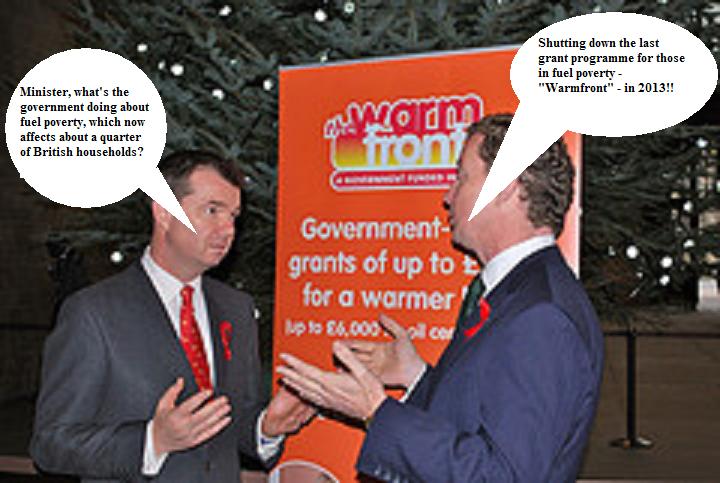
But there’s a letter in the Guardian (see below) and this photo (minus speech bubbles, naturally) was published by the Department of Energy and Climate Change flickr account and I couldn’t help myself*…

Your report rightly points out (Quarter of homes now in fuel poverty, 2 December) that the government should be highly embarrassed by new estimates that one in four English households is now in fuel poverty. But its reaction to this escalating problem would sadly suggest the contrary. Warm Front, the government’s one remaining grant programme for the fuel-poor, has had its budget slashed by two-thirds over the next two years and will end completely in 2013. Even more worrying was last week’s government consultation on the new Energy Company Obligation, which is designed to subsidise energy efficiency measures for low-income and vulnerable households from 2013. With 4.1m English households officially in fuel poverty in 2009 – and with a government duty to eradicate this scourge by 2016 – we hoped that the consultation would include ambitious plans for tackling the problem.
Instead we find that, even on the most ambitious estimates, the ECO will bring relief to only 840,000 fuel-poor households by the end of 2015. This will mean at least 3m households left to choose between heating and eating. In addition to urgently helping them with their energy bills, the answer to fuel poverty is to increase dramatically the energy efficiency of the housing stock, so that homes are effectively “fuel poverty proofed”.
More money must be found – and we urge government to use rising Treasury receipts from VAT on energy prices and the revenue from carbon trading and taxes to be directed into schemes to end the misery of fuel poverty.
Mervyn Kohler Special Adviser, Age UK
Jenny Holland Head of parliamentary team, Association for the Conservation of Energy
Martin Chadwick Chief officer, Beat the Cold
Simon Roberts Chief executive, Centre for Sustainable Energy
David Kidney Head of policy, Chartered Institute of Environmental Health
Audrey Gallacher Director of energy, Consumer Focus
Dr Brenda Boardman Emeritus fellow, Environmental Change Institute, University of Oxford
Andrew Pendleton Head of campaigns, Friends of the Earth
Kelvin Hopkins MP and Caroline Lucas MP Co-chairs, all-party parliamentary fuel poverty & energy efficiency group
Belinda Phipps Chief executive, NCT
Jenny Saunders Chief executive, National Energy Action
Kevin Allen Chairman, National Private Tenants Organisation
Jimmy Devlin Chairman, North West Tenants & Residents Assembly
Brendan Cox Director of policy and advocacy, Save the Children
Ed Matthew Director, Transform UK
Dave Prentis General secretary, Unison
Professor Cosmo Graham Director Centre for consumers and essential services, University of Leicester

*It’s true, I didn’t try very hard.
Marc Hudson

Posted in Energy, humour | Tagged , , , | Leave a comment

Book Review: Shaping Urban Infrastructures

How do you teach an elephant to tapdance? How do you get big slow lumbering beasts like states and city governments to make rapid and broad changes to the way they do things? These are questions posed by a bunch of academics (many based in Greater Manchester) in a rather interesting collection published this year. Beware though, this is a book by academics for academics, and as such Joe Public and Jane Activist are going to struggle.* That’s a pity, but to be expected (complaining about the lack of clarity and verve in academic writing is like complaining about the lack of car chases in Proust).

The book’s focus, as the subtitle suggests, is on “intermediaries” – individuals and organisations that try to act as ‘go-betweens’ to make new things happen (or keep things the same…). According to the authors “The key policy and research interest lies in ascertaining whether intermediaries can effect systemic change to urban infrastructures, in particular in the interest of advancing more sustainable modes of production and consumption.”

While none of the chapters is a “dud,” several stand out as particularly useful to activists. Sally Randles and Sarah Mander of Tyndall Manchester look at the way the Internet encourages the taking of flights that might otherwise not happen, and how this is an unacknowledged problem for efforts to reduce carbon footprints. (Of course, you can always do what Manchester City Council and AGMA do in their climate strategies – pretend their Airport doesn’t exist!!) Rebecca Whittle and Will Medd “Bridging the Recovery Gap” got people involved in helping Hull residents in the aftermath of the 2007 floods to keep diaries, and their article deserves especially wide readership in this new age of council cuts.

There are several case studies – on energy, water, and transport, buildings and so on. All of them are detailed and thought-provoking. The big gap, in this reviewer’s opinion, is on how publics are (dis)engaged from policy formation and implementation. The coming decades will need governments with a credibility that can only be won through extended and genuine dialogue. It would have been good to see work on adaptive leadership and what some call “shadow organisations.”

Other chapters, on including the “conceptual framework” quartet that makes up the book’s first section, will appeal to the more theoretical reader. It’s not a book for the casual reader, but any academic working on these issues should have a copy, and a few could usefully find their way to the policy writers at local and regional level.

Marc Hudson

* Fear Not! The heroic staff of MCFLy will interview several of the authors over the coming months and cajole and threaten them into speaking English.

TITLE Shaping Urban Infrastructure: Intermediaries and the Governance of Socio-technical Networks
AUTHORS Simon Guy, Simon Marvin, Will Medd and Timothy Moss
PUBLISHER Earthscan
ISBN 978 – 1- 84971 – 068 – 8
PAGES 217 + index
PRICE £65 (hardback)

[Disclosure: We asked for and received a copy of this book.]

Posted in AGMA, Book Review, Manchester Airport | Tagged , , , , , | Leave a comment

Manchester climate academic quizzed at House of Commons

Two climate change academics spoke on Tuesday 29 November to a group of MPs at the House of Commons. Dr Alice Bows of Manchester University’s Sustainable Consumption Institute (1) and Leeds-based Dr John Barrett presented their work on “embedded carbon” (from the energy used to produce goods that are imported) to the Energy and Climate Change Select Committee.

Dr Bows explained to MCFly the nature of their argument; “We told them that using just one indicator as a measure of what mitigation approaches should be taken to tackle climate change, is inadequate.” Dr Bows added that while the current “production-based” or “territorial” approaches to setting targets should not be abandoned, “the consumption-based accounting approach offers further insights into the drivers of emission growth, and highlights new levers that could be pulled to tackle rising emissions.”

Continuing in the vein of speaking truth to power, the academics told the politicians that “if emissions are included from international aviation, shipping and the emissions associated with imported goods for UK consumption” then the UK’s total emissions have been going up markedly, rather than declining.

The politicians pressed – as their job entails – on “how policies could actually work in relation to consumption”, especially on how border tariff adjustments could work, and how they might violate World Trade Organisation rules.

MCFly intends to conduct further in depth interviews with Dr Bows on the implications of “consumption-based accounting” at some point in the new year.

Dr Bows also informed us that the Sustainable Consumption Institute’s consumption-based scenarios were recently the focus of a project workshop to describe ‘backcasts’ to possible 2050 food futures. Dr Bows stated that “the next stage in our project is to estimate the cumulative emissions associated with the 2050 scenarios, based on what our stakeholders said would be necessary to deliver the various ‘worlds’. These included one in which the UK is virtually self-sustaining, through the use of indoor growing environments to ward against the worst climate impacts, and another where livestock has been broadly abandoned in favour of laboratory grown meat!” (see the website for info)

(1) And yes, that’s the same SCI set up with a wodge of cash from Tesco.

UPDATE 5/12/2011. Ellie Dawkins, also funded by the SCI, but at the University of York’s Stockholm Environment Institute also gave evidence

Posted in Energy, Food | Tagged , , | 6 Comments

Event Report: South Manchester Environment Forum #4

Six volunteers working for Action for Sustainable Living  have pulled off an excellent and (1) deeply flawed “South Manchester Environmental Forum” tonight. The event, which saw a total of seven presentations given to a packed room of more than 60 people, was the fourth in a series of forums (2) with the explicit aim of information sharing and networking.

After brief welcomes, five speakers gave “pecha kucha” powerpoint presenations. In peta kucha each slide is up for twenty seconds, and a presentation lasts for 20 slides. This is an excellent way of stopping people over-running their allotted time!

The Transition Cholton (sic) presentation was somewhat light on concrete achievements in the last year (and the Transition City Manchester website has been updated about three times in the last year – not a sign of a thriving organisation)

The presentation on the Mosscider project got everyone thirsty for cider, and hopefully some will be available at the next-SMEF-but-one.

Continue reading

Posted in Climate Change Action Plan, Event reports | Tagged , , , , , , , , | 4 Comments

Steering Group chair to respond

An update to last Thursday’s article story “Steering What, Where?” about the Stakeholder Steering Group and its failure to announce or consult around the delay to the “Annual” Stakeholder Conference on Climate Change.

In a telephone conversation today, the Group’s Chair, Steve Connor, told MCFly that no minutes have been taken at any of the Group’s meetings during the last 18 months, only “action points.”

The Terms of Reference of the Group, seen by MCFly but not posted on the official manchesterclimate.com website state: “Agendas and minutes will be publicly available and circulated to an emailing list. Reports to the Group will similarly be made public unless a specific request for confidentiality is made and agreed by the Group”.

It is not clear if any member of the Steering Group has ever read these Terms of Reference. If they did, they did not appear raise the lack of minutes as an issue. (We can’t be sure – there are no minutes.) Continue reading

Posted in Democratic deficit, Manchester City Council | Tagged | Leave a comment

Ecocities Conference postponed

A major conference about how Manchester can adapt to climate change has been postponed at very short notice. The final “Ecocities” conference was due to take place on December 6-7, but an email sent on November 23 announced a delay to “early in 2012.

Ecocities is a collaboration between University of Manchester, Manchester City Council and the property company Bruntwood. The purpose is to generate an “adaptation blueprint” for Greater Manchester, so that people, buildings and organisations are prepared for the drier summers and the warmer wetter winters that are coming.

Dr Jeremy Carter. of University of Manchester’s School of Environment and Development, told MCFly the decision was taken “by an advisory group which includes representatives from the University, Bruntwood and the City Council” and that financial considerations were not an issue. Manchester City Council referred questions to Ecocities, and Bruntwood had not replied at time of going to press. Continue reading

Posted in Adaptation, Manchester City Council | Tagged , , | 1 Comment

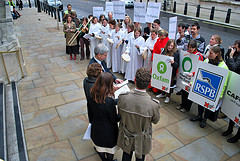
Caption Contest: The Climate Choir

So this* is one of those frankly embarrassing stunts that NGOs do from time to time.**  We want you to come up with a ‘Private Eye’ style caption.

“The climate choir are joined by Climate Change Minister Greg Barker and Chris Huhne, Secretary of State for Energy and Climate Change. 22 November 2011”

So far suggestions include:

“Can you sing ‘It’s the End of the World as We Know It?'”

“Oh, and I thought we didn’t have a prayer.”

“Hmm, we all seem to be out of time. No, wait…”

* Via Decc.gov.uk, and CROWN COPYRIGHT.  (Punishment for misuse? “Orf with their heads”)

** Always

Posted in humour | 2 Comments

MCFly climate bulletin # 4, Nov 28 2011

Hi all,
the first Manchester Climate Monthly (dead tree format) hits the streets on January 2nd, 2012. Please encourage your climate-concerned friends to take out a (free!!) subscription – via our subscribe page.
Here’s a 40 second video explaining the top ten reasons folks should subscribe
And follow us on twitter (@mcr_climate).

and while you are wasting your life on the Interwebz, why not vote for Manchester’s own Carbon Co-op as it tries to win a big pot of money for its exciting work.  More details here. Continue reading

Posted in Weekly bulletins | Leave a comment