What #Manchester could learn from Cape Town on #climate action (but won’t)

MCFly reader Jon Silver on what Manchester – its people and government – could learn from “the South.” But given the wilfully blindness and deafness of the Council’s elected members and bureaucrats, don’t hold your breath…

Learning from Cape Town’s climate change actions

Cape Town is not a city without it’s own problems but the work on climate change over the last decade by the municipality and a growing network of university, NGO, business and civil society partners has helped it to at least begin to create a co-ordinated response to these issues. Whilst Manchester is keen on claiming to be the best city EVER it is clear that the Council could learn a lot from this African city in terms of creating momentum, knowledge and partnership in addressing climate change issues. In what follows I set out some of the things I’ve learned over the last few years in Cape Town that might help MCC to actually take climate change seriously.

Use the universities better

This work to create a knowledge base does not need to be done just by MCC but through close partnership with our academic institutions and the wealth of talent and energy they possess on climate change dynamics. Creating a dedicated Climate Change Think Tank at the African Centre for Cities in partnership with the City of Cape Town led to conversations between municipal and university partners, to a scientific approach to climate change being adopted by the municipality and ongoing support. The work culminated in the publishing of a book that brings together the various strands of debate and knowledge about climate change in the city. In Manchester such a partnership might be a useful way to mobilise new individuals and groups, bring science into the centre of decision making processes at MCC and of course the passionate, extra resources of those at the universities.

Producing a state of energy and climate change report

The release of the State of Energy and Energy Futures produced in Cape Town over the last decade provided both an important understanding of the challenges being faced by the city and a detailed, data anchored analysis that has acted as the basis for the municipality to not just create objectives but assess its progress over the years. Whilst we have the Certain Future strategy, and promises of updates each quarter producing such a publication would show a real commitment by MCC to take this energy and GreenHouse Gas stuff seriously and allow us as residents to hold them to account

Create a dedicated council team working on climate change

Even in an era of austerity and unprecedented cuts having a dedicated team within the council to drive forward the city’s response to climate change is a no brainier if MCC are actually going to take these issues seriously (or at least put up some pretense). The establishment of the Energy and Climate Change branch within the ‘Environmental Resource Management Department’ at the City of Cape Town has meant dedicated and expert staff building up knowledges and momentum and more importantly having some passionate and clever champions within the organisation. This work alongside civil society and keep the pressure up on elected officials . And this does not need to be just municipal staff. Cape Town have drawn in human resources from the university and the NGO sector to help, guide, challenge and support the team as it grows and develops. This dedicated team in Cape Town is in direct contrast to the disbanding of the Environmental Strategy team at MCC.

Innovate using local regulation

Now that Manchester has gained some degree of devolution, however messy and undemocratic it provides a great time to start using local regulation to instigate low carbon pathways. In Cape Town the municipality spent much time developing a solar water heater by-law that sought to improve energy security, reduce electricity use based on carbon heavy production, improve the quality of life for residents and stimulate local economies around solar technology. The bylaw has meant up to 10,000 units being installed each year saving up to 20,000 tonnes of carbon. This bold leadership on solar technology led to its implementation at a national level showing how innovation in cities can influence national policymakers. And its not like Manchester has not helped to shape legislation at a national level through lobbying and devoting its time and resources. Perhaps it is time to do something at a local level with the potential to upscale across the UK that is more worthwhile than restricting the rights of peddlers.

A low carbon city centre

In Cape Town the central economic area is responsible for generating 40% of the city’s carbon output. The City of Cape Town decided to do something about this and has developed a strategy that has provided some important data that has provide a way to engage some of the big landlords and buildings owners to think about retrofitting green roofs, solar technologies and such like. Now we know that Manchester has already engaged the big landlords of the city to fund research around adaptation but it is not clear exactly whether any of the property owners have done anything since.

Take back the power

Whilst a very different context to the UK the role of the City of Cape Town as the main electricity distributor shows the potentials of municipal control over energy. Imagine MCC became the distributor of electricity in the city with all the benefits of keeping our energy money in the city for investment in retrofitting buildings, developing a renewable only purchasing policy and of course being able to better address fuel poverty through subsidisation. Recent calls to nationalise energy, including from within the Party suggest this is not as far fetched as it sounds. Put alongside recent developments in places such as Berlin in which the fight for the re-municipalisation of energy is slowly being won. It’s time to shift our gaze, in this new era of devolution talk beyond the squalid neoliberal present and even the (re) nationalisation of energy to think about models that can equip our city with the tools and resources needed to shape a low carbon future. If elected officials can espouse the benefits of municipal control of the airport then surely it’s time for them to wake up from there carbon slumber and use these skills of persuasion to articulate the need to take back the power.
 

Posted in Adaptation, Democratic deficit | Tagged , | 3 Comments

Davyhulme Incinerator “on hold”

From press release:

The Breathe Clean Air Group is delighted to hear that plans for constructing the Davyhulme Incinerator are on hold. “This is very encouraging news”, said Pete Kilvert, Chairman of the group “and we wish to place on record our thanks to Trafford Council for continuing its dialogue with the Peel Group and all Councillors who have supported our campaign on behalf of the community. This is a great day for Trafford and Greater Manchester.”

Local campaigners the Breathe Clean Air Group opposed the plan and elicited the support of Trafford Councillors. The Council unanimously rejected the planning application in November 2011, then a Public Inquiry held in November 2012 allowed the application, it was then approved by Secretary of Sate for Communities and Local Government Eric Pickles, and a High Court Appeal by Trafford Council in Feb 2014 failed to overturn the Public Inquiry decision.

The Breathe Clean Air Group has maintained that the incinerator would create air pollution that would have massive ill-health impacts. The design would not be using best available technology, the furnace temperature at 850 degrees C would be too low to destroy deadly dioxins, the out-dated bag filtration system would not be able to capture all the tiny Particulate Matter and heavy metals such as arsenic, and the chimney stack (at only 44 metres) would not be high enough to disperse the emissions effectively.

The incinerator, which was planned to be built near the M60 motorway bridge over the Manchester Ship Canal, would be located next to an Air Quality Management Area, where levels of nitrogen dioxide are already well above European safety levels. “There are several schools, sports facilities and many houses in the fall-out zone for this incinerator’s air pollution,” said Chairman Pete Kilvert. “We have campaigned to protect our children and residents for the right to breathe clean air. We are so pleased that our campaign looks to be coming to a satisfactory conclusion. However, the team remains vigilant and will also continue to campaign against a proposed fracking venture, motorway pollution, sewage smells and other air polluting processes in our neighbourhood.”

Posted in Energy | Tagged | Leave a comment

Upcoming Events: “Cultural Politics of Climate Change” + “Energy Transition pathways” #Manchester Thurs 19th Feb

Two events at University of Manchester promise to be excellent think-fodder next Thursday, 19th February.

From 2pm there’s a seminar on “the Cultural Politics of Climate Change” by Matthew Paterson, now at the University of Ottawa (see biog here). It’s at room 10.05 of the Harold Hankins Building.

Then, from 4.30pm,  “Tyndall Manchester would like to invite you to attend the first talk in our new seminar series ‘Transition pathways for a UK low carbon electricity future’ by Dr. Tim Foxon, Reader in Sustainability and Innovation at the Sustainability Research Institute, School of Earth and Environment at the University of Leeds on Thursday 19th February (room C1, George Begg Building, Sackville Street).”


Transition pathways for a UK low carbon electricity future

Dr. Tim Foxon, Reader in Sustainability and Innovation at the Sustainability Research Institute, School of Earth and Environment at the University of Leeds (biography attached)

This research explores the roles of actors and governance framings in a low carbon transition, by developing and analysing scenarios or pathways to a low carbon electricity future, as well as potential branching points along these pathways. Pathways under market-led, government-led and civil society-led framings have been analysed (see special issue of Energy Policy), and further research is exploring the changes in technologies, institutions, business strategies and user practices that would be needed to realise these transition pathways, including potential new institutional arrangements for a civil society-led pathway.

Posted in academia, University of Manchester | 1 Comment

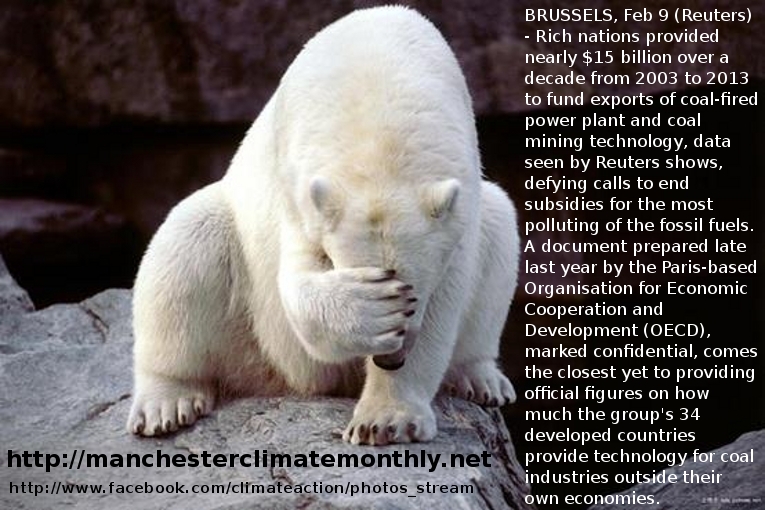
Polar Bear Facepalm: £15bn subsidies for coal technologies

From here.

polarbearcoalsubsidies

Posted in Polar Bear Facepalm | Tagged | Leave a comment

Upcoming Event: Vigil for cyclist, Friday 13th February, 6.30pm

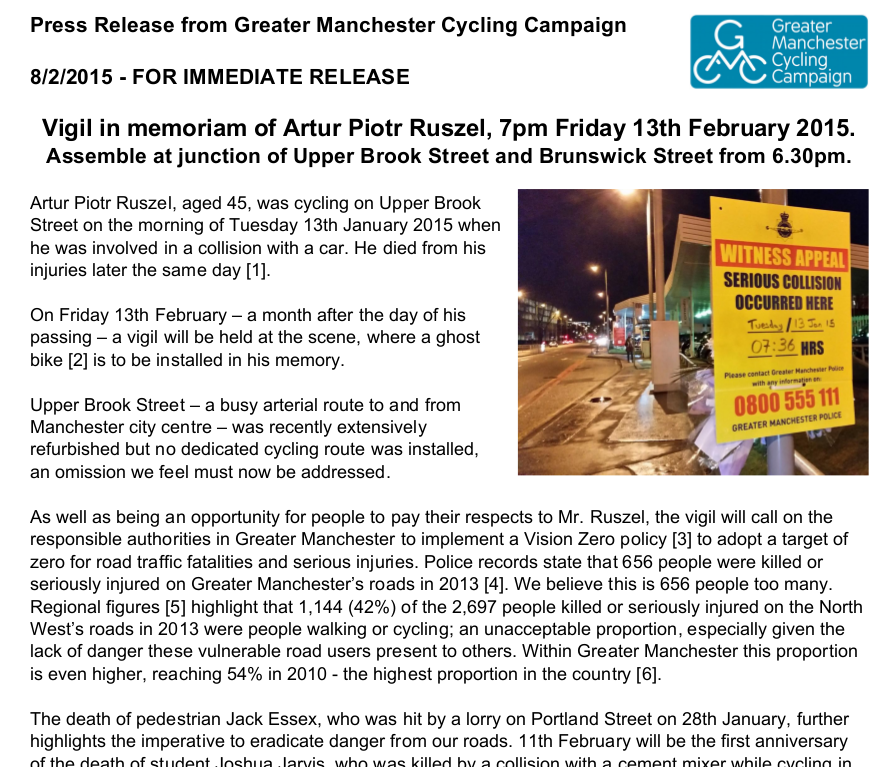
cyclingvigilArtur Piotr Ruszel, aged 45, was cycling on Upper Brook Street on the morning of Tuesday 13th January 2015 when he was involved in a collision with a car. He died from his injuries later the same day [1].
On Friday 13th February – a month after the day of his passing – a vigil will be held at the scene, where a ghost bike [2] is to be installed in his memory.
Upper Brook Street – a busy arterial route to and from Manchester city centre – was recently extensively refurbished but no dedicated cycling route was installed, an omission we feel must now be addressed.
As well as being an opportunity for people to pay their respects to Mr. Ruszel, the vigil will call on the responsible authorities in Greater Manchester to implement a Vision Zero policy [3] to adopt a target of zero for road traffic fatalities and serious injuries. Police records state that 656 people were killed or seriously injured on Greater Manchester’s roads in 2013 [4]. We believe this is 656 people too many.
Regional figures [5] highlight that 1,144 (42%) of the 2,697 people killed or seriously injured on the North West’s roads in 2013 were people walking or cycling; an unacceptable proportion, especially given the lack of danger these vulnerable road users present to others. Within Greater Manchester this proportion is even higher, reaching 54% in 2010 – the highest proportion in the country [6].

Posted in Campaign Update, Transport | 3 Comments

Upcoming Event: Offshore wind in the UK and global production networks Mon Feb 16th #Manchester

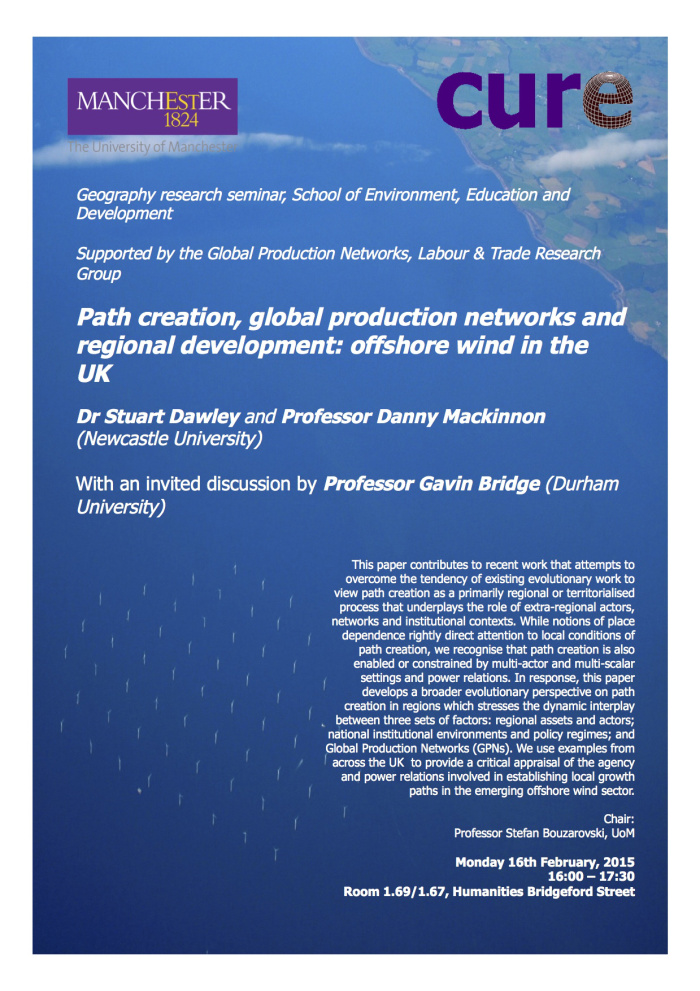
cure_posterxThe Centre for Urban Energy and Resilience at the School of Environment, Education and Development (University of Manchester) is co-hosting this event with the Geography research seminar series and the Global Production Networks, Labour & Trade Research Group: 
 
Path creation, global production networks and regional development: Offshore wind in the UK
Monday 16th February, 2015. 16:00 – 17:30 Room 1.69/1.67, Humanities Bridgeford Street (2 minute walk from the Blackwell’s on Oxford Road)
 
Dr Stuart Dawley and Professor Danny Mackinnon (Newcastle University)
 
With an invited discussion by Professor Gavin Bridge (Durham University)
 
This paper contributes to recent work that attempts to overcome the tendency of existing evolutionary work to view path creation as a primarily regional or territorialised process that underplays the role of extra-regional actors, networks and institutional contexts. While notions of place dependence rightly direct attention to local conditions of path creation, we recognise that path creation is also enabled or constrained by multi-actor and multi-scalar settings and power relations. In response, this paper develops a broader evolutionary perspective on path creation in regions which stresses the dynamic interplay between three sets of factors: regional assets and actors; national institutional environments and policy regimes; and Global Production Networks (GPNs). We use examples from across the UK to provide a critical appraisal of the agency and power relations involved in establishing local growth paths in the emerging offshore wind sector.
 
Chair: Professor Stefan Bouzarovski (University of Manchester)
 
Posted in academia, Energy, Upcoming Events | Leave a comment

Councillor Rosa Battle says hundreds consulted on Green Infrastructure. Actual number – fewer than 50.

Councillor Rosa Battle, Executive Member for Culture and Leisure, told elected members of the Council that hundreds of people had been consulted on the outsourced-for-£30,000 “Green and Blue Infrastructure” strategy. The actual number, once you take out council employees? Less fifty.

In December 2014 Manchester City Council presented its draft Green and Blue Infrastructure Strategy, very long overdue. (1) The thorny question of who had been consulted came up spontaneously (Cough, cough; see this video for the gory details.)

Councillor Rosa Battle, who was presenting the report because the Executive Member for the Environment was then on maternity leave, said that if all the stakeholders consulted were invited to the March 2015 meeting of Neighbourhoods Scrutiny Committee (where the final strategy is to be presented), the meeting would need to last 24 hours and “this whole table [of over 20 people] would be full of people ten times over.”

You can see that for yourself here. (sorry, the embedding is not working.)

http://www.manchester.public-i.tv/core/share/open/webcast/0/0/560/158817/158817/webcast/start_time/4774000

So, how does this statement of “over 200 people consulted” actually stack up?

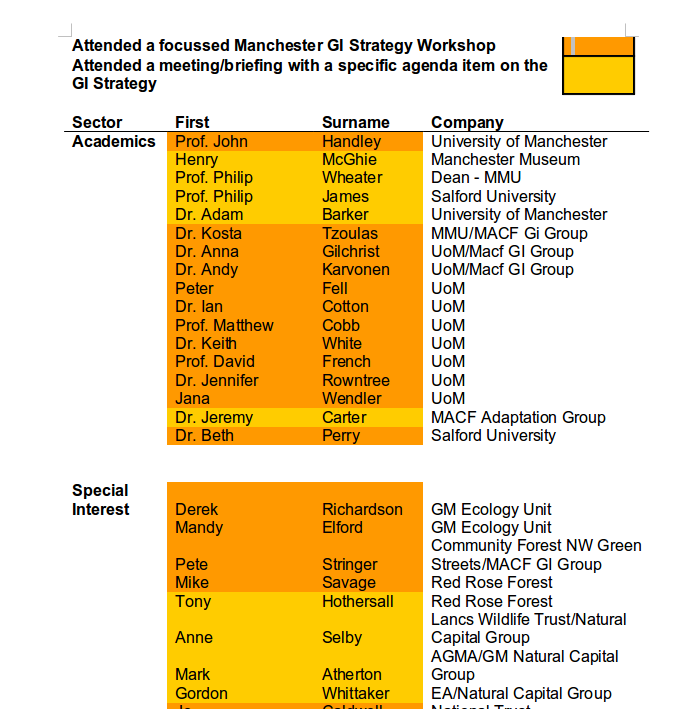
 An official document has been released (it’s attached here.)


stakeholderconsultation

The ACTUAL number is even less than fifty, because the list provided includes people who attended a “meeting/briefing with a specific agenda item on the GI Strategy”

actualnumber

and also seems to include attendees at a (University of Manchester) workshop that didn’t in fact take place until 2 months AFTER the claim of hundreds of consultees. And I’ve nothing against academics (cough, cough), but they’re not exactly ‘members of the public,’ now are they?

Will Neighbourhoods Scrutiny Committee take this forward?

Watch this space.

Footnotes

(1) In July 2013 the Council Leader Richard Leese told full council that the already long-delayed Green and Blue Infrastructure strategy was going to Neighhourhoods Scrutiny the following week.

(2) MCFly sent Councillor Battle a series of questions in December. Some of the answers to those questions are provided in the document above.   And the ignored questions are –

“Finally, since the last document and its consultation in early 2014, there doesn’t – to my clearly inadequate eye – seem to have been much consultation and engagement. To correct my misapprehension, could you please point me to

  • any pages on the City Council website where people have been invited to leave a comment about the evolving GBI strategy
  • any public events held by Manchester City Council at which the Green and Blue Infrastructure was the focus of discussion, including the dates and venues of these meetings, and the rough estimates of attendees.
  • any use of social media (facebook, twitter, youtube) about the GBI by Manchester City Council
  • The same questions as above for both the BDP, the contract winner, and the Manchester A Certain Future Steering Group Green and Blue Subgroup (fortunately, the same person will be able to provide answers for both organisations!)
  • Indicative examples of where opinion has been sought via the communications (newsletters, magazines, e-bulletins) of partner organisations (e.g. Red Rose Forest, GM Ecology Unit). As I said in the meeting, no mention of the GBI strategy has, to my knowledge, been made in Friends of the Earth’s weekly digest.
  • The dates and venues and attendees of any academic workshops held with experts at University of Manchester.  [They did this in February 2015.  Perhaps prompted by this very question?!]
  • The numbers of official consultation documents sent out and the number of replies received.I know this seems like a long list, but you were very confident that a large amount of consultation had indeed been done, so this shouldn’t take too long to knock together.”
Posted in Democratic deficit, Green spaces | 5 Comments

No future, for you and me. Or #Manchester, frankly.

Watch this video. It will put you in the mood.

futureclimateforum

Fifty people met (let’s get the demographics out the way; 2/3rds male, mostly 40+ professionals and retireds. A grand total of two people of colour. “Pale, male and stale” a phrase I learnt from a dynamic and innovative person.) They were ego-fodder.

What happened? Well, one after another, seven people stood on a stage and did their “death-by-powerpoint” sage schtick at varying speeds and with variable coherence (Six white men, one white woman, since you ask; such diversity!) There was a break for questions, and more before the last speaker.

The event took place in the Central Library, the refurbishment of which was one of the Council’s nine “catalytic actions” of early 2009 (1), back when there was still plausible hope and credibility in regional/local climate politics.

The tl;dr If you weren’t there, you dodged a bullet. If you were there, you bit it and stuck around (tellingly, some people left as soon as they decently could).

There was little new for anyone with more than a passing familiarity with climate issues, and of course no concrete reflections on the failures at a local level (Emissions reductions? Low carbon culture? Carbon literacy training? Mentioned vaguely, but it doesn’t do to go into details if you want to keep on the good side of the “Great” and the “Good”.) No mention that the Council is abolishing its Environmental Strategy Team, or expanding the Airport as fast as it can.

There was no sense (besides a glancing reference to “exciting time, terrifying time”) of the fundamentally horrifying urgency of action, the likelihood that – as with the last 25 years – nothing will be done, and the imminence of the consequences of past and present inaction. Like people who live too close to the gigantic dam, we can’t mentally afford to think about what might happen.

What is the “point” of these events?
Some function must be served, right? Well, the organisers get to tick the “public engagement” box, and put some photos in the annual report.

The speakers get to tick the “public engagement” box.

And people who come, well, they get to be seen, and schmooze, and maybe ‘learn something’. (2) But more than that, they get to feel knowledgeable and responsible. And maybe there is some good old-fashioned Kubler-Ross-style ‘bargaining’ and magical thinking – if I am a Good Person (being Concerned) then Bad Things won’t happen, because it is a Just World after all.

And perhaps most of all – I may lose some of you who I didn’t already– but imma quote myself-

The social function of these events, with some cod-Transactional Analysis thrown in for larfs
“We” (members of the climateriat) are afraid because of the concatenating environmental crises. We are afraid because we see the hollowing-out of our democracies, and the clear inability of civil society organisations to challenge the eco-cidal global elite with more than occasional occupational spasms.
We are afraid. Very afraid.
When we are afraid, we want to “regress” to a state where someone else has to look after us.
The elite described in Neslen’s book need to regress all the way to diapers. The rest of us, with less responsibility in our day-to-day lives, are able to regress merely to being a school-child, sat in rows, listening to the Clever Parent at the front. No jobs, no direct-reports, no kids to look after, we can, for the length of the event, just be the docile/obedient Child.
Attempts to turn us into Adults in this setting will be resisted, both by those who wish to be Parents, and by those who want to be Children. Efforts at de-ego-fodderification are, thus, futile.

From: https://manchesterclimatemonthly.net/2013/12/10/event-report-groaning-the-city-citycons-manchester/

Wire mommy has the milk, after all…

What was good

  • One speaker coming closer than ever before to admitting that I was right after all and we are, in fact, doomed. Next time, maybe? (btw CCS just fell in a hole (geddit?) again.)
  • This quote from a British Rear-Admiral Neil Morrisetti “You can probably secure a 2C world… it’s most unlikely you can secure a 4C world.” [See Telegraph story here, Nov 10 2014]

What was fricking hilarious

  • The unwillingness/inability of those in office if not power to control the speaker who went on for about double the agreed time. Some began to doze, many eyeballs were rolled, and I did fleetingly wonder if it was some elaborate social psychology experiment (the smoky room thing, perhaps?)

  • The invocation, at the end of a sage on the stage event par “excellence” (cough cough), that sage on the stage is a Bad Thing. “Well duh” as the young people say.

The compassionate version

Recently someone taught me (by their example as much as by their words), of the fundamental importance of compassion. And the compassionate version of this blog post would say, look, people really ARE doing ‘the best they can’ (or are willing to do within the constraints they laid upon themselves so long ago that they’ve forgotten, that have become fetishised, naturalised).

We – all of use – are incapable (either unwilling or just cognitively limited) to move beyond the scripts and rituals that have ‘worked’ and continue – for many – to ‘work’. We dare not see what we have done, are doing. We dare not, the implications are unbearable, especially for the parents among us. The beautyful ones, it seems, are not born. (3)

A final word, on the climate “movement.”

It’s a very odd time. Some climate activists are trying to build the Paris negotiations as “the focal point.” However, memories of Copenhagen are too fresh (or rancid) for that to work. Some are deluding themselves that a march in March (geddit?) is going to be the biggest climate march in the UK ever. Um, ALL the NGOs spent all of 2009 urging people to be part of “the Big Wave.” And that got what, 50 or 60,000. I will eat my hat if the march in March (geddit?) gets 20,000.

Meanwhile, I think, everyone is looking at everyone else not freaking out, despite all the ever-more-dire warnings and defeats and thinking “well, nobody else is freaking out. Everyone’s just going along to these stupid sage on the stage events and sitting obedient. So it can’t be as bad as I think it is, or else they’d be doing something different.” Verily, the room is getting smoky.

Strange days indeed. That vasectomy, over ten years ago now, looks like the least stupid decision I ever made.

Marc Hudson
mcmonthly@gmail.com

Footnotes

(1) See the “Call to Action” report, which the Council hired a London-based consultancy called “Beyond Green” to write, for something in the region of £28,000. Its crapness inspired the “Call to Real Action.”  The rest is (ancient) history.

(2) Why did I go? For the lulz, and the blog fodder, natch. And because some people I don’t see often enough were braving it too.

(3) And they are leaving it quite late, frankly.

Posted in Event reports, Fun, humour | 1 Comment

Scrutiny Week Feb 2015 for #Manchester Council – why aren’t they releasing info in this format?

There is no page on Manchester City Council’s “award-winning” website where you can see “in one go” the agendas of all the 6 scrutiny committees that are supposed to keep tabs on the all-powerful Executive and the shadowy and equally (more?) powerful unelected officers.

Funny that.

Tuesday 10th March

Young People and Children’s

10am The Scrutiny Committee Room, Level 2, Town Hall Extension

Agenda

Reports

Neighbourhoods

2pm The Scrutiny Committee Room, Level 2, Town Hall Extension

Agenda

Reports

Wednesday11th March

Economy

10am The Scrutiny Committee Room, Level 2, Town Hall Extension

  • Wednesday, 11 February 2015

Agenda

Reports

Communities

2pm The Scrutiny Committee Room, Level 2, Town Hall Extension

Agenda

Reports

Thursday 12th March

Finance

10am The Scrutiny Committee Room, Level 2, Town Hall Extension

Thursday, 12 February 2015

Agenda

Reports

Health

2pm The Scrutiny Committee Room, Level 2, Town Hall Extension

Agenda

Reports

Posted in Democratic deficit, Manchester City Council | Leave a comment

#Manchester Council misses #climate plan deadline

Manchester’s elected representatives will NOT get the chance to scrutinise the city council’s climate ‘achievements’ and future plans this week. An annual report on the council’s climate plan had been promised to the Neighbourhoods Scrutiny Committee since last February. Despite having twelve months to prepare it, it is now not going to happen until March, at the last meeting before the scrutiny committees break up before the May elections.

Last year the Council simply did not produce a report on its 2013-4 ‘actions’, and activists had to stitch one together using the Freedom of Information Act.  The shocking report revealed that many promises (e.g. “hold 5 events during Climate Week”) were broken, and many actions were not even measured against stated targets.

There a couple of possibilities to this latest delay.

  • One is that the Environmental Strategy Team, which is being disbanded, simply didn’t have the capacity to do the job in a timely fashion. [A request for a statement about the disbanding and its implications has been received by the Council weeks ago, but not replied to].
  • Another is that a report was completed, but then someone somewhere has decided it wasn’t up to scratch, and has asked for more time.

Neither option speaks well to this Council’s ability to perform what should be utterly standard actions.

Meanwhile, still no word on who the 23 councillors who HAVE completed their carbon literacy training by the end of 2014 are (the Council’s target was 60). This despite a Freedom of Information Act requesting names as well as numbers having been submitted in early December.

MCFly says:

The switch to a three year cycle was supposed to streamline the annual reports. This clearly hasn’t happened.  It will be interesting to see if any scrutiny committee members point this out.

Quarterly “progress” reports were promised by the Executive Member for the Environment. With the exception of one extremely brief document outlining only the emissions (which had gone UP), this hasn’t happened. It will be interesting to see if any scrutiny committee members point this out.

And it’s not like the Council doesn’t have form. The 2012 report was delayed because, in the words of a previous Exec for the Environment. “The item was deferred from July until the next available meeting in September as we wanted to guarantee that the figures being put before the committee were accurate.”

Meanwhile, the 2013 report tried to spin an INCREASE in the council’s emissions as a decrease.

Through all of this debacle, the people elected to secure the long-term future of Manchester have just sat there and taken it, with a couple of them asking for quarterly reports, but then being willing to be fobbed off.   It will be interesting to see if there is any change this year.

Next post: the monthly “what’s being scrutinised” list, since the Council is unwilling/unable to produce such a list itself.

Posted in Democratic deficit, Manchester City Council | Leave a comment