Upcoming Event: #Manchester University students call for divestment – Fri 13th Feb, 12 noon

Press Release:

As part of Global Divestment Day on the 13th of February, Manchester students in conjunction with local campaign groups will be demonstrating outside University Place at 12pm for divestment from the fossil fuel industry. Fossil Free are campaigning at the University to freeze, reduce and eventually end all investment in fossil fuels to manage the transition to a renewable and low-carbon energy-based economy. We argue that the University is contradicting its “Policy for Socially Responsible Investment”, which states that “the university will use its influence in an effort to reduce and, ideally, eliminate, irresponsible corporate behaviour leading to… environmental degradation and Human rights violations.”

Our research has revealed as of April 2014, the University of Manchester has 846,337 shares in fossil fuel companies, worth a total of £9,529,172 an increase of £544,805 from last year. A further £29.5 million is invested in the 7 FTSE 100 fossil fuel companies via the University’s pension fund in the form of equity and corporate bonds. In total this represents almost £40m of funding for the indsutry. We have also found that during the Deepwater Horizon oil disaster in April 2010, which killed 12 people and caused huge amounts of environmental damage in the Gulf of Mexico, the University’s 646466 shares in BP in April 2010 cost them £2.28 million in share devaluation by the end of June the same year. This highlights the massive volatility in share price, making the case for divestment economic, scientific and moral. The university receives £16.37m in inward investment from BP in various departments, everything from sponsorship to paid staff and research. Shell invests a further £4.74m across the university.

At least two-thirds of current fossil fuel reserves must remain unburned to avoid a catastrophic 2°C rise in temperature, yet the University continues to invest in new carbon-intensive and uneconomical exploration and extraction methods, prolonging our societal addiction to fossil fuels. A global agreement at the UN climate conference in 2015 (COP 21), widely regarded by climate scientists as the last chance to avoid 2°C warming, stands to cost the fossil fuel industry $29.8 trillion over the next two decades (calculated by ExxonMobil who have also warned investors that they see a deal as highly unlikely). It’s time for the University of Manchester to abandon an industry with a business model which is so fundamentally at odds with a safe climate. It’s time invest in a clean and secure future for us all; no amount of wealth is worth the people and planet’s health.

Meet at 12pm at University Place on Friday the 13th of February to demonstrate for divestment from fossil fuels and join over 1500 other people in signing the petition.

Posted in academia, press release journalism, University of Manchester, Upcoming Events | 1 Comment

Book Review: This Changes Everything, by Naomi Klein

This excellent book review is re-posted with permission from the site of a PhD student colleague.  His site has many other posts as insightful as this one below…

A passage in Naomi Klein’s new climate manfesto, entitled This Changes Everything, stood out to me:

The southeastern [Indian] state of Andhra Pradesh has been the site of several iconic struggles, like one in the village of Kakarapalli, surrounded by rice patties and coconut groves, where local residents can be seen staffing a semipermanent checkpoint under a baobab tree at the entrance to town. The encampment chokes off the only road leading to a half-built power plant where construction was halted amidst protests in 2011. In nearby Sompeta, another power plant proposal was stopped by a breakthrough alliance of urban middle-class professionals and subsistence farmers and fishers who united to protect the nearby wetlands

Richard Branson tossed a globe around at a climate change-related press event. Naomi Klein argues that this image is illustrative of the fundamental political problems of climate change: We think we’re in charge of the Earth.

If you’re a bleeding-heart lefty like me, then that quote probably makes you very happy. After all, it ticks all the boxes: Pastoralism, nonviolent direct action, organized peasants, and a vaguely anarchist makeshift checkpoint set up under a tree. This, and other passages in This Changes Everything make climate activism seem like the culmination of all that the left has been working towards for decades. That, in fact, is precisely Klein’s argument: Climate change might be terrifying, but we can solve the problem with the same movements and policies that, by a convenient coincidence, fit exactly with the movements and policies that Klein already supports.

In case you haven’t detected it yet, I should say at this point that I’m somewhat skeptical of this thesis.

It’s not that Klein is wrong. Not exactly. Her argument can be broken down into two premises: Firstly, that climate change cannot be addressed without also changing the neoliberal economic order which prevails around the world today; and secondly, that existing left-wing movements already provide a template for how to create a low-carbon society. Klein’s argument in favour of the first proposition is entirely convincing. One chapter points out how international agreements to deal with climate change constantly run up against the free trade agenda. Another demonstrates how “green billionaires” such as Richard Branson are basically useless: at the end of the day, capitalism being what it is, they have to prioritize their investors over the climate. The first half of the book has a radical premise, but it is extremely well-supported by a unique synthesis of recent environmental history.

But once Klein is finished tearing down old systems, she devotes about a third of the book to building up an alternative. And this is where the problems emerge: Klein abandons the critical approach she applies to the prevailing right-wing order, giving the left-wing largely sympathetic treatment where the climate is concerned. Rather than taking up the difficult soul-searching that will be required to adopt even left-wing movements to the challenge of climate, Klein instead simply presents a series of tropes that have been staples of the left-wing echo chamber for decades. This approach isn’t always off the mark; it’s unsurprising that those who have been fighting against neoliberalism for three decades will have at least some of the answers when it comes to averting the harm it does to the climate. And Klein does indeed point to some promising movements for change. Her account of the role of indigenous movements in stopping pipelines and fracking is particularly compelling, particularly as she draws links between these and other kinds of on-the-ground resistance efforts.

But even in this case, she seems to have half-forgotten about climate change. In many of the cases she cites, the resistance is primarily motivated by concern about the local effects of the fossil fuel industries: Water tables poisoned by fracking, mountaintops destroyed by coal mining, and coastlines threatened by oil tankers. These are very real and pressing concerns, and we should support people fighting back against these harmful effects of the fossil fuel industry. But Klein leaves a very important question unanswered: If these impacts on the local environment are somehow mitigated, then can we still count on this kind of local resistance purely for the sake of the climate? If fracking is made healthier, coal mining is made less destructive, and fossil fuel transportation by ship and pipeline is made safer, then can we expect these movements to stick around purely for the sake of the climate? Perhaps there is an argument to be made that we can, but Klein doesn’t make it.

Another problem is that while Klein spends a good deal of her book excoriating the established environmental movement for its collaboration with industry, she falls hook, line and sinker for some of the cultural baggage that has been holding environmentalists back. Environmentalism, she argues, should be low-tech, democratic, and rooted in the need to protect local ecosystems. Klein makes an absurd comparison between view of conservation inspired by images like Earthrise and the Pale Blue Dot, and the image of Richard Branson holding up a big inflatable globe, as if he’s “in charge” (a favourite term of Klein’s) of the entire planet. If your environmentalism is inspired by an enterprise as technocratic of the space program, Klein argues, then you’re doing it wrong. Much better to fight to protect the lower-case earth: the ground beneath your feet. Klein’s stretched comparison between her own fertility struggles and the struggles of the planet to bring forth life reaffirm this view when she heavily implies that the naturopath she visited was far more effective in helping her become pregnant than the more traditional fertility doctors she had previously tried.

Klein’s fertility treatment is her own business, of course. But when combined with her thoughts about the Pale Blue Dot, it becomes clear that Klein’s book is based firmly in 1970s environmentalism, which was at its heart a reaction to industrial technocracy. This led to a deep distrust of scientists and engineers in favour of a personal, even spiritual engagement with nature. And forty-four years after the first Earth Day, Klein is pushing the same basic narrative, in which science and technology are primarily part of the problem rather than the solution. I bet you can guess what Klein thinks of nuclear power.

The thing is that nothing is that simple. Yes, technology has been poisoning the planet on a large-scale since the nineteenth century, and scientists and engineers have often done more harm than good. But this is not the 1970s, and many of the scientists now sounding the alarm about the climate are part of the kind of large, bureaucratic scientific institution that makes hippy environmentalism so uncomfortable. The engineers developing wind turbines, electric cars, and new kinds of bike infrastructure are also often very establishment figures, many of whom probably lack any kind of spiritual connection to nature. But we need all hands on deck to address the climate crisis. Yes, we need to challenge the prevailing economic order as well as our own rates of consumption. But we also need to leverage every single sustainable alternative we can get our hands on, regardless of whether it is centralized, local, high-tech, low-tech, socialistic, or capitalist. Because the climate doesn’t care about our political and economic preferences.

I don’t really mind if environmentalists prefer to see the planet as a space-ship, a goddess, a super-organism, or even a resource to be exploited, so long as that worldview is mobilized into a willingness to fight. But Klein’s distrust of scientific diagnoses and technological solutions is dangerous. The planet may well need its equivalent of naturopathic doctors who are capable of looking at it holistically and proposing low-tech solutions that take advantage of existing environmental processes. And it certainly needs dedicated activists ready to put their bodies on the line in the fight against fossil fuel companies. But the Earth also needs something more like traditional medicine: lab-coated scientists who use satellites, computer algorithms, and advanced chemistry to diagnose its problems, as well as ambitious engineers who can prescribe high-tech solutions. We need all of the above.

Anybody who has read more than a few posts in this blog can tell that I’m pretty left-wing. And that means that, naturally, I think that left-wing thought is a better approximation of reality than right-wing thought, including the centre-right consensus of the current economic paradigm. But it’s hubristic to think that any political ideology, which is an imperfect product of political alliances and historical contingencies, provides the perfect analysis of or solution to climate change, which is bigger than any political debate. Klein is probably right that right-wing ideology is inseparable from the practices that are causing climate change. But just because we on the left are more sympathetic to the problem, it doesn’t mean that we, too, won’t have to make political sacrifices. Real action on the climate demands that we seriously reconsider our positions on things like gentrification and technocracy. We need to fit our concern for the oppressed into the harsh facts of climate change, and find ways to help them that don’t make the problem worse. This difficult task is what Klein misses in her book.


Posted in Book Review | Tagged , , , | 13 Comments

Upcoming Event: Chico Mendes film screening/event , Sat 28th Feb, Mossley

chamadaFromChicoMendesInteractive Digital Carnival Installation inspired by environmental activism stories from across the world – including Chico Mendes.
SPECIAL OPENING EVENTS SAT 28th FEB incl. Film Screening, discussion, Multimedia Music Performance, live Brazil link, interviews, poetry and free food! Full details: http://metaceptive.net/chamada/

at Global Grooves Centre until 21st March. 10 mins walk from Mossley station – just 20 mins train from Manchester, only £4 off-peak day return ticket!

– 4pm: Film “TAKING ROOT: WANGARI MAATHAI” + discussion.

– 7pm: LIVE PERFORMANCE by Kooj/Holly/Leon, guided tour, poetry by Sai Murray, live link with Brazil environmentalists + Free Food!

Here’s the link to the (free!) ticket booking

Posted in Upcoming Events | Leave a comment

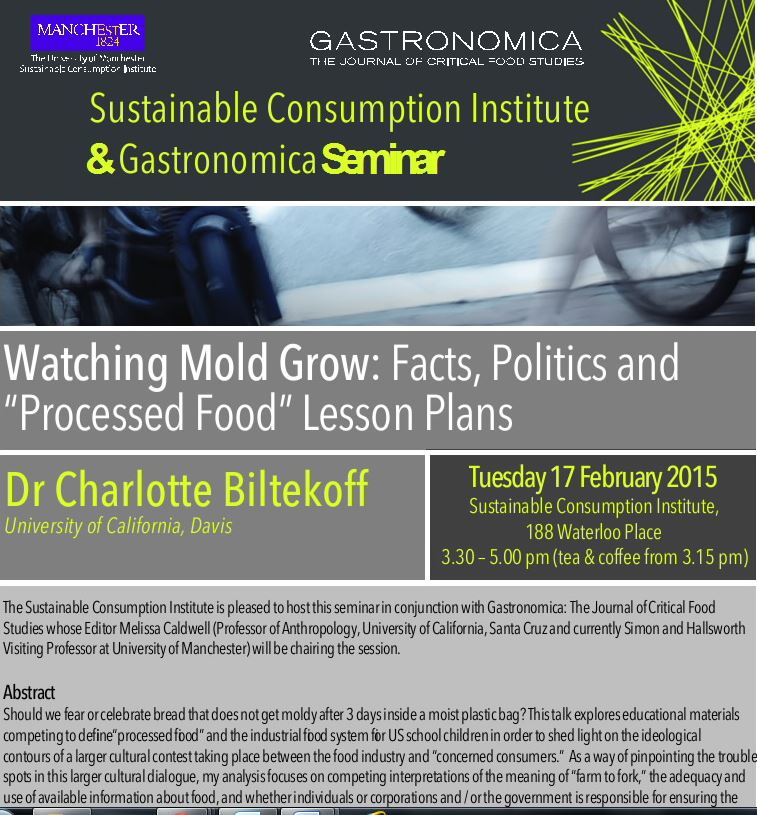
“Processed Food” event in #Manchester Feb 17th, 3.30 – 5.00pm

feb17thseminarWatching Mold Grow: Facts, Politics and “Processed Food” Lesson Plans
 
Dr Charlotte Biltekoff, University of California, Davis
 
Should we fear or celebrate bread that does not get moldy after 3 days inside a moist plastic bag? This talk explores educational materials competing to define “processed food” and the industrial food system for US school children in order to shed light on the ideological contours of a larger cultural contest taking place between the food industry and “concerned consumers.”  As a way of pinpointing the trouble spots in this larger cultural dialogue, my analysis focuses on competing interpretations of the meaning of “farm to fork,” the adequacy and use of available information about food, and whether individuals or corporations and / or the government is responsible for ensuring the health and safety of American diets.  Thinking about these curricular materials through the lens of framing contests helps to explain why competing sides in the processed food framing contest find each others arguments entirely unconvincing.
 
Charlotte Biltekoff is Assistant Professor of American Studies at the University of California at Davis, where she also holds an appointment in Food, Science and Technology. She is the author of Eating Right in America: The Cultural Politics of Dietary Health (Duke University Press, October 2013) and her research program focuses on the cultural aspects of dietary health.
 
The Sustainable Consumption Institute is pleased to host this seminar in conjunction with Gastronomica: The Journal of Critical Food Studies whose Editor Melissa Caldwell (Professor of Anthropology, University of California, Santa Cruz and currently Simon and Hallsworth Visiting Professor at University of Manchester) will be chairing the session. 
Will be held at SCI, 188 Waterloo Place, Oxford Road (on the right as you head out of town, just before you get to the Manchester Museum).
Posted in Food, Upcoming Events | Leave a comment

#Manchester Evening News letter about “carbon literacy” failure #climate

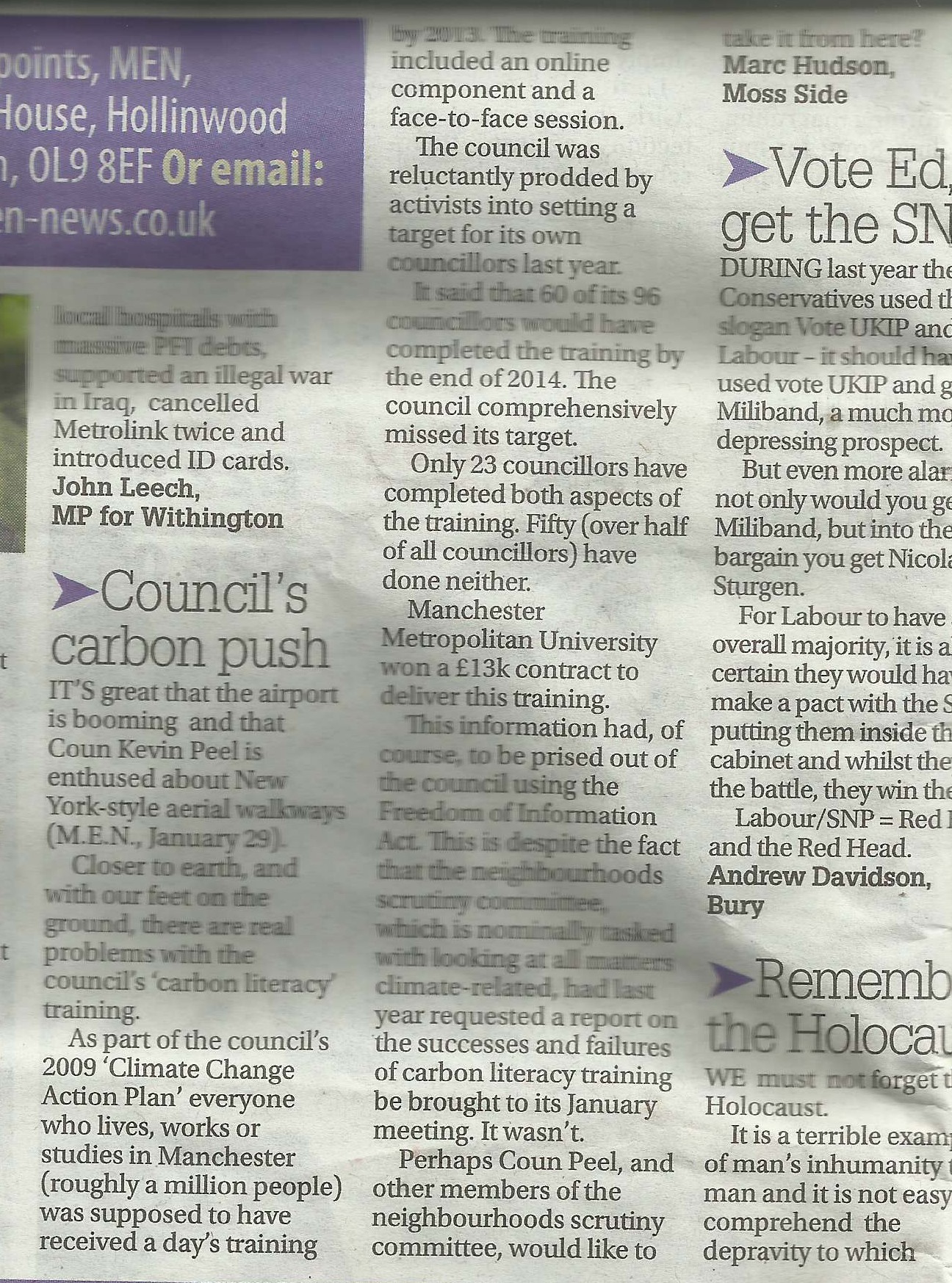
Last Friday Manchester Evening News published this letter.

councilscarbonpushIt’s great that the airport is booming  and that Councillor Kevin Peel is enthused about New York-style aerial walkways (Manchester Evening News, January 29th).

Closer to earth, and with our feet on the ground, there are real problems with the Council’s “carbon literacy” training.  As part of the Council’s 2009 “Climate Change Action Plan” everyone who lives, works or studies in Manchester (roughly a million people) was supposed to have received a day’s training by 2013.  The training included an online component and a face-to-face session.

The council was reluctantly prodded by activists into setting a target for its own councillors last year. It said that 60 of its 96 councillors would have completed the training by the end of 2014.

The council comprehensively missed its target. Only 23 councillors have completed both aspects of the training. Fifty (over half of all councillors) have done neither.

Manchester Metropolitan University won a £13k contract to deliver this training.

This information had, of course, to be prised out of the Council using the Freedom of Information Act. This is despite the fact that the  Neighbourhoods Scrutiny Committee, which is nominally tasked with looking at all matters climate-related, had last year requested a report on the successes and failures of Carbon Literacy training be brought to its January meeting. It wasn’t.

Perhaps Councillor Peel, and other members of the Neighbourhoods Scrutiny Committee, would like to take it from here?

Marc Hudson

Editor Manchester Climate Monthly

Posted in Democratic deficit, Letters to the MEN, Manchester City Council | Tagged | Leave a comment

#Manchester professor – “UK shale gas industry incompatible with 2 degree #climate target”

Professor Kevin Anderson has written a detailed blog post about the implications of a UK shale gas industry for climate change.

The post, based on analysis developed by Professor Anderson in collaboration with Dr John Broderick, is in response to another Professor’s work entitled “Hydraulic fracturing for shale gas in the UK – an opportunity to shape a constructive way forward”.

Professor Anderson begins “Professor Mair’s Royal Society post suggests that the development of a UK shale gas industry is compatible with the UK’s climate change targets. I suggest this conclusion is premised on a partial and overly simplistic interpretation of the UK’s muddled climate change obligations.”

You can read the rest of his post here.

Posted in academia, Energy, Fracking | Tagged | Leave a comment

#Fracking in Lancashire: Interview with Friends of the Earth campaigner

Ali Abbas of Manchester Friends of the Earth answers questions about fracking in Lancashire. Please SHARE this post. It’s full of information that  you and other people can ACT upon.

There was supposed to be a decision today in Lancashire, but it didn’t happen because the company that wants to frack requested more time. Why do you think Cuadrilla wanted the delay? Are they hoping it will get lost in the general pre-election fuss, or are there other motives afoot?

The planning committee was due to decide on whether or not to give Cuadrilla permission to frack at two sites near the Fylde coast. Officers had recommended refusal because of the noise and traffic impacts, so Cuadrilla asked for a deferral so they could amend their plans to lessen those impacts. By doing so, Cuadrilla are hoping planning officers will recommend approval of the revised plans, making it harder for the planning committee to refuse them.

More importantly, what would you like individuals and organisations who don’t want fracking to DO in the next few weeks?

If you haven’t already, please sign and share this petition to Lancashire County Council leader Jenny Mein – and encourage all your friends and colleagues to do so too.

If you’ve got any spare time over the next few weekends, we’ll be out with local anti-fracking groups across Lancashire asking residents and businesses to sign letters to the council – call/text me on 07786 090520 for more details.

And if you’re short of time but have some money to spare, please consider making a donation to Friends of the Earth’s campaign fund to help stop fracking in Lancashire (and across the UK).

How can they get involved in what Friends of the Earth is doing on fracking?

As well as supporting the campaign in Lancashire, we’ve also been taking action against fracking in Salford and Trafford, and we’d like to encourage more councils across Greater Manchester to go frack-free. If you’d like to get involved, come to the next Manchester Friends of the Earth meeting at 7pm on Tuesday 10th February at the Green Fish Resource Centre, 46-50 Oldham Street, M4 1LE, or call/text me on 07786 090520.

Some people will think “If not fracking, how are we going to keep the lights on? What about the jobs?” What would your answers be.

The best way to meet our energy needs affordably while staying within our carbon budgets is to focus on using less energy, such as by properly insulating our homes and workplaces, and accelerate uptake of renewables, with a particular focus on community ownership to make sure the profits stay in the local economy.

And that would create many more jobs than fracking – six times as many jobs per unit of power generated or saved, and around three times as many jobs for the same investment, according to recent analysis by the UK Energy Research Council.

If you’d like to see more investment in renewables and energy efficiency, please support Friends of the Earth’s Run on Sun campaign, and join the Energy Bill Revolution. And if you’d like to read more about future energy scenarios, this report shows how we can cost effectively decarbonise the power sector by 2030 without the need for nuclear power.

Anything else you want to say

On a related note, a small group of us is in the process of setting up a community benefit society so we can raise funds via a share issue to install solar panels on schools and community buildings across Greater Manchester. If you’d like to find out more or get involved, especially if you’ve got legal or marketing skills, please call/text me on 07786 090520.

Posted in Energy, Fracking | Tagged | Leave a comment

Manchester Council aims for 60 carbon literate councillors. Gets … 23.

Manchester City Council set itself a public target last year of getting 60 of its 96 councillors to undertake “carbon literacy training.” The training involves an “on-line component, and a face-to-face session, and takes less than a day.

“23 councillors have completed on-line and face-to-face elements of carbon literacy training.”  In a long-overdue and only partial response to a Freedom of Information Act request, the Council was also replied-

b) 1 councillor has completed on-line training.
c)  22 councillors have completed face to face training.
d) 50 councillors have not completed face-to-face or on-line training.

Yep, over half of Manchester’s councillors (all Labour) have not completed either training….

On 4th December 2014 MCFly requested not just numbers, but names of councillors in each category. This portion of the FoIA has been ignored.  This has been pointed out to the Council.

MCFly recently revealed that is Manchester Metropolitan University is being paid £12,960 “for Delivery of the Carbon Literacy training to MCC staff Phase 1b and Councillor training.

It will be interesting to know if there are any performance criteria at all for that contract, and if penalty clauses for poor performance exist and are being invoked.

This comprehensive but sadly not unprecedented failure would also explain why the agreed report about the Carbon Literacy training’s successes and failures to January’s Neighbourhoods Scrutiny Committee did not happen. There ARE no successes…

MCFly says: The levels of incompetence are bewildering and revolting. There has been a complete and abject failure of political and bureaucratic leadership. In any functioning democracy, this would be front page news and a major scandal. In any functioning democracy…

Posted in Manchester City Council | Leave a comment

Jan 28, 1987- “A warning from history” – Two scientists tell the politicians how it will be…

As well as “sniping” at Manchester City Council (I’d happily publicise anything climate-y they were doing that was genuinely innovative or useful), and doing a PhD, I also… run a blog called “All Our Yesterdays – 365 climate histories.”  Today there are two posts – one about the 1969 Santa Barbara oil spill, the second (cut and pasted below) about two scientists who tried to get politicians to listen.  Back in 1987…

An extra “All Our Yesterdays” post today, in honour of two excellent scientists, Professor Veerabhadran Ramanathan and Professor Wally BroeckerIt was Ramanathan’s work on non-carbon dioxide greenhouse gases which had stiffened the resolve of the Villach attendees, and Broecker had been similarly involved. On January 28, 1987 they testified to Congress. Here is a long quote from a chapter in an ancient but sadly prescient book, “The Challenge of Global Warming.”

The Senate took up the greenhouse effect and ozone depletion issues again in January 1987. In fact, it became the subject of the first major hearing by the Senate Environment and Public Works Committee in the new Congress. Two critical and relatively new problems were discussed at this hearing that were to become central aspects of the growing urgency associated with the global warming problem.

Ramanathan argued in the hearing that atmospheric greenhouse gas concentrations had already been altered sufficiently by 1980 to commit the earth to a 0.7 to 2 degrees Celsius warming. With each passing decade Ramanathan estimated that an additional 0.2 to 0.5 degrees Celsius was being added. His analysis meant that by the year 2020 – in 33 years – the earth would be committed to as much as 4 degrees Celsius warming. Many scientists believe that the earth has not been 4 degrees Celsius warmer for tens of millions of years. Ramantahan’s testimony established that society was already locked into a substantial amount of climate change no matter what governments did. The problem was no longer a question of whether a change would occur but how much and when.

The second major issue was raised by Wally Broecker, a geochemist at the Lamont Dougherty Laboratory.  Broecker’s testimony was a follow-up to a talk he had given at an EPA conference in June. Broecker said that an examination of the history of climate change suggested that the greenhouse effect might push the earth into a state of rapid change – reorganizing the earth systems in the process. Broecker had little faith that society would experience a linear and gradual change in global temperature and climate as suggested by general circulation models of the atmosphere. The key implication of Broecker’s testimony was that the buildup of greenhouse gases could force the climate system to go into a state of rapid change and that society ultimately had limited ability to predict what that change might bring.

Page 264 Pomerance, R. (1989) “Dangers from climate warming: A public awakening,” in Abrahamson, D. (1989) The Challenge of Global Warming. Washington, DC: Natural Resources Defense Council

Posted in Uncategorized | 1 Comment

Upcoming event: #Manchester Saturday 31st Jan: How Clean is my Air? (Clean Air Workshop)

Saturday 31st Jan: How Clean is my Air? (Clean Air Workshop)

This workshop will give you the skills to undertake a ‘citizen science’
study of air quality/ air pollution in your neighbourhood. Find out how you
can check the air quality where you live using easy to use equipment. Is it
within the limits?

The workshop will cover:
* planning the project; materials to use; creating an air quality map; interpreting the results;

* national limits for air pollution. No special equipment or skills needed – just bring yourself.

* Meeting at 1pm for a shared lunch. Bring your own food/food to share.

Tea/coffee provided.

The event is free but please register in advance by emailing: Andrew Wood of Network for Clean Air at contact@cleanairuk.org

Clean Air Workshop – open to everyone

Organised by Manchester Friends of the Earth and Network for Clean Air.

When: 1pm – 4.30pm, Saturday 31st January.

Where: Meeting Room A ; Green Fish Resource Centre, 46 – 50 Oldham St, Manchester, M4 1LE

Posted in Upcoming Events | Leave a comment