There’s a chap called Graham Wayne who has persistently and consistently been writing excellent stuff on all aspects of climate change (science, policy, denial, etc).
His latest piece, “What connects Edward Snowden, climate change, GCHQ and lemmings?” is very fine, and very depressing. Excerpts below, but you really should read the whole thing.
Climate change – which I write about for the most part – is coming to a front room near you at a speed nobody reckoned with, and nobody knows how to stop it. The first article I wrote for the Guardian was about civil liberties, after I realised that when threatened, any government will seek to enforce totalitarian, blanket restrictions on the public, their only counter to threats they cannot properly assess, understand or address. The technology of the digital world is a dream come true for the government; the intelligence services, while constantly playing catch-up, do understand the risks, just as the criminal fraternity are slowly learning about it all….
Climate change (remember that?) is going to unhinge society. If you read the Pentagon or Joint Chief’s assessments, civil disorder on a global stage is one of the key threats they believe they will have to address in the future. In successive Quadrennial Defense Reviews, including this latest (PDF), they warn of civil disorder placing demands on armed forces that they are neither trained, equipped or funded for. In other words, their assessment now is of threats not only from abroad, but from within – and they fully expect military involvement in domestic law and order in the near future. The security forces clearly mirror those concerns, given the amount of resources they now employ to spy not just on Russia or China, but on me and you.
They also warn that, at the same time, they will face increasing threats overseas from terrorism, fuelled not only by the hostilities we already comprehend (to some extent) but exacerbated by the privations that climate change is going to visit on us all, predominantly on those who are already so distraught they are prepared to blow themselves up to make their voices heard.(A summary of the Pentagon’s latest report is on DeSmogblog and elsewhere).
Which all serves to remind me that the success of yesterday’s Research Training for Activists event will have to be multiplied and extended several gazillion times if we’re to get anywhere with averting the (?)inevitable.
MCFly’s biodiversity correspondent, Dave Bishop, reads a “brilliant, lucid, very readable, scientifically up-to-date, tragic and utterly terrifying” book…
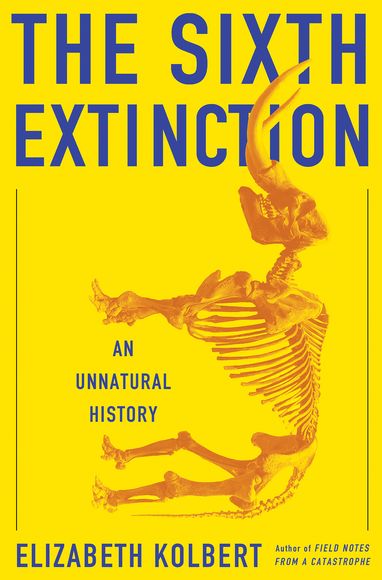
Review: ‘The Sixth Extinction: An Unnatural History’ by Elizabeth Kolbert; Bloomsbury, 2014.
On one fateful day 66 million years ago, the Earth’s gravitational field captured an asteroid. It was travelling at around seventy thousand kilometres per hour on a flat trajectory. It slammed into the Yucatan Peninsula and generated a white-hot, supersonic shock-wave which was directed mainly northward. The author of this book quotes a geologist who said: “Basically, if you were a triceratops in Alberta, you had about two minutes before you got vaporized (sic)”. Trillions of tons of sulphur- rich material was blasted into the air, which led to a condition analogous to a ‘nuclear winter’. Whole orders, families, genera and species of plants and animals went extinct – most famously the non-avian dinosaurs. It took the world millions of years to recover from these catastrophic circumstances – but they are probably why we’re here, rather than some descendant of the dinosaurs.
There had, in fact, been four mass extinction events before the one described above. The most devastating was probably the one at the end of the Permian, some 252 million years ago when around 96% of all living things went extinct – although the reasons for that event are not as well understood. When interviewed recently the author of this book, Elizabeth Kolbert, stated that life on Earth is “contingent” i.e. subject to chance or unforeseen circumstances. The title of her book is based on the rapidly growing consensus among scientists that we’re now living through the sixth extinction event in the history of life on Earth – and that our own species, Homo sapiens, is directly responsible for it. Our current epoch is increasingly being referred to as the “Anthropocene” because our species is now so dominant and has so modified the planet’s surface and atmosphere that the fate of the biosphere is now in our hands.
Elizabeth Kolbert is an American journalist and author. She is best known for her book on climate change, ‘Field Notes from a Catastrophe’ (2006), and as an observer and commentator on environmental matters for the ‘New Yorker’ magazine. This present book is brilliant, lucid, very readable, scientifically up-to-date, tragic and utterly terrifying. We learn that although certain species, such as the Great Auk and the Dodo, have been deliberately exterminated through over-exploitation in the recent past, more recent losses can be directly attributed to our gross and ruthless modifications of the planet’s surface and atmosphere – in particular there are direct links between species’ extinction and climate change. For example, carbon dioxide is soluble in water and produces a weak acid. As the CO2 content of the atmosphere increases, the oceans become more acidic. This affects the viability of organisms that use calcium in their body plans; shellfish and corals are particularly badly affected. In tropical waters, reefs formed by corals provide ecological niches for thousands of non-coral species; if corals are damaged or killed, all of those dependent species are put at risk as well. Tropical rain forests contain hundreds of different tree species. Each tree species has specific habitat requirements and also provides niches for many other species of plants and animals. As temperature rises, trees which produce few seeds and/or are slow growing are at a serious disadvantage, and, consequently, so are their attendant species. Trees which produce lots of seeds and/or are fast growing can move uphill to cooler climes. But even the latter are still at risk because many rain forests are now so fragmented that there are limited spaces for them to move to.
The much vaunted ‘globalisation’ is a serious problem too. Many organisms have been (often inadvertently) transported around the world and have caused havoc in places in which they do not belong. Currently, Central American amphibians and North American bats are being wiped out by imported fungal diseases.
I took away two surprising ideas from this book:
1. This is undoubtedly the first extinction event in history which is being studied, in meticulous detail, by elements of the causal agent! In her research for this book, Ms Kolbert interviewed many scientists working in the field and accompanied some of them on their field trips. The ingenuity and dedication of these scientists is often astonishing.
2. Time scales can often be difficult, or impossible, to grasp; who can get their head round 66 million years – let alone 252 million years – for example? It is now, more or less, agreed that when humans migrated out of Africa, they exterminated large animals (mammoths, giant ground sloths, moas etc.) everywhere they went. Kolbert interviewed a paleobiologist, named John Alroy, who described this ‘megafauna extinction’ as a “geologically instantaneous ecological catastrophe too gradual to be perceived by the people who unleashed it.” The ominous fact is, though, that extinctions are currently happening within single human lifetimes.
This is an important but scary book. Brace yourself and read it!
The hosting; immaculate
The presentations; fascinating That question; crucial.
The “North West Sustainable Business Quarterly” (the clue in is in t’name) meetings are held high above the city streets, on the 24th floor of the City Tower. Many (not all!) of the attendees are high-to-medium flyers. But the topics of the events are far more down-to-earth.
Last night for example, after the customary warm welcome and shout out to the awesome caterers (Good Mood Food) and sponsor (The Energy Solution Group) , the assembled 60ish people (nice demographic mix too- not just follicly-challenged white men) heard about … supermarkets and showers.
Julian Walker-Palin, Head of Corporate Sustainability at Asda Stores Ltd gave a fact-filled presentation (1) on just how much information Asda gets from its customers on their views on sustainability and who should be doing what.
Richard Wright, Behavioural Science Director at Unilever gave an equally useful talk about the lengths Unilever goes to understand who uses the products and how they use them. A recent study captured data on how long people spend in the shower (on average, 8 mins, oddly less than the self-reported 14 mins).
Their presentations were pretty much like what I suspect the work behind underpinning them is – detailed, thoughtful and meticulous and delivered to time and budget. If this is “greenwash,” it is the most subtle kind you could imagine. It’s far more useful to think of it as ecological modernisation on steroids.
Detailed, thoughtful, meticulous and on budget; but missing something… The crucial question came from Eric Woodcock, a professor of project management.(2)
He pointed out that while the presentations both showed how the footprints of products could be reduced, “the number one thing is for people to consumer far far less.”
The response came – and it’s a reasonable one – in that there are many people on the planet who are not consuming enough – (enough food, enough hygiene materials, enough energy.)
This is not something that advocates of a steady-state economy – be they Professor Kevin Anderson, or Steady State Manchester – would argue against. It’s true in so far as it goes. It does however sidestep the question of what is to be done about the “West” (and portions of the “developing” world, of what happens when aforementioned ecological modernisation collides with Jevons’s Paradox…
The bitter truth is that those over-consumers, consuming three planets or five, don’t have talons, oversized incisors or green saliva. If we want to look at the people whose consumption habits are leading future generations to an unimaginable hell, we need only look in our mirrors.
That the NWSBQ events can’t help us with that dilemma is no criticism at all; far more shouty and “right on” groups have failed far more miserably.
The only mystery to me is that the events – always hitting the sweet spot between efficient and friendly – aren’t even more over-subscribed. The next one, on “Social impacts in the supply chain” is on Thursday 12th June. Book here.
Manchester University’s Centre for Urban Resilience and Energy (CURE) in collaboration with Manchester Energy and Geography at SEED Seminar series would like to invite you to the plenary lecture ‘A Vote of ‘No Confidence’: Why US Local Governments Take Action in Response to Shale Gas and Oil Development’ by Professor Susan Christopherson, Cornell University.
The lecture will commence at 5 pm on Wednesday 19th of March and will be followed by a wine reception.
Event venue: Cordingley Lecture Theatre Humanities Bridgeford Street building University of Manchester M13 9PL
After I published an interview with the excellent blogger over at “And Then There’s Physics” there were some brief and exceptionally useful exchanges with a few people (some more than others), on the D word… I promised a video. Voila.
[Comments on the youtube channel will be moderately moderated, comments on the blog immoderately.]
Update: 17th March. This John Russell guy clearly… is right. Sigh. #schoolboyerrors
While I agree with the points it was trying to make, unfortunately it wasn’t much good as a video. Why? Well it broke rule number 1, which is something every communicator should understand. Rule number 1 is: “when on-screen text is used, it should always match the narration”. In other words, the narrator should be repeating any text that appears on screen (or the text should echo the narration). The human mind cannot comfortably read text and listen to different narration: either the ears of the eyes will command most attention and the other will be missed. Even if the text and narration are both making the same point, if they use different words then they will pull against one another.
This week, Claire Woolley is under the metaphorical spotlight.
)
1. “Who are you?” (Name, where you live, and – if you want to say – what you “do”)
2. “What does Manchester need to become more sustainable?”
3. “What knowledge and skills do you want to acquire in 2014?”
Why this? Because we need to celebrate what is happening, imagine what could happen and also connect people who have skills with people who want them. #movementbuilding.
So, watch out. If I see you before you see me, and I’ve got my video camera handy (I will), you might be in the frame…
* And an optional 4. – “Anything else you’d like to say?”
Manchester City Council has included sustainability as a factor in the awarding of contracts to run its leisure centres. As part of the evaluation criteria, sustainability will be given a 10% weighting (with price at 50% and quality at 40%).
Presenting a report entitled “Indoor Leisure Contract” to the Neighbourhoods Scrutiny Committee on Tues 4th March, the Executive Member for Culture and Leisure, Rosa Battle, was careful to deflect praise for the innovation onto senior officers.
Councillor Dan Gillard (Withington) asked if there was a way of increasing the 10% criteria in the tendering. The explanation (in MCFly’s opinion an entirely reasonable one) was that most of the factors involved in the carbon emissions etc of Leisure Centres are actually under the control/therefore the responsibility, of the Town Hall. An officer explained “The operator has very very limited to scope to push up this because the Council is responsible for plant etc.”
MCFly says: This is what needs to happen (what needed to happen years ago, but we #donthaveatimemachine.) We need all Executive members to be embedding this sort of thing in all their portfolios. And we need scrutineers – be they elected members of the council or self-appointed busy-bodies – to be asking as many awkward questions as they can think of. The fact that the answer to “why not more?” on this occasion was entirely legitimate should not dissuade people from asking it again.
#iblame the parents. And the journalists. And, maybe just a bit – the kids.
For what, you ask?
For their utter (almost wilful) blindness to the numbers that matter. The numbers are not the turn-out at the Manchester Central bye-election last year (18%, since you ask, a level lower than anything since the middle of the war). The numbers aren’t the paleness, staleness and maleness, of the House of Commons, nor the House of Lords gerontocracy . The numbers aren’t even the low low numbers of 18-24 year-olds who vote (44%, less for females).
What the hell are the numbers, then? Well, the parts per million of carbon dioxide in the atmosphere (nudging 400, heading inexorably upwards). The number of MPs able to articulate a way out of this horrorshow (close to zero). And the chances of avoiding rapid and catastrophic climate change (closer to zero than Caroline Lucas’s chances of being joined by another Green in 2015).
Yeah, those numbers.
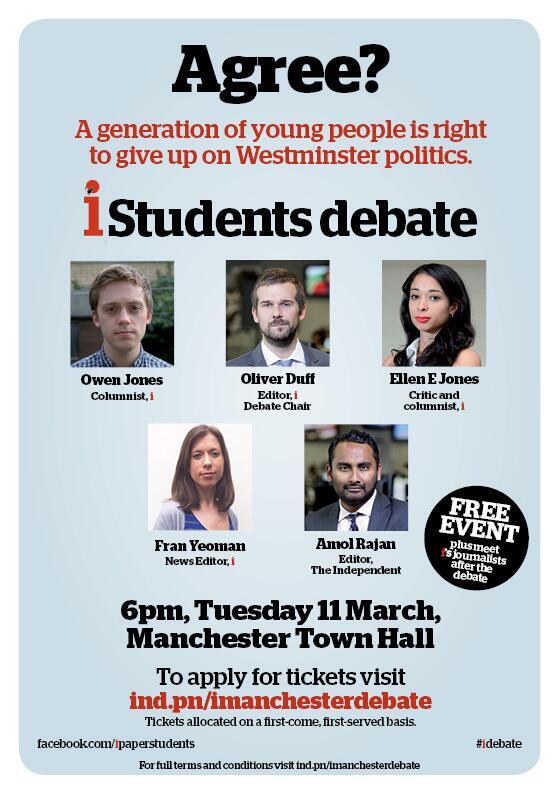
In over an hour of “#idebate”, with a stale format allegedly made down wiv da kids by a twitter feed on the big screen behind the four panellists and their compère, these latter numbers never got an outing. There was a single glancing reference to “environmental crisis” by Owen Jones, at the very end of the event.
That’s extra-ordinary at an event that – big picture – is about how young people are getting screwed over and what they can hope for from the future.
Four-hundred and twenty young’uns (and token #oldfarts like me and a Labour councillor hopeful – hi Mandy!) heard from 5 people, all of whom write for the Utterlydependent and/or its tabloidesque mcnuggets paper, the “i”.
At the outset the chair reffed various issues (youth unemployment, housing etc). And that nearby is St Peters Field, site of the Peterloo massacre (I think there’s a secret rule that says this must be mentioned at any political event in Manchester).
The four speakers introduced themselves laid out their stalls (two saying “don’t vote, but do other stuff.” The other two saying “vote, and do other stuff”). Each was supposed to do this for “two minutes” but this was loosely interpreted, especially by the first speaker, Amol Rajan, the editor of the Indie. Clearly starved of an outlet for his views, he ended up – through the course of the evening – taking up pretty much as much time as the other three panellists combined.
None of the four seemed worried that everyone was basically ego-fodder, and that energy levels sank through the course of the “debate”. Energy levels picked up near the end when the chair asked for a few shows of hands (“who would stand as an MP?” “why/why not?”)
None of the four panellists raised the issue that will dominate the adulthood and senescence of the 400 people in the room – the clash between ecological limits and the inevitable (?) and insatiable need for growth by our economies. (aka “suicide machines”).
Questions were pitched and caught on the usual stuff – compulsory politics lessons, disengagement, policy convergence, technology (that Cameron photo got a mention).
Owen Jones pointed out that proportional representation leads to horse-trading and coalition governments. He could have paraphrased Orwell- “Imagine Nick Clegg, stamping on a student face. Forever.” Maybe he will in the second edition of his new book (out soon) “The Establishment and how they get away with it.” You can have that one for free, Owen.
The best trick the devil ever played…
The “C” word never got spoken. Which one? There are so many. In this instance, capitalism. We should be dewey-eyed about this sort of thing. And by that, I mean John Dewey, the American philosopher –
As long as politics is the shadow cast on society by big business, the attenuation of the shadow will not change the substance.
Quoted in John Dewey and American Democracy by Robert Westbrook (Ithaca: Cornell University Press, 1991), p. 440; cited in Understanding Power (2002) by Noam Chomsky, ch. 9, footnote 16; originally from “The Need for a New Party” (1931) by John Dewey, Later Works 6, p. 163. (Via Westbrook.)
Reasons to be cheerful
It was free
We were spared the spectacle of Johann Hari.
#i got to try to monkey-wrench the “vote” at the end, where you were supposed to hold up either a picture of Russell Brand (you know, the video) or “iVote”. #i scrawled “Guardian” on the back of mine, even though #i am an FT man. They’ll airbrush it out. (Last time I tried to monkey-wrench an Indie photo-op was back in 2006, with Drax in the background. So little has changed since then. (No, actually, we have gone backwards.) And the real danger is that – in the run-up to Paris 2015 – the climate movement will “recover”. And that the story it will tell itself of its previous failure is that it was the (undercover) cops; fault. Or the COPS‘ fault. Or the media’s. Or Westminster’s. And we will repeat the same old mistakes. Watch this space.
Our "leaders" are going to keep making empty promises. It makes them feel good. It gets the activists to act like zombie kittens. If you want to have some self-respect and perhaps make a difference (actual facts may vary), then find a functioning group that cares about your skills and knowledge - what you have, what you want.
One useful group might be www.climateemergencymanchester.net - you can email them on contact@climateemergencymanchester.net




 manchester climate monthly