#Manchester Council #climate plan 2014-7 released #souldestroying

The bad news just keeps on coming.  On Tuesday 4th February at 2pm, the Neighbourhoods Scrutiny Committee of Manchester City Council will discuss the so-called Climate Change Action Plan 2014/15 – 2016/17.

The following Wednesday (12th February) this 40 page fantasy document will be rubber-stamped by the Executive of Manchester City Council.  Both of these eye-stabbingly depressing non-events will take place in the utterly-misnamed “Scrutiny” room of the Manchester Town Hall extension.

Full analysis of this “plan” will follow this weekend on this site.  For now it suffices to say that it contains more fine words and aspirations, but few firm SMART goals with names dates and metrics attached.   Despite a section entitled “Performance since 2009/10” there is precisely zero acknowledgement of the almost-total farce that has been the City’s (not just the Council’s) enacting of the 2009 “Climate Change Action Plan.  If we can’t even admit that there has been more going wrong in this city than can be blamed on the Tories’ austerity budgets – and their singling out of Manchester – then there isn’t really much hope for change, is there?  Not from the centre, from our lords and masters, anyway…

Despite the requests at the July 2013 Neighbourhoods Scrutiny Committee by councillors Kevin Peel and Fran Shone for there to be quarterly progress reports, no such commitment has been made.  This will shock nobody, of course.

I’ll leave you with this gem from deep in the report –

“A challenging interim target of a 20% reduction had been set for the end of 2013/14, from 2009/10. Performance to date indicates this is unlikely to be met.” (p 13)

Marc Hudson
mcmonthly@gmail.com

Posted in Climate Change Action Plan, Democratic deficit, Manchester City Council | Leave a comment

Food Poverty in #Manchester. Council going through the motions

Below find the text of a motion to the next meeting of full Council (Weds 29th Jan, 10am) that just might scrape through.*  It’s motherhood and apple-pie with the obligatory puff for “high tech”**.  If the Council has the same promise-delivery ratio on food poverty as it has had on climate change since 2008, then all I can say is that those who are hungry are going to be getting hungrier…

Food is essential to life, has a major influence on health and well-being and is a key
public health priority for the city. Poor diet is a significant contributor to ill health and
the associated costs of this to the public purse are significant. Less than a quarter of
people in Manchester eat the recommended five fruit and vegetables a day; dietary
factors account for up to a third of deaths from coronary heart disease and a quarter
of cancer deaths.

Food is also important in our ability to participate in society and an inability to buy
and share food similar to our peers is socially isolating. There is gathering evidence
that food poverty, defined by the Department of Health as “the inability to afford or to
have access to, food to make up a healthy diet”, is increasing in the city; this is
damaging to the health and well-being of individuals and communities. Also the
impact of the food system on the environment is vast.

While taking action on food is imperative to address the issues above, it also
presents a positive opportunity to improve the economy and vitality of our city.
Procuring food sustainably creates a market for local food businesses thus creating
jobs, and there is opportunity to encourage and support investment in high-tech
sustainable commercial growing systems – creating jobs and increasing local food
production.

There is already much good work going on in the city by the City Council and
partners. Manchester has been a pioneer of multi agency and community action on
food since 2004, when it became one of the first cities in England to establish a
comprehensive food strategy and partnership (Food Futures). However, it is clear
that we now need to do more to rise to the challenges above and to realise the full
economic and social benefits that food can bring to the city.

A new national initiative – Sustainable Food Cities – a coalition of NGOs led by the
Soil Association, Food Matters and Sustain has been established to support Cities to
use food to support positive change through networking and support. Next year it is
expected that Cities will be invited to apply to become an accredited Sustainable
Food City. This initiative has prompted the establishment of a new Food Board to
champion and oversee this work in the city; this Board has identified four key priority
areas for action, reflected in the commitments below.

This council therefore:
 Welcomes and supports the establishment of a new Food Board
 Commits to working towards Sustainable Food City status
 Commits to develop a policy on health and take-aways to support
improvements in the diets and health of our residents
 Commits to working towards reducing food waste in the city
 Commits to working to alleviate the scandal of food poverty in the city
 Commits to supporting sustainable food procurement through its own
purchases and through its influence with other public sector organisations
Commits to investigate options for attracting investment in high-tech sustainable food
growing industry to create jobs and prosperity in the local economy.

(Signed by: Councillor Akbar (Proposer), Councillor Stogia (seconder), Councillors
Chappell, Lone, Flanagan and Ollerhead)

Footling notes

* Labour has 86 – soon to be 96 – of the 96 Council seats.

** Sustainability Fix

and Ecological Modernisation, anyone??

Fwiw, is it just me, or is there a complete lack of phrases like “Meat Free Monday”, “vegetarian,” “vegan”, “permaculture,” “cruelty-free” etc etc etc in here?

Posted in Food, Manchester City Council | 2 Comments

Inclusivity and diversity in the #Manchester #climate movement. How far we’ve come!!

This is a repost from February 2009, when we were still Manchester Climate Fortnightly.  We post it gain just for all of us to congratulate ourselves on just how far we have come in the last five years on this issue.  Bravo!!!  Not.

Congratulations to Arwa Aburawa, who won the recent essay contest organised by Manchester Climate Forum. The question people were asked to address is “What are the current problems/future opportunities for climate campaigners in Greater Manchester.” The judge was Dr Brian Doherty of Keele University.

Here is Arwa’s entry:

Looking around at the participants of any climate change meeting, one thing sticks out for me: they are racially unrepresentative. It is widely acknowledged that environmentalism and climate change in the UK attracts far more people from white, middle-class backgrounds than people from Asian, Black, Muslim or Jewish backgrounds. Whilst there is nothing wrong with this in itself, climate change is the biggest threat that this earth has faced and we need everyone on board to have a real chance of tackling it and avoiding the worst effects. So we can introduce more diverse people in Manchester’s environmental scene, I think it’s important to consider the following issues:

A. The history of the movement has set-up stereotypes about who is/isn’t involved that need to be actively tackled

British environmentalism originated from an interest in natural history, specimen collection and conservation. As the movement grew its predominantly white, middle-class supporters continued to focus on countryside issues and wildlife preservation at the expense of working class and ethnic minorities whose experiences centred around an urban environment. This historical background set-up clear stereotypes about what an environmentalist looks like, their demographic, their gender and what their interests are. These stereotypes not only excludes a vast amount of people who experienced the environment and climate change in an entirely different ways but it has also marginalised the contributions made by minorities in tackling climate change.

Clearly, the movement has come a long way from these beginnings but there needs to be a more active attempt to break from these powerful stereotypes. Actively and loudly acknowledging the contributions made by ‘poor’ environmentalists such as environmental justice activists in India and minority activists in America who emerged after major environmental disasters, even local minorities (Hulme/Moss Side) who are taking control of their impact on climate change is a really positive way to open up what climate change it about, who it affects and why we all need to be involved. It takes it out of ‘white’ hands and makes it a wider global issue in which everyone’s ideas are heard and respected.

B. Making links with wider issues which have a direct connection to ethnic minorities.

Environmentalism is a really broad topic and certain aspects can be highlighted to appeal to pre-existing interest. For example certain groups will already understand the importance of regeneration and so it makes sense to link up these aspects of environmentalism. Others topics could include religion, conservation and environmental justice. Here are some suggested steps for action:

  • Contact diverse groups on their ground, where they feel comfortable and open to debate

  • Spark their interest by making direct links to them, their religion, culture, history, families

  • Raise profile of campaigners, famous figures, national heroes, religious figures who espoused environmental respect

  • Eg. Gandhi, India’s vibrant environmental movement, Prophet Muhammed and Hadith, Jewish festivals such as Tu B’Shvat (Festival of Trees) etc

These steps makes it easier for diverse groups to relate to environmentalism, gives them pride in the issue and stops the issue from being alien to them/their culture. For this involvement to be sustainable in the long-term, people also need to be empowered, confident with their input and given ownership and responsibility of the issue. This means giving diverse people the skills, knowledge and expertise to take the movement forward in a truly representative way.

  • Empower them and provide a space for them to take their own ideas forward

  • Give them ownership over the issue and respect their ideas

  • Allow them to see the issues from a perspective which brings together different issues such as environmental justice, regeneration, environmental inequality and poverty.

Posted in Campaign Update, Competitions | Leave a comment

“More long term support needed for families displaced by #flooding say researchers”

From a press release –

Planning for the emotional aftermath of devastating floods is as important as dealing with the immediate impact of such emergencies, say researchers from the Hull Floods project at Lancaster University.

As local councils brace themselves for the estimated £400m repair bill for damage caused by the recent storms and flooding, Dr Rebecca Whittle, Lecturer at Lancaster University’s Lancaster Environment Centre said “It’s actually about what comes after – it’s about that long and very protracted recovery period. It’s about that secondary trauma of having to deal with insurers and builders – trying to recover some semblance of normal family life.”

A new short film released this week, entitled  ‘Life after Flooding’, and funded by the Economic And Social Research Council (ESRC), shows how these academics worked with 50 Hull residents for two years following the floods of 2007.

During the deluge the city received a sixth of its annual rainfall in just 12 hours.  More than 10,500 homes were evacuated and many were unable to return to them for over two years.

The researchers asked those who had been most affected to keep a diary, and brought them together for regular group discussions. Dr Marion Walker, Senior Research Associate at Lancaster University Environment Centre, says parents and teachers were also worried about the youngsters who had been displaced. She said: “We realised then that it was important to talk to the children and young people to find out how they were coping.”

So they encouraged them to draw and write storyboards about their experiences.  The researchers found it was a very therapeutic way for the youngsters to deal with their trauma. Ian Lamb, Education Coordinator for Hull City Council, said: “It allowed us to work in a more emotional way. I think if we hadn’t done that with these children then certainly their outcomes and attainment would have suffered. We built that into the curriculum and certainly into the social way that we dealt with families.”

The findings of the Hull Floods Project have influenced government policy – but researchers feel more could still be done. For instance – it should become educational policy that young people severely affected by the disruption caused by flooding carry a record of what happened to them throughout their school life so teachers understand its impact.

In addition, Save the Children UK invited them to work with them to develop a set of resources to help young children and their carers to process their emotions after a disaster.

Posted in academia, Adaptation | Leave a comment

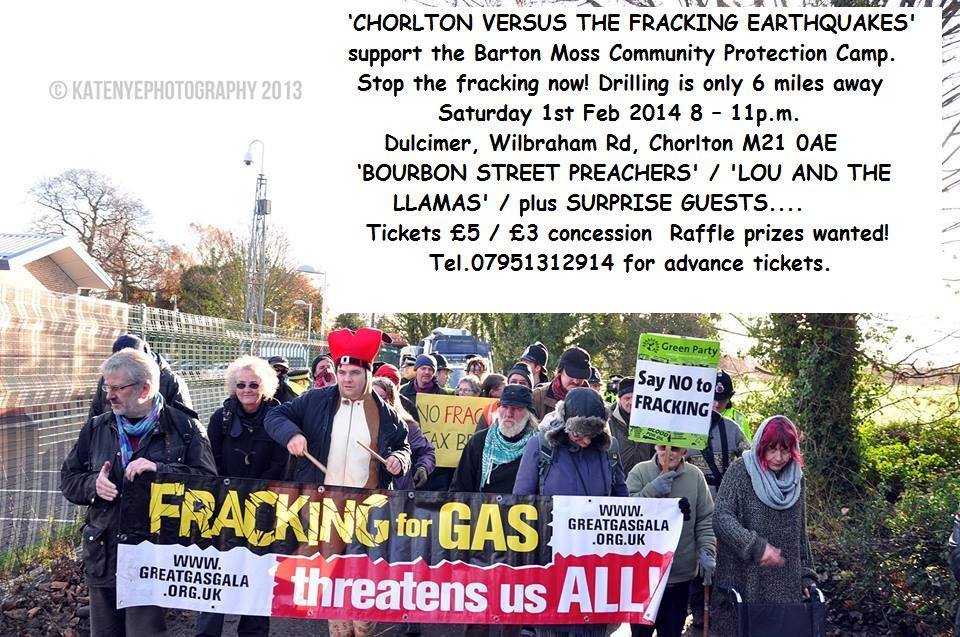
Upcoming Event: Barton Moss #fracking fundraiser Sat 1st Feb #Chorlton #Manchester

chorltonevent

Not an endorsement, just a notification!

Posted in Campaign Update, Upcoming Events | Leave a comment

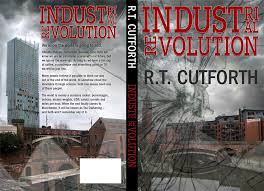
Book Review: Industrial Revolution by R.T. Cutforth #Manchester writer

cutforthLocal author RT Cutforth has written an entertaining and suitably (post-)apocalyptic novel set in Manchester. “Industrial Revolution” opens with a bravura scene of “physical interrogation” (when we do it; torture, when our enemies do it) that recalls the “Is it safe?” sequence in Marathon Man.

Our unreliable and amnesiac narrator, Seth, ekes out an existence in a largely-deserted Northern Quarter, starving but for herb pizzas he gets in exchange for scrap metal. The clock is ticking – the torturers of the opening scene have given him a deadline (in every sense) for when they want the information from him. Information he simply cannot recall.

It’s a kind of mash-up of Twelve Monkeys and Total Recall, with smatterings of the one good episode of the TV show Logan’s Run.* All against a sort of “The Death of Grass” backdrop.

What I am trying to say is this – there are very few “original” plots. Shakespeare nicked most of his, and we remember him for his execution. R.T. Cutforth isn’t Shakespeare (nobody is), but this is a well-written book, especially its action sequences, including a brilliantly-executed confrontation/chase in a windy Beetham Tower.

Saddo quibble: As a health care professional with a smattering of anatomy, I will quibble on one thing – the clavicle and the humerus don’t have a joint. I know, I know, I should get out more. But then who would submit FoIAs to Manchester City Council about this and that?

Marc Hudson
mcmonthly@gmail.com

PS Need some short apocalyptic fiction? Try the winner and runners-up of last year’s Manchester Climate Monthly short story contest!

Posted in Book Review | 1 Comment

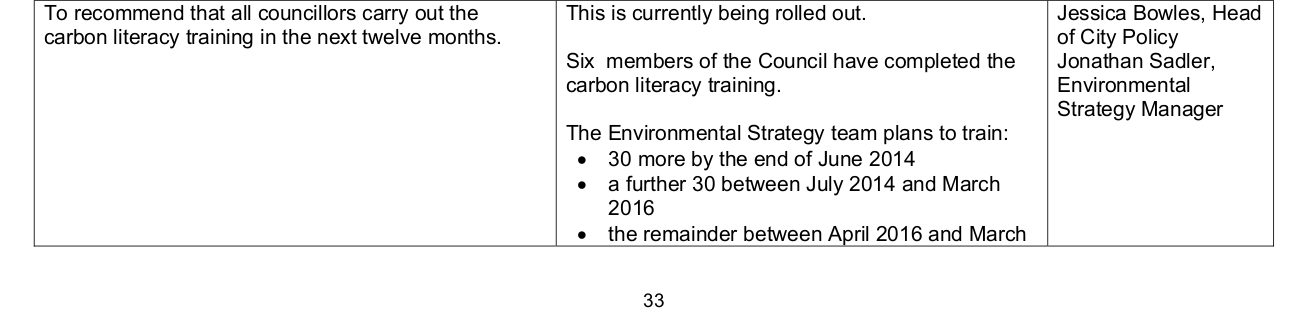
#Manchester City Council has 96 councillors. How many are “carbon literate”? 6.

Four years after committing to ensure “carbon literacy” for the entire city, Manchester City Council has managed to get only 1/16th of its elected members to undertake a day’s training on the central issue of the 21st century.

The information, contained in a report being discussed next Wednesday, 29th January, tells you pretty much everything you need to know about how much progress has been made over the last four years towards creating an-as-yet undefined “low carbon culture”.
six councillors

This abject failure also speaks volumes about just how committed the leadership of Manchester City Council is to the nitty-gritty of action, away from big and easy set-pieces such as inviting Professor Kevin Anderson to address full Council.

This latest scandal sits alongside an increase in the Council’s own emissions last year (an increase they tried unsuccessfully to spin as a decrease) and the fact dismal that instead of a thousand “implementation” plans for the “Manchester A Certain Future” plan there are… two.   And as for the state of adaptation preparations? Not much has been heard of this since a somewhat underwhelming report two years ago.
The only thing that does seem to have captured the Council’s attention is… the plans to massively expand the “Airport City.”

Contacted for a statement about the extremely low number of “carbon literate” councillors, Dave Coleman and Phil Korbel of “Cooler Projects” (the body that created the carbon literacy programme), told us –

“The Carbon Literacy Project is delighted to see the Council celebrating its first 500 Carbon Literate staff at its “graduation” event in the first week of February. We will work with those staff and the first six Carbon Literate Councillors to enable all their colleagues to follow them in gaining their Carbon Literacy accreditation over the next two years. Councillors in particular have a vital role to play in influencing others in the city to empower themselves to act effectively on the urgent challenge of climate change. The more elected representatives who are Carbon Literate the better, as both they and the Council are better equipped to deliver policy that supports their constituent’s work, health and well-being in the long term….”

This graduation event is on Wednesday 5th February at Manchester Town Hall. Sir Richard Leese will be opening the event, at which there be “a number of stalls for staff to browse over lunchtime, as a ‘green fair’ format of active Manchester organisations to provide staff with information and opportunities for staff to continue their ‘low carbon journey’, all with an interactive element.”

Manchester Climate Monthly has formally requested a stall. We’ll let you know how we get on.

Marc Hudson
mcmonthly@gmail.com

P.S. A careful observer of that report will note that in the first column the recommendation [made in May 2013 at the Economy Scrutiny Committee] is “within twelve months”, followed in the second column by the confident claim “this is currently being rolled out.”  Directly underneath that is a timetable that shows they are actually planning to take … a further  thirty-eight months to do this (until March 2017), when the deadline for the recommendation is actually May 2014.  In a long list of epic fails, to acknowledge a commitment, say it is being “rolled out” and then show it isn’t, all in three sentences, is one of the more epic ones!  Bravo!!!

P.P.S.  Why not find out if your councillors are carbon literate?  If they’re not (and frankly, the odds are pretty fantastic that they are not, then why not find out when they intend to get around to showing the teensy-weensiest bit of leadership.

P.P.P.S.  No, I have not undertaken the carbon literacy yet.  At the risk (!) of arrogance (!!), I probably know most of that stuff already.  I spend more than 8 hours every week on climate change, every week.  If I were an elected politician, I would have considered a duty to show some goddam leadership on this.

Posted in Democratic deficit, Manchester City Council | 2 Comments

#Manchester citizens answer 3 questions – 003 Mark Haworth #3qthurs

So, Thursdays are hereby proclaimed to be 3 Questions* Thursdays.

Every Thursday we will put up a short video of a Mancunian answering the following –

1. “Who are you?”  (Name, where you live, and – if you want to say – what you “do”)
2. “What does Manchester need to become more sustainable?”
3. “What knowledge and skills do you want to acquire in 2014?”

Why this? Because we need to celebrate what is happening, imagine what could happen and also connect people who have skills with people who want them.  #movementbuilding.

So, watch out. If I see you before you see me, and I’ve got my video camera handy (I will), you might be in the frame…

* And an optional 4. –  “Anything else you’d like to say?”

Posted in 3 question Thursday | Leave a comment

Action for Sustainable Living seeking small premises, will employ less than one full-time equivalent #Manchester

The charity Action for Sustainable Living has announced its first year of shrinkage.  At its Annual General Meeting last nights, its chair Chris Wright announced that “2013 was the first year in which AfSL received no new grant or contract for community or schools work from any Greater Manchester local authority.”  As a consequence, they are moving out of their current offices at the end of the month, and in negotiations for an alternate city centre location.
Presumably this will be a smaller one.  In response to questions from MCFly, Mr Wright and fellow head-honcho-type Gabby Porter explained that staffing levels would be three part-time people “getting to one full-time equivalent.”  They were not able to say which days someone who phoned in order to get involved would speak to a human, with that information going on the website soon.   Asked about when AfSL would know if it indeed has been successful in accessing grants about which he spoke with cautious optimism, Mr Wright said “it could be as soon as the end of February, it could be longer.”

All this completely undermines the speculation for which MCFly was mildly chastised back in November.

Here’s the audio of a brief interview with Chris Wright

<iframe width=”560″ height=”315″ src=”//www.youtube.com/embed/U6b0LHug_kw?list=UU3d3BqOHXxsTELcNZIYI_Bw” frameborder=”0″ allowfullscreen>

More – on the fantastic food (well, duh, the event was catered by Didsbury Dinners) and the excellent but curiously incomplete speech by Executive Member for the Environment Cllr Kate Chappell – to follow.

Posted in Campaign Update | 2 Comments

Upcoming Event: “Connecting #fuelpoverty and well-being” #Manchester Tues 4 Feb #austerity

austerityeventfeb42014Austerity, warmth and well-being: connecting fuel poverty and urban health

Tuesday 4 February, 6-8pm, International Anthony Burgess Foundation (3 Cambridge Street, Manchester, M1 5BY)

Fuel poverty discussions often focus on how low-income residents can pay their household energy bills in winter months. However, there are also significant health issues associated with living in cold conditions for long periods of time. Damp and draughty houses have negative impacts on the physical and mental health of occupants, particularly vulnerable populations of children and the elderly.

Please join cities@manchester for an Urban Forum focusing on the health aspects of fuel poverty. A panel of experts will provide insights on these interrelated problems, followed by a discussion with the audience, and an opportunity for informal socialising.

Invited panelists include:

Arpana Varma – Institute of Population Health, University of Manchester
Paula Whittaker – Medical Practitioner
Damian Burton – SmartGreen Sustainability Limited
Sergio Tirado-Herrero – Centre for Urban Resilience and Energy, University of Manchester

Posted in Energy, Upcoming Events | Leave a comment