
Original here. Follow ’em on twitter.
Kevin Anderson, are you reading this, hmm??
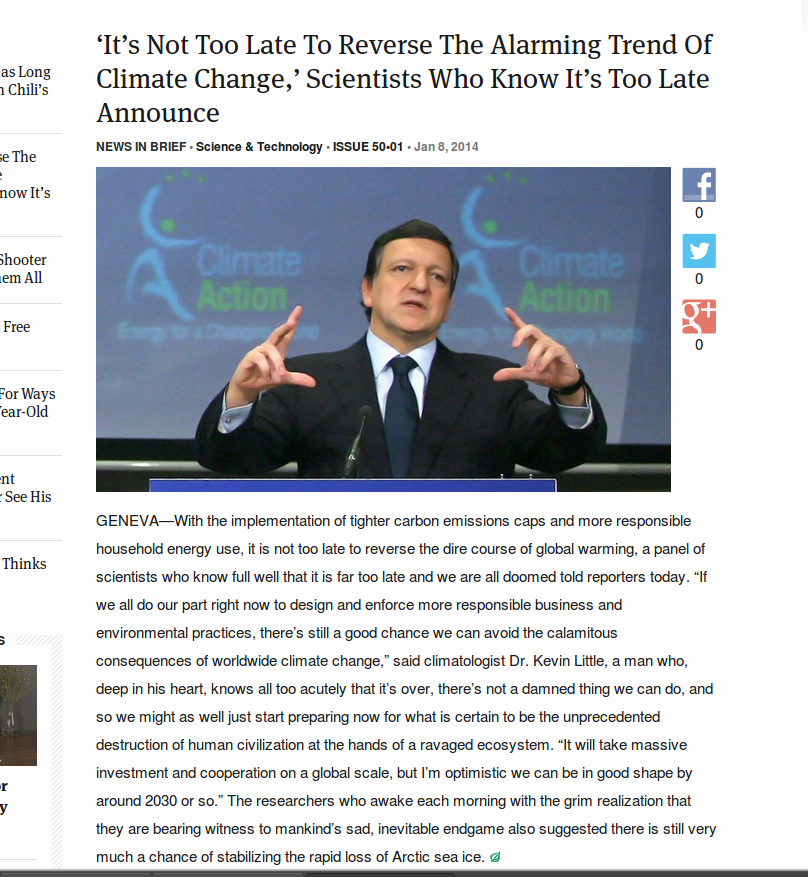
So, Thursdays are hereby proclaimed to be 3 Questions* Thursdays.
Every Thursday we will put up a short video of a Mancunian answering the following –
1. “Who are you?” (Name, where you live, and – if you want to say – what you “do”)
2. “What does Manchester need to become more sustainable?”
3. “What knowledge and skills do you want to acquire in 2014?”
Why this? Because we need to celebrate what is happening, imagine what could happen and also connect people who have skills with people who want them. #movementbuilding.
So, watch out. If I see you before you see me, and I’ve got my video camera handy (I will), you might be in the frame…
* And an optional 4. – “Anything else you’d like to say?”
From facebook…
“The next Incredible Edible Levenshulme meeting is on Wednesday 15th January 7pm, at The Sidings pub on Broom Lane. [M19 2UB]
We’ll aim to go through committee business between 7pm and 8pm, then from 8pm to have a general discussion. You are welcome to attend for the whole meeting or to come along for 8pm.
Hope to see you there!”
Manchester City Council is (not) at it again.
In January 2013 the Neighbourhoods Scrutiny Committee had a discussion of the “Certain Future” (Manchester Climate Change Action Plan ‘refresh’. MCFly’s editor was there, which made the conversation a little bit more robust than perhaps senior councillors were hoping for.
One of the things that emerged was a promise that a report about the Steering Group (see MCFly passim, ad nauseam) would be presented to Neighbourhoods. This was, with customary sense of urgency, put down for January 2014. Nothing like long grass, is there? And there the promise of the report stayed, on the “forward plan” for January 2014, until as late as November (see below)
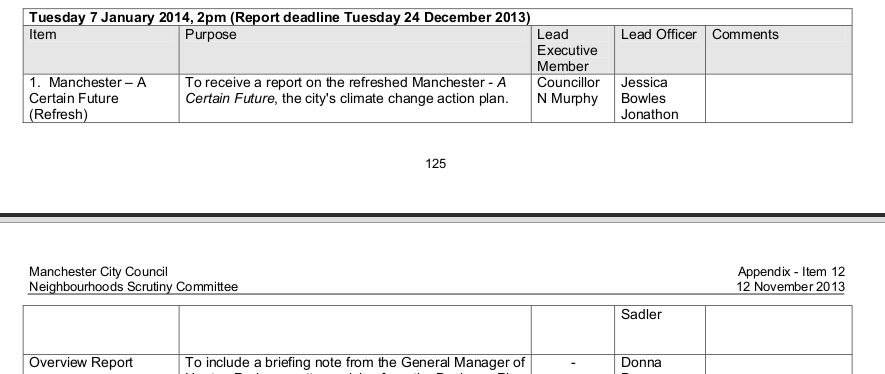
And guess what! The Neighbourhoods Scrutiny Committee met yesterday. And… no report.*
This is so typical that it is barely worth reporting.
And they wonder why people regard them as untrustworthy and not serious.
To call this a farce is unfair. To farces.
Marc Hudson
mcmonthly@gmail.com
* Yes, doubtless someone will pop up and say “it’s on the agenda for the Environmental Sustainability Subgroup.” Not good enough. [UPDATE 22 Jan 2014 – nope, not even there.] Neighbourhoods has responsibility. And what happened to the idea of quarterly progress reports on the Annual Carbon Plans? And what happened to the Annual Carbon Plan 2013-4 which never even went to Executive!
And when is the Council’s 3 year “plan” going to go to scrutiny. Rumours of it appearing before Communities seem unfounded. And in any case, it belongs under Neighbourhoods. Guess what, it’s not on their forward plan either!!
Sunday 12th January 1.30
Support the Barton Moss Protection Camp!
SAY NO TO COAL BED METHANE & SHALE GAS!
Support the fight to stop fracking everywhere!
Call out to everyone opposed to turning Greater Manchester, other parts of the UK, and elsewhere in the World into a fracking hell!
BRING YOUR OWN PLACARDS, BANNERS & TORCHES (for twilight torchlit procession!)
Assemble as previous: Junction Barton Moss Road/Liverpool Road, Barton, Eccles M30 7RL
Event will include speeches, live music & more.
Called by Frack Free Greater Manchester
If you need you need a lift to get to the event, then check out this facebook page:
https://www.facebook.com/pages/Barton-Moss-Liftshare/322201437919361?ref=profile
LATEST NEWS: Agreed last night at the Frack Free Greater Manchester meeting: Everyone who is able to, is now being encouraged to assemble at the Salford City Red’s Stadium car park, Stadium Way, Eccles, M30 7EY at 12.30pm, and to march from there, with their banners and placards, up the wide cycle path of the A57 to the junction of Barton Moss Road/Liverpool Road, Barton, Eccles M30 7RL for the rally there at 1.30pm. After that to march to the camp and entrance to the drill site, and then back to the Stadium car park afterwards.
Apologies for the short notice and any inconvenience caused. People who are unable to get to the Stadium car park are obviously welcome to assemble at the lay by at the top of Barton Moss Road from 1.00pm onwards as previously advertised.
Pauline Hocking of Climate Survivors on last year and next…
 What was your biggest achievement in 2013?
What was our biggest achievement is a difficult question to answer. It was great to be involved in getting a local food growing project off the ground. It has brought that community together in a positive way and it’s great to think that this season people will have lots of fresh fruit and veggies. Much of our energy went in to organising an event “An Economy for the 99%”. We had high ambitions for the outcomes and, if we are honest, they weren’t achieved but other outcomes were like getting to know a much broader group of people with whom we share hopes, dreams, visions and values and with whom we can collaborate on a range of other projects and campaigns.
If you could go back to the beginning of the year and give yourself one warning/piece of advice, what would it be?
Advice would be – be focused, incredibly focused, as there is so much to do out there so go for what in our hearts we believe to be the most effective things we can do and don’t be deterred or derailed. Also, never tire of discussing with people. Spreading the word, and providing the information that to most is ‘hidden’, is invaluable’. Don’t judge – we are all doing our best in incredibly difficult circumstances.
What have you got planned for 2014, and how can people get involved in what you do.
A series of meetings with speakers, serious launch campaign of Charter for Abundance, possible showing of Chasing Ice, continued attempts to spread the word amongst people who do not usually discuss or are aware of climate change.
In our food growing group, which is linked to climate survivors, we’re laying raised beds in 10 – 12 gardens over the next few weeks + planting lots of fruits trees on the deprived Old Moat estate where i live thus enabling those on low incomes to cut carbon and food costs.
The way to contact us is by emailing climate survivors@gmail.com or joining the site climatesurvivors.ning.com (this site is now devoted to developing our Charter for Abundance but also has meeting information). Like our page on Facebook ‘Climate Survivors’ and/or tel. 07712566144.
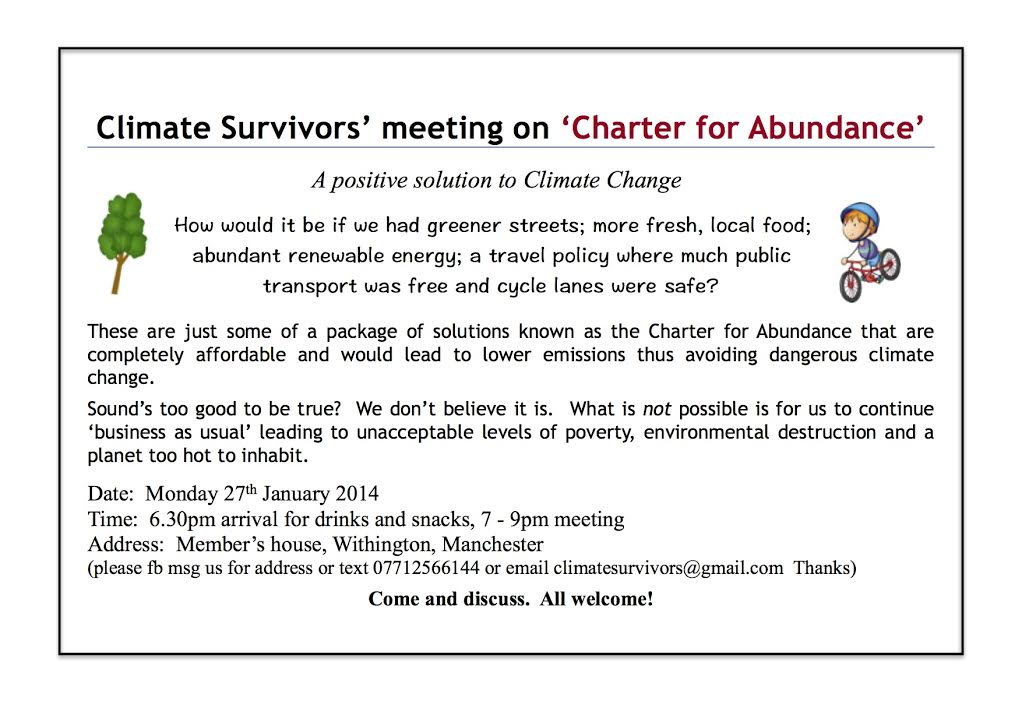
Next meeting is coming up – leaflet attached. (Mon 27th Jan)
Isn’t the weather awful? Can’t think why. Labour recently speculated on whether Owen “climate change will be good for the UK” Paterson, the Environment Secretary (so help us all) might have been the teensy-weensiest bit blinkered about investing in flood defences. Instant howls of “cheap shot” outrage “spending has never been higher” from the Tories. Blah blah blah. Well, now Friends of the Earth (you can join here. The Manchester site is here) have issued a detailed statement, that makes depressingly predictable and predictably depressing reading.
David Cameron’s claims about flood defence spending aren’t borne out by the Government’s own figures.
Sometimes you have to say things many, many times for get politicians to listen. Back in October, I challenged Environment Secretary Owen Paterson’s claims about flood defence spending, arguing that he was presiding over a cut in spending, rather than a rise. I certainly wasn’t the first – others who have previously highlighted the Coalition’s cuts to flood defence spending have included the House of Commons Library, the Committee on Climate Change, and the Guardian’s Damian Carrington.
Still, these warnings seemed to fall on deaf ears, until this past week. Now, with Britain battered by torrential rain and widespread flooding, Owen Paterson has been forced to defend his department’s policies. Most significantly of all, the Prime Minister has had to intervene, claiming: “We’re spending £2.3 billion in this four-year period on flood defences, which is more than the previous four-year period.”
As I say, we’ve been over this ground before: it’s a claim that isn’t true, and moreover, it fails to mention that we should be spending much more on flood defences if we’re to keep pace with climate change.
But because the Prime Minister and Environment Secretary have set so much store by this claim, I felt obliged to re-examine my figures, just to check. To be fair, it is a surprisingly confusing subject, with multiple sets of statistics being bounced around by different bodies. I apologise in advance for the dense stats and lengthy explanation that follow, but bear with me, it’s worth it.
Let’s begin with the figures for flood defence spending set out by the National Audit Office (NAO) in a report from October 2011. The NAO is a well-respected body, a trustworthy source free from political axes to grind, so you’d expect their statistics to be accurate. The table below shows the ‘grant-in-aid’ funding Defra has given to the Environment Agency for flood and coastal risk management work between 2007 and 2015 (the years 2011-2015 based on what the Coalition had then formally announced in terms of spending).
| Year | Total spending (£m) | Total over 4-year period (£m) |
| 2007/8 | 436 | |
| 2008/9 | 564 | |
| 2009/10 | 607 | |
| 2010/11 | 629 | 2,236 |
| 2011/12 | 521 | |
| 2012/13 | 510 | |
| 2013/14 | 498 | |
| 2014/15 | 485 | 2,014 |
As you can see, according to the NAO, the four-year period from 2007-2011 saw spending of £2,236m (that is to say, around £2.2bn) on flood defence; whereas the Coalition’s budget was very clearly lower – having been cut to a total of £2,014m over the four-year period 2011-2015. It’s important to remember that, although the Coalition Government came into power in May 2010, government expenditure for the financial year 2010-11 had been already set under Labour; it’s from 2011 onwards that constitute the Coalition’s flood defence spending policies.
However, the NAO’s figures aren’t complete. In November 2012, responding to serious flooding across much of the UK, the then new Environment Secretary Owen Paterson managed to wring an additional £120m of funding out of the Treasury for flood defences (£35m more to spend in 2013/14 and £85m more in 2014/15). So when you add that in, the total figure for the four-year period 2011-2015 rises to £2,134m – but still lower than the previous four years. These figures are confirmed by the Parliamentary EFRA Select Committee, who reported on flood defence spending in July last year.
So, what’s going on? The Prime Minister’s claim isn’t backed by either the NAO or the EFRA Select Committee – who themselves state they source their figures from Defra and the Environment Agency. So, I went back to Defra’s webpages to see what they had to say for themselves. Defra’s most recent statistics for flood defence spending are from April 2013, and confusingly, they set out a slightly different set of numbers to the ones reported by the NAO and EFRA committee. I’ve put the totals in the table below, alongside the NAO figures for comparison (and including the extra £120m in the NAO column).
| Year | Defra figures for total spending (£m) | Defra total over 4-year period (£m) | NAO figures for total spending (£m) | NAO total over 4-year period (£m) |
| 2007/8 | No data | No data | 436 | |
| 2008/9 | 568.2 | 564 | ||
| 2009/10 | 627.9 | 607 | ||
| 2010/11 | 664.1 | 1,860.2 (over 3 years) | 629 | 2,236 |
| 2011/12 | 573 | 521 | ||
| 2012/13 | 559.9 | 510 | ||
| 2013/14 | 574.5 | 533 | ||
| 2014/15 | 612.7 | 2,320.1 | 570 | 2,134 |
As the table shows, Defra’s figures are consistently higher across all years than the NAO/ EFRA stats. Crucially, for the four years 2011-2015, they sum to £2,320m – the £2.3bn figure that David Cameron has recently been referring to in media appearances. So this would appear to be the source for his claim. But the Defra figures don’t provide evidence for his other claim, that “we are spending more over this four-year period than the previous four-year period”, because the document only provides figures for the previous three years, 2008-11. Clearly this wouldn’t be a fair comparison – it’d be like comparing apples with oranges. This, naturally, aroused my suspicion, so I dug deeper.
It seems that the reason for Defra’s slightly higher figures for flood defence spending can be almost wholly (though not entirely) explained by a separate smaller set of budget lines not accounted for by the NAO or EFRA – monies that Defra themselves administer to Local Authorities and Drainage Boards, rather than giving to the Environment Agency to hand out. So, the crucial question then becomes: what are the comparable figures for the ‘missing year’ of 2007/8?
I googled and searched, and eventually found a set of tables on an archived part of the Defra website which appear to hold the answer. These show that for 2007/8, in addition to the £436m of flood defence funds already accounted for in the NAO’s analysis, Defra administered a further £70.2m of funds to LAs and IDBs for flood defences. This would bring the total for the year to £506m… meaning that over the four-year period 2007-11, the government spent £2,366m on flood defence: slightly more than the £2,320m being spent over the current four-year period.
In other words, the Prime Minister is not correct to claim that his government is spending more in the current four-year period than in the previous one.
And quite apart from any discussion of funding in cash terms, it’s clear that current spending constitutes a real-terms cut on previous levels, as it isn’t inflation-proofed.
Does this constitute the final word on flood defence spending, then? Probably not, as Ministers have tried to deploy other forms of smoke and mirrors in the past:
These figures matter; certainly they seem to matter to David Cameron and Owen Paterson, who have set such political store by them. But in the grand scheme of things, whether one government spends more than the last lot is irrelevant if they haven’t spent what’s necessary. And to protect the country against increasing flood risk as a result of climate change requires rising investment. In 2009, the Environment Agency calculated that we need to be spending £20m more (using 2010-11 as the baseline and on top of inflation), each and every year out to 2035, just to keep pace with climate change. And by that measure – the measure that truly matters – David Cameron’s government isn’t even treading water.
So, got up at stupid o’clock this morning to go and do the “read the papers” thing on the Allan Beswick show, the fifth (?) time. It’s on listen again if you missed it, for a week. Here’s the link
At 45 mins (climate change – the weather and proposed 60mph limits on the motorway, World War 1 and the history wars…)
and at
1 hour 20 mins (learning languages, naked Aussie men trapped in washing machines and… the Ashes)
Two knob gags and too much cricket, perhaps? Should have talked about the fracking protests too. Next time…
The wonderful high-visibility and high-impact Steering Group is… not holding an annual stakeholder conference this year. And it’s still not holding elections. Apparently this is Too Hard.
Below is my contribution to this non-debate.
Coming up-
a) Me on the BBC Radio Manchester’s Alan Beswick show tomorrow morning (Tues 7th), doing “read the papers”. Probably about 0650 and 0720.
b) Interview with Chair of the Steering Group, Gavin Elliott.
How to hold goddam elections or “Never Mind the Ballots”
Why you need to do this
Er, you said you would (see “background”) and there’s a basic question. If you can’t even organise elections, why should anyone pay any attention to you when you say you are both aiming at and capable of helping Manchester to create a “low carbon culture”?
Background
It’s there in your terms of reference. There was a long discussion about it at the March 2012 Steering Group meeting, and a promise at the March 2012 Stakeholder conference about elections being held in November. Of that year.
Legitimacy either comes from doing stuff (the Steering Group hasn’t) or in being elected (the Steering Group isn’t), or – god help us all – in both at the same time.
So, the first thing to say about creating democratic legitimacy and credibility, is that it’s a process, not an event. That is, if you had started when you promised you would, when you should have – in 2010 – we’d be there by now. But you didn’t. It’s now 2014. Without a time machine, we just need to crack on from where we are…
Here’s how you could do it
In the first year, you elect three people who are “supernumerary” to the existing slimmed down Steering Group. Their role is to plug gaps, be gadflies, help get the website into some semblance of usefulness (hahahahahahahahahahaha) and to grow the number of people on the electoral role.
They are elected for a two year term (three years is too daunting a prospect), but they can be kicked off if they don’t turn up to meetings etc etc.
Who is the electorate?
I keep hearing this. It’s so unbelievably puerile an “objection” that I am not sure if the people throwing it up are merely trying to make me throw up.
The electorate is… anyone who is eligible.
There, that wasn’t so hard, was it?
Oh, who is that you ask? The same people who were supposed to be getting carbon literacy training by the end of 2013- anyone who lives, works or studies in Manchester. Hell, if you want to fudge the whole Manchester/Greater Manchester issue, then expand your eligibility criteria to include the wilds of Oldham and Stockport and so on.
So, you get your deadline. I don’t know. Say May. THIS YEAR.
You get some posters done, you have a facebook group etc etc
It’s a job for your communications bod (and since you ask, there’s a job spec for that poisoned chalice coming up soon on this site.)
You put flyers in relevant places (the Town Hall, the Friends Meeting House, the Cornerhouse, the Libraries etc etc)
You come up with a list of events at which you ask the organisers if you can have three minutes to explain what the Steering Group is (hahaha) and why it’s having elections.
You have application forms handy so that people can sign up then and there.
You have a hashtag. Either #mcristoast or #vote4climategroupmcr or something like that.
[Btw, In the first year, you’ll only have 1000 or so people sign up. So it goes. And the skeptics/denialists will say you’re not legitimate. And they will be right. But it’s a process, not an event.]
That application form
You need their name, their postal address, their email (not to be shared) and, if they don’t live within the boundaries of Manchester the reason they are eligible (job, study).
As an optional extra, they can fill in a sentence “in order to be ready for the changes that are coming, Manchester should…” These sentences, stripped of their author’s name, would make an interesting resource…
These paper applications (and online ones) are processed as soon as they come in. A follow-up email is sent, confirming that they are now on the electoral roll for the Steering Group. You ask them to put this up as their Facebook status and also on twitter and all that malarkey, social validation blah blah blah
You have a regular blog about the progress towards the deadline, updating people on how many people there now are on the roll and so on.
About a month before the registration closes, you ask for people to put themselves forward as candidates. In order to be a candidate, people have to supply some basic biographical information and write a 300 word statement about what they would want to achieve in their two years on the Group.
You could cap candidates at 20 (I don’t think you’d get that many, tbh – the Steering Group has achieved the remarkable feat of being both a nonentity and a reputational risk).
Or you could have it unlimited?
In either case, you’ll then need to slim down so that there are no more than 10 candidates for the three positions. Don’t quite know how you would do that, if needed. External person ranking the quality of the statements? Picking names out of a hat?
Once you have your short-list, you announce this, and then create physical ballot papers. To save money, you only send these to people who are definitely not going to attend one of the hustings/election events you have scheduled. You include a freepost envelope…
Voting would be open for, say, a fortnight.
You could hold a hustings/election event in Central Manchester where the ten people who made the final short-list set out their brief (!) spiels. These (3 minute?) spiels could be posted on youtube for people to watch. Doubtless the speeches will contain good ideas and inspiration.
You could then hold separate voting “events” in different parts of the city (not, please, all of them in Chorlton), where people who had registered could come to a meet with other registered voters, watch the videos of the candidates, then cast their own paper ballots.
There would, of course, need to be some other attraction to get folks along!! People seem to like hearing from scientists, so you could get the Tyndall Centre folks to do a series of presentations. Burning in Burnage, Drenched in Didbsury, Hot in Harpurhey… You get the idea].
You could have some “on-line” voting too, I suppose, if you find a techie both willing and able to sort it out for you.
At the end of your two week voting period, you have a public count of the electronic votes and of the paper ballots.
You announce the three people who got elected. Blah blah blah.
Crucially, the people who don’t get short-listed, or don’t get elected, must not be discarded. They are clearly motivated to help, so tasks should be found that match their talents.
In subsequent years
You continue campaigns to grow the electoral roll.
You put different posts up for election (the comms role, the conference organiser role etc)
Even, gasp, the role of chair of the steering group might actually be open to election. How outrageously democratic.
A couple of random questions
Why doesn’t the steering group have a student rep from the universities and colleges?
Why doesn’t it have an observer from the Faith Network for Manchester
Why on earth are its meetings held in private?
My prediction
Some of you lot will say
“Interesting ideas. Not sure all of them are practicable. Let’s look into it further. Shall we pencil it into the agenda for our September meeting?”
others will say
“Marc Fucking Hudson can fuck right off.”
And nothing will be done. And in a year or so, the Steering Group will die, and release a press release saying that the fabulous groundwork that it laid is being taken over by the GM Low Carbon Hub.
(Ab)normal service will resume Monday. In the meantime, this is the Q and A session after the session at University of Manchester a couple of months back. My initial spiel- “From Toy Story 3 to Noam Chomsky” – can be seen here.
And yes, I know I’ve been causing that famine in Africa. #newyearsresolution.
 | Dave Bishop on COP27 and the fantasies of sal… |
 | manchesterclimatemon… on The messages we send – o… |
 | Anon on The messages we send – o… |
 | Stephen PENNELLS on Climate emergency? What climat… |
 | marchudson on Twelve years ago in Punxatawne… |

 manchester climate monthly