The tl:dr? MCFly editor Marc Hudson blunders further into the debate about what (climate) scientists “should” and “shouldn’t” be saying. They should be doing more, not less. But activists can’t keep expecting scientists to do all the heavy lifting!
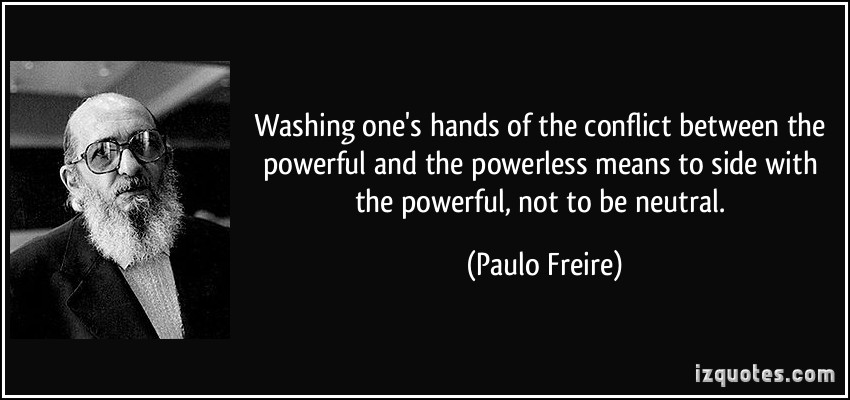
What duties do scientists owe to society? According to Professor Kevin Anderson, interviewed by Manchester Climate Monthly a couple of weeks ago, “[Scientists] may think we’re doing this neutrally, but we’re not at all. That silence is an advocacy for the status quo. So there are no such things as scientists that are not political. Scientists by their nature are being political, whether they engage or do not engage in the wider debates. And I would argue that the ones are who are the least political are the ones who engage in it.”
This portion of the full interview attracted comments. One of these – from “And Then There’s Physics” – was uncharacteristically (1) (cough cough) misinterpreted by the editor of MCFly and led to a brief and happily since resolved flame war.
Declaring sympathy for ATTP’s position, Brigitte Nerlich on Nottingham University’s “Making Science Public” blog wrote
“it does seem unfair to suggest that those who choose not to engage are advocating for the status quo. There are many reasons why people may choose to engage or not and we should be willing to let people do what they think is best. That doesn’t mean that they’re beyond criticism, but a blanket judgement seems unjustified.”
I think a blanket judgement IS justified for (at least) three reasons.
I believe that power brings responsibility. And even if it didn’t, these are special circumstances (the civilisation/species is under a frog’s backside at the bottom of a coal mine, after all). I’ll return to this second point at the end of this post.
Finally, scientists are, by and large, intellectuals (well, at the very least they are academics!). And, as the anonymous quote goes, “it is the responsibility of intellectuals to expose lies and tell the truth.”
Meanwhile, Judith Curry pitched in. Well, I’ll pass over it in, um, silence for the most part. Except this; Curry writes
“Nehrlich’s article points discussion of a recent workshop took place at Imperial College London entitled Silence in the History and Communication of Science . From the Workshop’s web site:
Silence is often construed negatively, as a lack, an absence. Yet silences carry meaning. They can be strategic and directed at particular audiences; they can be fiercely contested or completely overlooked. Silence is not only oppressive but also generative, playing a key role in creative and intellectual processes. Conversely, speech, whilst seeming to facilitate open communication, can serve to mask important silences or can replace the quietude necessary for insightful thought with thoughtless babble.
Ah, yes, hermeneu-bloody-tics. Well, there’s another meaning silence can carry. Orwell nailed it, as he did so much else.
Silence can be a signal of acquiescence, of self-censorship and fear of rocking the boat. Qui tacet consentit (“Who is silent consents.”) and all that…
Still, while I think more scientists should be using their privilege in the public sphere, I also think that “the public” is…
Asking too much of the wrong people
Everyone wants “the planet” [i.e. their current and future standard of living] to be saved, as long as it doesn’t personally inconvenience them. Everyone wants someone else to do the heavy lifting.
Activists, many of whom have either an arts degree or no higher education, often feel they lack the social standing or the knowledge to explain science. And so they look to scientists to not only “do” science but also to explain it to the “unwashed masses”.
What activists don’t generally understand about scientists is that
- they generally haven’t received training in public engagement (not that training helps much…),
- they don’t really get that many career brownie points for doing it (for the purposes of the RAE or whatever it’s called these days, it’s better to be talking to policy-makers) and in fact
- there can be significant risks attached (I’m not thinking about the odd death threat or endless email attacks, but rather the raised eyebrow in the staff room, and the mutterings about ‘dumbing down’.)
Rather than train themselves up, develop and hone their own communication skills and scientific knowledge (that’s all time-consuming and tricky stuff, trust me), activists by-and-large want the scientists to do the job for them.
Still and all…
It happens to be an emergency, some things don’t come for free
When I was growing up, I went to Mozambique. It was a country that had been on the receiving end of a form of colonialism that was towards the very brutal and very rapacious end of the spectrum.(4) When it won its independence in 1975 there were very very few Mozambicans with even complete secondary education. Seventeen years later the covers of the school exercise books still had an exhortation (placed there by the Marxist-Leninist government, Frelimo” which said (in Portuguese).
“Let us study and make of our knowledge an instrument of the liberation of the people.”
Given how small the social surpluses were in the 1980s and 90s, there was no way someone with even five years of schooling could pretend that they had no obligations. It’s murkier for us now, here in the West, since we are not living in the aftermath of horrible extractive domination.(5)
Finally, my point is this; our scientists are an elite. With the great privilege of being able to think and explore and use up finite resources, comes – in my opinion – great responsibility. If they have important information about what is happening to the climate that has been pretty damn stable for 12,000 years, then they have a moral duty to speak out. If the waters are being systematically and skilfully muddied, they have a moral duty to speak out. The lack of training in this is not an excuse. The potential risks to their reputation and career progression is not an excuse. The fact that it will not make a blind bit of difference in the cosmic scheme of things is not an excuse. They are “experts.” If not them, who? If not now, when?
Marc “probably flying home and back this year” Hudson
mcmonthly@gmail.com
PS Trolls, please note; A “moral duty” is not a mandatory one, one that should be enforced by the state. I am saying the scientists owe society, not to the Khmer Rouge regime that you will doubtless smear me with.
Footnotes
(1) And I got it so embarrassingly wrong! For the first time ever, didn’t check through thoroughly enough. I have since apologised privately and publicly to the owner of the Wotts Up With That blog.
(2) I’m acutely conscious that a cynic might say that I’m being inconsistent. After all, when George Bush declared “you’re either with us or against us” I disagreed. Surely such polarisations are bound to lead to more heat than light? Well, we’re not asking scientists to cheerlead in blowing the crap out of peasants and shepherds who’d had nowt to do with September 11th. We’re merely asking them to expose lies and tell the truth… Meanwhile, the same cynic might even suggest that I am taking Prof Anderson’s side in part for bad reasons – that I’ve known him for years, he’s a very very nice bloke, very hard working etc. I think not, but perhaps I am.
(3) Politically and morally, if not intellectually or emotionally.
(4) Yes, I think you can argue that there were gradations. Everything else being equal, I’d rather have been in Egypt or India than the Belgian Congo or Namibia. Though none of it was exactly a barrel of laughs.
(5) Actually, given what the species has been doing to other species these last ten thousand years or so, we do. But not at the sharp end. Yet.
Further reading
For very useful thoughts on science communication, see Alice Bell’s “Through the Looking Glass” blog.
For useful metaphors and memes on climate change Climate Bites
For some of the background on the notorious and still virtually universal “Information Deficit Theory” see the following wikipedia page.
An interesting blog (hat-tip to Jonathan Atkinson) on the 7 ineffective habits of scientists





 manchester climate monthly