“Wake up call for #Urmston” – press release from BCAG #Trafford #Manchester #airpollution

Here’s a press release from the Breathe Clean Air Group

“The residents of Urmston, Flixton and Davyhulme face the biggest challenge to the air they breathe since the battle against smog in the 1950s” declared Pete Kilvert, Chairman of the Breathe Clean Air Group.

“Not only do we face the possibility of the Davyhulme biomass waste incinerator with its toxic emissions, and the certainty of the M60 motorway exceeding air quality safety limits with traffic fumes, but we now face the risk of air pollution from other, local, industrial processes” he added.

The most immediate threat is from a project to search for coal bed methane right next to the M60 motorway at Barton high level bridge. The plan is to drill
down into the coal layers, then drill horizontally under the proposed biomass incinerator site and force liquids under pressure to fracture the coal and release methane gas. This is commonly called fracking and it’s going to happen on our doorstep if Trafford Council grants planning permission. Residents should email development.control@trafford.gov.uk now, include your name and address and quote planning number 81446/RENEWAL/2013. Say that Trafford must not
grant planning permission as it will adversely affect the health of your family.

(See http://www.frackfreegtrmanchester.org.uk for further information).

It has also been revealed that toxic fracking liquid from Blackpool is being held in tanks at the United Utilities Wastewater Treatment site, awaiting permission from the Environment Agency to transfer it to the Flixton Lagoons, located near the “Mile Road” in Flixton. Hydrocarbons such as benzene, toluene and xylene, which are known to cause cancer, could vaporise and blow into Flixton and Urmston on the prevailing wind. There is also a risk of radiation from this source.

In Carrington, it has been revealed that the 860 MegaWatt gas-fired power station is now going to increase to a massive 2,150 MW. The paper mill has an incinerator that burns waste plastics and the former Shell Chemicals site will be available to build industrial plants that produce toxic emissions. Urmston is downwind of Carrington.

“The Breathe Clean Air Group is most concerned about the deterioration of air quality standards and the effects it will have on all of us, especially our children,” said Pete Kilvert. “I urge residents to contact their local Councillor and tell them that they must not allow any more polluting plants to be built in Trafford.”

Posted in Democratic deficit, Energy | 2 Comments

Full Council of despair – #Manchester City Council in business-as-normal mode

After an hour of advertising for HS2, we got what we came for. The small and intrepid(1) band that ventured into Manchester Town Hall to witness “democracy” did indeed get to see what passes for democracy in action today.

It was a meeting of Full Council. For years this has been a three-ring circus. Real decisions are made in the meetings of the 9-member Executive (or rather, before them). Full Council, which all Council members are expected to attend unless they’ve got a damned good excuse (a death in the family, a holiday in the United States), is an opportunity for ambitious junior politicians to score points, raise their profile and maybe get their name in the Manchester Evening News. Given Labour’s not-quite-yet absolute stranglehold, it can only be thus.

In January this year, Professor Kevin Anderson gave a presentation on climate change to them all. That’s all safely forgotten now though, as the very expensive toy-train set that is HS2 got almost an hour’s worth of advertorial.

Then, around 11ish, after declarations of interest, it was down to business. And the business that we had come for was the signing off of the “Clean and Green [sic] Places” initiative. This is £14.5 million pounds of airport windfall money that the Council COULD consult on how to spend. Instead they’ve dreamed up (on two sides of A4) a very loosely-defined scheme that will enable money to be disbursed to interested groups without too many hoops being jumped through. (And one of their own ideas is “smart bins” that send a text message to the street cleaner saying “I’m full, come and empty me.”) Anyone would think there were council elections coming up, eh?

There was almost no discussion at all of this item, such is the speed and size of the red rubberstamp. Councillor Mary Di Mauro (Lib Dem, Northenden) had had her hand up to speak about the motion, but the Mayor seemed not to have seen her and the motion was “agreed.” After a few moments confusion and conferring on the top table, she was allowed to speak.
She said that the windfall was a tremendous opportunity to consult and engage, and that the failure to consult was a glaring example of of decision-making taking place in secret, behind close-doors. Where, she asked, was the accountability, the scrutiny.
She cited ward co-ordination and the cash-grant system as modes by which the Council could have engaged citizens, and found the “different priorities in different wards.” She pointed to Northenden, (her ward, where she will be trying to hold onto her seat in May next year) as an example of where local activists would want to keep their library open.

The most jeering (including a highly-excited Councillor Karney on his feet, pointing his finger!) came when Councillor Di Mauro suggested that this was “an opportunity to consult, engage and make yourselves more popular.”

Now, no doubt the more, um, tribal, Labour councillors would simply say that they were reacting with derision to a lecture on popularity from a Liberal Democrat. After all, since Nick Clegg decided to trade his credibility for a limo in 2010, no Liberal Democrat has come within a hundred gazillion miles of holding on to a Council seat in Manchester. Oblivion for all who tried.

The more nuanced and far-sighted councillors (2) , the ones who have read their Freud, might wonder if the strength of the anger was the sign that the Liberal Democrat had struck a nerve, had said something that councillors don’t want to admit, especially to themselves. These councillors would move beyond the fact that Labour have 86 of the 96 seats, and in all likelihood all 96 after next May. They would remind themselves that these elections are often won on a derisory turnout, and are anyway largely a referendum on national issues (those with longer memories will remember the beating that Labour took in Manchester after the invasion of Iraq in 2003).
They will factor in the anger and resentment and understandable cynicism that non-voters have towards the political classes and the Punch-and-Judy on display today.
Some of them might even realise that in five or ten years time, when they are running the show, their credibility and “soft power” will be diminished by the sorts of cack-handed and high-handed decisions being made now…
They would perhaps even go so far as to read Angela Eagle MPs fine words in her recent speech “Building a Better Politics” about re-engaging and reconnecting with citizens. But they will not, as yet, stand out and be counted in public.

But I digress; as did Council Leader Richard Leese, in his response. He gave some entirely predictable responses (3), including the ‘we are having to close libraries because of the unfair burden of cuts by the Conservative/Liberal Democrat government’ line. He also claimed that the idea “came from the people” and the “councillors.” This is very interesting and not quite perhaps what a constituency Labour Party in the south of the city might entirely agree with. Still, the Labour councillors who were against the idea at Labour Group on September 10th (and since) showed their customary (not to say admirable) discipline in keeping poker faces in public. The outbreak of potential-democracy was, sadly, still-born.

Next stop? The Ask the People of Manchester campaign will continue, trying to get 4,000 signatures by Monday 18th November, and so cause a debate in the next full council on Wednesday 4th December on however much of the money has not been disbursed. You can sign the petition here, if you’ve not already signed it. To be eligible you have to live, work or study within the boundaries of Manchester City Council…

Marc Hudson
mcmonthly@gmail.com

Footnotes
(1) At the beginning we followed councillors up the stairs and into the extension. We were then told that we actually had to go downstairs and through the extension (even though we could much more easily have walked along the hallowed ground to the back of the chamber then up a flight of stairs).
So down we went, accompanied by a helpful member of Council staff. When we got to the glass doors of the extension opposite, a tall G4S guy (beard, shaven head) told her that we would all have to sign in. So we were trooped along a corridor, where she investigated further.
We didn’t, in fact, have to sign in, and made it up to the public gallery after a total delay of about 10 mins.
This would have been TREMENDOUSLY intimidating and disheartening to a “normal” member of the public, or anyone on their own.
What is G4S told about full council and people’s right to attend? Is it part of their morning briefing on those days? We shall find out…
(2) They do exist. They tend not to be the ones who leave comments on the Manchester Climate Monthly blog, but they do exist. I’ve even had some civil and constructive conversations with some of them!!
(3) saying that the Lib Dems say one thing in the press and one thing in the Council chamber. This is curious, given that Richard Leese has had occasion to berate the Manchester Evening News in the past. Surely he does not believe everything he reads there? I asked Councillor Simon Wheale about the same allegation made at Executive on September 11th.
And Councillor Nigel Murphy, the Exec for the Environment said that the Lib Dems say one thing in the press and another in Executive in relation to this matter. What do you think he meant, and what’s your response?
[Laughs] I’ve absolutely no idea what he meant, because everybody’s been saying exactly the same thing, which is that the community should drive this process….”

Posted in Democratic deficit, Manchester City Council | Tagged , | 14 Comments

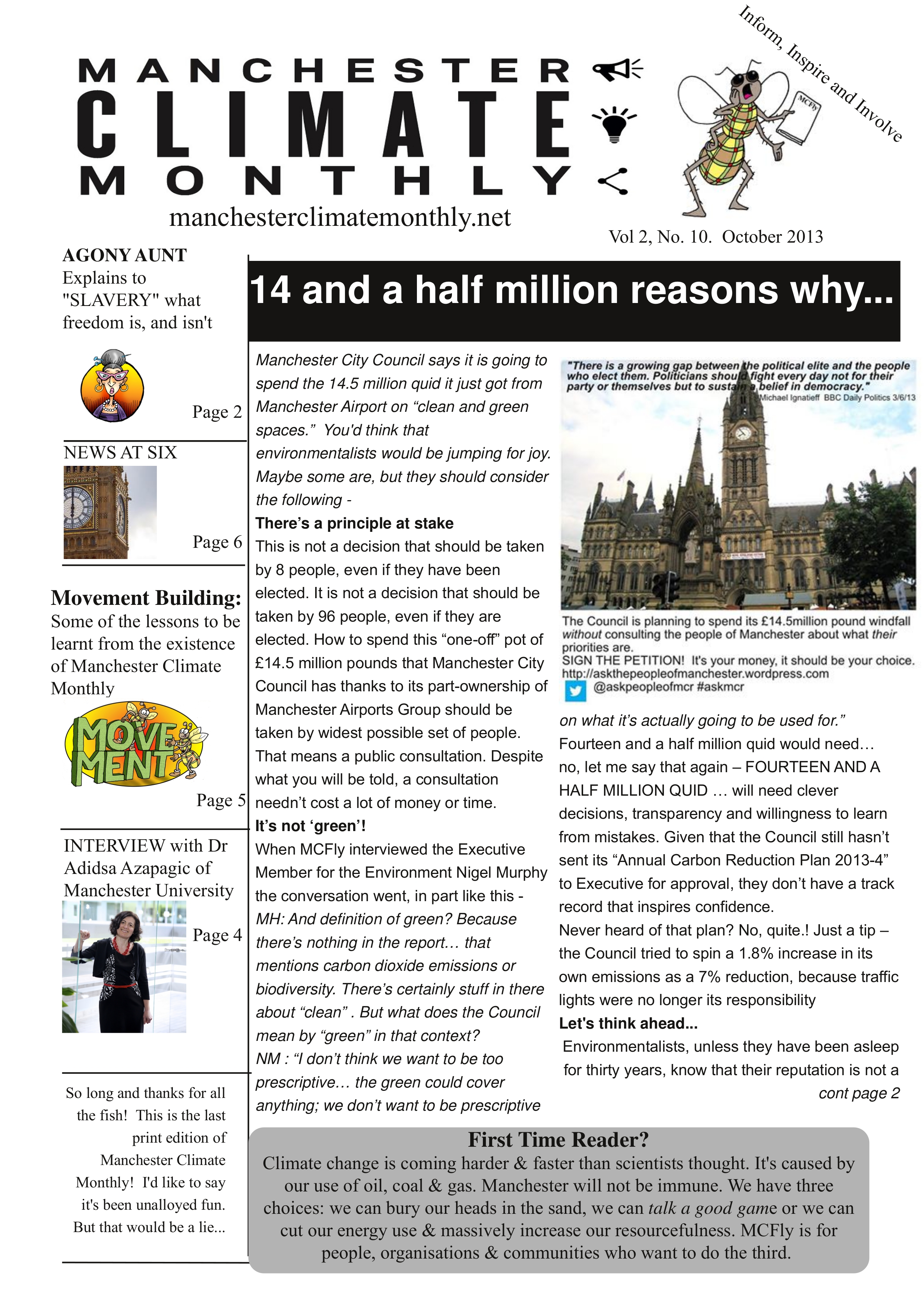
The final print #Manchester #climate monthly out now!

And, for the first time, we missed the first-Monday-of-the-month deadline. Oh the irony…

Contains stories on the £14.5 million pound windfall that the City Council has, an interview with a US Navy submarine captain, an interview with a University of Manchester academic, a book review, a calendar and all the usual stuff…

mcfly22page1

mcfly22page2

mcfly22page3

mcfly22page4

mcfly22page5

mcfly22page6

mcfly22page7

mcfly22page8

Posted in print editions | 6 Comments

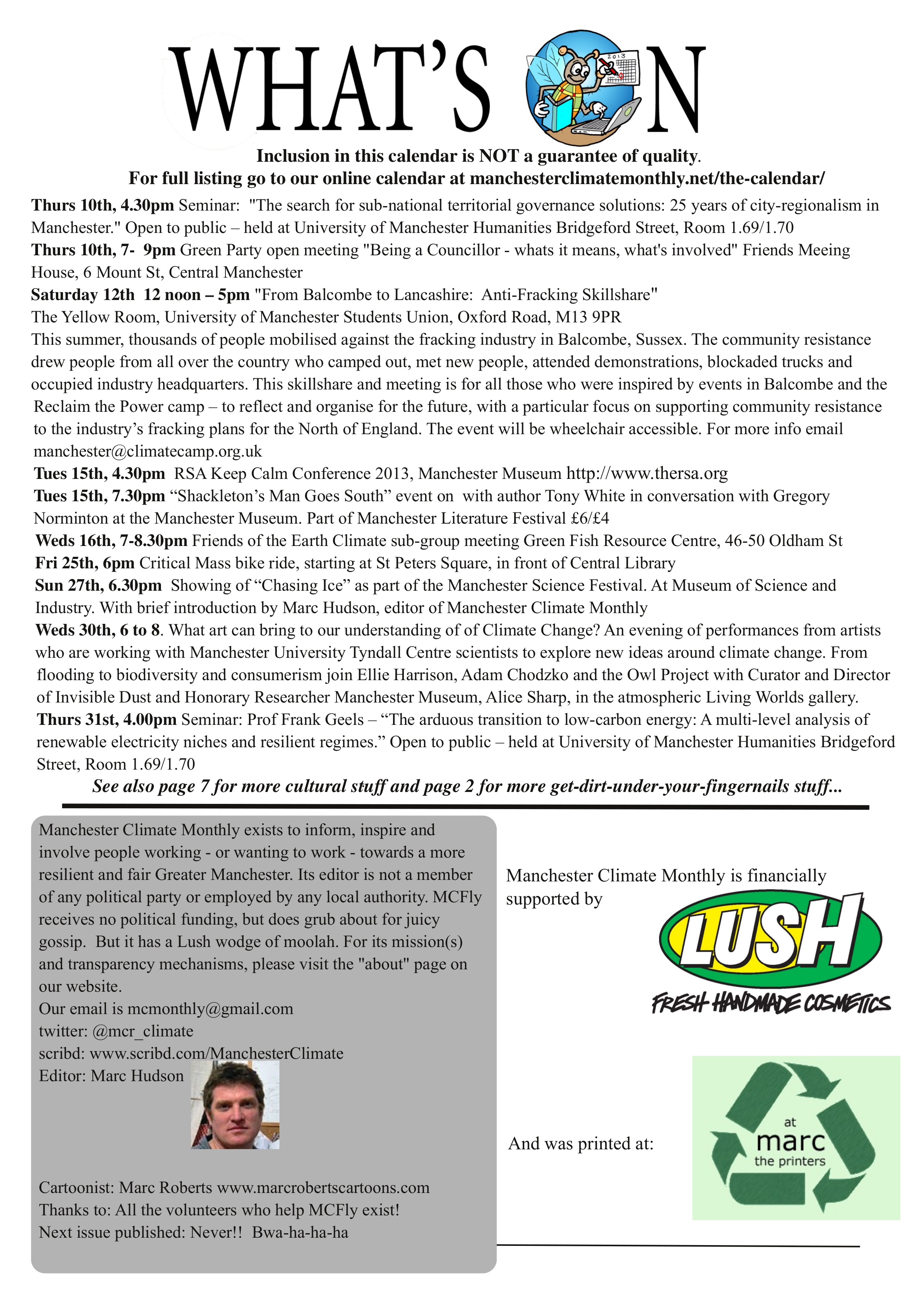
Win tickets to “Chasing Ice” showing, #Manchester Science Festival, Sun 0ct 27th

Manchester Science Festival is back, and they’re showing the documentary “Chasing Ice.”

MCFly editor Marc Hudson is doing a brief intro on the night.  If that hasn’t put you off, I don’t know what will, but we have two lots of two tickets to give away.  See below for details.

chasingice


This is a bit of meme warfare they want us to add –

“This event is part of Manchester Science Festival; Come out and play, create and experiment at this eleven day Festival www.manchestersciencefestival.com”

And this logo;MSF_SIEMENS_LOGO_colour


And the competition? Simply send an email to mcmonthly@gmail.com with the subject header “Chasing Ice competition” and a brief description of the Keeling Curve (you can cut and paste it from Wikipedia!).  Entries close Sunday 20th October at 5pm.

We will pull names from a hat, and contact the Science Festival with the names and emails of the winners.  Simples!

Posted in Competitions, Upcoming Events | Tagged , | Leave a comment

Book Review: Fugue for a Darkening Island

Christopher Priest – until Christopher Nolan’s 2006 film of his book ‘The Prestige’ by Christopher Nolan – was one of our ‘unsung heroes’ of off-kilter literature. The Separation was a tale of melded alternate histories of WW2 and Inverted World placed its action in a wheeled city as it trundled through a blasted landscape. ‘Fugue…’, was his first book – written in 1971 and re-printed last year with a foreword by the author.

Once you get past the disjointed narrative, the plot is relatively simple, Africa is rendered uninhabitable by nuclear war and a massive exodus of survivors ensues – tramp steamers beached in the Thames, ships wrecked off the South Coast – thus the ‘darkening’ of the island. Most of the world does what it can for the refugees but dear old Blighty has some sort of turbo-charged UKIP government, so it’s not long before the refugees take matters into their own hands and take over streets and areas to call their own. Bloody chaos ensues.

Our way into this scenario is college lecturer Alan Whitman. His dawning realisation of his family’s peril and subsequent flight through a war torn south of England paints a grim enough picture to satisfy any disasturbator. Brutality abounds from all sides, military and civilian (the latter either displaced or hunkered down in fortified towns). Alan has lost everything to the ‘Afrims’ but can see the justice of their fight – until his wife and daughter are taken from him. And don’t rely on the ending for uplift – this is all as unremittingly bleak as the scenario demands.

Priest’s foreword to the new edition is illuminating. He was inspired to write in 1971 by the TV footage of The Troubles in Northern Ireland – new to UK TV screens. He was fascinated by images of war in streets in our own country and that, combined with the threat of nuclear war gave him his impetus. His new version was partly motivated by wanting to adapt the language to be more in line with today’s cultural sensibilities. Not having read the original I can only imagine the 70’s vocabulary used to describe the Africans. Interestingly Priest also notes that his book has been described as both left and right wing. It is neither.

From an environmentalist’s point of view whilst there is no explicit ‘green message’ but the inference is clear – scrub nuclear war, replace with catastrophic climate change and the refugee crisis would be the same. Faced with upheaval our great nation will surely respond with political extremism, disorder and violence. Sweet dreams one and all.

Sir Fred Spong (which is, you’ll be shocked to learn, a pseudonym)

Posted in Book Review | 3 Comments

Crosspost: Gathering before Full Council on Weds 9th Oct #manchester #askmcr

Cross-post from “Ask the People of Manchester,” which is trying to get 4,000 signatures on a petition by 18th November (we are almost at 1,000!!)

Event: gathering before Full Council on Weds 9th October, 9am #askmcr

weds9theventWe invite you all to attend a gathering on Wednesday 9th October from 9am at the Friends Meeting House, 6 Mount St.

We want to meet people who have signed the petition, put them in touch with each other, and share knowledge and ideas and energy.

We will then, just before 10am walk across the road to attend the Full Council meeting where, we regret to say, the so-called “Clean and Green Spaces Initiative” will be agreed by the Labour members of the Council.

We are continuing to collect signatures.  Our target is to have 4,000 valid signatures by Monday 18th November.  We can then trigger a debate at the following Full Council meeting, on Weds 4th December. It is true that some of the £14.5m will have been allocated, but our argument will be that a full consultation can be held on whatever remains!

Please share the event on facebook.

Any questions, please email us at askthepeopleofmanchester@gmail.com

Posted in Uncategorized | Leave a comment

#Manchester Council admits that business is free to ignore council policies #climate #epicfail

Well, one of them, at least…

A council officer has admitted under questioning that since the official Manchester Climate Change Action Plan “wasn’t in their [businesses’] language” then the council did not pursue endorsements of official Council policy*, and instead allowed businesses to sign up to far less specific “Environmental Business Pledge.”

This extraordinary admission was made on Wednesday 2nd October by the head of the Council’s Environmental Strategy Team, during an official meeting. It was greeted without as much as a murmur of surprise, so well-trained and self-selected are we people who attend meetings of groups with titles like the “Environmental Sustainability Sub-group.”

The question was posed by Councillor Victor Chamberlain, (Lib Dem, Chorlton) who noted that only 220 organisations have endorsed the Manchester Climate Change Action Plan, created by stakeholders in 2009 and also going by the confusing name “Manchester: A Certain Future.”

The two headline goals of the plan were a 41% reduction of carbon dioxide emissions, on a 2005 baseline, by the year 2020, and the creation of a “low carbon culture.”   The council officer conceded that the original target was indeed to get 1000 organisations endorsing the plan and that only 220 had done so.

It remains to be seen how far members of the public will get if they refuse to pay their council tax or car-parking fines on the basis that the regulations “weren’t written in their language.”  MCFly suspects that these privileges might only be open to a certain class of “person.”

Marc Hudson
mcmonthly@gmail.com

* At the time, in 2009, the Council made a very great play that this was a plan for the whole city, not just the Council.  What they clearly meant was “a plan for all those in the city who will sign up, since we aren’t going to lift a finger to persuade anyone, or do any prolonged advocacy.”  This is leadership?  Really? God help us all.

Posted in Climate Change Action Plan, Democratic deficit, Manchester City Council | Leave a comment

Interview: Prof Elizabeth Shove, ahead of #Manchester lecture on #energy demand, Weds 9th Oct

eliz_shoveProfessor Elizabeth Shove, Co-Director of DEMAND and Professor of Sociology at Lancaster University, will be giving a seminar on “The Dynamics of Energy, Mobility and Demand” on Wednesday 9th October. Organised by Tyndall Manchester, free and open to the pubic, it takes place in room C1, George Begg Building, Sackville Street) at 4.00pm. Professor Shove will “introduce some of the core ideas that underpin the DEMAND Research Centre. The Centre is designed to tackle fundamental questions about how the demand for energy and mobility, arises, varies and changes.”
Ahead of the event, she kindly replied to MCFly’s questions…

Where did the demand for the DEMAND centre come from (sorry, couldn’t resist)? That is, what gap is it trying to fill, for who? Policy-makers, fellow academics, practitioners?
In one sense, the DEMAND for DEMAND came from research funders and policy – there has been so much effort on energy supply and so little on demand that it was an obvious gap, hence the six End Use Energy Demand Centres funded by the Research Councils UK. In another sense, and more fundamentally, we are having to work quite hard on building DEMAND for DEMAND in that there is no ready made ‘home’ in policy or business communities for debating and engaging with fundamental issues about what energy is for, and how that changes. The ‘need’ for energy is usually taken for granted.

Can you give us a couple of examples of how “social practices and energy demand are shaped by infrastructures and institutions, and that these systems reproduce interpretations of need and entitlement, and of normal and acceptable ways of life.” Would one such example be the deliberate destruction of streetcar/ trolley car systems in the United States in the 30s and 40s, to get people to buy cars?
Possibly – but there are other more obvious cases. For instance, how has the ‘need’ for home heating evolved alongside central heating technologies? How has the ‘need’ for a car become established? In both cases we’re interested in how changing concepts of what constitutes an ordinary/acceptable way of life develops alongside the technological and institutional systems of provision – all of which have implications for the total amount of energy consumed.

What overlaps/synergies are there between the work of DEMAND and the Multi-level Perspective/Transition Management of Frank Geels et al?
We are also interested in systemic changes, and there are different ideas about how this works across DEMAND. From my point of view the MLP remains an account of technological innovation (even if that is socio-technical). As such it prioritises processes and relationships that would not be prioritised if the focus was on the dynamics of social practice. Across DEMAND we are not following ‘niches’ and ‘regimes’ – nor are we working with a notion of micro, meso and macro in the same kind of way. Rather than focusing on innovation we also interested in how practices and technologies disappear; and we are concerned to understand intersecting systems and infrastructures in their own right – not only as the context or outcome of some particular innovation process. There is more to say but that is a start.

What are the challenges we – as both an advanced Western society but also as a species – face in “confronting basic issues about what energy is for“?
A first challenge is that this is not a normal question to ask. And because of that, a range of related also far-reaching questions about well-being and the energy resources ‘required’ to participate in society are also not asked. ‘Need’ seems to be non-negotiable. Bringing that topic back into view would bring other issues into view too – including issues of equity, justice etc. According to the WWF model of one planet and what it can sustain, European societies in the 1970s were within that limit. So the challenges are to figure out how the demand for energy – what energy is for – or more generally energy-demanding practices might be reconfigured in a more sustainable way: not by going back to the 1970s, but by going forward with new patterns of demand.

Posted in Energy, Transport, Upcoming Events | Tagged , | 1 Comment

What is the Green Deal? White Elephant? Dead White Elephant? Something else? #Manchester #energy

MCFly reader X* asks – Is it the biggest home improvement scheme since the second world war? Massive white Elephant? Dead in the Water?
If this topic interests you, see also this interview about GM domestic retrofit

The Government, and especially the Department for the Environment and Climate Change, have high hopes for it. They hope to have all 25 odd million domestic properties renovated to high environmental standards by 2030. With the hope that this will carve 30% from their collective carbon emissions. Launched in early 2013, (already 3 months later than first planned) it was announced with all the fanfare of a very quiet kazoo. Since then it has been beset with problems, software problems, supply chain problems, but most importantly, take-up problems.

Because, although the concept is a good one – that home-owners don’t have to pay for expensive carbon saving measures upfront and instead pay for them with the savings that they make – the mechanism which delivers the money is complicated. First an assessor assesses how much carbon a measures will save, then a provider works out how much money that will generate and therefore how much money can be borrowed. Then an installer installs it. That’s a lot of people who want their piece of the carbon saving pie.

I got involved because I thought the concept was a great way of improving a home’s energy efficiency that avoids the massive upfront cost that some measures cost. I’ve been going into people houses in recent years and been asked to install a new boiler, when in reality the best thing to do would be insulate internal walls or clad the outside. But because it is easier and cheaper to install a boiler that’s what they want, even though keeping the old boiler and insulating would save them more money.

The Green Deal should provide a mechanism that gets the most energy saving measure in first and then the glory projects (PV, Solar Thermal) in at the end.

Along side the Green Deal is the Energy Company Obligation scheme (ECO), which again is a great concept (for the Government). We are tied into the Kyoto agreement we have to reduce our emissions by 80% on 1990 levels by 2050, if we don’t the Government gets fined. How does the government deal with these potential fines? It passes them onto the big 6 energy companies.

On the way to 2050 there are a few milestones, 21% reduction by 2008 (already met), 34% by 2020. The big 6 have been told, sorry forced, to make these savings on the governments behalf. If they don’t meet these targets in the time-scales already set, they get fined, and they’re massive. 10% of global turnover.

Needless to say the big 6 are working hard to meet the targets.

There’s a whole industry grown up around ECO in just 9 short months. Basically the ECO scheme targets the fuel poor, pensioners, and those on certain welfare benefits. And rightly so, it is this area of the populace that normally live in the worst-performing homes. They have high energy bills, use payment cards (the most expensive way to pay for energy) and have little money to change their circumstances.

Because of the delays in the Green Deal most of the companies set up to “Green Deal with it” have gone head-first into the ECO scheme as a way of making money. You might have heard that the level of insulation installations has dropped by 97% since last year. I know of companies renowned for loft and cavity wall insulations mothballing their installation vans and employing teams and teams of boiler installers. Why is this? It’s because it’s easy. It’s easy to calculate the carbon saving, it’s easy to get installers to throw them in, it’s easy; Rip out an oldish boiler, throw in a high efficiency condensing boiler, get the carbon saving, meet your target, don’t get fined, everyone’s happy.

Except the people living in the substandard homes get a poor quality boiler and none of the other measures get installed. It is true that some loft and cavity walls are still being done. But the hard-to-treat properties, those with solid walls or narrow cavities are still leaking heat like sieves do water. And now they have boilers that will break down within a few years and need to be replaced (probable on the next ECO scheme. There’s that much demand for boilers on the ECO scheme that the installation time and payment for doing it is so low it would be impossible to make good job of it.

When the Green Deal was first announced it was not going to be a boiler installation exercise, Insulate, A-Rate, generate. That was the mantra; then the big 6 got involved. Why on earth would they want people to use less energy? That’s a ridiculous idea, burn less gas, are you mad?

And so, its a boiler installation exercise.

Things will change. Things have to change otherwise the Green Deal is dead in the water, and what chance will we have in lower our emissions.

In my opinion the government will tweak the finance mechanism to make it more palatable for home-owners. They will more than likely increase the cash-back amount per measure, they will increase the pressure on the big 6 to fund hard to treat properties and get them up to scratch to.

They will do this because otherwise we’ll miss our Kyoto targets of reduced carbon emissions, and where would we be then?

MCFly reader X is not Jonathan Atkinson. If you want to discuss any of the issues raised with him/her, please get in touch via mcmonthly@gmail.com and I will put you in touch with Michael O’Doh…. sorry, “MCFly reader X”

Posted in Energy | 5 Comments

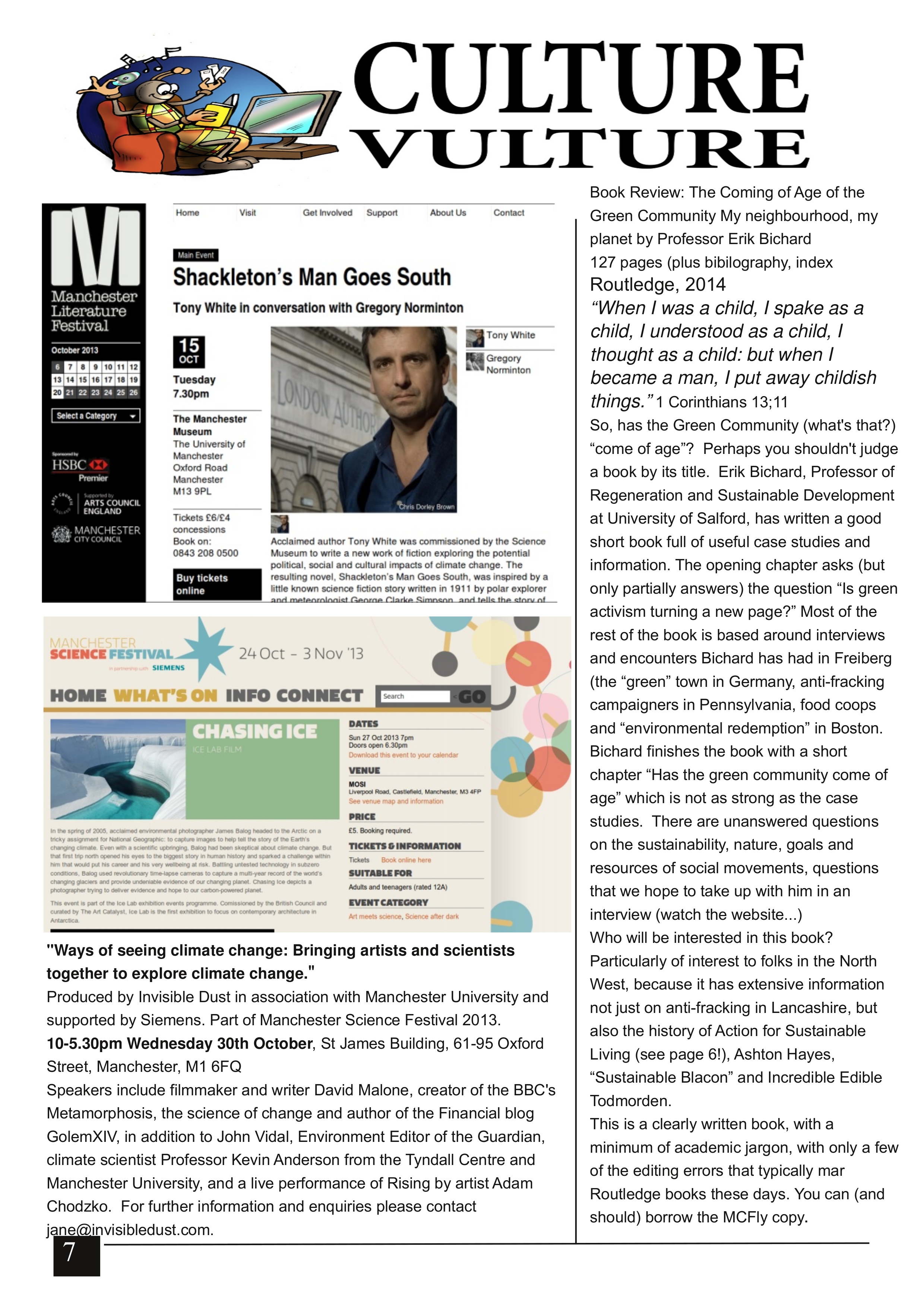
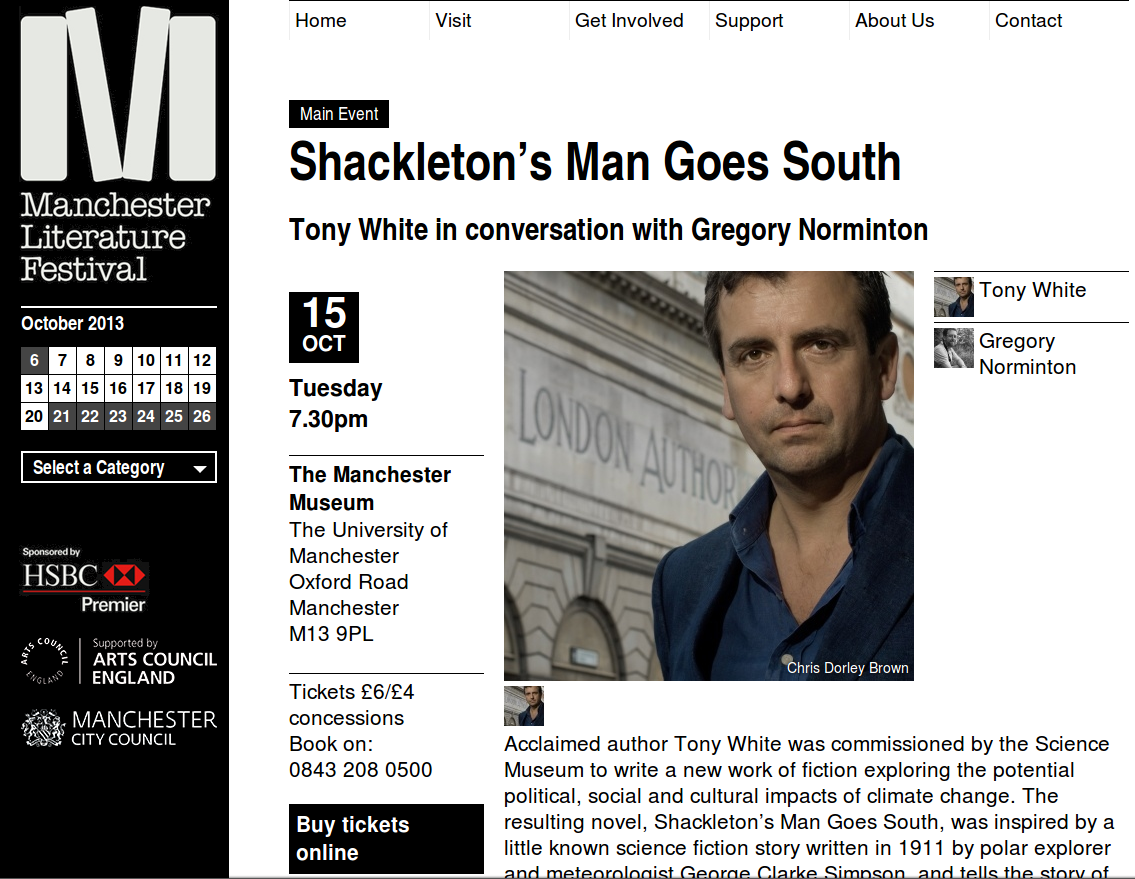
Upcoming Event: “Shackleton’s Man Goes South” #Manchester Literature Festival & #climate Oct 15th

This event is at the Manchester Museum.  £5. MCFly has two free tickets!  See below for details.

shackletons


Acclaimed author Tony White was commissioned by the Science Museum to write a new work of fiction exploring the potential political, social and cultural impacts of climate change. The resulting novel, Shackleton’s Man Goes South, was inspired by a little known science fiction story written in 1911 by polar explorer and meteorologist George Clarke Simpson, and tells the story of refugees fleeing to the safety of a post-melt Antarctica.

Tony’s previous publications include the novel Foxy-T and the non-fiction work Another Fool in the Balkans: In the Footsteps of Rebecca West. He will discuss his bold and gripping new novel-cum-manifesto with Gregory Norminton, author and editor of Beacons: stories for our not so distant future.”

To enter the competition, simply send us an email to mcmonthly@gmail.com with “shackleton” in the title.

Give us your name, and complete the following sentence:  “The thing the people of Manchester will most regret not having done about climate change – when the human fecal matter contacts the air circulation blades  – is….”

Deadline is Friday 11th October at 5pm.

The consistency and quality of your sentence will NOT preclude your eligibility, but please give us the best answer ya got. Two names will be drawn from a hat and the winners notified!

Posted in Competitions | Tagged | Leave a comment