The tl:dr. Comments haven’t been disabled on the Leader’s Blog. Glitch in the software, old chap. Web monkeys working overtime to fix it.
Richard Leese has been the leader of Manchester City Council for 23 (twenty-three – quarter of a century, less some change (1)) loooong years.
For a while now he has had a blog, since he has so very few outlets for his ranti… his rambl… his statements (of various factfulness (2) and worth, but that’s another story).
He relaunched the blog in July of this year because (and these are his words) “principally as a response to social media which has its purpose but is not really suitable for more detailed argument. This is often compounded by people posting stuff that has absolutely no substance but which then gets repeated as if it was gospel.”
Because, you know, on social media, the serfs, peons and scum who don’t know their place, well, they can holler back.
No, no, I am totally wrong. The whole point of the blog has been that reasoned debate can be engaged in, like the mature but not-too-mature adults we all are…
That’s why there have been 12 (one for every two years we have been blessed) blogs and not a single comment. And it seems that it never seemed to occur to Our Glorious Leader that there was a glitch in the software.
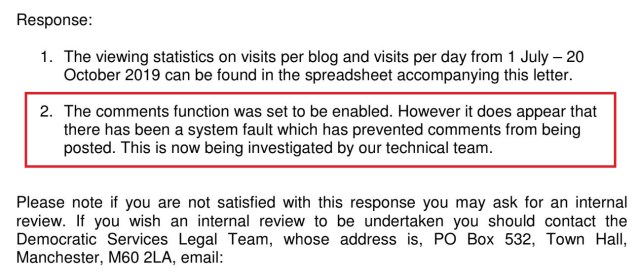
So, on 16th October (which was one of those days – see (2) below), Manchester Climate Monthly (aka Marc Hudson) submitted a Freedom of Information Act request.
2. Whether comments are disabled or not – it does not say anywhere that they
are, but various people have tried to leave comments and received error
messages of late, and there are NO comments from July 2019 onwards (I have
not bothered to look further back)
3. If comments are disabled,
a) when this happened,
b) on whose authority/who made the decisions
c) with what rationale
d) whether the decision-maker sought the opinion of legal advice and/or public
relations advice within the City Council before making this decision.
e) if they did, what advice was received
f) why there is still a comments form , since this is a waste of people’s time and exactly the kind of fake ‘dialogue’ offer that has the young folks sharpening their pitchforks.
Now, normally when I FOIA the Council, they wait the maximum legal time (20 working days) before supplying the information (or a version of it). Here’s the hilarious bit-
Given that there is a little online wtafuckery about Richard Leese claiming he wants to work with people (see here and here, and see here for my reply to one of his sprays) it seems somebody has decided the usual delay-till-the-last-minute-on-general-principles will hurt more than it will help. Here we are, ten-ish working days later, with the answers –
Well, that’s alright then.
Footnote
(1) Change? Manchester? Nope.
(2) See forthcoming post
For reasons which will become clear soon, I’ve been rooting around in old blog posts. Came across this, from back when I believed that even though the people in charge might be a bit slow and a bit defensive, they would still basically recognise a good idea, and give a shit about improving this city’s response to climate change. How naive I was
..
We wish you good luck in your new endeavour. Manchester desperately needs your energy and unique position in the “eco-system” of organisations, businesses and the like.
We know how little time you have. We know how little money there is. We have some suggestions, for which money is not needed. Here they are;
1) Ask tenants and residents associations, mosques, churches, trades unions etc if you can come and talk with (not “to”, not “at”) them about the Action Plan, the Conference, and hear their ideas and questions. Do Chorlton last. Keep a public log of these meetings, including the questions people raise. Reflect on how to make the meetings more inspiring and “sticky”. Avoid “sage on the stage” and “death by powerpoint.” They are not sticky, they do not inspire.
2) Undertake training, as members of Steering Group, in how to be part of interactive forums (ok “fora”) and discussions, rather than the traditional “death-by-powerpoint followed by Q and A” that are mis-sold as “workshops.”
3) Hold quarterly meetings (in public!) with the EnvironmentalAdvisoryPanel (on which some of you sit), the Environmental Strategy Programme Board and other “key stakeholders” where members of the public are able to ask questions. Record these. Tweet them. Et cetera.
4) Hold. Elections. It’s not difficult, and it will do your credibility no end of a favour.
5) Call your arty friends at the Cornerhouse and organise a film festival. What films? See our suggestions here. It’d be a good excuse to have a couple of public discussion events too.
6) Call your arty friends at the Royal Exchange, or the Library Theatre, or the Contact or the Lowry, and get them to stage a run of Henrik Ibsen’s “An Enemy of the People.” It’s all about a beloved doctor loses his beloved status when he accurately reports that the economically essential asset everyone loves is actually really unhealthy. Who knows, maybe Manchester Airport Group will sponsor it. Organise a couple of post-performance discussions
7) Call your friends at the Manchester Evening News and get a monthly (or even weekly?!) column about climate change, its local impacts, local actions being proposed/taken, difficulties encountered etc. The journos at the MEN already seem to be not entirely opposed to printing good news from Castle Grayskull and her outposts, so it shouldn’t be a big ask.
8) Create a quarterly “question time” style event, with panelists such as the Exec Member for the Environment, the Council Leader, MAG, MEN, members of the Manchester Board (other than your good selves) and maybe a token business person or activist-type. Some sort of gender and race balance would be good. The Town Hall would probably give you a good discount on a room.
9) Make loads of youtubes and other multimedia explaining what the plan is, what progress is being made. (Probably want to avoid talking about how many Implementation Plans have been written though, at least in the short-term…)
10) Set up a short story contest, or film contest (or both) for people who live, work or study in Manchester, about how the city could and should look in the year 2020, or 2030, or whenever.
Once you’ve done all these, feel free come back to us – we’ve got loads more suggestions, many of them which appeared in an April 2009 document a few of you may recall. To real action!
Young people from all over the UK are coming together to organise a Youth Environmental Conference. It will take place at Manchester Metropolitan University on 23 -4 November [website here]. The gathering is one of over 50 happening around the world, and will feed into the International Climate Change talks (COP25) taking place in Chile from 2-13 December.
Conference of Youths, COY, normally happen in each host country right before the UNFCCC climate change talks, but this year, Local Conferences of Youth, LCOY’s are taking place all around the world, including the UK, to amplify the voices of youth on climate action.
George, from the organising committee kindly provided the following answers to questions.
This is the first local “COY” in the UK – how does this build on previous work by UKYCC and other groups?
The UKYCC has been an active organising group in the UK for several years now, with a network of contacts both across the UK and internationally. The organisation has led on multiple campaigns such as Systems Change (Anti-Fracking in the UK), Youth Strikes and most recently, developing Community Working Groups to support local environmental education and create a network of sustainability ambassadors that will provide young people who have been invested in the Climate Strikes, a platform to channel that passion. Many of our UKYCC members also attend several international conferences, such as the COP, to ensure that we can contribute to the fight for global climate justice. So, as you can see, the first Local Conference of Youth in the UK has an impressive array of young environmentalists at the helm who know exactly how to engage young people in the most prevalent issue of our time.
Traditional conferences are very much dominated by speeches/panels and then a question and answer session which tends to be dominated by the most confident/best-informed/loudest. Doubtless the organisers of this conference are both very aware of this problem and have a plan to minimise the problem- what other formats will attendees of the conference be exposed to?
The LCOY is all about engaging young people and platforming their voice in the fight for our planet. Whilst we have key note talks and panel discussions, much of our conference will be interactive workshops that will not only educate delegates but allow them to put forward thoughts and challenge ideas. Also, the LCOYUK isn’t simply a conference you attend and then leave; for the duration of the event we will be creating a policy document entirely supported by the voices of our delegates. We hope that the LCOYUK policy document will go onto influence other campaigns/initiatives and eventually lead our networks towards the COY 2020 that will be held in Glasgow next year.
Given, again, that these sorts of conferences tend to be achingly middle-class and pretty white, what are the active steps in place for people from other backgrounds to attend. So, for example, are there travel bursaries for people who couldn’t otherwise afford to come. If so, how can people apply?
We’re ensured that accessibility to the first LCOYUK is our biggest priority. As our demographic is young people, we understand that there are variable factors that could prevent people from attending. We have committed to providing free tickets to a number of delegates who may not be able to attend otherwise due to financial barriers. These are on a limited basis as we are a grassroots organisation, but for further information, all interested parties have to do is contact our LCOYUK email (lcoyuk2019@gmail.com). We also acknowledge that the LCOYUK cannot be simply centred around climate change education and activism, but instead highlight the challenges that currently face the movement. Friends of the Earth will be joining us on the Sunday to host a session titled, ‘The Environment and Race’ whilst representatives from the University of Nottingham will kick start the conference on the Saturday with a workshop on “Climate Change and Modern-Day Racism”. We want to ensure the necessary conversations are made across the conference to certify all voices are platformed in the climate change movement.
Will any portions of the conference be live-streamed, or recorded so people who can’t be there for the weekend can still participate, or see what was talked about?
Unfortunately, the conference will not be livestreamed or videoed. As this is the first LCOY in the UK, we have had limited resources to expand further than what we have already committed too. Although, documentation and materials will be circulated after the LCOYUK, with general updates and information available on our website (https://lcoyuk.wixsite.com/lcoy) and on our social media platforms (@LCOYUK).
Will there be sessions about handling emotions (especially grief, fear. despair and anger), since these seem to be – understandably! – bubbling away under the surface?
Of course – eco anxiety is something affecting young people more and more. All our workshops are built to engage, support and empower young people. Whilst education is fundamental, we want our delegates to leave understanding that their contribution is significant and that change is coming. Several of our sessions touch upon activism groups and network structures that will support our delegates to address their concerns. At the LCOYUK, we have also created a safe Wellbeing Space which can be accessed throughout the duration of the conference, in case any individual feels overwhelmed at any point.
Is there a session on campaigning on local authorities and climate emergency declarations (how to get a council to make one, what to do when they make it and then do nothing about it)
The LCOYUK has an entire theme/strand dedicated to climate change activism and we are making a conscious effort to ensure that local lobbying is as much of a focal point as national campaigning. We’re proud to say that we have organisations such as The Yorkshire Wildlife Trust and People and Planet who will be running activism and campaign planning workshops throughout the two-day conference. Many of which are focused on lobbying your local MP and engaging your council.
How old is the upper limit for ‘youth’?
Currently we identify anyone under the age of 35 as a youth.
Anything else you like to say.
We’re extremely proud to be hosting the first LCOYUK in Manchester. It’s history in activism, the city’s diversity and the vast student community that spans every corner of the city made it a sought-after location for our conference. After the climate strikes, the XR rebellions and other protests many young people have asked, “What’s Next?” The LCOYUK is next. Help us create a network of inspiring young activists and empower our communities to take action for global climate justice.
Recently Marc Hudson, one of the five core members of Climate Emergency Manchester, was interviewed by Elizabeth Hindson-Hall , a student journalist at the University of Salford for Utter Radio. She presents a show called ‘The Truth About…’.
Here’s the complete clip of the show, which also gives a bit more context about the history of Manchester Climate Fortnightly (2008-2010) and Manchester Climate Monthly (2011- present)
Thanks to Elizband also to the producer of the show Molly-Jayne Maddison.
Join Gina Dowding, Natalie Bennett & guest speakers to learn what a Green New Deal could look like in the North West.
About this Event
What is a Green New Deal?
In the face of the climate emergency, we need to fundamentally transform our society within the space of just a few years. The scale of the challenge requires at the very least a Green New Deal – a radical mix new institutions, a truly green industrial strategy, and an unprecedented level of investment in clean and low carbon infrastructure.
Most importantly, a Green New Deal is about delivering a ‘just transition’, ensuring that costs and benefits are shared equitably and no one is left behind. This means change must be delivered locally, committing resources where they are needed most and reflecting each community’s unique strengths and challenges.
What is this event about?
Join Gina Dowding MEP as she launches a new report exploring what a Green New Deal for the North West could look like, focusing on five key areas: renewable energy supply; energy efficient buildings; sustainable transport; green industry; and land use and food. The report will outline key opportunities and examples of best practice from across the region, and set out some of the policies needed to scale up action.
Gina will be joined by a range of expert guest speakers including former Green Party leader and newly appointed member of the House of Lords, Lady Natalie Bennett. Attendees will also have the opportunity to take part in table discussions and feedback their views.
Who is this event for?
The event is aimed at representatives from across the public, private and third sectors in the North West, including local policymakers, business owners, employees and trade union representatives, NGOs and think tanks, campaigners and anyone interested in learning more about the Green New Deal.
Agenda
10.00 – Registration, refreshments and networking
10.30 – Welcome and introduction – Gina Dowding MEP
10.45 – Keynote presentations on five key themes: Land use, energy, buildings, industry, and transport. Guest speakers include Natalie Bennett and representatives from Electricity North West, Carbon Co-op, Transport for Greater Manchester, Arcola Energy and local manufacturer Crystal Doors
11.45 – Refreshments and networking
12.00 – Themed roundtable sessions: what next?
12.45 – Summary, future networking and closing statement
This Council is ugly as a dog that has been chasing too many parked cars. Even if the parked cars are, as our exalted life-time leader points out, “are zero emissions, they’re only a problem when they move.”
Manchester City Council’s Planning Committee today had a choice. It chose to chase more parked cars. Outraged residents? Whatevs. An eleven thousand signature petition? Talk to the hand, sister. It seems that despite declaring a climate emergency three months ago, despite announcing they would create a ‘low carbon culture’ ten years ago, we are still in the early steps of a “journey” when it comes to, you know, respecting human life and health.
The Trees not Cars campaign had tried valiantly to resist the inevitable. Manchester City Council had bought out the leese – sorry, lease- for 37 million quid. According to a leaked email read out by the Trees not Cars superb spokeswoman, the council leader (since 1996), Richard Lease, had admitted that recouping some of that money through having a 440 space car park next to a school was therefore a Good Thing.
And of course, when it comes down to impact statements, the numbers had massaged, and apples compared to oranges (the old car park was never busy-to-full, weekends and match days not considered) but since it was a car park, well, no change there then. Yeah, of course – in the same way that a butter knife and a machete are the same thing and you’d let a three year old play with both.
But it was always (for now – see below) going to end the way it did. A couple of impassioned and articulate councillors denouncing it, others hedging and asking for some token changes that could be put on an election leaflet. Bish bosh, 7 to 3 in favour, next agenda point please. Shocked members of the public, shat on again, though this time knowing it, left the chamber…
Morbid symptoms
There’s a dead white male – Antonio Gramsci (1) – who had lots of useful things to say. One of them (sorry, it is overquoted, but what are you gonna do?) is this-
“The crisis consists precisely in the fact that the old is dying and the new cannot be born; in this interregnum a great variety of morbid symptoms appear.”
We have an old in every sense leadership of the council (with some young apparatchiks, it’s true). Old in body, old in thinking, unable to see that the usual tactics, of empty energy-sapping promises and misdirection, are likely not going to work in future. They do not know what to do, other than cling on, with the same blandishments, and hope that the storm of concern blows itself out. Meanwhile the new are too small in number, not yet sure of themselves, not legitimate or connected enough. The task is to continue to expose the bankruptcy of the current regime, and to work to build coalitions. It’s boring, it’s frustrating, and there have been far too many (buried and memory holed) failures in the past. But what are you gonna do? What next?
So, a defeat again for a campaign. And what do our lords and masters want, what do they rely on at moments of fragile victory like this? They rely on the following
a) that the leadership of the campaign that has suffered a palpable defeat is unable to support their supporters through the anger and despair of the grieving phase,
b) that the leadreship cannot help people maintain and extend the skills, the knowledge and relationships that have been formed over the last weeks and months.
c) that if (as would be sensible) the campaign group connects with other groups, which connect with others, then ultimately the coalition will get
i) co-opted by a political party or
ii), or captured by dreary newspaper selling Trots, with interminable meetings and stitch-ups behind the scenes.
None of that has to turn out that way. It’s the choice of activists, but like so many choices in life, not a conscious choice, but one of the usual compromises, the usual patterns and habits, the usual fear of innovating.
Here’s another smart guy (and yes, this post has been a sausage fest – my bad) to close out with –
“If you go to one demonstration and then go home, that’s something, but the people in power can live with that. What they can’t live with is sustained pressure that keeps building, organisations that keep doing things, people that keep learning lessons from the last time and doing it better the next time.”
Random points that I probably should have integrated above, but it’s hella late and nobody is paying me for this.
1) Maybe if senior officers and chairs of committees might spend as much time informing themselves of what the filming meetings policy of the Council ACTUALLY says as they do in trying to get people not to film, they might have a little more credibility and get a little respect. #justsaying and watch this space…
2) Anyone wanna bet that in two years the Council, quite liking the income the park generates, say something like “well, it’s already been here two years, so the little tikes’ lungs have probably gotten use to it – what’s another two years between ‘friends’. [assumimg the whole thing doesn’t become a pitched battle site with XR etc stopping it being done]
Footnotes
(1) I recently had cause to reflect that just because somebody likes Gramsci, it doesn’t mean they are not a worse-than-useless twunt. Sorry for the venomous attack. Not sorry.
A so-called academic alerted me to your blogpost, and said “‘seems like his writing directly to you :-)” Others have commented on how brittle and defensive it is. Richard, I’m worried about you. This is the kind of fact-free spittle-flecked delusional ranting that we expect of the President of the United States, not the long-long-term leader of Manchester City Council. I’m like, are you okay?
I don’t know if you have the cognitive and affective tools to make use of this post, but I am going to try to explain to you what you have been unable to say, and why a real understanding of Manchester’s (dismal) history of climate policy failure matters for doing things (MUCH) better in the future. Because the future matters, even though you may not be part of it for all that much longer.
Below, in italics, is the entirety of your latest blog. (By the way, the title “How green is my city” is telling. Do you think it is your city, Richard? What are the 550,000 people who live here- fodder for your ego? Something else? Btw, the answer to your question is “nowhere near as much as the Council wants everyone to believe.”)
In the paragraphs in between I will try to jog your memory, and point out the, ah, gaps in what you say. Not for your benefit so much – I fear that you might need more help than I can provide – but, well, so other people can see what is going on (many already do, by the way, which may be discombobulating you.)
A couple of weeks ago I posted on Twitter about the greenhouse gas reduction target for the city set in 2009 to be achieved by 2020, 41%, and that the City Council, with a 2.1% share of the city’s emissions, had far exceeded that target by the end of 2018/9.
But Richard, your tweet was in response to my response to a tweet about the lack of city council mentions of climate change since the July 10th climate declaration. You weren’t being, you know, proactive, as a forthcoming report on your twitter activity will show.
As for the city council reduction target….
Richard, have you forgotten austerity? All those libraries closed? All those shuttered child-care centres, all those poor people in Manchester made that much poorer? They haven’t forgotten, Richard. And many of them also know that the Council had 10 thousand staff and lots of buildings in 2010, before the Coalition started swinging the axe. The Council now has 6 thousand staff, offers fewer services, has fewer buildings. OF COURSE its emissions are down, (and independently of t’National Grid being partially decarbonised). You do understand that, right? Or do you not have the mental acuity anymore? I worry. Surely it can’t be that you do know it, but hope people don’t notice. That would mean you were trying to trick people, and that you thought they were really stupid. No, no, I refuse to believe that.
Just to be clear, I was not denying the Council’s role in providing broader leadership on climate change, but was making an obvious point to all those who point the finger at the Council, and at the same time throwing out a challenge, that if the rest of the City was doing as well as we are we would be in a lot better place.
Richard, you’ve been leader of Manchester City Council since 1996. It only got a climate policy – thanks to activist pressure – in 2009. I am not sure you should be talking about providing broader leadership. Also, have you forgotten that you launched the ‘carbon literacy’ programme in October 2012 at the Arndale Centre but despite repeated, er ‘prompts’ only did the training yourself in mid-2017. Perhaps you kept forgetting to do it?
I don’t want to overwhelm you though, with examples since you seem not to remember your actual behaviour, versus what you want (need?) to believe.
It’s worth looking again how that target was set and what has been done since to achieve it. Like now, in 2008 lots of individuals and organisations were berating the Council for alleged inaction. Our response was to invite all our critics in and to work with us to write and deliver our climate change strategy and action plan.
There were actually two goals for the Climate Change Action Plan, as I am sure (well, I hope!) you know. Do you not remember though, that in 2008 it was Manchester Climate Fortnightly (which I co-edited) doing most of the berating for real (not ‘alleged’ inaction). Can’t you think back to how the second Executive Member for the Environment, your cherished friend Neil Swannick, produced a ‘Principles Document’ on climate change in early 2008, which said there would be a stakeholder engagement process by the end of the year?
Is it beyond your ability to remember that in early 2009 a laughable and expensive desk-study, prepared by a London-based consultancy, emerged. It was called ‘Call to Action’. In outrage and disgust, a bunch of activists created a ‘Call to Real Action’ in a bare six weeks, with no money. There were dozens of us, and we produced a 60 page report chock-full of good ideas, most of them still un-implemented.
Richard, the first time we met was in late April 2009, at the first meeting of the Environmental Advisory Panel (an idea I had suggested to the then Executive Member for the Environment, Richard Cowell). I gave you a copy of C2RA, saying “er, I am not sure if you have seen this?”
You said to me “But that’s what we are here tonight to talk about.” And sure enough, your officers had marked up copies, with lots of highlighting.
Richard, it’s only ten years ago. How can this be so difficult for you? Have you forgotten my role on the EAP, explaining how the official plan could be put together in the few short months before you needed to fly off to Copenhagen with a completed climate plan? Have you forgotten how the plan also called for the creation of a low carbon culture, with the council leading that? I’ve put the text in a box, to jog your memory.
Have you achieved this, Richard? Have you?
So, moving on.
Most accepted the invitation and the result was the ground-breaking Manchester : A Certain Future and later the establishment of the Manchester Climate Change Agency, the Partnership organisation tasked with delivery.
Yes, I accepted the invitation to be involved in the EAP for several years. You agreed it needed an overhaul and tasked your officers with doing that with me (I still have the emails). They didn’t, the EAP was then abolished and recreated without me. But who cares about me? What matters is this
Do you recall doing anything when those elections never happened? I don’t recall you doing anything.
Do you recall how the MACF was supposed to hold annual day-long stakeholder conferences but only managed one, in 2010. In 2011 nothing. In 2012 a half-day atrocity. In 2013 another half-day atrocity that Arwa Aburawa and I were banned from.(though it seems we dodged a bullet).
Do you recall doing anything when the stakeholder conferences were then abandoned? I don’t recall you doing anything.
And that plan you mention. The Council committed to getting a 1000 endorsing organisations, which would then write their own implementation plans. Your officers sent out 1 email, got 220ish endorsers. No plans, no further action.
Some chose to remain carping from the sidelines and some of those are still carping from the sidelines adding nothing but venomous hot air to the task ahead.
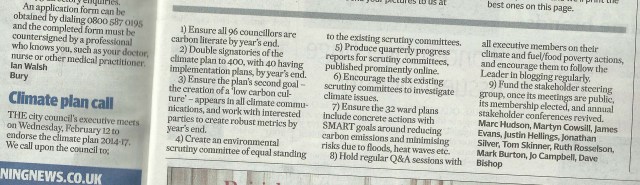
Oh dear, poor Richard. Do you not recall how I and loads of other people produced a 30-page document in 2014 and brought it to Executive, listing 9 actions (deliberately chosen for their cheapness and impact) the city council could take?
There was an accompanying video (sorry about the production values – I am amateur AF).
“In March 2014 MCC at both Neighbourhoods Scrutiny Committee (NSC) and Economy Scrutiny Committee (ESC) agreed to implement its recommendations. But both attempts to create an implementation plan have been rejected by Economy Scrutiny as unsatisfactory. Rather than wait for a third attempt, a group of Manchester citizens has decided to write a plan and circulate it. This is done in a spirit of constructive criticism, imperative because of the enormous challenges of the linked crises in environment (including climate) and economy facing the city.”
We then produced a 21 page implementation plan. It was viciously attacked and ignored in the scrutiny committee. As for ‘venomous’, um, (1)
For its part the Council is taking the climate emergency extremely seriously but also knows that all though we are on a very steep slope there are no overnight solutions.
Richard, now I am getting really worried. Are you not able to tell the difference between what you want to be true, what you wish others would believe, and the actual facts? Your blog’s timing suggests that you have seen the ‘Dead Tortoise Society’ report. That showed that on half the 23 elements of the climate emergency declaration there has been no action. Richard, that report is based entirely on Freedom of Information Act requests – the words of your own officers. Also, not a new penny has been assigned or sought for climate action.
Richard, do you see people see you?
As for “overnight solutions” – do you see how setting up a strawman is a failed debating trick that is clearly coming from a position of weakness? Richard, you’ve had 23 years as leader to come up with solutions. It’s ten years since the climate plan. There’s no overnight about it.
Our zero carbon city still needs more homes and more jobs and the most sustainable way of providing for those is through dense development on brownfield sites close to public transport nodes. The alternative is concreting over greenfield sites for what would be very car dependant development. As our outline city centre transport strategy sets out we are aiming to reduce the number of car journeys into the city, but at the same time we recognise many people will remain dependent on the car for a large number of reasons. So we need those cars to be cleaner, ideally electric, but they will still need somewhere to park. Parked cars are zero emissions, they’re only a problem when they move.
“Parked cars are zero emissions.” It saddens me to say it, but really think you should seek a professional assessment. (How) can you possibly believe this is a persuasive argument for the 10,000 people who have signed the petition?
Finally, what we are interested in is practical, deliverable solutions that have support across all our communities to tackle a fundamental issue. We are open to working with anybody who wants to join us in that task.
So am I, Richard, So. Am. I. That’s what I have been doing for over ten years. I look forward to working with you – and your successor – quite soon.
Finally, some reflections on legacies and reputations. A real king of spin, Shane Warne, on quitting Test cricket, said ‘it’s better that people ask “why are you retiring?” than ‘”why don’t you retire?”’ Already one of your deputies will have a lot more time on their hands, come May. Perhaps, rather than waiting for younger colleagues to stage an intervention, you might think about getting out while the going is good, with at least a little dignity left? Speaking as a friend.
But perhaps you are worried about what people will say about you? I mean, you have clearly known about climate change and the need for local authority action since 1994 (at the latest), when you attended the ‘Global Forum’. You became leader in 1996. Admittedly the first years were dominated by the aftermath of the IRA bomb. But Manchester only got its first climate policy in 2009, and has not implemented it, choosing instead to take the credit for national level factors. Ten wasted years, without that low carbon culture getting implemented. Do you worry that this record will be seen as one of harming children?
Footnote
(1) Have you seen how some of your older whiter maler Labour colleagues (you know who I mean), treat the Liberal Democrats? Oh, Richard, you’ve not become one of those thin-skinned old people who can dish it out but can’t take it? By venom, I think you actually mean constant informed constructive criticism by people who refused to become tame meat-puppets, who were willing to conflate access for influence.
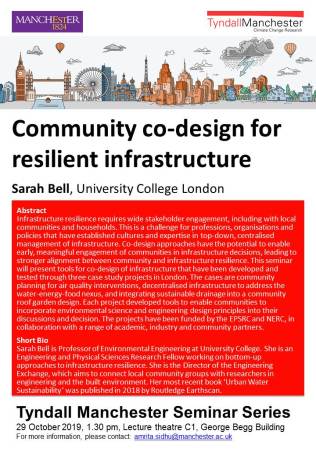
‘Community co-design for resilient infrastructure’ by Professor Sarah Bell, on Tuesday 29th October (room C1, George Begg Building, Sackville Street) at 1.30pm.
[No need to book. Just turn up. Tyndall seminars always good, sometimes fantastic]
Infrastructure resilience requires wide stakeholder engagement, including with local communities and households. This is a challenge for professions, organisations and policies that have established cultures and expertise in top-down, centralised management of infrastructure. Co-design approaches have the potential to enable early, meaningful engagement of communities in infrastructure decisions, leading to stronger alignment between community and infrastructure resilience. This seminar will present tools for co-design of infrastructure that have been developed and tested through three case study projects in London. The cases are community planning for air quality interventions, decentralised infrastructure to address the water-energy-food nexus, and integrating sustainable drainage into a community roof garden design. Each project developed tools to enable communities to incorporate environmental science and engineering design principles into their discussions and decision. The projects have been funded by the EPSRC and NERC, in collaboration with a range of academic, industry and community partners.
Speaker bio
Sarah Bell is Professor of Environmental Engineering at University College. She is an Engineering and Physical Sciences Research Fellow working on bottom-up approaches to infrastructure resilience. She is the Director of the Engineering Exchange, which aims to connect local community groups with researchers in engineering and the built environment. Her most recent book ‘Urban Water Sustainability’ was published in 2018 by Routledge Earthscan.
Campaigners have revealed that Manchester City Council has assigned no additional resources to climate action after its ‘climate emergency’ declaration in July. In response to a Freedom of Information Act request submitted in early September, the Council was forced to admit that “no additional staff have been seconded to work on this area since July 2019” and no resources from within the council reassigned. In response to a question about whether any external bids for funding had been made, the Council admitted “No bids have been submitted since July 2019.”
“Declaring a climate emergency was a vital step but the task ahead is enormous,” says Rose Arnold of Rising Up! Manchester Families. “Manchester missed last year’s target of 13% carbon reduction by 11%. We’re nowhere near. There’s no way the changes needed can be carried out without resources. At the very least a team is needed, which should include a member of the Executive Committee. We’re deeply worried that the declaration of emergency won’t translate into the action needed.”
Calum McFarlane of Climate Emergency Manchester said “this is disappointing, but not surprising. We know that many councillors genuinely care, and want to see action. They, like us, are angry at the lack of any sense of urgency from the leadership of the council, both elected and unelected. We will continue to work with people throughout Manchester to raise not just the level of ambition, but also action. We need deeds, not words.”
On Thursday10 October – the three month anniversary of the City Council’s declaration – Climate Emergency Manchester will release its first quarterly progress report on the Council’s actions, based on a series of Freedom of Information Act requests. The report, known as “Hung Drawn and Quarterly #01”, will be free to download from www.climateemergencymanchester.net
If you want to sign the petition calling on Manchester City Council to declare a climate emergency, you can do so here. If you want to get involved in CEM’s work, email us on climateemergencymanchester@gmail.com
We’ve discovered that Trafford Council has over £36million of your money invested in BP, Shell, British Gas and other fossil fuel giants!
We believe this money should be invested in green solutions, instead of subsidising these polluters. We want the Council to changeit but we need your help.
The money is in Greater Manchester’s Pension Fund. Unbelievably, they have over a billion pounds of pension money across Greater Manchester invested in the fossil fuel industry – making the climate crisis worse, instead of better.
How can you help?
– Can you come to Trafford Council on Wednesday night? Bring posters, T-shirts and banners. We’ll be meeting at the 6pm at the main entrance (opposite the Old Trafford cricket ground).
– If you live in Trafford, contact your councillors asking them to support the Green Party motion. Let them know how important this issue is to you. You can find their contact details here https://www.writetothem.com/
– If you live in another part of Greater Manchester contact your councillors asking them to bring a similar motion to their council. Let them know how important this issue is to you. You can find their contact details here https://www.writetothem.com/
– Share this story on social media and tag @traffordgreens.
Trafford declared a climate emergency last year, thanks to your Green Party councillors. But we need actions, not just words.
Thanks for your support and hope to see you Wednesday!
Our "leaders" are going to keep making empty promises. It makes them feel good. It gets the activists to act like zombie kittens. If you want to have some self-respect and perhaps make a difference (actual facts may vary), then find a functioning group that cares about your skills and knowledge - what you have, what you want.
One useful group might be www.climateemergencymanchester.net - you can email them on contact@climateemergencymanchester.net

 Conference of Youths, COY, normally happen in each host country right before the UNFCCC climate change talks, but this year, Local Conferences of Youth, LCOY’s are taking place all around the world, including the UK, to amplify the voices of youth on climate action.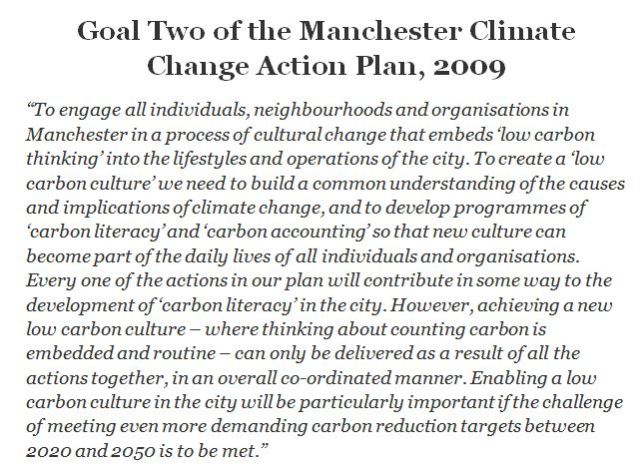
 “Declaring a climate emergency was a vital step but the task ahead is enormous,” says Rose Arnold of


 manchester climate monthly