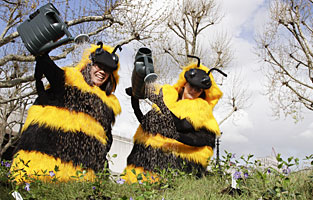
Upcoming Event: Why? Bee Cause! #Manchester Weds 20th Feb 6.30pm #biodiversity #campaigning @ManchesterFoE

You’d think that our species would understand that it’s not going to have much of a future if we wipe out the species which pollinate our crops. Apparently not. Some of the people making the decisions on behalf of our species are a bit dim sometimes*, and need a bit of help…

bee_cause_21_313Weds 20th 6.30 to 8.30pm Friends of the Earth bee campaigning meeting.
“As you may have read in the media and through FOE, things are buzzing on the bee campaign with many MPs backing Friends of the Earth’s call for a National Bee Action Plan and several high street companies banning neo-nicotinoids from their pesticide range.
“To keep the momentum going the group are holding a meeting this Wednesday to update people on this year’s plan for the campaign and to start organising for stalls and hopefully a bee friendly wild flower meadow.
“We will be building a bee costume and making bee ‘hotels’ as well as looking at the new bee resources available from FOE this year.
“If you would like to find out more and get involved please join us!”

bee_cause_logo_rgb1Green Fish Resource Centre, 46-50 Oldham Street, Manchester, M4 1LE
More info: Contact stephanielynch86@googlemail.com


* Or perhaps a bit greedier than is in their own long-term self-interest. A debate to be had in the pub after doing something useful, perhaps?
Posted in Biodiversity, Upcoming Events, volunteer opportunity | Tagged , | Leave a comment

Crosspost: #Manchester Friends of the Earth meeting on “how ethical is your shopping basket”

Manchester Friends of the Earth has a “full-group” public meeting on the second Tuesday of every month, at the Greenfish Resource Centre on Oldham St. Here’s a report, by one of the FoE co-ordinators, on the most recent meeting.

Report on the open meeting: How ethical is your shopping basket?

A brief report on the “How ethical is your shopping basket” open meeting hosted by Manchester Friends of the Earth on Tuesday 12th February.

Over 20 people gathered at the Green Fish Resource Centre on Oldham Street to learn more about consumption, waste and the growing range of ethical products available.  The meeting started with the 20 minute Story of Stuff film (transcipt available).  Despite being a little dated and US focused the Story of Stuff gives a good overview of the sheer amount of waste, social and environmental injustice caused by our current system of planned obsolescence (or designed for the dump), perceived obsolescence and the ‘Golden Arrow of Consumption’.

Golden Arrow of Consumption 150The film describes how the ‘Golden Arrow’ “is the heart of the system, the engine that drives it. It is so important [to propping up this whole flawed system] that protecting this arrow is a top priority for both these guys. That is why, after 9/11, when our country was in shock, President Bush could have suggested any number of appropriate things: to grieve, to pray, to hope. NO. He said to shop.  TO SHOP?!  We have become a nation of consumers. Our primary identity has become that of consumer, not mothers, teachers, farmers, but consumers. The primary way that our value is measured and  demonstrated is by how much we contribute to this arrow, how much we consume. And do we!”

Rachel Kenyon, from the Co-operative’s Social Goals team,  gave an overview of the story of ethical consumerism in the UK, from the 19th Century Co-operative Revolution through the increasing awareness of Human Rights, Animal Welfare and Environmental issues to the rise in certified produce, as reported for over a decade in the Ethical Consumerism Report, produced by The Co-operative Group.

Household ethical spend - Cooperative  300Her presentation described how the average ethical spend per household in the United Kingdom had increased from £291 (2000) to £868 (2010) and now to £989 (2011), how sales of organic/free range eggs now accounted for over half (51%) of all UK sales and Fairtrade bananas making up 45% of UK sales with the Co-operative deciding to only sell Fairtrade bananas and chocolate.

Rob Harrison gave a broader view of the growth of ethical consumerism, particularly the increase in the supply side range of ethical goods, the difference in approaches between Fairtrade and the organic movements, as well as the importance of “buycotts” or positive purchase decisions.

The Question & Answer session had detailed contributions questioning the role of supermarkets in ethical consumerism as well the effectiveness of the ethical consumerism itself.    The meeting concluded with announcements of forthcoming events and then a social visit to a local hostelry.

Pete Abel. (13th February 2013)

Posted in Event reports | Tagged , | 1 Comment

Parents of #Manchester – what are you telling your children about #climate change?

This below is a repost from an excellent blog called “The Learning Planet.”  What do MCFly readers with young children have to say? We’ve added a “starter comment” from a good friend…

2011-07-25 00.50.29

This is a very brief post because I want to know what you think. I’m very interested in the question: At what age do we start talking with children about the unfolding environmental catastrophe? Do we cover it up and make life as good as we can for now, or do we start to prepare them, in a combination of therapy, practical survival skills and enlisting them in active resistance? How do we overcome our own denial, however constructive it is, and listen to the alarm bells ringing with our children?

Please comment below….I have no clear answers. I do have some thoughts which can partly be seen in this post Children and the Olympic Century.

Also, click on the Comments link to reveal them and read them, as they are all really interesting.

The photo is of an adult & young child watching one of Feral Theatre’s Funerals for Lost Species, which mourn irretrievable extinctions of iconic species.

A final quick note: It looks as if this organisation, the Climate Psychology Alliance, may add some useful resources on how not to overwhelm children but to give them agency. They are calling for resources and articles so if you have anything to share with them, get in touch.

From the MCFly reader:

I think they make good points on building up the interest, the awareness etc, but I’m very conscious that the terrible doom scenario is rather too oppressive for young minds who have not created the problems, don’t see the connections between cause and consequence at global levels yet, and have to deal with understanding themselves as well as figuring out the meaning of life and the rest of what society is throwing at them.
I’m extremely aware of the fact that the leading cause of death in 12-34yrs old is suicide for all sorts of “can’t cope” reasons already- is adolescence the time to give another hook for their internal despair?
So I have the same approach with it I have had with everything else: here are the reasons why I do x and y , here is what I have heard/read/know etc. answer their questions if any, relates their actions to the same and leave it at that. They will reach their own conclusions, but if you’re lucky you’ve also given them ideas on how to slow/ change / act on the problems too.

Posted in education | Tagged , | 2 Comments

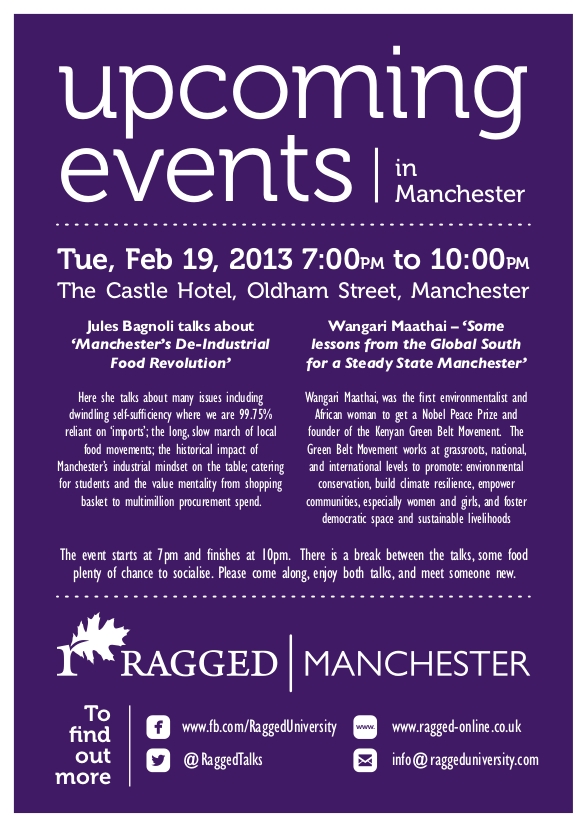
Upcoming Event: Talk about Wangari Maathai (and #Manchester’s De-Industrial Food Revolution”) Tues 19th Feb, Castle Hotel,

MCFly caught up with Judith Emmanuel (a friend of both editors) about her upcoming presentation on Tuesday night.

What’s happening on Tues 19th?
ragged19thfebI will be leading a discussion at Ragged about Wangari Maathai – some lessons from the Global South for a Steady State Manchester’. Jules Bagnoli will be talking too, about ‘Manchester’s De-Industrial Food Revolution’. it is at the Castle Hotel on Oldham Street in Manchester 7pm to 10pm at the Castle Hotel in Manchester

We will;

  • show a short film about Wangari Maathai and the Green Belt Movement’s work
  • give a brief introduction to Steady State Economics and Steady State Manchester
  • explore the relevance of the successes of the Green Belt Movement’s work for introducing Steady State ideas in Manchester
  • consider how we can use this learning

So who was Wangari Maatthai, and why should people in Manchester be more aware of her?
Wangari Maathai, was the first environmentalist and African woman to get a Nobel Peace Prize and founder of the Kenyan Green Belt Movement. The Green Belt Movement works at grassroots, national, and international levels to promote:

  • environmental conservation
  • build climate resilience
  • empower communities, especially women and girls
  • and foster democratic space and sustainable livelihoods.

They have been amazingly successful, apart from everything else they have done they have inspired the planting of 52 million trees since 1998.

Dealing with the issues of today is enormous, I think that is an important reason why people deny what is happening or feel powerless.

Wangari Maathai was born in a village in colonial Kenya. At the time she set up the Green Belt Movement Kenya was coping with IMF imposed structural readjustment, a notoriously corrupt and sexist government, 93% of tree cover in Kenya had disappeared. They have achieved a lot through their holistic and empowering approach. Their story can encourage us to feel we can succeed and moreover we an all do something.

I am really keen to share what I know about Wangari as my experience of doing this in the past has had an amazing impact in the past. for example, I showed Taking Root a lovely film about Wangari to a neighbour who is a teacher. As a result she wrote a teaching aid for the staff at her school, did an assembly at the school about Wangari and they planted a tree.

What are you hoping will happen on the night/why should people come?
My presentation will include a brief introduction to steady state ideas and a short film about Wangari and her work. I am really excited that my presentation will be complemented by Jules talking about things that are happening in Manchester.
We hope to stimulate a lively discussion and that people will leave excited and feeling able to contribute even more to creating a sustainable world. We want to hear what others are doing and what they would like to do too.

Whether they can come or not, how else can they get involved in the work you are doing?
This is a pre-event for to Celebrate WANGARI MAATHAI DAY, Sunday 3rd March. We invite you to celebrate it alongside Steady State Manchester. Other events are being organised in homes, student residences, a GP practice, involving women asylum seekers, literature lovers and many others. You can:

· Encourage conversations about Steady State Manchester
· Link up with Kaoma Environmental Resources Initiative, a grass-roots projects in Western Zambia.
· Use available teaching aids and DVDs are to help you mark the day
· Respond to the council’s consultation about the budget  by 20th February  and challenge their commitment to economic growth. See
www.steadystatemanchester.net for model letter and Steady State Manchester’s response .

Contact Judith@judithemanuel.co.uk

Events include:
Wednesday 6th March, 7.30pm, ‘Taking Root’ a beautiful film which tells the dramatic story of Wangari Maathai. The film will be followed by a discussion to consider what we can learn from this inspiring woman and the Green Belt Movement to develop a healthy, sustainable future within Manchester. Alexandra Practice, 365 Wilbraham Rd, Manchester M16 8NG

Thursday 7th March
, (please note new date) 6pm for 6.30pm – 8.30pm. Launch of Beacons: stories for our not so distant future with BEACONS editor Gregory Norminton and writers Clare Dudman and Rodge Glass. The Manchester Writing School at MMU, Manchester Literature Festival and Steady State Manchester invite you to explore how literature can connect us with the predicaments of our age. The stories are inspired by, and will be sold for the benefit of, the Stop Climate Chaos Coalition @ International Anthony Burgess Foundation, Engine House, Chorlton Mill, 3 Cambridge Street, Manchester M1 5BY. http://www.manchesterliteraturefestival.co.uk/preview-events/beacons

We hope to see you on Tuesday and at the events in March.

Posted in Upcoming Events | Tagged , | 1 Comment

Upcoming Event: Feeding the City: The Politics & Promise of Urban Food #Manchester Tues 19th March

Hmm, last time this lot organised an evening forum, MCFly was under-whelmed.  Hopefully this one will be a forum rather than a panel debate followed by Q and A, eh?

feedingthecityUrban Forum on Food // Feeding the City:  The Politics & Promise of Urban Food

Book your place: http://foodforum.eventbrite.com

Cities around the world are emerging as key locales for growing food. A variety of approaches are being piloted to enhance health and well-being, encourage local economic growth and self-sufficiency, enrich social cohesion and community development, and diversify urban greening and resilience. In this research forum, we will discuss the opportunities and barriers of urban agriculture and speculate on the future of growing food in cities.

Time and Date:

Tuesday 19 March, 6-7.30pm (followed by drinks / food reception)

Panel:

Graeme Sherriff, Manchester Architecture Research Centre, University of Manchester

Chris Walsh, Kindling Trust

Debbie Ellen, Freelance researcher / food consultant

Liz Postlethwaite, Director – Small Things Creative Projects

Chaired by Carly McLachlan, Tyndall Centre and Sustainable Consumption Institute

Venue:

Anthony Burgess Foundation, Chorlton Mill, 3 Cambridge Street,  M1 5BY

Posted in Food, Upcoming Events | Tagged , | Leave a comment

EMERGENCY ACTION: Please protect #climate #democracy in #Manchester today. (Elections cancelled, questions unanswered.)

If you want climate change action in Manchester to become even more undemocratic, even more ineffectual, simply stop reading now and move on.
If you want the people of Manchester to have the transparent and democratic institutions they deserve and need in order to meet the challenges that lie ahead, keep reading, then act.
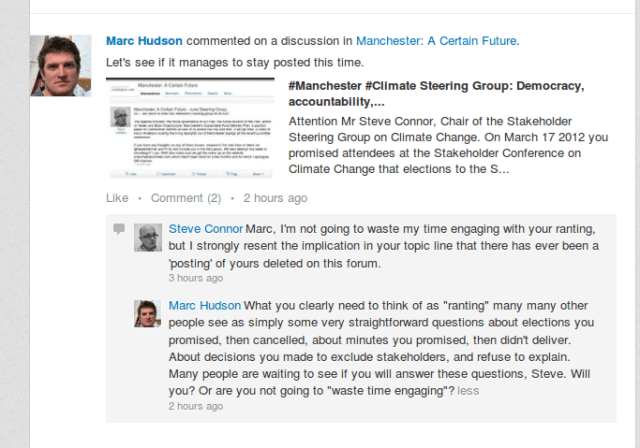
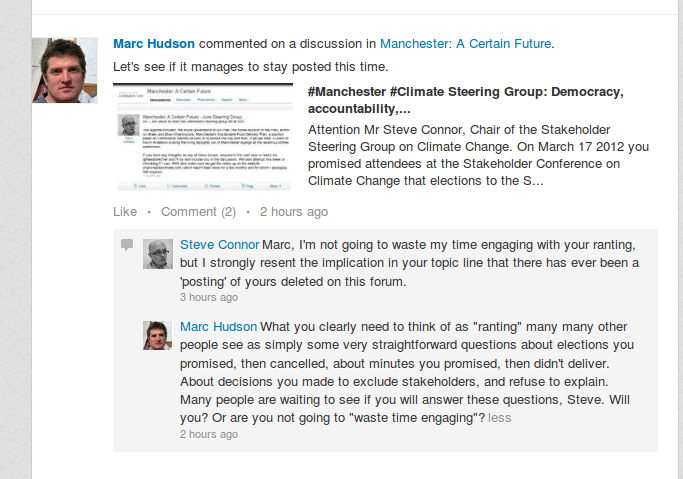
macfpostThis is the most important of the 630 or so blog posts that have appeared on this site. And it’s one I* really hoped not to have to write. But straightforward questions about cancelled elections are being dismissed as “ranting”. When the chair of the “Steering Group” (itself unelected) declares that to answer questions about transparency and decision-making would be to “waste my time”, MCFly readers have to decide if they will take action or do nothing.

Because if elections can be cancelled without so much as an acknowledgement that they were even promised, then only trouble lies ahead.
If groups that claim to deserve a leadership role can hide behind closed doors, and can arbitrarily exclude people who ask awkward questions, then there is certainly no future for official climate action in Manchester. It will descend into ever more farcical and self-serving nonsense. If you are happy with that, stop reading now.

I have put together a suggested letter, but obviously we are not telling you what to write.

UPDATE 22/2/13: A MCFly reader has suggested the following – ‘I am very concerned that MCC does not appear to be living up to its professions on climate change; that the planned elections have not yet taken place; and that meetings of the unelected Steering Group are taking place behind closed doors, without any definite commitment to letting the elected committee take over. I do not agree with the exclusion of the editors of McFly, or any other members of the public, without good reason being shown. The council rapidly needs to regain its focus and take action if it is to carry out its responsibilities in this area.’

Please take the time to write to the following people about this.

PROPOSED LETTER

Dear Sir/Madam

I am writing to you because I am gravely concerned about democracy and climate change, here in Manchester. I am writing to you in the hope you will reply to my concerns.

While I was delighted to see that Professor Kevin Anderson addressed full Council recently on the subject of climate change, I am dismayed to find out just how little has been happening “on the ground.” And I am especially dismayed that the unelected Steering Group has cancelled elections, creating a credibility deficit that the city can ill-afford now, let alone in the future.

Democracy
The original Terms of Reference for the Stakeholder Steering Group stated that “The Steering Group will have 12 members: 3 will be nominated by the Manchester Board, 3 will be nominated by Manchester City Council, 3 will be elected annually by the Annual Conference and 3 to be co-opted annually by the Steering Group.”

At the 2012 Stakeholder Conference the current chair told attendees that the group was “exploring election mechanisms” so that members could be elected at next year’s conference. He added that they were looking at a co-operative model and details would be finalised by November 2012. There has been absolutely no mention of these elections since then, so presumably they have been cancelled.

Cancelled elections happen in North Korea, or Stalinist Russia. They should not happen in Manchester, ever. This is intolerable.

Effectiveness
The Stakeholder Steering Group contains roughly thirty people. For the privilege of being part of it, they could at least be communicating what they are doing. One of the goals of the “key early actions” of the Action Plan ws to “create visible public promotions so people can follow progress on carbon reduction.”  The official manchesterclimate.com website has had, in the last two years,  13 blog posts. This is unacceptable. This sends a message of lack of seriousness and failure about the most important long-term issue facing us.

The Stakeholder Conferences have been getting shorter and shorter, with less and less notice for each one. The latest one, for which people have only now received confirmation of attendance, three weeks before it happens, is a mere 3 and a half hours long. Within this three and a half hours, time is being devoted to presentations about Leeds and Liverpool. I think the Stakeholder Conference should be focussed on what is and is not happening in Manchester, and how we make sure that the pace of activity radically increases. I hope you agree.

Transparency
It also dismays and alarms me that the Stakeholder Steering Group is meeting in private, and not releasing its minutes. It has been asked to do so repeatedly, and the chair, in both June and July 2012 undertook to post minutes online. This has still not happened. It is worth noting that the Terms of Reference of the group state – “Agendas and minutes will be publicly available and circulated to an emailing list. Reports to the Group will similarly be made public unless a specific request for confidentiality is made and agreed by the Group.”

No explanation has ever been given as to why the Stakeholder Group should meet in private like this, or fail to publish its minutes for 2012.

Finally, no explanation has been given as to why the two editors of Manchester Climate Monthly have been excluded from this conference. The decision was NOT taken by the full Steering Group. If small unelected groups within larger unelected groups can exclude their critics like this, I fear very much that we will end up with nothing more than a mutually back-slapping echo-chamber. That is not fit-for-purpose for Manchester in the 21st century.

The Steering Group needs democratic legitimacy. It needs to be transparent and effective, and its decisions to exclude stakeholders need to be explained.

I await your reply.

xxx

* This post was drafted by MCFly co-editor Marc Hudson.

Posted in Climate Change Action Plan, Democratic deficit | Tagged | 7 Comments

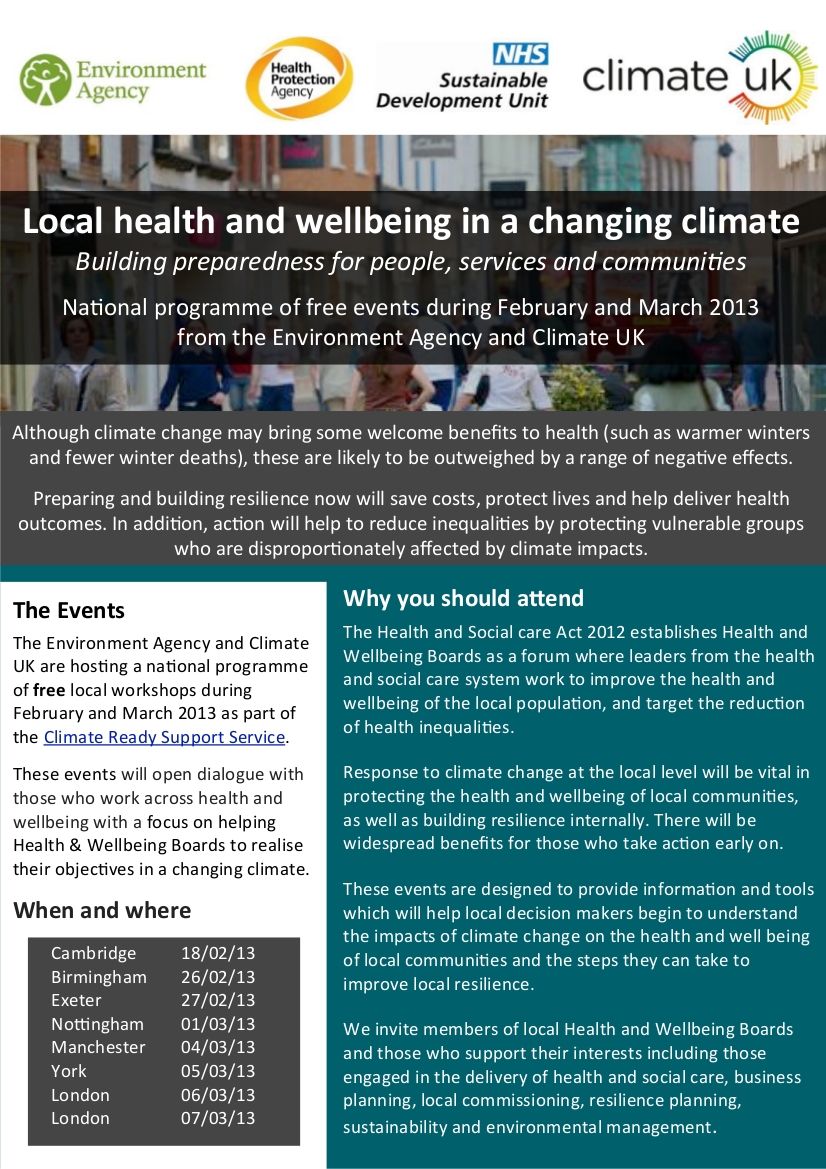
Tell your councillors! – Free workshop on “local health and well-being in a changing #climate.” #Manchester Mon 4th March

Free training, thanks to the Environment Agency and Climate UK. (All text below from here). You can find the members of Manchester City Council’s Health Scrutiny Committee here. If you are a Manchester resident and any of them is one of your councillors, please DO send them a personal email with link!)

HWBs_National_Flyer1The Environment Agency and Climate UK are hosting free local workshops to encourage integrated strategy-making on health and well-being. The events will help decision-makers understand the impacts of climate change on community health and well-being, leading to improvements in local resilience.

Anyone engaged in the delivery of health and social care, public health, business planning, local commissioning, resilience planning, sustainability and environmental management is welcome.

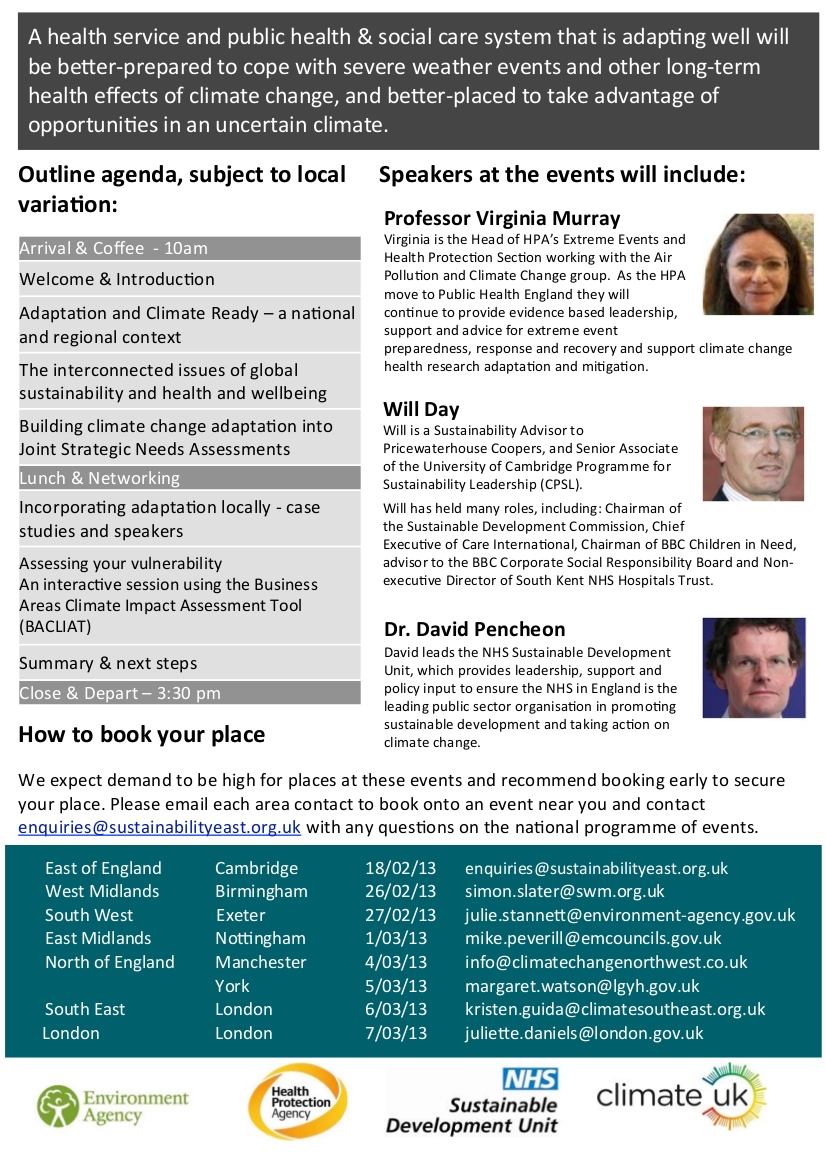
Why is adaptation important to the provision of health and wellbeing services?

HWBs_National_Flyer2A changing climate is expected to have significant impacts on human health and wellbeing. For example, the heatwave in 2003 resulted in 35,000 excess deaths across Europe and at least 2,000 premature deaths in the UK alone.

Climate change can also have indirect effects on the population:

  • flooding can seriously undermine the mental health of communities that are impacted or those that fear they may be in the future
  • the quality and quantity of the food supply chain can be impacted
  • high temperatures increase ozone and other pollutants in the air, aggravating cardiac and respiratory problems
  • pollen levels are frequently high during a heatwave aggravating allergy sufferers symptoms

The vulnerable groups in our society such as the elderly, young or chronically ill are likely to be worst affected by the impacts – caring for these groups must be factored into planning to meet future demand for health services.

Local service planning and design must take climate change evidence and impacts into consideration to ensure that our health infrastructure − hospitals, health care centres, and surgeries − are resilient to extreme events, maintaining business and service continuity.

Posted in Adaptation, Manchester City Council, Upcoming Events | Tagged , , | Leave a comment

PMT #7: Respond to #Manchester City Council’s budget “consultation”

You have until February 20th to reply to City Council’s request for public opinion on their proposed actions. While of course it is very important to save this library or that swimming pool from closure it’s also important

a) to realise that when councillors join in “save this…” or “save that…” campaigns they may well have tacit permission from the leadership, and that the decision has already been made to spare whatever-it-is. The result is that these “rebellious” back-benchers get to look powerful and the Council gets to look responsive. See Orwell’s “1984” for more info.

b) to keep a view on the big big picture – of the growth economy as a suicide machine for this species. Personally, the MCFly co-editors will be sending in versions of this model letter below from the Steady State Manchester group (of which they are both members).

Model Letter

Manchester residents have until 20th February to respond to the councils consultation to the proposed 2013-5 budget.  Below is a model letter for your councillor / response to consultation. Please do personalise it. You can respond via http://www.manchester.gov.uk/info/200024/consultations/5921/budget_consultation_2013-2015 

I/we welcome the opportunity to express my/our views about Manchester’s proposed spending plans.

I am concerned that the proposals emphasise the City’s priorities as strong and sustainable economic growth and growing our economy to create jobs.  The global economy is almost 5 times the size it was 50 years ago. Such growth has an unsustainable environmental cost and despite growth more than a quarter of children in Manchester live in severe poverty (the highest rate in the country). More than one in twenty working age adults is unemployed.  Yet it has now been demonstrated repeatedly that economic growth does not clearly bring benefits in terms of well-being.

Many of those with jobs are poorly paid, and rely on benefits to make ends meet. The price of energy and resources and the cost of living go up and up. This situation will worsen as climate and resource shocks batter the global and local economy alike so the city needs to emphasise economic, social and ecological resilience as cornerstones of its strategy.

The city now urgently needs a planned approach to a society where we can all live a good life, satisfied with enough, without seeking endless growth and accumulation, respecting the planetary limits: which takes seriously both the mitigation of climate change (through radically decreasing emissions) and adapting to the climate change that is already gathering.  This will mean a re-balancing and re-localising of the local economy.

I/we was/were very encouraged that the full council invited  Professor Kevin Anderson to address them on 30th January and by Sir Richard Leese’s powerful blog post “Apocalypse Now”, published the following day where he reports that Prof Anderson told the councillors that if we want to have any chance of keeping the rise between 2 and 4 degrees we have to act now. As Sir Richard says “… how much of a gamble do we want to take with our future and our children’s future?”. Please keep up the good work and start now.

There are citizens working on options for Manchester for a sustainable, more equitable future where all Manchester citizens live well.  Manchester led the way in the industrial revolution; I/we urge you to  now lead the way by introducing a steady state approach.  I/we recommend that Manchester City Council works to develop the ideas in Steady State Manchester’s report In Place of Growth: Practical steps to a Manchester where people thrive without harming the planet and their response to the budget consultation as a basis for strategic direction so Manchester can ensure all its citizens have a future, and can live well and equitably.
Yours    ,

pmtlogo

Posted in Democratic deficit, Manchester City Council, PMT, Steady State Manchester | Tagged , , | 2 Comments

Event Report: “Creativity, energy and climate change shared learning workshop” 8-9 Feb, #Manchester

Roger Griffiths writes about a wander through time and place during a recent “Climate and Creativity shared learning” event in Manchester.

A twenty minute walk along the Ashton Canal from Piccadilly Station takes you past several old mills.  These were an important part of the industrial revolution and a contribution of our present plight of global warming.  But at the end of this trail is one mill, part of which is dedicated to trying to prevent this crisis.

Bridge 5 Mill, in Ancoats, was converted some years ago into Manchester’s first Centre for Change.  It is a haven for green businesses, campaigning groups and charities and forms a meeting point for debates and action concerning sustainability.

In 1996 four people established MERCi  (Manchester Environmental Resource Centre Initiative) and over five years managed to raise over three million pounds from various sources, including Europe.  With volunteers and trainees the mill was refurbished and opened in 2001.

On Friday evening and all Saturday (8th and 9th Feb) a Creativity Workshop Course was run by ‘Action for Sustainable Living‘ (AfSL) [See comment #2 below for a clarification. Eds].  This is a charity based in Manchester dedicated to help and support people take action towards environmental sustainability.  It was lead by Jo Hamilton, from Oxford.  The main venue was large,  airy and friendly but there were little classrooms as well.  Much of the furnishings were probably second hand and it thankfully lacked the corporate style of a 1970’s futuristic film set.

Friday night was mainly given over to getting to know each other.  To my knowledge there were groups from the north-east Middlesbrough area, Oxford, Cardiff, Chester, Derbyshire and Manchester.  Some of these people were professionals working in the climate change ‘industry’.  They gave introductions as to what they would talk about on Saturday or descriptions of their type of art through which they expressed their ideas.  The most moving example for me during the weekend was from a Catalonian artist whose main interest concerned waste rather than recycling.  It was a short film of a sort of coconut shy.  Instead of the coconuts there was a pretty girl, in shorts and bikini top and instead of soft balls there was a pile of rubbish which people were throwing at the girl.  In the end she was covered in various fluids and scraps of rubbish and managing to dodge some of the heavier items.  It was quite disturbing.  I am sure you can work the meaning out for yourself.

On Saturday there was four workshops arranged, two in the morning and two after lunch.  In the morning the choice was ‘Visual Arts’ which I chose and down stairs a ‘Creative Writing and Poetry’ workshop.

Lois Muddiman from Low Carbon West Oxford showed us a video of one she had prepared earlier.  It was a Flash Mob.  Turn to Wikipedia :-

 A flash mob (or flashmob)is a group of people who assemble suddenly in a public place, perform an unusual and seemingly pointless act for a brief time, then quickly disperse, often for the purposes of entertainment, satire, and artistic expression. Flash mobs are organized via telecommunications, social media, or viral emails.’

We were asked to criticise it and say how it could be done better.  The conclusions were that there were too many distractions and it was too long and complicated.  Also that some of the people in it looked embarrassed and this could make their audience feel embarrassed and turn away.  It was suggested that an event should be well-rehearsed and also perhaps something like a dance, with a formal structure, would work better.  In the afternoon the workshops were ‘Communicating energy and climate change’ and Theatre and Music’ and how it can be used to engage and communicate energy.  This included radio plays, bird calls and bike repairing.  I must confess to being rather tired at this point and had lost the plot a little.  I was also a bit piqued and sulky because someone had criticised opera as being precious.

Walking back along the canal I reflected that this had been a lovely day with some very kind and interesting people.  I could not contribute much but if everyone took away as much as I did then we all benefited. I would like to thank  AfSL and especially  Jo Hamilton.

 Roger Griffiths

Posted in Event reports | Tagged | 3 Comments

#Manchester #Climate Steering Group: Democracy, accountability, promises unkept. An open letter to Steve Connor from banned climate activists..

Attention Mr Steve Connor, Chair of the Stakeholder Steering Group on Climate Change.

On March 17 2012 you promised attendees at the Stakeholder Conference on Climate Change that elections to the Steering Group would be held at the 2013 conference. You assured everyone that details of this would be announced in November 2012. That promise has not been kept.

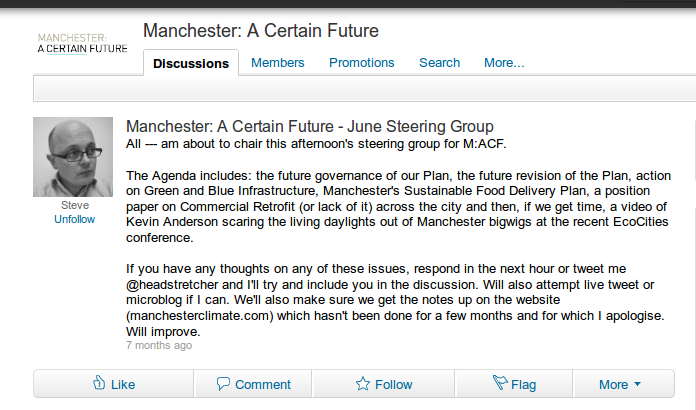
june26On June 26th 2012  you promised members of the Manchester A Certain Future “Linked In” group that you would start to post the notes of the Steering Group’s meetings.  That promise has not been kept. (1)

On January 7 2013 you promised to  post answers to questions about the [lack of appointed] chairs to the new “sub-groups” on the Steering Group. That promise has not been kept.

We really could go on, at great length.  But we have questions instead.

Given the track record above, and the established fact that your idea of media management is to hang up on journalists, we don’t really expect you to answer the following questions. But nonetheless, we think you should. Why? For the sake of whoever has the poisoned chalice of Steering Group chair after you. For the sake of all those Steering Group members whose credibility is damaged by what you have done (see above).  And, as citizens of a city that desperately needs courage and transparency in its climate preparations, we hope against hope that you will answer.

1) Has anyone else besides the two editors of Manchester Climate Monthly been banned (2) from attending the Stakeholder “conference” on Monday March 4th? What are the criteria for becoming an un-person anyway?

2) Why have we been banned?

3) What were the mechanics of this decision to ban us? Were you told by someone to do it? If so, who, and why?Or did you decide this entirely on your own? You certainly did not consult the entire 30 member Steering Group, which would have been the only even-vaguely democratic means by which we could have been excluded. You emailed us last Thursday several hours BEFORE the Steering Group met. Members we spoke to said they had not been consulted.
So, was it you alone or was it you and small coterie of like-minded people on the Steering Group? Who are these other people?

4) Will elections ever be held to the Steering Group?

5) Will its meetings ever be open to the public?

6) Will you ever release the minutes of its meetings?

The final question is rhetorical, so feel free to ignore it even more strenuously than you will doubtless ignore all the others;

7) Will the Steering Group ever actually DO anything?

yours “regretfully” and with “regards”

Marc Hudson and Arwa Aburawa
mcmonthly@gmail.com

Readers; Mr Connor has, as you can see above, a less than exemplary track record in responding to us. We hope you have more luck. His email is steve@creativeconcern.com. The phone number of Creative Concern is 0161 236 0600.

Footnotes

(1) People ask us why the minutes haven’t been released. We tell them that to get the official version they should ask you. But if we were forced to speculate we would say that the minutes would reveal that attendance at the meetings is poor, with many SG members simply turning up about once a year, and that the actions that get agreed at meetings never quite materialise. A bit like the Environment Commission, the Environmental Strategy Programme Board and the many other keep-the-bureaucrats-busy farragos that infest this city. When we tried to ask you about the minutes, you hung up on us.

(2) Yes, banned. We have not been put on a waiting list. We have been told we are not welcome. And we suspect that if we took up the offer that several people have made since reading our post – of using their tickets – we would be denied entry by security.

Posted in Democratic deficit | Tagged , , | 4 Comments