Mersey Valley’s Warden Service Facing The Axe?

Chair of ‘Friends of Chorlton Meadows’, Dave Bishop, got in touch with us about his concerns over the discontinuation of the Mersey Valley Countryside Warden Service and its implications for the valley’s wildlife. He wrote to his councillors (see below) and it appears that a decision to cut this service in April looks likely. However, the council states that no final decision has yet been made and a four week consultation will take place. Read on to find out what you can do to help.

Dear  Councillors,

I keep hearing rumours to the effect that the Mersey Valley Countryside
Warden Service is to be disbanded. Are these rumours  true, or not? If the
rumours are true, are Friends groups, like the Friends of Chorlton Meadows,
who have devoted hundreds of hours of their free time  to the Mersey Valley,
going to be properly informed and consulted – or are we just going to have
to rely on rumours?

Yours sincerely,
David  Bishop, Chair of FoCM

———————————————————————————————————-

So far I have had the following reply from Cllr Victor Chamberlain:

“I understand that the City Council’s  budget proposals mean that the
service will close down in April. A cut of  £150,000 from MCC along with
Trafford’s lack of a payment commitment mean  that the service is unlikely to
survive. It’s really poor that you  haven’t received any information about this so I
will ask the Council how  they plan to engage Friends Groups in the
proposals and the  future.”

He  subsequently wrote:
“I  understand that the meeting was very sombre and that members accepted
the  budget cut. Some Councillors argued that Trafford Council’s decision to
cut funding last December encouraged Manchester to do the same. Apparently
there is going to be a consultation which opens from today however the
service is  likely to be run down between now and the end of  March.”

Councillor Sheila Newman, Labour Member for the Chorlton Ward added:

“The proposals re the Mersey Valley  Warden service are part of the Council budget, which was agreed for a four week consultation at the Executive Committee meeting on Wednesday 23rd January.  All comments on the proposals are welcome and you can respond on line. As a local councillor, I am also keen to hear the views of local residents. The Mersey Valley is a valued part of Manchester and Chorlton and I do not wish to see a reduction in service or maintenance. Many of the wardens are proposing to take VER or VS and this will greatly impact on the service provided.  

“However as you know the Mersey Valley warden service  has been jointly funded by Trafford and Manchester. As Trafford have reduced and now withdrawn their funding, it isn’t possible for Manchester to continue with the same level of funding, given we are faced with £80million budget cuts imposed by the government.Many of the proposed reductions in the budget are  not things we would choose to do, but we have to work within the budget available. No final decisions have yet been taken and there may be amendments to the budget up until mid February.”

———————————————————————————————————-

Dave Bishop: So, the Mersey Valley project appears to be dead and the fate of a well-loved piece of local green space hangs in the balance. As a long-term user of this  green space myself I am saddened and angry. I might also ask: What is the  point of a consultation when the decision already appears to have been made?

As  you are a Mersey Valley user, I’m sure that you will share my concerns,
so  please, please, please take some time to express those concerns by
e-mailing Councillor Rosa Battle, Executive Member for Culture & Leisure (cllr.r.battle@manchester.gov.uk )

Questions  that you might like to ask Cllr Battle could  include:
– What are the implications of the disbanding of the Mersey Valley Countryside  Warden Service for the future of the Mersey Valley?
–  How does the Council intend to maintain sites like Chorlton Ees/Ivy Green and  Chorlton Water Park in the future?
– How does the Council plan to protect these sites from vandalism and other forms  of damage?
– How does the Council plan to protect Mersey Valley wildlife?
– Have the Council have any plans for selling off any Mersey Valley sites?

It  would probably be a good idea to copy your ward councillors in on this
correspondence; you can find your ward councillors here.

It  is absolutely essential to keep your message polite!

Please feel free to circulate this e-mail to as many people as  possible.
Let’s show the Council that we love the Mersey Valley and that we don’t intend to lose it!!

Dave Bishop,
Chair of FoCM

Posted in Democratic deficit, Green spaces | Tagged , , , | 5 Comments

“Lobbying #Manchester council about #climate. MCFly reader shows the way.

We are rather impressed with the email (see below) a MCFly reader sent to his councillors asking them to attend a council meeting to hear climate scientist Kevin Anderson speak. Why not send your councillor the same and ask them to sign the pledge to ‘do more on climate change’? You can find out who your councillors are here.

Dear Councillors Razaq, Stogia and Watson,

Next Wednesday 30th January at 10 am Professor Kevin Anderson from the
University of Manchester will talk to the full Council about climate change
in the Great Hall.  I know you’re very busy but I hope you can be there,
and that if you have any questions for him, you ask them. He’s genuinely a
world expert and the Tyndall Centre http://www.tyndall.ac.uk he’s part of is one
reason we can be proud of Manchester as a “knowledge capital”.

Climate change is an issue we may all regret not having taken more action
on. It’s affecting vulnerable people here and now in Manchester through
food and energy prices. We’re also likely to see more “environmental”
migrants displaced by conflict fed by long-term drought and other climate
change. It’s not just about what may happen to people far away and in the
future. The good news is there has already been action to make Manchester
more resilient: independent moves like Steady State Manchester and the Council has made some good plans as well.
Those plans need a bit of a “push” to make them into reality.
I hope to get along to one of your surgeries soon to talk with you about
this. There are some basic things our elected representatives can do on the
issue:

1. learn more about climate change and its impacts on Manchester and the
wider world;
2. take a greater role in turning the Manchester Climate Change Action
Plan (2009) into reality;
3. raise the issue in Scrutiny Committees to look at Manchester’s
response and vulnerabilities, especially as they affect the poorest and
most vulnerable;
4. investigate what can be done at ward level to ensure that the most
vulnerable people and habitats are protected against the impacts of climate
change, and to make the findings public.

Manchester’s domination by Labour only looks like increasing at the next
election. I know some view this with anxiety as it could mean our elected
representatives feel complacent. I don’t see it like that. I see it as an
opportunity to take some radical steps to tackle climate change as far as
that is possible locally. Climate change is also a chance to get some real cross party consensus and progress. There is a host of issues crying out for action based on a longer view: transport, housing, waste, power (GM Fair Energy is good first step) etc.

No one has all the answers. It’s something we’re
going to have to work out as we go along. That’s why it’s important to
start locally, finding practical approaches. It takes some bravery from
politicians/leaders to acknowledge they don’t have all the answers and that
it is probable that standards of living, as currently defined, are likely
to decline. Labour’s domination of Manchester takes away some of the
short-termism of most political balances of power and leaves the way open
for politicians to actually lead, setting out why the City should take
radical steps. It’s a chance to recapture some of Manchester’s forward
thinking leadership in the nineteenth century that brought so many
improvements locally and then nationally.

In the meantime Kevin Anderson himself may not have all the answers but he
knows most of the questions to ask and can help us assemble the facts on
which to make some good decisions. I look forward to seeing you on
Wednesday.
All the best,

[MCFly reader]

Posted in inspire, Manchester City Council | Tagged , | Leave a comment

Something for the Weekend 25 January 2013 #Manchester #Climate

To kickstart your weekend, a bad joke:

  • What do you call an 800 pound gorilla?
  • Anything he wants to be called.

And this weekend, the only eco event we know of is:

Friday 25th 11-6.30pm  “Friends Meeting House OPEN DAY
“You probably know that we’ve in the midst of some major changes here at the Friends Meeting House in Central Manchester.  The end of the building work is now in sight… and it’s looking great! In a few weeks’ time we’ll have some fantastic new meeting rooms, a much more accessible building, and a much more sustainable and eco-friendly one too. We’d love to show you what we’ve done, and our fabulous new facilities …  so we’re holding an open day.  Friday 25th January 2013 …pop in any time between 11am and 6.30pm.  We’ll ply you with tea and cake, and our team will be available to chat and show you round.”

Sat 26th, 12noon – onwards

Campaign against Climate Change Trade Union Group national meeting. The venue is the Methodist Central Hall, Oldham Street which is 10 minutes walk from Manchester Piccadilly Rail Station.

Posted in Something for the Weekend | Leave a comment

URGENT REQUEST: MCFly readers to publicise/attend #climate meeting on Weds Jan 30, and lobby #Manchester councillors before and after

You can help create change in Manchester.  Next Wednesday, Professor Kevin Anderson will be speaking to the full Council Meeting  of Manchester City Council (10am, Great Hall, Manchester Town Hall).  This hasn’t happened before, and may not happen again.  Councillors are very very busy people, and many of them probably know less about climate change than you do.  This meeting could be a really big eye-opener for them.  The councillors need support and encouragement to “get” climate change and its impacts on Manchester.  That’s where YOU come in.  It’s not glamorous, it’s not an adrenaline rush. But it is essential.*

menletterjan252013you can a) attend the event – it’s free, open to the public. There’s a facebook “event” here

b) whether you attend or not, you can help make this event more influential.  How?

1)) tell your friends and family about it. Send them this blog post, talk to them.  Make sure that you and they-

b) lobby your local councillors.

If you don’t live in Manchester City Council area, then ask your council why IT isn’t having a climate scientist along to address full council. It’s a really good idea (from, it pains us to admit, Sir Richard Leese) and every other Greater Manchester council should do it as soon as possible.

If you DO live in Manchester City Council area, then contact one or more (you have three!) of your councillors.   You can find who they are and how you can contact them via this page of the Manchester City Council website (just enter your postcode in the yellow search box at the top right)

Here’s a suggested letter (but make up your own!) The crucial thing is to start a relationship, a dialogue with them about this.

Dear [x]

next week at Full Council Professor Kevin Anderson of the University of Manchester is going to be giving a talk about climate change.  I hope that you will be at full council, and  that if you have any questions for him, you ask them.

I appreciate that you are very busy, but climate change is one of those issues we will regret not having taken more action on.  It is already hitting the more vulnerable people in Manchester. As food prices and energy prices go up and up, it will hurt your most vulnerable constituents more.  The good news is that there are some good plans for making Manchester more resilient and resourceful. Those plans need a bit of a “push” to make them into reality.

I hope to get along to one of your surgeries soon to talk with you in person about this.  I will want to ask you if you are willing to take the following pledge –

1) I pledge to learn more about climate change and its impacts on Manchester and the greater world

2) I pledge to take a greater role in turning the Manchester Climate Change Action Plan (2009) into reality

3) I pledge to raise the issue in the Scrutiny Committee(s) that I sit on, and make sure the committee(s) examine Manchester’s response and vulnerabilities, especially as they affect the poorest and most vulnerable among us.

4) I pledge to investigate what can be done in my own ward to ensure that the most vulnerable people and habitats are protected against the impacts of climate change, and to make public the findings of my investigations.

Thanks in advance…

[your name]

c) Help Manchester Climate Monthly report this event.  If you go, take notes, tweet it, take photos.  Send us suggestions on how to spread the word further.

Marc Hudson
mcmonthly@gmail.com

Footnotes

(1)  We here at MCFly know everyone is busy.  We know that climate change is a confusing and scary topic.  We rarely deploy emotional blackmail.  This occasion is too important, has too much potential for us not to.  Consider yourselves emotionally blackmailed into doing this! Thank you.

Posted in Manchester City Council, Upcoming Events | Tagged | Leave a comment

Newsflash: Professor Kevin Anderson scheduled to address #Manchester City Council on #climate change, Weds 30th Jan

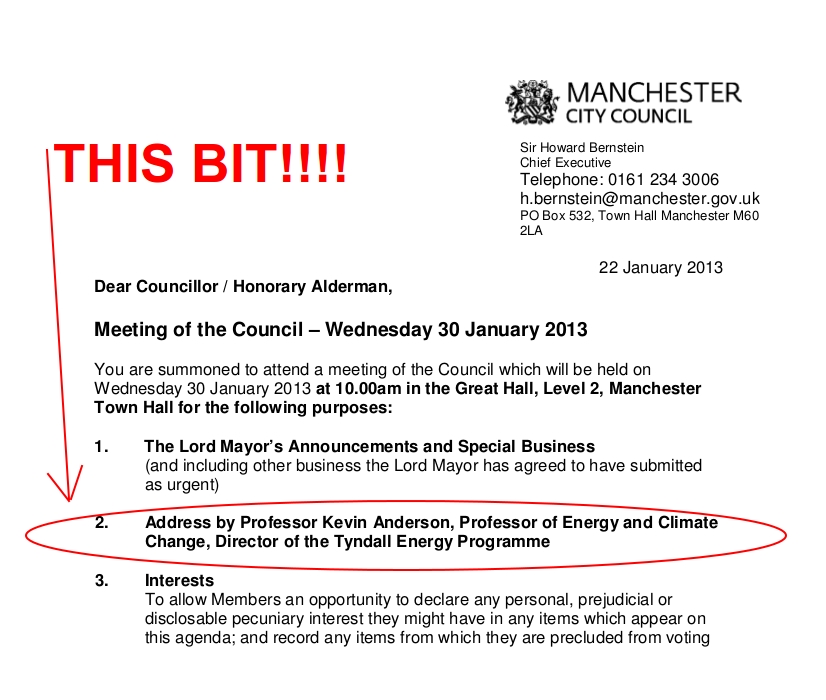
Climate expert Professor Kevin Anderson (1) will address the elected members of Manchester City Council at a meeting next Wednesday, 30th of January.

According to the agenda (see below), Professor Anderson will be speaking in the Great Hall of Manchester Town Hall, shortly after 10am.

kevinandersonspeaks

MCFly will confirm these with the Council and Professor Anderson tomorrow (a previous attempt to hold the talk was postponed). This address is a tremendous opportunity for climate activists in Manchester to engage constructively with their elected representatives on the crucial issue of the twenty-first century. Professor Anderson is a very accomplished public speaker, with the facts at his fingertips and the willingness to tell unpalatable truths.

More to follow.

Marc Hudson
mcmonthly@gmail.com

(1) From here: “Kevin Anderson is professor of energy and climate change in the School of Mechanical, Aeronautical and Civil Engineering at the University of Manchester. He has recently finished a two-year position as director of the Tyndall Centre, the UK’s leading academic climate change research organisation, during which time he held a joint post with the University of East Anglia.

Returning full time to Manchester, Kevin now leads Tyndall Manchester’s energy and climate change research programme and is deputy director of the Tyndall Centre. He is research active with recent publications in Royal Society journals, Nature and Energy Policy, and engages widely across all tiers of government.

Kevin’s research interests include: understanding the implications of rising emissions and the latest climate science for mitigation and adaptation policy; analysing opportunities for rapid decarbonisation of the UK’s energy system; and quantifying the role of international transport (aviation and shipping) in a low-carbon society.

With his colleague Alice Bows, Kevin’s work on carbon budgets has been pivotal in revealing the widening gulf between political rhetoric on climate change and the reality of rapidly escalating emissions. His work makes clear that there is now little to no chance of maintaining the rise in global mean surface temperature at below 2C, despite repeated high-level statements to the contrary. Moreover, Kevin’s research demonstrates how avoiding even a 4C rise demands a radical reframing of both the climate change agenda and the economic characterisation of contemporary society.

Kevin has a decade’s industrial experience, principally in the petrochemical industry. He sits as commissioner on the Welsh Governments climate change commission and is a director of Greenstone Carbon Management – a London-based company providing emission-related advice to private and public sector organisations. ”

You can read a June 2012 interview MCFly conducted with him here.

Posted in Manchester City Council, Upcoming Events | Tagged , | Leave a comment

Upcoming Event: “Introduction to Food Foraging” Thurs 7th Feb, #Manchester Art Gallery, £6

This event (book here) at Manchester Art Gallery, looks interesting!

Introduction to Food Foraging

Thursday 7th February 2013

Demonstration and Talk by wild food expert Jesper Launder

6.00-8.00pm The Restaurant 

 It’s hard to imagine that winter and wild food might go hand in hand, however wild food expert, Jesper Launder, challenges you to re-think this assumption.

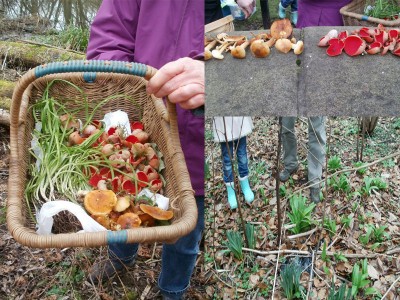
Jesper will introduce you to some wonderfully edible and visually satisfying seasonal wild food delights.  From tasty young plant shoots, to edible roots, to health-giving gourmet wild mushrooms, this workshop offers an opening into the fascinating world of ‘food for free’.

A collaboration with Cracking Good Food http://www.crackinggoodfood.org 

Part of a special evening for Dickens’ 201st birthday, that links with ‘The Walk to Dover’ by Turner Prize nominee, Spartacus Chetwynd, a contemporary art intervention in our 19th Century Galleries, inspired by Dicken’s novel David Copperfield.  During Copperfield’s walk to Dover to find his aunt,  he survived by foraging for food.  This has prompted us to think about what foraging means today.

There will be other Copperfield related activities taking place over the course of the evening from 6pm. Plus wild food related items on our Cafe menu.

If you have any difficulties booking tickets through this site please ring 0161 235 8822 or 234 8859 or 7983 481 886 or email e.anderson@manchester.gov.uk or c.witham@manchester.gov.uk


Posted in Food, Upcoming Events | Tagged | 1 Comment

PMT #4: Tell us your experiences of meetings, positive and negative… for #Manchester #climate #movement-building

webMCFlyWe want to hear from you!  We hope you will share your experiences of meetings(1); things that went well or poorly, things that happened that inspired or demoralised you.  Please add your comments under this post (not on facebook!), or else email us at mcmonthly@gmail.com

If you are feeling particularly adventurous and helpful, why not ask your “non-climate” friends for their perceptions of what happens at meetings put on by environmentalists!

What are we going to do with all this information? Well, from the next issue of Manchester Climate Monthly (published on Monday 4th Feb) onwards, we are going to have a page of people’s thoughts on issues around “movement-building”. Topics will include – well, if you’re interested, scroll down for some examples!

PS. PMT #3 – success! Thanks to all who have helped so far!

pmtlogo

(1) We are leaving that word ambiguous. It might be a big public meeting, or an “organising” meeting of a group. It does not have to be a “climate” or “environment” meeting, or one that happened in Manchester, or even in the UK. Or even in this millennium. Open season!!

Probable order of questions.
Jan – What are people’s experiences of meetings? (especially new people)
Feb – How do we maintain morale so that people who are already “in” the movement don’t drift away/leave in despair?
March – How do we get more people (especially ones who don’t look like us; white, middle-class, child-free) involved in the “climate movement”?
April – How do we attract back people who were involved but have become burnt out,/
disenchanted/engaged in other things.
May – What are the particular difficulties groups trying to tackle “climate change” face?
June – What do people need (skills, knowledge, other stuff) in order to stay involved in the “climate movement”?
July – What lessons can we learn from other movements (local or elsewhere, present or past)
August – How do we make sure we learn and share (the right lessons) from our successes and failures?

Posted in PMT | Tagged , | 3 Comments

“If a tree falls in a park”; Alexandra Park, #Manchester City Council and changes – political, cultural & #climate

The Save Alexandra Park Trees group has sent out this press release:

Residents of Whalley Range horrified as Manchester City Council arrive today with chainsaws to fell up to 400 trees as part of the Alexandra Park Development.

Residents have been writing and challenging the Council since the extent of felling became known in December 2012.  Residents met with the Council in late December to raise their concerns and draw attention to a petition of now over 2000 signatures objecting to the felling.  Despite this MCC appear to be intent on progressing with the plans.

Residents are gathering in the park today to challenge the council and plead for a delay in fellings until a better solution can be found.

For further information:

Resident contact in the Park: Ian 07757639668

Website http://savealexandraparkstrees.wordpress.com/ with link to petition (over 2000 signatures) and videos

Fellings from yesterday:
http://savealexandraparkstrees.wordpress.com/2013/01/21/cherrytree-avenue-felled-21-jan-2013/

or see videos on
http://www.youtube.com/user/Environment4all?feature=watch

http://www.youtube.com/watch?v=3hRrzTd8lSU  part 1 film of locals
http://www.youtube.com/watch?v=Qo-r5sIh6h4  part 2 film of locals


MCFly says:
Both MCFly co-editors use Alexandra Park regularly. It’s a beautiful space. It’s a Good Thing that money has been found to do renovations. What’s not so good is that there are strings attached. Because these strings mean trees have to come down, the Council seems not only uninterested in dialogue/explaining itself, but actively resistant to the notion of transparency, consultation and citizen engagement (above and beyond its normal levels!).

This is what you get with bureaucracies, especially in Britain, one of the most secretive countries in the world. Sometimes, when there are competing political factions, then the factions leak selectively against each other, and important information gets out. In Manchester – not so much. Eighty-six of the 96 councillors are Labour. Next year that will, barring a miracle (and the Germans have outlawed miracles), go up to 96. As in, 100%. The technical term is “one-party state”…

But even one-party states have politics; they are just harder to see. The protestors who are currently so (understandably) upset at what is being done in Alexandra Park will, we hope, stay involved in the important job of trying to prise open the Council, long after the trees they care about are gone.

It is only bottom-up relentless and growing pressure that can force change upon the complacent and often contemptuous political culture of this city. That pressure will involve lobbying of individual councillors, attendance at Scrutiny Committees, full Council and Executive, Freedom of Information Act requests, public meetings, letters to the “news”papers, petitions and a host of other tactics. Not all of these actions are easy, not all of them successful, not all of them result in raised status within the activist sub-culture. But they will all have to be done.

Posted in Biodiversity, Democratic deficit, Manchester City Council | Tagged | 1 Comment

Manchester’s Climate Vulnerable – An Interview with Atiha Chaudry

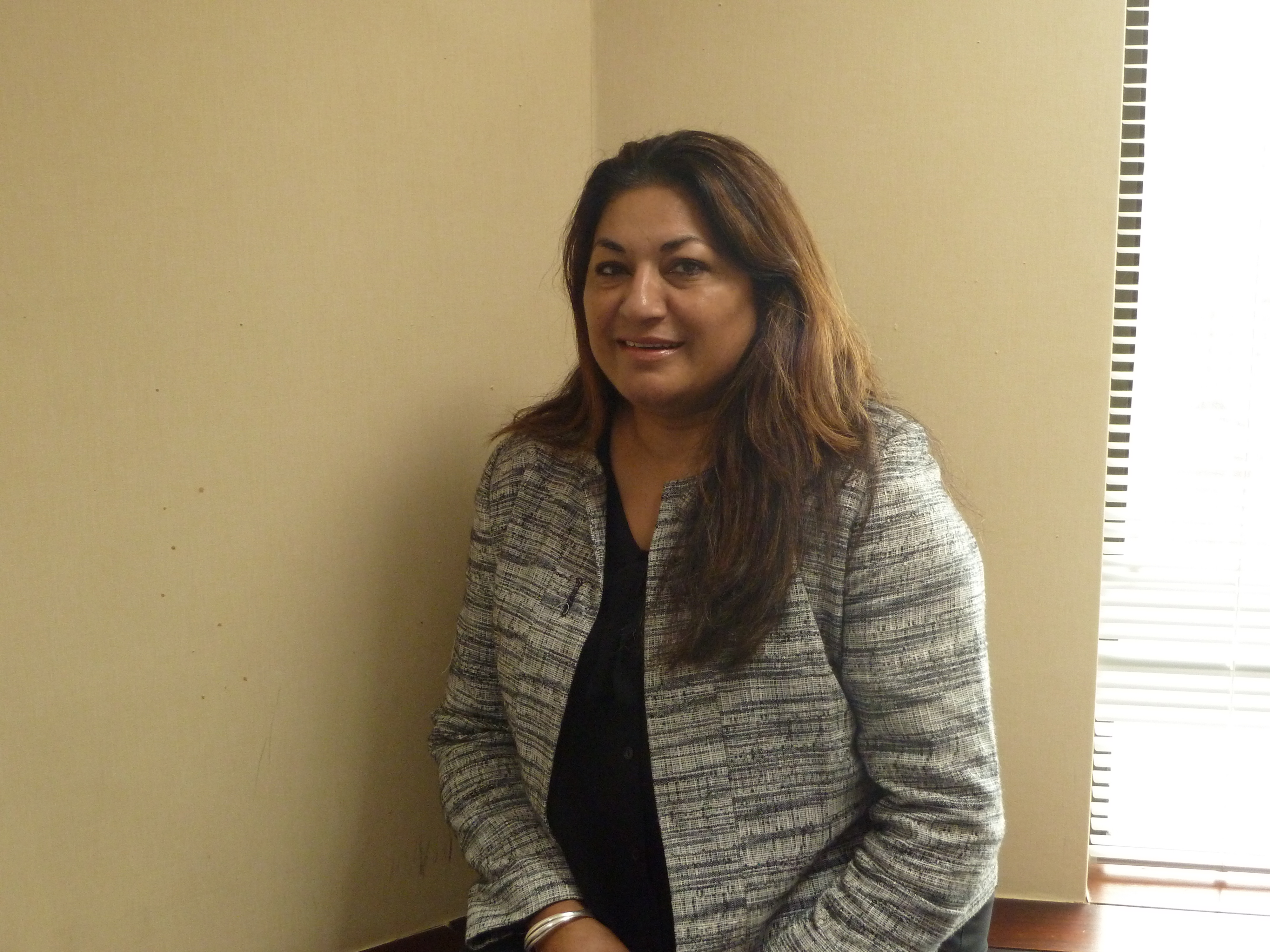
P1000904Whilst it’s easy to think that all those people ‘really vulnerable’ to climate change live in far away places, the truth is they don’t. They live in cities great and small all over the world. And there are some living right here in Manchester. Who are they? Well, there are the marginalised, the socially, economically and politically vulnerable. They are our old, our BME, our asylum seekers and refugees and whilst our climate keeps changing, we ought to figure out a way to protect them.

Last year, the Manchester BME Network got £15,000 from Defra to do exactly that. They were tasked with “mapping the needs of BME, older people and refugee and asylum communities to better understand their needs and concerns about the impact of a changing change.” The project also wanted to find the gaps and consider how these might be addressed. The project is led by Muslim Communities UK (MC-UK) with direct support from Manchester BME Network (MBMEN), Salford Refugee Forum and Creative Hands Foundation. The partners interviewed 100 people and held four focus groups.

Ahead of the final report which will be released next week, MCFly caught up with Atiha Chaudry, from MBMEN, to talk about their findings and what happens next.

Could you tell us a little about the Manchester BME network and the work it does?

The MBMEN is a well established network supporting BME groups and organisations in Manchester. It holds regular networking meetings addressing key issues relevant to the BME sector and brings together a diverse range of groups, individuals and local stakeholders to meet and share knowledge and experience. The Network delivers a range of projects and currently is involved in the following: a partnership with Fareshare to address the issue of food redistribution and meet the needs of those in most need; climate change and its impact on the BME sector; safeguarding and supplementary schools; sexual health and BME women.

You mention that the network has been involved in climate change before. Could you tell us what form the project took and why you were keen to tackle this issue?

We were invited by NCVO a year ago to work with them on a pilot project in Greater Manchester which would look at working with a cohort of 20 BME groups. We brought together these groups and sat on the steering group for delivering this project . It involved 3 workshops to build knowledge and understanding of climate change, disseminate this to others the groups work with and build a better awareness in the local communities.This was really successful and lead to the success of the bid to Defra for a £15,000 grant for further work gathering evidence of need and developing solutions. The NCVO work will be presented at a national conference where we will have the opportunity to share our experience and influence the national strategy.

Why do you feel it’s important to explore the climate change and BME link now?

Because, many BME communities need more awareness and connection to local strategies so that the particular concerns of BME communities are taken on board. BME communities also have an added issue about the impacts of climate change to their friends and family in their country of origin as well as the overall impact of this on wider issues (eg foods they are used to eating from their countries of heritage).

What do you hope to do with these findings and the information that emerges from your research?

We hope to produce a toolkit that addresses the concerns people share with us so that it can provide advice and support. We are also holding a conference at the end of the project (end of March) to share our findings, engage the strategic and wider sector, influence local work and national strategy and look at ways to continue the work we have started.

Is the funding for research only or will some be available to implement some findings?

It’s for research only but we are hopeful that through engaging local stakeholders we can continue the work.

Posted in Adaptation | Tagged , , , | 1 Comment

Newsflash: @SirRichardLeese answers questions on #Manchester #climate #adaptation

Sir Richard Leese, Leader of Manchester City Council, has broken his silence on the question of climate adaptation. In an email to a MCFly reader, he has stated that the newly-created Local Nature Partnership will make the difference between earlier inertia (our words, not his) and future action on climate adaptation in Manchester. The full letter can be seen at the foot of this blog post.

Every Wednesday we ask MCFly readers to perform a “Practical MCFly Task” (PMT). Last Wednesday, the task was to contact Sir Richard Leese and ask him to answer questions that had been put on his blog by a MCFly co-editor and left unanswered for several days. (See here). Those questions related to the (lack of) action around adaptation since the Ecocities launch last May, and what exactly would be different “going forward.”

This afternoon, the answer below arrived. To be fair (1), a few days delay in reply to the PMT-inspired letter is to be expected, given the fact that Manchester City Council is having to announce and explain a further horrendous round of budget cuts.

The lesson here is that if enough people ask (and it doesn’t have to be a huge number), answers can be forthcoming. The next PMT is announced on Wednesday (every week of the year, MCFly will be giving you PMT). Watch this space.

Now, that letter…

Dear [MCFly reader]

Two way yes but if you look at the history, not Q and A.

In response to the report “Future Ways of Working”, presented to the Hub Board on 6th December, the Board noted the key deliverable activities within the GM Environment Team Business Plan and that good progress had been made in delivering against them.

It was noted that Manchester City Council has launched the Carbon Literacy project across Manchester, though this of course is not strictly true as it is the Cooler and the wider partnership, including MCC, did the launch. It is proposed that the roll out beyond the City’s boundaries would be carried forward to the 2013/14 business planning period.

In relation to the work on Eco-cities, the report was accurate in that the GM Environment Team has not progressed the actions from the Ecocities launch as much as they would have wished, as this activity was subject to the attenuation of additional funding. However, I can advise you that the AGMA Planning and Housing Commission has been undertaking some work to evidence and prioritise climate change risks in Greater Manchester since November. This project will generate a better understanding of Greater Manchester’s priority climate change risks. In addition, the GM Environment Team have recently (January 2013) been successful in attracting £10k of funding from Defra to investigate eco-system services `pinch points’ across Greater Manchester. These two pieces of work have been designed to build upon the results of the previous Eco-cities research and complement each other.

The difference, going forward, is that GM has now established a Local Nature Partnership (LNP)which will report to the Low Carbon Hub Board. The LNP has a remit to develop the natural capital of Greater Manchester, which includes climate change adaptation of GM’s green and blue infrastructure. The LNP has oversight of these two pieces of research and, once complete, will advise the Hub Board on appropriate next steps.You are correct that the Public sector is having to deal with significant funding cuts. Part of the rationale for establishing the Low Carbon Hub is to build a stronger delivery partnership with the private and voluntary sectors across GM, not just to achieve our 48% carbon reduction target, but also to prepare Greater Manchester for the likely changes in climate that are now inevitable.

Richard Leese

Footnotes
(1) We are, frequently.

Posted in Adaptation, AGMA | Tagged , , , , | Leave a comment