Repost: “Prof Kevin Anderson’s ‘real talk’ on #climate change” #Manchester #mcc @CllrSuzanne

Cllr Suzanne Richards (Labour, Longsight) has blogged about Professor Kevin Anderson’s presentation to full council.  We republish the blog (from here) in full.  Please note the site’s disclaimer – “All posts are made in a strictly personal capacity and do not reflect Labour Party policy or Council policy (except where they do!).”

The whole Council sat in silence on Wednesday morning listening to the grim reality of how Climate Change will impact on our city and the rest of the world if political leaders continue on their current path. As Councillor Fletcher-Hackwood would say it was ‘real talk’. Real talk of the starkest and most depressing kind. The figure that really shocked me was that 1% of the world’s population are responsible for 50% of the worlds CO2 emissions. That 1% is probably you or me. If you have taken a flight on holiday in the last year it’s definitely you. If you earn over £30k it’s definitely you. But that figure is also where the hope in Prof Anderson’s real talk is. Figures show that making changes to the supply side of energy production won’t have an impact on reducing CO2 emissions fast enough to keep climate change temperature rises below 2°C (the point at which beyond it is now widely accepted the consequences would be devastating to the world). But on the demand side small changes can make a huge impact in terms of emissions. Basically it’s down to us. Deciding to put a jumper on rather than turn the heating on an hour early. Buying the A++ rated fridge rather than the A rated one. Small changes to our lifestyles can make a big difference. If we as individuals can make such a difference how Manchester City Council acts can make a phenomenal difference. That is why we have the Manchester: A Certain Future Action Plan. In June 2012 we held a mini-Conference in the Economy Scrutiny Committee on Manchester’s economy in the context of sustainability. We came up with a number of recommendations but I think a number of us as Councillors would have liked to have gone further and been more ambitious in our recommendations. In light of Prof Anderson’s talk this week I wouldn’t be surprised if we re-visit our discussion on steady state economics very soon! Watch this space.

Posted in Manchester City Council | Tagged , | 4 Comments

Upcoming Event(s): Free films about the End of the World! #Manchester, Mon Feb 25th #SoylentGreen, #food #acertainfuture

What do academics, climate activists and a pub landlord have in common? They’ve all joined forces to put on a free season of films (1) , around the theme of the end of the world.

On Monday 25th February Mancunians will come together to watch the classic 1970s film “Soylent Green”, starring the late great Charlton Heston. Following the film they will discuss its relevance to Manchester’s future while drinking beer and wine at the Sandbar on Grosvenor St (2).

soylentgreenMarc Hudson, co-editor of Manchester Climate Monthly said “Soylent Green is a brilliant and highly entertaining film. No, wait, all the films being screened are brilliant and entertaining – but they also raise important issues…” It’s really important that concerned Mancunians can find like-minded people to think and act on climate change. This film season is one way people can do that.”

The film series, called “Climates of hope of despair,” continues for the following two Mondays (4th and 11th March) with two more films – “The Day the Earth Caught Fire” and “Mindwalk.”

Inevitably, there is a facebook event

More info

(1) The film festival is co-hosted by two organisations.

Trauma is a free film screening group based at Manchester Metropolitan University. Films are shown every Monday during term time, with seasons lasting three to four weeks. Trauma also occasionally collaborate with other groups to screen one-off films and mini seasons. http://www.hssr.mmu.ac.uk/trauma/

Manchester Climate Monthly is a free and independent publication that aims to “inform, inspire and connect” people in Manchester who are taking action on climate change. http://www.manchesterclimatemonthly.net

(2) Mon 25th February from 6pm at the John Dalton Building. Given the fact that it’s hard to find, we will be meeting at 5.50pm at the statue outside and then going together the specific room – E22 E-145

(3) The Sandbar is a hotspot for Manchester culture. Carved out of a couple of ramshackle Georgian terraced houses, Sandbar opened in 1996 and quickly established itself as a favourite watering hole for students, academics and local people who enjoy speciality beers and friendly conversation in this intimate, independent local. 120 Grosvenor Street, Manchester M1 7HL

PS If this looks like a cut and paste of a press release, that’s because… it is. One what I wrote, so that’s alright then…. MH

Posted in Upcoming Events | Tagged | 1 Comment

#Manchester Scrutiny Committees, #climate and #elephantsintheroom

Stop right there.  Have you had your dose of PMT this week? If not, you should.  Click here, then come back.  This post will still be here once you’ve done your Civic Duty.

Right – next week there are five scrutiny committee meetings. They all happen at Manchester Town Hall.  Climate change is not on any of the agendas (but, we’re reliably informed, it may get some important mentions).  Below please find a graphic – hopefully a self-explanatory one.  The good news is, MCFly has some dead-keen graphic designers and illustrators, so in future the image will be easier on the eye…

Documents-page001

Posted in Democratic deficit, Manchester City Council | Tagged | 6 Comments

Science speaks to democracy on #climate, or, “Manchester’s climate Wake Up Call” #manchester #mcc #acertainfuture

2013-01-29 11.30.41
Climate scientist Kevin Anderson talks to Manchester’s full council about turning climate rhetoric into reality, steady state and why it’s too late in the day to be pinning our hopes on technologies 

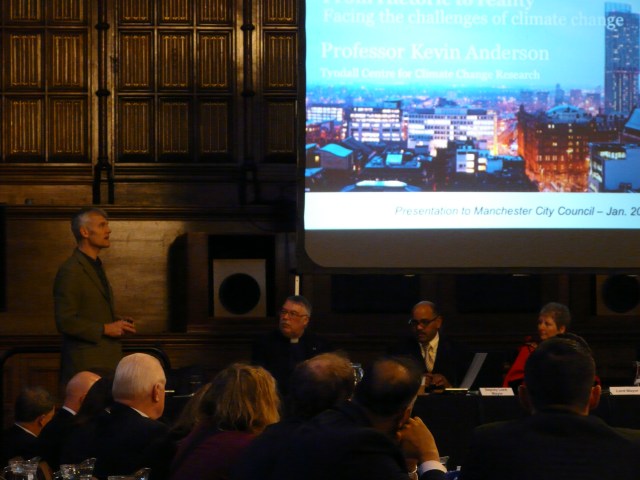
Weds Jan 30: Kevin Anderson, professor of energy and climate change at Manchester University, was invited to give a 30 minute presentation to Manchester’s full council meeting today. The great hall was packed out with 90+ councillors and over 35 members of the public. Here’s what happened next…

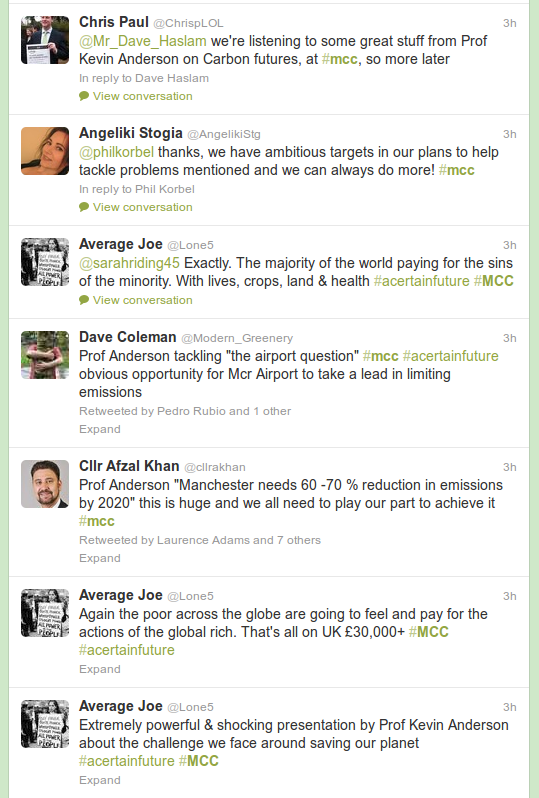
screenshotmcc1As usual, Professor Kevin Anderson delivered a no-nonsense presentation about what the science is telling us about climate change – that it’s coming faster and harder than even scientists thought – and what we are doing to stop it (very little basically). In fact, we are producing more carbon every year. Anderson kicked off by saying that whilst a 2 degree rise in global temperature was seen as acceptable twenty years ago, the latest research shows that it’s actually more dangerous than previously thought. And yet we continue to pump carbon into the atmosphere. Leaders fly into agree carbon cuts at climate summits and yet our emissions climb steadily upward. Globally, emissions are rising by 3% every year and every decision that we make now will ultimately decide our fate.

screenshotmcc2“We can’t do enough to stop these rising emissions with just supply technologies,” explains Anderson who is Deputy Director of the Tyndall Centre for Climate Change Research. “The only way you can change this is by changing demand [for resources] and behaviours now. We can’t wait for technologies in 2030, we have to focus on what we can do right now.” If targets set by the council in their climate plans ‘Manchester – A Certain Future are delivered, then that would put Manchester on the right path he added.

However, Anderson states that the council needs to be more ambitious. They need to cut CO2 by 60-70% by 2020 and 90% by 2030 rather than 41% by 2020. Manchester City Council also needs to adapt the city and the homes of its poorest inhabitants for a changing climate whether that means more flood, more heat-waves or colder winters.

screenshotmcc3“We need to ask ourselves if we can live in a world 4 degrees warmer where trains can’t run, there are water and food fights and there is a breakdown in sewage and energy infrastructures,” says Anderson.”If not, then we must do all we can and at all costs to avoid. “The world after 4C is beyond adaptation, it’s unstable and the warmer it gets the more likely it is to trigger other things which make it more unstable,” says Anderson. “We need to avoid this at all costs- if death is the alternative than it’s not too expensive and we must do all we can at all costs.” So, how do we make such changes? Well, Anderson points out that 80% of the emissions are from 20% of the population and so the town hall which is full of influential and well-off people need to change their own habit and lifestyles.

The question is; are we sufficiently concerned to accept to make personal sacrifices and changes to our lifestyles? he asks. Are we sufficiently concerned to accept a steady state rather than a growing economy?

That brings us neatly to the Q&A which included questions from councillors on topics such as nuclear, aviation, employment, the voice of the poor and also steady state economy.

Leader of the council Richard Leese highlighted the Low Carbon Hub which will be investing 7 million in domestic retrofit in the next 2-3 years and acknowledged that encouraging a reduction in demand of energy is important. He also raised a question on nuclear to which Anderson replied that the UK shouldn’t be considering nuclear when it has so many renewable options although globally nuclear will need to play a role. Anderson also added that retrofitting is a great way to provide job and also make homes more resilient – a win-win situation and a counter to those who say that we need to tackle unemployment first and foremost. Labour councillor Neil Swannick welcomed the talk as an important ‘wake up call’ at a time when climate change appears to have slipped off the agenda.
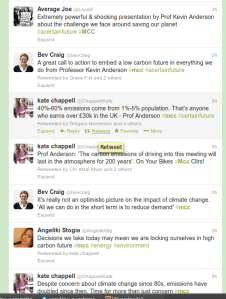
screenshotmcc4Lib Dem councillor Norman Lewis also asked what MCC’s recent acquisition of Stansted airport means for it’s carbon commitments given that the aviation industry is such a large polluter. Only half jokingly, Anderson said that if the council was buying them to close them then that would be okay. “We can’t see emissions from aviation grow and so the airport can’t expand,” he said. “You can make planes technically more efficient but you do need to constraint the amount of aviation we have or live in colder homes. As flying is mostly what rich people do, then we can’t really ask poorer people to make that sacrifice.”

Labour councillor Kate Chappell asked whether the figures in the recent report by Steady State Manchester with regards to aviation producing more emissions than home energy consumption were accurate and highlighted the need to deal with aviation. Anderson said they seemed broadly accurate as locals living near an airport tend to fly more often that those living with further away and so have high aviation footprints.

Speaking to MCFly after the event, Richard Leese said: “I’ve heard Kevin Anderson give that speech before which is why I asked him along to full council. I think there is a certain shock factor which will help stimulate people into action and encourage members to be active in the implementation of the council’s climate plan. My aim is to get councillors to be active proponents in tackling climate change and not just passing strategies.

“The real task now is to address those things we can address such as behaviour change which is in our Manchester – A Certain Future plans and is the aim of projects such as Cooler which is all about carbon literacy. We need to use Kevin’s address as a catalyst to push that kind of work forward.”

It’s certainly been an enlightening if depressing event, as Nigel Murphy, executive member for the environment put it, but it’s been an important wake up call. It may seem depressing for many councillors right now but at least they have a better sense of the reality we face. As Kevin Anderson states, real hope can only come from an honest assessment of the scale of the challenge we now face. I think today’s talk may have brought us a little step closer.

Arwa Aburawa
mcmonthly@gmail.com

Posted in Manchester City Council | Tagged , , | 10 Comments

#Manchester City Council Scrutiny Committees- #climate change, democracy and #beingready

Manchester City Council has six “scrutiny committees.” These meet ten times a year. One committee (Neighbourhoods) is explicitly tasked with looking at climate change, but ALL of them have a role to play in helping the Council – and the City- prepare for the challenges ahead. Below are a few broad suggestions of things that councillors could ask for reports on. Doubtless they themselves will have better ideas!

Meanwhile, there are also cheap and easy things the Scrutiny Committees could do to raise awareness of their existence (it is pretty low at present!)

  • Send out invites to civil society groups whenever an item of interest is being discussed.
  • Keep web pages updated (on several the latest news is from July 2012)
  • Have agendas and minutes and reports all viewable without having to click on “download”, e.g. via issuu.com

Social media-

  • Have twitter accounts for the committees and use hashtags
  • Have a facebook presence
  • Make short videos about each committee – who they are, what they do and put them up on youtube/vimeo etc
  • Encourage committee members to blog (individually or collectively) about what the committee is discussing, how the committee works and how people could get involved.

Communities Scrutiny Committee

See here for more info

  • How Manchester’s vulnerable people (especially the elderly, victims of domestic violence etc) would cope in a prolonged heatwave
  • What are the policing implications of a prolonged heatwave/other environmental events? How frequently are plans being updated, with reference to other cities’ experiences.
  • How might disputes between countries in the rest of the world affect community cohesion here in Manchester (e.g. water wars fought between neighbouring countries ‘spilling over’ into local communities)

Economy Scrutiny Committee

See here for more info

  • The committee could complete a process begun in November 2010, when it commissioned a report on Steady State Economics. That led to a large public “green seminar” in June 2012, at which the creation of a citizen-led report on Steady State economics and its implications for Manchester was announced. The committee could ask for a presentation about this report.
  • How can the digital culture sector of Manchester be encouraged to help make Manchester greener and fairer?
  • What skills will be needed for Mancunians to thrive in the coming decades (outside the traditional curriculum), and what is Manchester City Council’s role in helping these happen?

Finance Scrutiny Committee

See here for more info.

“Two broad roles. One is to keep a close eye on the Council’s finances and the other is to make sure that the Councillors you have elected can voice your concerns in an effective way to different public services, such as the Council, NHS, Police and Fire. We have discussions with these organisations and use our local knowledge of Manchester to recommend to them how they can ensure their services meet your needs.

“Our areas of interest include finances, Council buildings, staffing, corporate and partnership governance as well as Council tax and benefits administration.”

  • What progress is being made with the role out of “carbon literacy” training for Council staff, and what synergies exist with other large organisations? What lessons have been learnt, what changes will be made?
    What preparations have the NHS, Police and Fire made for extreme weather events? How are they working to ensure greater levels of community resourcefulness in the face of extreme weather events?

Health Scrutiny Committee

See here for more info

  • The physical and mental health impacts of climate change on various communities (old, young, disabled, poor). Obviously the direct impacts – of extreme weather events, but also the “indirect” effects of bad news in the media, and from extended families in parts of the world that are already suffering significant climate impacts.
  • What plans does the NHS have in place to cope with extreme weather events? Are these fit for purpose?

Neighbourhoods Scrutiny Committee

See here for more info

  • Annual Carbon Budgets of the City Council (the next one is due in July 2013) and other partner organisations
  • The performance of the Steering Group in galvanising climate action in Manchester
  • The Annual Stakeholder Conferences – successes, failures, lessons for the future
  • Ways that councillors could work more effectively with civil society groups to create momentum and transparency in climate action

Young People and Children Scrutiny Committee

See here for more info

The skills that will be needed for thriving in the 21st century

Posted in Democratic deficit, Manchester City Council | Leave a comment

PMT #5: Help find out who is chairing the #Manchester #climate Steering Group sub-groups on #transport #energy etc

Please write a polite letter [see example below] to the Chair of the Stakeholder Steering Group on Climate Change, Steve Connor, asking him to fulfil a commitment he made over 3 weeks ago. That commitment was to answer questions about who will be the chairs of the Steering Group “sub-groups” for Buildings, Energy, Transport, Sustainable Production & Consumption and Green & Blue Spaces. You could also ask about the elections to the Steering Group which were promised at the end of the last Stakeholder Conference in March 2012.

For background you can read this. The email Mr Connor uses for Steering Group business is steve@creativeconcern.com, and if you’re a twitterer, you could try @headstretcher

Please ONLY send this checking http://www.manchesterclimate.com/blog to see if a post on this topic has gone up (hint – it will be the first one in January). As in, this is NOT an invitation to spamming. This is a genuine effort to get answers to basic questions.

Here’s a suggested letter, but please feel free to use your own format.

Dear Mr Connor,

I am, like you, deeply concerned that Manchester take real action on climate change. And like you, I know that these are extremely challenging times for the public sector, private sector and voluntary sector.

Therefore it is all the more important that initiatives like the Stakeholder Steering Group on Climate Change succeed.

Two of the ingredients for its success are clarity and transparency. Therefore I am writing to you to ask you to answer the questions about who will be chairing the sub-groups around Buildings, Energy, Transport, Sustainable Consumption and Green and Blue Spaces, and the reasons for the delays in appointing/announcing these positions.

These questions were asked a month ago, and on January 7th, over three weeks ago, you undertook to post answers on the Steering Group website. To date that has not happened. I appreciate that you are very busy, but these answers do matter.

Additionally, in March of 2012, at the last Stakeholder Conference, you announced that said the Steering Group was ‘currently “exploring election mechanisms” so that members can be elected at next year’s conference and you added that the group was “looking at a co-operative model and details will be finalised by November.” ‘  Could you please advise on where this is up to, since the publicity for the next Stakeholder Conference contains no such details.

Yours sincerely

[x]

pmtlogo

Posted in Democratic deficit, PMT | Tagged | Leave a comment

#Manchester City Council #climate presentation: “pre-meeting” from 9am if you want!

Members of the public who are attending the Kevin Anderson presentation at Manchester Town Hall on Weds 30th January are invited to join MCFly co-editor Arwa Aburawa and others from 9am at the Waterhouse pub, on Princess Street.

You will –

  • Meet other people concerned about climate change
  • Learn more about how Full Council works and what to expect
  • Get to check out who your local councillors are (if you don’t already know)
  • Get copies of a letter that you can try to give your councillor before or after the Full Council meeting.
  • Talk about how we continue and extend the discussions with councillors in the hours/days/weeks/months AFTER the meeting to maximise its impact. MCFly intends to produce some basic materials to help people engage with their councillors. What should those be? Opinions welcome!!

Here’s the current draft of the letter. Comments welcome. A printed-off version will be available.

30th January 2013

Dear Councillor ________________

I am one of your constituents, and I have come today to the Full Council meeting to see Professor Kevin Anderson of the University of Manchester. He has been invited by Council Leader Sir Richard Leese to give a talk about the realities and consequences of climate change.

I appreciate that you are very busy, but climate change is one of those issues we will regret not having taken more action on. It is already hitting the more vulnerable people in Manchester. As food prices and energy prices go up and up, it will hurt your most vulnerable constituents more and more.

We cannot rely on international action – and certainly not on “action” from central Government – to make Manchester fairer and safer for the challenges ahead. The good news is that there are some good plans for making Manchester more resilient and resourceful. Those plans need a bit of a “push” to make them into reality.

I hope that if you have questions today that you ask them. I  hope you will take time to learn more about climate change and its impacts on Manchester and the greater world. And to take a greater role in turning the Manchester Climate Change Action Plan (2009) into reality. One way you can begin to do this is to try to attend the next stakeholder conference on climate change. It’s on Monday 4th March, from 1.30pm to 5pm, at Piccadilly Place. You can apply for a ticket to go here – http://www.manchesterclimate.com/node/4595

I hope you will raise the issues around climate change in the Scrutiny Committee(s) that you sit on, so that the committee(s) examine Manchester’s response and vulnerabilities, especially as they affect the poorest and most vulnerable among us (the young, the old, the disabled, the poor).

I hope that after today’s talk that you will feel it is important to investigate what can be done in our own ward to ensure that the most vulnerable people and habitats are protected against the impacts of climate change. I hope, for example, that the next ward plan contains explicit actions around reducing our emissions of greenhouse gases and putting sensible measures in place for future extreme weather events.

I hope to get along to one of your surgeries soon to talk with you in person about the issues raised by today’s talk..

Your sincerely

Name:
Address:
Email:

Posted in Manchester City Council, Upcoming Events | 1 Comment

Professor Kevin Anderson talks #climate ahead of #Manchester City Council presentation Weds 30 January

Professor Kevin Anderson has spoken(1) to MCFly, ahead of his presentation tomorrow morning to the full Council meeting of Manchester City Council. (2) In the interview he pointed out that “the industrial revolution began [in Manchester] and then spread across the planet. So maybe again we could have a green revolution … which would not just be all about technology, but technology and behaviour, policies, politics, economics – a revolution around those agendas.”

His presentation will cover the causes and impacts of climate change, before turning to the need for very very steep reductions in emissions of carbon dioxide from burning oil, coal and gas. The presentation, which is scheduled to last 35 minutes and be followed by a question and answer session with councillors, will also pose the question about whether a growth economy is compatible with the kinds of reductions we need to keep global warming to an “acceptable” level.

Council Leader Richard Leese has invited Professor Anderson to give an updated version of his presentation to a conference held last May on Manchester’s need to adapt to the coming changes in weather patterns. Professor Anderson will update his previous work, with references to a series of stark reports released since then, by organisations such as the World Bank and PWC.

A full transcript of the interview will appear tonight. Here’s a teaser –

Devil’s Advocate question – “surely there’s little we can do at a local level? – it’s all an international and perhaps a national problem.” What would you say if someone said to that?

Anderson: My first thought is that industrialisation has spread around the world, and that started in Manchester, so it does appear that you can actually start something in one place. In fact we have very good empirical evidence that you can … in the North of England, around the Manchester region, where the industrial revolution began, and that spread across the planet. So maybe again we could have a green revolution … which would not just be all about technology, but technology and behaviour, policies, politics, economics – a revolution around those agendas.

“It could be started and triggered in Manchester. We already know that some people elsewhere in the world are starting to drive in this direction, so it wouldn’t be that Manchester was on its own. There’s already quite a lot of groups, and sometimes towns, and sometimes cities that are starting to move in this direction. So it’s a matter of finding your bedfellows elsewhere in the world and trying to coalesce around a similar agenda and lead by example. I think Manchester could easily lead by example. It’s the choice between being the sheepdog or the sheep, and Manchester can make a decision about which way it wants to go on that.”


Footnotes

(1) The Manchester City Council press office was asked (twice) last Thursday to provide a statement. As of close of play Monday they’d still not done so. In these circumstances it’s always best to put to reach for the explanation of “cock-up”. If, however, it is “conspiracy” we say this – guys, if you’re worried that we will run a headline “Council takes 8 months to schedule a talk after climate expert says ‘yes, I’ll come’” then, well, chillax; there are plenty of genuine things for us to berate the Council for. This ‘delay’ is not one of them.

(2) The meeting is held in the Great Hall of Manchester Town Hall (Albert Square) from 10am.  It is free, open to the public and you do NOT need to book.  You will NOT have the right to ask questions. Come prepared to lobby!

Posted in Manchester City Council | Tagged , | 2 Comments

#Manchester #climate nuggets Jan 28th 2013 #

Hi all,

please try to get along to the Full Council meeting of Manchester City Council this Wednesday (10am, the Great Hall, Manchester Town Hall, Albert Square) to see Professor Kevin Anderson talk about climate change.  You can also lobby your councillors too. There are worthwhile actions to take even if you can’t get along.  For more details, see here .

All best wishes, and as ever, if you want to get involved in Manchester Climate Monthly, drop us an email at mcmonthly@gmail.com

Arwa Aburawa and Marc Hudson

Coming up this week

Tues 29th, 8am Breakfast at Rylands Sustainability, coffee, discussion.

Tues 29th – 7pm Sustainable Fashion Clothes Swap Party Manchester Women’s Institute
Swap an unloved good quality piece of ladies clothing (on hanger please), piece of costume jewellery, handbag or a pair of shoes (max 3 each items to swap)
‘One woman’s trash is another woman’s treasure!’
With special guests including eco-friendly fashion designers and budget busting personal stylists.

Tuesday 29th , 7.00–9.00pm — and the same time each following Tuesday — Manchester Green Party and Manchester Young Greens members, friends and supporters meet at Kro Bar, 325 Oxford Road (opposite the University of Manchester students union building). There’s no agenda — just meet, talk, share information & ideas.

Stories you may have missed on the MCFly website

Local news

Why airport passenger duty is a Bad Thing. No, really.  *Sigh*

Envirolution (Disclaimer – MCFly has been invited to run the discussion section) has a new “Great Art Installation” challenge in the lead up to its next event (May 2013).

The Council seems hell-bent on cutting down trees in Alexandra Park…

AfSL gives a shout out to a Fallowfield Secret Garden volunteer.

National news

Boris Johnson starts doubting the existence of climate change, which is what anyone wanting to lead the Conservative Party would have to do, isn’t it?

Economist Nick Stern admits he boo-booed – things are far worse than he thought in his 2007 Review. So it goes.

International news

Obama said some fine words in his inauguration address.  Polar bears applauded and the icecaps decided to re-freeze in appreciation.

Things to read while the algae grows on your fur
6 Economic Steps to a Better Life and Real Prosperity for All

Growing Cities (the movie!)

What You Need To Know to Understand the Scale of the Climate Change Problem and The Continuing US Press Failure to Report on the Urgency of this Civilization Challenging Threat

Posted in Weekly bulletins | Leave a comment

Repost: A tale of two cities- Alexandra Park, biophilia and #Manchester City Council

Two must-read articles about Alexandra Park, where the chainsaws are moving in… (See our previous editorial on the subject here).

From the Hulme Green Party, “Alex Park protesters take to trees to stop “Felling Vandalism”

Manchester Green Party Chair Deyika Nzeribe commented “The campaign group has done everything right. They got over 2000 signatures asking for the plans to be reconsidered, they got local experts to show how the councils plans to be altered to preserve trees and they have been in dialogue with both the Council and funders the Lottery every step of the way. They have been completely ignored.

To draw a parallel, last week Manchester City Council made a great show of how unfair the cuts to local budgets were and how the government were ignoring them. The council are acting in exactly the same way as the government to this local issue.”

From Nadine Andrews, who is part of the Save Alexandra Park Trees group, a post that gives you history, useful theory and references.

…. 150 years later Manchester City Council plans to ‘restore the park to its former Victorian glory’ reintroducing formal areas and increasing the amount of recreational areas at the expense of the wilder natural areas, felling around 400 trees and clearing over 3 acres of habitat supporting protecting and priority species.

Despite huge local opposition to the proposed scale of tree felling and habitat destruction (over 2000 people to date have signed an e-petition), the council intends to march on with its plans regardless, all the while claiming it has local support but without actually supplying any verifiable evidence of this. Hardly a shining exemplar of participatory democracy.

Posted in Biodiversity, Democratic deficit, Green spaces, Manchester City Council | 1 Comment