Event Report & Upcoming Event: #Manchester Friends of the Earth mingler and AGM…

Attention Conservation Notice: Grudging and belated admiration for Friends of the Earth’s innovation in its formatting of a meeting, and plug for its upcoming AGM and pub grub.


Manchester Friends of the Earth
holds monthly public meetings. We even made a video about a recent one. So why is this all news? Well, they … innovated.(1)  In early-November (Tuesday 6th, to be specific) FoE did something different, and there was a palpable buzz in the room.

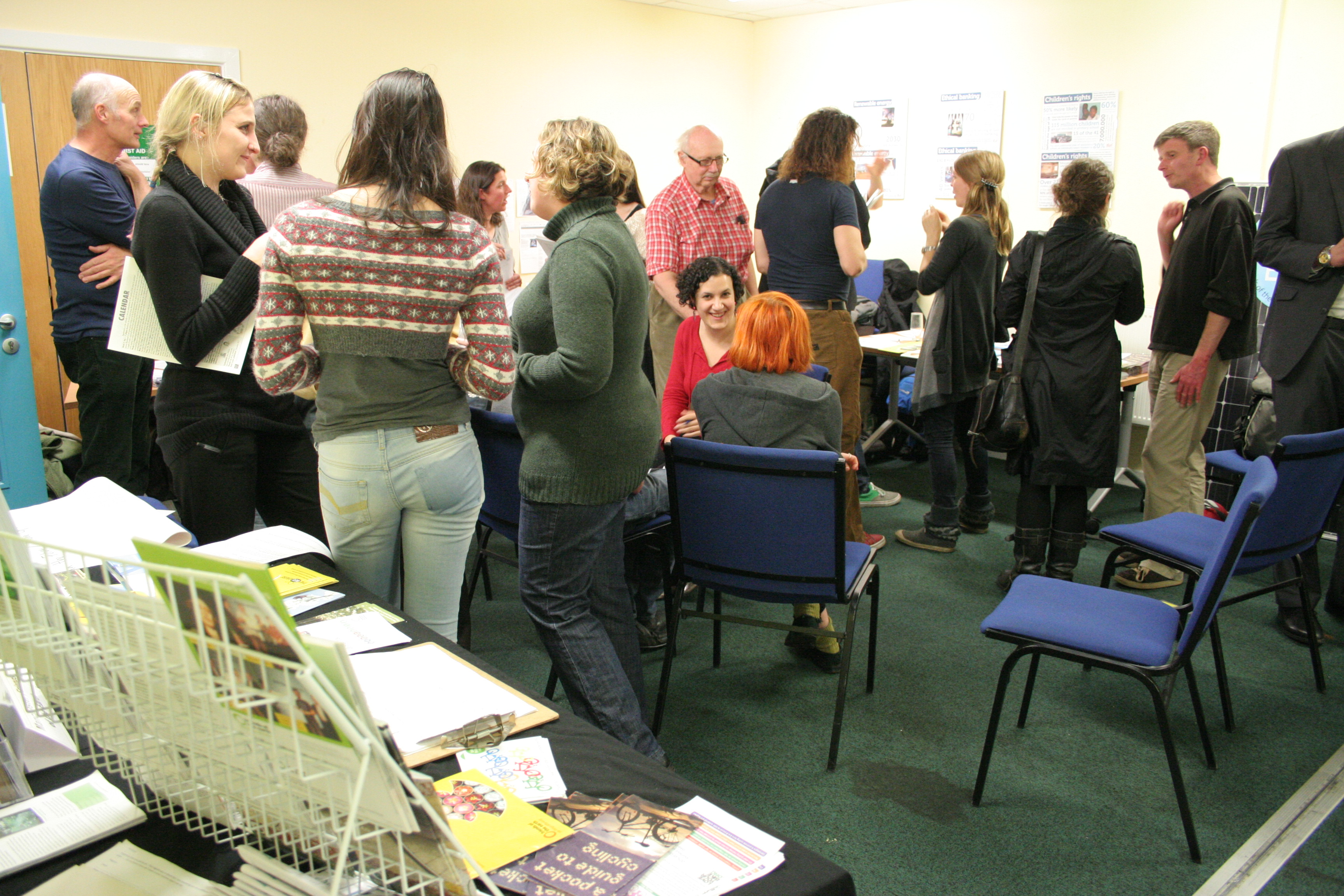
Meeting as usual at the Greenfish Resource Centre (Oldham St), they did away with everyone sat around a table listening to one person at a time for longer-than-you’d-expect followed by another, repeated… Instead, there extended mingling (and nibbles and wine – not that has in any way influenced the journalistic coverage). After a brief welcome and intro, knowledgeable members of Friends of the Earth then explained to all and sundry what campaigning activity was going on – in food, transport, climate, biodiversity etc. This gave everyone a chance to judge quickly whether they would be interested in that sub-group’s activities, what they might do and learn if they got involved. After these brief spiels, everyone was free to find out more about the specific campaigns that were particularly attractive to them, or simply to mingle and chat.

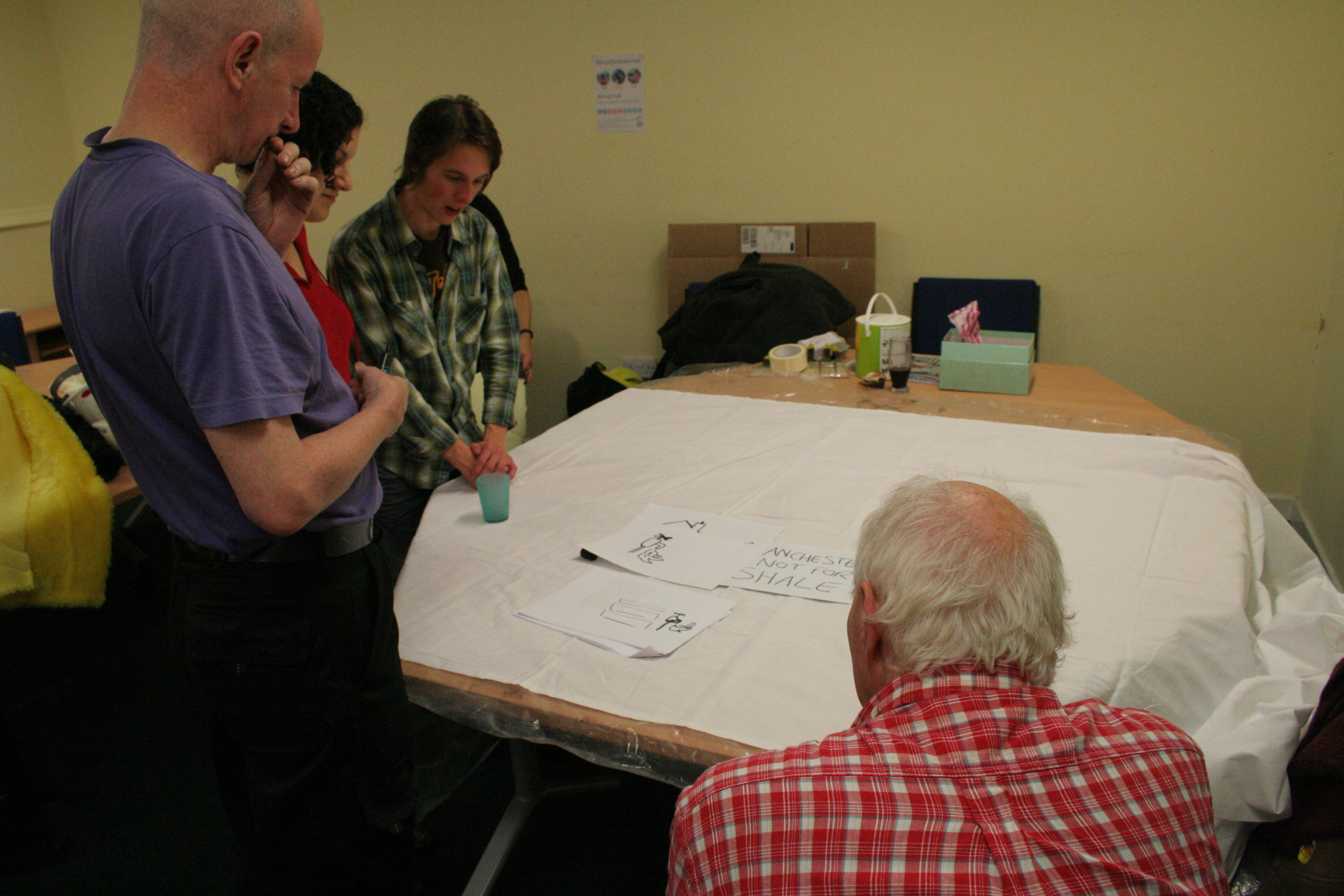
At 8pm, things turned practical, with the opportunity for people to make some good practical work on banners, bee costumes and seed bombs.

Should every meeting be like this? Clearly not, but it was good to see something different being done! (And recently, Action for Sustainable Living had taken similar adventurous steps.)

So, how can you get involved in Friends of the Earth? If you’re reading this within a day or so of Monday 26th, you just about have time to book for their post-Annual General Meeting meal. See below –

Tue 4 Dec: MFOE Annual General Meeting and Xmas Social, The Angel

Our AGM and Xmas Social, is next week, so don’t miss out on a great night out- with a delicious vegie meal prepared by the Angel pub’s kitchen and, of course, great company!

This year we are heading to The Angel Pub on Tuesday 4th December. (http://theangelmanchester.com/index.php)

6.30pm – 7.15pm AGM. Our AGM will be held in the restaurant and all are welcome to attend this whether or not you wish to stay for a meal – there is no charge to attend the AGM.

7.30pm onwards meal / Christmas social. We will stay in the restaurant to enjoy a two or three-course meal for a set price of £15 and £20 respectively.

We do need to select our menu options this week, so please make your choices as soon as possible. Payments to be made on the night, although a deposit has been made for each place, so do let us know if you book and later discover that you can’t make it.

Please use the Survey Monkey link below to let us know whether you will be joining us for the AGM, the Xmas meal (or both) and select your Christmas menu options.

You can book via this link http://www.surveymonkey.com/s/QMZFM6X

For more information please contact: Cat cat@manchesterfoe.org.uk

Disclaimer: MCFly co-editor Marc Hudson is currently a member of Friends of the Earth. And may well continue to be so, as long as he is allowed to pay cash.

Marc Hudson
mcmonthly@gmail.com

Footnotes
(1) It’s almost as if someone had sent them a snottygrumpy email about meetings charters and things, but who cares the reason.

Photo credit: Pete Abel

Posted in Event reports, Upcoming Events | Tagged , | Leave a comment

#Manchester #climate nuggets November 26 2012

Hi all,

great to see so many of you at the launch of the first two reports of “SteadyStateManchester” last Tuesday.  There’s a blog post and a short video over there, and there are lots of plans afoot.

This week we will be publishing a belated “event report” about Friends of the Earth‘s last meeting (a good ‘un!)- they have Xmas themed AGM on Tuesday 4th December, with AfSL and MERCi also having their AGM yet festive/fun meetings that week.  We will also be publishing an excellent interview with Colin Hughes, top sustainability bod at University of Manchester, and event reports on various, well, events.  As ever, your comments and critiques are very welcome.

Thanks to our stalwart writers who have kept us afloat this week, and to all who have helped, and will we hope continue to help, keep MCFly reporting on all the good things that are happening.

Arwa Aburawa and Marc Hudson

Coming up this week

Mon 26, 7pm Ethical Dilemmas ‘Is ethical finance possible?’, Chorlton Mill, Manchester
Event co-hosted by The Co-operative and Ethical Consumer. Panel of speakers looking at the question: “Can moving our money to mutuals help solve the banking crisis and make the world more sustainable?”
 The current panel is as follows:
• Louis Brooke from Move Your Money UK – on the growth of the UK’s newest consumer banking protest campaign
• Giles Simon from Co-operatives UK – on mutual finance and campaigning outside the UK
• Rob Harrison from Ethical Consumer – on campaigning to change bank behaviour – from South Africa to Cluster Munitions
• Chris Mills from the Co-operative Bank – speaking about the growth of the ethical banking sector
• Craig Lumsden, expert on co-operatives – speaking about the potential solutions offered by Credit Unions

Join the discussion, question the panel, or contribute from the floor. A lively discussion on one of most pressing political issues of the day.
Refreshments provided. Please arrive 6.30 for a 7.00pm start.
Do please confirm attendance if possible at:
https://www.co-operativememberevents.coop/coop_ems/event-details.aspx?object.id=c3c0422a-a77f-46b6-a2ad-fede92c6d801

Tues 27th, 7.30pm A Farm for the Future film showing by Transition Moss Side at the Phil Martin Centre, 137-9 Princess Rd Moss Side M14 Free, but donations will be asked for and places are limited – email transitionmossside@gmail.com

Tuesday 27th November,  doors open 7.30pm MANUFACTURED LANDSCAPES – film screening by Manchester Film Cooperative Jennifer Baichwal’s compelling documentary of photographer Ed Burtynsky’s voyage of discovery in today’s industrial China.

International Anthony Burgess Foundation
3 Cambridge Street, Engine House, Chorlton Mill, Manchester M1 5BY

Admission £3 waged/£2 unwaged
www.manchesterfilm.coop
Wednesday 28th November 6pm – 8pm CRUDE KILLINGS – Climate, Race, Poverty
a free event by Virtual Migrants

International Anthony Burgess Foundation
3 Cambridge Street, Engine House, Chorlton Mill, Manchester M1 5BY
Booking a place is strongly advised, please register your attendance at www.crudekillings.eventbrite.co.uk“Safe, Silent & Unseen” is how BP (the fourth largest company in the world) describe their operations, but we need to both see and hear at whose expense are their billions of dollars of annual profits.
How does the sanitisation of difficult, violent processes and imperialist histories inform the fight for climate justice today?Virtual Migrants present the latest in the ‘Passenger’ series of events: a combination of live performance of music and spoken word, plus a panel discussion, responding to Platform’s new book “The Oil Road – A Journey from the Caspian to the City”.The panel-led discussion will involve the book’s author James Marriott, Platform’s Anna Galkina, Jaya Graves from Southern Voices, Deyika Nzeribe from Hulme Green Party, Marc Hudson from Steady State Manchester, Arwa Aburawa from Manchester Climate Monthly, and chaired by Kooj Chuhan.
The performance will involve Virtual Migrants’ artists Sai Murray (poetry/spoken word), Aidan Jolly (music), Tracey Zengeni (vocals), and Tanha Mehrzad (visual projection/poetry).
Refreshements will be available at this event; wheelchair access is also available.

www.virtualmigrants.com

Thurs 29th, 6pm End of term XMAS SWAP @ Eighth Day, Oxford Rd!
https://www.facebook.com/events/249537265172122/
How it works:
Bring 3 items of good quality, clean clothing.
Take home anything you like!
FREE if you bring 3 items, £1 otherwise.

Thurs 29th @ 5pm – 7pm University of Manchester Students Sustainability Forum Room 8, First Floor, Steve Biko (Students’ Union) Building, Oxford Road, Manchester, M13 9PR
The SSF will be holding its first meeting of 2012/13 academic year with a chance to discuss sustainability issues at the University of Manchester with those in charge!
In attendance will be:
– Earl Harper (Undergraduate Chair)
– Andrew Welfle (Postgraduate Chair)
– Dr. Emma Gardner (Director of Environmental Sustainability)
– Lucy Millard (Environment and Sustainability Manager)
– Kaz Dyson (Community Officer, Manchester Students’ Union)
– Khalil Secker (Campaigns and Citizenship Officer, Manchester Students’ Union)
– Stuart (House Services, Manchester Students’ Union)So, bring yourselves and your ideas down to the meeting and lets open a discussion on sustainability at the University!You can either ask questions on the night, or post them on this facebook group to make sure they get heard!

Thursday 29th November 6pm-8.30pm, Fuelling Manchester
at the Buffet Bar, Stalybridge Station, StalybridgeRSVP if you’re attending as we’ll be providing food and snacks.
Involved or interested in Community Renewables in Greater Manchester? Come along to Fuelling Manchester, a social networking session organised by Carbon Co-op and Kindling Trust, with assistance from the Generating Success programme.
After the success of previous sessions, Fuelling Manchester 8 comes to Tameside, the gathering is for all those of us involved in community renewable projects, be that: water turbine co-operatives; bio-mass and woodland management enterprises; waste-to-energy projects, solar energy collectives or those involved in community-focused wind turbines.Except for introductions, the evening has no agenda and no structure, it is simply an opportunity to meet with like-minded individuals and complimentary projects from across Greater Manchester and beyond. To learn, share and make plans.Some of the projects who have been attended past events include: Greater Manchester Tree Station; Torrs Hydro; Unicorn Grocery; Energy Savings Trust; Fairfield Materials Management; MERCi, GMCVO; URBED; Co-operatives UK.Transport and access
Stalybridge Buffet Bar is situated on the Leeds-bound platform of Stalybridge Railway Station.
Train: Stalybridge station can be reached via trains from Manchester Piccadilly (12 minutes), Manchester Victoria (15 minutes), Huddersfield (17 minutes) or Leeds (35 minutes). http://www.nationalrail.co.uk
Bus: Services to Stalybridge are served from Ashton (10 minutes), Glossop (30 minutes), Stockport (1hr, 2 changes) and Oldham (45 minutes, 1 change) http://www.traveline-northwest.co.uk/journeyplanner/enterJourneyPlan.do
Bike: Lock ups are available on the station platform, Stalybridge is accessible from Manchester (45 mins), Oldham (30 minutes), Stockport (1 hour) and Glossop (30 minutes) via various cycle paths. http://www.cyclestreets.net/journey/
Car: Stalybridge is accessible via the M60 motorway, junction 23, parking is available at Stalybridge station. Needless to say we encourage people not to drink and drive (or cycle)!RSVP to info@communityrenewables.org.uk or http://www.twitter.com/carboncoop with an dietary requirements, or just turn up on the night though we can’t guarantee food!

Fri 30 Nov: Bike Friday from various locations around Greater Manchester

Held on the last Friday of the month, Bike Friday is a set of led commuter rides into Manchester from various starting places around Greater Manchester. Most rides leave at 8am but check the website as they vary depending on the distance from Manchester. Rides finish at the Eastern Bloc coffee shop (5A Stevenson Square, M1 1DN), in Manchester City Centre.

Whether you’re new to cycling, returning to your bike after a break, or cycle every day, join us on Bike Friday. We ride at a moderate pace and have experienced ride leaders. It is entirely law-abiding – we do not try to slow down the traffic. All welcome (bring a bike).

Contactgraeme@manchesterfoe.org.uk or cat@manchesterfoe.org.uk

More info: www.bikefriday.org.

Stories you may have missed on the MCFly website

Things to read while the algae grows in your fur

Manchester
Here comes an Airport Logistics Hub. That’ll help reduce emissions!!

Cycle safely in Levenshulme
!

National
Carbon target for UK energy production? What carbon target?

Global
EU caves in over aviation emissions.

CO2 levels hit a new high (quelle surprise)

Climate Change evident across Europe says report (21 Nov)

Chin-stroking pieces
George Monbiot “If children lose contact with nature, they won’t fight for it”

(Belated!) On the 50th anniversary of the publication of Rachel Carson’s “Silent Spring”

Turns out our model behaviour isn’t model – regional differences will be bigger than we thought. Translation: the predict and provide model is deader than this civilization will be in 200 years.

Posted in Weekly bulletins | Leave a comment

Event Report: “Peddling pedalling the Dutch way” – #cycling in #Manchester

MCFly reporter Roger Bysouth attended the recent two-day cycling event, and sent us this.  For another view, see madcyclelanesofmanchester.blogspot.co.uk.. Update: all the presentations are now available here.

The Dutch have been in our City evangelising about cycling. Alleluia. They’ve recently held four big events around England and have stirred interest among campaigners, planners and even politicians. Over there 27% of all trips are by bike. Here it’s 1%. Why is that? And can we improve by looking at what they’ve done?

The first thing to note is that the Dutch are not so different from us and have not been cycling merrily for generations. In the late 1970s cycling seemed in permanent decline, just like here. But get this; they decided to do something about it. Two main factors brought the issue into the mainstream:

  1. Cars were killing lots of cyclists, particularly children. There were years of street protests. It became a popular political cause.
  2. The seventies oil crisis alerted institutions and people to the dangers of reliance on oil.

It seemed a no-brainer to embark on a programme of encouraging cycling by building infrastructure. The decades since have seen cycling embedding in all aspects of life: a change in the law so that civil cases start from an assumption that the car driver will pay a minimum of 50% of the costs of any car-cycle collision. Campaigns to promote cycling. Improving parking. Links with wider urban design to create better city environments. Cycling organisations have a much higher profile and are less fragmented than here.

Little of this would have happened without not just support but leadership at national and local level across the political spectrum. At the moment it would be a brave national or local UK politician who proposed Dutch style investment in cycling. But the Dutch now have a coherent infrastructure and a cycling culture; and we don’t.

The events have been put on by the Dutch Embassy and the Dutch Cycling Embassy dutchcycling.nl – itself a reminder that public, private and non-profit sectors can work together to promote a social good that few other countries (Denmark, er, that’s it) can claim as good practice on. Yes it’s growth Jim, but not as we (at least David Cameron and co.) know it.

They’ve been two-day affairs:

On 19th November the Dutch went with local engineers and campaigners to look at some particular Manchester cycle planning challenges. They trooped off to the Stretford/Hulme Roundabout at the southern end of Deansgate (“it’s fundamentally too big”) and the Curry Mile (“make some choices about priorities”). They observed how these were used by cyclists and others and came back with some detailed recommendations. When do we start?

The following day, 150+ people from all over the North and North Midlands: councillors, local and transport authority staff, campaigners, assembled in the Town Hall. Mostly male and white. The morning was filled with presentations ranging through the history of bike planning since the 70s, an overview of where the rest of the world is up to, the value of giving bikes separate, continuous space from other traffic, parking and the health benefits (definitely bigger than the risks). For a great introduction watch youtube.com/watch?v=XuBdf9jYj7o. All the presentations may go up on nbso-manchester.co.uk, but if not ask rogerbysouth@gmail.com .

Worth a close look, especially for fellow Climate Monthliers and Steady Statists, is decisio.nl/wp-content/uploads/2012/04/SCBA-apr12-en.pdf’s explanation of social cost benefit analysis. It’s bringing factors into consideration in planning decisions that UK growthistas shy away from – quantifying and putting a cash value on how planning decisions affect communities and individuals’ health, as well as the supposedly “harder” criteria like creating employment and encouraging trade. Such tools are showing there is not necessarily a zero sum game of choosing either an economic or a social good. The tools can help work out how an informed judgement can mean both being met better. This may sound like potential greenwash fudge. But often it’s about showing the value of mixed urban environments, healthier communities, denser housing, local production and distribution and minimising carbon use. Such analysis sounds to me like a useful one for the steadystatemanchester.net toolbox.

The afternoon gave us a choice of workshops. I went to Health Benefits of Cycling to the Economy andCreating a Cycling Culture; Highlighting the Social Cohesion Benefits, eschewing the more technical/design ones. More on these available too. It’s no surprise that everyone thought the Dutch model is a great example to follow.

The $1m question is what is Manchester (in the guise of the City Council and Transport for Greater Manchester) going to do about it? The City Council has long had engineers, traffic planners and cycling officers but now has a great opportunity for (for a change, real) synergy coming up as it has recently got new statutory powers and staff on public health as well. Professor John Whitelegg compared what we could do now to the 19th century leap in public health engineered (literally) by local authorities providing clean water and effective sewerage. Can we afford it? Maybe not all at once. The Dutch advise: work out what we want to achieve and gradually build it up. This is fine and pragmatic; but how much time have we got? Perhaps making it a political issue and a social movement will move things a bit quicker. And that’s how it connects to steadystatemanchester.net.

Posted in Event reports, Transport | Tagged | 2 Comments

Cross-post from the Sustainable Change Co-operative” – Climate report gloom

The Sustainable Change Co-operative is a group of “leading environmental and sustainability consultants based in Manchester. [Their] goal is to help enterprises of all kinds thrive whilst playing a positive role in the move towards a fairer society that’s in harmony with the planet.”

Here’s a recent blog post, handily analysing recent reports about the state of climate (in)action internationally, and its local implications. If you have comments, it’s more polite and helfpul to post them over at the specific blog post, rather than on MCFly.

Climate report gloom

Submitted by Steven on Thu, 2012-11-22 18:52

The last couple of weeks has seen a rash of new climate change reports fighting for attention and hoping to influence the annual jamboree the is the Conference of Parties no.18. As the hope builds – surely after 17 goes we have to make a breakthrough this time – what message do these new reports bring?

Well I have read four: Bridging the Emissions Gap from the United Nations Environment Programme; Turn Down the Heat from the World Bank; Global Coal Risk Assessment from the World Resources Institute; and Too late for 2 degrees from Price Waterhouse Coopers. These are some of the some common themes and lessons that I have drawn from them.


Two degrees is moving rapidly out of sight

Current emission trends put us nowhere near where we want to be to have any chance of limiting average temperature increases to below 2°C. The UNEP report looks at the emissions reductions needed by 2020 to keep us somewhere on track for 2°C or below, then compares that with the trajectory implied by current emission reduction pledges made by governments around the world. By 2020 they say the gap would be 8-13 giga tonnes (GT) of carbon dioxide (GTCO2) – and that is assuming that all pledges are met.

PwC use carbon intensity, how much carbon is produced for every dollar of output to assess the situation (they are accountants after all). In 2009 they said that carbon intensity had to reduce by 3.9% per year up to 2050. After three years of prevarication and inaction that figure has risen to 5.1% per year – beyond anything that has been achieved globally in any of the last 50 years.

The idea that hopes of sticking to 2°C are slipping away has been voiced by people like Kevin Anderson and colleagues from Tyndall Manchester for a number of years but seems to becoming common currency now.


Things can change but will they?

So we are heading in the wrong direction but can we put it right? The optimistic position voiced in the UNEP report is that it is still ‘technically’ possible to make the emission reductions we need to close the gap back to a 2°C trajectory. However, you only have to look at current progress to concur with PwC who see this as “highly unrealistic”. The 5.1% annual reductions in carbon intensity needed are being achieved by individual countries – France, the UK and Germany beat this in 2011, and the EU as a while matched it. However, it seems this was partly luck due to an exceptionally mild winter (although we might be having more of those), and globally we only managed 0.7% from 2000-2011.

The reasons for this are many but one example from these reports stands out. As the World Bank publishes a report saying we must, whatever else we do, avoid 4°C warming (more below), they also “increased lending for fossil fuel projects and coal plants in recent years” according the World Resources Institute (WRI). Coal is the dirtiest of fossil fuels but there are currently 1199 new coal fired powers stations proposed around the world. If they were all built that would amount to somewhere in the region of an extra 4 GTCO2 being emitted each year (my calculations). There must be money to be made though judging by how involved top commercial banks are in funding coal projects. From 2005-2011 JP Morgan Chase invested €16.6bn, with Citi, Bank of America, Morgan Stanley, and Barclays making up the top 5. In total, for the top 20 commercial banks listed in the WRI report, a staggering €171bn has been invested in coal in this 6 year period, with the Government owned Royal Bank of Scotland contributing around €10bn.

Closing the gap… I don’t think so.


The outlook is grim

Not only are we missing our 2°C target it seems that we travelling headlong towards 4°C warming or more. How will this 4°C world look? Well according to the World Bank report it will be one of “unprecedented heat waves, severe drought, and major floods in many regions, with serious impacts on human systems, ecosystems, and associated services”.

The report details a litany of impacts focusing on sea-level rise, changes in extreme temperatures, agriculture, water resources, ecosystems and biodiversity and human health. None of it is good. Just to pick out one example on extreme temperature, “In the Mediterranean and central United States, the warmest July in the period 2080–2100 will see temperatures close to 35°C, or up to 9°C above the warmest July for the present day”. Recent heat wave events would become the norm and “and a completely new class of heat waves, with magnitudes never experienced before in the 20th century, would occur regularly”. It brought a staggering fact to mind that I read recently that if you are 27 or under in the US then you have you have never lived through a month that was colder than average… and you maybe never will.

If all that isn’t scary enough, the authors talk about the uncertainty around the full nature of the impacts with the emphasis very much on the possibility that these impacts are underestimated. So much so, they conclude “there is also no certainty that adaptation to a 4°C world is possible” and that “it simply must not be allowed to occur”.

Of course it cannot end with such doom and gloom so makes clear we can avoid this with early co-operative international action… but as was said earlier…


What to conclude?

Well clearly any Doha delegate reading these reports will be heading to Qatar with a fire in their belly to put all this right and set us back on course for somewhere nearer 2°C. Or maybe not. It is hard to be optimistic about a process that has brought so little meaningful progress despite the dire situation we are careering towards.

One lesson from these reports is abundantly clear – we need to get really serious about adaptation. I sit on the steering group for the Manchester Climate Change Action Plan and a recent discussion was about whether adaptation needed to have a prominent role. I think it would negligent if it didn’t. However, this has to be alongside a monumental effort to do what we can to reduce emissions. As the World Bank report says we really don’t want to go to a 4°C world. Maybe it is too late but if 4°C is bad then 6°C is going to be an awful lot worse.

The PwC report states that “The only way to avoid the pessimistic scenarios will be radical transformations in the ways the global economy currently functions”. However, in their view that transformation doesn’t include any move away from seeing economic growth as essential. This is an idea that we really need to start taking seriously. This is why it was great to see so many people at a recent event organised by the Tyndall Manchester called ‘we need to talk about growth’, and also at the launch of a report this week that looks at what a steady state economy might mean for Manchester.

So should we all retreat to our homes in despair? There is a strand of thought that what we need is an ecological disaster, a collapse and then we will do something about it and create the world we want. The trouble with this is that collapses rarely seem to lead to benign outcomes – the rise of Golden Dawn in Greece provides a sobering warning from current times and there are many other lessons from history. Given the individualistic culture we have, are we all likely to pull together when the trouble hits?

I like Joanna Macy’s concept of active hope, the idea that we should try and identify the outcomes that we would like to see come about and then play an active role in trying make them reality. The outcomes might not be likely but we put our energy into it because it is something important to us. I can only speak for myself but it seems more essential than ever to keep working for the things we believe in.

Posted in Climate Change Action Plan, Mitigation | Tagged | Leave a comment

Upcoming Event: Help weed asparagus and clear docks at Moss Brook Farm, Weds 5th December

Want to get some dirt under your fingernails while helping local organic food production??

“The Land Army will be visiting Moss Brook Growers again Wednesday 5th December. They need help weeding their asparagus crop and clearing docks from their orchard site. This will be a HALF DAY OUTING ONLY – leaving Hulme at 12.30 and back for 5pm. Only 3 hours on site so no lunch provided just hot drink and biscuits / fruit. We will provide tools and gloves and can provide wellies if you tell us your size. Please email chloe@kindling.org.uk if you can join us.”

(Kindling Trust have asked us to advertise this, and we’re happy to oblige.)

Posted in Food, Fun, volunteer opportunity | 1 Comment

Upcoming Event: Is Ethical Finance Possible? Mon 26th Nov, #Manchester

News just reaches us of this –

Free Manchester Event Monday 26th November, 7.00pm to 9.00pm at the International Anthony Burgess Foundation, Engine House, Chorlton Mill, 3 Cambridge Street, Manchester, M1 5BY

Venerable Manchester institution is co-host Ethical Consumer is co-host.

“We’ve got a great panel of speakers looking at the question: “Can moving our money to mutuals help solve the banking crisis and make the world more sustainable?”
The current panel is as follows:

Louis Brooke from Move Your Money UK – on the growth of the UK’s newest consumer banking protest campaign
Giles Simon from Co-operatives UK – on mutual finance and campaigning outside the UK
Rob Harrison from Ethical Consumer – on campaigning to change bank behaviour – from South Africa to Cluster Munitions
Chris Mills from the Co-operative Bank – speaking about the growth of the ethical banking sector
Craig Lumsden, expert on co-operatives – speaking about the potential solutions offered by Credit Unions

Join the discussion, question the panel, or contribute from the floor. A lively discussion on one of most pressing political issues of the day.

Refreshments Provided. Please Arrive 6.30 for a 7.00pm start.

The event is bought to you by Co-operative Group Membership in association with Ethical Consumer. Do please confirm attendance if possible at:

https://www.co-operativememberevents.coop/coop_ems/event-details.aspx?object.id=c3c0422a-a77f-46b6-a2ad-fede92c6d801

Hat-tip to Ruth Rosselson, who got it from Jim McClelland

Posted in Upcoming Events | Tagged , , | Leave a comment

Event Report: Greater #Manchester ESD Forum “An Introduction to Systems Thinking and the Circular Economy”

Laurence Menhinick visits Bridge 5 Mill for an event hosted by the Manchester Environmental Education Network.

An Introduction to Systems Thinking and the Circular Economy – with Andrew Turney from the Ellen MacArthur Foundation, 21 Nov 2012

The goal of the Ellen MacArthur Foundation ( yes, founded by the extraordinary Dame herself) is to “inspire a generation to re-think, redesign and build a positive future through the vision of a circular economy.” And may it succeed indeed! Today’s short introduction was aimed at educators and teachers, and presented the basics of cradle-to-cradle design and introduced the free educational resources available to all (lesson plans, booklets, videos and workshops).

A couple of quick group-thinking exercises on our own perceptions of sustainability and level of actions put us in the mood to think outside the box and challenge the familiar linear economy model ( take-make-waste) we have been accustomed to. Clearly our consumer recycling efforts are not going far enough in reducing waste, partly because recycled materials can be seen as inferior or low value but mostly because the largest waste happens before consumers get the product. On the other hand, the beauty of the circular economy model lays in the simple premise that whatever you have taken and consumed can be collected by its manufacturer to form the basis of their next cycle of production.

We are all familiar with the idea of using compost to enrich the soil to grow more food (this is the biological materials loop) – well the same principle can be applied to the design of the products we manufacture where your recycled materials become “nutrients” ( the technological materials loop) … Materials become valuable assets which are owned by the manufacturer who have a considerable interest in not wasting their material wealth. Of course the absolute basis of this model lies in what I would call really intelligent design: thinking in advance (ie before manufacture and use) about the reusability of your materials and factoring it into the design and production. Take your carpet for instance. Wouldn’t it be amazing if it was easy to replace just a small section if required? If after several years, when you needed to replace it completely, it was taken back to the manufacture, where the backing and based layer were stripped out, the yarn carded and re-spun and your next carpet tiles were re-constructed. This product already exists.

Of course you can also reconsider your business model and since what the customer wants is the service your product offers and not the actual item, propose rental or lease instead of sale, in which case you are guaranteed the return of your goods and customers retain flexibility of use.

Huge opportunities therefore to once again change and re-think our industries and our consumption patterns, and still fulfil our needs with the smallest impact possible. Now, where have I heard that before…

Laurence Menhinick


-Introduction to the Circular Economy videos: http://www.youtube.com/playlist?list=PLDE60BB4DB4BD28F1&feature=plcp

-Latest video: Walter Stahel, Founder-director of The Product-Life Institute Geneva on the Performance Economy

– Free CPD session for secondary school teachers, with Development/Field Officer (North of England) Andrew Turney

Posted in Event reports, Steady State Manchester | Tagged , , | Leave a comment

#Manchester #climate nuggets November 19 2012

Hi all,

we are biased, but we think that you all should get along to the launch event that Steady State Manchester group is putting on tomorrow night at the Mechanics Institute. Two reports – “In place of growth” and “Lessons on Living Well” are being launched. Here’s a short youtube about it…

You can register to come (it’s free), by following this link.

Arwa Aburawa and Marc Hudson

Coming up this week

Mon 19, 8:30pm – 10:30pm Permaculture For Communities
At the OKasional Cafe, 331 Great Western St, Rusholme
Taking the opportunity within an active community to consider the relevance and importance of the permaculture ethics, in particular people care in terms of designing for our personal impact within our local and global community. How does our own personal authority bare significance in the world we live in and how can we generate an authentic connection to that which matters in the face of global crisis?

Tues 20th,7.30pm  Launch of two “Steady State Manchester” reports “In Place of Growth” and “Living Well” at the Mechanics Institute, Princess St

Friday 23rd November at 9.30am – 12.30pm. Food Futures Forum on Food Poverty The Forum is open to anyone with an interest in tackling food poverty in Manchester and will be an opportunity to hear the latest evidence and to contribute to developing approaches to tackling it.

Places are limited so booking is essential. If you would like to attend please email c.raiswell@manchester.gov.uk

Stories you may have missed on the MCFly website

Things to read while the algae grows in your fur

Manchester-based

Scheme to give homes in North Manchester a £2m upgrade given go ahead

‘Students are key to solving future’s problems’: Manchester Met scholar takes climate change manifesto to EU ‘Students are key to solving future’s problems’: Manchester Met scholar takes climate change manifesto to EU

Of bus lanes, delaaaaaaaays and lessons for cycle campaigners

United Kingdom

http://lowcarbonkid.blogspot.co.uk/2012/11/britains-carbon-capture-dream-is-over.html

Global

Brilliant article from Grist magazine about the ominous parallels between Republican denial the Romney was behind and climate change…  Really good stuff…

That nice Mr Obama is taking personal charge of climate change. Doncha feel safer already?

And awesome article by Jeremy Grantham, an investment strategist: “Be persuasive. Be brave. Be arrested (if necessary)”

Posted in Weekly bulletins | Leave a comment

Youtube about #Manchester Hackathon, musings about technology and climate activism #mcrhack

Here’s a video I made about yesterday’s “Hackathon,” organised by Open Data Manchester.

[UPDATE: Sigh, I failed to mute a video clip, so have drowned out a bit of Dave Carter… So it goes. Fixed it!]

It was a great day, inspiring and bewildering (for us non-techies) in equal parts. During the presentations the master of ceremonies skilfully kept everyone to a very strict two minutes (as Marc Roberts, uber-cartoonist,  pointed out – coders and techies have a respect for numbers and precision that humanities graduates lack).

The variety of projects was impressive. If anything was missing it was a sense of social movement-ness. The various projects I heard explained were all about how individuals can park more easily, or find a toilet (not to be laughed at if you’re elderly or have bladder problems – there’s only one public loo in the city now) or choose a school. There wasn’t much sense of how people can come together to solve collective problems.

I want to emphasise that this is NOT the fault of the organisers, or those who attended. It’s the fault of the “environmental movement” (and the editors of MCFly are more culpable than others). Why aren’t “we” thinking – practically – about how open data and the new technologies of social media could be used to cajole the local state into being nimble, inform individuals and groups about what others with similar concerns are doing.?Where were the representatives from the Green Party, Friends of the Earth, the “Stakeholder” “Steering” “Group”? Why didn’t MCFly try to cobble together a tech team around one of the following apps (1)

  • an app that pulls details of upcoming scrutiny committee meetings, exec meetings and the blogs of the Executive Members (well, there’s only one – the Leader’s Blog), allowing you to select key words (waste, recycling, biodiversity, climate, transport) so you know what is coming up. Could be linked to your postcode so you are alerted to whether any of your councillors sit on the relevant committees, and the minutes of those meetings turned into structured data so you could see what (if anything) they have said or done on the issues you care about.
  • An app for your smart phone using geolocation (html5 blah blah) so that you were alerted to when you were near a business that had signed up to the Climate Change Action Plan but not made its own action plan (just fyi – 200 or so organisations have signed up to this masterwork, but only 1% – namely the Council and Northwards Housing – have got their own implementation plan). Then app could then link to their email/flickr account and you could take a photo of yourself walking away from their business. Or something.
  • An app that let you know when you were close to someone else who also cared passionately about climate change, sending an automated “want to meet for a (fair trade) coffee in a local (i.e. pays taxes) coffee shop?” Could be tied to an inventory of what campaigning skills/time you had, and allow people to swap skills and knowledge. In any case, it would help get lots of little conversations going, and combat the sense of isolation that many campaigners and would-be-activists say they feel.

(1) Okay, because I hadn’t thought of any of these apps before yesterday. But you get my point…

Marc Hudson

mcmonthly@gmail.com

Posted in Climate Change Action Plan, Event reports, inspire, Manchester City Council, youtubes | Tagged , , , , , , , , , | 4 Comments

Youtube: #madlab and its upcoming events

One of the things that gives this cynical and gloomy climate activist hope is the fantastic levels of innovation and generosity you encounter at “madlab” in the Northern Quarter.  Yes, there are downsides to the digital world, and it’s on its own going to Solve Our Problems.  But there are tools that climate – and social – activists ought to be learning, ought to be inventing.  That’s why MCFly, and other semi-related groups, will be using their space more in the future…  Here’s a brief advert I made for them, because it seemed like a good idea to.

Marc Hudson
mcmonthly@gmail.com

Posted in inspire, Upcoming Events | Tagged , , | 1 Comment