Job Alert: Real Food Wythenshawe Programme Manager

Real Food Wythenshawe [see MCFly article here] is an ambitious five-year programme to engage and excite the people of Wythenshawe in growing and cooking fresh, sustainable food. With a grant of £1,000,000 from the BIG Lottery Fund, Real Food Wythenshawe is a large-scale programme, which will reach as far across the entire community as possible. We also want to make Wythenshawe as exemplar for how food projects in the 21st Century should be. So we’re going to be building and running innovative indoor food growing systems and stimulating discussion around sustainable urban food production, alongside our many community activities. Everything we do will be inclusive, and will have the people of Wythenshawe at its heart.

“This is a full time position on a 5 year fixed term contract.

“The salary is £35,000 per annum, and the closing date is 8th November 2012.”

Here’s the link to the person specs and the application form etc.

Posted in Food, Job Alert | Tagged | Leave a comment

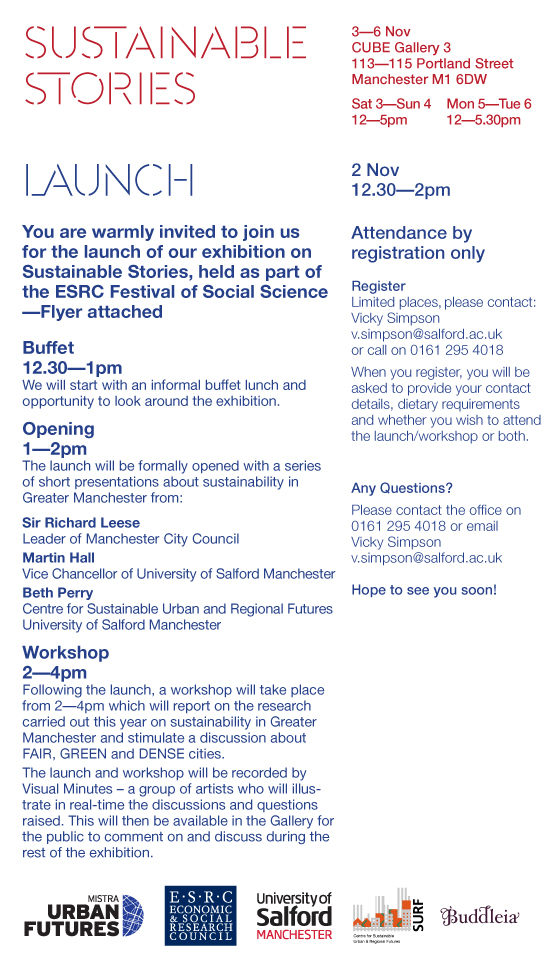
Upcoming Event: “Sustainable Stories” Friday 2nd November, Cube Gallery, #Manchester

Sustainable Stories:  An Interactive Exhibition

Sustainable Stories is an interactive exhibition designed to share and provoke discussion about the future of Greater Manchester.

The aim is to engage the public in a shared conversation about the challenges, issues and solutions to make Greater Manchester more sustainable.

You are warmly invited to join us for the launch at 12:30 on Friday 2nd November 2012 at the CUBE Gallery, Portland Street, Manchester.

The exhibition will be opened with a series of short presentations from Sir Richard Leese, Leader of Manchester City Council, Professor Martin Hall, Vice Chancellor of Salford University and Dr Beth Perry, Centre for Sustainable Urban and Regional Futures.

A workshop will then take place from 14.00-16.00 which will report on research carried out by the Greater Manchester Local Interaction Platform in order to stimulate a discussion about FAIR, GREEN and DENSE cities.

Please see attached flyers for more information and how to book for the launch and workshop (please note: booking is advised as places are limited).

The event is being held as part of the ESRC Festival of Social Science 3 -6 November 2012.


Posted in academia, Upcoming Events | Tagged , | Leave a comment

Youtube: The Biospheric Foundation & launch of “Bioremediation III” on Fri 26th October

Ahead of Friday night’s launch of Bioremediation III, here’s a very short video about the Biospheric Foundation, which is hosting the event/happening/performance…  For more details, see Jane Lawson’s website.

Posted in Upcoming Events, youtubes | Tagged , , , | Leave a comment

Upcoming event: The #Manchester Hackathon – Saturday 17th November 2012

This looks very interesting indeed. It’s happening at the wonderful Madlab, too, which is always a plus… Please pass on to any geeks you know…

Coders, Hackers & Developers needed to shape the future of the city.

For the first time ever, the City of Manchester invites you to dig underneath its digital skin. FutureEverything, Open Data Manchester and Manchester City Council are looking for experts and innovators to hack, code, programme and experiment with the city’s sets of open data to build new applications and develop future services.

Utilising the open data sets from DataGM made available by Manchester City Council and public sector partners, participants are welcome to produce anything they wish – develop applications to help people find their way around, stay safe, discover new experiences and everything and anything in between. All data is released under the Open Government Licence.

Taking place at MadLab in the heart of Manchester’s Northern Quarter on Saturday 17th November, the Manchester Hackathon is set to be an intense, productive and exciting collaboration between the brightest minds in software development and data processing. Entries from both teams and individuals are welcome, and there are cash prizes to be won for the best product at the end of the session, including;

• Grand Prize – £4,600*
• Best Under 21’s Creation – £600
• Best Visualisation – £600
• Best Locative Application – £600
• Developer’s Prize – £600
• Best Solution for an Identified Problem – £600
* £1000 prize & £3,600 development funding

The prizes will be selected by a panel of independent industry experts, including Dave Carter (MDDA) and Lou Cordwell (magneticNorth).

The Hackathon takes place on Saturday 17th November 9am – 7pm, with a warm-up and networking session beforehand at MDDA (Lower Ground Floor, 117-119 Portland St, Manchester, M1 6ED) on Friday 16th November 6.30 – 8.30pm.

The event is completely free to enter and open to all.

Click here now to sign up.

The Manchester Hackathon is partially funded under the ICT Policy Support Programme (ICT PSP) as part of the Competitiveness and Innovation Framework Programme by the European Community.
Posted in Upcoming Events | Tagged , | 1 Comment

Event Report: Sceptical about scepticism as the cause of the climate movement’s failure

Dr Lorraine Whitmarsh came to Manchester and gave a very compelling seminar about the causes and consequences of climate scepticism. MCFly co-editor Marc Hudson wonders, though, if the reasons for the laughable state of the “climate movement” – a topic that Dr Whitmarsh was not, to be fair, setting out to tackle – lie elsewhere…

She spoke to about 45 people at the latest in the Centre for Census and Survey Research, Institute for Social Change and Social Statistics Seminar Series. She opened with an overview of the consensus around climate change (IPPC 4AR and beyond) and the ways the public are involved (a. energy use – domestic, transport and also “embedded emissions”, b. on the receiving end of climate risks and c. supportive (or opposed) to specific policies),

Apparently awareness of the issue is virtually universal, but many/most see it as a distant/low priority. This is partly down to optimism bias (folks thinking they’ll be okay) and temporal discounting (“why worry, it’s the future?”) and psychological distancing (“far of people of whom we know little”).

Concern about climate change is volatile, partly due to the “finite pool of worry” and partly because of the “availability heuristic” (people can more easily imagine other problems).

In a pope-still-catholic moment, it turns out that (rich) old white men are over-represented in denialist circles.

On the question as to why some people are sceptical, Dr Whitmarsh said that there were two popular explanations

  1. it’s down to ignorance/misunderstanding (and the solution is… more information!)
  2. it’s due to different (and threatened) worldviews (as argued in Mike Hulme’s “Why we disagree about climate change”)

She said there’s empirical support for this, and described a survey she did in 2008 or so, a postal survey of two regions of the UK. It turns out, as per before, that old men, especially those with an income in excess of £75,000 are the most sceptical (see Terror Management Theory below)

So, lots of conservative voters “sceptical” and UKIP voters “off the scale.”

 Is scepticism rising?

Well, the Daily Mail would like to crow about that, and if it has indeed “doubled” its from a relatively low baseline.  In general, the answer is depends where you measure from, and concern/”belief” seems to be bouncing back up a bit…

At this point Dr Whitmarsh asked the audience what they thought might explain a dip in concern/rise in scepticism

  • individuals losing stomach for belief once it will cost them money
  • politicians not doing anything
  • no personal experience
  • the weather
  • recession
  • denialists being good at what they do
  • media milking controversy
  • boredom with the issue
  • people generally more sceptical about everything

Dr Whitmarsh mentioned the hacked emails “Climategate” in 2009, but it turns out those sorts of single events haven’t been that important – they’ve merely re-inforced specific views, and many people haven’t heard of it.

She pointed out that both the sceptical and concerned ways of thinking and justifications for inaction/action have been around for a generation (or more) and that the recent drop in concern is perhaps related to the reduced media coverage.

She closed with the “what is to be done” question. I’ll try to get hold of the slides for this.

Source – trusted, attractive, independent
Message – context, format, tone, language, balance, image. Fear should be used with caution, since it can lead to apathy, denial
Audience – those that are motivated to think
Context – timing, consistency,/congruence with other messages.
Target concerns and values of your audience-proposals

What could have been mentioned (though to be fair, an hour is not a very long time at all!)
the Issue Attention Cycle (Anthony Downs)
Terror Management Theory

Things to look up
Finite Pool of Worry

MCFly sez: We have some laws and “action” “plans”, but they’re not worth the paper they are written on. Our bureaucrats and “policy”- “makers” are in an circle je… echo chamber (this is a family publication, after all.) Meanwhile, the climate movement failed to find ways to communicate the urgency, to get beyond scare tactics. The climate movement failed to understand that it would be a marathon, not a sprint, and that sitting in a field surrounded by cops wasn’t going to put pressure on local politicians and local bureaucrats. We have met the enemy, y’see, and he is us.

Also, if we need more participatory forms of decision-making, then we also need more participative forms of academic ritual. Just sayin’.

Posted in academia | Tagged , | 2 Comments

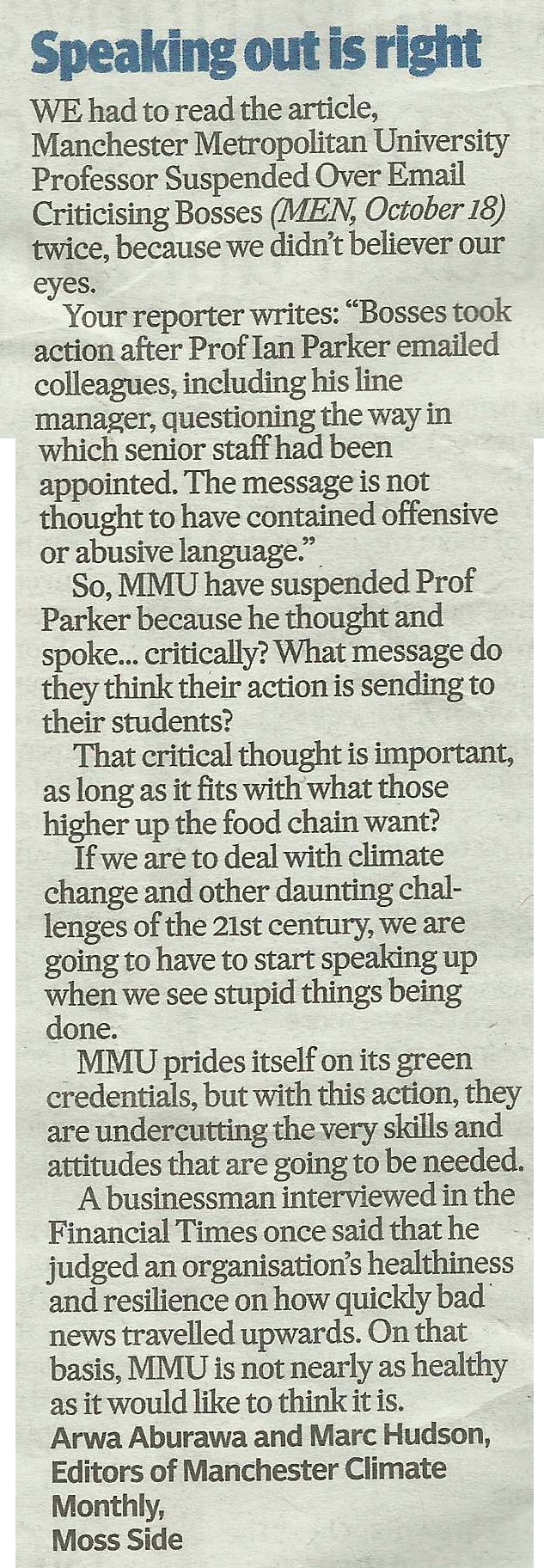
MEN letter on academic freedom, #MMU and the skills and knowledge we need for the rocky road ahead

UPDATE: Campaigners are asking you to “LOBBY Ian Parker’s disciplinary hearing – Wednesday 7th November, 08.30am, ORMOND BUILDING. (Please check www.asylumonline.net/ian  on the day – last time management changed the venue at a few hours’ notice).”

The Manchester Evening News published a letter of ours on Tues 23rd.  We wrote it to support Professor Ian Parker, who has been suspended by his employers for, um, thinking critically. You can read more about it here, and, if you wish, sign the petition.

We had to read Thursday’s article “Manchester Metropolitan University professor suspended over email criticising bosses” twice, because we didn’t believe our eyes. Your reporter writes “Bosses took action after [Professor Ian Parker] emailed colleagues, including his line manager, questioning the way in which senior staff had been appointed. The message is not thought to have contained offensive or abusive language.”

So, MMU have suspended Professor Ian Parker because he thought and spoke… critically? What message do they think their action is sending to their students? That critical thought is important, as long as it fits with what those higher up the food chain want?

If we are to deal with climate change and other daunting challenges of the twenty-first century, we are going to have to start speaking up when we see stupid things being done.
MMU prides itself on its green credentials, but with this action, they are undercutting the very skills and attitudes that are going to be needed.

A businessman interviewed in the Financial Times once said that he judged an organisation’s healthiness and resilience on how quickly bad news travelled upwards. On that basis, MMU is not nearly as healthy as it would like to think it is.

Arwa Aburawa and Marc Hudson
Editors of Manchester Climate Monthly

PS The “believe/believer” typo was accidental, and our fault.
UPDATE:

It is now common knowledge that Ian Parker has been suspended from MMU, and that he is prohibited from discussing his case with colleagues there, entering university premises or accessing his work email. At least this much is known to people inside and outside the university, but secrecy surrounds what exactly it is that he has done. Lest he attracts another charge of failing ‘to comply with a reasonable management instruction’, he cannot yet say exactly what has been happening. Not only have people declared their outrage at what has happened but they have made a leap of faith to do that. In some cases people have been concerned that they do not have all the facts, they are understandably reluctant to stand by Ian if there is a possibility that he has really done something terrible that merits the suspension, and the suspicion that the suspension breeds will already have had direct effects on his work. The secrecy surrounding his case is seriously damaging not only MMU but Ian’s reputation. Ian has made it clear that he is happy for all documents, letters and emails relating to his suspension and disciplinary process at MMU to be released to the public. As a first step to repairing his reputation, and reassuring those who have any doubts over this case, we call on MMU to desist from simply repeating that external speculation around the reasons for the suspension is ‘wholly inaccurate’ and to state openly what the charges are. Anyone who would like to support him, despite or because of lingering worries about what he may have done, could now simply demand of MMU that they tell the truth.

Letters to this effect can be sent to the Vice-Chancellor John Brooks (john.brooks@mmu.ac.uk) and of the Department of Psychology Christine Horrocks (c.horrocks@mmu.ac.uk). These messages can be copied as messages of solidarity to the MMU UCU chair Pura Ariza (p.ariza@mmu.ac.uk) and it is imperative that, at the same time, support should be stepped up to support Christine Vié (c.vie@mmu.ac.uk) the MMU UCU vice-chair who has been singled out for redundancy.

Posted in academia, Signs of the Pending Ecological Debacle | Tagged , | 1 Comment

Youtube: Greater #Manchester Tree Station and its community share offer

On Sunday 21st, Tree Station held a community open day. I went along and got some interviews with Nick, Matt and Patrick.

Would love people’s comments on these videos, especially suggestions for improvements!

Marc Hudson
mcmonthly@gmail.com

Posted in volunteer opportunity, youtubes | Tagged | 1 Comment

Interview with Warren Hatter on local government and low carbon policies

Warren Hatter is a London-based consultant and commentator with a special interest – and many years experience – in local government and carbon policy. MCFly co-editor Marc Hudson asks him a few questions…

Is local government where it needs to be on climate change, compared to the hopes that were around when the Nottingham Declaration was created?
You’d be surprised if I said that local government now was brilliantly addressing climate change, and I won’t let you down on that. You’re right about the Nottingham Declaration (in 2000) though. There was a lot of optimism, wasn’t there? I recall that those were more optimistic times generally around local government, which is a factor; I bet professionals in many fields would say that local government is a less hopeful place now than then. A new government had come to power with promises of devolving responsibility to local government (this might sound familiar!) and times were not as tough as they are now financially.

There was also a clear direction of travel in relations between central and local government; the idea was emerging that local government’s core function was “place shaping”, not simply delivering services. As a local authority leader, having a comprehensive approach to carbon and climate only really makes sense if you see your role in those terms. If you see yourself as first and foremost a service deliverer, then it only makes sense to address the carbon linked directly to service delivery.

However, I don’t think we ever had a positive, constructive narrative about low carbon places – about how we can be fulfilled, have fun, get on with people, be healthy, etc. Instead, carbon (and sustainability more broadly) has tended to be framed as a threat, addressing it looks dull and worthy, and the visions there have been look twee or hair-shirted to many. This is not local government’s fault, of course – on the whole, we went with the crowd.

I think there are governance reasons, too, for many local authorities not having successfully nailed their approach to carbon. In particular, I’d identify the lack of obligation to consider the half of our carbon footprint that is in the supply chains of the things we buy and use (scope 3 emissions) and the lack of interest in this – with honourable exceptions, of course. One problem with considering only territorial – or production – emissions is that these perspectives are simply not very engaging. Who, as a resident, could really get motivated by reducing the emissions of a place, which includes and excludes different items in a way that makes no sense behaviourally? For example, if I drive a car on a journey, the only emissions that count in the Borough’s footprint are those from the petrol I burn as far as the Borough border.

The lack of confidence in recent years has also been damaging. A confident local government family would, since the Climate Change Act, have been trying to persuade central government to let it take on responsibility for delivering on the UK’s carbon budget – each place taking its fair share. But, frankly, there was no stomach for this from the local government establishment, although a decent and impressive cross-section of Leaders campaigned for this with Friends of the Earth.

Most recently, the narrow focus that has come with dealing with extensive budget cuts has been another factor. And, over several years, the relative lack of officer capacity hasn’t helped.

I should add, though, that there has been progress, and some standout authorities, throughout the 12-year period you’re asking about. And, across UK local government, there are very many authorities with solid delivery on climate and carbon.

Could you name some UK local authorities which are doing well on mitigation, and give your impressions of what the reasons for that good performance are?
I’m not in the best position to judge, as I don’t get to hear about all the good stuff that goes on. Off the top of my head, I’ve been impressed by a number of the initiatives I’ve heard about in Bristol, and by the way that Haringey has introduced an annual carbon-focused full Council meeting. My time as a judge for the Low Carbon Council category in the Local Government Chronicle awards (I’m just waiting for this year’s batch of applications!) tells me that there are plenty of councils with impressive initiatives to reduce emissions in their own estate and operations, and also a number who have done good work with businesses: Oxford springs to mind. I’m pretty sure that there is some good work being done by councils in support of Transition initiatives, though the only one I know much about is Lambeth, near where I live, where the Council has supported the Brixton Pound, for example. Brighton & Hove introducing the Phlorum tool is a positive step, as it prompts the inclusion of supply-chain emissions in the consideration of building plans. Aberdeen, Peterborough and Durham should also get honourable mentions here. That’s all very top-of-mind, and I’m bound to have forgotten some really good examples. I’ll apologise in advance, and also point out that I’ve deliberately not mentioned clients; it wouldn’t seem right!

What does “behavioural economics” have to offer to help increase levels of participation in “green” activities (whether it’s recycling, civic engagement around low carbon etc)?
My view is that insights from behavioural sciences can be really useful. One of the flaws with the ‘green’ movement has been that, like many, we’ve tried to persuade people to do the right thing for the right reasons. In practice, we’re nowhere near as rational or in control as we like to think we are. We should be making sustainable behaviours easy, normal and rewarding
Understanding our biases, which all have sound evolutionary reasons, can also be good for helping us understand and change our behaviour as citizens. For example, if I understand loss aversion, I can find ways around it in my life: if deciding whether to keep a possession or pass it on, I should consider how much effort I’d be willing to make to obtain it (or how much I’d pay) if I didn’t have it. To understand loss aversion, do I need to understand its roots in evolution (that nearly all my ancestors didn’t know if they had enough food to get through the season, most of the time), or do I just need to access a tool to address it, and see if it works? I don’t know.
People might see this as a fad, but I reckon it’s deeper than that, not least because much of the evidence from decision sciences has emerged in the past couple of decades, and these things take time to filter through.

If you were David Cameron for a day, what would you do?
The two things that central government could do that would set the framework within which it would make perfect sense for local government to do a great job on climate change are, firstly, to find a way of moving towards consumption-based carbon metrics being the main reference point for addressing carbon …

If you were Eric Pickles for a day, what would you do?
… and, secondly, to disaggregate the national carbon budgets in the UK Low Carbon Transition Plan to the local level, so that each local authority – or, more appropriately, each place – is accountable for reducing its share of emissions. Ideally, this would include consumption-based emissions. This would bring an immediate focus to policy-making around influencing behaviour.

Anything else you’d like to say?
How about I tell you why I remain optimistic? Our species is phenomenally successful, which should give us some confidence in our ability to reverse the way we’ve begun to exceed our planet’s natural limits. The other side of that coin has always been that we *know* we’re exceeding those limits yet continue to push – but we are now beginning to understand our quirks and biases as humans, which are ideal for the world of 200,000 years ago, and which explain why we behave in this way – and this gives me some hope that we’ll still pull through.

Posted in Interview | Tagged , | 2 Comments

Job Alert: Horticultural Development Worker at Debdale Eco Centre in Gorton, #Manchester

from environmentjob.co.uk

Horticultural Development Worker
Organisation: Debdale Eco Centre
Salary: £16,000
Location: Gorton, East Manchester
Hours: Full Time
Position type: Paid
Contract: Fixed Term Contract
Website: http://www.debdale-ecocentre.org.uk
Contact name: Helen Dodd
Contact telephone: 0161 220 9199
Contact email: helen@debdale-ecocentre.org.uk

An exciting opportunity has arisen within Debdale Eco Centre (DEC) and Hulme Community Garden Centre’s (HCGC) Big Lottery Funded Local Food Project for wider organisational development. The role will see the successful applicant developing identified physical capital food growing projects which will contribute to longer term sustainability. You will need to be a self starter, able to take the initiative and with a passion for local food.

Some of the job responsibilities:

Develop identified capital projects – from build to harvest
Proactive recruitment of project volunteers and project partners
Develop sustainable growing projects working with vulnerable adults and volunteers
Identifying new opportunities and problem solving

The applicant will be responsible to the DEC Manager.

For a job description and application form please visit the Latest News page of our website – http://www.debdale-ecocentre.org.uk or ring Helen Dodd on 0161 220 9199

Please send completed applications to the email or postal address on the application form.

Deadline: 4pm on 5th November 2012

Interviews to be held Wednesday 14th/Thursday 15th May. We will contact applicants that we wish to interview by 5pm Thursday 8th November

Posted in Job Alert | Leave a comment

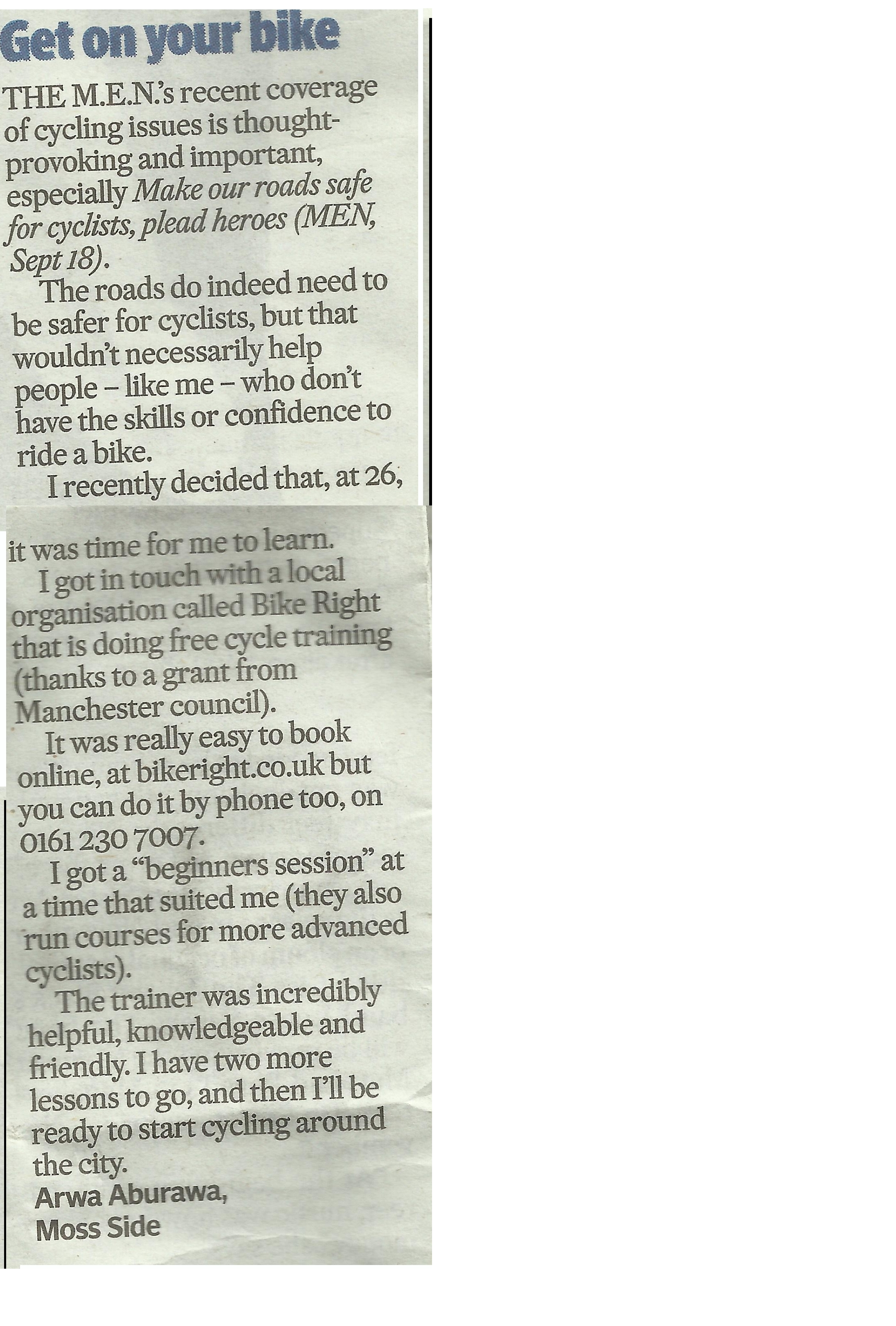
Get on your bike: free cycle training for #Manchester residents

MCFly co-editor Arwa Aburawa decides to learn to ride a bike…
Recently, after some coaxing by my MCFly co-editor that I just hurry up and get myself a bike, I attended the level 1 adult cycling training at Bike Right. I was lucky enough to get the trainer Lucy to myself for the whole two hours as it appears no-one else had booked for the session. She got me kitted up very quickly and took me to the nearby park to get started straight away. After gauging my cycling experience she talking me through the very basics such as getting on the bike in a more lady-like manner, setting off on my bike, standing up, signalling and also looking behind me on the bike. She also talked me through the gears and the basic components of a bike. I was really impressed with how encouraging she was and her advice about not over-thinking it all put me at easy and so it all came more naturally that way.
At the end of the two-hour session, which literally flew by, I was feeling a lot more confident about my cycling ability and I am already sorting out ways to keep me practising. I am also planning to re-attend the course in a couple of weeks to check up on my progress. It was pretty simple to book the session. They sent me an email explaining how to get to the centre via public transport and text me two days before to confirm I was still coming along. I also got a free cycling map at the end of the session!
Did I mention that this course is completely free? Well, it’s free and you can also go along to each of the training levels a maximum of three times which means you can build up your skills at your own pace.
PS I did an “advanced” training session, which was one-to-one.  Extremely knowledgeable, organised and useful.  We went and tackled a couple of roundabouts that have been giving me the heebie-jeebies.  I cannot recommend the BikeRight training strongly enough. Marc Hudson
Posted in inspire, Transport, Unsolicited advice | Tagged , | Leave a comment