Event Report: Launch of “Manchester Carbon Literacy”

Jonathan Atkinson, writing in a personal capacity, reports and comments on an important launch at the Arndale Centre…
Tuesday saw the launch of Manchester Carbon Literacy, a highly ambitious and powerful programme that seeks to make available a day’s worth of training in climate change awareness to everyone who lives, works or studies in Manchester.

The launch took place at the Manchester Arndale shopping centre and featured speeches from Manchester City Council Leader Richard Leese and MMU Vice Chancellor Professor John Brooks as well as Dave Coleman and Phil Korbel from Cooler, the social enterprise that have been pioneering the programme over the last few years.
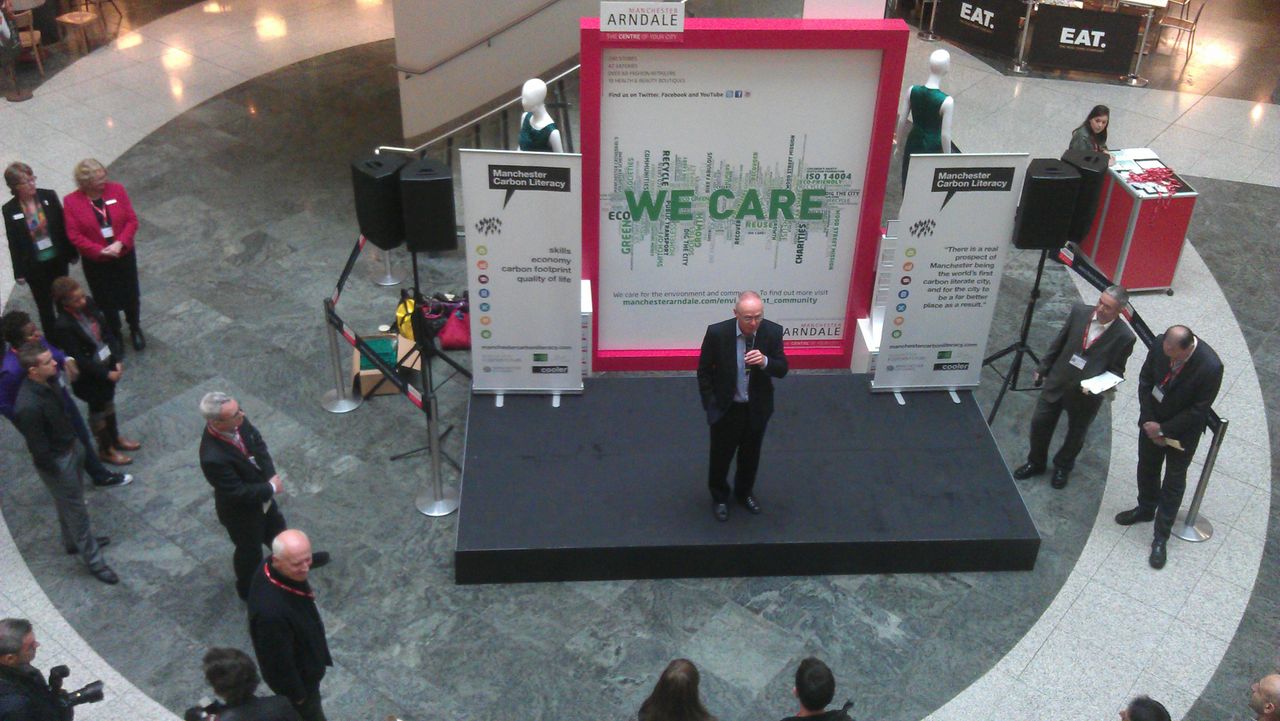
Carbon Literacy Pilots have been running throughout the city for the past twelve months and the first fifty Carbon Literate graduates, including staff from the Arndale, Manchester City Council and pupils from Stanley Grove Primary School, were awarded their green mortar boards at the event.

The presentations were followed by complimentary refreshments and general networking and mingling and it was encouraging to see a good turn out from a wider range of sectors including business, educational institutions , community and campaign groups as well as those graduates.

Manchester Carbon Literacy are now seeking to roll the project out city-wide and are planning a large-scale engagement event early in the new year and looking for freelance trainers.  [And more volunteers]

Find out more at: www.manchestercarbonliteracy.com

Comment (by Jonathan Atkinson)

I thought staging the launch in the Arndale, a modern-day temple of Mammon and surely an example of all that is unsustainable, was a brave move but ultimately a canny one strategically.

Firstly, for Manchester Carbon Literacy to succeed, by its very definition it needs to reach beyond the converted. Holding the launch in the middle of the day during the week at the Arndale succeeded in attracting a healthily, large and diverse audience, something traditional green groups struggle to do at venues such as the Student Union, Friends Meeting House or the back room of a pub.

Secondly there is the subversive element, if Manchester Carbon Literacy succeeds in its aim (and let’s hope to hell it does!), we’ll be blessed with a population of empowered, knowledgable and active citizens. In this carbon literate future we’ll be able to make our own, informed, choices as to the wisdom of cheap flights abroad, houses without any insulation and ultimately, a consumerist society.

In the end this is a project all environmentally-motivated people should support in the hope that this initiative might bring about a genuine culture shift on climate change from the bottom up.

Let’s hope so anyway!
Posted in Event reports | Tagged , , , , | Leave a comment

Shale Gas really not low carbon in any way shape or form (#pressreleasecutandpaste)

We really don’t like to cut and paste press releases, but right now we are totally snowed under…

US Shale Gas Drives Up Coal Exports

A report by researchers at The University of Manchester has concluded that whilst the US is burning less coal due to shale gas production, millions of tonnes of unused coal are being exported to the UK, Europe and Asia. As a result, the emissions benefits of switching fuels are overstated.

US CO2 emissions from domestic energy have declined by 8.6% since a peak in 2005, the equivalent of 1.4% per year.

However, the researchers warn that more than half of the recent emissions reductions in the power sector may be displaced overseas by the trade in coal.

Dr John Broderick, lead author on the report from the Tyndall Centre for Climate Change Research, comments: “Research papers and newspaper column inches have focussed on the relative emissions from coal and gas.

“However, it is the total quantity of CO2 from the energy system that matters to the climate.  Despite lower-carbon rhetoric, shale gas is still a carbon intensive energy source. We must seriously consider whether a so-called “golden age” would be little more than a gilded cage, locking us into a high-carbon future.”

Professor Kevin Anderson of the Tyndall Centre notes: “Since 2008 when the shale gas supply became significant, there has been a large increase in US coal exports. This increases global emissions as the UK, Europe and Asia are burning the coal instead. Earlier Tyndall analysis suggests that the role for gas in a low carbon transition is extremely limited, with shale gas potentially diverting substantial funds away from genuinely low and zero carbon alternatives”

This Co-operative commissioned report “Has US Shale Gas Reduced CO2 Emissions?” [pdf] is the third on shale gas from the Tyndall Centre – and builds on several years of research and submissions to the UK and European Parliaments as well as the International Energy Agency.

Chris Shearlock, Sustainable Development Manager at The Co-operative, said: “The proponents of shale gas have always claimed that it is a lower carbon alternative to coal. However, this is only true if the coal it displaces remains in the ground and isn’t just burnt elsewhere. Without a cap on global carbon emissions, shale gas is burnt in addition to other fossil fuels, increasing total emissions.”   

Posted in Energy | Tagged , , , | 1 Comment

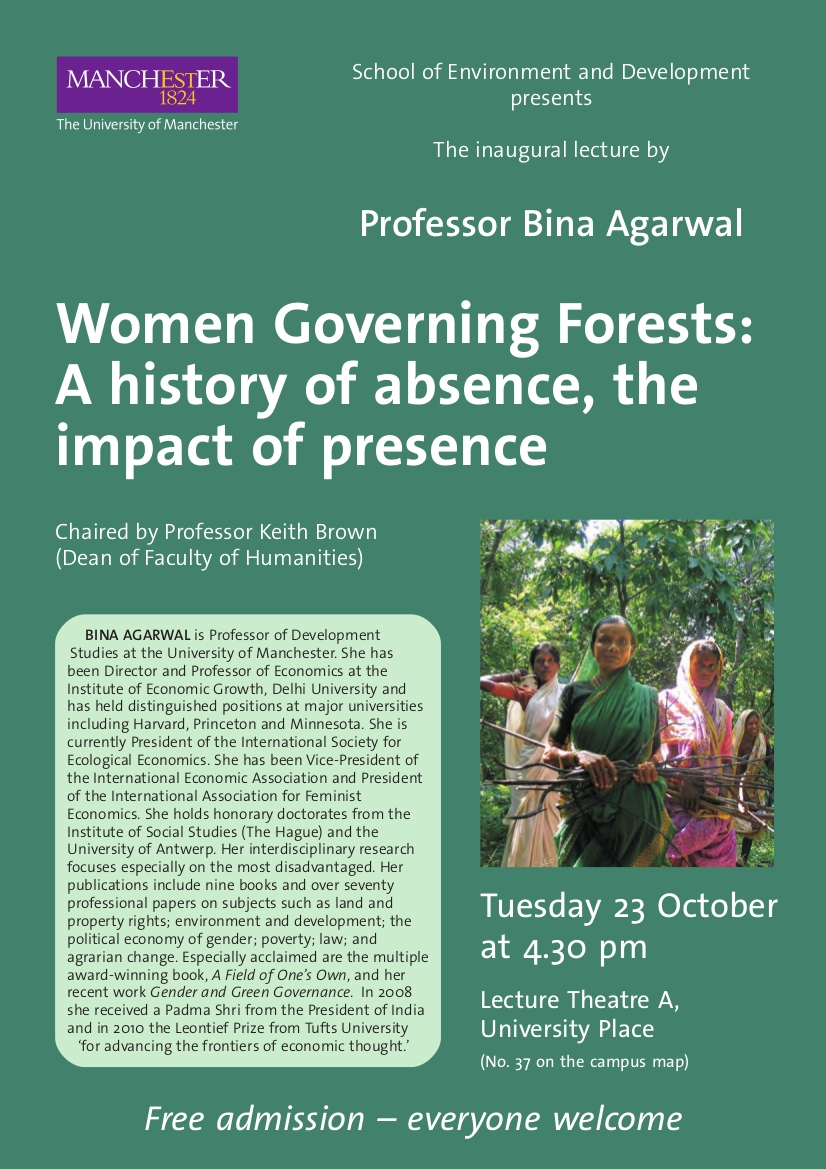
Event Report: “Women Governing Forests : A History of Absence, the Impact of Presence”

MCFly volunteer Judith Emanuel went along to the inaugural lecture of  Professor Bina Agawarl at the University of Manchester and had this to report.

Manchester’s environmental community has a wonderful new asset, Bina Agarwal Professor of Development Economics and Environment at Manchester University. Her inaugural lecture this October, with the lovely title above, was inspiring in terms of its jargon-free accessibility, gender, equity and environmental analysis. Bina pointed out that economists studying environmental collective action and green governance have paid little attention to the question of gender. While women worldwide are the principal gatherers of fuel and food from forests and are very knowledgable about forests generally this is not recognised and it is assumed that people or villagers are the ‘experts’.

There has been international concern about the state of forests since the 1970’s. Initial action was very top down and not successful at revitalising forests. Bina’s research has looked at the impact of women’s involvement in community forestry institutions (CFI’s) on forest canopy and regeneration in Nepal and the Gujerat in India. Her conclusions are that if landless women make up at least 25-30% of CFI’s and are in key positions, it makes a significant difference to greening the forests. Why? She argues that it takes a critical mass of women to have a voice on the committees and they bring with them their stake in conservation, their ability to conserve and their knowledge of plants and species because of their everyday dependence on the forest which men do not have.

While in the short term it may be in the interests of landless women to extract as much as possible from forests, through involvement in CFI’s, landless women have developed a greater understanding of the importance of conservation. They share their understanding and information with other women which has reduced hostility to conservation action and changed the way women use forests – a ‘win win’ situation.

Ultimately Bina is convinced that for the sake of environmental sustainability it is crucial that women’s dependence on the forest is reduced by the introduction of more environmentally friendly cooking stoves and clean fuel. What’s the learning for us? Can the changes we need to make be undertaken without the stakeholders who currently lack power and influence and whose short term needs may be best met by consumption rather than conservation? If we want their support do they need access to understanding what needs to happen and why and opportunities to influence change?

Further reading
Gender and green governance : the political economy of women’s presence within and beyond community forestry by Bina Agarwal Oxford University Press, 2010

Posted in academia, Adaptation, Democratic deficit, Event reports | Tagged | Leave a comment

Polar Bear facepalm: Hampshire Council to discuss banning wind farms

The BBC story is here.

Hat-tip to Pete Abel of Manchester Friends of the Earth for facebooking the story.
Posted in Energy, humour | 3 Comments

Event Report: ‘The Rapidly Changing Arctic Climate: what does it mean for you?’

MCFly wasn’t there at the Levenshulme Festival for this one, so is relying on the jottings of a couple of folks who were. Thanks to them!

As part of the Levenshulme Festival Professor Terry Callaghan of Sheffield University spoke on the theme ‘The Rapidly Changing Arctic Climate: what does it mean for you?’. Terry – who was brought up in Levenshulme – is a research scientist who shared the 2007 Nobel Prize as a lead author of the Intergovernmental Panel on Climate Change report.

  • Full room with seating on the diagonal to view a screen in one corner.  Little professor buzzing from one angle to another with lively commentary on successive diagrams, graphs and photos.
  • Ice mountains slipping tipping rotating and crashing into the sea.
  • Population graphs rocketing to vertical.
  • Heat out there quite separate from heat down here.
  • Oceans different from one another (now how mad is that when they are all joined up)
  • Huge new waterways across the Arctic where in my lifetime it was all solid ice.  Quick route to Japan.
  • Parts of Scotland still rising from the sea, while land elsewhere is flooding.
  • Bangladesh, Holland, Sweden for example could disappear under water in no time.
  • Millions displaced.
  • The wicked grip of multinational oil companies across the arctic and the world.
  • This was a vivid, informative display……..  while Rome burns.
  • Many certainties and loads of unknowns.

A young woman asked what she could do and the final shot from Terry Callaghan was to say that she could establish email contact with children in the Arctic to get involved in conversation with them, and he gave her some contacts. Otherwise he was unremittingly gloomy (!) – but then he is a scientist and in the nature of the meeting the politics & morality of response to climate change did not really get a voice.

Posted in Event reports | Tagged , , , | Leave a comment

Update: End of the Environment Commission

With the Environment Commission well and truly buried, all eyes are now on the Low Carbon Hub which is tasked with delivering Greater Manchester’s Climate strategy

After a shock announcement that the Environment Commission is no more, MCFly got in touch with the Association of Greater Manchester Authorities (AGMA) to find out why. An AGMA spokesperson informed us that since May 2012, when Dave Goddard -its first and only chair – lost his council seat in the local elections, the commission had lacked political leadership and had been under review.

The spokesperson added that leader of Manchester City Council, Richard Leese, has now taken an interest and will incorporate the commission’s work into the Low Carbon Hub, if the proposed plans are accepted at this Friday’s AGMA/GMCA executive meeting.

The work of the EC will be “streamlined” into the Low Carbon Hub’s work and these changes were about “improving management.” The spokersperson added that the changes to the EC are not unique as all the 5 AGMA commissions are currently under review.

The Low Carbon Hub, which was announced in March 2012, is part of the ‘Deal for Cities’ for Manchester which included the Green Investment Bank initiative. The Deal for Cities is part of a Central Government strategy to encourage economic growth in cities. According to the AGMA report which will be presented this Friday, the Hub will have four primary aims:

• Realising the economic opportunities associated with transition to a low carbon economy;
• Supporting Greater Manchester’s 48% carbon reduction target by 2020;
• Increasing awareness and understanding leading to behavioural change; and
• Preparing Greater Manchester to adapt to the unavoidable effects of climate change.

Richard Leese has been selected to chair the Low Carbon Hub Board with various members from the Environment Commissoin finding a place at the Hub. That includes the Cooperative Group, Roger Milburn from ARUP, Manchester Airport, Anne Selby from the Merseyside Wildlife Trust, Neil Swannick. The report also hinted that the implementation plan for the GM Climate Change Strategy, which the Environment Commission insisted would be published imminently, was nowhere near completion:

“The Low Carbon Hub offers the opportunity to jointly devise a climate change implementation plan for Greater Manchester aimed at setting a pathway towards achieving our 48% carbon reduction target by 2020… It is proposed that the Low Carbon Hub Board will be responsible, on behalf of the GMCA/AGMA Executive Board, for developing and putting in place the delivery arrangements for Greater Manchester’s Climate Change Strategy and other environmental priorities.”

MCFly says: As another organisation dies a quiet death and a shiny new one is launched, I can’t help but feel skeptical. For one, I am so report-weary at the moment and that is all that ever seems to come out of Greater Manchester when it comes to climate change. So until the Low Carbon Hub actually does something, I won’t be cheering them on from the sidelines.  Typically, the agenda item report also failed to admit that the EC has been something of a failure.  The writers of these reports seem either unwilling, or perhaps unable to look into how they could avoid making the same mistakes. In the absence of this reflection, what’s to prevent today’s Hub being replaced by a Commission in three years time?

Posted in GM Climate Strategy | Tagged , , , , | Leave a comment

#Manchester #climate nuggets October 29 2012

Hi all,

a date for your diaries: the evening of Tuesday 20th November sees the launch of the “In Place of Growth” report, looking at how Manchester can move towards a steady state economy. It’s at the Mechanics Institute on Princess St. There’ll be lots of mingling, opportunities to find out about things happening in Manchester that you can get involved in and generally interesting people to talk with.

Arwa Aburawa and Marc Hudson

Coming up this week

Mon 29, 10.30pm  Launch of Manchester Green Corridor walking circuit. See details here, via Cllr Victor Chamberlain’s site.

Mon 29 Oct – until Fri 2nd November Cooperatives United World Expo, Manchester Central

Monday 29, 6:30pm “Feeding a growing world” a discussion about solving the conundrum of feeding a growing world. Part of Manchester Science Festival. Free, but you need to book here. Venue is Cross St Chapel, Cross St.

Mon 29th 7pm, Withington Co-operative Eco-house is back! in Fuel Cafe Bar.

Tues 30 Launch of Manchester Carbon Literacy Project at the Arndale

Weds 31st “Greenspaces and Communities” conference at Manchester Town Hall. More details here

Wed 31 Oc 3.45pm – 5.45pm: The 4th Energy Revolution film screening, Manchester Central
Co-operative and community energy has the potential to play a lead role in addressing the urgent challenges of climate change, energy security and fuel poverty. It also brings a wealth of additional benefits and empowers communities to own, control and benefit from their own renewable energy and energy efficiency schemes.

A democratic revolution in energy is possible: be inspired to join the revolution at this special screening of the documentary ‘The 4th Revolution – Energy Autonomy’ followed by a Q&A and panel discussion with: Co-operatives Europe, The Co-operative Group, Friends of the Earth and Legacoop.
Watch the trailer: http://www.energyautonomy.org/index.php?article_id=29&clang=1

Thurs 1st Nov, 5-7pm, Tyndall Centre event: We need to talk about growth.  Roscoe Lecture Theatre B

Growth of the economy is generally taken to be an unqualified measure of success, but scientists from a range of disciplines are asking whether we might already have had too much of a good thing. Meanwhile, political economists are returning to the fundamental question of what the economy is for and what the consequences of setting other goals might be.

In Manchester, the City Council and civil society groups are considering the practicalities at a city scale and wondering if the financial crisis means that regional economies may struggle to return to economic growth at all.

This event, in a Question Time format, brings together a panel of experts and policy makers to discuss the key issues and answer your questions.

If you’d like to submit a question in advance please email tyndall@manchester.ac.uk with “Growth” in the subject line.

Speakers:
Richard Sharland, Head of Environmental Strategy at MCC
Baron Frankal, Director of Economic Strategy, New Economy Manchester
Dr Alice Bows, Sustainable Consumption Institute.
Prof Mark Burton, MMU & Steady State Manchester.
Dr Dan O’Neill, Centre for Advancement of the Steady State Economy & Leeds University


 Friday 2nd November, 12.30pm Sustainable Stories is an interactive exhibition designed to share and provoke discussion about the future of Greater Manchester.

The aim is to engage the public in a shared conversation about the challenges, issues and solutions to make Greater Manchester more sustainable.

You are warmly invited to join us for the launch at 12:30 on Friday 2nd November 2012 at the CUBE Gallery, Portland Street, Manchester.

The exhibition will be opened with a series of short presentations from Sir Richard Leese, Leader of Manchester City Council, Professor Martin Hall, Vice Chancellor of Salford University and Dr Beth Perry, Centre for Sustainable Urban and Regional Futures.

A workshop will then take place from 14.00-16.00 which will report on research carried out by the Greater Manchester Local Interaction Platform in order to stimulate a discussion about FAIR, GREEN and DENSE cities.

Please see attached flyers for more information and how to book for the launch and workshop (please note: booking is advised as places are limited).

The event is being held as part of the ESRC Festival of Social Science 3 -6 November 2012.

Stories you may have missed on the MCFly website


Posted in Weekly bulletins | Leave a comment

Event Report: “The goldilocks planet”…… or “Geology rocks!”

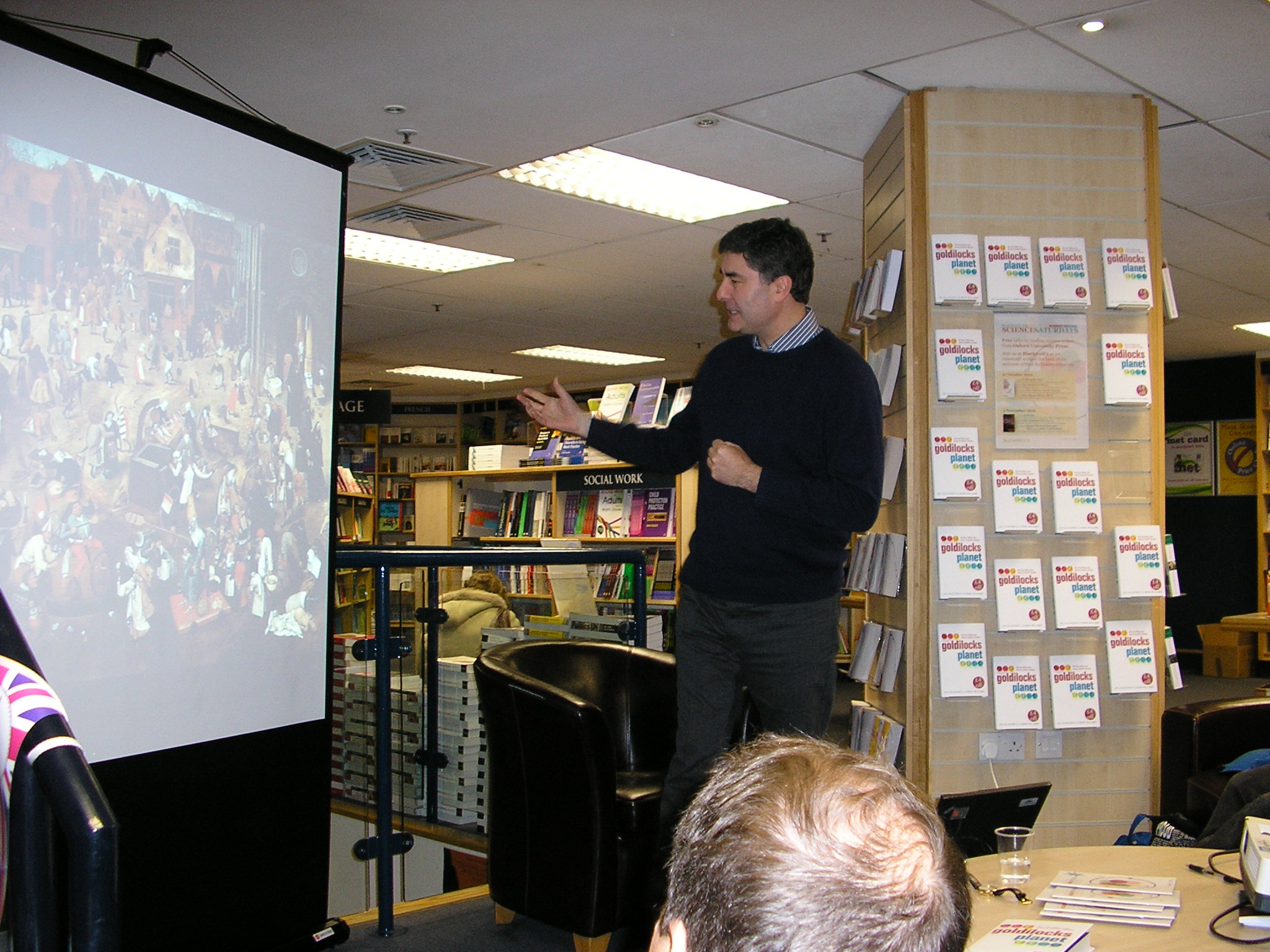
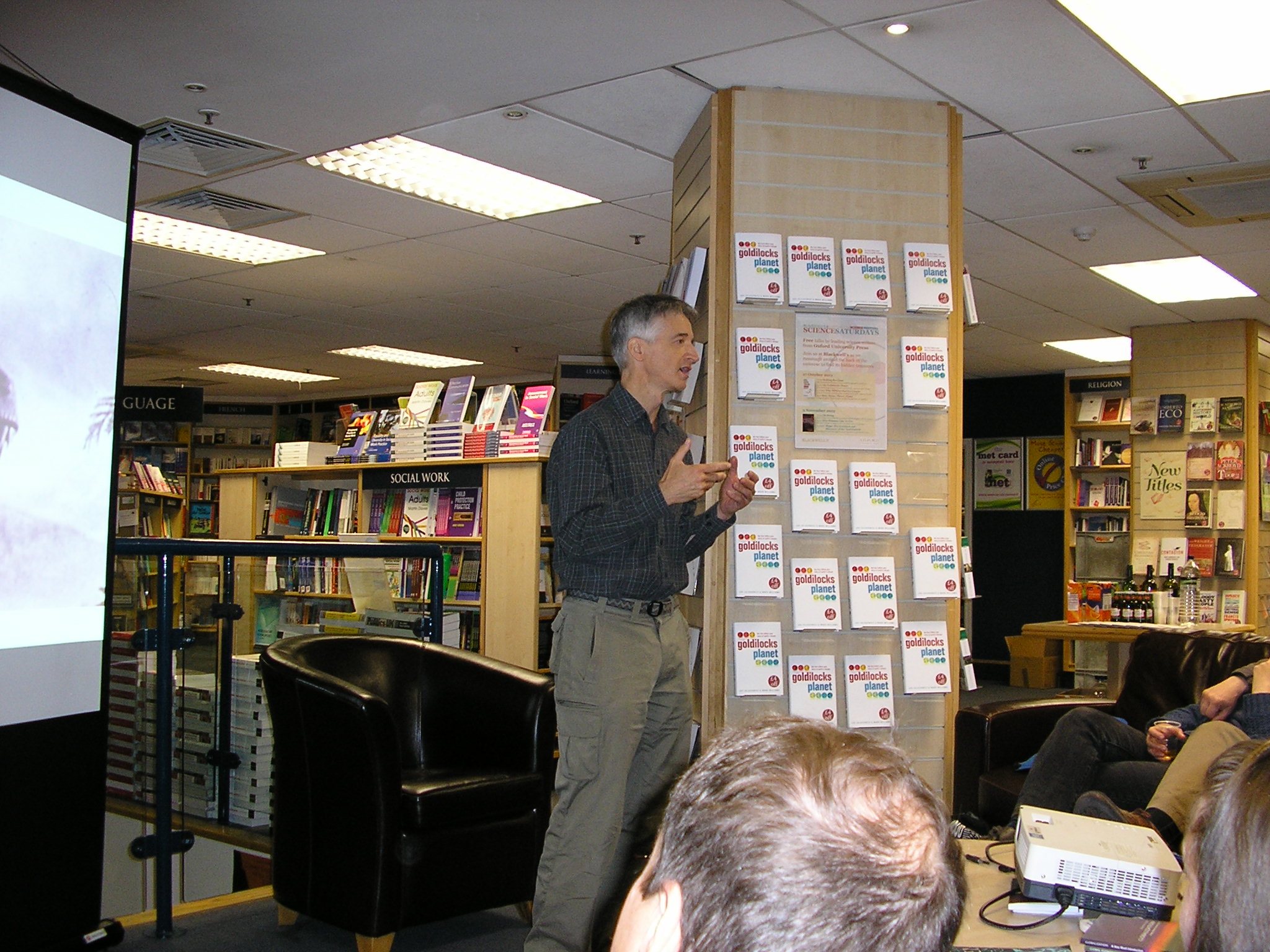
On Saturday, in less than 60 minutes, two academics raced through 4 billion years of Earth’s history, with time left over for questions. It was an enlightening and sobering experience for the 20 or so people present (an audience that included MCFly readers old and new). It happened at Blackwell’s bookshop on Oxford Road [the link lists the other five (free!) events over the coming week] one of the venues for this year’s Manchester Science Festival.

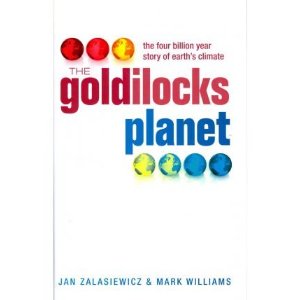
The academics in question, Dr Jan Zalasiewicz and Dr Mark Williams, both at University of Leicester, are co-authors of a book called “The Goldilocks Planet: the four billion year story of Earth’s climate.

They whipped through it all at a cracking pace. Mark Williams started, and an early analogy was compelling; a hundred years ago the state of geological knowledge was like that of a 13th century person using the “mappa mundi”. Now, in 2012, we’ve upped our game to … the 16th century.

There was lots of interesting stuff about the early oxygen releases binding to iron (and laid down, now dug up and used for, well, anything you use iron for). Once the iron was exhausted, the oxygen levels went up (2.5 billion years ago), and you start getting “glacial deposits” (ice, to you and me.)

Apparently there were long periods (a billion years or so?!) where not much was changing – it’s actually called the boring billion!. However, it wasn’t that boring – eukaryotic life kicked in.
There are then a series of “snowball earth” events (readers of James Lovelock’s Gaia got to nod wisely at this point), and that was only broken by lots of big volcanoes, caused by plate tectonics (the continents shimmying and rubbing up against each other).

One of Mr Wiliams points was that life is extremely hard to exterminate once it gets going. He spoke of the “Dry Valleys” in the Antarctic, which are so inhospitable that NASA use them as a proxy for Mars. And yes, there’s life there.

Zalasiewicz and Williams have an interesting concept of “the Calcite Metronome” – a “tick tock” that takes 100s of millions of years, involving plate tectonics and the opening and closing of continents.

Dr Williams got as far as the carboniferous, and then handed over to his colleague, who brought us from then (445 million years ago) to now.
He whizzed through the last big cold snap – 37.5 million years ago, btw – the Pliocene epoch and into the ”modern” world.

This includes the Holocene – the unusually stable last 12,000 years (think of lots of squiggles followed by a plateau. But don’t think of the ECG of someone flat-lining!)

And into the Anthropocene, the last 200 years (well, it’s complicated actually – see the video I made last year. Embedded below.). Our burning of fossil fuels has raised C02 levels to where they were 3 million years ago…

Dr Zalasiewicz closed with the classic understatement “we might expect interesting climatic times ahead,” and in the q and a he quoted Wally Broecker – “unpleasant surprises in the greenhouse.”

The question, of course, is how to communicate that… And then what to do about it.

Things that stood out:
Life is older than I knew. 3.8 billion years, anyone?
There were periods where everything in the oceans died because there was no oxygen, because of a 5 degree temperature rise, due to our old friend carbon dioxide – a “heart attack” he described it as.
10m of sea rise is no biggie, in geological terms (I knew this, but it’s good to be reminded).
The pre-Holocene to Holocene was accomplished in three years because of a “change in the plumbing” (I’ll try to track down the paper they mentioned)

How it could have been better?
Well, we came for a “sage on the stage” presentation, and they were certainly sagacious. Not every event needs to be radically participatory or “democratic” – that said, an invitation to talk to the person next to you before it kicked off, or to devise questions in pairs before the Q and A kicked off would have helped. This is quibbling, however, about a well-done event. Did these geologists rock? Yes they did.

Disclaimer: MCFly has accepted a kind (and unsolicited) offer from Oxford University Press for copies of both The Goldilocks Planet and Professor Bill McGuire‘s “Waking the Giant” (Prof McGuire gave an earlier talk which, by all accounts, was even more depressing than the geologist/paleobiologist one described here).
These two books will need to be reviewed. Any volunteers?

The Anthropocene

Posted in academia, Event reports | Tagged , , , , | 2 Comments

From the coalface – Pauline Lozoya Hocking and Climate Survivors

MCFly speaks to local campaigners Pauline Lozoya Hocking from Climate Survivors about how she got involved in climate change issues and what sustains her

What is your campaign trying to achieve?
I don’t know that I have, or have ever had, a specific campaign…. but
what I have, and have had, for well over twenty years since I first became
aware of climate change is a desire to raise awareness of the true nature
of the problem and the solutions that exist in abundance + of course the
ever ticking clock and finite timescale for action.  This has translated
into a myriad of actions (or campaigns) including youth projects, gardening
projects, film making, events, classroom sessions, dialogues with decisions
makers and – over the last 3 years – a regular commitment to the group Climate Survivors.

Why did you get involved?
After a crazy time as a lost and struggling young person – a time so self
destructive that I almost lost everything and could have easily died or
gone to prison (and not for respectable political reasons) – I found help
and it was like my life restarted.  I began studying and took up French and
Spanish.  I did a language exchange with a Swiss physicist called Serge.
He wouldn’t stop banging on about acid rain, ozone layers and climate
change and I thought he was an alarmist.  But suddenly, something clicked.
I had an OMG moment and have been banging on about climate change myself
ever since.

What sustains you?
Meditation, salsa dancing, hugs, chocolate, laughing with friends, lots and
lots of love in my heart and an undying belief that humans are capable of
and can achieve a much better world than the one we are living in.

What was the last big success your campaign had?
The nature of my ‘campaigning’ means I don’t have a straightforward answer
to that – but the big positives that have given me and others joy and had
lasting effects are – young people who are now adults saying that our
environmental youth work changed their lives and attitudes for the better;
the planting of a youth and community orchard in Platt Fields that
continues to mature and provide free food for local people; the making of a
young people’s film on climate change that has been seen by several
thousands and helped them understand and act on climate change; the setting
up of Climate Survivors and our joint writing of a ‘Charter for Abundance’
… that I suppose is now becoming a genuine campaign……..

If people got involved in your group/campaign, what sorts of things would
they end up doing?
In our Climate Survivors group it’s not so much about what you end up
doing, but how you end up doing it.  The aim is for all to feel good,
supported and heard.  So many groups become torn apart by clashes of
personality, egos dominating, internal conflicts, schisms, rifts…. I’m
sure we’ve all experienced these. I remember a visiting speaker from South
America saying “If humanity is to survive, we must realise we are one”.
When we are ripped apart by negative emotions – we are not one.

My self-destructive period mentioned at the start of this coal face interview
was the exterior expression of internal emotions storming within me.
Sometimes meetings to ‘save the world’ can be catastrophically stormy.
Yet, I believe, the ‘human’ technology exists for this not to be the case.
There are simple techniques that can be employed in meetings that bring
out the best in us, rather than the worst, and put us in touch with our
common humanity. Whatever the campaign or initiative, it benefits from
being born from and sustained by a positive and happy group of people.

If you could wave a magic wand and change one thing in the world, what
would it be?
Everyone knowing how to meditate.  I would wish for everyone to find that
beautiful loving peaceful place within – whatever might be going on on the
outer.  When you have peace within, knawing desires to mindlessly consume,
accumulate profit, zoom around the world, simply don’t exist.  Our choices
become more conscious and compassionate and within our control.  Our desire
to hurt or injure others dissipates and we want to hug them instead.

What advice do you wish you could give your younger self?
None whatsoever.  Young me had to go through what young me had to go
through.  And now I’m happy, fulfilled, passionate and wouldn’t change a
thing.  Having said that – of course my greatest desire is to be part of
changing the whole bloody world.  Ha ha!

Posted in Interview | Tagged , | 1 Comment

Something for the Weekend 26 October 2012 #Manchester #Climate

To kick off the weekend, a Halloween-inspired  joke:

Q: Why did the haunted house not like rain?
A: Because it dampened his spirits.

And this weekend, the only “eco” events we know of is this –

Friday 26th at 6:00pm at Biospheric Foundation, Irwell House, East Philip Street, Salford M3.
Exhibition by Jane Lawson and collaborators coming up at the Biospheric Foundation in Salford: Bioremediation II and III. If you’ve ever wanted to know what the architects of the global financial system look like after being detoxified with oyster mushrooms, now’s your chance….

Sat 27th, 2pm The Goldilocks Planet “In the struggle to cope with climate change, what lessons can be learnt from Earth’s long history? Two leading geologists explain the important insights science is now able to give us about dramatic changes in Earth’s distant past, and the delicate balance that ensures our planet is ‘not too hot, not too cold’, but ‘just right’ to sustain life.” Blackwell’s Bookshop, The Precinct Centre, Oxford Road, Manchester, M13 9RN Part of the Manchester Science Festival. No need to book.

If you know of other weekend events that are about “climate” (and that includes food growing, or cycling or whatever), then let us know and we can include them in future “Something for the Weekend”s…

Posted in Something for the Weekend | Leave a comment