a date for your diaries: the evening of Tuesday 20th November sees the launch of the “Beyond Growth” report, looking at how Manchester can move towards a steady state economy. It’s at the Mechanics Institute on Princess St. There’ll be lots of mingling, opportunities to find out about things happening in Manchester that you can get involved in and generally interesting people to talk with.
Arwa Aburawa and Marc Hudson
Coming up this week
Tuesday 23 October, 4.30pm Women Governing Forests: A history of absence, the impact of presence Leture Theatre A, University Place, Oxford Rd
Thursday 25th October, 7.30pm The Rapidly Changing Arctic Climate: what does it mean for you? Professor Terry Callaghan of Sheffield University Levenshulme Baptist Church, Elmsworth Avenue, M19 3NS.
Friday 26th, 6:00pm at Biospheric Foundation, Irwell House, East Philip Street, Salford M3
Exhibition by Jane Lawson and collaborators coming up at the Biospheric Foundation in Salford: Bioremediation II and III
If you’ve ever wanted to know what the architects of the global financial system look like after being detoxified with oyster mushrooms, now’s your chance…. https://www.facebook.com/events/533349396690642/?ref=ts
Local charity Action for Sustainable Living has rebooted its “Environmental Forums” with a pretty successfulish event in Fallowfield.
Around twenty people gathered to mingle and learn more about volunteering opportunities and activities in South Manchester. Representatives from various groups (Moss Side Community Allotment, Fallowfield Secret Garden and Envirolution) were present.
It all kept to time, and – importantly – alcohol was available.
What went well People got a chance to mingle, find out a bit about who else was in the room, via a “spectrum” that asked people to place themselves on a line of, for example, when they first became aware of environmental issues. There was enough space – both physical and in the agenda, for folks to properly mingle with the people they were interested in meeting.
It finished on time, without everyone looking nervously at watch so as not to miss the last train/bus etc.
What could have gone better
The dilemma for event organisers is finding the sweet spot of “open-ness.” Too top-down/information-deficit-y and you’ll lose some people to boredom and frustration, and perhaps even get a gentle nibble from hard-bitten journalists. Too ‘open’ and the space can get invaded by people who don’t understand that “45 seconds” means, um, 45 seconds. A few loud and (over-)confident people can dominate, which is also boring and frustrating.
Setting spectrum/mapping questions is a bit of an art. A facilitator will usually have to reword some suggestions, and reject (if they can’t find a workable formulation) others. That’s not domination/anti-democratic, it is, imho, entirely within the remit of the facilitator.
Feedback – give everyone a prepared feedback sheet, ask people to circle what they liked/didn’t like, with space for suggestions. Anonymous!
Crowd-sourcing the crowd control
There’s a real problem during “open mike” and “feedback” sessions. Some people, either through enthusiasm, low confidence, over-developed entitlement/low willingness to abide by the rules don’t stick to their time. If the facilitator succeeds in shutting them up, he or she can come across as a bully (most in the audience will appreciate it, but the person who is told to stop, and his/her friends may not). If the facilitator fails to shut them up, the role of facilitator is diminished, and it becomes a free-for-all, with the loudest longest voices crowding out other people.
So, how about having a comedy hourglass or egg-timer or clock, and when the time runs out, everyone agrees to start applauding? That puts the responsibility on everyone, rather than forcing one person to constantly be “nagging.”
A rose by any other name
They’re looking for a catchier brand than “South Manchester Environment Forum”. Sadly the prize for the winning suggestion is NOT a snog off either Catrina or Simon. Despite this disappointment, and fwiw, here’s MCFly’s suggestions;
South Manchester Uniting Greens. The acronym might be too accurate for us all though?
Preferred option would be; South Manchester Environmental Groups Monthly Assembly
Just saying.
The future
AfSL have funding to run these every other month for 2013. MCFly will publicise them, and we may even do some events like this in the “in between” months.
The Fallowfield Secret Garden is a very cool thing. There’s this “house-locked” patch of land just off Wilbrahim Road that is being transformed into, well, watch this video…
Video lessons to learn (and I took this footage a few weeks ago, when even less experienced than now, so mustn’t be too hard on myself)
Tripod!!
More shots of people doing things – even if it’s close-ups of hands etc (I couldn’t get kids’ faces in shots)
Er, give the right credit for the song!! It’s sung by Peter Paul and Mary, obviously. (Doh!)
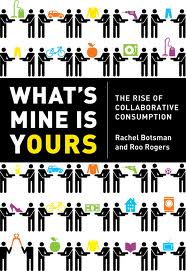
Book Review: What’s Mine is Yours – How Collaborative Consumption is changing the way we live
by Rachel Botsman and Roo Rogers,
Harper Collins 2011
When I picked up this book by chance, I thought it would be useful as back-up research, if only to find useful and insightful examples of co-ownership and co-operation in action.
The truth is that it turned out to be a very easy to read page-turner, with a lot more to say than the title ever suggested and all in all an excellent introduction to the subject for anyone and with a real interest in promoting intelligent consumption.
The book is divided into three parts, discussing first the evolution of consumerism and related behaviour: how the pressures of social norms, marketing and easy credits lead us to permanent dissatisfaction and pushed over-consumption. Then follows a very comprehensive exposé of the rise and momentum of the collaborative consumption movement (see below); and finally, a part on impact , which dealt with cradle to cradle design and community as a brand -although that was the weakest part to me as it felt a little repetitive.
Collaborative consumption was divided into:
-Product Service Systems: with the change in mind-set from “me” to “we”, away from the ownership of “stuff” such as cars, accessories or equipment in favour of rental of the service these items render. The authors draw attention to the potential of idling objects in our cupboards and garages (which get used once a month or a year!) as money-making and community-building assets.
– Redistribution Markets: which stem from the re-use of pre-owned items both from businesses and individuals (think Freecycle, Ebay and Craigslist)
– Collaborative Lifestyles: knowledge, skills and time in exchange for either a parallel local currency or other services in your community.
As the internet plays a large role in this collaboration, (you are defined by what online groups you adhere to these days), it is fair to say that the organization of these networks couldn’t have happened on such a scale and so quickly without modern technology.
Mobile apps, easy to use websites, real-time checks matching demand and offer, honest peer-to-peer reviews etc everything is organized, paired and agreed online. However, sharing and renting are not new ideas- it is only the size, speed and organization which are different now. Today’s collaboration still depends on community with trust at its heart but without a large choice and availability, the critical mass (ie. volume required to make it work) would not be achieved and nothing would happen at all.
Altogether, although sometimes the book felt like a long advertisement opportunity for all the sites and businesses involved in renting, sharing, hiring, re-using, collaborating
etc, it did manage to convince the reader of the increasing volume and variety (and business opportunities!) of the collaborative consumption movement. Did you know
about Landshare which connects growers with land and garden owners? Or Airbnb
where you can arrange to stay in someone’s spare room anywhere? Many more were quoted in the book, but there’s one temple of collaborative consumption you’ll know and
have used for ever. And that’s where I recommend you go and borrow a copy of this book…
Coming to Manchester on 7th November, the third accredited,interdisciplinary masterclass in this series exploring the potential to adapt our towns and cities to climate change through Green Infrastructure.
The workshop covers the theory and practice of integrating infrastructure assets such as living roofs and walls, rain gardens, street trees, looking at masterplanning, design, implementation and maintenance. We will also explore the contribution of Green Infrastructure to energy demand reduction, improvement of air and water quality, storm and surface water management, health and amenity – as well as supporting native biodiversity and biodiverse habitats.
The event is led by UK Green Infrastructure experts in design,policy and implementation, GARY GRANT (Olympics Biodiversity Legacy, ecologist and environmentalist, masterplanner, author and practitioner) and DUSTY GEDGE (Green Infrastructure campaigner, practitioner and policy instigator, Director of Livingroofs.org, President of the European Federation of Green Roof Associations).
THIS WORKSHOP IS RELEVANT TO:
Planners, developers, architects and landscape architects, utilities and regulators, engineers, ecologists, housing providers, transport and green space managers, environmental services, community groups and policy makers.
Elle Mitchell
Training Officer
RESET DEVELOPMENT
4th Floor 16 Hoxton Square
London N1 6NT
e · elle.mitchell@reset-development.org.uk
t · +44 (0) 20 7749 2512
w · http://www.reset-development.org
Registered Charity 1137511
Company Limited by Guarantee 07144369
I’ve got this friend who has worked on motorway maintenance for 15 years. He texted me and asked me to come round to his because he’d just had some really bad news. I texted back “yes, what’s the news?” He replied “I’ve been sacked!” I texted back “wtf?! Why??” He texted back “gross misconduct – theft.” Well, I didn’t believe it, but when I got to his house, the signs were all there.
And the only “eco” events we know of are these two:-
Friday 19, 6pm to 9pm Climate Survivors monthly meeting (film night) at Jacquie’s home, Chorlton “Our regular meeting, but including a film viewing and discussion afterwards – film to be confirmed.” For details, contacthttp://climatesurvivors.ning.com/
Showcasing some of our customers – Start in Salford, Green woodworking, Joinery
Refreshments and kids play area
Come on down and get involved!
More information: 0161 231 3333/info@treestation.co.uk
If you know of other weekend events that are about “climate” (and that includes food growing, or cycling or whatever), then let us know and we can include them in future “Something for the Weekend”s…
MCFly readers often ask us “what can we do?” We reply “do something in your local community that is likely to be successful, and that will leave you with more skills and enthusiasm than when you went into it.”
That, sadly, excludes most of the activism that seems to go on at the moment. The good news is that there are some projects that we can point folks to. One of them is “Manchester Carbon Literacy.” It’s run by a small social enterprise called Cooler Projects. Phil Korbel, one of the directors, answered our questions.
What’s been the biggest satisfaction/success you’ve in the last few months of running the project?
The easy answer is seeing one of our volunteers turn her two-day a week volunteering w us into a full-time 12 month post with Manchester Metropolitan University – focussed on Carbon Literacy. But we’re also very proud of the fact that all our volunteers are playing properly responsible roles in the project, nothing half-baked at all.
What’s been the biggest difficulty/roadblock?
That we can’t afford to convert all our volunteers into full-time paid posts.
Anything you’d have done differently with the benefit of hindsight?
Started recruiting volunteers earlier and putting in processes to support them before they arrived. Luckily the skills of our volunteers are such that they were able to help us construct those systems.
Last we spoke you were contemplating calling the “Manchester Carbon Literacy Project” something a bit catchier. That hasn’t happened – why not?
The appeal of ‘doing what is says on the tin’ has won out for now. Having said that, the project was always going to be called this, but the training might be branded differently as some training partners have been doing.
Why do you need more volunteers?
As above, one of our volunteers has got a paid gig, still involved with the project but in a different area, and people keep saying that they want to work with us – so demand is still outstripping our supply of paid people time and thus the on-going need for volunteers…
What sorts of skills would they learn?
Looking at the current group – project management, communication skills, creativity, design and working as a team – for starters. Did I mention Carbon Literacy?
MCFly says: In a perfect world, everyone would volunteer for MCFly. But since our particular brand of sarcasm and career suicide doesn’t have broad appeal, we are happy to endorse Cooler Projects’ Carbon Literacy programme. Is Carbon Literacy enough? Well, as Dr Lorraine Whitmarsh will argue next week, no, we need Carbon Capability. Is it an important starting place, and the provider of much-needed straws of hope in a city where Climate Change is talked about a lot more than it is actually tackled? Yes.
Richard Leese, the leader of Manchester City Council, has dramatically abolished the Environment Commission. Arriving at the end of the latest (and last!) of the group’s meetings, he told the assembled commissioners and advisors that it would be replaced by a “Low Carbon Hub.” The news came as a surprise to at least some of the commissioners.
The Environment Commission, which was supposed to operate at a Greater Manchester level, was established in 2009. It struggled to gain traction or funding, and had become a poor relation to the “New Economy” Commission, its ever-shrinking staff sitting within the larger body. In May its first and only chair, Dave Goddard, lost his seat on Stockport Council.
Few details are available about the mooted “Low Carbon Hub”, which will be chaired by Richard Leese himself. No announcement has appeared on the Commission’s website or on Richard Leese’s blog. It is not clear whether this Low Carbon Hub will now supervise the ever-delayed Implementation Plan of the Greater Manchester Climate Change Strategy, which calls for a 48% reduction in CO2 emissions by 2020.
MCFly was unable to get comment from commissioners and officers before publication. We will pursue this story.
MCFly says: It’s not often that MCFly and Richard Leese are in perfect synch. But on the futility of continuing the Environment Commission in its current form, we agree. The MCFly co-editors were going to attend the fateful meeting, and document (yet again) the Waiting-for-Godot nature of it, and the repetitive gap between promise and delivery. In the end, we decided it was a waste of limited time and energy. The questions, of course, are – will anything be learnt from the Commission’s failure (or will MCFly’s successors be writing a similar post in three year’s time?) and will the new “Hub” be democratically accountable and transparent?
Marc Hudson
mcmonthly@gmail.com
* These events happened on Wednesday 10th November. So, while it may be “news” it’s not exactly “flash”…
Arwa Aburawa (MCFly co-editor) attends an RSA event looking into the need for businesses to take green action and worries that the hard decisions are still being sidelined.
‘It’s no longer business as usual’. If I had a pound for every time I heard that… Well, I certainly wouldn’t be attending green business events in my free time. And events that bring together businesses taking green action such as today’s RSA event at Manchester Metropolitan University (MMU),are the worst offenders but more on that in a little while.
The first speaker of the day was Neil Swannick, head of GM Waste Disposal Authority and member of the [now deceased] Environment Commission, who welcomed the attendees to the event after a quick free lunch. He talked about a growing recognition of the impact of climate change in place like Bangladesh and also in the UK. Action is already being taken he added in Manchester which has carbon reduction targets of 41% by 2020 and is currently putting together an implementation plan to achieve that. It is no longer business as usual, he said and nodding heads around the room seemed to agree.
Ironically on the way to the next part of the event, I spoke to a young woman who had started her PhD on Sustainable Construction at Liverpool after working in the construction sector for a couple of years. What she told me was that the problem with the construction sector is that things are in fact, still ‘business as usual’. Companies don’t understand what sustainability is, are afraid of it or are doing the bare minimum to make sure that they win a green contract. So there is clearly a gap between rhetoric and action. Indeed, the panel debate which took place next highlighted another gap – the one between the action we know we need to take, and what action are actually taking.
Pam Warhurst from Incredible Edible Todmorden, Kevin Anderson from the Tyndall Centre for Climate Change Research, Jocelyn Cunningham who is director of Arts and Society from the RSA as well as Chris Roberts who is development director at Bruntwood were the panellists. To kick off the debate, the chair Mike Blackburn from BT, asked the panel to speak for a couple of minutes about what we as businesses and individuals can do to act more responsibly.
Pam Warhust started off by saying that we need to start believing in people and give them a time to create something better for themselves rather than telling them what to do. She said that Incredible Edible Todmorden had an entire town thinking differently about food, cooking and travel and it had achieved that by working with locals.”We have to get rid of the paternalistic way that we deal with the masses,” she said and and part of the problem is the top-down policy approach which seems to dominate government action. Warhust added that we need to give people the time and space to come to this agenda on their own terms.
Professor Anderson said the solution is that we start living our lives based on the scientific evidence. Universities, in particular, he said are not representing the levels of changes that their research is telling them is necessary or that they are advising others to take. “It’s all about behaviour and practice and the elites of the universities [which Anderson included as himself] need to take personal action so that others can live prosperous and reasonable lives.”
I then asked both Pam Warhurst and Professor Anderson whether they thought we had the time to allow people to take action at their own pace. Pam replied we can’t afford not to give people time and to allow them do it and get on with it. Anderson first pointed out that there is a big difference between sustainability and climate change and the reality is that action to deal with climate change is more urgent and has a much shorter timescale. There needs to be fundamental changes at every level, he said. For example at univerisities, Anderson asked why institutions which are leaders in climate change research are still working to attract international students when they know the carbon impacts of flying students in every year. “Why are there jags and cars in the university quad rather than making the most of green spaces?” he asked. “Universities are not applying the results of their research and so there is no leadership on this issue.”
From Bruntwood, Chris Roberts said that back in 2007 the property sector was moving towards a two tier market with those who were willing to pay a premium for more sustainable properties and those operating business as usual. That has now disappeared as behaviour change has fallen off the agenda and he admitted that his sector is not good at driving the green agenda if there is no demand. Another barrier to action that Roberts highlighted are the “muddled and unclear policies on what is and isn’t sustainable which mean companies are jumping from one measure to the next without achieving anything.” Roberts also added that everything we talk about in terms of energy efficiency isn’t about change, it’s about about keeping the way we live the same so we can drive to work and fly.
The next theme that emerged during the panel debate was how do we deal with unpopular but necessary green polices. Anderson said that it is our job as people switched on to the issue to support unpopular policies that move us towards sustainability and added that the bid to introduce a congestion charge in Manchester shouldn’t have been put to a vote. He added that the money that went to the bailing out the bankers could have been the first, vital step to moving us towards building a green infrastructure. And although that opportunity has passed us by, Anderson said the sorry state of the economy means that the opportunity is still there. Warhurst said that people realise that politicians are looking at the facts and there are some really unpopular policies that they are too frightened to pitch to the wider public- telling people what they can and can’t do isn’t the solution. Roger Milburn from ARUP agreed and said that it’s fine to tell people that they have leadership role in businesses but can we really tell them what to do in their private lives?
I get that choice is an important thing and we all have a right to choose how we live our private lives – but the fact that our lovely lives may be screwing the lives of other people the world over must surely come into the equation? Otherwise are we really saying that the ‘choices’ of white, rich, Western people are the only ‘choices’ that matter?
The next part of the event consisted of two workshops where basically businesses advertised themselves to you. The session I attended overran hugely and so everyone sat around the table barely got a change to introduce themselves. Fourth presentation in, I headed for the door. Not even the promise of tea and cakes in a couple of hours time could make me stay. I was told that once the presentations were over, businesses would get to pitch green projects to the RSA, which will be supporting them through various means.
Arwa Aburawa Freelance Journalist
mcmonthly@gmail.com
This should be very good indeed, and MCFly would recommend anyone with any interest to get along if they can. The presenter is Dr Lorraine Whitmarsh, Cardiff University, of whom we have written previously (e.g. Carbon Literacy versus Carbon Capability). We will go, blog and do a bit of filming too.
Despite growing scientific agreement about the human causes of climate change, recent years have seen a clear decline in public belief in and concern about climate change. In the wake of recent controversies, many within the climate change community have expressed fears that the public has lost faith in climate science and scientists. However, I argue that the impact of individual events, such as ‘Climategate’, has been overstated, and that the decline in public concern is likely due to multiple factors and may be part of longer-term fluctuations in opinion. I also consider prospects for intentionally shaping attitudes to climate change.
Seminars are held on Tuesdays from 5pm – 6.15 pm in rooms 1.69/1.70, Humanities Bridgeford Street Building.
Tea and coffee available.
No registration needed, all welcome.
For a full program of the CCSR/ISC/Social Statistics seminars please visit:
Our "leaders" are going to keep making empty promises. It makes them feel good. It gets the activists to act like zombie kittens. If you want to have some self-respect and perhaps make a difference (actual facts may vary), then find a functioning group that cares about your skills and knowledge - what you have, what you want.
One useful group might be www.climateemergencymanchester.net - you can email them on contact@climateemergencymanchester.net






 manchester climate monthly