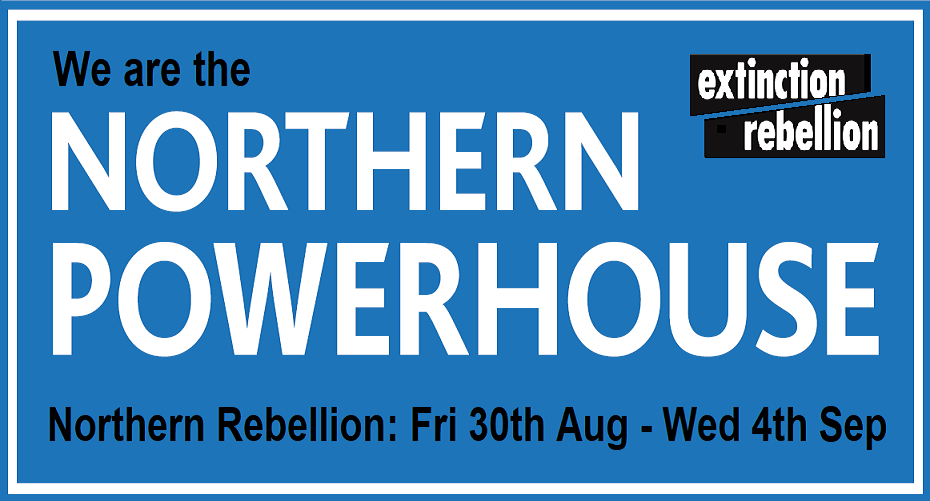
“We are the Northern Powerhouse” #ExtinctionRebellion #Manchester 30 Aug- 4 Sept

This via an email list:

We are the NORTHERN POWERHOUSE. Northern Rebellion: Friday 30th Aug - Wed 4th Sep

THE NORTH RISES UP! JOIN THE
NORTHERN REBELLION

Rebels, you’re invited to a civil summer…

It’s finally the North’s turn to rise up for the climate and ecological emergency. To keep up the momentum after the International Rebellion and the government’s declaration of a climate emergency, XR MCR remembers the rallying cry of those other Manchester rebels, the suffragettes, and demands ‘deeds not words’. The Northern Powerhouse should have at its heart a plan to act now, halt biodiversity loss and reduce carbon emissions to net zero by 2025.

Now that we’ve sounded the wake-up call, let’s get down to the business of radically changing the way we live and think with six days of non-violent civil disobedience, talks, workshops, art, performances, music and a coming together of energy and ideas in Manchester, the birthplace of so many progressive movements. It’s time to face the emergency and take the steps needed to save our one planet Earth.

From Friday 30th August to Wednesday 4th September, Manchester will host XR rebels from across the North.

We’ll be kicking things off at our weekly meeting next Monday 10th June with a ‘Heading for Extinction’ talk for new members. Find out why we act and why civil disobedience works at 6.30pm, the Bread Shed, 126 Grosvenor Street.

We’re hard at work setting up the structure that will support the rebellion. If you have experience in event management, or facilitating rapid growth of teams, we’d love to hear from you – email hello@xrmcr.org with “Newsletter” in the subject.

On Monday 17th June, we start shaping the rebellion. We will run a mass match-making session to fit volunteers to roles – from stunning art pieces to killer admin skills, we will need everyone on board. 6 for 6.30pm, the Bread Shed.

Let’s show ‘em what the North’s made of!


Find us on FacebookTwitter, at xrmcr.org or email hello@xrmcr.org. Support Manchester XR actions by donating here.

Posted in Extinction Rebellion, Upcoming Events | Leave a comment

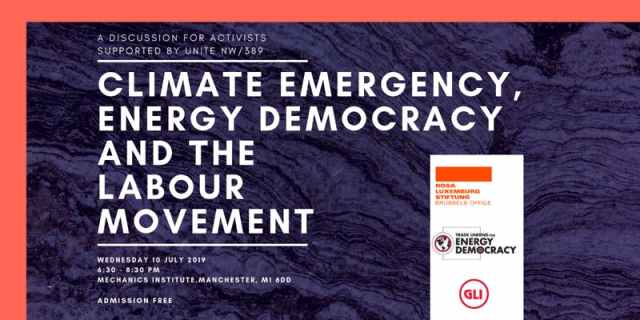
Upcoming Event: “Climate Emergency, Energy Democracy and the Labour Movement”, Weds 10 July, #Manchester

Details here.

climate emergency

UK labour movement representatives and international allies are meeting in Manchester on 9-10 July to discuss climate emergency, public control over the power sector and the Labour Party strategy for decarbonisation. The meeting will be assessing the Labour for a Green New Deal campaign, plans for a ‘Green Industrial Revolution’, as well as the recent rise in climate activism. The meeting is being organised by New York-based Trade Unions for Energy Democracy (GLI New York) and the Global Labour Institute in Manchester (GLI Manchester), with the support of the Rosa Luxemburg Stiftung.

Labour movement activists are invited to participate in an open discussion on Climate Emergency, Energy Democracy and the Labour Movement in the evening of 10 July, at the Mechanics Institute, 103 Princess Street, Manchester M1 6DD. Free admission.

Sponsored by Unite NW/389 Greater Manchester Social Action Branch

Invited (*confirmed) participants include

· Sean Sweeney*, Director of Trade Unions for Energy Democracy, New York

· Clara Pallard *, President, Culture Group Executive Committee, PCS

· Sarah Flores, Youth and Project Officer, IndustriALL Global Union, Geneva

· Rebecca Long-Bailey MP

· John Mark Mwanika*, Programs Officer ATGWU, Uganda, and Chair of the Urban Transport Committee of the International Transport Workers Federation

· Tony Kearns, Senior Deputy General Secretary, CWU

· Stephen Smellie*, Unison Scotland

· Jim Mowatt, UNITE National Environment Spokesperson

Tickets Can be reserved from Eventbrite here.

Posted in Upcoming Events | Leave a comment

Looting the Ivory Tower: interview with academics about UK energy policy and nuclear motivations…

Sometimes academics ARE useful to social movements. They have the time and sometimes the training to do research that can help social movements understand what is actually going on, behind the hype, the PR and the intense battles. Much of that work though,can be hard to access, behind either pay-walls or jargon-walls. One solution to this would be for social movement activists to cultivate academics and do interviews with them about their work. If you’re interested in cultivating those skills (finding academics, approaching them, coming up with interview questions etc) , let me know via mcmonthly@gmail.com.
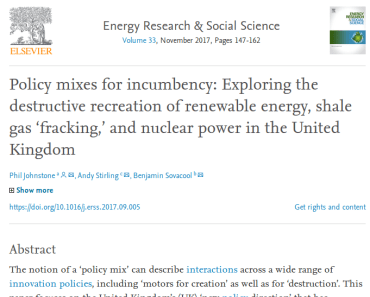
policymixesSo, here we go with an interview, with one of the authors – Dr. Phil Johnstone – of a recent excellent paper “Policy mixes for incumbency: the destructive recreation of renewable energy, shale gas ‘fracking,’ and nuclear power in the United Kingdom

  1. Can you explain what the motivation/curiosity for writing the paper? Can you explain briefly what research you and your co-authors did, and what conclusions you came to about UK energy policy? And in layperson’s terms, what is a policy mix and is ‘destructive recreation’ somehow related to the famous phrase of Joseph Schumpeter about the ‘creative destruction’ that is a result of competition in a free market?

The paper was driven by an empirical curiosity at some interesting developments taking place in UK energy policy over the last few years. The UK is anomalous in Europe and the ‘developed’ world as a whole as it is one of the few countries that is committed to a large nuclear new build programme. Yet, as discussed elsewhere, when considered from the perspectives of innovation theory and socio-technical transitions theory, the intensity of the UK’s nuclear enthusiasm is somewhat puzzling. The UK has a historically poorly performing nuclear industry compared to other countries like Germany that have made the decision to phase out nuclear. At the same time, the UK has by far the abundant and cost-effective renewables resource in Europe. Yet the UK seems to give special priority to the development of new nuclear. At the time of writing the paper, the UK was also one of the few countries in Europe to be intensely pursuing the development of fracking despite huge uncertainties and set-backs. Meanwhile a number of policies in support for renewables had been cut back in 2015.

These developments were intriguing and raised significant questions around ‘policy mixes’ which was the theme of the special issue. Policy mixes is a concept that focusses on the interactions and interdependencies between different policies as they affect the extent to which intended policy outcomes are achieved. This looks at how range of different policies affect the outcome or direction of a certain area such as fracking, nuclear or renewables. Some important work builds on Schumpeter’s insights on ‘creative destruction’ and highlight that as well as nurturing and enabling new technological trajectories, existing incumbent sociotechnical arrangements have to be destabilised through phase-out policies. Often this framing rests on an implicit assumption within sustainability transitions that apart from some ‘regime resistance’, ‘policy makers’ respond to the best evidence on what technological trajectories best fulfil energy security, cost, and climate change priorities. However, through examining the respective levels of policy prioritisation around fracking, nuclear, and renewables and the evidence-base regarding the respective costs and performance of these technologies, it is difficult to conclude that the government is basing its decisions solely in line with energy policy considerations.

2. In the paper you suggest 2015 was a pivotal year – what happened then?

This year was an important one in UK energy when a ‘policy reset’ took place representing a ‘new direction in energy policy’. In this year we saw several support mechanisms for renewables reduced or abolished meanwhile support for fracking and nuclear power intensified. On the renewables side, this included the halting of onshore wind construction, an 85% reduction in the solar Feed-in-Tariff, the abolishment of the green homes scheme, and the removal of a guaranteed renewables obligation subsidy for coal or other fossil plants converting to biomass amongst other changes. Around the same time, loan guarantees worth £2 billion for Hinkley C were being announced along with R&D funds for developing entirely untested Small Modular Reactors. Planning for fracking was fast tracked, a shale wealth fund was created, and a local council decision not to proceed with fracking was overturned by the Home Secretary. So this was a time when the priorities of Government regarding energy trajectories became clear. What we call the ‘policy apparatus’ unveiled at this juncture revealed an intense enthusiasm for fracking and nuclear power in comparison to support for renewables. The effects of this were damaging for the UK renewables industry. This included 12,000 jobs being lost in the solar industry, and investment in UK renewables being halved by the end of 2017. International observers such as Al Gore referred to this ‘policy reset’ as ‘puzzling’.

Looking at the policy priorities revealed during this juncture, it seemed that rather than ‘creative destruction’ something akin to ‘destructive re-creation’ was being enacted. Incumbent and increasingly uncompetitive technologies were given priority in the government’s new energy policy, while renewable technologies had important support measures removed. Again, this is something that runs counter to the implicit notion of policy mixes orienting around ‘creative destruction’ that dominates much transitions thinking.

 3.  In layperson’s terms – what do you and your co-authors suggest is behind the British states support for nuclear and fracking instead of the vastly more popular renewables?

There are of course multiple factors influencing energy trajectories, and key differences between what is influencing support for nuclear and fracking. At a broad level, our analysis indicates that to a certain extent broth fracking and nuclear policy in the UK are driven by factors beyond energy policy and outside of the usual focal point of analysis in ‘sustainability transitions’. As discussed, work in sustainability transitions implicitly assumes that energy policy is generally driven by matters of costs, climate change, and energy security with some levels of resistance from ‘the regime’ yet there are factors beyond energy policy influencing both cases which point to factors that have been somewhat neglected by sustainability transitions approaches. In the case of fracking, we highlight in the paper the well-documented links between the fracking industry and the current government and the privileged access that the industry seems to have with regards to the UK policy process. Rather than this being the case of the incumbent ‘regime’ lobbying the state it in fact seems that the lines between industry and the state are somewhat blurred raising questions regarding how the state is understood in sustainability transitions.

In terms of nuclear, this paper touches on a line of research that Andy Stirling and I have been working on for several years now. To put it simply, our research indicates that sustaining the capabilities to build, operate, and maintain the UK’s nuclear submarine fleet, is a key reason why the UK is so committed to an intense programme of new nuclear power despite increasing costs and lengthy delays. A large civil nuclear programme helps in maintaining a reservoir of key skills, educational investment, R&D, and supply chain activities to be able to construct the extraordinary feats of engineering that are nuclear propelled submarines.

Since this paper was published important developments have occurred. In 2017, following evidence that we submitted to the public Accounts Committee (PAC), Permanent Secretary for the MoD Stephen Lovegrove confirmed that civil nuclear was important for building up the UK’s nuclear submarine industry. Since then, there has now been open declaration of the need to enable ‘mobility’ between civil and defence nuclear and key actors such as Rolls Royce expressing openly that investment in Small Modular Reactor development will ‘reduce the burden’ on the Ministry of Defence (MoD) to maintain capabilities and skills for the UK’s nuclear ‘deterrent.’ A senior politician at BEIS stated that the line between civil and military nuclear is in fact, ‘artificial’, overturning decades of official wisdom regarding the separation of civil and military nuclear activities.

In 2017 in the USA, a series of high level reports also confirmed that a declining civil nuclear programme would seriously undermine the USA’s nuclear submarine capability and thus civil nuclear power should be pursued and further subsidized on the grounds of national defence. As we have written about in the Nuclear Industry Status Report 2018 and elsewhere with nuclear increasingly becoming obsolete as it is increasingly outperformed by renewables, the countries where new nuclear is most intensely pursued are nuclear weapons states and states aspiring to have a nuclear weapons capability. Yet, while in the USA the military rationale for constructing civil nuclear power is acknowledged, this issue has been largely neglected in the UK in terms of parliamentary scrutiny and wider media coverage despite the more acute challenges the UK faces due to its smaller economy and far smaller nuclear industry.


4. Besides being ignored and being called ‘conspiracy theorists’ has there been any substantive critique of your hypothesis so far?

Prior to 2017 we were indeed called ‘conspiracy theorists’ by among others, representatives in the pro-nuclear organization the Breakthrough Institute. After the dramatic policy revelations in 2017 on both sides of the Atlantic confirming the interdependencies between civil and military nuclear this position is no long tenable. We had some criticism from a prominent trade unionist in the Guardian following a blog that we published, however this did not engage with the substance of the evidence we have documented.

Another more recent response is to give the impression that it has always been the case that these interdependencies have existed so it’s no big deal. But there are two problems with this response. The first is that civil-military nuclear interdependencies have not been acknowledged until very recently so this points to a serious lack of transparency in the UK’s ‘nuclear renaissance’. The reasons they are now slowly being acknowledged and pushed to the surface is because of the declining fortunes of nuclear power in the UK and elsewhere. Second, this is a big deal. Putting an exact number on it is tricky, but with top up payments from Hinkley C alone amounting to some tens of billions of pounds over a 35-year period, and with the costs of low carbon renewables continuing to fall even further below new nuclear, substantial additional costs are set to be paid by British consumers in order to support the military nuclear industry without any discussion or democratic scrutinisation.

5. How do you think academic work like your own could be more useful not to the usual “stakeholders” – by which we seem to mean policymakers (politicians and civil servants) and business groups – but to other stakeholders, such as citizens, NGOs, unions etc?  Is there some “good practice” that you see being done?

This work highlights the importance of examining the broader topic of qualities of democracy that can be useful for a range of stakeholders. There has been significant scrutiny of fracking and important journalistic work revealing the close connections between government and the fracking industry that reveal something decidedly anti-democratic in the determination to push fracking through. So on that front there is a lot of great work being done which enables citizens to have a more balanced idea of why their government is so determined to pursue a policy option that seems counter-intuitive.

On the nuclear front however, there has not been the same level of scrutiny despite the National Audit Office clearly stating that there are reasons ‘beyond the energy trillema’ for why the UK is so intensely pursuing new nuclear. The National Audit Office also outlined that it was a “bad deal” that had “locked in” British citizens into something that was “risky and expensive”. The Public Accounts Committee then concluded that this was a deal that would “hit the poor the hardest”. That’s only Hinkley C, before we consider further unprecedented financial privileges for nuclear such as the RAB model of financing, and even more funding for entirely untested SMRs, or government taking a direct stake in nuclear which the Labour Party seem to want to do. Yet the fundamental question of why there is such determination to pursue new nuclear in the UK is rarely examined in the media or parliament, or by prominent NGOs.

It seems to be the case, that commitments to sustaining military nuclear capabilities is a key reason yet are almost entirely neglected in policy discussions and analysis. Whether you are pro are anti-nuclear power or nuclear weapons, that these matters remain undiscussed is deeply worrying in terms of the current state of British democracy.

Posted in academia, Looting TIvory Tower | Leave a comment

Exclusive: Manchester City Council to hold “Climate Action Summit” in July

Manchester City Council has told backbench councillors that it intends to hold a climate action summit in July, to provide “a space for children and young people to discuss their views, and articulate what they want”

In an email from 3 weeks ago, in response to forward copies of Emma Greenwood’s Open Letter, the Executive Member for Schools, Culture and Leisure , Luthfur Rahman, wrote that “the event is not going to be about what the Council can do for you but rather what can we all do individually and collectively to reverse/slow down the pace of climate change.” So, no responsibility-shifting there then, at all…

Much is unclear about the approach the council is taking. It is not clear which students will be invited, or how will they be selected. It is not clear whether tere will be an upper age limit (e.g. will university students be able to attend).

Certainly the Council will be keen to avoid awkward questions about its own failure to undertake meaningful action in the last ten years. Much of its own carbon reductions are due to selling off buildings and having only 3/5ths of the workforce it had before the Tories’ Austerity began. What the Council will say to any astute and informed students who asked whatever happened to the “Steering Group” elections and the annual stakeholder conferences, which were cancelled in 2014, remains to be seen. Also as to why carbon literacy training for members and officers has stalled, and why luminaries and intellectual leaders such as Richard Leese, chief executive Joanne Roney and Executive Member Angeliki Stogia have delivered no speeches on climate change to general audiences in the last two years. Much can be blamed on Westminster, but not these (and other) failings…

PS It’s not clear whether this Climate Action Summit is even going ahead – the email sent to backbenchers was 3 weeks ago, and since then there appears to have been no public announcement at all. It’s also not clear whether the whispers of a stage-managed portion of the full Council meeting on Weds 10th July are superseded by the putative ‘Climate Action Summit.’

Posted in Manchester City Council | Leave a comment

June calendar, for what it’s worth #Manchester #climate

Here’s the best list I can compile of upcoming climate events in Manchester I can find. Some groups don’t have a website, others don’t update theirs, others still, oh, look, who actually cares? The take-home message is this – that everyone is knackered, stressed and about to go into some form of hibernation. The students are all about to piss off and normal service, with a little extra ideological recuperation – see tomorrow’s post) will ensue. That went quickly, eh?

Tuesday 4th, 7.15pm Frack Free Greater Manchester meeting, Greenfish Resource Centre, Oldham St.

Thursday 6th   Deadline for “When September Ends” competition

Friday 7th  Fridays for Future, 12 to 2, St Peters Square

Sunday 9th Open Farm Sunday (Stockport)

Monday 10th Fossil Free Greater Manchester meeting, Greenfish Resource Centre

Friday 14th  Fridays for Future, 12 to 2, St Peters Square

Sat 15th “How do we respond to the climate emergency, locally?”  Climate Emergency Manchester event, Northenden (venue and time to be confirmed)

Sat 15th, 12-2pm Litter pick organised by Youth Climate Strikers.  Meet in Piccadilly Gardens.

Weds 19, 2pm Neighbourhoods and Environment Scrutiny Committee, Town Hall Extnesion

Thurs 20th, 1pm Tyndall Seminar – ‘Buildings as Power Plants: The role of buildings as active components in our future energy networks’ by Dr Sara Walker,  room C21, Pariser Building, Sackville Street

Friday 21st  12 to 2, Youth Strike for Climate St Peters Square (facebook details)

22 June – 7 July  Fortnight 2019 []

Weds 26th  Mass Lobby of Westminster . Organised by Climate Coalition and Greenpeace. Doubtless there will be a coach from London.

Friday 28th Fridays for Future, 12 to 2, St Peters Square

Posted in Upcoming Events | Leave a comment

New website: Rising Up! Manchester Families

Yesterday Rising Up! Manchester Families staged an excellent family-friendly protest march from All Saints Park to Piccadilly Gardens.  Hundreds of people, including mums with kids, babies in strollers, old farts and new farts, promenaded to the city centre.

Alongside this, Rising Up! Manchester Families have now got a website up.  It’s here.  Follow them!!

risingupmcr


Posted in Campaign Update | Leave a comment

Frack-Free Greater #Manchester meeting, Tues 4th June.

Next Frack Free Greater Manchester is Tuesday 4th June, from 7.15pm at the Greenfish Resource Centre, Oldham St, Central Manchester.

Agenda

1. Further discussing about possible campaign actions against Ineos

2. Upcoming events and co-ordination with other GM Climate groups re:

Mon 8 July Manchester Climate Change Agency Conference

Wed 10 July Manchester City Council full meeting re: call for declaration of climate emergency

Fri 19 July GM Pension Fund AGM in Droylsden

Hope to see you then

Posted in Uncategorized, Upcoming Events | Leave a comment

Event Report: Green Drinks #Manchester on the “#Climate Emergency”, May 30th @GreenDrinksMCR

About fifty people crammed into the Patagonia store on King Street (no, I didn’t know there was one there either), last night to hear a talk about solutions to the climate emergency.  The event was organised by Green Drinks Manchester (twitter handle
@GreenDrinksMCR , which is the local application of an international ‘monthly meets for eco-professionals and others’.  They’ve been holding meetings, of varying size and effectiveness over the past few years. This time they didn’t quite knock it out of the stadium, but it was either a one bounce and over the ropes 4, or a 6  (apologies to anyone who isn’t a cricket nut: translation – “it was a good event“).

Free beer, soft drinks and lentils were on offer as people mingled among the expensive-but-high-quality jackets, trousers etc that Patagonia sell (Patagonia is a wild company, privately owned still by its founder, who never met a business strategy book that he wasn’t willing to use as toilet paper. Very very interesting.)

vegboxpeople

Image lifted from the twitter feed of

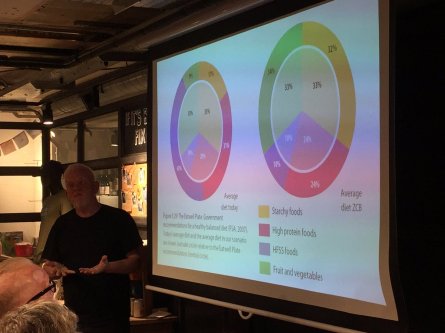
We were then beckoned downstairs and, crammed among the backpacks, were treated to a half-hour or so presentation by Paul Allen, who has been at the Centre for Alternative Technology in mid-Wales for donkey’s years.  He began with a quick explanation of planned obsolescence (light bulbs designed to die early so you buy new ones), then Edward Bernays and the (claimed) use of psychoanalysis to induce false needs, on through National City Lines (GM, Firestone and Standard Oil buying up streetcar companies to bankrupt them so people travelled on buses instead. And cars. Lots of cars).  Allen then pivotted to the “Zero Carbon Britain” project of CAT.  They have been producing plans and blueprints about how – well, the clue is in the name – since 2006.  He rattled through energy, transport and food etc, before turning to the Climate Emergency (fwiw he didn’t talk about how climate emergency declarations could go very horribly wrong).

All the reports he mentioned (and hella lotta work has clearly gone into them) are available on the CAT website here.

There was time for some questions, and these were of better quality than at some previous Green Drinks events.  How to fund the energy transition? Which levers to pull to make it all happen? And a couple of others.  Reader, indulge me, here was my question (which I said after a short advert for Climate Emergency Manchester).

“You mentioned 2006 as the year Zero Carbon Britain started. It was also the year of the first Climate Camp, Al Gore’s Inconvenient Truth and so on. If I close my eyes, the rhetoric I hear these days is exactly that of 2007, 2008. Yes, we now have Greta Thunberg, the school strikes, the IPCC 1.5 report. But the dynamics feel the same.  The last wave ended in 2010. What do “we” need to do differently this time?”

Allen said, as many others have, “more pressure, build movements.”  To his credit, he’s the first person I’ve asked this question to who said “what do you think?”  Conscious of time (and I probably took up too much) I said something like this (or wish I had. I was probably far more verbose)

“We need to make sure meetings are welcoming to people who’ve never been to any before. We need to get out of the smugosphere of people who agree with us.  We need to make sure that going to meetings, monthly or weekly, doesn’t become a substitute for action.  We need to make sure that people can be involved meaningfully without ever coming to meetings, because many people can’t or won’t come to meetings- [see here]. We need to be pressuring week in, week out, not building up to big orgasmic events that leave us happy but knackered.”

The meeting then broke into discussion groups (a newish and encouraging trend).  So, across the three floors of the store there were discussions about energy, buildings, transport, art and culture and so on.  I floated between, earwigging.

Observations –

  • one group in particular seemed very dominated by one individual.  The lack of self-facilitation processes and norms around introducing selves/each other, doing pair-work, who is holding the bloody conch and for how bloody long clearly needs addressing
  • there was no group addressing the question of politics and power, the risks of co-optation and good ideas being killed off in the committees (as they have been these last ten years in Manchester),  or thinking about how to avoid past mistakes  (though of course this is difficult if, as many at the event seemed to be, you are ‘new’ to the game.)
  • the final “report back” was quite lengthy and at points felt like a shopping list of all the nice things we’d like to have.

HOWEVER.  Most people stuck around to keep chatting (the sign of a good event), and lots of people made a number of new connections.  So, kudos to Green Drinks Manchester, and kudos to Patagonia for hosting the event.

The next green drinks is on Friday 21st June, from 7 to 9pm at
Old Bank Residency, Hanover Street, NOMA, Manchester, M4 4AH

Jordan Strong – Protect Our Winters UK

The evening will see Jordan introduce POW UK followed by a short film screening and discussion.

POW UK is a charity that inspires and equips UK based outdoor communities to take positive action to address the climate crisis.
https://protectourwinters.uk/

Posted in Event reports | Leave a comment

Interview with #climate activist Jo Murphy. #Manchester #ExtinctionRebellion

The latest interview with an Extinction Rebellion activist – see here for others!

My name is Jo Murphy , I’m a 53 yr old mother of 3 and Pilates teacher.

murphy gluedWhen did you first become aware of climate change as an “issue” and how. As far as you can remember, what were your reactions to it?

I first became aware of talks about the ozone layer and aerosol use when I was younger and I was concerned . About 14 yrs ago Global Warming came into my consciousness and with young children I was very concerned and had many sleepless nights . Over the years I’ve signed petitions , donated money , recycled , only have one car and use it rarely etc but I have flown , I’ve been a lapsed veggie for years and I’ve never been an activist .
I’ve been asleep , trusting that someone else , the powers-that-be would sort it out !

Assuming that “something changed” recently to get you heavily involved, what was that? (Greta Thunberg? IPCC report? XR meeting?)
It was reading the IPCC report last October that woke me up !
I realised how urgent the situation was and couldn’t believe that it wasn’t headline news every day ! Why wasn’t more being done ? Why didn’t everyone feel the urgent need for action ? I also felt guilty that I’d been asleep and hadn’t been doing more . So I joined XR in October and was sitting down on Waterloo Bridge waiting to be arrested in November.

What have been the most positive things about being involved so far?
A feeling of active hope that despite the terrible possibilities I am able to do something and affect some small change . Being able to add to the noise that has changed the conversation and brought it out and further up the political and social agenda .

What would you say to someone who said that groups like XR often go up like a rocket and down like a stick, that they involve lots of the ‘same kind’ of people (students, middle class people with degrees, retired hippies) without reaching beyond that particular type of person?
Yes I’d agree to an extent .That’s why we need to keep the effort and noise . Reaching out to the wider community , appealing to other sections of society . Increasing visibility, telling the truth about the climate emergency so it becomes more normal , people recognise the urgency and so feel happier getting involved .
But there are also lots of other people involved from lots of different backgrounds and groups that don’t fit your description and I’m one of them .

What do you personally hope to get from being involved?
See above answer to positive things .

What mistakes do you think previous groups made in trying to get climate change onto the political/cultural agenda?
They’ve been too polite , climate scientists have also been unwilling to tell the truth and groups haven’t been able to mobilise enough people who were willing to get involved in nvda or state their willingness to be arrested.

Posted in Extinction Rebellion, Interview | Leave a comment

Climate fictions contest “Anthropo-Scenes”

From here.

anthroposcenes

Climate scientists use models and graphs and maps to tell us what the world might be like in times to come – but telling us what life in those worlds might be like is the role of literary writing. In all of its forms and genres, fiction imagines and depicts the human – and, sometimes, the nonhuman – experience. In the case of climate change, stories can bring the abstract trends and statistics of climate science to life by presenting the manifold textures of the human perspective. Fiction making is an inherently speculative practice. Future-oriented fiction tasks us to conceive, anticipate and authorise subjective accounts of life being lived in circumstances different from our own. This isn’t (just) about new gadgets or dystopic disasters; it’s about the challenges of living in a world that, at present, we can only imagine.

But all lives are lived differently, and every perspective is unique: there is no “The Future”, but many imagined futures, plural and unevenly distributed in space and time alike. We believe that by surveying such imagined futures, we can learn a lot about the ways in which we might live in a warming world.

That’s why the Climaginaries research project in cooperation with the Narrating Climate Futures initiative is hosting a climate fiction competition: we want to curate a small collection of stories whose narratives depict and explore a climate-changed world. We’re open to a variety of formats: short stories, screenplays, art and design fictions, and comics (see below for a full list, including guidance on submission sizes).

The submission deadline will be 15th August 2019. Starting from February we will be hosting a series of events aimed at providing you with worldbuilding tools that will help you create a vivid climate-changed storyworld for your narrative to explore. (If you’re not nearby, or you’re already a masterful worldbuilder, don’t worry – you don’t need to attend the events to take part in the contest!)

We want this to be a fairly open process, but even so, it wouldn’t be a competition without some rules… or without a prize to compete for! The prize for the best entry in each category, as judged by our panel of experts (to be announced), will be publication in an e-booklet produced by the Climaginaries project, and a payment of 2000 SEK first world online electronic publication rights; all other rights to the works will be retained by their creators. We will also list two runners-up in each category in the e-booklet, along with a short synopsis of their stories and the worlds in which they take place. Finally, there will also be a gala to celebrate the stories that have been created .

Categories and so on – go to the site for this info!!

RULES AND HOW TO SUBMIT

Please submit your entry as a .pdf attachment to anthroposcenes2019@gmail.com no later than August 15th. Submissions that do not follow the format and process specified will be deleted without consideration. No exceptions!

Original works only, please; we’re not interested in reprints or rip-offs, we want fresh material. (We’re academics, and as such we have access to plagiarism detection software – you have been warned!)

Can be in either Swedish or English. But no other languages, the jury is only bi-lingual…

Maximum of two (2) submissions per person. Please don’t use pseudonyms to get around this rule! It’s next to impossible for us to prevent you doing that, however, so we’re just going to ask you to treat the other entrants as fairly as you’d like them to treat you in the same circumstances, and to not submit more than two pieces. If we have reasonable grounds to believe you have done so, we will exclude all works submitted by you from consideration, and we fully reserve the right to make that judgement call on whatever basis we like.

Posted in Competitions, Uncategorized | Leave a comment