Action for Sustainable Living recruiting “Local Project Managers”

Action for Sustainable Living have sent us the following:

We are recuiting for this wave of Local Project Managers (LPM’s) Who knows where this opportunity may lead: New skills, new friends/networks!

Are you ready for a challenge?

Action for Sustainable Living supports people to live more sustainably. Our unique approach is doing that in the context of the local community, so that local issues and priorities are tackled and resolved locally.

We are looking for keen and enthusiastic voluntary Local Project Managers who want to lea rn to manage projects to make a difference in their local community. We provide full free training, support & mentoring (worth over £600!) to enable you to develop and implement your project idea. This is an excellent opportunity for you to learn new skills whilst making a positive contribution and meeting like-minded people.

We have a track record of many of our Local Project Managers going on to find paid work or into further education using the skills they have learned during their project.

There are limited places available and applicants must be available to attend the training session taking place over the weekend of 12-14th October 2012

Deadline for application: Midnight 21stSeptember 2012
For more information and download of the application pack visit:
http://www.afsl.org.uk/get-involved/jobs/
To apply, please download the application pack and email to recruitment@afsl.org.uk

Don’t miss your chance!
Or for further details contact: Kate, Jo or Erika on 0161 237 335

Posted in volunteer opportunity | Leave a comment

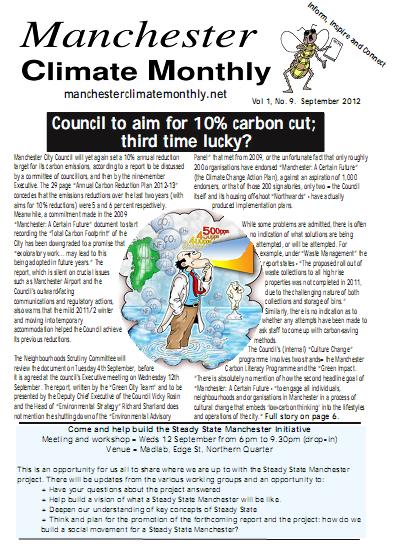
Manchester Climate Monthly #9, September 2012 out now!

manchester-climate-september

What is permaculture? What does practical solidarity with the people in rural Africa look like? What are the ins and outs of the Council’s latest carbon reduction targets? What does anthropology have to teach us about climate change? What can YOU do to get involved in creating a fairer, more “resilient” Manchester [Hint]
All this, a calendar, book reviews and “much more” in the latest Manchester Climate Monthly. Please share on all your networks.


As ever, your thoughts and comments welcome – mcmonthly@gmail.com

Posted in print editions | 1 Comment

Newsflash: “Real Food. Wythenshawe” gets £1m for 5 year project

Real Food Wythenshawe, “an ambitious five-year programme to engage and excite the people of Wythenshawe in growing and cooking fresh, sustainable food” has received funding of £1,000,000 from the BIG Lottery Fund.

That money, which will be matched by sponsoring organisations and fundraising, will be spent on five “flagship projects. According to the programme’s website, these five are;

1. The sustainable indoor growing system at the Wythenshawe campus of The Manchester College will see “the development of a closed loop bio-system to showcase modern indoor growing techniques and demonstrate what sustainable food production can mean in an urban setting. The system has been designed by award winning Manchester-based cooperative, URBED, who specialise in design, sustainability and community engagement.”
2. Green Spaces to Growing Spaces, which “will see Willow Park and Parkway Green Housing Trusts focus on helping Wythenshawe residents to grow food in their own gardens through a programme of awareness raising and engagement.”
3. Mapping and harvesting abundance, which “takes as its starting point the known existence of a large number of fruit trees, planted at the time of the creation of the Wythenshawe garden suburb. By mapping, harvesting and preserving fruit from these and other orchards, such as those at Wythenshawe Community Farm and the Walled Garden, we will reintroduce people to the foods available on their doorstep.”
4. Wythenshawe Park Walled Garden – Outdoor Growing: a new generation, which “will develop a hub for community growing, training and skills development through a horticulture centre and possible ‘veg box’ scheme. This project will be delivered by Manchester City Council Adult Social Care and BITE.”
The final project, Cooking and Eating Sustainably. is “still being developed, but will help the people of Wythenshawe to develop the skills and the passion to cook healthier, cheaper and more sustainable food. It will also include cooking demonstrations and enterprise opportunities.”

Other projects in the North West that will receive money from the Big Lottery Fund include The Broughton Trust – Irwell Valley Sustainable Communities Project in Salford, Greater Manchester will receive “close to £1 million. The project will support Lower and Higher Broughton, and Kersal in East Salford, an area susceptible to flooding from the River Irwell, and one of the top six deprived wards in Salford with over 40 per cent of children classed as living in poverty, and with over 70 per cent of the population dependent on benefits and living in social or private rented accommodation.”

Posted in Adaptation, Food, inspire | Tagged | 1 Comment

Upcoming Event: Ballad of the Burning Boy

The immersive audio drama Ballad Of The Burning Boy (broadcast on Radio 3 last week)  follows Miriam as she walks the streets of Preston, desperate to find her son George who has got mixed up with an extreme eco movement, the Pre-Arkwrights.  Written by Lavinia Murray and starring Suranne Jones and Lemn Sissay, it’s a highly charged examination of what happens when the young decide to put themselves in the way of harm in order to protect the planet.

This Saturday evening, 8th September,  sees its live launch – you can become part of the action and walk the route (in Preston) with the invisible film on your headphones.  There will be surprises. It’s free – more detail here – www.balladburningboy.com.

Posted in Upcoming Events | Leave a comment

Help the Land Army grow organic food for #Manchester, or “what’s up docks?”

Moss Brook Growers, an organic farm that supplies food to Unicorn Grocery in Chorlton, is looking for help from volunteers.

The taller half of the MCFly editorial team spent an entirely delightful Saturday helping to pull up docks a couple of weeks ago, and intended to write it up.  Still, there is this far more entertaining post about Land Army-ing for you to read.

If you’re interested in helping, please use these contact details

chloe@kindling.org.uk, or you can ring the Kindling Office on 0161 226 2242.

Posted in Food, inspire, Upcoming Events, volunteer opportunity | Tagged , , , | Leave a comment

Arctic: “No ice ice baby”

Here’s a graph of the Arctic ice melt that’s getting soooo much front page/lead story coverage in the mainstream media.


As the original post says, “We’re going to need a bigger graph.”

Apologies for the title of this post. It’s an early 90s thing

Posted in academia | Tagged , | Leave a comment

Newsflash: Anderson & Bows – “the threshold of 2 °C is no longer viable”

Professor Kevin Anderson and Doctor Alice Bows are Manchester-based academics working on climate change and what its impacts will be.

They have written many peer-reviewed articles and reports, and given seminars a-plenty. (We recently interviewed Kevin – read the full transcript here).

They have just had a commentary published in the prestigious journal “Nature Climate Change” (currently behind a paywall, sorry). Its title is “A new paradigm for climate change.

They open with robust statements about the fantasy of long-term targets…

Long-term and end-point targets (for example, 80% by 2050) have no scientific basis. What governs future global temperatures and other adverse climate impacts are the emissions from yesterday, today and those released in the next few years. Delaying an agreement on meaningful cuts to emissions increases the risk of exposing many already vulnerable communities to higher temperatures and worsening climate-related impacts. Yet, behind the cosy rhetoric of naively optimistic science and policy, there is little to suggest that existing mitigation proposals will deliver anything but rising emissions over the coming decade or two.

Echoing the “goodbye to the two degrees target” statement made by Bob Watson last week (after Anderson and Bows had completed their article), they write:

…the science demonstrates that the threshold of 2 °C is no longer viable, at least within orthodox political and economic constraints. Against this backdrop, unsubstantiated hope leaves such constraints unquestioned, while at the same time legitimizing a focus on increasingly improbable low-carbon futures and underplaying high-emission scenarios.

They give explanations as to why scientists are not speaking up, but point out that

… work on adapting to climate change suggests that economic growth cannot be reconciled with the breadth and rate of impacts as the temperature rises towards 4 °C and beyond — a serious possibility if global apathy over stringent mitigation persists. Away from the microphone and despite claims of ‘green growth’, few if any scientists working on climate change would disagree with the broad thrust of this candid conclusion. [Emphasis added]. The elephant in the room sits undisturbed while collective acquiescence and cognitive dissonance trample all who dare to ask difficult questions.

Repeating something that Prof Anderson has said in public, but to our knowledge not written before…

At the same time as climate change analyses are being subverted to reconcile them with the orthodoxy of economic growth, neoclassical economics has evidently failed to keep even its own house in order. This failure is not peripheral. It is prolonged, deep-rooted and disregards national boundaries, raising profound issues about the structures, values and framing of contemporary society.

In the final section, entitled “A new paradigm”, they advocate the following –

Leave the market economists to fight among themselves over the right price of carbon — let them relive their groundhog day if they wish. The world is moving on and we need to have the audacity to think diferently and conceive of alternative futures.
Civil society needs scientists to do science free of the constraints of failed economics. It also needs us to guard against playing politics while actively engaging with the processes of developing policy; this is a nuanced but nonetheless crucial distinction.
Ultimately, decisions on how to respond to climate change are the product of many constituencies contributing to the debate. Science is important among these and needs to be communicated clearly, honestly and without fear.

The world is indeed moving on. One of Manchester’s problems is that it has done relatively well out of the “inward investment”. Its political and economic elite, having played its cards in that game very well indeed, see no reason to consider that we will soon be playing with a different deck altogether.
It is therefore up to civil society to do the preparations that outfits like Manchester City Council and the oh-so-silent “Stakeholder Steering Group” will not, cannot do. If you, gentle reader, want to be involved in one of the civil society responses, around “Steady State Manchester”, then come along to the next public meeting, on Wednesday 12th September, from 6pm to 9.30pm (drop-in, you don’t have to be there for the whole thing!), at Madlab, on Edge St.

Marc Hudson
mcmonthly@gmail.com

Posted in academia, Article alert, Manchester City Council | Tagged , | Leave a comment

Youtube: Vandana Shiva on Rio +20, “Green Economy” GM food etc

Not ’bout Manchester, but the bigger picture…

Indian eco-feminist and activist Vandana Shiva gets her points across well in this four minute video.

Posted in youtubes | Tagged , , , | 1 Comment

#Manchester #climate nuggets August 27 2012

Hi all,

next Steady State Manchester meeting; Weds 12th September at Madlab, Edge St (Northern Quarter).  Drop-in from 6pm to 9.30pm, with structured activity from 7.30 to 9pm

apologies to people who got a wonky (out of date) version of this post. Human error, perpetrator sent for re-education, blah blah blah…

Marc Hudson

Coming up this week

Weds 29th August – probable date for “Annual Carbon Budget” to appear on manchester.gov.uk website… Other than that, nowt…

Stories you may have missed on the MCFly website

Lessons we like to pretend we have learnt
Being organised is a Good Thing

Things worth reading

And Shanghai might get a surprise….

Bob Watson, chief scientific advisor to DEFRA, formerly boss of the IPCC, thinks we have no chance of keeping to the two degrees target

Posted in Weekly bulletins | Leave a comment

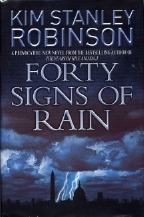
Book Review: Forty Signs of Rain

Forty Signs of Rain
Kim Stanley Robinson 2004
356 pages

Kim Stanley Robinson is not a muppet. That’s important in a human being, and even more so in an author. And in an author trying to help readers exactly how their species got into this dreadful dreadful mess, it’s downright essential. Robinson, probably best known for his “Mars” trilogy, about the colonisation of the Red Planet, here tackles politics, anthropology, bureaucratic in-fighting, biology, the nature and practice of science, economics and… also manages to tell a rollicking story, that ends with a hurricane and flooding in Washington DC that is eerily like Hurricane Katrina (Robinson got their first, btw)

Putting aside a bizarrely inaccurate precis of the current state of atmospheric concentrations of C02 (page 143) there is much for anyone interested in climate science, politics and our collective future to chew on here.

A few quotes –

“… the minute details of the everyday grind involved in any particular bit of scientific practice can be tedious even to the practitioners. A lot of it, as with most work in this world, involves wasted time, false leads, dead ends, faulty equipment, dubious techniques, bad data, and a huge amount of detail work. Only when it is written up in a paper does it tell a tale of things going right, step by step, in meticulous and replicable detail, like a proof in Euclid. That stage is a highly artificial result of a long process of grinding.
Page 78

But tit-for-tat was not the perfect strategy, because it could spiral in either direction, good or bad, and the bad was an endless feud. Thus further trials had found successful variously revised versions of tit-for-tat, like ‘generous tit-for-tat’, in which you gave opponents one defection before turning on them, or ‘always-generous’, which in certain limited circumstances worked well. Or, the most powerful strategy Frank knew of, an irregularly generous tit-for-tat where you forgave defecting opponents once before turning on them, but only about a third of the time, and unpredictably, so you were not regularly taken advantage of by one of the less cooperative strategies, but could still pull out of a death spiral of tit-for-tat feuding if one should arise. Various versions of these ‘firm-but-fair’ irregular strategies appeared to be best if you were dealing with the same opponent over and over.
Page 112

But Frank had seen Stuart Thornton on panels before. He was the kind of scientist who habitually displayed an ultra-pure devotion to the scientific method, in the form of a relentless scepticism about everything. No study was designed tightly enough, no data were clean enough. To Frank it seemed obvious that it was really a kind of insecurity, party of the gestural set of a beta male convincing the group he was tough enough to be an alpha male, and maybe already was.
The problem with these gestures was that in science one’s intellectual power was like the muscle mass of an Australopithecus, there for all to see. You couldn’t fake it. No matter how much you ruffed your fur or exposed your teeth, in the end your intellectual strength was discernible in what you said and how insightful it was. Mere scepticism was like baring teeth; anyone could do it. For that reason Thornton was a bad choice for a panel, because while people could see his attitude and try to discount it, he set a tone that was hard to shake off. If there was an always-defector in the group, one had to be less generous oneself in order not to become a sap.
That was why Frank had invited him….
Page 123

The book in question is the first of a trilogy, and –  hands up – I’ve only read the first two. And I’ve spread that out over so long, I really have to go back and re-read the first two before tackling the final one. It will not be a chore, but a pleasure.

Marc Hudson

mcmonthly@gmail.com

Posted in Book Review | Tagged | Leave a comment