
Made by University of Manchester folks, this 5 minute video is well worth a look!!
From the Fallowfield Secret Garden website…
Made by University of Manchester folks, this 5 minute video is well worth a look!!
From the Fallowfield Secret Garden website…
Davey, B (Ed.). (2012). Sharing for Survival: Restoring the Climate, the Commons and Society. Dublin: FEASTA. ISBN 9780954051020. 188 pages, paperback price: £14.95. [website]
 This is an interesting book with some really good material. It is based on the idea that the international negotiations (Copenhagen, Cancun, Rio) are not going to deliver a solution to the climate crisis and indeed could make things worse. Therefore, instead of relying on such grand international agreements and programmes, the authors suggest that change will need to rely on ‘civil society organisations’ (neither market nor State) working together globally and coming up with initiatives that are then scaled up and/or ratified by governments (local, regional, national and international). Together with this idea there is an emphasis on ‘cap and share’ as an alternative to the existing carbon trading models. In cap and share, the body that brings hydrocarbon energy into the market has to pay a levy and this levy is then shared among the population (there are various ways of doing this) to mitigate the increased cost of energy and to facilitate the development of non-carbon intense alternatives. Nowhere in the book is there a succinct exposition, but here is a diagram (see http://www.capandshare.org/index.html)
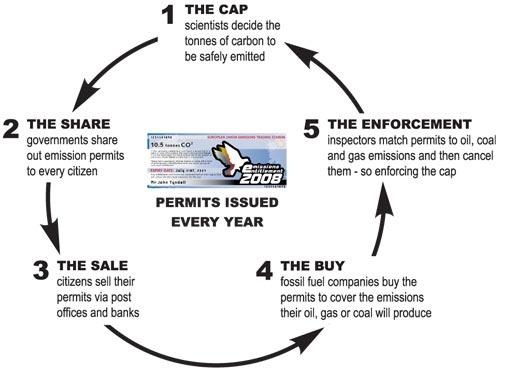
Perhaps the biggest weakness of the book is the paradox that although it emphasises dispersed bottom-up initiatives, rather than waiting for governments to act, to work cap and share will require government action, indeed legislation (not to mention struggle against ogres like the World Trade Organisation). This contradiction is not resolved by the authors.
Nevertheless the book contains a wealth of useful information and ideas. A key emphasis is on ‘commons approaches’ that recognise that the environment and its resources belong to all of us and should be managed collectively and not via the money system nor by top-down direction. This idea draws from indigenous practices in managing forests and the point is made that almost everywhere there has been a robbery of these shared resources – think of the enclosure acts in England, the clearances in Scotland, the genocide in the prairies, pampas and rainforests of America, not to mention the sale of council houses and the privatisation of pension, health services and education.
Noteworthy chapters are those by Kenrick on The Climate and the Commons, Bardsley on the alignment of necessary policies (another demonstration that it can’t be left up to civil society on its own) and Bruges and Sharan on applying cap and share to the rural context of the majority of India’s population.
The book includes a chapter written by the ecological economist Richard Douthwaite and nearly complete at the time of his death last year. He argues that although the situation is grim, not all is lost and, breaking the problem down into its components, there are a number of practical steps to take which are still feasible. This seems to rely in large part on the coming of Peak Oil, and hence rising hydrocarbon costs to price carbon out in comparison with renewables. On balance this looks reasonable to me, even when taking tar oil and shale gas into account but we clearly can’t just wait for oil price hikes to kick in but need to prime the replacement arrangements for a different way of managing our society and its economy. We can take from the book the importance of local initiatives both as points from which to scale up society-wide solutions, or just as lifeboats when (to use a metaphor from Kenrick’s chapter) the ship of the growth economy finally sinks.
Rather than ordering from Amazon, you can get the book from News from Nowhere Bookshop, a Liverpool workers co-op with a reliable on-line channel at http://www.newsfromnowhere.org.uk
Mark Burton
Hi all,
if you want to help out with “Steady State Manchester“, please do get in touch – steadystatemanchester@gmail.com
All ideas, critiques, suggestions about Manchester Climate Monthly also very welcome!
Arwa Aburawa and Marc Hudson
Tues 14th, 6.45pm
This month Manchester Friends of the Earth’s full group meeting will be held outdoors – and will see Dave Barlow(Manchester City Council’s Biodiversity officer) take us on an urban bee walk.
Meet at 6.45pm at the Green Fish Resource Centre on Oldham Street (next to Mint Lounge) to join them on this fascinating tour of the Northern Quarter and City Centre’s biodiversity hotspots.
Meet at Green Fish Resource Centre, 46-50 Oldham Street, Manchester M4 1LE
Lessons we like to pretend we have learnt
Procrastination is “a habit you develop to cope with anxiety about starting or completing a task. It is your attempted solution to cope with tasks that are boring or overwhelming.” (quoting this guy)
Reading the Manchester web
From Sustainable Housing blog- “how to make green beer”
Things worth reading
United States says goodbye to “two degrees” target
meanwhile, the Observer reports
Rate of arctic summer sea ice loss is 50% higher than predicted
MCFly co-editor Marc Hudson attends (yet) another informative seminar about climate change, but wonders how long we will go on like this…
There was nothing intrinsically wrong with the latest Tyndall seminar, held on Thursday 8th August. Covering recent research on the “embedded” carbon in things that the UK imports, it was short (half an hour), clearly- presented, and with plenty of scope for questions. Sure, the slides lacked pictures and bite, but this wasn’t supposed to be a theatre spectacle .
The main problem is that we – the presenter and the audience – didn’t really talk about our main problem; the unmitigated disaster of unmitigated carbon dioxide emissions and the unavoidable consequences coming at us. (We don’t know exactly how it will come, or when, but coming it is. We ought to be preparing, not reporting on the might-have-beens.)
One of the questioners, another academic asked if it was time to give up on the whole notion of a “two degree above pre-Industrial global average temperature” target. Dr Ruth Wood, who had kindly answered our questions in an interview you can read here, was obviously deeply uncomfortable when she said “Two degrees is undeniably incredibly challenging to deliver. But it’s not impossible, and if we abandon two degrees, it’s easy to abandon [3 and 4].”
I chipped in with the cheery fact that Todd Stern, chief climate negotiator for the United States, has already come out with “two degrees is a barrier to international agreement” speech. [Though he’s since said ‘That is not what I meant at all. That is not it, at all‘.]
So, over 40 people (Council officials and members conspicuous in their absence, as usual) gathered together to hear about rigorous work done about… something that is no longer in any way likely. I understand and sympathise with the reasons behind academic/intellectual inertia. (I , like any MCFly reader who isn’t superhuman, suffer from versions of them myself.) The funding (probably) isn’t out there to look closely at the social consequences of a rapid ecological debacle (as opposed to a debacle stretched out over decades). I don’t see the ESRC funding a research stream entitled “We greedy westerners have irrevocably trashed the planet, to the point things will go very tits up sometime soon. Now what?” The closest we probably have, at the moment, is the Resilience Alliance folks; “concatenated global crises” and also stuff by Will Steffen et al.
To survive (and – cards on table – I really don’t think we will, as an organised global civilisation) we need to start building interpersonal links, and the habit of linking, now. Tyndall, and other organisations hosting these sorts of discussions could do more to help make those links happen. Even something as simple as a “turn to the person behind you and spend a couple of minutes chatting,” done at every opportunity, builds ‘bridging capital’. FWIW.
Marc Hudson
mcmonthly@gmail.com
Things of note
By the end of the year, the UK government is going to say what its position on who “owns” international aviation emissions. That’ll be fun…
The next Tyndall seminar will be at the end of September/beginning of October.
The week before last, out of the blue, we were invited to the next meeting of the Steering Group meeting. What’s the Steering Group? Well you might ask…
Anyway, we said “yes, in principle.” And then we went and spoiled it all by… making some entirely reasonable – and entirely unrealistic – requests. The most important of these requests was around the Steering Group becoming transparent about its, um, total lack of transparency. This, unexpectedly again, led to the invite being withdrawn. The full exchange of emails is below.
Hi Marc,
I don’t think we have met personally but I follow your blog. I provide the administrative support for the MACF Steering Group.
I’m emailing to invite you along to one of the future sessions, to give a bit of a talk to the group and tell them about your network and blog.
If you have the availability, the next two sessions are 23rd August and 18th October. The meetings are 4-7pm, but you wouldn’t have to stay for the whole thing and we could arrange a time closer to the day. I’d have to confirm the 23rd – as we may not have enough space on agenda if you wanted to come along to that meeting, but I could guarantee a slot on the 18th October.
Would be good if you could join us – it wouldn’t be to formal or anything, it’s just a friendly invitation and I’m certain you’ll already know a lot of the members of the group anyway!
Many thanks,
Sam
So we mulled it over for a few hours, and then sent this back –
Hi Sam,
Thank you for your unexpected email! We are very interested in
attending the Steering Group meeting on Thursday August 23rd, and will be happy to share information about our network(s) and activities.As well as discussing our activities – with “Manchester Climate Monthly”, “Steady State Manchester (http://steadystatemanchester.net) and “Activist Skills and Knowledge” (http://askfortheworld.net), we would also expect there to be time during the meeting to engage in a discussion about the relative inactivity of the Steering Group as a body.
Given that our activities are available for Steering Group members to review prior to the meeting, we would suggest a one-to-two ratio of time for this (i.e if 10 minutes were devoted to “MCFly” etc, there’d be 20 minutes for discussion between us all of the Steering Group.
For us to be able to attend though, given our publicly-stated
opposition to non-transparency, some issues that would need resolving.
Obviously, we would regard the meeting to be on the record, and would feel free to report as we saw fit.Most importantly of all, we would need, before we attended either the
August or October meeting, a statement from the Steering Group as to the reasons for its meetings not being public (the lack of publication of minutes, despite repeated assurances to that effect, is a separate issue).The statement on private meetings would have to address the following questions;
Who made the decision for the meetings to be “not open to the public”, when, and why?Specifically, was this decision taken by an individual (in which case, who), a subset of the Steering Group (in which case, who were these people), or was it made by the entire Steering Group?
Has it been reviewed since the Steering Group expanded to its current 31 members. If not, why not?
Is there any written statement on the costs and benefits of making the meetings private versus public – i.e. has any risk assessment been done?
Will there be a secret ballot of the 31 member Steering Group as to
whether the meetings will continue to be secret? If not, why not?Finally, we’d like to mention that Manchester Friends of the Earth and Manchester Green Party have both endorsed the “meetings charter” that MCFly – with others – have set out.
https://manchesterclimatemonthly.net/about/projects/meetings-charter/
We’d be very happy if the Steering Group were to have a discussion
about signing it too. But maybe that would be something we could
discuss on the day?Arwa Aburawa and Marc Hudson
Very quickly (almost as quickly as you could hang up a phone), we received this
Dear Marc and Arwa,
Thank you for taking the time to respond to Sam’s email. I regret that having consulted with the rest of the Steering Group we are agreed that we won’t be able to meet your demands as set out below and as a result, we will now reallocate the place on our agenda to another Manchester project.
Regards
Steve
What’s interesting is just how quickly the entire Steering Group (“the rest of”) was able to make such a decision (less than 30 hours!). If only they showed such speed and decisiveness in, you know, doing the jobs they volunteered for? Just sayin’…
Although we won’t be at the meeting (and neither will you be, gentle reader. Please don’t confuse this with a democracy), we will be producing a handy guide to our activities and sending it to the Steering Group members beforehand. There in spirit and all that…
But we won’t, as per page 4 of the latest print issue, be spending any time or energy or ‘bandwidth’ worrying about something that is deader than a doornail. Wake us up when Steering Group 3.0 comes along.
Dr Ruth Wood of the University of Manchester’s Sustainable Consumption Institute is presenting a seminar on Thursday 9th August, from 4pm. It’s called ‘Consuming Our Future: The Climate Change Impact of UK Consumers’. Part of Tyndall Manchester’s new series, it’s free, you don’t need to book and you can find more details about it here.
We caught up with her and threw some questions her way.
1) Legally, every country is responsible for its own production of emissions. The West has been spectacularly unwilling to cut them. What hope is there that they will agree to become responsible for their consumption (via the notion of “embedded carbon” etc)?
Kyoto signatories committed to reduce the GHG emissions produced within their territorial boundaries, and since 1990 it appears most countries are on track to meet their Kyoto targets by the end of this year. There are obviously limitations of Kyoto, not all countries particularly the USA ratified the treaty and the target was not in line with the more recent agreements to aim to avoid a global mean surface temperature increase of more than 2oC. Negotiating a new global agreement with binding territorial emission reduction targets, is it seems proving difficult.
Consumption-based emissions accounts count the amount of GHG associated with the goods and services consumed in a country – no matter where in the world the gases are physically emitted. Consumption-based emissions provide a complementary measure to territorial accounts, helping a country understand its wider responsibility for emissions in the world. While there may not yet get global agreement regarding a country becoming legally responsible for its consumption emissions, there is growing interest in understanding the global trade flows in carbon and how this could inform future policy. In the UK Defra have recently started publishing the UK’s consumption emissions and they have been the subject of the House of Common’s Environmental Audit Committee enquiry, so in terms of how the UK plans to take responsibility for its consumption emissions watch this space.
It’s not just Governments that can use consumption emissions information though, retailors and manufacturers have been using this information to try and reduce the carbon footprint of the goods and services they provide. This information provides the opportunity to work with supply chains to identify emission hot spots and alternative low emission ways of production.
Individuals can also use the information to make decisions on what they consume, not all goods may be carbon labelled but asking retailors about the environmental impacts of their products demonstrates that consumers are interested in the impacts and can help create consumer pressure to reduce the carbon impacts of products. In the interim, it is important to recognise that virtually everything we buy has an environmental impact, buying wisely – thinking twice before buying new items, buying it second hand or investing in a long lasting durable product can help reduce our consumption emissions.
2) Manchester City Council has stated that it will introduce a “Total Carbon Footprint” approach to its calculations – is that in-line with the sort of arguments you are making in this seminar?
MCC should be applauded for their actions on this. Understanding the full carbon impact of our lifestyles, then identifying where and how we can take appropriate action to reduce it is essential if we’re to seriously tackle climate change.
3) The blurb for the event mentions a new “scenario tool” about consumption and production – can you elaborate on that at all?
The scenario tool was developed to support a project examining the emisisons impact of future food funded by the Sustainable Consumption Institute
http://www.sci.manchester.ac.uk/news-events/news/whatacircs-cooking-acirc-the-ukacircs-potential-food-crisis
It enables a range of researchers and stakeholders to pool their expertise to estimate the impacts of different energy and technology futures on the greenhouse gases embodied in the goods and services we consume in the UK. The tool also allows the users to explore how different patterns and levels of consumption could change the total consumption emissions in the UK. Combining estimates of how both the emissions intensity of consumption could be reduced by technology alongside changes in future consumption patterns enables us to understand the relationship between the two and inform policy that addresses both consumption and production.
4) The blurb also mentions (over)reliance on technological fixes and “exponential growth.” What’s the matter with economic growth, from a climate change perspective (and any other perspective you care to add!)
It’s often assumed that technology can fix climate change, that if we could just get the right technology in place the problem would be solved. There are at least two problems with this premis: firstly, it takes time to get technology in place and in that time, emissions are still rising and eating into the cumulative carbon budget that we have to adhere to to avoid 2oC; secondly even with a largely decarbonised energy system, the rate at which the population is growing and consuming mean that even though per unit of consumption the emissions may be lower than they were, because we’re consuming more, in absolute terms, the resultant emissions are higher than they need to be to avoid 2oC.
At the moment, economic growth is still correlated (albeit less than it was) to the use of carbon intensive-energy and resources, unless we can completely decouple the production of goods and services from greenhouse gas emissions, then the logic is inescapable.
Unplugging themselves from their blueteeth and tearing themselves away from their tablets, a mix of Manchester’s digerati met tonight at a Northern Quarter watering-hole, for the latest in a long line of informal “social media” gatherings. Green campaigners who want to learn more about social media and its potential really should get along to these…
The “Social Media Cafes,” run by Julian Istar and Martin Bryant , have been going since late 2008. Formats vary slightly (sometimes panels [see our long report here], sometimes workshops), but the several I’ve been to have been friendly, informative and useful.
Tonight’s, at the Northern pub, was no exception. Six people (present reporter included) got five minutes to entertain/inform/inspire/provoke the small but perfectly formed gathering.
First up was a Cypriot-turned-Mancunian with an app that turns words into pictures on facebook (it’s a long story) and gets you more hits.
Next was some crazed Australian who tried to convince the audience that they wanted to help make Manchester greener, and to make activists more skilful and knowledgeable with all things social media. Someone helpfully pointed him towards “fix my street.”
Then Ian Forrester (a smc_mcr stalwart) gave his view on how to be interesting, which was, well, interesting. Not sure about talking to people in lifts though – they don’t have the chance to run away from you…
After a decent length mingling break (during which there was, in fact, lots of mingling) Martin Bryant then squeezed much of an hour’s worth of talking about various new mobile phone applications (or “apps”, as I believe the young people call them). There were too many to mention, but “social path” – “facebook for your real friends,” wavii.com (a news aggregator) and “taskrabbit.com” (microtask auction site – yet to come to the UK though) all looked fun.
A chap called Nathan, who’d been doing the filming, then interacted with a filmed version of himself while ruefully recounting how he had managed, in the aftermath of the Olympics opening ceremony, to get 100,000 people to sign up to follow… a fake Danny Boyle.
Last up was a chap called Adrian (sorry, didn’t catch his last name), plugging Manchester Metropolitan University’s scheme to get its undergrads doing work in the Real World. It’s called mmuagencylife.com. PR/Digital etc agencies take on (unpaid) students in various formats over the course of an academic year. He was at pains to say it was “HMRC legit – you won’t go to jail.” Sounds interesting, and MCFly will be trying to poach some free labour…
Take-aways
The wonderful Madlab has been hosting the Manchester-bit of a three day training event called “Young Wired State” for young coders. They apparently have a seven year old who is blowing everyone’s socks off..
The next event is on Tuesday 4th September. These events are fun, free, they’re interesting, and you might just meet someone who is willing and able to help you develop useful skills for your activism. Be there or be netsquared (which is happening at Madlab on Tuesday 25th).
Disclaimer: I applied for one of the speaking slots and got it. This may have given me an extra dose of the warm fuzzies towards the organisers.
A few months ago MCFly published a volunteer’s account of his (highly enjoyable) time with the Land Army. And we also fired questions at the organisers about health and safety, transparency etc (ones that they answered with aplomb).
Now the Land Army is calling for more recruits. If you’ve a day spare, and you want to spend it in the sunshine (fingers crossed!) and meet new people and help local food growers, then read on…
*Fri 10 Aug: Land Army! – A day helping Moss Brook Growers on their 22 acre organic farm in Glazebury.*
If you’re keen to get out into the open, learn how to grow produce, meet new people and help out organic farmers in Greater Manchester, why not join the ranks of The Land Army?
With regular outings to learn about and help out with sowing new plants, harvesting crops and assisting with the upkeep of farms, it’s a hands on experience that’s fulfilling and informative.
Practicalities on the day:
A day out with the Land Army is quite a physical day’s work (though we’ll look after you and make sure we get proper breaks!), but it’s really satisfying and a great chance to get your hands dirty, experience and learn a bit about market garden/field scale food growing from the experts, and spend the day with a like minded and interesting bunch of people like you!
We’ll provide lunch and hot drinks (though if you’re going to Glazebury feel free to bring your own flask if you like a lot of tea – there’s no drink making facilities), and your transport from Hulme to the farm and back again.
Make sure you come prepared. Wear sturdy boots/shoes, and bring drinking water, snacks (if you like to nibble while you work!), waterproofs & sun cream/a sun hat (we can dream!)
To register your interest please e-mail chloe@kindling.org.uk
*When*: Friday 10th August, 9am pickup in Hulme, Drop off back in Hulme by 4.30pm
*Where*: Glazebury.
There are other days too, including a Saturday event for which one of the MCFly editors needs a cast-iron excuse to avoid. All offers welcome-
Fri 17 Aug: Land Army! – a day helping Glebelands City Growers on their organic market garden in Sale.
Sat 18 Aug: Land Army! – A day helping Moss Brook Growers on their 22 acre organic farm in Glazebury.
Fri 24 Aug: Land Army! – a day helping Glebelands City Growers on their organic market garden in Sale.
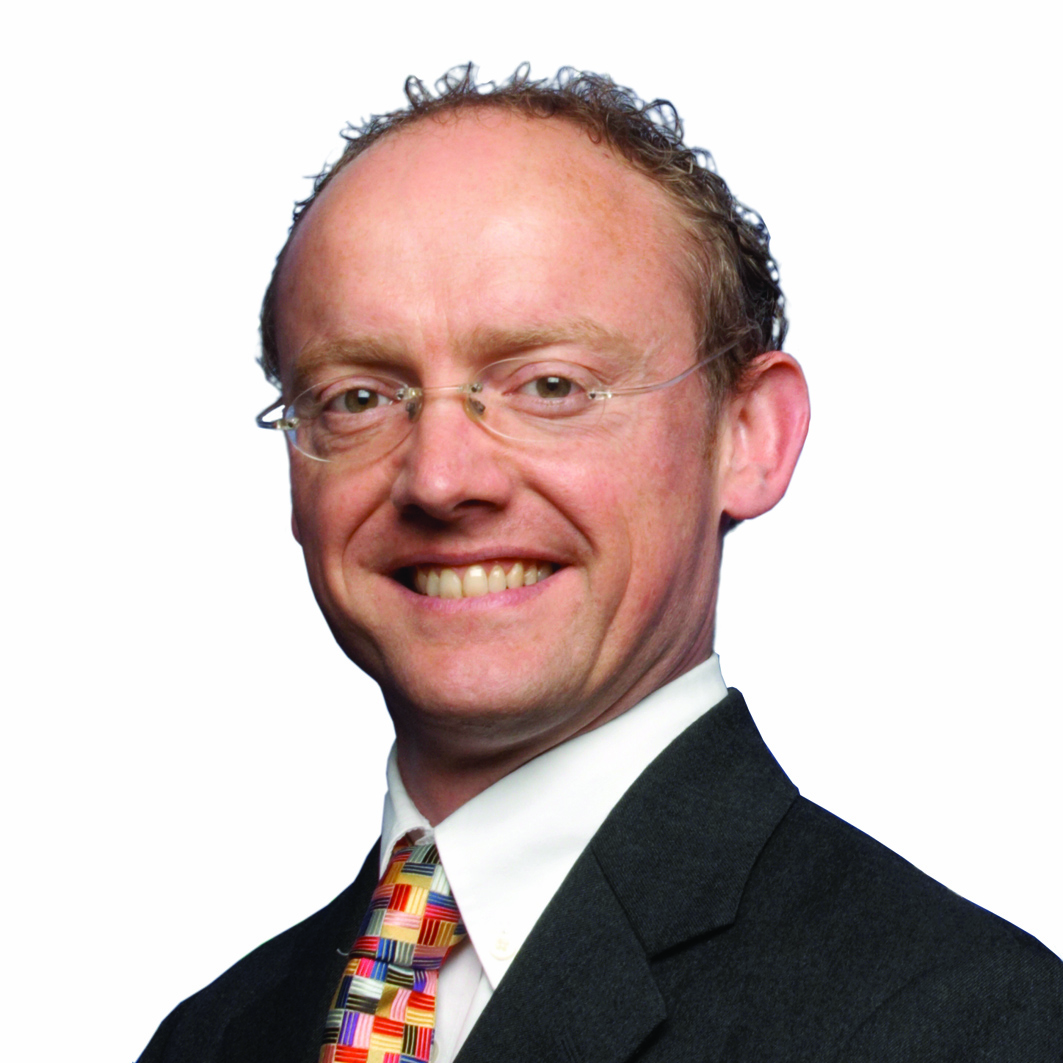 MCFly spoke to Todd Holden, Head of Low Carbon Policy and Programmes at Greater Manchester Chamber of Commerce, about low carbon supply chains, steady state economy and how we can influence businesses to act more envronmentally.
Can you tell us a little about your role at the GMCoC and when and why it got setup?
Well the role of low-carbon policy and programming has existed for almost two years now and the main rationale behind it was that the low carbon economy is growing all the time and in terms of its scale it is growing faster in the UK than any where else in the world. At at time when most parts of the economy aren’t growing we want to get behind it. Manchester is doing quite well in terms of developing and getting behind it and so it seemed like a very good time to have a dedicated resource. Not just from a policy point of view but from a practical perspective in terms of helping our members and developing projects.
Do you think that there are ways to have a growing carbon economy without using up more and more finite resources?
I think there is a clear need for us, as we go forward, to de-couple the use of resources and resource/energy-efficiency programmes are a good way of doing that. They have significant implications for the bottom line of businesses and they also reduce their environmental impact. In terms of the wider economy, we can grow in a more sustainable way than we are at the moment so it’s about how we adopt those best practices and how we change the way we consume, and how we move from a consumer-led society to one which is more service-focused where we don’t own as much stuff, so we don’t throw away as much stuff so that’s the big move we need to make… When you have population growth and a growing pressure on finite resources and rising costs, the only way we will be able to afford the lifestyles we have now is to go towards services.
What do you think about the concept of a Steady State Economy?
The Sustainable Development Commission did a really interesting report called ‘prosperity without growth’ which was looking at growth, issues around GDP, social wellbeing and social values. I think the challenge around steady-state is that it is almost impossible for a single geographical location to do on its own without facing the economic penalties for doing it and the problem with that is that it has social consequences. I think the idea that there is even a small part of the economy that is not growing is really difficult to achieve in reality without a lot of social inequality. That’s not to say that’s isn’t possible or desirable – it’s just very difficult to achieve right now from where we are.
I understand the chamber of commerce is looking to develop low carbon supply chains. Can you tell us a little more about that?
Yes, we’re developing a low carbon framework. We recognise that one of the barriers in terms of accessing support is that companies don’t necessarily know what they want or if they do, they don’t know if they support that they are getting is reliable. If you were a businesses thinking about generating some of your own electricity, you would quite easily find people who say you need a PV system or you need a wind turbine. What you wouldn’t find is somebody will say that actually PV isn’t appropriate and what you need is this – there’s no independent source of information.
So the idea of these of these frameworks is to collate a list with all the providers from everything from insulation of buildings to retrofitting to getting your boilers and other technologies. So it’s about giving people confidence about the providers, that they are legitimate and that they have controls in place and the final part of the process is getting people who will fit the technologies in situ. So hopefully that will be up and running in the next 6-8 weeks.
How can councils and people influence businesses and help encourage environmental policies?
One way to influence businesses is through regulation and tax breaks which is what national government does. Another way to influence businesses is through demand. The local authorities have quite substantial buying powers so the use of public sector money is a very powerful mechanism. Keeping the money within GM and making it work harder for the region is probably one of the big ways of influencing businesses. Also if you want people to follow then you need to get your own house in order pretty quickly. That ability to act as an exemplar whether that is in your travel policy or your energy, you need to have your own house in order before you talk to others about taking it up.
As individuals we can also influence our employers to get involved in things and take up opportunities to save energy. Also if individuals see something they don’t like they should speak to their MPs and councillors – talking to these elected members to raise your concerns is a really good way to taking action and we’ve found that it tends to be quite effective.
The full transcript of the interview is on our website under the interview tab.
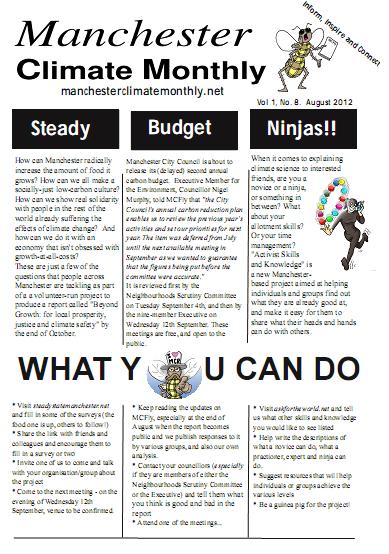 Steady Budget Ninjas?! As in, steady-state economics, Manchester City Council’s delayed annual carbon budgets and how you move from “novice” to “ninja” on a variety of skills and knowledge.
Also in this MCFly – Older people and activism – what are the barriers? How to spend your August. An interview with Todd Holden of the Greater Manchester Chamber of Commerce. Rudyard Kipling’s “If” for activists. “What YOU can do”… and much much more.
As ever, your thoughts and comments welcome – mcmonthly@gmail.com
 | Dave Bishop on COP27 and the fantasies of sal… |
 | manchesterclimatemon… on The messages we send – o… |
 | Anon on The messages we send – o… |
 | Stephen PENNELLS on Climate emergency? What climat… |
 | marchudson on Twelve years ago in Punxatawne… |

 manchester climate monthly