Manchester Climate nuggets 21st May 2012

Hi all,

hope you’re all well.  Please do read the story before this one on the site – Manchester City Council is going to be releasing a report about Steady State Economics soon. This is, I think, a Big Deal, regardless of what conclusions the report actually comes to.  More later.

In the meantime, as ever, we want your news and views and your spare hours of time here and there.  If you want to volunteer, get in touch! mcmonthly@gmail.com

Marc Hudson

Coming up this week

Weds 23 May  First meetings of two rejigged Manchester City Council Scrutiny Committees – “Economy” and “Communities”.  The Economy is going to be having a “Sustainable Economic Development” meeting in June!

Friday 25 May – Climate Jobs Caravan events
In Manchester the caravan will be in Piccadilly Gardens 11am to 3.30. All Saints from 4.15 till 6pm. The evening meeting will be at the Friends Meeting House (M2 5NS) from 7-9pm. Speakers will include Sir Richard Leese, Martin Empson from the Campaign against Climate Change and Hannah Thomas from the Otesha Project in London. We will argue that one million climate jobs could be created, cutting CO2 emissions by 80%, and we will call on the government to set up a National Climate Service (NCS) to invest in climate jobs.

Sat 26, 11am to 11pm ECODAYA “12 non stop hours of sustainable salsa fun” The Lifestyle Centre, Wythenshawe, M22 1QW

Stories you may have missed on the MCFly website

Lessons we like to pretend we’ve learned
We can’t pretend we’ve learnt any this week.

Paid gigs!
Job Alert: Herbie Coordinator

National News
Caroline Lucas not standing to be leader of the Green Party again
The Committee on Climate Change release their Local Authority advice. All of which – and it kills us to type this – Manchester City Council is already doing.

16 May William Hague, foreign minister, has been warning Dave C about the threats to Britain’s clean tech (green/low carbon) industries) because of ministers’ “failure to make the case vigorously”

17 May Britain’s first geoengineering experiment – spraying water into the atmosphere from a tethered balloon, is cancelled.

19 May The Financial Times reports that ex-minister Peter Hain is backing another Severn Estuary tidal power thingie.
Things worth reading
Local film-maker and artist Erinma Ochu on a resilience self-audit.

Scary Science
Arctic melt releasing ancient methane by Peter Black (BBC)

Posted in Weekly bulletins | Leave a comment

NEWSFLASH: Council to release report on Steady-State Economics

First the good news; Manchester City Council has committed itself to producing a report on Steady State Economics.  This follows an open letter to its Economy Scrutiny committee [see membership here]. last November. That letter was signed by co-ordinators of Friends of the Earth, several academics and social enterprise leaders and one of the editors of Manchester Climate Monthly.

According to a document released on the City Council’s website the report will;

Include “a potential strategy to counter the tension that exists between the sustainability that steady state economics advocates and the Council’s economic policy.”

Explain “how the Council’s economic policy fits into the context of the priorities identified in the report to create a model of sustainable economic growth based around a more connected, talented and greener city region;”

Provide “comparison of the steady state economic models with other economic models”

and explain “the economic model that the city works under ensures the economy grows in ways that minimise negative impact on the environment.”

The report is scheduled for discussion at a meeting to be held from 10am on Wednesday June 20th, 2012 at Manchester Town Hall.  (We would encourage everyone who is interested in Manchester’s future to attend! It’s free and will be very very interesting. We promise.)

Now the caveats and quibbles
– the signatories of the Open Letter that kicked all of this off last November have not been alerted to the impending report and meeting.
– the offer from the signatories of the letter was to work WITH the Council. What is being offered by the Council is – if you were being cynical – the opportunity to be a rubber stamp for work that they have done in-house, without collaboration.
– we have no idea how thorough or even-handed the report will be.  The reason there was an open letter in November 2011 was that the Council’s first bite at this cherry had taken a year and was little more than a page in length.

Still, “victories” of this sort are rarer than horse’s teeth, so let’s not look the gift hen in the mouth. Or something like that.

Watch this space.

Marc Hudson
mcmonthly@gmail.com

Still confused?
What’s a Steady State Economy? Visit the Centre for the Advancement of the Steady State Economy.

Why is infinite growth a bad idea? Watch this short youtube – “The Impossible Hamster”

Posted in Adaptation, Campaign Update, Climate Change Action Plan, inspire, Manchester City Council, Mitigation, Upcoming Events | Tagged , , , | 1 Comment

Event Report: Transforming Manchester, or “The thin veneer of climate governance”

MCFly co-editor Marc Hudson went to an academic seminar about, well “Transforming Manchester” and came away informed and intrigued.

The first of the two speakers was Dr Jeremy Carter, of the Centre for Urban Regional Ecology and the Ecocities project (yes, the very same one MCFly recently dissed). He explained the “adaptation imperative” for Manchester.

He set the scene with a few observations;

  • there has been a significant acceleration of climate change in recent decades
  • recent impacts are above/beyond the IPCC’s “worst case scenarios”
  • recent emissions have been above the IPCC’s “worst case scenarios”
  • it turns out thresholds for significant impacts have been revised downwards (i.e. it turns out it is going to get worse sooner than we thought)
  • there is little commitment by government, business or society to address this.

So, for example, if five years ago you’d talked about a four degree global average temperature rise in the coming century as a given, you’d have been risking your reputation as a reasonable and serious commentator. Now four degrees is the new normal (as seen in the new website, www.adaptingmanchester.ac.uk), with its strap-line “Four degrees of preparation”

Dr Carter said that for Manchester the main direct impacts would be flooding (especially surface water flooding) heat waves and droughts, with impacts on “critical infrastructure” and health and well-being.

In a subtle rebuke to the relentless framing of climate change as both a threat and an opportunity, he said “the opportunities perspective is quite hard to see when you look closely.” Indeed!

After looking at the advantages and disadvantages for (Greater) Manchester in planning around climate, Dr Carter mentioned the framework of Albert and Kern (2008) (see footnote 1), with cities tackling climate through 1) self-governing 2) governing by enabling, 3) governing by provision or 4) governing by regulation. Manchester is, it seems, governing by enabling. If ever we  at MCFly Towers see any enabling, we will report it, and we ask our reader(s) to keep his/her/their eyes peeled.

He closed with some observations around the difficulty for adaptation versus mitigation – Conceptually the problems included the lack of a clear time-line or endpoint for adaptation.
Practically he cited “institutional inertia, short term political motivations, regulatory structures that facilitate mal-adaptation” and posed a (rhetorical?) question around whether adaptation planning should go further, in recognition of ‘its holistic and cross-cutting agenda’?

Sandwiched between questions of “what is mal-adaptation?” and “what about the free-rider problem?” MCFly asked the following “Looking back 20 years from now, what will we regret having done/not done in the period 2009 to 2014?”
Dr Carter said it would be not drawing up the connections between mitigation, adaptation and transport. The problems can’t be solved individually without solving the others, so the siloed agendas need to be joined up.

Dr Hannah Knox of the Centre for Research on Socio-Cultural Change (CRESC)  (footnote 2) was up next, with a presentation entitled “Green and Digital Manchester: A reflection on two revolutions”
She was at pains to say that it is based on work she is in the middle of doing, so her perspectives and analysis are very provisional.

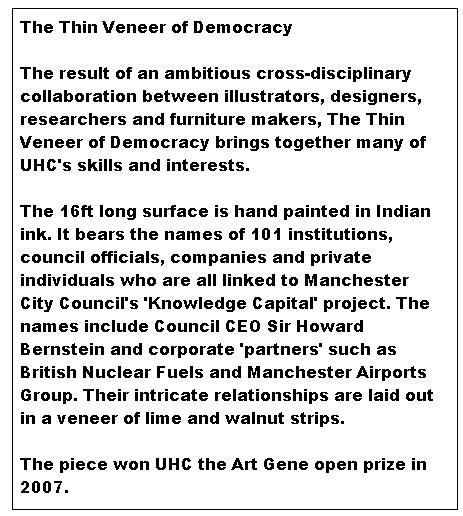
She started by introducing a work of art that was launched in 2007. UHC, a local art collective, produced a work called “The Thin Veneer of Democracy”.

On a big oak table they had etched a schema of the links between individuals and organisations in Manchester around
Knox pointed out how, in the space of five years, the diagram had become surprisingly dated – institutions are gone, projects renamed, new links formed.

Using her anthropological training, looking at the “cultural expectations” individuals and organisations have, Knox is looking at how Manchester is gearing up (or not) to deal with the “catastrophic forces” of climate change, using the late 90s/early 2000s action around ‘digital Manchester’ as a compare-and-contrast.
Back then (and not much has changed!) the media revolution was to be inspired to move to Manchester because it had all the “right” ingredients – a music scene, ethnic diversity, cheap office space, universities The key trope was “convergence” around technological knowledge, creative flair and managerial ability. The public sector saw itself as trying to get networks going (hosting events, minglers, etc – almost ‘enabling’ you could say). [Much of the same language is used for climate, and Knox’s observations fit neatly with Aidan While et al’s notion of the “sustainability fix.”]

Reiterating that her observations were provisional, Knox said that she is looking at the “cultural politics of climate change” – what is deemed ‘appropriate’ in terms of responses by different actors.
After outlining to the two headlines of the Manchester Climate Change Action Plan (a 41% cut by 2020, and a process of culture change), she turned her attention to the thorny question of carbon footprints. Whose emissions? Counted how? You can either tote up the energy use data, or you can look at the “Total Carbon Footprint” (TCP) (which includes the energy used to create the products that are then imported from ‘abroad’). [Manchester, btw, is committed to moving to a TCP approach – something Dr Knox didn’t mention.]

She touched briefly on the built environment and the way that Housing Associations are becoming important players, and asked where precisely the ‘Manchester collaborations’ will lead.

In the Q and A Professor Kevin Ward asked her whether she’d looked at how policy documents bring some issues forward and silence others [and MCFly thought about George Monbiot’s observation – that we can’t seem go Google – that the policy documents are the policy] and Peter Fell, director of regional and economic affairs at the University of Manchester, highlighted the fact that University of Manchester is a major energy player, in terms of Research and Development.

Footnotes
Footnote 1 Albert and Kern (2008) Governing Climate Change in Cities: Modes of Urban Climate Governance in Multi-level Systems [30 page pdf here]
Footnote 2 Knox is co-organising a panel at CRESC’s annual conference in early September on “Promises of a Green City”

“Transforming Manchester” is a programme within the “cities@manchester” collaboration. You’ll be shocked to learn that  MCFly blogged about the previous event, held in January.

Posted in academia, Adaptation, Event reports | Tagged , , , , | 4 Comments

Thoughts on a protest…

MCFly writer Philip James ponders the ethics of non-violent direct action, and seeks readers’ opinions…

Take the Flour Back is a non-violent direct action event against a crop trial of GM wheat taking place at the Rothamsted Institute in Hertfordshire on May 27th. The action aims to destroy the crops, or conduct a ‘decontamination’ as the campaign puts it. Many Manchester campaigners are in support and planning to attend (see http://www.underthepavement.org/listen-again/ for an interview with two such campaigners).

However, there are concerns that direct action of the kind planned by Take the Flour Back sets a dangerous precedent: if you don’t agree with something, break it. If every time somebody disagrees with something they break it, where does that leave us? Is it acceptable to destroy the power lines to a wind farm because you hold the sincere opinion that it spoils the environment and harms birds? We are entering highly charged times and the environmental movement might just need the rule of law and much as it needs to circumvent it. To quote A Man for All Seasons:

William Roper: So, now you give the Devil the benefit of law!
Sir Thomas More: Yes! What would you do? Cut a great road through the law to get after the Devil?
William Roper: Yes, I’d cut down every law in England to do that!
Sir Thomas More: Oh? And when the last law was down, and the Devil turned ’round on you, where would you hide, Roper, the laws all being flat? This country is planted thick with laws, from coast to coast, Man’s laws, not God’s! And if you cut them down, and you’re just the man to do it, do you really think you could stand upright in the winds that would blow then? Yes, I’d give the Devil benefit of law, for my own safety’s sake!

Then again, if you always took the Thomas More line where would we be?

Do you sometimes have to break the law to change it? Are all forms of
direct action equally valid? Is passive resistance more powerful than an act of destruction?

Any thoughts Dear Readers on direct action of this kind and where it leads for the environmental movement. Go on, post a comment!

Posted in Campaign Update, Democratic deficit, Food, Upcoming Events | Tagged | 5 Comments

Articles Review: Crises, Camps and Citizenship

MCFly co-editor Marc Hudson reads three academic papers on the stepper at the gym. And is impressed, distressed and depressed, in that order. Compressed reviews follow.

Economic and Ecological Crises: Green new deals and no-growth economies Bob Jessop
Beyond the ‘Green Economy’: System change, not climate change? Nicola Bullard and Tadzio Muller
Incentives to Promote Green Citizenship in UK Transition Towns Amy Merritt and Tristan Stubbs
all published in Development: Greening the Economy, Vol 55 (1) March 2012

Bob Jessop is a very big name in theories of the state and capitalism. He’s been around a looong time, and a lot of people cite his ideas. That doesn’t, of course, automatically mean this paper is any good. Turns out it is though.

He sets out to explain that we think in stories, and that these stories can be unpicked (“critical semiotic analysis”). So, there are stories we tell ourselves about the economic crisis (greedy bankers, sleepy regulators, dodgy mortgagers) and stories we tell about ecological crises (greedy capitalists, sleepy publics, dodgy technologies). He uses the term “imaginaries” to label these stories.

“An imaginary provides one entry point into a supercomplex reality and can also be associated with different standpoints, which frame and contain debates, policy discussions, and conflicts over particular ideal and material interests.”

As in – some stories hide more than they reveal, and are successful because of who they are told by, and how they help things stay the same/change. Stories are fought over (the sides have different resources and ‘truth’ doesn’t necessarily win”.)

Interestingly, Jessop then talks about crises in a system and crises of a system.

“Crises of a system are less common. They occur when there is a crisis of crisis-management and efforts to defer or displace crises encounter growing resistance. Such crises are more disorienting than crisis ‘in’, indicating the breakdown of previous regularities and an inability to ‘go on in the old way’, indicating scope for new imaginaries, visions, projects, programmes and policies.”(p 19)

Having laid this theoretical ground work, Jessop looks at the way elites have talked about the recovery from economic crisis.

“Of particular concern is how the imaginaries and imagined paths to recovery from the GFC that shaped crisis management neglected or marginalized ecological issues, food and fuel crises, and issues of social development and social justice from the mainstream policy agenda.” (p 20)

Well, concerning, yes, but hardly surprising (I suspect Jessop would agree). He then looks at how the various “Green New Deal” proposals become an inkblot test for individuals and institutions to project their own desires and expectations.

It is hard, Jessop points out, to think “outside the box” (‘never ask a goldfish for a definition of water’, as we say too frequently here at MCFly towers).

“… it is the deeply rooted nature of these categories that makes it so hard to think outside a capitalocentric imaginary, and therefore relatively easy for the logic of capital to reassert itself theoretically and practically. Small-scale trial-and-error experimentation and the collection of best-practice have a critical role to play here in designing and implementing a no-growth strategy and in providing evidence that another, non-economistic, ecological-friendly world is possible…. Local solutions can be developed to address the short-term effects of the crisis in its various local manifestations, and the challenge is to establish ways to exploit this real-time experimental laboratory to find what works, for whom, when, and why, as a basis for mutual learning and policy transfer among subaltern groups.” (p 23)

Jessop has made a rigorous and nuanced argument that will doubtless repay repeated reading. I defy anyone to say the same about Bullard and Muller’s effort.

They argue that the main reason for the weakness of the “counter-hegemonic ‘climate justice’” movement is that global elites are not talking about climate change in the way they did up to the end of 2009.

There is an extraordinary brace of sentences (p56) “The movement’s hopes were set high. Indeed, Barack Obama had (in)famously referred to this summit as ‘the last, best hope’ for avoiding runaway climate change.”
Several points here. The movement, as I recall, was far more skeptical about a positive outcome, but went on and held its marches (anyone remember the “Big Wave”?) and its summit-hoppings anyway. For various reasons, none of them that reflect well on the participants.

The suggestion that no-one predicted failure is akin to George Bush arguing that nobody could have predicted Hurricane Katrina, i.e. demonstrably false and morally repugnant.

For example, the current author was arguing – in print – by the middle of 2008, that Copenhagen, in the words of Admiral Akbar “a trap” that would at best drain energy away from local climate activism and at worst create the kind of dilemma faced by NGOS after the Kyoto Protocol (complaining it was grossly inadequate, but defending it all the same). Much more significantly, and with far more suppleness, an Australian writer Ant Kelly wrote “Demobilisation: avoiding the post cop doldrums.” It is extraordinary that this work is nowhere mentioned in reference list (nor the response it elicited by Tord Bjork).

From reading Bullard and Muller’s article, an uninformed reader would have no sense that thorough-going critiques of activist cultures and assumptions were written in the aftermath of the J18 Carnival(in Cologne and London) that provided the inspiration for the “Battle for Seattle”. [Give up Activism. much?] The reader would not be aware of the critiques of “summit-hopping” (turning up to disrupt IMF, World Bank and G8 meetings). The problems of summit-hopping (Gleneagles 2005) was a major spur for the very creation of the Camp for Climate Action that Bullard and Muller write about. The bitter irony that in the space of a mere three years the Camp went from staging its own events on its own terms to … summit-hopping at Copenhagen is one that has either escaped the authors or one that they feel it would be impolite to mention.

The article also takes at face value the movement’s self-description  “open, networked and consensus-based”, where all these terms could profitably be challenged. Still, we should be grateful that they at least are able to see that these features (whatever label you would want to put on them) create “problems in terms of sustainability and organizational growth and from their extremely narrow base from which broadening-out has been very difficult both to other existing movements and towards affected communities.”

To use the word “dynamic” for climate justice movements in the Global North is, frankly, embarrassing. The movement desperately needs thorough, unsentimental and constructive analysis. This article is not within a thousand miles of that.

Finally, Merritt and Stubbs want “to determine the key challenges of participation in the green economy, and how local and central government can play a role in promoting community action through formal political channels.” Turns out you can’t trust councils to help out (who knew?). The paper then “explores innovative ways of funding community initiatives by publicly indexing local sustainability initiatives, and considers how indexing could work in practice.”

They did a desk survey (i.e. read a lot) and “supplemented [their] findings with extensive primary research, including interviews with TT members, environmental campaigners, political party candidates, policymakers, academics, NGO and think tank staff in the UK.”

But not anyone particularly cynical, it seems.

Still, there were a couple of wry and rueful smiles to be had –

“people become very passionate about their work in TTs, and egos come into play rather than looking at the bigger picture”;

“TTs tend to be dynamic [that word again – it’s the new ‘sustainable, it seems] in areas where the local council is dynamic on sustainability issues. In more deprived areas, TTs tend to be more lacklustre: their council shave to deal with more pressing socio-economic issues.’

“Our research has identified engaging people from marginalized and poorer backgrounds to be a key challenge for TTs.”

Dr Amanda Smith‘s work on Nottingham Transition Towns is conspicuously absent. Whitmarsh, Seyfang and O’Neill’s distinction between carbon literacy and carbon capability might also have usefully got a look-in, but still and all, these three from the bibliography look interesting –

Brannan, Tessa, Peter Jon and Gerry Stoker (eds) 2007 Re-energizing Citizenship: Strategies for civil renewal. Basingstoke

Trachtenberg, Zev (2010) Complex Green Citizenship and the Necessity of Judgment Environmental Politics 19 (3): 339- 55.

Weber, Edward P. (2003) ‘Bringing Society Back’ in Grassroots Ecosystem Management, Accountability, and Sustainable Communities. American and Comparative Environmental Policy. Cambridge MA: Massachusetts Institute of Technology.

Posted in academia, Article alert | Tagged , , , | 5 Comments

How about we…

This is from a website called “The Learning Planet.” It’s a brilliant list of things we should start doing…

…face what we really feel about future threats to life on Earth rather than self-anaesthetising with constructive denial?

…acknowledge the current threats to the biosphere, and agree that devastating effects of climate change are happening now everywhere, that it is not a vague and indefinable future threat?

…stop asking children to get angry about their future on our behalf?

…stop fighting in a growing panic between camps that prefer different solutions and instead try many clumsy solutions?

…stop feeling that it is shameful, inappropriate or pessimistic to raise our fears or anger about the devastation to our planet?

…know that every time a political or business decision is made it impacts on all living beings, including people, not just on people, because we are all interdependent?

[continues]

Read it all here

Posted in inspire | Tagged | 1 Comment

Event Report: Green Expo 9/10 May in #Manchester

MCFly writer Phil James attended the Greenbuild Expo last Wednesday, Manchester’s annual show-and-tell for all things Green and buildy.

I’m not sure what I was expecting, but this is what I found; Preparation for the Green Deal continues apace. At a packed Q&A industry figures discussed their thoughts. The processes for assessors and installers to get accredited seems to be in place and companies are ready to help you get accredited (for a fee). Some concerns were raised that the role of Green Deal providers (the big guys who’ll hold the purse strings) will lock out Small and Medium -size Enterprises (SMEs). The role of local authorities was seen as crucial in ensuring SMEs can get involved…

The stands on display had a healthy mix of technologies, with noticeably less PV installers than last year if my memory serves. Perhaps indicating that changes to the Feed-in-Tariff have already put a dent in the flourishing PV industry/unsustainable PV goldrush (take your pick)…

Attending a seminar on Life Cycle Analysis was an interesting experience, with the message I took being this: crunching the numbers and knowing how much embodied carbon you save by going easy on the concrete is all well and good, but out-of-town shopping centres are not green buildings…

Finally, taking inspiration from/ripping-off a well known left-wing organ, I’d like to do an In Praise Of… for the Green Building Store http://www.greenbuildingstore.co.uk/ whose stand I visited. This small company based in Huddersfield have been pioneers in developing low energy building products and methods. They built one of the UK’s first Passivhaus homes using the traditional UK method of brick and block cavity walls, and what’s more they told the world what they did, all the technical details of how they did it, and what they’d learned FOR FREE in blogs, videos, documents and discussions! True green pioneers…  

Phil James

Posted in Energy, Event reports | Tagged , , , | 4 Comments

Environment Commission plays musical chairs; without a chair.

and the song is “The Sound of Silence.

By dawn on May 4th Dave Goddard, chair of the Environment Commission, knew he had lost his council seat. Later that day we phoned and then sent an email to officers who help run the Environment Commission. We requested information about the mechanics of replacing the chair (a subject the Terms of Reference are silent on), and implications for the (delayed) Implementation Plan for the Climate Change Strategy.

On Tuesday 8th May we received the following communication

As Cllr Goddard has been the Chair since the Commission’s inception, this is new ground for us. I will respond to your enquiry as soon as possible, and aim to provide an outline of the likely timeline and process.

We would of course wish to avoid any unnecessary delays to the development and implementation of key environmental initiatives wherever practicable.

Since then, nada.

It all raises an interesting question, doesn’t it? If the Environment Commission is so completely unable to think about the possible outcomes of the 2012 election – an event that has been scheduled since before it came into existence in 2009 – then how can it expect to be trusted with the ever-so-slightly more messy and unpredictable realities that climate change will throw up?

Answers on a postcard to the usual address.

Posted in AGMA | Tagged , | Leave a comment

Event Report: #Manchester #madf or a digital future. A green one? Not so much.

Attention Conservation Notice: This is an account of a two hour ‘debate’ about Manchester’s digital future. Nobody brought up climate change as an Issue.

A panel consisting of Dave Carter (Manchester Digital Development Agency), Dave Mee (Madlab) Tim Roberts (I-Com) Ernima Ochu (Squirrel Nation) and Dr Alex Roy (New Economy), with Martin Bryan (smc_mcr) in the chair

Ironically, for a meeting all about networks and interactivity we started without a “turn to the person next to you/behind you and introduce yourself”. Instead we had each speaker introduce themselves and then answer questions from the chair, with periodic check-ins with the audience to see what answers they had to these questions. The panel, and the audience, were up to the task of keeping it interesting, but there were a fair few unanimated faces when MCFly looked around the room periodically…

The first question was “What’s the most important decision for Manchester’s digital community in the next three years.”
Dr Alex Roy (“Head of Research at New Economy, and responsible for – among other things – the statistics about football’s benefit to the economy) reckoned it was to ramp up the city’s international profile, leveraging the beeb, the football clubs, the music.
Erinma Ochu (who makes films and art and gets communities involved) said it was about local groups (e.g. A community choir) learning how to use online tools to amplify their voice, around fund-raising, for example).
Tim Roberts (of Icom, “one of the largest digital organisations”) said Manchester was going to have to get off its backside and invest in small businesses. I could be wrong, but he seemed to not like all the money going to certain corridors of the city.
Dave Mee (“Madlab is a youth club for adults”) extolled the virtue of Fab Lab. Wot’s a Fab Lab? “A Fab Lab (fabrication laboratory) is a fully kitted fabrication workshop which gives everyone in the community from small children through to entrepreneurs and businesses, the capability to turn their ideas and concepts into reality.”
Finally, Dave Carter (“MDDA is about digital inclusion, open innovation, data networks, smart cities/smart citizens”) reckoned it’s about
a) infrastructure – there may be trouble ahead – (cites Will Video Kill the Cloud Star?)
b) start-ups universities needing to be more modular, mash-ups (MCFly’s term) of work and study
c) punk finance (in the way that it used to be ‘learn three chords and go form a band’ it’s now ‘find three ways to raise money on-line and you’ve got community finance”

Next up – How is Manchester faring?
Everyone thought not so well.
The Chattanooga Geek Hunt got a mention by Dave Carter

How is connectivity for you?
Tim Roberts “It’s a disaster”, and was echoed vociferously from a business guy in the audience.

What about skills retention?
Well, said Roberts, there’s the bigger issue that the universities are not turning out the right kind of graduates; “ the standard of interns is “appalling”
Dave Mee pointed to how hard it construct a course when the technology is moving at such a rapid rate that a three year degree course is out of date by the time a cohort is through. He gave a shout out to the intriguing-sounding omniversity.

What skills is Manchester lacking?
“Absolutely everything” said Dave Carter, giving a shout-out to NESTA’s “studio schools”
Erinma Ochu pitches in on the need for more than just digital skills. She’d like to see a kids TEDx to hack a new curriculum. And mentions a youtube film “You can’t be my teacher” that sounds interesting. [I’ve had a look. It is]

So, how does Greater Manchester benefit from this digital economy?
After Dave Carter’s point that Manchester itself has impressive levels of child poverty and adult worklessness, there was discussion of the standard high-fibre diet prescriptions (nice fat broadband along the Metrolink expansion etc). Making sure opportunities were there for uber-deprived neighbourhoods

Various discussions about schools and IT, and how business can help universities, and a pointed comment from the floor about the recent Digital Skills Summit not getting enough (business) support.

How to get folks knowing about what’s going on? A tech blog? More quangos (as if there were money for them). A central depository

Then – extraordinarily – “Is it we don’t sing Manchester’s praises enough?
Riiiiiight. There’s um, not enough boosterism in Manchester…. tumbleweed.
Dave Carter at this point mentioned San Francisco’s creation of a Chief Innovation Officer.

Erinma Ochu, reading, it seems, off twitter, pointed out how few women had been heard from. (to this point it was just her – intermittently – and one female from about 10 or so questioners, in a room with a male to female ratio of about 3 to 1.

The chair responded by saying that there had been the intention of a second woman on the panel but that “you can never engineer representativeness. When you open it up to the floor anyone is able to speak at any time.”

This is an extremely interesting assumption, that should have been challenged there and then (my bad). It might be worth reading this wikipedia page. Or this one. Or this extraordinary piece of writing about class and privilege and education from Boston MA “The boy next to me sings all the time.” To state baldly that everyone enters a given space with the same amount of cultural capital, confidence etc is problematic.
And surely the phrase “we’ve heard from a lot of men. Are there women who’d like to ask questions?” might be like touch screens – initially odd, but then unremarkable?

Anyhow, Ms Ochu’s intervention seemed to encourage the XX chromosomers. One piped up and pointed out just how important it was to have an ecological view (in the sense of networked actors, big and small) rather than a ‘one big central point’ notion, and this was followed by someone else making a comparison with Manchester’s cultural organisations and their networking.

Final Question from the chair – what is Manchester’s digital future?
Alex Roy – no single quango; you out there doing it
Erinma Ochu – possibilities of data archives and story telling
Tim Roberts – Manchester’s great
Dave Mee – Build the future rather than anticipate it. The Web is basically the printed page on a screen, we need to look at new spaces.
Dave Carter – Look at the idea of 3D printing. If in ten years time homes and businesses have this, where are we training people now? And a repeated slogan “infinite bandwidth, zero latency.”

So, after all that; The elephant in the room.
If this meeting had been held three years ago, someone would have mentioned the Pending Ecological Debacle. Someone would have at least paid lip-service to the consequences of treating the atmosphere like a sewer. But the “environmental movement” has made such a poor job of keeping the fate of the earth on t’agenda that, now that the media is not mentioning climate change, the techno-geeks are able to sit around for two hours and talk about “the Future” without talking about how we will need all our smarts, including our digital ones, for the very rocky road ahead.

Oh well. There’s always next year.

Verdict:
smc_mcr is pretty good at what it does. The next meeting is in early July, and will be worth going to.

Marc Hudson

Further Reading:

Eaarth by Bill McKibben (he bangs on, in t’second half, about the importance of the Internet)
The Green Digital Charter*
Jjasonwhatsinseason.wordpress.com “Seasonal ideas for local and organic produce in Manchester and UK”

* Dave Carter said afterwards if he’d recognised the MCFly reporter, (whom he last saw with a crewcut), he’d have thrown in a reference to the Green Digital Charter to head off criticism. My wife loves long curls, Dave; what’s a dutiful husband to do?

Posted in Event reports | Tagged , , , , | 4 Comments

Ecocities “widening debate” on Manchester adaptation – in parallel universe, maybe

Words like “engagement”, and “involvement” and “stakeholders” get tossed around pretty lightly in Manchester. The reality is somewhat more tawdry. The latest example of the gap between what is said and what is done comes to us from the world of climate adaptation. That’s a small concern for many people now, but it won’t be in a generation from now…

Ecocities is a project that was set up in 2009 to create a climate adaptation blueprint for Greater Manchester by the end of 2011.  A joint venture between Manchester City Council, Bruntwood and the University of Manchester, it never exactly set the world on fire.  MCFly covered its opening event, its halfway [sic] event and the fact that its final conference was postponed at very short notice. Just yesterday we visited the site to find out when their much-promised big event would be. Here’s what we found.

And today we get a press release.  You can read the whole thing here.  We’ve cut and pasted the second half of it below and put in bold the bits that made us laugh out loud.  Our comments are in italics –

from the press release

Sir Richard Leese, Leader of Manchester City Council, added: “I’m proud that Greater Manchester is leading the way on such an important issue, and one that has the potential to impact hugely on people’s everyday lives, our public services, our businesses’ productivity and our city’s infrastructure. I hope that the EcoCities project – in showing the way forward for an integrated approach to climate adaptation – will offer other cities, both within the UK and further afield, some best practice solutions to this seemingly most intractable of issues. We must widen this debate to ensure that everyone who has an interest in this area now takes part in both the debate and in arriving at practical solutions. No one has a monopoly of ideas in this field.”

Yes. That’s why there has been precisely no invitations to anyone outside the charmed circle.

The EcoCities project has enhanced capacity for individuals and organisations to take action to adapt Greater Manchester to the changing climate, and hopes to become a source of information and best practice guidance to other cities both across the UK and further afield.

Really? How? When? Evidence? Metrics?

The summit marks the start of the process to find practical and economically viable solutions of how climate adaptation can, and should, happen at a number of levels: individual building, local community, and strategic city-level region.

“Marks the start of the process” ; So what on EARTH has been going on for the last three years? And wasn’t a blueprint for adaptation supposed to be in place at the end of 2011?

In order to do this the EcoCities project team has widened the discussion to incorporate other stakeholders. [And who are these stakeholders?  Churches? Trades Unions? Sports clubs? Tenants and Residents Associations?  Small businessmen?  Don’t be silly…] Representatives from Arup, Drivers Jonas Deloitte and the Association of Greater Manchester Authorities (AGMA) will all be speaking at today’s summit and will be involved in finding the solutions and implementing them.

So that, presumably, is who Richard Leese means everyone who has an interest in the debate? This is how Manchester does engagement and involvement of its citizenry?   And presumably, therefore, the much-vaunted “carbon literacy” is going to be about mitigation rather than adaptation? Good luck with that.

Marc Hudson

Disclaimer: As you will tell by the tone of this article, we are indeed pretty peeved that we haven’t been invited.  Was it something we said? Is that how Ecocities acts – only voices that say what they want to hear will be heard? Is that how it expects to create resilience? Seriously?

Far more important, of course, is the truly grotesque failure of the Council and the Ecocities project to reach out and work with – and teach and learn from – civil society on what will, after all, be the defining issue of the 21st (and 22nd, if we have one) century.  In a generation’s time, people will look back on these wasted years with bewilderment and anger.

Oh, and in a beautiful example of just how informative the press release was, it didn’t even mention that that Ecocities have set up a new website www.adaptingmanchester.co.uk.
London-based PR companies eh? Were there no Manchester-based ones in a position to do the job?

Oh, and the twitter tag #adaptingcities? The only people who tweeted were the London-based PR company employees. #fail.

Posted in Adaptation, AGMA, Democratic deficit, Manchester City Council | Tagged , , , , | 1 Comment