“What is it that is following me?” A southern voice on climate change

From Kashmir to Delhi, Moscow to Manchester, what is it that is following me?
by Irfan Syed, (Chair, Salford Interfaith Network and Co-Chair Salford Forum for Refugees)

Lush green mountains, deep lakes, fresh air and singing birds of Kashmir. I remember swimming in Dal Lake and setting up school camps in the woods of Pahalgam. These are the memories of my childhood.

As I grew something is following me. What is it? Lush green mountains started to become naked, the bottom of lakes started to show, rivers became drainage ditches. What is it? As I am getting older it is getting stronger. It is not my business. What is it?

Delhi is the place where I made my future. Did I really make my future? Concrete jungle, noise of electric motors pulling water from the heart of the earth. Something is still following me. What is it that is following me from Kashmir to Delhi? Who cares? I have a degree, my future is safe.

Unprecedented heat waves, cyclones, floods, salinization of coastline and effects on agriculture, fisheries and health. Is my future safe? Who cares? My degree is safe.

Decreased snow cover, affecting snow-fed and glacial systems such as the sacred Ganges. Who cares? I have a degree, my future is safe. What is it that is following me? Who cares? I have a degree, my future is safe.

Now I am scared of what is following me; I will run away from whatever it is. I will fly 2696.87 miles from Delhi to Moscow; it will stop following me. Has it really stopped following me? What about hazardous and toxic air emissions following me? Who cares as long as flights are cheap? Now I am not scared; I am in one of the most powerful countries in the world. Will it stop following me? Big skyscrapers, expensive big cars, designer shops – is Russia getting richer? Birdsong is now replaced by the noise of expensive cars, trees are now being replaced by billboards, bright lights have replaced twinkling stars. Is this development?

Rising gas cost in Siberia, polluting coal is replacing gas in residential homes. The situation in Russia’s regions is becoming more severe with the growing use of coal, this means shortened life expectancies for Russians – whose short average life-spans are already creating a demographic crisis as the health of Russians is sold abroad in the form of expensive gas. I was wrong: it is still following me. Stronger countries were not able to stop that which is following me. Siberia even you were not able to stop it. What is following me?

Who cares what is following me as long as I am enjoying my holidays. Looking at the map and passing different countries I can’t find the Aral Sea. Is Central Asia drying up? Where is the Aral Sea? Once the fourth biggest land –based water source in the world, now it is dead, no more water, no more sea. Is it here even before me, that which is following me? Still we have time to save the Caspian Sea and an endorheic lake, Issyk-kol, in the northern Tian Shan mountains in eastern Kyrgyzstan. Please help me to stop what is following me as I want to keep something for my children to see, please help me to stop it. Please help me. What is following me? Someone please answer me – what is following me?

On Tuesday 1 May 2012 in Manchester I got my answer to what is following me; it is Climate Change that is following me.

It was workshop organised by the National Council for Voluntary Organisations (NCVO) that helped me to know what was following me. I was happy to see many representatives of different organisations attending this workshop. Together we are united and stronger. We discussed impact of climate change on BME communities.

The hall where we attended this workshop was full because of Kate Damiral and Nick Wilson’s hard work and dedication in bringing us all together to fight climate change. It was the first time in my life that I attended this type of workshop. After attending this workshop I got a feeling I was reborn to save this planet and my community.

A presentation by Kate Lonsdale gave us an insight into how the world is affected by climate change. Nick Wilson’s powerful presentation introduced seven climate change drivers, that is : rising temperatures, rising sea levels, floods, drought, climate effects elsewhere and pressure for a low carbon society.

On 5th May at Pendleton Gateway in Salford I gave a small presentation to 50 members of the Salford Forum for Refugees and People Seeking Asylum on climate change and its effects on BME Communities, using what I had learned from the NCVO workshop. We have members from Africa to Asia, Russia to Iraq. It was well received by our members I felt happy and proud that by attending this workshop it has started showing results. Members asked many questions about how they can stop the effects of climate change in their communities and the countries they had come from.

In the NCVO workshop we also explored the implications of climate change on BME communities in Manchester. I attended this workshop with questions in my mind but when I left the building I had answers to how to tackle climate change starting from my home, then my community and then from my country. Powerful countries are not able to defeat it but if we all stay together and united for this cause we will defeat it once and for all. It is our duty to save this planet for our future generations to come.

Rightly said by Mahatma Gandhi: “We must be the change we wish to see in the world.”

[Salford Refugee Week runs from 18 to 24 of June. There will be an event around climate change impacts. More details to follow.]

Posted in education, inspire, Upcoming Events | Tagged , | 10 Comments

Manchester Brewing Co-operative going for green

The famously thirsty MCFly talks to Jonathan Hartley of Manchester Brewing Co-operative, which is holding a beer festival in Levenshulme on Saturday 12th May. MCFly will be there, conducting extensive research. PS Latest MCFly out now.

When did you become established as a coop? whose idea was it?
When our founding member, Josh, found some old brewing equipment wasting away in a skip, the thought occurred to turn those discarded fermenters into fermenters of purpose! And so, with a thirst for knowledge, and for tasty brews, the cooperative journey began. Now, from the ‘skip-day’ to present, we have been joined by knowledgeful brewers as well as brewers to be, underpinning a support network for anyone interested in learning how to ‘brew it yourself’!

What have you done so far?

So far, we have primarily become a support network for anyone who is interested in learning how to brew beer, make wines or ciders and where to find the ingredients as locally as possibly; from local grains, to berries, fruits and infusing ingredients available as foraged ingredients, we have taught ourselves and each the whereabouts and particularly the abundance of locally available produce. Having accumulate a lot of equipment, we now have several ‘brew boxes’ which are the complete package of equipment and ingredients paired with a knowledgeable brewer to help you with your first brew. This has been promoted at all of our free workshops (primarily during the apple harvest time of year) comprising brew workshops, wine and cider pressing days. We believe in making use of local produce and particularly, produce that would otherwise be wasted. Last Autumn, we were lucky enough to have a whole orchard’s apples donated to us by a local farmer as well as apples collected from abandoned trees all around Manchester with which we were able to make around 350L of cider. The ‘pressing’ days were not only productive in a cider sense but also in getting a group of individuals, many of whom had never met before, to cooperatively put their time and energy into pressing pure, fresh apple juice. The resulting cider has been used particularly in charitable fundraising events (the last one at the OKasional cafe raising around £800) through donations to a cause, with gratitude expressed through a bottle of FREE cider. Naturally, we can’t and don’t sell any alcohol we make.

What efforts have you made to minimise the “carbon footprint” of your ingredients (hops, barley…) are they locally sourced, or are overseas sources actually better?
Hops are difficult to get locally, as they don’t cope well in our northern climate. They do grow in England, even in the north, but are very hard to grow and don’t yield high amounts of useable crop. This is something that we are looking into for future projects, perhaps building – to grow in etc. However, grains are very much available locally and we would source this as close to home as is possible. As I mentioned before, we make a lot of seasonal drinks and our ciders and wines are all made from foraged/donated ingredients, using produce (that is in abundance) that would other wise go to waste. We believe that if we can make a load of cider for people to drink and enjoy, when they find out all of the apples were destined to compost, they might notice the sheer abundance of fruit available on their doorstep.. and with our foraging days, we would like to expand upon that realisation and show local residents exactly where to get this produce (even produce that has nothing to do with beverage craft will be demonstrated).

What environmental policies do you have in place, what are the difficulties in becoming “greener”?
We always bottle our beers and reuse the bottles over and over again. Re-using glass is obviously much more effective than recycling so this is an obvious first step to maintaining good environmental practice. As I mentioned, hops are hard to come by locally, a good range of hops at least. So we would like to eventually be growing our own, or build a link with local farmers to grow specifically for us and other breweries. We have a strict ‘zero isinglass’ policy. to explain, isinglass is a filtration additive to clear out the beer which is in fact made from the internals of a particular fish. Believe it or not but a very large proportion of commercial beers are not vegan, let alone vegetarian. Using traditional methods and ‘racking’ for longer, and ‘dropping’ the beer several times clears out the beer very naturally. A little more time taken over this process saves a lot of fish and a lot of money… a no brainer really!
One of our primary goals is to become a registered brewery that can sell our products to local pubs and bars, the profits of which will be reinvested into other sustainable, local projects, effectively turning the sustainable pub trade into a lucrative fund-raiser for charity. We can also gently persuade local establishments to go’ greener’ by offering our stock cheaper if they fulfill certain criteria, offering a good incentive for eg, a cafe/bar to compost (locally) all of their coffee and green waste by offering a 10% per cask if we can see evidence of this happening.

What links do you have with other beer cooperatives in other parts of the UK? What lessons have you learnt from them? And, most importantly, do your products taste good?!
As of yet, we do not have any links with any other beer cooperatives in the UK. There are a few cooperative brewery pubs in our networks but not really anything to do with us. To be honest, all though we have been established for a year and a half now, things have really started to pick up in only the last 6-8 months with many more members joining, several BIG workshops, sustainability conference and a massive fundraising brew (around 450L of beer, 200L cider!) we haven’t had time to really make many links with other coops. Im not that sure that many exist? We have made a lot of links with local micro-breweries, especially as some of our members work in the pub trade, and this festival too has introduced us to many fine local brewers.

The main thing that we have learned from them is more to do with branding, promotion. remember, we are a cooperative of people who simply love beers and ciders, and what a cooperative often has is many members. So we are collectively trying and tasting and continually being inspired by so many of our members individual beer/pub related experiences. This has led to us having a very powerful think tank where we can all try variations of, say, a west coast American IPA. We achieve that near perfect recipe quickly because we collectively trial many different variations on the same recipe, record the all, and publish the results. So, I can only say, in answer to your last question, come down on the 12th of May and see for yourself! We have a beautiful chocolate and vanilla stout, a curried ginger beer as well as some traditional classics to try (not buy!).

Jonathan Hartley

Posted in Biodiversity, Fun, Upcoming Events | Tagged | 3 Comments

Manchester Climate Monthly #5 out now

Who is looking for a new boss after those local authority elections? Who got loads of moolah?  Where can you drink co-operative beer and salsa in a solar-kind-of-way?  What does the Sustainable Consumption Institute do?  When will Manchester start retrofitting?
All good questions, and you will find answers in the latest “Manchester Climate Monthly,” along with the usual “what you can do” “council gritter” and extensive calendar of green events on the back page.   Please email it,  re-tweet, share on facebook and generally tell other people about it…
As ever, your comments and critiques and suggestions are v. welcome, to mcmonthly@gmail.com

Posted in print editions | 1 Comment

Stick the boot into MCFly!!

The MCFly editors are meeting next Sunday. We are looking back on the last 6 months of MCFly (we started up online in October 2011, and in print in January). We are also looking forward to the next 18 months. We would be very very grateful if you would spend some time answering any or all of the following questions with as much brutal honesty as you like

1) What has gone well?
2) What has not gone well?
3) What do you wish we’d done differently?
4) What do you think we should do next?
5) what should we do more of?
6) What should we do less of?
7) What should we start doing?
8) What should we stop doing?
9) Anything else you’d like to say.

and send answers to mcmonthly@gmail.com.

Anonymity if you trust us not to be petty and vindictive
We will cut and paste all the answers we receive, without looking at the content, into a document that we then print off on the Sunday. Given the volume of emails we get, we don’t remember from minute to minute, let alone week to week.
Anonymity if you don’t trust us…
Alternatively, you could send it to a friend to forward it on to mcmonthly@gmail.com with “anonymous feedback” in the header,

Posted in corrections, Democratic deficit, print editions, volunteer opportunity | Leave a comment

Off-topic: Activists and Academics – thesis and antithesis?

Every so often invites from academics (for this seminar or that interview) land on the doormat at MCFly Towers. Or else we invite ourselves along to something that, although by and for academics should not be an “academic” subject. You know, things about democracy and participation and transition to low carbon societies and so on. Our experience of all these events has so far been, um, mixed.
So, below are some thoughts on the “invisible” (cough cough) barriers that keep academics and activists from falling in love. And some thoughts on how to overcome them.

To have become an academic you will have sat through several hundred hours of top-down “sage on the stage” seminars, presentations, conferences. You will have learnt how to sleep with your eyes open, and how to ask self-serving questions that get you noticed by the “right” people. You will have played the games. These games involve –

  • long words, long sentences, long lists of citations that add little/nothing but look impressive
  • death by powerpoint
  • theory for its own sake
  • linking ideas to other ideas because you can, not because it helps

To have become an “activist” you will have sat through several hundred hours of meetings that are usually billed as “consensual” and “non-hierarchical”, and a certain number of sage-on-the-stage events too. You will have learnt how to sleep with your eyes open, and how to make suggestions and voice approval that get you noticed by the “right” people. You will have learned to play the games. These games involve –

  • specific buzzwords (non-hierarchical, grassroots, natural, indigenous, democratic, encuentro) that add nothing but look impressive
  • death by march-point or camp-point
  • action for its own sake
  • linking activists to other activists because it’s “how we do things around here”, not necessarily because it helps

Activists tend to be “opportunistic” in a good sense – more interested in picking individual ideas, without too much concern for where they come from or how they fit into a bigger picture. They tend to be spottily-read (at best), suspicious of “grand theory” and interested in ideas for action, rather than building a detailed and coherent understanding of the World (philosophers have, after all, always tried to interpret the world – the point is to change it.)

Both activists and academics exist within subcultures. Each subculture of course has its own (largely unspoken) rules and rituals about how meetings should be held, how status is gained and lost, what “success” in the coming months/years looks like.

It is MCFly’s impression that academics gain little or nothing by “popularising” their ideas for a “mass market”. Quite the opposite, we suspect – it might well be dangerous to one’s reputation to be seen to be “slumming it” or “going native”. Even elite scientists (Carl Sagan, Sherry Rowland etc) used to get flak for talking outside of the Ivory Tower.

Further, if academics have engaged with activists (the whole participant observation schtick), and then write anything other than hagiography, the activists will feel they’ve been used or patronised (activists generally do not take criticism at all well. They’re human, after all.)

Activists will gain little or nothing by hob-nobbing with academics, even if they have the time and inclination and translation skills. They will probably not get “flak” from fellow activists though, unless they start spouting the jargon that they’ve learnt when trying to persuade fellow activists towards their preferred course of action.

So, both sides need to go into any relationship with Eyes Wide Open, aware of the barriers. These barriers;

  • Language
  • Time
  • Definitions of success
  • Mutual miscomprehension

And those solutions
LanguageAn optimal strategy for the maximised interpersonal exchange of knowledges might consist of a conscious and conscientious minimalisation of the use of specialised technical vocabulary and a willingness to create “interstitial trading posts” spaces and technologies of mutual comprehension.  Meaning? Enough with the jargon already. Translate it into English (or whatever language is spoken locally). It is possible. Supply glossaries. Work with activists to make bluffers’ guides, youtubes etc.
Time – activists work on a shorter time frame. They can’t wait around for the normal article production to play itself out, let alone book production. When they say they need information, they mean this year, not next. (See “Timing is everything” below)
Success metrics – for academics it will be articles published and this new “research impacts” malarkey. For activists it will have been stopping something stupid from going ahead – or, more rarely (sadly), making something not stupid happen. Activists tend not to be bothered with citations. See Gamson (1990 and 1998) for potential metrics for activists.
Mutual miscomprehension – well, that’s now solved, because this article has supplied everything anyone needs to know. Oh yes.

Timing is everything
Academics may study some governance issue or other – do some interviews, then do the write up. Get it peer-reviewed. Submit revisions. Then, by the time it is published, two years later, it might bear basically zero resemblance to the facts on the ground that the activists are trying to understand and influence. Epic fail.

Advice for academics
Study. The. Rich.
Make your findings available in English. Not jargonese, not academese. Enough with the five line sentences already. If your ideas are complicated, then it is all the more important that your prose is simple.

Advice for activists
The key question; What is in it for you? What are you and your organisation going to get from giving your time and energy and knowledge to some academic? You are helping them. How are THEY going to help you?
How are their findings (such as they are) going to be presented in formats that are usable for you and your group. Dense and delayed articles in journals no-one reads do not count.
If you are going to submit to an interview (and really, shouldn’t the person studying you be studying the rich?), and you want a copy of the transcript, by a certain date, then GET THAT PROMISE IN WRITING. And if a promise – verbal or written – ain’t kept, it is your responsibility to complain to that academic’s boss(es). And if that boss/those bosses don’t deal with your complaint, then maybe you should go public while also complaining to their bosses.

References
Gamson, William A. 1990 The Strategy of Social Protest 2nd edn. Belmont, Calif.: Wadsworth. (First edition, 1975.)

Gamson, William A. 1998 ‘Social Movements and Cultural Change’ in Marco G. Giugni, Doug McAdam, and Charles Tilly, eds, From Contention to Democracy. Lanham, Md: Rowman & Littlefield, 57-77.

Haraway, D. 1989 Primate Visions: Gender, Race, and Nature in the World of Modern Science, New York, NY; Routledge, Chapman & Hall Inc.

UPDATE: A Kiwi professor has written a book called “Stylish Academic Writing”. See Times Higher Education Supplement review here.

Posted in academia, humour | Tagged , , , , , , | Leave a comment

“Screw all the hippies”- An event report from the Big Six Energy Bash.

By Henry Davis

In February 2011, Climate Camp produced a statement which contained the following: “As a movement, to be relevant, we need to move with the times. Therefore the Camp for Climate Action has decided, after much discussion and reflection, to change.”

This meant no more national Climate Camps, with the intention being to “allow new tactics, organising methods and processes to emerge in this time of whirlwind change. With the skills, networks and trust we have built we will launch new radical experiments.” So, we were told, new tactics and radical new experiments would be on the way – sounds like a good idea.

Out of this came the Climate Justice Collective

(CJC) and top of the list of their stated aims for 2012 is to “help to join together campaigns on different energy issues” which, again, sounds like a very worthwhile thing to be doing.

Thursday (3rd May) saw their first big action in the form of the Big Six Energy Bash. The date and location were chosen to coincide with the UK Energy Summit where “representatives of corporate energy and politics will be meeting” to discuss how to “keep on profiteering from fuel poverty, climate change and trashing the planet.

The plan for the day seemed a little unclear in the run up, though an article published the day before the action said that “differently themed blocs” would “converge to create a celebratory space encompassing spectacle, direct action, theatre, music, workshops and much more, evoking the spirit of popular resistance”.

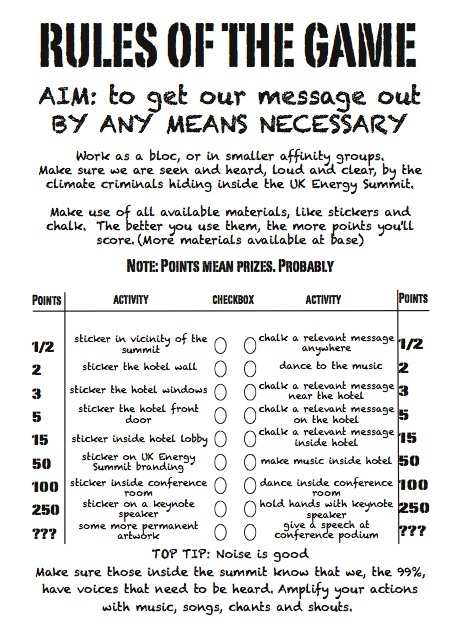
This ‘Rules of the Game’ sheet also explains that the aim was to “get our message out by any means necessary” with points being awarded for putting stickers or chalk near, on, or inside the hotel where the summit was being held, or getting in and disrupting the conference.

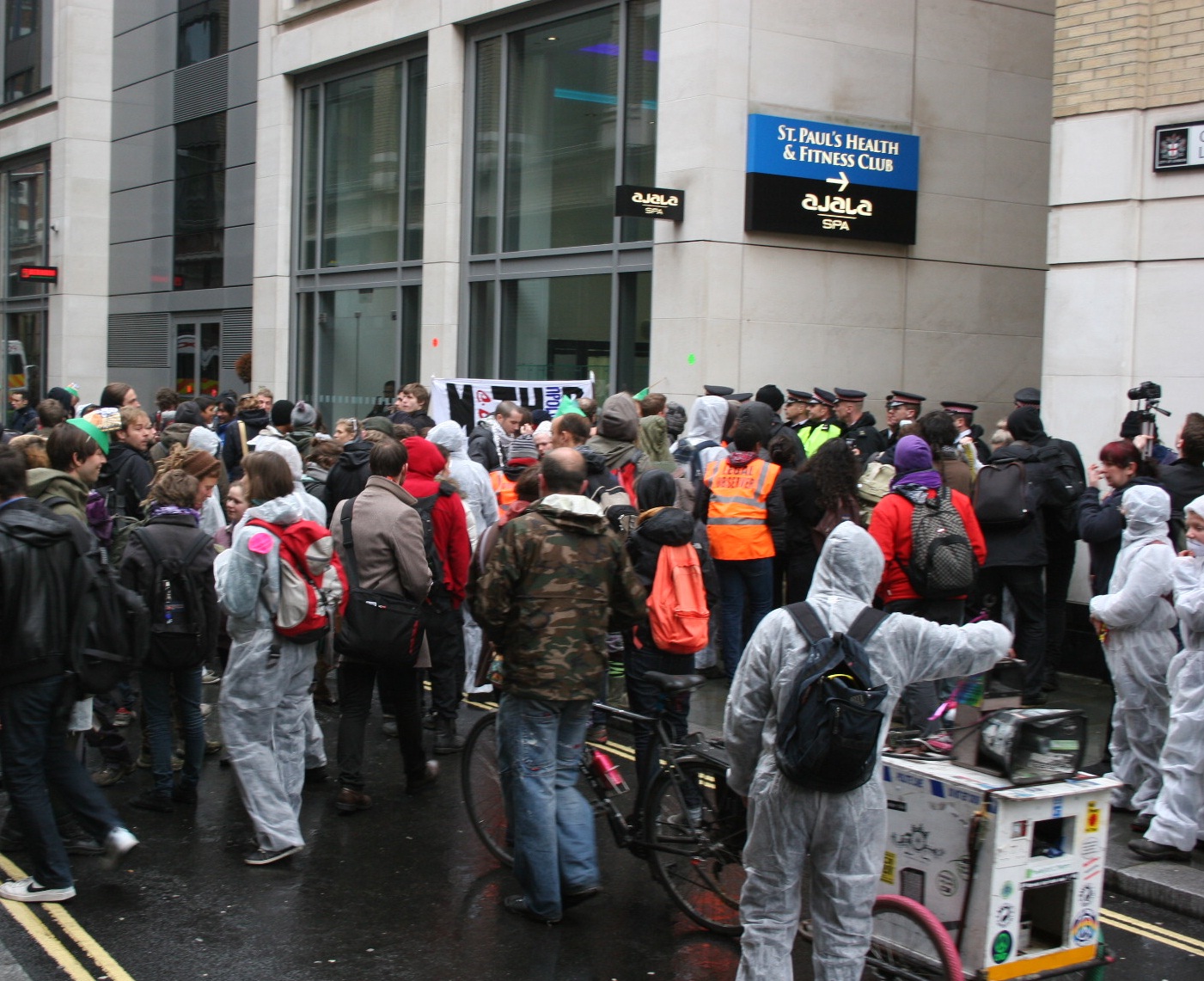
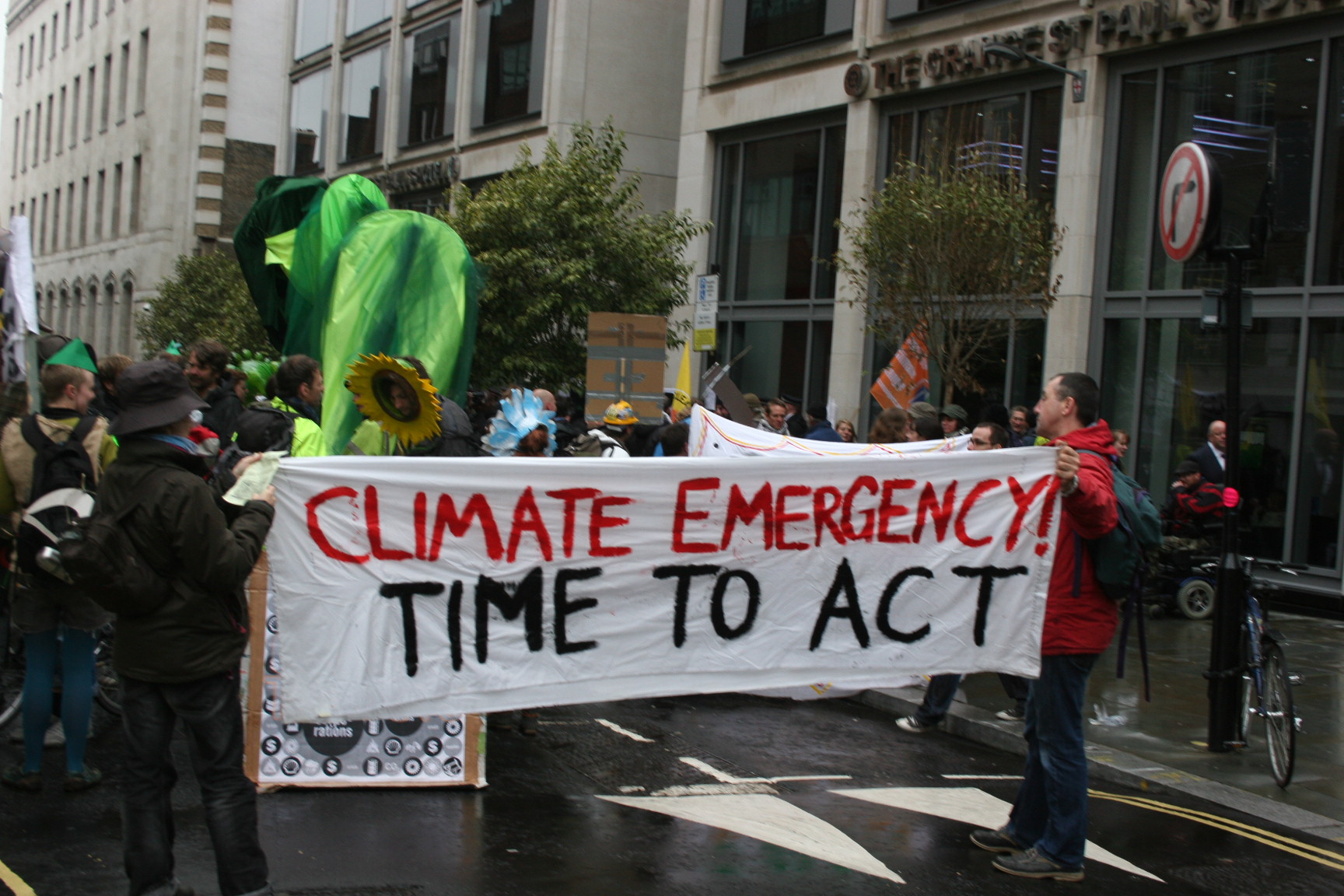
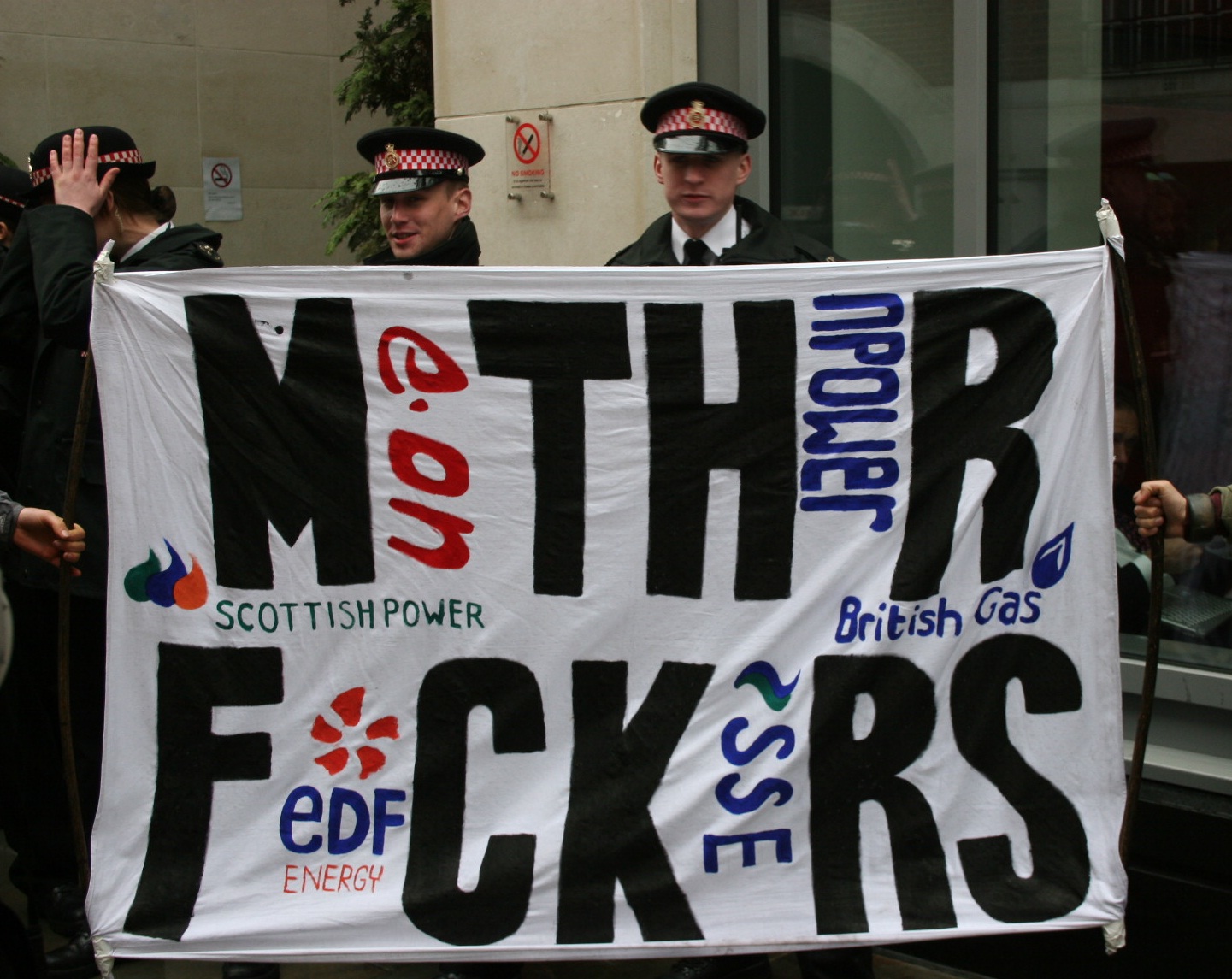
Despite an impressive list of ‘supporters’ turnout was pretty low, particularly for an event in central London which had been a couple of months in the planning. CJC claimed on twitter that there were “at least 300” people there, though I guesstimated the figure to be around half that. Perhaps they had included the police and journalists in that figure. The day was meant to combine “party and protest”, though this amounted to a familiar blend of portable sound systems with microphones, fancy dress and banners.

In a nutshell; everyone converged outside the conference, there were several unsuccessful attempts to rush various doors, a few people were arrested and injured, lots of people got ‘kettled’ for a couple of hours, and then were released one-by-one in an orderly fashion. By the afternoon the CJC proudly proclaimed “we did it!” I couldn’t help but wonder exactly what it was that we were meant to have done.

The intentions were certainly admirable: experimenting with new tactics, linking up different energy campaigns, and being “part of the ongoing renaissance of large-scale climate action in the UK”. All of this is meant to help “end the stranglehold that the Big Six energy companies have on energy in this country” with the hope that “ordinary people” will “take action against corporate control and create an affordable, sustainable, community-controlled energy system.” Big talk, though the reality on the day fell short.

With ambitious aims such at these, you can’t expect to succeed unless there are lots of people also struggling for those same things. Any action that alienates or isolates ‘us’ from ordinary folk must therefore be seen as counter-productive. Of course it is always difficult to judge the impact of one-off spectacular actions such as these, but at times I felt embarrassed to be part of the crowd, with the sense of being part of roving freak show.

Passers-by did not, as far as I could tell, seem to be very inspired, engaged or persuaded of anything. One school boy’s comment of “screw all the hippies” seemed to sum up what I imagine many others were probably thinking.

A few lines about the reasons for the protest in the media coverage it received, is in no way enough to conclude that the day was a success.

Whilst sat in the kettle, I read an interview with Paul Mason in the latest edition of the Occupied Times. He wonders about how “to avoid failure? Social history tells us it’s numbers and relevance”. To boost our numbers into the thousands rather than the hundreds, we need to find ways of acting that resonate with ordinary people outside of the activist scene. For this we will need to break out of old habits and be brave enough to really try new things, and to learn from our mistakes so that we can succeed the next time, or at least fail better. I saw no evidence at the Big Six Energy Bash that this vital process of critical reflection has been happening.

As Noam Chomsky notes “you cannot check or look in a textbook to find the answers. It depends on careful evaluation of the situation that exists, the state of public understanding, the likely consequences of what we do, and so on.” [Emphasis added] Fuel poverty and the obscene profits of energy companies are issues that could inspire large numbers of people to get engaged in effective collective action that has the potential to make real improvements in people’s lives. More of the same alienating direct action by ‘activists’ is, however, not the way to work towards this goal.

I hope I have been too critical and that there were some positive outcomes from the day that I am not aware of. I suppose only time will tell. CJC and others are trying to do something very important, and I hope they, or rather we, succeed. But what I saw at the Bash doesn’t fill me with hope.

Posted in Energy, Event reports | Tagged , | 12 Comments

Something for the Weekend 4th May 2012

What do vegetarian cannibals eat? Swedes.

And this weekend…
Saturday 4th, 1pm
A new group “350 Manchester” will be handing out leaflets etc on Market St. It’s not quite clear who they are trying to convince to do what though. We wish them luck.

If you know of weekend events that are about “climate” (and that includes food growing, or cycling or whatever), then let us know and we can include them in future “Something for the Weekend”s…

And if you know any jokes of the high standard we’ve used so far, please submit ’em.

Posted in Something for the Weekend | 1 Comment

Climate Stakeholder Conference Workshop Write-ups

The write up of the workshops held at the stakeholder conference 2012 are up in case you hadn’t spotted it on the website or got an email. There is also an interesting blurb from the Steering Group highlighting the ‘recurrent themes’ that emerged throughout the course of the day. Of particular note is the call for greater transparency, action and communication. Glad to see it’s not just us that is twittering on about the importance of those things. Anyway, the cut and paste job is below. For the full write up of the workshops go to the manchesterclimate.com website.

Manchester: A Certain Future Conference 2012 – Follow Up


Dear MACF supporter,

On March 16, following more than a dozen ‘spoke’ events run by other organisations during Climate Week, more than 130 stakeholders and supporters of Manchester: A Certain Future gathered at Manchester Metropolitan University for a series of workshops and presentations centred around the theme of behavioural change and our children’s future. The notes from those workshops can now be found on the MACF website on the Conference 2012 page, or by clicking here.

A number of recurrent themes emerged throughout the course of the day and should inform the work of everyone helping to deliver Manchester’s action plan, A Certain Future. They include:

Communications: There was a widespread demand from participants for more communications across Manchester on our progress on climate change, both communications between organisations and groups as well as more communications from the Steering Group on its view of the progress being made against the plan.

Culture: The conference participants re-affirmed the target of ‘a low carbon culture’ and carbon literacy across Manchester as critical if we are to break down barriers to progress and battle entrenched opinions and resistance to change.

The basics: Themes like food, transport and energy dominated discussion. Are we doing enough to make our food consumption and production sustainable? Have we invested enough in cycling and walking? How are we doing on renewables or retrofit?

Transparency: Participants wanted to see greater transparency in how progress was being measured against our climate plan and to see a greater level of democratic accountability on climate change.

Action: A regular point made was the need for action to be taken, to deliver against our strategy and to ensure that we don’t continue to craft more plans and visions in lieu of taking real action, on the ground, against climate change.

The first and fourth points, which lie squarely with the Steering Group of A Certain Future, will be addressed directly through a new communications plan for the group, including the setting up of a LInkedIN network and the plan to open up elections, in November, for those Steering Group places coming available.

Thanks are due to a number of people and organisations who supported the 2012 conference including the facilitators and speakers mentioned on the pages that follow, Tom Burke, the keynote speaker, Groundwork, Manchester City Council, Manchester Metropolitan University, organisations running the ‘spoke events’, members of the Steering Group and, of course, the participants who generously gave of their time.

Many thanks, 

MACF2012 Events Team

www.manchesterclimate.com

Posted in Climate Change Action Plan | Tagged , , , | Leave a comment

Elections: New chair needed for Environment Commission, Lib Dems wiped out in Manchester

Dave Goddard, chair of the Environment Commission(and, incidentally leader of Stockport Council)has held lost his seat in the latest local authority elections. Standing for re-election in Offerton ward, he was edged out by Labour’s Laura Booth (1346 votes) to his 1301. The Environment Commission, which next meets in July, will have to appoint a new chair.

In other news
Neil Swannick (formerly Executive Member for the Environment), Council Leader Richard Leese, Pat Karney (chair of Transport for Greater Manchester) and Andrew Fender were among the Labour stalwarts all re-elected by the expected narrow margins (cough cough).

The Liberal Democrats, now reduced to 8 councillors, are looking for a new group leader after Marc Ramsbottom (City Centre), who was interviewed by MCFly in January, was unable to hold on to his City Centre seat – Joan Davies winning convincingly. All the other Liberal Democrats standing lost their seats. The scale of the swings has in some cases (e.g. Rusholme) surprised even MCFly.

Manchester Green Party were focussing their efforts in two seats, Hulme and Levenshulme. In Hulme – a ward where the Greens had a councillor from 2003 to 2008 – Amina Lone (Labour) held the seat with 1301 votes, with Deyika Neribe of the Greens in second place (595). The Liberal Democrats were out-polled in this ward by the Conservatives, which is going to be a bit of a worry for them.

In Levenshulme Nasrin Ali(1722) won the seat for Labour. It had been held by Liberal Democrats (new candidate John Commons polled 955 votes. The Greens’ David Mottram Green got 674 votes.

So: In a 96 seat council, Labour now hold 88 seats, with the Liberal Democrats holding on to 8 seats, until 2014. [Update: apparently we did our math wrong – it’s 87 to 9]. This doesn’t, in the opinion of this writer, really change the rules of the game as far as climate activism is concerned. Manchester has been a one-party-state, with the benefits and costs that this entails, for some time, and will continue to be so for the foreseeable future.

More analysis in the coming days and weeks.

The numbers are taken from the MEN. http://menmedia.co.uk/manchestereveningnews/news/politics/local_elections/1_Manchester

UPDATE – Three Environment Commissioners who were all up for re-election as councillors were all re-elected (this does not automatically mean they will continue as Commissioners). Tony Isherwood (Labour, Bury) – outpolled his nearest rival by over 4 to 1
Linda Blackburn (Conservative Trafford) held of a Labour challenge in Davyhulme ward (1480 to 1295)
David Molyneux (Labour, Wigan) held onto his seat by a whisker (1790 votes to second places 300 or so)

Posted in Uncategorized | Tagged | 4 Comments

“There’s no justice, there’s just us”

We asked MCFly reader “shakkka” to tell us what she thought about the past, present and future of non-violent direct action on climate change. Here’s what she sent us. (We’re publishing this today to mark this.)

As Paul Mason said in his 2011 blog post, it’s “kicking off everywhere”[i], and that can be applied to virtually any scale; globally with the various ‘Springs’ (from the Arab spring has sprung  – excuse the pun – numerous movements including the latest, ‘Maple’ Spring relating to student protests in Quebec); nationally with anti-austerity and anti-cuts campaigns as seen particularly last winter; and locally on a host of fronts.

Amongst all of this oppositionary, and often radical, clamour, it seems that climate activism has lost some of the voice it had gained over the past few years. People are focussing more on their immediate present, with economic hardship being top of most priority lists. The widespread resistance to government austerity measures and the riots last August perfectly demonstrate this, though in contrasting ways.

In the most recent generation of climate activism, it seems to me that the ‘Golden Era’ of a radical Climate Camp and a high profile, influential Plane Stupid has passed its peak. Several events stand out in my memory of the period; the 2007 Heathrow and 2008 Kingsnorth Climate Camps; Plane Stupid actions at Manchester in 2007, Stansted in 2008 and Aberdeen in 2009; the beginning of the No Third Runway campaign[ii] which has continued into the incredible project that is Grow Heathrow [iii].

Perhaps my view is guided by the fact that the start of this period coincided with my radicalisation and introduction to the activist world, as well as the fact that I have spent a lot of time in London, but I think the lull before the recession provided the perfect conditions for climate conditions to gain a footing in public awareness. Loath as I am to admit it, it is cool to be Green, especially amongst the readership of the Guardian, and although that doesn’t directly imply nor incite activism, it opens up new avenues of acceptance and support. Most climate demos attract publicity in sympathetic media outlets like Indymedia[iv] (which is a grassroots, independent and non-corporate network), though events such as the over-policing of the 2008 Climate Camp or G20 reached more mainstream news, thus upping the profile of climate activism.

Different things have changed since that peak; climate issues are still important but they hold less sway, particularly outside of the affluent, middle-class sectors of society. It is much to my disdain that the ‘scene’ remains hopelessly inaccessible to outsiders at times, as well as often being very white and middle-class. I think that is something that has to change if climate issues are to be linked up with other struggles – which has to happen – because without those connections, we are unlikely to succeed. The recession and slow realisation that the banking system and capitalism is flawed changed things, as every newspaper became clogged with dire economic forecasts and people put their hands back into their pockets. The resulting cuts enforced by the Coalition government diverted attention onto problems of student fees, cuts to EMA, the NHS and benefits. People have reason to be angry about a multitude of other things now.

It almost seems like climate activism, spurred by NVDA groups like Plane Stupid or Climate Rush, was big while we could afford to focus on it, because activism takes time, and time means money.

Climate change is inexorably linked to capitalism, and to economics, and to labour, and to development, and to politics, and to an infinite number of other things – ultimately there is huge scope for activism and particularly NVDA to be connected with whatever inspires and engages people. It’s easy to see how anti-airport expansion and anti-cuts movements are related for instance, but the link between climate and the concerns of the majority of people who aren’t involved needs to be dissected.

A fresh wave of anger and discontent looks set to tip the scales; Plane Stupid and Climate Rush recently occupied Southend Airport[v] and as Transition Heathrow faces eviction next month[vi], it appears as if NVDA and climate activism are creeping back up the agenda. Watch this space.


[i]http://www.bbc.co.uk/blogs/newsnight/paulmason/2011/02/twenty_reasons_why_its_kicking.html

[ii] http://www.notrag.org/

[iii] http://www.transitionheathrow.com/grow-heathrow/

[iv] http://www.indymedia.org.uk/en/

[v] http://www.planestupid.com/blogs/2011/11/3/plane-stupid-runway-southend

[vi] https://twitter.com/#!/search/%23DefendGrowHrow

A note on the title of this blog post; it was chosen by a MCFly editor, not the author of the post.

Posted in Campaign Update, Energy | Tagged , , | 5 Comments