Climate Hustings – never mind the ballots

Around 50 people gathered in Central Manchester last night at a debate and “q and a session” on the topic “Is Manchester City Council taking the right action on climate change?” Chaired by Lucy Danger of Emerge, the panel consisted of Cllr Nigel Murphy (Labour), Cllr Marc Ramsbottom (Lib Dem) and Brian Candeland (Greens).  Questions ranged over food, education, cycling, recycling, behaviour change, the Council’s own programme of action and the international responsibilities and capabilities of a city like Manchester.

There were, inevitably, more questions than could be covered in the hour available. Unasked questions were collated and will be put to the panellists. A “blow by blow” account will follow shortly on this website.

The event was filmed by Reelmcr, and small portions of it will be available to view at a later date.  Reelmcr also interviewed several audience members about their thoughts on climate change and the actions they are taking.

Feedback forms were also collected (more than six, or is it petty to say so?), and along with accounts, these will be published within a week. Many people made constructive suggestions about how such events could be improved in the future, and these too will be shared.

Marc Hudson
mcmonthly@gmail.com

Posted in Event reports, hustings | 4 Comments

Metrolink – unlinked from biodiversity concerns?

Dave Bishop, MCFly’s biodiversity reporter, has more questions about the Metrolink expansion and the rhetoric-reality gaps “on the ground.”  Dave will be attending the climate hustings tonight, at the Friends Meeting House, 6 Mount St.

Last summer (2011) I noticed that, because of the ground disturbance, in the vicinity of the St Werburgh’s Road Metrolink stop in Chorlton, hundreds of arable ‘weeds’ had appeared on the newly created embankments. The seeds of such plants can remain buried but viable for decades (perhaps even for a century or more) and disturbance, and subsequent exposure to sunlight, causes them to germinate. Many of these ‘weeds’ (not a scientific term!) would have been familiar to the old Chorlton farmers and their farm workers (they probably cursed such plants – but they were trying to maximise crop yields). There were poppies, wild pansies, wild radish, fumitories and many more. Many of these plants were recorded in the local floras from the mid-19th century and in the local collection in Manchester Museum Herbarium. And it was not just me that appreciated these profusely flowering plants – they were also covered in bees, butterflies and other pollinating insects.

When I returned, a few days later, with my note book and camera, to record all of this richness, I found that the whole bank had been sprayed with herbicide. This is, of course, the ‘traditional’ response to wildlife: “Not wanted here – kill it!”

But, as I’ve noted before, in their ‘Wildlife Habitat and Tree Replacement’ policy, Transport for Greater Manchester (TfGM) have published some very specific promises about ‘protecting’ and ‘enhancing’ local biodiversity and ‘mitigating’ for any losses, and given such promises perhaps they (or their contractors) should not have automatically reached for the herbicide spray in the situation that I have described above.

The loss of my weedy bank is just one of many losses that we have suffered, and are due to suffer, as a result of the recent and planned Metrolink extensions. The old railway cuttings between Chorlton and Old Trafford and Chorlton and East Didsbury had developed into rich wildlife habitats in the 40 to 50 years since they had been abandoned. Many species of native mammals (particularly bats), birds, amphibians and plants flourished in them. Some sections were flooded and provided good habitats for the amphibians (frogs, toads and newts) and several species of water plants; both of these groups are now locally scarce because of the very severe shortage of ponds and wetlands. The loss of these wildlife refuges is particularly catastrophic given that so much green space has been lost in this region over the last 20 years or so. In this period we have seen a laissez-faire approach to development which has led to the infilling of countless green spaces – including many large gardens.

But worse was, and is, to come; the line to the airport goes straight through the Lower Hardy Farm part of the Hardy Farm Site of Biological Importance (SBI) in Chorlton. I have known this site for nearly 40 years and considered its plant life to be particularly important. On the south side of the river a number of mature Beech trees, near Jackson’s Boat pub, have been destroyed and at Sale Water Park a large green space will be tarmaced over to create a 300 vehicle car park. The line will then run parallel with the M60 for some distance. In the 1990s much habitat, in this area, was lost as a result of motorway widening; now this transport corridor is to be made even wider. In a previous article I discussed the loss, or impending loss, of other mature trees in Chorlton and Wythenshawe.

So, what has TfGM done so far to “mitigate” for all of these losses and to “protect” and “enhance” what’s left? Well, as far as I can see, very little. A lot of trees have been planted (some very ineptly) and two or three cheap pond liners installed in some fairly inaccessible spots (one, in Withington, has been sited on top of a narrow embankment – hardly an ideal site for a pond!). It should be noted that the pond liners were installed up to two years after the amphibian habitats had been destroyed (what were the frogs etc. supposed to do in the meantime?).

But TfGM should be making far greater efforts. For example, in October 2011, DEFRA published some Indicators of Biodiversity in England (http://www.defra.gov.uk/statistics/environment/biodiversity/england-biodiversity-indicators/).

They concluded that: “Of those indicators for which it is possible to make a long-term assessment of change, the following 10 measures show a long-term deterioration: farmland birds, woodland birds, habitat specialising butterflies, wider countryside butterflies, bats, plant diversity in neutral grassland and boundary habitats and the extent of invasive species in freshwater and terrestrial environments [plus two more related to marine environments]”. I would suggest that most of these are relevant, in some way, to the impact of the Metrolink developments, and I imagine that it should be possible to develop similar indices of purely local relevance (I note, in passing, that nowhere does the DEFRA document mention planted trees!).

But TfGM does know precisely what it’s destroying. The policy document, mentioned above, states: “As part of the planning process for capital schemes (such as Metrolink extensions), comprehensive habitat surveys should be conducted, including specific surveys for protected species such as bats, badgers and voles. An Environmental Statement should be prepared for each scheme that includes measures to reduce the impact on biodiversity.”

From where I’m sitting it looks as though TfGM spends public money on having (independent) surveys conducted, ticks the box labelled “survey conducted”, files the survey report, destroys what the surveyor has found and then … well … plants some trees in ‘compensation’. It’s worth quoting the great woodland expert, Oliver Rackham here: “Planting trees is not synonymous with conservation; it’s an admission that conservation has failed.”

Increasingly concerned about these circumstances and a few more, which will be made plain below, I decided to ask TfGM a series of eight questions. I originally posed the questions to TfGM on the 28th February this year – but received no reply. I then tried sending the questions as Freedom of Information (FOI) requests. TfGM received my questions on 19th March and told me that only two of them qualified as FOI requests and would be answered within 20 working days (I’m still waiting and will follow the appropriate procedures).

The remaining six questions are as follows:

  1. Does TfGM intend to revise its biodiversity policies (e.g. ‘Wildlife Habitat and Tree Replacement Policy’) so that they fully conform with the principles contained in HM Government’s White Paper, ‘The Natural Choice: securing the value of nature’ (June 2011) (http://www.defra.gov.uk/environment/natural/whitepaper/)?
  2. Given that TfGM controls so much land with wildlife habitat potential in Greater Manchester, why wasn’t it represented at the Greater Manchester Local Nature Partnership consultation workshop held at New Central Hall, in central Manchester, on 3rd February, 2012 (https://manchesterclimatemonthly.net/2012/02/13/a-local-nature-partnership-for-greater-manchester-maybe/)?
  3. When the Greater Manchester Local Nature Partnership is set up later in 2012 does TfGM intend to join and to take an active role?
  4. Given that so much local biodiversity has been lost in South Manchester as a result of the latest Metrolink extension does TfGM have any further plans (apart from recent tree planting and pond liner installation) to “mitigate” for these losses and to “protect” and “enhance” what remains?
  5. Given that TfGM is not listed as a partner in the ‘Manchester Biodiversity Action Plan, 2012 – 2016’ (https://manchesterclimatemonthly.net/2012/02/11/mcfly-02-the-biodiversity-action-plan-2012-16/), does TfGM intend to contribute to the achievement of the plan’s objectives?
  6. Is TfGM exempt from contributing to the plan’s objectives?

I suspect that I might have to wait a long time for any answers to these questions.

Dave Bishop, April 2012

Posted in Biodiversity | Tagged , | Leave a comment

Black & Minority Ethnic groups – £150 for climate change project participation

If you are Black/Minority Ethnic and you’re reading Manchester Climate Monthly, read this below!!

If you arent’ “BME”, but you know someone who is and who would be interested, then please please forward this on to them.  Thanks!

How will climate change affect BME communities in Greater Manchester?

Take part in our project to find out.
Our climate is changing. Here in the UK we’re facing warmer, wetter winters and hotter, drier summers, with more chances of extreme weather such as heatwaves and heavy rainfall. As a consequence, we’ll face greater risks of drought and flooding, and other knock-on effects. Meanwhile, other countries across the globe are facing their own climate change challenges.

What impact will all this have on the BME communities you work with?
For example:

Hotter, drier summers could:

  • make cities unpleasant to live in
  • increase pollution levels and the risk of heat stress and dehydration.

Climate change impacts in other countries may:

  • add to worries about family and friends abroad
  • create extra financial burdens for service users sending money home.

Manchester BME Network, One North West, Voice4Change England and the Black Environment Network are working with the National Council for Voluntary Organisations (NCVO) to find out more.

Take part in our project
We’re looking for BME organisations working in Greater Manchester to join us on this project from May to November 2012. The programme includes a series of three one-day workshops in central Manchester and the chance to run your own project with some of your service users, plus £150 for taking part.

This is a unique opportunity to:

  • get to grips with climate change – one of society’s biggest challenges
  • focus on your service users’ future needs and ensure your services remain relevant and viable
  • better understand how your work can contribute to a sustainable future world – and access emerging funding streams relating to ‘sustainable development’
  • work with climate change experts and other local BME organisations
  • boost your profile with decision makers, funders, beneficiaries and supporters.

Places are limited to 20 organisations so to ensure your involvement, apply today! First workshop: Tuesday 1 May.

To find out more and apply, contact Kate Damiral at NCVO or visit the website.
Tel: 020 7520 2540 Email: kate.damiral@ncvo-vol.org.uk
http://www.ncvo-vol.org.uk/climatechange

Posted in education, Upcoming Events | Leave a comment

Manchester Climate weekly nuggets: 16th April 2012

Hi all,

we may have mentioned this already, but this Tuesday night (17th April) there’s an pre-election debate/Q and A – “Is Manchester City Council taking the right action on climate change?” event. It’s at the Friends Meeting House, 6 Mount St. There’ll be contributions from Cllr Nigel Murphy (Labour), Cllr Marc Ramsbottom (Lib Dem)  and Brian Candeland (Greens), and lots of scope for questions from the audience, and mingling and networking. Book your free ticket here. And if you’re wanting to ask a question, please read this

Coming up this week

Monday 16 7 until 8:30pm GM wheat – national day of action Come and plan what we can do in Manchester The Yard, 41 Old Birley Street, Hulme, Manchester

Tuesday 17, CLES event – Making places resilient
This course will explore the characteristics of place resilience based on CLES’ own research into resilient places
£200 plus VAT: £105 plus VAT for charity, voluntary sector organisations.

Tues 17, 7pm Election hustings at Friends Meeting House, 6 Mount St.  Hear members of Labour, Lib Dems and Greens answer the question “Is Manchester City Council taking the right action on climate change?”

Weds 18  12 to 1, From Arab Spring to Sustainable Consumption? A Historical Perspective South Theatre, Samuel Alexander Building, South Wing, University of Manchester This lecture will focus on two pivotal Middle Eastern countries—Egypt and Saudi Arabia—in detailing the spread of mass consumption in the Middle East during the oil boom era (c. 1974-1984). During this period, tremendous hikes in energy prices and, not less dramatic, migration of millions to work in oil-exporting countries revolutionized basic human needs and aspirations for shelter, food, and clothing. The period also experienced new selling venues and promotion of goods and services. Significantly, preoccupation with buying things closely corresponded with deepening religiosity as part of everyday life and as politics.To register online, please visit http://sci18april.eventbrite.co.uk/

Weds 18, 6.30pm to 9pm  Celebrate Sustainable Communities
Action for Sustainable Living event at Platt Chapel, Wilmslow Road, Fallowfield http://afslcelebrate2012-eorg.eventbrite.co.uk

Stories you may have missed on the MCFly website

Lessons we like to pretend we’ve learned
Tuesday and Wednesdays are different days. If someone invites you a pint at the Port House on Wednesday, don’t turn up 24 hours early.  Sigh.

Things worth reading

http://greenallianceblog.org.uk/2012/04/04/tales-of-rising-climate-scepticism-are-overstated-and-misleading/

Guardian 13 April Info about Green Deal

Guardian 13 April Eat less meat

Posted in Weekly bulletins | Leave a comment

Youtube: A “progress” report on the Climate Change Action Plan

Did we mention the Tuesday 17th election hustings at the Friends Meeting House? From 7pm for mingling etc, 7.30pm start. Tickets here.

Here’s a four minute video explaining a bit about the Manchester Climate Change Action Plan. If you’re coming to event, then try to have a watch beforehand…

Posted in Climate Change Action Plan, hustings, Manchester City Council, youtubes | Tagged | Leave a comment

Professor Geoff Beattie interviewed about behaviour change

Professor Beattie, author of “ Why Aren’t we Saving the Planet?”(reviewed here) talks to MCFly writer Laurence Menhinick about his research and his conclusions about between our explicit behaviour (what we say we do) and implicit behaviour (what we actually do which matches our core values).


Professor Beattie, could you explain to us how you came to do this research? What were the main questions you were trying to answer?
As a psychologist, I am fascinated by the notion that human beings don’t know themselves as much as they think, and I was fascinated by the notion that a lot of people (big retailers, government through DEFRA) thought they could read people’s minds. To me that was a bit of a challenge because everyone was saying that they all had the solutions to the whole climate change issue, that the scientific evidence seemed pretty convincing and a lot of the public say they get the message… but don’t do what they say.

That raises a lot of interesting psychological challenges: Why is that? Why aren’t we all cycling? Why aren’t we all selling our cars? Why aren’t we buying low carbon footprint products in supermarket? If you read DEFRA reports, they say you have to take into consideration people’s ability to change and willingness to change, to me that is like mind-reading and I wasn’t sure that was correct. Do we even know what our fundamental attitudes are?

As I have said at the conference [Consumption: A Multi-disciplinary Point of View, SCI Manchester 8-9 March 2012] “There are people who think they can read minds, but it’s more difficult than they think because human beings don’t have a mind. They have two.”

Some aspect of behaviour are not conscious and reflective, they are automatic and impulsive.[the implicit behaviour]. People are discrepant, they are conflicted. People say one thing but their implicit attitude seems to be at odds with it; what I am arguing is that conflict within human beings is important; therefore if we are going to do anything about climate change we have to start of with that assumption.

Now if behaviour is automatic and not open to reflection, how are you going to change it? There are a number of things you are going to have to do: start considering the concept of implicit attitude, and how do we change that? We know it can be done because if you look at the great alcohol and cigarette adverts in the 1950s and 1960s, they turned something cancerous into something glamorous and sexy. How? The answer is in understanding how to promote things implicitly. I have an article coming up in Nature Climate Change on this very issue: people put the carbon footprint information on cartons but we have done the eye tracking: it is obvious it doesn’t work, people are not looking at it (…). If you look at an Easter egg, you will look at the calorie content, and the fat content too, but the carbon footprint? People don’t look- partly because it is not clear what it means, and also because it “doesn’t mean anything personal and emotional to them” so it raises all sorts of challenges: how do you make it personal? Or emotional? How do you get it noticed in the first place?

Your research was based on a very small number of people, how do we know that it may be representative of the general public?
I presented the results based on a tiny sample, suggesting that the implicit /explicit are discrepant as I believe that it is universal, but I don’t believe it is representative of the whole population- I wanted people to start thinking along those lines, but the beauty is that we have now an online version of the Implicit Association Test (IAT)* and access to enormous database of shopping habits and we have the opportunity to get a sample of shoppers to fill the IAT – so we will be able to link those two things up.

(…) I have also been trying to understand the enormous variation in cultural value, for instance I went to Newcastle in Australia and to the US to try and run similar tests there. Let’s see how it translates there. But if you are going to think about behavioural change and changing attitudes, you have to take into consideration this weird implicit system which governs much of our every day action especially when we are under stress or tired.

In your book I was surprised that you included yourself in the study. Is this usual in psychology?
I am aware of that – I have written autobiographical novels and academic papers and the two worlds were completely separate, but the Planet book was where it all started to collide and I wanted to do so, and the [new] “Our Racist Heart?” book, even more so. I am interested in the issue of the divided self and I didn’t want to keep myself out of the loop. When it comes to the environment it looks like I fall within the same group as the “green fakers”.

I am interested in the “green fakers”. Could you tell us a little more about who they are, and can we change them?

They are a group of people who explicitly say they care hugely about the environment and when we measure them implicit attitude it doesn’t seem to be the case; the two things don’t converge. These are conflicted individuals – It seems to me that regarding the environmental change issue they are the interesting people – (…)

They may be aware that their behaviour doesn’t match what they say but I think what is interesting is how they process that information. [this is also analysed in the Racism book to come, so there is evidence that ] they are trying to persuade themselves. It is not just excuses and justifications about why we don’t do things, “ I’ve got to fly, sorry” for instance, it is more about the way we process this information in our everyday lives.

There will be a million places to look at concerning the way they process information. One thing we did recently, is look at environmental messages. I did a little piece with film clips from Al Gore’s “ An Inconvenient Truth”. And we looked at people whose implicit attitudes are at odds with their explicit attitudes, and what is interesting is that they don’t look at the messages in the same way. If you look at where they are looking for the first 200 milliseconds, they are not looking at the clip – they are managing to ignore the message. This again has never been looked at before- it would be interesting to understand it. The psychology of the green faker, the conflicts within the individual seem to be at the core of the whole issue. That gives us a starting point. It is not a case of “people don’t care about the environment” it is more than that, people say they care- but at some automatic level they don’t.

What you have changed in your personal behaviour ?

 It was almost as if I was putting myself forward as a problem case, and if you can change me you can change a lot (of others). I am much more sensitive to carbon footprint than I was. But on the other hand if I can crack the problem of me I can crack the problem of anyone – I am always discounting because “I am too busy to do this” or unfortunately “I must fly to X”– you also have academics who see themselves as separate but I don’t think so I like to reflect on the process that shape me and I don’t want to lose sight of that.

Are you going to work on follow-ups? Will you do any more environmental studies?

 Yes, relating to behaviour there are the online IATs coming up .

Also I am thinking about a book on communication about environmental issues– how can we maximise that? I’m interested in the risk perception, how to communicate risk more effectively, and how we frame communication.

Also more research in the divided self within human being and I want to look at biodiversity too. What I want to do is face up to the big issues really.

Laurence Menhinick

* http address to follow when the tests have been released

(Interview with Professor Geoff Beattie, of the School of Psychological Sciences at Manchester University- 9th March 2012)

Full transcript here.

Posted in academia, education | Tagged , , | 1 Comment

Something for the Weekend – April 14/15 2012

First the top-quality joke; What do you get if you cross the Atlantic with the Titanic?
Half way.

Then the events we are aware of;

Sat Apr 14, 12.15pm to 3.45pmHidden Stories, Learning from the Arab Spring, Our Role in the Struggle. Southern Voices workshop Hulme Hall, Claremont Resource Centre, Rolls Crescent, Hulme , Manchester , M15 5FS

Sunday 15th, 11am to 4pm ‘Spring Thing’ at Hulme Community Garden Centre

Sunday 15 April, 2-5pmBee Open Day
Everything you wanted to know about bees, beekeeping and honey. Information, demonstrations and activities. Chat to the beekeepers and see the bees at work. Light refreshments available. Raffle to win a 1lb jar of local honey. Grow For It Community Allotment, part of Scott Ave Allotments, Chorlton M21 9QW (entry via the gate along the alleyway opposite Chorlton Baths)

For more info contact Loucas on 07973 139068

Did we mention the Tuesday 17th election hustings at the Friends Meeting House? From 7pm for mingling etc, 7.30pm start. Tickets here.

Posted in Something for the Weekend | Leave a comment

Digging in Didsbury – Sat April 22nd food planting

These days it seems Manchester Climate Monthly only publishes stuff if there’s a direct relation to the upcoming climate hustings. (Since you ask – it’s on Tues 17th April, from 7pm, at the Friends Meeting House. “Is Manchester City Council taking the right action on climate change?” Cllrs Nigel Murphy and Marc Ramsbottom, Brian Candeland, lots of audience mingling and questioning. Free!!)

But if talking about things isn’t enough for you (cough cough), and you want to get soil under your fingernails, then Amanda from Didsbury Dinners has some news for you!

Earth Day big food plant

Residents, schools, clubs and businesses: help us support Earth Day (22 April) with a big food planting day in Didsbury.

Seven trees are enough to offset your carbon footprint for a year.* What’s more, planting lovely edible plants helps to create more of a sense of community, makes our neighbourhood an even more healthy, attractive place to live, and creates local, seasonal food in every sense of the word.
There are three main ways to get involved:

1. Grow your own at home, big or small. Whether it’s a windowsill chilli plant or pot of herbs, or a tree in your back garden, we want to shout about it! Please email your food plant photos to us with a brief description, and we’ll add them to a photo montage on our website. The idea is to capture people’s imaginations with what we can all grow at home, with minimal effort.

Love to grow your own fresh fruit and veg, but wouldn’t have a clue where to start? The real-life case studies on our website show how it’s done. You can even grow mushrooms indoors for £1 (with no need for green fingers, I might add…)

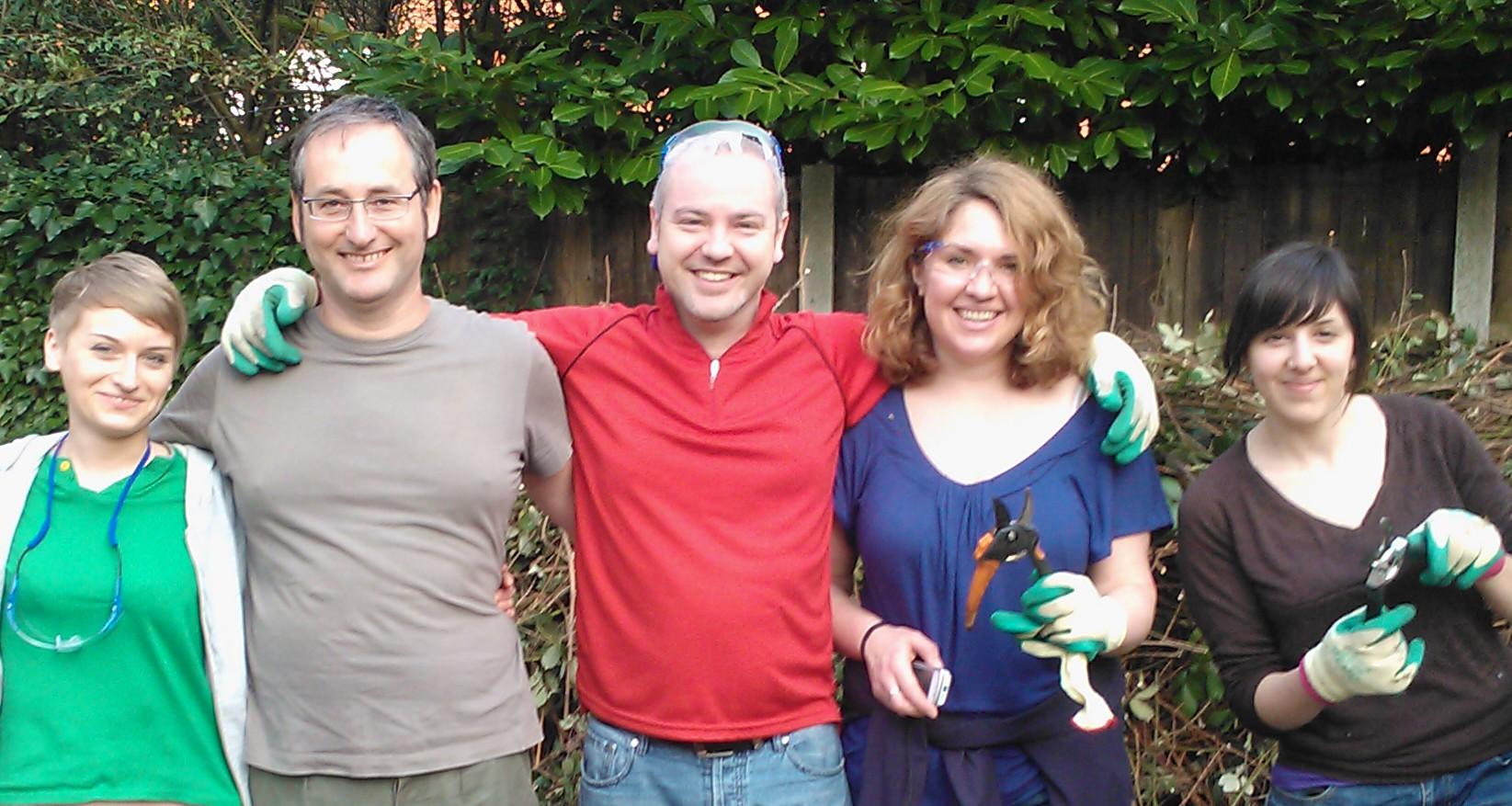
2. Join our community growing team as a volunteer for the day (or hour)! We’ll be planting at our new community gardens on Saturday 14 and Saturday 21 April (12-4 pm), and many hands make light work. Help us to plant new fruit bushes and trees… to be enjoyed by anyone in the community for free, for years to come. Special working parties can be arranged for groups of 6 or more business or school volunteers on a variety of dates around Earth Day. Just email us for details. We even provide free refreshments while you work! No previous experience is necessary.

3. Fund our planting (and eco-cookery) efforts via Crowdfunder. Even if all you have is a spare quid, we can grow it into much more! See our pitch on Crowdfunder for details of how we’ll use your money, and the rewards that we can offer you, in return.

Cooking up a storm
We’re also hoping to cook up a storm with our new free eco-cookery sessions, starting up in autumn.

We piloted these recently with a free four-week course at West Didsbury Sure Start Centre. As well as teaching people how to make cheap, tasty meals, it was an opportunity to make new friends. Priority places on the course were given to people with below average cookery skills, a small regular income, and low savings.

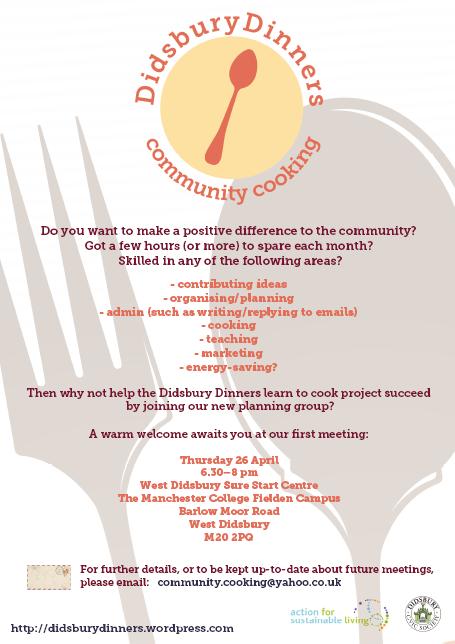
We plan to teach 100+ more people how to cook in 2012, and are currently recruiting for a planning group to help us to reach this ambitious goal.

A warm welcome awaits you at the first planning group meeting:
Thursday 26 April
6.30-8pm
West Didsbury Sure Start Centre
The Manchester College Fielden Campus
Barlow Moor Road
M20 2PG

So, if you have a few hours spare, a flair for any of the following, and want to make a positive difference to the community, please email community.cooking@yahoo.co.uk (or just show up on 26 April):
• organising/planning
• admin (such as writing/replying to emails)
• cooking
• teaching
• marketing
• energy-saving.

* On offsetts – MCFly editor – see the Tyndall Centre’s Professor Kevin Anderson here.

Posted in Food, volunteer opportunity | Tagged , | Leave a comment

Carbon literacy versus “carbon capability”

Many of the academic articles we read here are MCFly Towers – when we aren’t organising the climate hustings on Tuesday 17th April – are obtuse, abstruse vocabulary abuse.  That is, they are long on long words, short on good non-banal ideas.

A recent honourable exception is Public engagement with carbon and climate change: To what extent is the public ‘carbon capable’?. It is a 9 page wonder by Lorraine Whitmarsh, Gill Seyfang and Saffron O’Neill,* published in Global Environmental Change 21 (2011) Here’s a pdf.

Here’s the bit that leapt out at us.

Carbon capability is defined as: “The ability to make informed judgments and to take effective decisions regarding the use and management of carbon, through both individual behaviour change and collective action’. We identify three core dimensions of carbon capability:

(1) decision-making (knowledge, skills, motivations and judgments
(2) individual behaviour or ‘practices (e.g. energy conservation), and
(3) broader engagement with systems of provision and governance (e.g. lobbying, voting, protesting, creating alternative social infrastructures of provision).

In contrast to the concept of ‘carbon literacy’, then, carbon capability is not defined in a narrow individualistic sense of solely knowledge, skills and motivations (although these are important components); rather, the concept of carbon capability implies an understanding of the limits of individual action and where these encounter wider societal institutions and infrastructure, and so prompt the need for collective action and other governance solutions. The notion also suggests an appreciation that much consumption (and hence carbon emissions) is inconspicuous, habitual and routine, rather than the result of conscious decision-making.

There’s more, all of it bloomin’ useful. At some point in the next few months, we shall make a youtube about this article’s contents. Nag us if we don’t.

We will ask the people behind Manchester’s “Carbon Literacy” program for their perspectives, which may appear as comments here or in a ‘response’ article….

* Only a crazed feminazi would suggest that having three female authors might lead to an outbreak of clarity and a lessening of chest-beating and posturing.

Posted in academia | Tagged , | 3 Comments

Money, Democracy and Feedback – We talk to the Steering Group

The Steering Group, which is tasked with implementing the city-wide climate change action plan, insists that it is not a public body to be scrutinised

Here at MCFly, we like to ask questions. Lots of lots of them to lots of different people. Call it curiosity- even better, call it good journalism. Over the years, we have been asking the Steering Group some of our questions. Not particularly difficult questions but important ones (we think) about the openness, transparency and democratic nature of the group. In the past, we highlighted the fact that elections for the members of the group had been unfairly cancelled. At the annual stakeholder conference a couple of weeks ago, the steering group announced that they would now hold elections. Victory. So, we asked them a whole load of other questions.

Could we have a breakdown of the costs of the stakeholder conference?

Steve Connor, who heads the Steering Group, insisted that the cost of the conference was very low and that he didn’t see the point of using up time to go into the details of the costings. “It was about £4-5,000 in total. It was a very cheap conference, we called in favours, there were no speaker costs and lots of people volunteered their time to run the workshops. Do you really think it would be time well spent if I got Groundwork [who work with the Steering Group] to go through the accounts and produce a spreadsheet on the minute detailed costings of the conference?”

Why has there been so little information about the conference available on their website?

Connor responded that the reports from the 8 workshops were now complete and would be available on the website shortly. Following the conference, a request was also sent out via email to all the attendees for feedback. The response, however, was not great. Connor told me that just six people responded to the email and that he attended a meeting today about it and the need for more feedback responses to help them evaluate the conference. Feedback not just on the practical aspects of the conference (such as timing, location etc) but the strategic feedback about who they are trying to connect with, their audience and what they want to achieve.

If you attended the stakeholder conference and want to give the Steering Group some feedback, you can visit the manchesterclimate.com website.

Can the public attend the full Steering Group meetings?

No. That’s the short answer. Connor added that the steering group is not a public body or a council organisation to be scrutinised. He did however admit that the issue had not been raised in the group before and that he would be happy to raise it at the next meeting for consideration.

Is the Steering Group Still working to encourage organisations who endorsed the Manchester A Certain Future strategy to actually come up with an action plan?

Connor admitted that the current record on action plans (just two- one by the council and the other by Northwards Housing) was “fairly rubbish” and recognised that there is a problem. He explained that they have been looking at how to best approach this problem and the need to “pitch the idea right” to be able to generate more plans. One of the ideas is to approach it sector by sector and pitch the importance of the action plan in more specific terms to the sector. Connor also added that they would be focusing on the worst performing sectors rather than those who were actually doing well.

Arwa Aburawa 

Mcmonthly@gmail.com

Posted in Democratic deficit | Tagged , , , | Leave a comment