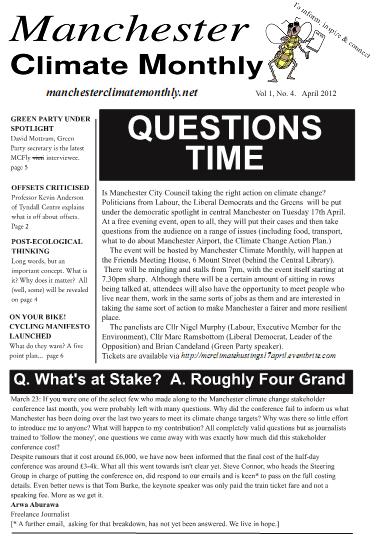
Manchester Climate Monthly #4 out now!

Eight pages of information, inspiration (we hope!) and connection…

What’s happening on Tuesday 17th April that everyone should know about?   Why did Professor Kevin Anderson withdraw from a prestigious conference?  What is “Didsbury Dinners”? What is the Green Party up to?  What do the people who wrote “Get Moving: A Manifesto for Cycling in Greater Manchester” want? What is “post-ecological thinking”?  All this and much more (book reviews, the calendar, inspiring quotes) …

Posted in print editions | Leave a comment

Monthly Journal Overview #3, April 2012

Welcome to the latest semi-random pickings from recent journals.  We hope that something below is of use to either academics or “activists”, or both. Journals are listed alphabetically.  If we’ve missed something written by a Manchester-based academic, or about Manchester, please let us know.

Antipode Volume 44, Issue 2,
Sensuous Solidarities: Emotion, Politics and Performance in the Clandestine Insurgent Rebel Clown Army
pages 428–452, March 2012 Paul Routledge
Abstract: This paper is concerned with the political performance of the Clandestine Insurgent Rebel Clown Army (CIRCA) during the protests against the G8 meeting in Gleneagles, Scotland in 2005. In particular, the paper is concerned with how emotional experiences within political moments or events can be constituted through performances that fashion “sensuous solidarities”. Sensuous solidarities are generated through diverse bodily movements and techniques, and are indicative of both the performative character of activist subjectivities and the content of activists’ public (political) performances. Reflecting on my participation in CIRCA, this paper will argue that sensuous solidarities constituted a series of complex, contradictory and emotive co-performances and resonances with police, other protestors and the public and in doing so will consider the efficacy of those forms of activism that Duncombe (2007, Dream: Reimagining Progressive Politics in an Age of Fantasy. London: The New Press) has termed “ethical spectacles”.

Capitalism Nature Socialism
vol 23, 1
The Movement of Homo Sapiens Against Homo Sapiens to Save Homo Sapiens

On the Prospect of Preventing Global Climate Catastrophe due to Rapid Social Change
Olli Tammilehto

A Critique of Degrowth and its Politics
David Schwartzmann

Climatic Change 111: 165–175.
Moser, S. 2012. Adaptation, mitigation and their disharmonious discontents: an essay.
Abstract: Decision-makers are often advised to harmonise adaptation and mitigation policies. While many opportunities do exist to realise co-benefits by designing and implementing both in mutually supportive ways, critical tradeoffs also exist, along with policy disconnects that are shaped by history, sequencing, scale, contextual variables and controversial climate discourses in the public.  Moser argues that to ignore these issues can undermine a more comprehensive integrated climate risk management portfolio. This paper discusses the implications of these tradeoffs between adaptation and mitigation for science and policy.

Ecocities
Kazmierczak, A. and Connelly, A. (2012). Adaptation to weather and climate in office buildings in Manchester.
This EcoCities report analyses current use and the perceptions affecting the potential future use of the physical and behavioural climate change adaptation measures in commercial office buildings.
The case study considers two different types of office building common to Greater Manchester. One is a listed building dating from the early 20th century and the other is a modern 1960s high-rise building. Both buildings are owned and managed by a property management company, and the individual office suites are rented out to tenant companies.
A mixed-method approach is used. A quantitative analysis of building occupant survey data, collected by Arup Manchester with the use of Arup Appraise methodology, is complemented by two series of semi-structured interviews with building management teams and representatives of the tenant companies.
The report considers physical adaptation measures in the current climate that affect the interactions between the weather and climate, the buildings and the people working in the offices. It draws out the key issues that affected the use of physical adaptation responses by building users. It also investigates perceptions of office workers on the impact of weather and temperature; what affects their thermal comfort and how behavioural changes could be promoted at the level of individual, company and the landlord.
The buildings investigated here are also subject of a report aiming to estimate the changes in expenditure on energy associated with heating and cooling under different climate change projections (see Cavan and Aylen 2012).

Cavan, G. and Aylen, J. (2012). The challenge of retrofitting buildings to adapt to climate change: case studies from Manchester

Ecology and Society March 2012
Learning in Support of Governance: Theories, Methods, and a Framework to Assess How Bridging Organizations Contribute to Adaptive Resource Governance
Abstract: Humanity faces increasingly intractable environmental problems characterized by high uncertainty, complexity, and swift change. Natural resource governance must therefore involve continuous production and use of new knowledge to adapt to highly complex, rapidly changing social-ecological systems to ensure long-term sustainable development. Bridging and boundary organizations have been proposed as potentially powerful means of achieving these aims by promoting cooperation among actors from the science, policy, and management sectors. However, despite substantial investments of time, capital, and human resources, little agreement exists about definitions and measures of knowledge production and how this is achieved in bridging organizations and there is only meager understanding of how knowledge production and its use are shaped by social interactions, socio-political environments, and power relations. New concepts, methods, and metrics for conceptualizing and measuring learning in support of natural resource governance and testing the conditions under which it can be achieved are therefore badly needed. This paper presents an attempt at a holistic framework to address this, drawing on theory, methods, and metrics from three research areas: knowledge utilization, boundary organizations, and stakeholder theory. Taken together, these provide a solid conceptual and methodological toolkit for conducting cross-case comparisons aimed at understanding the social environmental conditions under which learning in such organizations does and does not occur. We use empirical data to show how the framework can be applied and discuss some of the practical considerations and important challenges that emerge. We close with a general discussion and an agenda for future research to promote discussion around the topic of how to erect systematic comparisons of learning in support of adaptive natural resource governance as it occurs in bridging organizations.

Environment and Planning C: Government and Policy
Greenwood D, 2012, “The challenge of policy coordination for sustainable sociotechnical transitions: the case of the zero-carbon homes agenda in England”  30(1) 162 – 179

Abstract. Emerging in recent research on sociotechnical transitions towards a low-carbon economy is the question of the extent to which such transitions require centralised, intentional coordination by government. Drawing from Hayek’s conceptualisation of coordination, I evaluate the effectiveness of policy for low-carbon and zero-carbon homes in England. A detailed analysis is presented of how policy makers address complex choices and trade-offs as well as significant uncertainty. Particular attention is given to those policy decisions which are widely agreed by stakeholders to cause distortive effects. The focus here on the impacts of policy definition and delivery in terms of multiple evaluative criteria can complement and enrich the more process-orientated cross-sector and multilevel analyses that predominate in existing research on policy coordination. Furthermore, the coordination problems identified yield further insights into the actual and potential effectiveness of policy processes in shaping complex sociotechnical transitions.

Environmental Politics Special Issue on Climate Change, Discourse and Democracy

Changing climate, changing democracy: a cautionary tale
Neoliberal climate policy: from market fetishism to the developmental state
Can ‘climate champions’ save the planet? A critical reflection on neoliberal social change

Local Environment, Vol 17, issue 3
Achieving sustainable lifestyles? Socio-cultural dispositions, collective action and material culture as problems and possibilities
Eva Svensson
This article focuses on the everyday life of ordinary households, their behaviour and responsibility with regard to environmental and sustainability issues. Previous research has shown that there is a gap between what households perceive as ideologically correct behaviour and what they actually do. It is argued here that socio-cultural dispositions, material culture and collective action need to be included in future strategies for creating more sustainable lifestyles. The investigation is based on a study of families participating in a year-long project in which the families learned to live in a more environmentally friendly way. In the study of the families, material culture interacted with routines, family relations and citizenship in a reproducing manner. The lifestyle changes were gender-biased, with the women as driving forces but also bearing most of the extra workload. From early life experiences, garbage sorting stood out as an especially powerful tool for a change towards more sustainable lifestyles.

Nature Climate Change
Psychological effectiveness of carbon labelling pp214 – 217
Geoffrey Beattie
Despite the decision by supermarket-giant Tesco to delay its plan to add carbon-footprint information onto all of its 70,000 products, carbon labelling, if carefully designed, could yet change consumer behaviour. However, it requires a new type of thinking about consumers and much additional work.

Progress in Human Geography
April 2012 vol. 36 no. 2 188-203
Policy transfer, consultants and the geographies of governance
Russell Prince
Abstract: The emergence of increasingly transnational geographies of governance presents a challenge to geographers. Geographical work on policy transfer, which links this process with the extension of the hegemonic ‘regimes of truth’ that define policy norms, has much to offer conceptions of emerging geographies of governance, particularly when linked to the production of governance structures, such as global policy networks. The paper argues that increased use of ethnographic methods in policy transfer studies enables a focus on how global policy networks are produced through the actors driving the transfers. This is illustrated through a discussion of policy consultants.

Technology Analysis and Strategic Management. Special issue entitled “Innovation, Consumption and Environmental Sustainability” includes contributions of papers authored by researchers from the Sustainable Consumption Institute including:
Andrew McMeekin & Harry Rothman (2012): Innovation, consumption and environmental sustainability,
Andrew McMeekin & Dale Southerton (2012): Sustainability transitions and final consumption: practices and socio-technical systems,
Chris Foster, Andrew McMeekin and Josephine Mylan (2012): The entanglement of consumer expectations and eco-innovation pathways: the case of orange juice,

Transactions of the Institute of British Geographers
Volume 37, Issue 1, pages 89–103, January 2012
Post-political spatial planning in England: a crisis of consensus?
Phil Allmendinger and Graham Haughton
Abstract: This paper argues that spatial planning in England needs to be analysed as a form of neoliberal spatial governance, underpinned by a variety of post-politics that has sought to replace antagonism and agonism with consensus. Conflict has not been removed from planning, but it is instead more carefully choreographed and in some cases displaced or otherwise residualised. This has been achieved through a variety of mechanisms including partnership-led governance arrangements and inclusive though vague objectives and nomenclature around sustainable growth. Other consequences include the emergence of soft space scales of planning often deploying fuzzy boundaries that blur more concrete policy implications and objectives. Opposition to this post-political form of planning has led to new avenues for dissent that challenge spatial planning and its consensual underpinnings, ironically paving the way for the radical ‘rollback’ planning reforms of the Coalition government.

Posted in MoJO | Tagged | Leave a comment

Exclusive: Labour to stand aside for Greens in Hulme, Chorlton and Levenshulme

Manchester Climate Monthly has learnt that the Manchester Labour Party is planning to “gift” three council seats to the Greens at the next Council elections, to be held on Thursday May 3rd.

Speaking exclusively to Manchester Climate Monthly, Nigel Murphy, Executive Member for the Environment, explained the decision. “Many people – rightly – describe Manchester as a one party state. That’s only going to get worse once the Liberal Democrats – rightly – get toasted in 6 weeks time. They’ll go from “Twenty’s Plenty” to a “dirty dozen” or so. So, to maintain a veneer of democratic accountability and ideological diversity, we thought we’d give the Greens a free run at about 3 percent of the total seats available.”

The mechanics of the scheme are still shrouded in secrecy. Labour will stand candidates, but they will produce poorly-worded and unconvincing leaflets. On the doorstep they will mostly talk about how awful the Conservaties are, rather than try to defend Manchester Labour’s record. It is hoped that these measures will help Green candidates – who are noted for their coherence, discipline and personability – to achieve the electoral success that has, with one brief exception, eluded them to date.

“Look,” said Councillor Murphy over a third pint. “There’s 96 seats on the Council. We own – own I tell you – most of them. Even with that guy in Moston going, we still rule this city with an iron fist. And frankly, if you look at how we’ve done over the last few years on climate issues, we could do with either a little help, or someone to blame.”

Asked to expand on this theme over a fifth pint, Councillor Murphy continued “Well, when you take the secrecy of the Environmental Strategy Programme Board, the infrequency of the Environmental Advisory Panel and the bewilderment of the “Steering” Group, there’s not much left. We hope that the Greens will bring sensible policy ideas that we can poach. And if they don’t, they’ll make good scapegoats.”

Over a seventh pint, MCFly asked if the scheme, of dubious legality, had been popular. Councillor Murphy warmed to his theme at this point. “Sure, there was some resistance to this idea. Richard Leese and Pat Karney dug in their heels, and word reached us that Sir Howard Bernstein wasn’t happy. But at the end of the day, Manchester Labour Party is democratic. The people at the top don’t always get things their own way, you know.”

The Green Party could not be reached for comment.

Posted in Democratic deficit, Manchester City Council | Tagged , | 5 Comments

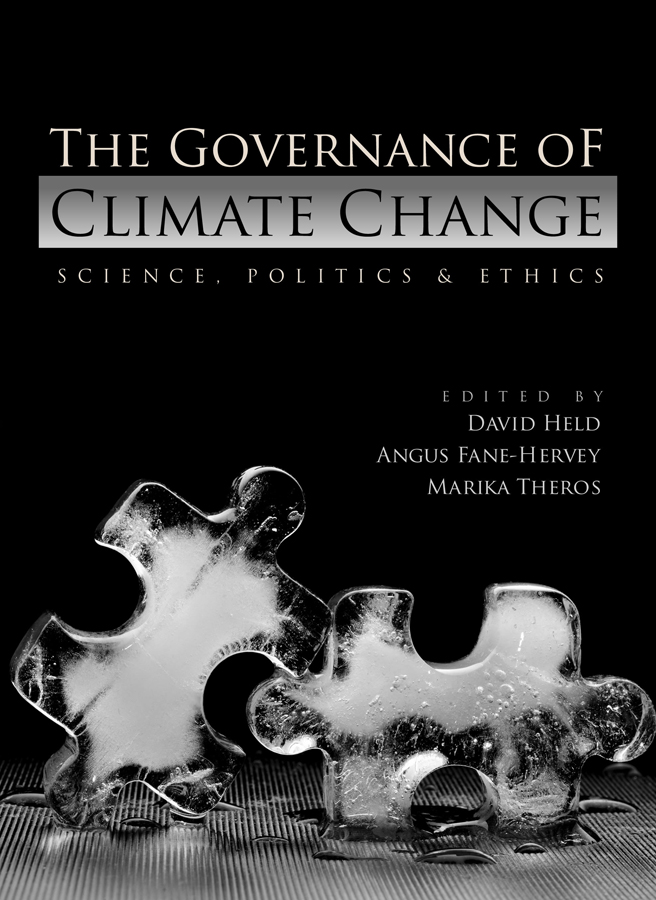
Book Review: The Governance of Climate Change

The Governance of Climate Change – Science, Economics, Politics and Ethics
Edited by David Held, Angus Hervey, Marika Theros
Polity Press, 2011, 228 pp.
(see official page here)

We’ve so far gambled and lost on getting a universal treaty on climate change governance – but we can and have to work with what’s available. And what the climate crisis has given us is an opportunity to recognise and act on our common identity and interests in the face of the threat.

This collection of essays and lectures is not so much about what we’re going to do about climate change, as how we’re going to make decisions about what we do. The only non-academics contributing are perhaps the two most bookish of UK politicians: David and Ed Miliband. So ‘here be academics’ – covering the fields in the subtitle.

The book is in three parts: six pieces on the challenge of climate change; three on social justice and three on where to go next. That already suggests that the book is possibly better on stating the problem than on providing solutions; but, even so, it has opened my eyes and I’d recommend it. After all, aren’t most of us in danger of falling at the first fence because of the difficulty in getting our heads round all of the complex issues before we get some perspective on what to do next.

The book was finished just before the UN climate change conference in Cancun in December 2010, and just when many of “us” were feeling disappointed after the Copenhagen conference a year earlier. It asks: were we expecting too much from Copenhagen? If changing emissions is so urgent, where are the power and will to do it and how do the decisions get made?

These questions are easy to ask but complex to answer. We haven’t been here before. There are no maps, but maybe a few parallels we could learn from. The answers involve science, economics, ethics and politics, none of which is, as it were, an exact science.

Science though is perhaps the least of our problems. Yes, the sceptics are recalcitrant and getting their messages into the mainstream. But the science is well understood and we have developed very good international ways of sharing and verifying what’s happening and will happen. That’s a tribute to thousands of years of honing the scientific method. There are numerous areas where we can’t predict with accuracy what will happen in the longer-term, and the acceleration of change and innovation hampers forecasting; but we are developing more sophisticated models that give a better account of what is certain, probable and possible.

Economics is more difficult. Every nation state wants economic growth and aims to get it by attracting capital. The markets aren’t loyal to nation states. The world is one big investment opportunity: markets, resources. If one country has scruples about, say, workers’ rights or environmental impacts, then investors amorally put their money elsewhere, where they can exploit more efficiently. Economic power has gone global. But political power lags behind, shackled within national parochialism and short-termism, despite the growth in international agreements since 1945. We may not like global finance, but markets can give part of the answer: carbon trading and green innovations.

Science can play an important role in informing ethics to help us develop a global awareness of the effects of what we do, our obligations to act and how we exercise economic power. And all of these roads lead to politics – or governance. The nation state can’t fix it on its own. We’ve gambled and lost on getting a grand, binding, universal treaty on climate change governance (Copenhagen), though made some headway on international agreements. The book ends with an appeal for a “building blocks” approach: uni/bi/multi- lateral agreements where possible with a steady build up of power in international institutions.

There’s a slight whiff of the ivory tower about the whole book. Academics preaching gradualism can seem unsatisfactory. Some of us want to see off the nation state and capitalism before we build up more just means of exercising power. And yes, they’re to blame for much of where we are now. The best of this book proposes using what we’ve got (cos that’s all there is at the moment, and we need
to act now) and going beyond that: to a “vision of a marriage of reason between modernity and ecology”. It’s no accident that this book is probably greater than the sum of its parts: the contributors,
though from the relatively small world of academia, have different perspectives, different facets of the truth, probably disagree about quite a bit, but come together in a larger project: to move us on. It’s a lab demonstration of the “cosmopolitanism” some of them prescribe. The opportunity we have now is the common identity/ interest everyone on the planet has had foisted on them by the crisis.

Besides, I was afraid it would be turgid and technical; but it wasn’t. It was actually pretty inspiring.

Roger Bysouth

Posted in Book Review | Leave a comment

Something for the Weekend #7

Anyone see that wildlife documentary the other nighght where the hyena broke into the food tent and snaffled a box of Oxo cubes? Made a complete laughing stock of itself…

New MCFly on Monday, and the only thing to kill the anticipation pangs this weekend is this: –

Saturday 31 March
Chorlton’s Big Green Festival, an annual celebration of sustainable living in Manchester. St Clement’s Church, Edge Lane, Chorlton

We never did get answers to our questions ’bout that.  So it goes…

Posted in Something for the Weekend | 1 Comment

Prof Kevin Anderson withdraws from conference – “offsetting without scientific legitimacy”

Breaking News: Professor Kevin Anderson, the Manchester-based Deputy Director of the Tyndall Centre, has withdrawn from a prestigious conference because of its use of “carbon offsetting.”
In a strongly-worded blog post, entitled “Offsetting (& CDM): a guarantee for 100 years or just a clever scam?” (see here), Professor Anderson – writing in a personal capacity explained –
“The Planet Under Pressure [website here] organisers have insisted that all delegates contribute £35 to a compulsory ‘offset’ scheme, and although they acknowledge “carbon offsetting is complex and controversial”, they nevertheless conclude “it seemed appropriate to take some responsibility for greenhouse gases for an international conference.” This position has forced me to withdraw from participation, instead I reiterate my long-held judgment that offsetting is without scientific legitimacy, is dangerously misleading and almost certainly contributes to a net increase in the absolute rate of global emissions growth.”

Professor Anderson’s article, which was written with help from John Broderick and Dan Calvery, explains that “when considering our impact we have to consider the total sum of our emissions released between 2000 and 2100; offset projects must be measured over this period. There is no point in reducing emissions in the short-run by 1 tonne if the knock-on impact is 2 tonnes emitted in 2020 or even 1.5 tonnes in say 2050. The implications of this for the concept of offsetting … are profound.”

It concludes with a detailed explanation – with a ‘worked example’ of how good intentions involved in ‘offsetting’ a flight may very well rebound to cause higher overall emissions in the long-term.

MCFly has contacted (5.10pm, 27 March) the Press Office of The Planet under Pressure conference and made them aware of the post. We have asked for a comment, and as soon as one is provided, we will update this post to reflect that.

MCFly says: Anyone who has had the good fortune to see Professor Kevin Anderson explain the science of climate change and its implications will know he does not mince his words. We need more scientists to come out and tell it like it is. But scientists on their own cannot carry the weight. We need doctors, teachers, engineers, schoolchildren, pensioners and – well, everyone who can – to speak out and act responsibly. For this energy to be harnessed and sustained we do not need more conferences. We need (local) government, businesses and “civil society” (campaigning groups, trades unions, churches, sports clubs etc) to behave with transparency, intelligence and courage. Our children (or in any case our nephews and nieces) will not forgive us for our failure of nerve and resolve.

Posted in academia | Tagged , , | 1 Comment

Gallows irony at the Metro “newspaper”

The layout drone at the Metro (“commuter mcnuggets r us”) has a sense of the bleak absurdity of 21st century life. See page 7 of yesterday’s dead trees.

The article in Nature Geoscience is here
We here at MCFly haven’t read the article in question yet, but suspect we are all (almost literally) toast anyways. Meh, so it goes.

Posted in Article alert, humour | Tagged , , | 1 Comment

Growing flax in Manchester; Sew What?

Roisin Weintraub flaxes her writing muscles…

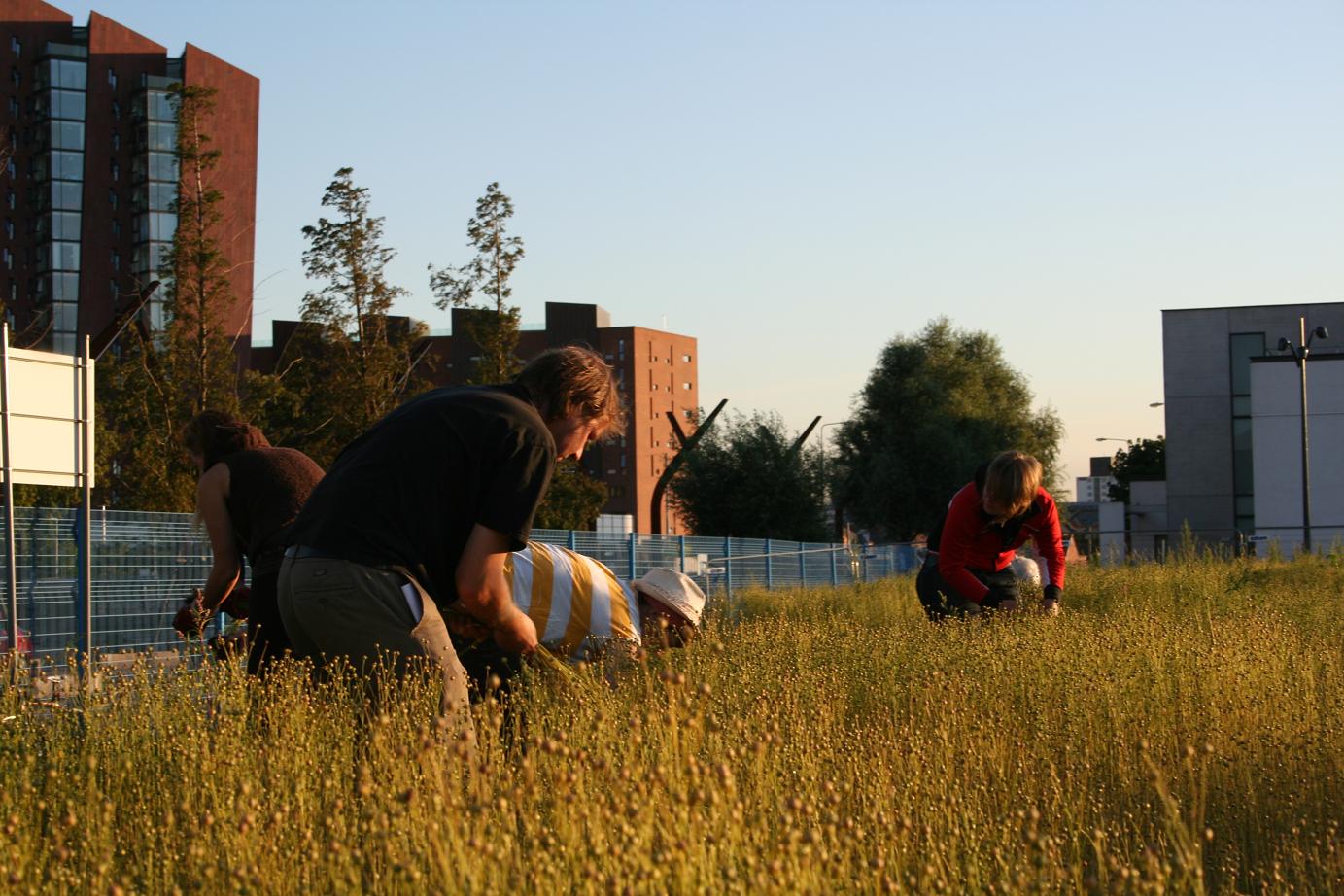
Ancoats at one time was an area full of mills. Manchester’s first cotton mill was built there in 1783 and the area was at one time a bustling hive of cotton-producing activity with the last mill closing in the late 1950s.

Ancoats is that bit right behind Manchester City Centre, so close it contained a retail park before they became an out-of-town phenomenon. There was an attempt maybe 5 years ago to gentrify the area. New flats (one of which my cousin lives in) sprang up, as they did all over the city. The momentum -and the money – ran out and an Urban Splash development in an empty hospital sits, seemingly abandoned, swish street lights line an unusable street in an area still largely council housing, undeveloped brown fields and butty shops.

It is here in one of the old mills that MERCi (Manchester Environmental Resource Centre initiative) exists, an environmental project centre. I was there to meet Sophia, the organizer of one of their projects Sow Sew. Sow Sew is a project that sees the production of flax (a plant that can be woven a bit like cotton) on a bit of brownfield, donated by the aforementioned Urban splash.

I missed seeing the flax growing in the field by the time I turned up last week it had been harvested and was off being processed  (into thread, wool, yarn, fabric and joins for  these ; http://www.bikebamboo.com/ )

The 10th of an acre produced 150 bundles of flax. Fortunately for me there where a few at the Merci offices, it’s quite strange stuff with very little effort the length of the plant becomes thread-like fibers, stronger but not quite as elastic as cotton. However it’s absolutely suited to the Manchester climate – you hardly have to water it in our weather. Sophia gave me an envelope of seeds with the full growing instructions which you can download here.

The North West has been growing flax and producing its own locally grown sustainable fabric for years, says Sophia. Indeed it was the advent of the Industrial Revolution and an influx of cheap cotton produced through slavery that put the local flax economy out of business. Right now Sow Sew is only producing a small quantity of flax but has returned at least a small part of the city to its fabric producing past. They are hoping to gain more meanwhile sites, and are in talks with Manchester council.

So why is Sow Sew growing flax? The harvest will become the inspiration for an exhibition. Artist and makers will be using the flax in its various forms to create works hoping to demonstrate the true flexibility of the plant. I may even join in; there is something really quite fascinating about a plant that can become plastics, fabrics and bank notes.

Sophia adds that the project’s ultimate aim is to show that “we can grow our own organic fabric in the UK and to raise awareness of this. It is also to show that there are alternatives to importing vast amounts of cotton.”

Roisin Weintraub
MCFly volunteer

Photo courtesy of Sophia Perkins

Posted in Biodiversity | 2 Comments

Manchester Climate weekly nuggets #6

Hi all,

If you’ve not already booked your ticket, you’ll want to. What for? This – a pre-local-council-elections opportunity to find out “Is Manchester City Council taking the right action on climate change?”  It’s on Tuesday 17th April, from 7pm. It’s free, and you can reserve your place here.

Just a reminder- if you want to start writing or volunteering for MCFly
a) you’ll be joining a growing band of folks
b) all you have to do is email us – mcmonthly@gmail.com

Please encourage your climate-concerned friends to take out a (free!!) subscription to the blog/newsletter – via our subscribe page.
If they need convincing, here’s a 40 second video explaining the top ten reasons folks should subscribe
And follow us on twitter (@mcr_climate).

Coming up this week (see our March 2012 calendar page for more info)

Mon 26, 12.30pm – 4pm Community Run Green Energy Workshop, Bridge 5 Mill
Is your organisation interested or involved in renewable energy but unsure where to go for support? MERCi, GMCVO and Carbon Co-op will present recent research to show the barriers, success factors and general best practice for developing community run green energy projects.  Plus opportunities to share information and network.Free for front-line, grass roots voluntary and community sector organisations.  Limited places for support agencies at a charge of £50.
http://www.gmcvo.org.uk/green-energy

Tues 27, 7pm Friends of the Earth Climate Subgroup meeting. Greenfish Resource Centre, Oldham St.

Thursday 29th March, 4pm til 7.15pm FeedingManchester #9
MERCi, Bridge 5 Mill,
22a Beswick Street, Ancoats, Manchester, M4 7HR.
Food will be served during the workshop.
* We shall be introducing the two new Feeding Manchester co-ordinators Rob Allen and Beth Creedon.
* Discussing and collaboratively planning our campaign for supporting Greater Manchester’s sustainable food movement.
* Hearing an inspiring case study of how small organic food enterprises in Manchester have strengthened their resilience through working collectively.
* Along with the usual mix of socialising and networking the events offer something for everyone involved in Greater Manchester’s sustainable food movement. For more info contact chris@kindling.org.uk

Thursday 29th March from 7pm “Plants and Plans” Biodiversity in Chorlton – St Clements Church, Chorlton
This fringe event for the Chorlton Big Green Festival will be an evening of short films, speakers and discussion on biodiversity in Chorlton. it will look at what is being done, what people can do and why they should do it.
Register at event-brite: http://smefchorlton.eventbrite.com
Saturday 31 March
Chorlton’s Big Green Festival, an annual celebration of sustainable living in Manchester. St Clement’s Church, Edge Lane, Chorlton

MCFly stories you may have missed

Manchester Green Party under the spotlight
Book Review: Why aren’t we saving the planet?
Book Review: Climate Change and the Crisis of Capitalism
How to make a Green Impact
Greater Manchester makes its decision on the Green Deal (sort of)
Event Report: Ecology as the Opium of the People
Manchester gets ready to retrofit

Lessons we like to believe we’ve learnt this week
It’s cheaper to fly to Spain than to take the train
Jobs that need doing!
Could someone trawl twitter for groups MCFly could follow?

Regional News
Another Big Scheme is announced – this time labelled “A low carbon hub”.  Maybe it will happen.  In any case, it won’t reduce our carbon emissions in line with the science, and won’t prepare us for the challenges ahead.

Reading and Watching

The BBC’s Susan Watts examines fracking

Energy Savings Trust on fuel poverty “in from the cold

Steve Jobs, Climate Quackery and Democracy

Climate Change and the Question of Death

Dave Pollard on Preparing for the Unimaginable

Facebook Groups versus Pages, explained well by a Manchester Friend of the Earth.

And finally…
We’d like to announce that the cosmetics company Lush has given us a big wodge of money to continue our work, that we currently pay for the privilege of doing (printing isn’t free.) We’d like to announce it, but it wouldn’t be true. Apparently we don’t “closely fit with [their] priority areas, values and interests.”

If anyone has any bright funding ideas or rich green relatives, let us know…

Posted in Weekly bulletins | Leave a comment

Manchester Green Party under the spotlight

On Tuesday 17th April, representatives of Labour, Lib Dems and the Greens* will tackle the question “Is Manchester City Council taking the right action on climate change?”  It’s at the Friends Meeting House, 6 Mount St, and  you can book your free ticket here.

Ahead of this, we’ve interviewed David Mottram, secretary of the Manchester Green Party. It’s a discussion covering the good and bad of the City Council’s (in)actions, the Airport (naturally), the nature of democracy and “much much more.”

You can read the full transcript here.

* The Conservatives have been invited, but are – frankly – shilly-shallying.

Posted in Manchester City Council, Upcoming Events | Tagged , , | Leave a comment