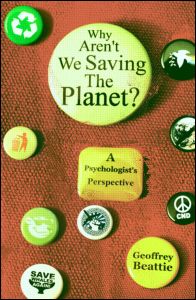
Book Review: Why Aren’t We Saving the Planet?: A Psychologist’s Perspective

Laurence Menhinick the Prolific reviewed this book before interviewing its author. who is a Manchester-based academic. The interview will appear on this website very soon.

Why Aren’t We Saving the Planet?: A Psychologist’s Perspective

Beattie, G., 2010, Routledge, London and New York.

I’ve discovered that I have a new hobby: understanding people’s behaviour. Why do we act the way we do, and howcan behaviour be changed. Did you notice it too?“Behaviour” is thenew “sustainable” these days so I jumped on the buzz word bandwagon and picked up the book that looked like it had found the answer… But before we get too carried away, let me reassure you: these 250 pages will not answer the question. Well certainly not fully, but rather it starts the process by studying some attitudes and reactions relating to a few situations, and ends up with more questions than answers.

First, although this book reads quickly, it was certainly not what I expected. Divided into 4 parts it has an unusual style, swinging from personal anecdotes to specific academic research, with a fair amount of explanations about psychology and its methods in between. I was quite taken aback as from the onset Professor Beattie seemed to talk a lot about himself: very personal events, family events, deep-rooted buying habits and lack of environmental interest for instance. Is this usual? Do psychologists usually include themselves in their study of people behaviour? Was this a bald move or an attempt to combine autobiography and research into one book? In the end I think this was actually an interesting and fairly honest stance since -let’s face it – it is quite hypocritical to try to analyze other people’s lack of interest towards climate change knowing full well that you are like them really. But still, such personal stories and details may put readers off and in the end what I wanted was a lot of research and facts.

So what was the research about then, I hear you say? In a nutshell:

  • the impact and perception of the carbon footprint information on various products : how size and positioning are everything when all you have is 10 seconds to grab attention
  • the interesting lack of synchronicity between explicit (public if you like) and implicit (deep-rooted personal) attitudes in some people, which means that actions don’t follow because deep down there is no real acquirement of the issue
  • the mismatch ‘speech – hand gestures’, which displays these discrepancies
  • how the delivery and emotional content of environmental videos can affect people’s moods and reactions either way

In the end I think there was a lot to gain from this book but I would have liked the précis edition, concentrating on the methods, the research and the conclusion.

A couple of little things also stuck with me: how do you generate a “flashbulb memory” in relation to the environment? ie. a kind of sudden violent realization which sticks in your brain and changes your habits forever (the sort of event in your life which could have been fatal and changes you). Or, since you can be unconsciously influenced by names, it is true that the term “global warming” does sound too nice and cozy to convey urgency and disaster. Maybe “climate disaster” would be better. Or “global climate danger”. Or “climate threat”. Or…

Laurence Menhinick

Posted in Book Review | Tagged , | Leave a comment

Something for the Weekend #6

No jokes at the start of this week’s post, just a puzzle; Why is there only one Monopolies Commission??

A date for your diary – Tuesday 17th April, 7pm for 7.30pm start we have a Q and A/debate with representatives from Labour, Lib Dems and Greens (Conservatives tbc) on “Is Manchester City Council taking the right action on climate change?”  It’s at the Friends Meeting House on Mount St, behind the Central Library.

Climate-related happenings this week –

Sunday 25th March 10:30 am Litter pick on Ivy Green Meet: Ivy Green car park (This is on Brookburn Road opposite the Bowling Green pub).If you have any questions, please e-mail Dave Bishop or phone 0161 881 6276.

Sunday March 25th, 1 to 5pm Manchester LETS trading event at ArcSpace, St Wilfrid’s Enterprise Centre, Hulme.
The event is open to LETS ‘newbies’, and experienced ‘traders’ alike. Whether you are an individual, family, sole trader, or local business, your presence at the Spring Fair will be welcome! It will be a great opportunity to open an account in Manchester LETS if you haven’t already done so, meet other members, and start trading using your very own Manchester Pounds. If you have goods or services to sell, and wish to have a stall at the event, please call Julia on 0161 232 8839 or email julia.farrand@afsl.org.uk to find out more about the terms and conditions, and to arrange this. You don’t have to have anything to sell right now to come to this event. You can start trading straight away in LETS – you can spend Manchester Pounds before you have even earned any!! Or just come along to find out about LETS and see what it has to offer you. There will be a fresh fruit and veg stall on the day, selling a range of produce at 50% Manchester Pounds and 50% sterling.
Entrance to the event is £1 sterling, and one Manchester pound.  Don’t worry if you haven’t got a LETS account yet, as we will be able to set this up for you on the day. http://ManchesterLETS.Org

Sun 2, 3.30 – 5.30pm Cake Liberation Front meet-up
Friends Meeting house, Behind Central Library, 6 Mount Street, Manchester M2 5NS
£1 with vegan baked goods (sweet or savoury)
£2 without
All drinks free and free entry for kids

Bring along some vegan friendly baked goods to share, meet others
interested in cruelty free baking, swap recipes and drink tea.

For more info / access etc see
http://www.cakeliberationfront.com/events.htm

Posted in Something for the Weekend | Leave a comment

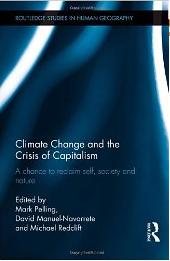
Book Review: “Climate Change and the Crisis of Capitalism”

MCFly reader [who now prefers to be anonymous – I guess has never heard of google cache?] invites you to twist your brain inside out with a challenging book about climate change.

If you’re looking for a quiet read on a Sunday morning while you wait for the spring shower to abate as you contemplate getting back to those weeds, this isn’t the right book for you. On the other hand, if you enjoy having your brain twisted inside-out with the theoretical reasoning behind the combined economic and ecological crisis, then you’ve come to the right place!

With contributions from leading academics in the fields of environmental and economic policy, international development, human geography, International Relations, socio-ecological systems-theory and environmental sociology, you could say that the editors were a little over-zealous in their choice of contributors. There is, however, a method behind this particular pair of green-tinted spectacles, even if there are a number of lenses. For if you accept the logic of a ‘co-evolution’ thesis, which this book ultimately does, then a smorgasbord of academics is, frankly, the only way you’re going to make any sense of it, for it necessitates the addressing of a number of spheres of social activity and concurrent theoretical approaches. Not only that, but, in its addressing of the differences between the reformist and radical approaches to the combined economic and ecological crisis (one of the book’s main aims), it also calls for a ‘co-revolution’ within these spheres. That said, unless you’re versed in the Marxist conception of dialectics, you made find it difficult to get your head around such ideas, which are important to grasp if you stand any chance of understanding the underlying theoretical framework of the book and hence the prevailing arguments; but when you do, the fruits of knowledge to be digested are certainly worth the effort.

So, what is the co-revolution thesis? Essentially, it is a line of argument developed by none other than the demi-God of contemporary Marxist studies himself, David Harvey, as found in both his A Companion to Marx’s Capital (2009) and subsequent Enigma of Capital (2010). Transformational change, the argument goes, occurs in the interactive, or ‘dialectical’ (apologies to all Marxists for this gross simplification), relationship between seven fundamental spheres of social activity – “(1) technological and organizational forms of production, exchange and consumption; (2) relations to nature; (3) social relations between people; (4) mental conceptions of the world, embracing knowledges and cultural understandings and beliefs; (5) labour processes and production of specific goods, geographies, services, or affects; (6) institutional, legal and governmental arrangements, and (7) the conduct of daily life that underpins social reproduction” (p. 191). It is within each of these spheres, according to the editors, that there needs to be a transformational change, a ‘co-revolution’, if we are to address the combined economic and environmental crisis.

Still with me? Good! The underlying argument is, ultimately, that the social relations to be found in the capitalist mode of production create tensions, ‘contradictions’, within these spheres, causing crises in both economic and ecological terms. Take our relationship to nature (#2), for example, the book argues that the way we produce commodities and consume them creates tensions with the natural environment, such as in the over-production of resources, like trees in cases of deforestation. Therefore, it is argued that we need to not only change our relation to nature by reorganising production (#5), but that to sustain such a shift in behaviour will also require a ‘co-revolution’ in the other spheres, such as in mental conceptions (#4), in the need to convince others of the necessity for change, and subsequent regulatory institutionalisation of such changes (#6).

Having accepted this logic, you’re free to enjoy the rest of the book, which, in my view, is rich in insight and ways forward. For instance, Carson, in chapter five, builds the convincing argument that effective reform in liberal democracies is near on impossible due to the entrenched interests of capital and its lobbying power against any measures which may incur loss of profit for big business. Furthermore, Redclift, in an outstanding analysis of the global capitalist economy, argues that the socio-cultural phenomenon that is consumerism, and the debt mechanisms which underpin it, is unsustainable, not least in its tendency to alienate people from nature – a theoretical mainstay of the book which takes its inspiration from the Marxist concept of commodity fetishism. Added to these insights are Mitlin’s chapter on the role of grass roots movements in effecting decisive change; North and Scott Cato’s positive views of the potential of the Transition Towns model; and Hjerpe and Linner’s view of the role utopian outlooks have to play in convincing people of the necessity for radical change in our relationship with nature. I’d also recommend a read of Barry’s contribution on the need to limit economic growth, a fundamental drive of the capitalist economy in its search for an average of 3% compound growth year upon year; as echoed by Manuel Navarette in chapter ten.

As I said at the beginning, if you don’t like a brain strain on a Sunday morning then you’re probably best picking up Alan Titchmarsh, but, on the other hand, if you’re interested in getting to the bottom of why we are killing this beautiful planet of ours and finding out the ways in which we can fight this unfortunate tendency of our species, then, please, have a go, you might like it.

Climate Change and the Crisis of Capitalism: A Chance to Reclaim Self, Society and Nature, by Mark Pelling, David Manuel-Navarette and Michael Redclift, eds., 2012, London: Routledge, 224 pgs, ISBN 978-0415676946.

At the time of writing this review, [Mr Anonymous] was a member of the National Committees of both Socialist Resistance and the Campaign against Climate Change, as well as Transition Moss Side.
As of March 2013, he is no longer affiliated with Socialist Resistance, and is now International Coordinator for the Campaign against Climate Change.

Posted in Book Review | Tagged , | Leave a comment

How to make a Green Impact!

Laurence Menhinick learns how to conduct a green audit, and finds that virtue is its own reward.

Having read about volunteering to audit Manchester Metropolitan Uni, I decided to take the (free) training offered by the Green Impact team last week. I was so pleased that I came back for more!

Since 2006, the NUS has taken the lead in greening student unions and universities, in keeping with students’ own environmental concerns and demands to make a “difference from within”. After a pilot at Bristol University, the Green Impact accreditation programme was opened to UK universities; its aim to help student unions to green not only their department and universities, but also their communities through student training and engagement. This year, 1540 teams from 46 universities (totalling 45000 staff) are competing to be awarded Green Impact Bronze, Silver or Gold awards based on a range of criteria set to achieve high environmental standards. These relate not only to improving environmental habits about printing, travel, heating, air conditioning, food and drink, recycling, energy use but also to raising awareness by actively promoting best behaviour, reviewing impact and encouraging change.

As a volunteer auditor, you were certainly given a lot to do! There was training in the morning and auditing all afternoon. The 3 ½ hours training session itself included an introduction to the scheme, an explanation of the standards and criteria we would be auditing, and very comprehensive and relevant techniques in both auditing and decision making. After familiarisation with the standards we were off in pairs to audit one to two departments all over the campus before coming back to base and report.

Charlotte Bonner, the Green Impact Development Manager,trained the 80 volunteers who audited the 67 departments taking part at MMU this year, and her enthusiasm for the visible efforts the teams and staff have made was visible throughout. I for one (having done 3 audits) was also very impressed with the level of interest and commitment from the teams, clearly there was a lot of collective work done to reach good standards. (Award ceremony to follow late April)

One of the MMU Green Impact Coordinators, Robert Croll, was also helping with the training and proceedings. He commented to me that this programme is “the first MMU staff and student behaviour change programme but there are also about 20 environmental projects throughout the MMU”. He mentioned amongst others iCYCLE , the Met Munch student food network and the significant involvement in the new Business School building and Birley Fields Campus. (1)

The opportunities for expansion for the scheme are endless, especially within the community and local authorities. Indeed things are already moving on with the UH Bristol NHS Foundation Trust, and the announcement last month that Manchester City Council will be running a pilot.

So altogether this was a brilliant opportunity to pick up new skills, to witness real positive change and to learn about a worthwhile programme to support.

Laurence Menhinick
[Who wants to declare that she got a free lunch for her trouble. Which is more than those slave-driver editors at MCFly ever give her!]

List of GI participants http://www.green-impact.org.uk/green-impact-participants/

Footnotes
1. If any Hulme residents want to write us an article about why the Birley Fields Campus is a Bad Thing, they are very welcome! We will get a react quote from MMU, and voila, indepth investigative reporting at yer service. Eds.

Posted in volunteer opportunity | Tagged , | 3 Comments

Greater Manchester makes its decision on the Green Deal (sort of)

In a bid to keep our readers awake and me sane, this report is only of the key decisions and interesting debates that took place at the Environment Commission’s 21 March meeting (1). It is not an official record of the event. If you’re interested in that, it will be part of the upcoming meeting’s documents which you can find here.

First things first – the agenda. It was good to see that the draft of the delivery plan to help Greater Manchester fulfil its Climate Change Action Plan promises was on the agenda. In a previous article, we revealed that the sign-off of the delivery plan was delayed from March to July 2012. We were told that this had no effect on the implementation which would be be backdated to March and that the Environment Commission would be looking a draft of the report the same month to keep the ball rolling.

The main message coming from the officers in charge of putting together the delivery plan was that it was in some way a resources plan. It was looking at what money, time and officers they had and what jobs they could allocate to these. Richard Sharland, who is in charge of the plan, pointed out that at the moment they have a skeleton crew and more resources would mean that they could put in and get out more from the plan. He also added that they were eager to get the support of the government, even if this meant further delays to approving the plan.

Neil Swannick, chair of the Greater Manchester Waste Disposal Authority, suggested that they try and get European funding on the grounds that their work was regional and this was an agenda which would be supported.

Officers also promised that a priorities list would be circulated to the members of the commission well before July when the final plan would be up for AGMA approval. It was also suggested that they ensure that all influential and useful organisations and business across GM as well as other GM commissions get the chance to contribute to the delivery plan. Once the plan has been approved, the tasks will be delegated to the priority areas in May. It was also revealed that a report will be published in June which will deliver a benchmark on how the Environment Commission performed in 2012.

The Green Deal – if you’re not sick about hearing about this, you will be soon. But let’s trudge on. In the last Environment Commission (EC) report, we highlighted the fact that the GM councils were still considering all their options in terms of how to react to the Green Deal. A decision of sorts has been made. AGMA won’t be leaving the Green Deal to its own devices and have opted to either act as A) facilitator/marketer of Green Deal providers or B) a large scale Green Deal provider. The next step is to narrow this down to their final decision.

There is no particularly rush, as AGMA are hoping to launch their plan a year after the policy details of the Green Deal are announced in October. (Well, it turns out the government may be taking a little longer to make their final announcement anyway). There is a £45k budget associated with the development of a business case for GM’s Green Deal. £39.5k is allocated from the GM Environment Team budget.

A really interesting point that Michael O’Doherty made was that localised energy advice centres – such as the one being closed down in Manchester due to DECC’s plans to go for a national phone line instead – were one way to encourage uptake of energy efficiency technologies. He added that the timescale for setting up the new national service was very short as the old centres close in March and the new call centre opens in April. O’Doherty, who is head of Climate Change at Manchester City Council said: “We have been in touch with DECC to put forward our concerns and we are looking at AGMA funding and other sources to see if we can keep it (the Manchester Energy Advice Centre) going in case it’s something that we want to use as part of our Green Deal work.”

A decision will be made in mid-April over whether the centre will be stay open.

The final bit of news coming from the Commission is that the Energy Plan will be launched by the new Secretary of State for Energy and Climate Change at the end of March. Neil Swannick, who will not be able to lead on this publicly due to the elections that will be taking place, hoped that this would help make the EC more visible. Edward Davey may also be paying the Manchester United Stadium a visit as they managed to score highly on the Carbon Reduction Commitment Index. Although were some cynical mutters of ‘hot air’, Sharland insisted that the visit may help encourage further action.

The next meeting is the 13th of July 2012.

Arwa Aburawa
Mcmonthly@yahoo.co.uk

(1) Environment Commission has been meeting now for a three years. Manchester Climate Fortnightly covered its birth (here and here) early progress (here, here, here, herehere, here and here). The basic idea is sound – get a group of councillors from different local authorities, some other interested parties from business and the ‘third sector’ (charities, etc), and support them with a bunch of officers. Then hope that they can, with their smarts and their contacts books, start Greater Manchester down the path to a greener, safer (and fairer?) future, with the occasional kick in the pants from the political leaders of the 10 local authorities that make up AGMA/GMCA – via Marc Hudson.

Posted in AGMA, GM Climate Strategy | Tagged , , , | 2 Comments

Event Report: Ecology as the Opium of the People

MCFly co-editor Marc Hudson attends a meeting with muscle relaxants mentioned in the title, but comes away neither relaxed or impressed.

Wrap your thinking gear around this quote from the eco-thriller “Zdt”

 Wrong. Nature in the Middle Ages was a hierarchy, a chain of being, a pyramid from the many at the base to the One at the top. A description that mirrored the society that described it. For the first industrialists and the Age of Reason it was a machine, an engine, a thing of many distinct parts held together by checks and balances like the American Constitution, and expected to work like a clock or a factory. For Charles Darwin Junior, for AFI, Nature is a state of war, of endless ruthless competition between the strong, and repression and exploitation of the weak by the strong. But what is she really? An endlessly, incomprehensibly complex web of interactions, of dependencies in which the whole is infinitely greater than the sum of the parts, and where no parts are intrinsically more important than any of the others. Is that really what she is? Or is that Nature the way a socialist society might want to see her? Deep thoughts, and, of course, because of them, I lost the way…
page 290 of Zdt by Julian Rathbone

There. I’ve just saved you sixty minutes of numbed buttocks and tenderised eardrums. At the final pre-Easter “Lecture and a Curry” put on by the Manchester Environmental Students Society, Professor Eric Swyngedouw took that long to get that far (the quote is not from his lecture, btw). Fortunately we were “saved by the bell”, since there was no particular end in sight. Unfortunately, as we had to vacate the room, there was no time for discussion. This shortly after we were told that more important than being environmentalists was the task of “reclaiming democracy as public space, organised under a presumption of equality.” Quite.

Sixteen people (male to female 11:5) had had the immense privilege of sitting through what the good Professors said was his standard presentation. It contained slabs of white text (often 20 or so lines) against a bright blue background. There were no illustrations. These slabs of text, often pure academese, were then read out to us.

There was not a single concrete example of the sorts of ‘depoliticisation’ via appeals to “Nature” that Prof Swyngedouw quite rightly warns about. The pages of the business press (The Economist, the Financial Times) are full of glossy adverts for technocratic solutions (wind farms, carbon capture and storage, nuclear) that create a vision of nature in harmony with humans’ rapacity and stupidity. The mainstream environmental NGOs often perpetrate similar “we can have our cake and eat it” lies. But instead of a few scanned images that would help the audience to understand what was being critiqued, they got more slabs of text, more Zizek, more sentences like “Nature becomes symbolically charged. Not neutral in its performativity but mobilised to express a multitude of functions.” I don’t disagree, but I know for a fact that smart people present in the room had not a scooby what was being propounded. And propounding it again and again, louder and louder, didn’t – oddly enough – change that.

Look, Donna Haraway has said all of this, with more verve and nuance, twenty years ago. This tonight was, imho, Roland Barthes reheated by Frank Furedi.

Don’t get me wrong, there were good and original bits to this. Unfortunately, the good bits were not original and the original bits were not good. All the usual suspects were invoked – Badiou, Derrida, Zizek.  It was like playing pomo bingo.

Expecting a raid from the irony police
There is a very unintentional irony here, and not for the first time. That irony is of someone proclaiming loudly that politics matters while being relentless anti-political. What do I mean by this? Well, politics is surely about dialogue, no? And dialogue needs time. So when there is an hour for an event, and instead of taking up a third to a half with your presentation, you take up every single second with your own monologue, I call that pretty anti-political

Suggested for implementable improvements
Have a pre-presentation “talk to the person beside you/behind you” for a minute or three.
Cap any lecture at a maximum of two thirds of the available time (e.g. 40 minutes), allowing a decent amount of time for comments, questions etc. This shouldn’t even be necessary for me to type this, but apparently it is.
Make sure that quotes ascribed to “a climate scientist” come from, um, a climate scientist. Not from historians who have never ever claimed to be climate scientists. Google, much? Just saying.

Things to track down
Neil Smith and the concept of “nature-washing
The New Spirit of Capitalism Boltanski and Chiapello 2007

Concepts worth a look
Ecological modernisation (see MCMonthly #3)
Post-ecological thinking (see MCMonthly #4)
Green Confucianism (Ecology, Class and the Green Movement)

Videos to watch as the algae grows on your fur
Nulture
Mind Your Language

Footnotes
1. Imagine the print edition cover of MCMonthly # 3, only even worse, and without even our lame excuse of lack of time and the self-awareness that it is an aesthetic crime, a crime we say,  to be that crap that consistently.

Posted in academia, Event reports | Tagged , , | Leave a comment

Manchester Climate Election Hustings; Tues 17 April 2012

“Is Manchester City Council taking the right action on climate change?”

Politicians from Labour, the Liberal Democrats and the Greens  (and maybe the Conservatives!) will be put under the democratic spotlight in central Manchester on Tuesday 17th April.  At a free* evening event open to all, they will put their cases and then take questions from the audience on a range of issues (inevitably including food, transport, the airport, the Climate Change Action Plan etc).

The event, hosted by Manchester Climate Monthly, will happen at the Friends Meeting House, 6 Mount Street (behind the Central Library).  There will be mingling and stalls from 7pm, with the event itself starting at 7.30pm sharp.

Panelists confirmed are – Cllr Nigel Murphy (Labour, Executive Member for the Environment), Cllr Marc Ramsbottom (Liberal Democrat, Leader of the Opposition) and Brian Candeland (Green Party speaker).

Tickets are available via this eventbrite page!

MCFly editors Arwa Aburawa and Marc Hudson would VERY much like the help of someone in putting on this event.   Please get in touch, unless you are a current member of any political party.

* Gold coin donation from everyone very welcome.

Posted in Manchester City Council | Tagged | Leave a comment

Manchester Gets Ready to Retrofit

MCFly writer Philip James investigates plans for a Mancunian “retrofit revolution”

Manchester is readying itself for a retrofit revolution. Our leaky existing housing stock has to be transformed into well-insulated, airtight and efficient homes that are fit for a low carbon future. Helping things along (maybe!) will be the “Green Deal. ” The government’s flagship green policy is due to start in October, and will provide loans for domestic energy efficiency improvements, wit the loan repayments made by whoever pays the property’s energy bill.

Here in Manchester, several organisations are accesssing funding from DECC’s Local Energy Assessment Fund (LEAF). We looked at two; Action for Sustainable Living in partnership with consultants Ecospheric, and the Carbon Coop in collaboration with sustainable designers URBED. Together they are undertaking a total of 60 detailed home energy assessments. The aim is to assess the current condition and energy use of the dwellings and produce a range of bespoke behavioural and retrofit options to reduce energy use, carbon emissions and fuel bills.

The LEAF funding is enabling the groups to develop and refine their assessment methods. Ecospheric are using thermal imaging and moisture mapping to get to the nitty gritty of heat loss on a house-by-house basis. Meanwhile URBED are developing a whole house survey with the data fed into a much more detailed and flexible version of the tool used for Energy Performance Certificates. This allows them to take into account occupant behaviour and to recommend appropriate, dwelling specific energy efficiency measures.

The measures recommended by the home energy assessments are not nailed down at time of press, with frantic report-writing still underway. However, Kit Knowles of Ecospheric told us that they will first focus on airtightness, draft-proofing and ventilation, with insulation coming next. Mechanical Ventilation with Heat Recovery is a favoured technology due to its ability to save energy and create a healthier internal environment with cleaner, dryer air. Ecospheric also have methods to improve existing windows by reducing air leakage and adding panes and ‘warm edge spacers’ to reduce conduction heat losses.

Carbon Coop/URBED will consider a range of options including solid wall insulation, new windows and doors, A-rated appliances, biomass boilers, solar PV, and solar hot water. And they too have identified new ventilation systems as a priority in some dwellings to improve the internal environment.

The cost of the measures and the energy bill savings they achieve are clearly important. Asked whether all the recommended measures have short payback periods URBED’s Charlie Baker answers with a concise, “No”. Jonathan Atkinson of Carbon Coop elaborates that a range of packages will be identified with varying costs and payback periods. Paying for the recommended measures could involve Green Deal finance.

However, the Green Deal’s ‘golden rule’ is that loan repayments must not exceed the predicted energy bill savings of the installed measures. Baker is concerned that the Green Deal will simply tackle the ‘low hanging fruit’, rather than incentivising the type of whole house retrofits that can achieve deep reductions in energy demand and carbon emissions. Carbon Coop and URBED want to help people go further by using a Carbon Re-Investment Society to provide long-term finance, low interest rates, and cross subsidy from Feed in Tariff revenue.

Ecospheric’s Kit Knowles also has concerns over the Green Deal. Firstly, that the quality of advice and installation may be lacking, meaning the energy savings won’t match expectations. But also that occupants should be aware of the potential rebound effect where reduced heat loss from their home leads them to enjoy higher temperatures rather than lower fuels bills, whilst still needing to pay off the Green Deal loan. This highlights the importance of education, not only to reduce energy use by behaviour change but also so that occupants know what to expect from their retrofit.

Ecospheric conducts a full ‘lifestyle interview’ at the start of each assessment, whilst Carbon Coop are aiming to create an online community where retrofitters can share experiences and knowledge.

Both groups are expecting a good take-up of recommended measures. Ecospheric are already taking forward a number of retrofit projects. Meanwhile, Carbon Coop is about to launch its member offer with benefits including reduced cost home energy assessments, advice on finance, the possibility of reduced cost measures through bulk purchase, and an online community. Ultimately, the financial benefits of a retrofit will depend on fuel costs, weather, occupant behaviour and the rest, but the likes of Ecospheric, URBED and Carbon Coop are aiming to show that retrofits can be affordable, create a better living environment, save energy and carbon, reduce your exposure to high energy prices … and might even be fun!

Watch this space for further updates on Manchester retrofits and the Green Deal.

Read the full MCMonthly Home Energy Assessment Q&A with Kit, Charlie and Jonathan here.

Philip James

Competing Interest: MCFly co-editor Marc Hudson has had an energy survey performed by Carbon Coop.

Posted in Energy | Tagged , , , , , , , , , , | 4 Comments

Manchester Climate weekly nuggets #5

Hi all,

Just a reminder- if you want to start writing or volunteering for MCFly
a) you’ll be joining a growing band of folks
b) all you have to do is email us – mcmonthly@gmail.com

Please encourage your climate-concerned friends to take out a (free!!) subscription to the blog/newsletter – via our subscribe page.
If they need convincing, here’s a 40 second video explaining the top ten reasons folks should subscribe
And follow us on twitter (@mcr_climate).

Coming up this week (see our March 2012 calendar page for more info)

Monday 19th, 5.30pm to 7pm EMERGE 3Rs: Zero Waste CelebrationEMERGE is a Manchester – based social enterprise promoting the idea and practice of the 3Rs: REDUCE, REUSE, RECYCLE Join them from 5.30-7pm on  2012 at Brazennose House West, Brazennose Street, Manchester, M2 5AS
· Yummy Love Food Hate Waste Cookery Demonstration…
· Zero Waste Exhibition
· Reduce Reuse Recycle Tips & Info
· EMERGE & FareShare showcase
Come and have your say on what EMERGE should be doing to help the community reduce waste!
Refreshments provided. If you have any questions, please contact Nicola on 0161 223 8200.

Tues 20, 6pm – 7pm ‘Ecology as the new Opium of the People’ – Prof. Erik Swyngedouw lecture-and-a-curry
Location: Room 4, University of Manchester Students’ Union, Oxford Road, Manchester, M13 9PR

Weds 21 March
Gunter Pauli workshop and evening lecture at MERCi, in Ancoats.
Details here.

Wednesday, March 21, 6 to 7.30pm Life Friendly Event: “Keeping on: sustainable art-activism” at Chinese Arts Centre, Market Buildings
Thomas Street Manchester
Platform is a London-based group of artists, environmentalists, human rights campaigners and activists who work together on issues of social and environmental justice. Founded in 1983, their current focus is on getting society off its dependence on oil because of its human rights, resource justice, and climate change impacts. The major campaigns and creative initiatives at the moment include finance (getting British investors to withdraw from backing Tar Sands extraction in Canada), cultural sponsorship (driving a wedge between Tate and BP, Shell and Southbank Centre), and corrupt corporate practices (revealing Shell’s complicity in militarised violence in the Niger Delta). This talk and discussion will look at some of the strategies and lessons learnt over many years to enable artists and activists to keep on making work that challenges the status quo and speaks truth to power, while at the same time sustaining ourselves, our imaginations, and our communities.
Book here.

Weds 21,8 to 11pmA Reasonable Cause, A mixture of Music, short film a talk about something green and as much fun as we can have.
This month we have the delightful sounds of Folkin El, and the stunning Violet Youth.
We have David Barlow, Environmental Strategy lead on Biodiversity from Manchester City Council. Films, drawing and more.
See ye there. (at Kraak Gallery, 11 Stevenson Square) Facebook page

Thursday 22nd, 7.00-8.30pm Carbon Coop meeting in Moss Side
Claremont Pub 124 Claremont Road, Moss Side M14 4RR
Free, informal, food provided
Can our homes be made energy efficient, if so how would that work?
We need to cut the average amount of energy our homes use by 80% to deal with climate change and rising fuel bills. Carbon Coop have been having a look at the options and want to know what you think would work, what wouldn’t and why.
The Carbon Co-op and residents in Hulme from Homes for Change (the Yellowbricks) and Bentley House (the Redbricks) and in Moss Side from the The Avenues Residents Association have been working with energy experts URBED on detailed assessments of the properties for both retrofit options (insulation etc.) and community renewable heating systems.
This is not a consultation about any planned developments, so don’t get your hopes up, we are just trying to build up models of how communities might take control of energy usage and want to find out what people think about both what is possible and desirable. Advice will be on hand though for anyone interested in taking the ideas forward.
Have your say, get involved, eat free grub!
Places are limited, RSVP: info@carbon.coop or call 0161 408 6492
See here for details.

Thursday March 22nd 7pm An evening of information and discussion on how to make our homes warmer, more energy efficient and cheaper to run. St Clement’s Church, Edge Lane, M21 9JF
Chorlton Refurb presents:
-Local home owners describing successful improvements.
-Energy efficiency experts to answer your questions.
-News on the Government’s Green Deal.
-Findings from Chorlton LEAF.
Chorlton homes are some of the least energy efficient homes in Manchester as they are older, bigger than average and solid-walled. What can be done? Chorlton LEAF, funded by Dept of Energy and Climate Change, is a project that aims to find out. 20 comprehensive energy assessments are being carried out on typical Chorlton homes, investigating household behaviour and building performance and making detailed and practical recommendations. All the reports will be available at http://www.chorltonrefurb.net. On the night there will be a free prize raffle for a detailed home energy assessment and an opportunity to sign up for a very reduced price thermal imaging survey.
7pm Refreshments and Stalls
7.30pm Presentations and Discussions

MCFly stories you may have missed

Cllr Marc Ramsbottom (leader of the Mcr Lib Dems) interviewed.
Stakeholder hold stake: Dissent breaks out at Stakeholder Conference
Stakeholder Conference: The culture workshop
Newsflash: Steering Group steers towards democracy
Manchester Energy Advice Centre to shut
Event Report: Engineering an energy solution

Lessons we like to believe we’ve learnt this week
Things can be worse than you expected
Flying to Spain is much cheaper and quicker than taking the train/coach

Jobs that need doing!
Could someone trawl twitter for groups MCFly could follow?

National News
The Tories to launch a bonfire of the “red tape” about things like, oh, asbestos, invasive species and industrial air pollution; protection for wildlife and common lands
Guardian story here.

Mon 12 Insider Media reports “Banks Renewables, part of the Banks Group, has completed a £16m funding agreement with The Co-operative Bank to fund the construction of its first wind farm in Cumbria. Work on the Armistead Wind Farm is set to begin shortly after Durham-based Banks agreed a deal with The Co-operative Bank, which previously provided the financial backing for the company’s Marr and Hazlehead wind farms in Yorkshire.”

Weds 14th Energy Saving Trust Advice Centre is Toast….


Reading and Watching

Chorlton Councillor (Lib Dem) Victor Chamberlain on “Twenty’s Plenty

The Arctic Methane Emergency Group holds a meeting at the House of Commons http://www.ameg.me/index.php/letter-to-world-leaders

Sherwood Anderson, the guy who discovered the hole in the Ozone Layer, and said this “What’s the use of having developed a science well enough to make predictions if, in the end, all we’re willing to do is stand around and wait for them to come true?” dies. Real Climate does a great obit.

We can’t prevent Climate Change. So what can we do?

The Fallacies of Green Growth (an UNCTAD report)

Resilience: Motherhood Statement, Rhetorical Slogan or Neo-liberal shift?

George Monbiot reckons that – on nuclear at least – Friends of the Earth has lost the plot.

Fracking Hell!” say some activists in Wigan.

Carbon Blood Money in Honduras (hat-tip to Dominic)

Council Leader Richard Leese reports on his recent trip to Chicago

Posted in Weekly bulletins | Leave a comment

Lib Dem leader Marc Ramsbottom interviewed by MCFly

Councillor Marc Ramsbottom, leader of the Liberal Democrat group within Manchester City Council, was interviewed by MCFly in early February (see full transcript only now posted here). In a wide-ranging discussion that took in Manchester Airport’s future, ward plans and how to create a “low carbon culture”, Cllr Ramsbottom advocated as much local (ward-level) control of decisions and budgets as was practicable, a “jobs and growth” agenda and improved transparency of decision-making in the Council.

On the Airport, 55% owned by Manchester City Council, Cllr Ramsbottom told MCFly “First of all, the airport is an hugely important economic driver. Not just for the city, but also for the Greater Manchester area, the North West and for the north of England. It’s probably the most economic driver in terms of transport hubs that the region has. We’re not about to say “it’s a dreadful evil thing, we must try to curb it.” That would be wrong. But any development, or any plans to develop the airport has to be done in a way that is sensitive, and respects the environmental as much as possible.”

You will have a further chance to hear how a Liberal Democrat-run Manchester would be greener by attending the MCFly pre-election hustings on Tuesday 17th April, at the Friends Meetings House.

This interview follows an interview with Council Leader Richard Leese.  An interview with the Green Party secretary will follow shortly.

Marc Hudson
mcmonthly@gmail.com

MCFly welcomes criticism – what questions didn’t we ask? What questions should we have asked differently? What killer-facts should we have brought to the table? We are all ears…

Apologies to Cllr Ramsbottom for the delay in finalising and posting this transcript.

Posted in Manchester City Council | Tagged | 4 Comments