
Upcoming Event: “Disaster Dialogues” Mon 15th February #Manchester

from here.

Disaster Dialogue: Three myths in our dealings with disasters, climate change and development

image
Starts: 16:00 15 Feb 2016
Ends: 18:00 15 Feb 2016
What is it: Seminar
Organiser: School of Arts, Languages and Cultures
Who is it for: Adults, Alumni, Current University students, General public, University staff
Speaker: Terry Cannon, Gemma Sou

The Disaster Dialogue series, hosted by HCRI, is a regular multi-disciplinary forum that responds to the urgent challenges posed by disaster events, including their interface with climate change and sustainable development. It provides an opportunity for the disaster scholars, practitioners and students to dialogue and exchange ideas about the state-of-the-art research on disaster risk reduction and resilience capacity development.

In this presentation, Terry Cannon discusses key areas of work that overlap between development, climate change and disaster preparedness, in relation to three myths. The first is that people share the same priority for severe natural hazards with outsider “disaster managers”. Most people do not, because they have other priorities (of everyday life). Many people interpret risk through culture and religious beliefs, which are also ignored in DRR. The second is the myth of “community”. Does it actually exist, or do we pretend it is there in order to enable us to do our work? From this I explore the problems that arise when we do use the notion of community in what we do, or what others do. This is linked to the assumption that people are “rational” in the way we assume, and that evidence is collected and acted on. Instead, we need to take account of different rationalities (rather than irrationality) and the significance of emotions and experiences in determining behaviour in relation to “evidence”. The last myth relates to whether governments actually care about their people. When we do research to provide evidence for policy (“policy uptake”) we are making an assumption that there will be a rational, logical process that links our research to policy design and implementation. But what if the responsible organisations (national governments and international organisations) don’t actually care, or are constrained by factors that make evidence-based policy irrelevant? In all this the missing element is any consideration of power relations as the major determinant of what does and does not happen.

Suggested reading:

IFRC, 2014, World Disasters Report 2014 focus on Culture and Risk, Geneva: International Federation of Red Cross and Red Crescent Societies, http://www.ifrc.org/en/publications-and-reports/world-disasters-report/world-disasters-report-2014/ (free download) – especially chapters 3 and 4.

Cannon, Terry & Detlef Mueller-Mahn, ‘Resilience, vulnerability and disasters’ Natural Hazards, 2010, 55:621-35.

Speakers

Terry Cannon

Role: Research Fellow

Organisation: Institute of Development Studies, based at the University of Sussex

Biography: Terry has a background in development studies, and specialises on rural livelihoods, disaster risk reduction, vulnerability analysis and adaptation to climate change. He is Senior Research Fellow at the Institute of Development Studies (IDS) in the UK, and previously worked with International Institute for Environment and Development (IIED), University of Greenwich (London) and the Natural Resources Institute (UK). He recently co-edited and co-authored the World Disasters Report 2014 focus on Culture and Risk, and is co-author of At Risk: natural hazards, people’s vulnerability and disasters (with Wisner, Blaikie and Davis), which is one of the most widely cited and used works in disaster risk reduction. He is currently working on a project in Bangladesh on cyclone preparedness and how to protect livelihoods as well as lives.

Gemma Sou

Role: Lecturer in Disaster Management

Organisation: Humanitarian and Conflict Response (HCRI)

Biography: Gemma received a BA in International Relations and Politics at the University of Sheffield (2008), an MA in Urban Planning with specialism in cities of the Global South (2009) at the University of Manchester and a PhD in Development Studies (2014), also here at the University of Manchester. She has worked on diverse projects for BBC Worldwide, the ESRC and DFID, the Ford Foundation, Goldsmiths University of London, The Natural Environment Research Council, the World Bank and UNOY Peacebuilders, based in The Hague. Broadly speaking her research focuses on the experiences of marginalised groups in cities of the Global South and their representation in development discourse. She focuses particularly on multi-scalar approaches to address disaster risk in ‘Southern cities’, the intersection of disaster risk management and broader development processes and how vulnerable groups are embedding disaster risk management into social and cultural norms at the grassroots level.

Posted in academia, Preparedness | Leave a comment

Floods, climate change and council pension fund investments. #Manchester

From press release:

Local campaigners are calling on Greater Manchester’s local authority pension fund to learn the lessons from the recent floods and redirect investments away from the fossil fuels that cause climate change.

The terrible flooding that hit parts of Greater Manchester, Cumbria, Yorkshire and other areas highlights the urgent need for divestment from fossil fuels. Burning fossil fuels creates the global warming that is changing our climate. Expert opinion is that climate change makes such extreme weather more likely.

The Greater Manchester Pension Fund (GMPF) has a legal responsibility to invest wisely on behalf of its members working for local councils and other organisations. This means protecting the value of assets, ensuring a reasonable return and ensuring that investments do not contribute to risks. (1)

But as Mark Carney, Governor of the Bank of England, recently warned the potential losses from falling share prices for fossil fuel companies were “potentially huge” as their reserves of coal, oil and gas become “stranded” as they cannot be burned if the world is to tackle climate change. (2) The GMPF lost an estimated £148 million over the last 18 months on its investments in coal mining (3).

Chris Smith, from local campaign Fossil Free Greater Manchester, commented:

“The hundreds of people across Greater Manchester who were affected by the recent flooding must be wondering why the Greater Manchester Pension Fund has £1.3 billion invested in coal, oil and gas companies.

“If GMPF is serious about securing a prosperous future for pension scheme members, it must divest from companies like Shell and BP, whose products are making climate change worse and flooding more likely.”

Over £1bn of Greater Manchester pensioners’ money is currently locked into these damaging fossil fuel companies, according to Platform, Community Reinvest, 350.org and Friends of the Earth. Nationwide, this data shows local council pension funds have £14bn invested in fossil fuels. That’s more than double the estimated £6bn cost of this years’ floods so far. (4)

In 2014, the Greater Manchester Pension Fund decided to divest from tobacco stocks because of public health concerns. (5) Public Health England have highlighted the health risks associated with climate change. (6)

Public health considerations should mean they now begin to divest from fossil fuels to encourage the needed rapid transition to a carbon neutral economy.  Money released by phased divestment could be diverted to renewable energy and energy conservation as well as to preparation for the impacts of climate change.

Fossil Free Greater Manchester is campaigning for the Greater Manchester Pension Fund to freeze its investments in fossil fuels and then carry out a managed programme of divestment over a five year period. (7)

Fossil Free Greater Manchester are encouraging local residents to support their campaign by signing an online petition at http://bit.ly/divestgmpf

Posted in Campaign Update, press release journalism | Tagged | Leave a comment

“Community Energy GM” – #Manchester #solar

From press release:

Something amazing is happening right on our doorstep…and it’s called Community Energy GM (CEGM)

18 of our local community organisations in Greater Manchester – youth clubs, community gardens, disability charities and furniture recycling centres to name a few – are working together to fundraise for their own solar roofs.

This is all part of their plan to make a future for themselves and guarantee that they’ll still be supporting our communities in years to come. I think we’ve all felt the pinch over the last few years but these panels will provide them with some extra resource to ensure they can continue doing the work they do. The work that makes Greater Manchester the wonderful place it is!

To make it happen though they need to raise £3,000 each. A challenge, yes. So, let’s make it easier for them! Can you help us support them by doing one or more of the following actions:

  • Spread the word on social media. You can either retweet this post or share one of the drafts below on Twitter or Facebook.
  • Do you have a newsletter, mailout or blog going out in the next few weeks that could feature CEGM?We have images saved here for use and can easily put together some text too. Just let us know on 0207 388 6688 or email cecily@1010uk.org.
  • Donate – can you spare £5 to kick start their fundraising? Donate here – www.cegm.org.uk.
  • Do you know anyone else in Manchester that may want to get involved? Please feel free to forward this email on if so. Anyone is welcome to take part – the more the merrier!
  • Any other ways you can help? If you have any other thoughts or suggestions then let us know – a meeting with the CEGM team or a suggested event or venue, we’d love to hear from you on cegm@1010uk.org

The groups are going to be investing the £3,000 they raise into a larger co-owned solar roof through a community benefit society (bencom). Later in the year, you’ll be able to invest too. Fancy it? Register your interest atcegm@gmcvo.org.uk

For now though, let’s start them on their journey with a bang. We’ll keep you updated but in the meantime you can check their progress at cegm.org.uk.

Thanks so much,

Ali Crush, 0161 277 1022, alison.crush@gmcvo.org.uk

Posted in Energy, press release journalism | Leave a comment

On renewables versus fossil fuels- games incumbents play… #Manchester #climate #LootingTIvoryTower

lootingivorytowerHere’s the latest “Looting the Ivory Tower” blog post, by Sarah Warren. Sarah worked in the NHS for a number of years and is currently studying with the Centre for Alternative Technology in North Wales, towards a MSc in Sustainability and Adaptation.

Geels, F. W. (2014) ‘Regime Resistance against Low-Carbon Transitions: Introducing Politics and Power into the Multi-Level Perspective’, Theory, Culture & Society, 31(5), pp. 21–40. doi: 10.1177/0263276414531627.


The TL;DR
Their argument in a tweet: “Incumbent UK energy companies effectively obstruct the transition to renewables by exerting influence over government, who in turn set terms for debate.”
Should activists pay attention?: Yes. Current UK energy policy is being dictated by nuclear and fossil fuel industries, and addresses none of the key issues: energy security, high energy prices, climate change.
Should activists try to read the source material, or is this summary All A Busy Activist Needs To Know? Summary suffices

What’s the issue (and why should we care)?
Why isn’t the transition to renewable energy taking place more effectively, based on current rapid technological developments? What is the role, if any, of players in the incumbent energy companies?

What do they have to say?
The traditional way of thinking about new technologies penetrating a market is that innovations gradually build up momentum, then as they begin to change the market landscape, this creates pressure on the incumbent market players, destabilising them and creating a window of opportunity for the new players. However, Geels considers the penetration of renewables into the UK electricity market, and argues that the incumbent regime actually actively resists the incursions of the new players. The established market players form an alliance with policy-makers oriented towards maintaining the status quo – because of their close mutual dependency. Companies use overt lobbying, but ministers also begin to internalise the points of view of incumbent industry, as a result of close working and frequent meetings.

How convincing is their methodology?
Convincing. Geels illustrates the article with data demonstrating that UK coal and nuclear generation are both increasing. He also considers what other writers have had to say about political power, and about the framing of media coverage – which has moved on since the financial crash from focusing on climate change, to a much greater concern for short-term cost.

What would a critic say?
A highly-regarded and much-cited paper by a world-leading scholar in the field.

What else could they have said?
Paper seems pretty comprehensive. I guess he could have looked at other industries or countries, to establish if the same issues arise – although these are dealt with in his wider body of publications.

What are the implications for local activism?
Fracking continues to be pushed hard by government, and will require concerted and determined direct action from the whole community to resist. Meanwhile, obstacles (both financial and planning) are being put in the way of renewable development – so these will require very active and imaginative support from the whole community to have any chance of success.

What else do these people refer to that looks interesting?
Hess, D. J. (2014) ‘Sustainability transitions: A political coalition perspective’, Research Policy, 43(2), pp. 278–283. doi: 10.1016/j.respol.2013.10.008.

Levy, D. L. and Newell, P. J. (2002) ‘Business Strategy and International Environmental Governance: Toward a Neo-Gramscian Synthesis’, Global Environmental Politics, 2(4), pp. 84–101. doi: 10.1162/152638002320980632.


For sake of transparency – The author of the paper under discussion is the PhD supervisor of the editor of Manchester Climate Monthly.  So, accusations of sycophancy etc etc.  The author of the review (Sarah Warren) was not asked to write what she did!

For the sake of the pedants- don’t write in about the tweet being too long.  “Incumbent UK energy comps effectively obstruct transition 2 renewables by exerting influence over govt, who in turn set terms for debate.”

Posted in academia, Looting TIvory Tower | 3 Comments

Greater #Manchester Low Carbon Hub tenders for “core dataset” framework. At last.

Four years after launching its climate change “plan”, Greater Manchester has finally gotten around to establishing a”core dataset and accounting system framework” for its climate change, energy and greenhouse gas data. In fact, it’s even worse than that, because they’ve not yet established it, they’ve merely put it out to tender. Doubtless there will be months more of wrangling before any work gets done!

Manchester City Council repeatedly promised climate strategies in the second half of the last decade. It eventually established one in 2009, mostly as part of its marketing strategy. Greater Manchester, a bigger and even slower beast, was significantly slower. An implementation plan to explain how it would reach its ambitious targets was endlessly delayed, and when it did come out, was merely a re-heated wish-list with insufficient metrics and clear lines of responsibility.

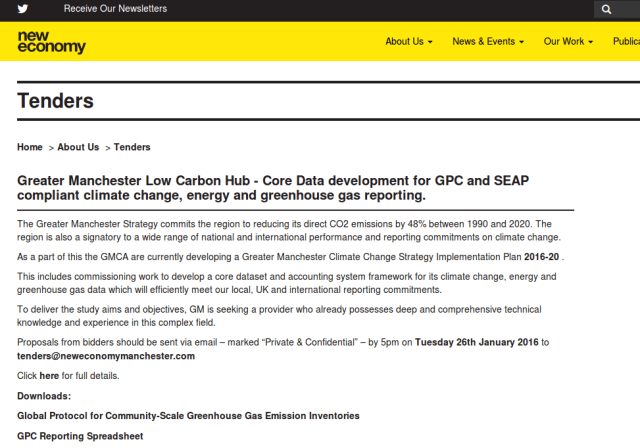
With the abandonment of central Government’s “Green Deal”, which was supposed to enable residential retrofit, Greater Manchester has not got a snowball’s chance in hell of hitting its targets. Not that this is anywhere to be seen in the following tender. (screengrabbed 25th Jan).


lchtender

“Greater Manchester Low Carbon Hub – Core Data development for GPC and SEAP compliant climate change, energy and greenhouse gas reporting.

The Greater Manchester Strategy commits the region to reducing its direct CO2 emissions by 48% between 1990 and 2020. The region is also a signatory to a wide range of national and international performance and reporting commitments on climate change.

As a part of this the GMCA are currently developing a Greater Manchester Climate Change Strategy Implementation Plan 2016-20 .

This includes commissioning work to develop a core dataset and accounting system framework for its climate change, energy and greenhouse gas data which will efficiently meet our local, UK and international reporting commitments.

To deliver the study aims and objectives, GM is seeking a provider who already possesses deep and comprehensive technical knowledge and experience in this complex field.

Proposals from bidders should be sent via email – marked “Private & Confidential” – by 5pm on Tuesday 26th January 2016 to tenders@neweconomymanchester.com”

Click here for full details.

Downloads:

Global Protocol for Community-Scale Greenhouse Gas Emission Inventories

GPC Reporting Spreadsheet

Posted in GM Climate Strategy, Low Carbon Hub | Leave a comment

#Manchester Green Party resolutions for 2016, assessment of 2015

Here are the answers of Manchester Green Party to the 11 questions that MCFly is asking lots of different environmentally-oriented groups.  So far Kindling Trust, Carbon Coop and Global Justice Now have also answered.  There’s still time for other groups to tell readers what they’ve done and what they’re up to.  Finally, for the sake of transparency – MCFly is broadly supportive of Green Party efforts, but its editor is not a member of any political party.

1. What is the purpose of your group? (three or four sentences)

Manchester Green Party’s purpose is basically twofold. Primarily our aim is to get elected in order to promote policies which we believe will create a sustainable city. We also believe in using our position to hold other political parties to account for their policies.

2. How do you find out what skills and knowledge the people who get involved have?

Currently we hold skills audits via phone and email. However, this approach may be reviewed in future. Talking to people face to face is also a main method.

3. How do you find out what skills and knowledge the people who get involved want to develop?

The process is similar to the approach outlined above – asking people, but also offering opportunities.

4. If people get involved in your group, what sorts of things will they end up doing? (stuffing envelopes, selling newspapers, knocking on doors, getting arrested etc etc)

There are so many different things which people could expect to do, these include (but are not limited to): delivering newsletters, attending meetings, knocking on doors, going on protests, writing articles, managing websites, managing social media accounts, making phone calls, filling in forms, speaking to journalists, conducting research, attending election counts, attending polling stations, organising social events, attending and/or giving training, cooking food/making drinks for events, organising petitions, meeting with other activists, contacting councillors, designing printed materials, risking splinters by stapling placards and flags to sticks.

Successes and “opportunities for improvement” in 2015.

5. What have been your group’s main Manchester-based successes in the past year? (i.e. nothing that took place outside the ring road counts)

We continued our position as the second party in Manchester at local elections by percentage of the vote. We grew our membership, tripling our members in a year. We also came second in the Gorton Constituency parliamentary election, which was a first for us.

6. What were the things you hoped to achieve but didn’t.

We had hoped to get a councillor elected.

The coming year

7. What do you hope to achieve in 2016? What are your success metrics for December 31st 2016.

  • We hope to get a councillor elected. We aim to push the council in a number of areas on the environment and beyond. Success will mean:
  • Increasing the number of active members as measured by participation at events.
  • Getting the council and individual councillors to talk about issues they aren’t addressing at the moment.
  • Increasing our skills-base as measured by a skills audit.
  • Increasing the level of training we offer our members.

8. What (up to 3) things would you like do see done in Manchester to make the city less crap on climate action

a) by the City Council.

Develop an environmental scrutiny committee. Take proper scientific advice on emission targets and for an independent report to be commissioned if the targets are not met.

b) by the “climate movement”.

Work on improving the resiliency of the movement. Address issues around engagement by exploring why people aren’t involved. Focus energy into areas which will achieve victories, as this could energise the movement.

9. What is the stupidest thing the “climate movement” could do this year?

Continue to focus on issues which might make complete sense but only make sense to those who are already involved.

10. How can people get involved?

Attend a Green event such as a social or a Green Party forum. Email/phone us to receive more information. More details on the website: www.manchestergreenparty.org.uk Become a party member (via the links on the national Green Party website: www.greenparty.org.uk). When you see us at protests / talks / events wearing our Green Party badge, speak to us.

11. Anything else you’d like to say.

Always the most difficult question to answer! We think that it is vital to make sure that environmental issues are kept on the agenda this year, with the EU referendum campaign, national security and the economy all set to receive much comment we will be working hard to push the message of climate action, both in relation to these areas and outside of them.

Posted in Campaign Update | Leave a comment

NEWSFLASH: Low Carbon Hub meetings now open to the public #Manchester #democracy

Some good news.  In a welcome and sensible move, the meetings of the Greater Manchester Low Carbon Hub are now (re)-opened to the public.

That does NOT mean anyone can go along and say anything they like (“a public meeting”), but it DOES mean that people who want to find out what is being planned, and done (or not quite done) in Greater Manchester about the ‘low carbon economy’ can do so, and see what the organisation is up to (a “meeting in public”).

The next meeting of the Low Carbon Hub is on Friday 22nd January (as in, tomorrow!) from 10am to 12 noon.  The venue is  Room 312, Level 3, Manchester Town Hall, M60 2LA.

If you can’t go tomorrow (#shortnotice), Councillor Derbyshire is also part of a meeting that Friends of the Earth is organising about the consequences of Devolution for climate change action.  That meeting, which is free to attend, is happening on Saturday 23rd at the Methodist Hall on Oldham St.


Why did this happen?  Yesterday Manchester Climate Monthly wrote to the new(ish) Chair of the Low Carbon Hub, Councillor Sue Derbyshire, leader of Stockport Council.  We asked if in light of the recent “Compact” signed by Greater Manchester’s Interim Mayor, the meetings would be open.

Councillor Derbyshire responded extremely promptly this morning –

Dear Marc,

I agree and have asked that this be looked at urgently, occasionally there is sensitive information that has to be on a private part of an agenda but in general I would see value in as many people as possible being aware of the work of the Low Carbon Hub.

She has since confirmed that the meeting tomorrow IS open to the public. You can read the agenda here. I’ve cut and paste it below. The links take you through to papers that will be discussed.


MCFly says:  This is important. If (Greater) Manchester is to have a sensible response to the coming horrors, it needs to act transparently so that new thinking can come forward and trust can be (re)built with civil society. Councillor Derbyshire is to be commended for both the speed and nature of her reply. It’s now up to activists to start ‘adopting’ specific issues, reading the reports, translating them into English and making sure that the many fine words that the Low Carbon Hub generates get turned into reality.


Posted in Low Carbon Culture, Low Carbon Hub | Leave a comment

Carbon Coop social,”retrofit stories” Sat Jan 30th

Carbon Co-op January Social

Come and join us for brunch at Honest Coffee, an exciting new creative space in Salford.

WHEN: 10:30am – 1pm, Sat 30th Jan
WHERE: Honest Coffee, 77-79 Chapel Street Salford, M3 5BZ
COST: Members FREE, Non-Members £1 on the door, Children FREE
TO BOOK: https://carbon-coop-jan-social.eventbrite.co.uk

This Saturday morning social will be a space to share your ‘retrofit stories’ – the good, the bad and the ugly! You’ll have a chance to listen to what has and has not worked well for other members, bring your own retrofit conundrums and get informal advice.Come along, share your stories and pick up some tips.

Have you got a story to share? Want to do a 5 min ‘show and tell’? If so please contact aneaka@carbon.coop

A vegetarian/vegan buffet and teas and coffee will be provided.

This event is open to non-members and children are welcome too. Look forward to seeing you there!

Additional Info:

  • The venue is wheelchair accessible, although the toilet is not wheelchair compliant, but is accessible.
  • The nearest bike park is on the railing outside.
  • The nearest train station’s are Salford Central (6 min walk) or Manchester Victoria (9 min walk), the nearest metro is Market Street (10 min walk), and a number of buses stop within a 1 min walk: 10, 27, 67, 73, 92, 93, 97, 98, 100, 110, 149
  • There are two car parks nearby that are £5 all day. See map.
Posted in Upcoming Events | Leave a comment

Scrutiny Week – January 2016. #Manchester

Manchester City Council has 6 “scrutiny” committees that are supposed to keep tabs on what the 9 member Executive and the officers are up to. Supposed to. One of the problems is, there is not a single non-Labour councillor. So, while there are some councillors with axes to grind and bones to pick, there are very few who will get hold of an awkward issue on which the council has been faaaaaaiiiiiiling consistently (take, oh, I don’t know, climate change as a random example) and ask specific questions, and then refuse to be fobbed off by the officer or Exec member. Failure to back off and accept the nonsense they spout would be a career-limiting move, you see. The people at the top do not reward such awkward independence that lets cats out of bag, skeletons out of closet.

But asides from them all being from the same party, the problems go deeper.  Reports are opaque, delivered at short notice and there is simply too much for some committees to tackle.  And councillors are just normal human beings (well, most of them), with other commitments (jobs, family, volunteering, helping people who are getting screwed by the Tories).  So the amount of time and energy they can dedicate to piercing the propaganda is extremely limited.

Meanwhile, both the media and civil society are largely asleep at the wheel. [For more on all this, see here] .

So, scrutiny is an empty soothing ritual, where naïve activists go to get their belief in the representatives of representative democracy crushed.

If you DO want to go to a scrutiny committee meeting then please, for the love of gaia

a) do not go alone

b) do not go unprepared.

Some of the most miserable, horrible, soul-destroying hours of my life have been spent watching the farce that calls itself ‘scrutiny’.

It IS worth going (once or twice maybe), but not alone, and not unprepared. Srsly. Here’s a five minute video about what happens and some further advice.

Please feel free to contact MCFly – mcmonthly@gmail.com if you want more info.

Here below I have click click clicked through to all the specific pages of the website where the six scrutiny committee agendas are.  The Council COULD, if it wanted, easily have one page where all the agendas were available. The fact that it doesn’t tells you exactly how much they care about keeping citizens informed.

Tuesday 26th January

Young People and Children’s

10am The Scrutiny Committee Room, Level 2, Town Hall Extension

Reports

Neighbourhoods

2pm The Scrutiny Committee Room, Level 2, Town Hall Extension

Reports

Wednesday 27th January

Economy

10am The Scrutiny Committee Room, Level 2, Town Hall Extension

Reports

Communities

2pm The Scrutiny Committee Room, Level 2, Town Hall Extension

Reports

Thursday 28th January

Finance

10am The Scrutiny Committee Room, Level 2, Town Hall Extension

Reports

Health

2pm The Scrutiny Committee Room, Level 2, Town Hall Extension

Reports

Posted in Democratic deficit, Manchester City Council | Leave a comment

Basic question about the Low Carbon Hub and “consistent public reporting” #transparency #climate #Manchester

Dear Councillor Derbyshire,

I am writing to you in your capacity as the chair of the Greater Manchester Low Carbon Hub.

I hope the event on Saturday morning that Friends of the Earth has organised goes well. Sadly I cannot attend so am emailing you the following question rather than asking it in person.

As you may be aware, the Low Carbon Hub used to be known as the “Environment Commission”, and was chaired by an earlier leader of Stockport Council. Its meetings were open to the public.

When it transmogrified into the “Low Carbon Hub”, and was chaired by Richard Leese, the meetings were no longer open to the public. No explanation or justification was given.

I was delighted to see that the interim mayor of Greater Manchester, Tony Lloyd, recently participated in a pledge about climate change.

“Through the Compact, we are strengthening our pledge to reduce local greenhouse gas emissions, create ambitious climate targets, track progress and enhance Greater Manchester’s climate resilience. With consistent, public reporting of our city’s climate data, we will show how our actions can effect real change.”
[Source]

Does this commitment to “consistent, public reporting” extend to returning the Low Carbon Hub to its earlier status of a meeting which citizens of Manchester can attend? If not, why not.

Thank you

Marc Hudson

[address supplied]

Posted in Low Carbon Hub | Leave a comment