“What is to be done?” An oracle speaks #Manchester #climate #movementbuilding

First off; why on earth read this?  What credentials do I have to mouth off about successful movement-building?  There was a moment 6 years ago (Call to Real Action), but you can’t dine out on that stuff forever, you know. There was a failed effort last year (People’s Environmental Scrutiny Team), from which I learnt a lot.  But anyway, if you insist-

In response to a very sensible question,

Marc, what can we DO? Answers on a postcard – a big one though……

here goes.


First off, what we DO depends on what result we hope to achieve.  I know that sounds banal, but actually, part of the problem is that a lot of our activism is, quite understandably, aimed at getting others (usually governments and corporations) to do something.  Personally, I think the time for that has largely passed.  There is a real mess coming (the second half of the twenty-first century is going to make the first half of the twentieth look like a golden age of peace and love), and states and corporations are going to be less and less willing (or able) to do ‘the right’ thing, even if cajoled into it.

On a trivial level, for instance – I’ve watched Manchester City Council move from a not-very-smart elephant (and unable to tapdance) in 2008-9, with all its fine promises about climate change to its current status as an anorexic gnat that hasn’t been taking its OCD medication (gaia help us all after DevoManc).  Thanks to all the Tory cuts, the council has lost a few occasionally reasonable members of staff and (thank goodness) a lot of  outright muppets.  Of the 96 Councillors, there is but a handful who are worth talking to.  My point is – even if the council as an organisation had the will to keep some of their promises (doubtful) there is actually very very little they could themselves DO.  So why waste breath or attention on them, except for the lulz?

So, for me, it’s about how we can do activism that yes occasionally makes demands of others, but is more focussed on identifying the skills and knowledge we have, the skills and knowledge we will need (and the single points of failure – i.e. is there only one person in the group who knows how to update the website. What happens if they leave?!).

That however, is a fundamentally different mindset from comfort-zone of  “the demo is in three weeks?!  Who is going to print the placards?  We need to sell lots of papers/collect lots of signatures!”

We also do indeed need to get the existing groups co-ordinating.  But each is (happy in) its silo, and folks are busy enough with their own group(s)’ meetings without attending another one and having tussles about who is ‘in charge’.  There is lots of mutual suspicion about groups trying to “take over”, and about these co-ordination efforts being more trouble than it is worth.  I am not sure if this can be solved [probably it would take a committed, trusted and available ‘Big Cheese” with amazing interpersonal skills]. I don’t know of that person in Manchester.  So we’d be looking for a less-skilled individual…  “not me” – I am far too loathed and also far too busy.

So look, I don’t believe that we (“climate activists”) will (or perhaps even can) create the kind of activism that can do the two things we really need

a) pressuring the state to be less rubbish

b) creating exchanges of skills and knowledge that build the confidence of individuals and groups, their connectedness and their – dreadful word – ‘resilience’.

The rest of this post is simply some questions.  (I have some answers, which if you do keyword searches for things like meetings, movement-building 1, movement-building 2, emotathons, ego-fodder, smugosphere, novice lines you might find something of use.)

  • Why do so few people who come to our meetings stick around for the ‘long haul’?
  • How can we make being involved in a campaign/group less dependent on availability for an evening meeting or a march?
  • How do we identify and people’s skills and knowledge?
  • How do we create opportunities for people to gain in skills, knowledge, confidence, connection?
  • How can we be ‘welcoming’ without freaking people out and having them think we are a cult?
  • How can we get “old” people back involved (ones who left because of burnout, cynicism, unmanaged conflict)?  What is required here?  Should we always get these people back?!
  • How do we manage conflict between individuals and groups (especially when it involves us)?
  • How do we make sure we don’t waste people’s time/attention/bandwidth
  • How do we maintain morale (given that it is going to be escalating and accelerating nastiness from here on).
  • Why are our meetings and organisations (largely) so white?  And relatively male?
  • How do we capture tacit knowledge and explicit knowledge, and share it?
  • How do we increase individuals’ and groups abilities to  conduct honest and thorough post-mortems of success and failure (rather than have people slink away to lick their wounds, taking their insights with them into their caves).
  • How can we create synergies between groups?

For all of the above questions  we need think

  • 1) What is the current level? (and how do we find out, reliably and efficiently)
  • 2) What can we do to increase each of these?  (what do we need to start doing straight away?)
  • 3) What skills and processes would we need to help increase these? (long-term, what’s needed?)
  • 4) Are there ways that we can efficiently and meaningfully measure our impact?
  • 5) What are some of the common (past, present, possible) fuck-ups to do with each of these?

What will actually happen?
We (in social movement organisations) will just keep doing what we always have done.  That’s what we do, that’s who we are.  Innovation is painful, and if you think you’re right, and that you will be rewarded sometime, why would you change?

‘New’ people will come to our meetings and events. They will judge (rightly) that either

  • a) nothing important is happening, or
  • b)  they would only benefit in terms of skills learnt/camaraderie shared if they  became a part of the inner clique. This would take more time/energy/motivation than they have … so they will walk away, largely unnoticed.

Some groups will die, but others will be sustained by a flow (often a trickle) of newbies who ‘stick’.

And the carbon will accumulate, and the desperation will accumulate.  We will reach for various Gods and Geo-engineering.  And it will be pretty horrible for a long time.  After that, after everyone alive now is dead, or wishes they were? Well, that doesn’t bear thinking about….


Posted in humour, narcissism, Signs of the Pending Ecological Debacle, Unsolicited advice | Tagged , , | 2 Comments

On the flooding in the North West. #Manchester #climate

This is from Pauline Hocking, a Manchester resident, reposted (with permission) from her facebook.

PLEASE EVERYONE IF YOU ARE PLANNING TO TRAVEL, CHECK FLOOD WARNINGS. Unprecedented flooding is spreading across the whole of the North West. Not just Cumbria but Salford, Bury, Rochdale, Leeds… the list is growing. Friends & family affected, my heart goes out to you. Those I do not know, my heart goes out to you.

I have to say, shout, scream…. “we need to talk about climate change”. To anyone who says “Now is not the time.” – you are right. The time was in 1988 when the Toronto conference of climate scientists said if we do not reduce carbon emissions, our climate will warm. They correctly predicted that a warmer climate would lead to greater weather extremes, especially extremes of drought & flood. In the interim, as they tried with all their might to warn us, they have been disbelieved, insulted, vilified. In all investigations as to their integrity they have been 100% exonerated.

How has this happened? How did we block our ears and not hear them shouting ‘fire!’? There are now investigations into Exxon Mobil, Peabody Energy & other fossil fuel companies for deliberate campaigns of misinformation that purposely seeded doubt and confused the science. Why would anybody lie in this way? Why would they commit the greatest crime against humanity, robbing future generations of a viable planet and putting present generations through a living hell? Dead simple – they all benefit financially from the sale of carbon rich fossil fuels that when burned produce heat trapping CO2.

For me it’s got so personal. The lakes where I now spend all my hols is sopping. We tried to support businesses there & stay for the festives, but after driving through deep surface water, a swollen river and an overspill of Lake Windemere itself, we bottled it and bolted. And now my Aunty’s house could be underwater, my cousin’s and the houses of many, many friends.

What is to be done? For starters, money to be found as quickly and easily as it was for bombing Syria and every other war (usually with an oil related motive) in order to comfortably re-home & re-furnish the thousands of people and businesses affected. But beyond this, we need to question and re-think the whole money economic system as we know it. Too much to put in one fb post but the best current book expanding on this, without doubt, is “This changes Everything” by Naomi Klein. Climate Change is more urgent than urgent.

Surprisingly, the changes needed are only truly painful to a tiny few and would enrich and improve life for the vast majority (and arguably for the tiny few too). Cleaner air, greener cities, better public transport, clean jobs in renewables, energy independence, lower energy bills in better insulated houses, healthier children… who wouldn’t want all these and the list could go on.

How do we get there? By living and breathing climate action in all of our lives. By demanding it of our elected representatives and in all economic life. By continuing to work together in the heart warming, cooperative, compassionate manner being demonstrated in these floods and continuing beyond that to ensure such floods do not become a permanent feature of ours and future lives.


Climate Survivors, a group that Pauline is involved in,  is meeting early January  but haven’t got a date settled yet. But people can join the facebook group and/or email climate survivors@gmail.com

Posted in Adaptation | 2 Comments

#Manchester Professor (Kevin Anderson) on#climate deal in Paris

Professor Kevin Anderson has a typically blunt article in the latest edition of the journal “Nature” – here is a the beginning of it;

The climate agreement delivered earlier this month in Paris is a genuine triumph of international diplomacy. It is a tribute to how France was able to bring a fractious world together. And it is testament to how assiduous and painstaking science can defeat the unremitting programme of misinformation that is perpetuated by powerful vested interests. It is the twenty-first century’s equivalent to the victory of heliocentrism over the inquisition. Yet it risks being total fantasy.

Let’s be clear, the international community not only acknowledged the seriousness of climate change, it also demonstrated sufficient unanimity to define it quantitatively: to hold “the increase in … temperature to well below 2 °C … and to pursue efforts to limit the temperature increase to 1.5 °C”.

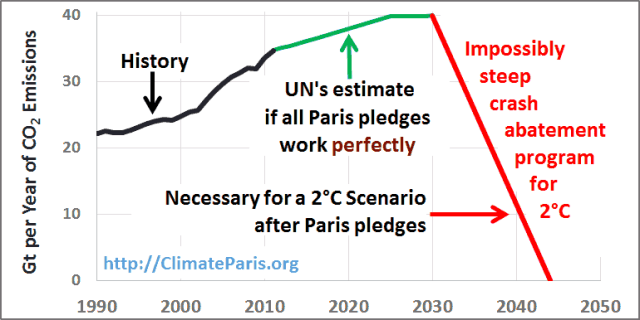
To achieve such goals demands urgent and significant cuts in emissions. But rather than requiring that nations reduce emissions in the short-to-medium term, the Paris agreement instead rests on the assumption that the world will successfully suck the carbon pollution it produces back from the atmosphere in the longer term. A few years ago, these exotic Dr Strangelove options were discussed only as last-ditch contingencies. Now they are Plan A….

Want to read more?  Click here.

You can see his pre-Paris interview with MCFly here.

Posted in academia, University of Manchester | Tagged | 1 Comment

“2 degrees” = dangerous #climate change. Interview with author

The Two Degrees Dangerous Limit for Climate Change: Public understanding and decision making” is a (very) new book by academic Chris Shaw. Here he responds to a series of questions about the two degree limit, the recent Paris conference, and ‘what next’. [The book itself is a good ‘un – if anyone in Manchester wants to borrow my copy, contact me through the usual channels.]

Your book was ‘inspired’ by the 2003 heatwave that killed thousands in Europe. And you did your interviews in 2009, before Copenhagen. It’s 2015- what took you so long? Did “Real Life” get in the way? When did you send it to the printers?

The book started as a PhD thesis. It was 2003 that made me doubt the ‘climate change not dangerous until 2c’ narrative. So I had to go away and do the research. It was 2005 when I went back to university to do a masters and then a PhD whilst also being primary carer to two young children. So that was all slow going. Then that was followed by a period of self-doubt, where the idea’s any good etc. Once I realised it was worth publishing then, as you note, the data felt perhaps a little old. So I thought, OK, I will write a whole new book. But by then I was working full time, alongside home and family commitments and I found writing the book a real struggle. But I didn’t want to just re hash what I had done previously. Even though my thesis was passed without correction and described as very literate I still felt I could do better, that my thinking had progressed. But when it came to it, I really struggled to find the time and whilst I could have continued with new research etc I was also keen to get it published by COP 21, with 2C back in the headlines. So in the end it is a mix of new ideas and the interview data from pre – 2009 which is actually timeless, as it is describing how the idea of a dangerous limit to climate change took hold. It went to the printers in  the summer.

Who do you hope reads it (and don’t say ‘everyone’!)

Mostly climate change communicators. The debate, such as it is, is  characterised by political naivety, that somehow corporate and human agendas can be aligned and that we have a pluralist democracy. I want to challenge that bourgeois complacency. I have seen a shift in the discourse since 2009, it is now sometimes described as a political target or an internationally agreed target rather than something scientists say is dangerous. We need more of that, an acceptance that we don’t know what we are doing, that science hasn’t identified a magic line below which everything is fine. We need to develop a discourse which allows us to make sense of what is happening around us (today in the Telegraph Boris Johnson was writing that the exceptionally warm weather is nothing to do with climate change)

For those who aren’t up on their Kuhn/Lakatos/Popper etc – What do you mean by by 2 degrees being a ‘constructed number’ -if a bunch of scientists agree it, isn’t in then Scientific?

But they don’t agree. It is very clear, science can offer probabilistic projections of future climate impacts but it is not the role of scientists at what point those impacts become unacceptable.

You say that the construction of the two degrees target silenced other voices. At times you imply that was a deliberate silencing. Could you elaborate on that, and on whose voice(s) were silenced

It is a globalised perspective. An abstract statistical construction. Most people in the west have never heard of it, have no idea what it means or the risks it implies. The concept is a complete irrelevance to the vast majority of the world’s population – what does it mean to a subsistence farmer in Asia? The trade-offs involved, the costs of  the costs-benefit analysis underlying the 2c claim, will be born by  those who have no awareness of the idea.  To measure the emissions of the global economy, match those against projections of warming and associated impacts requires laboratories, higher education, a scientistic culture. It has given birth to a way of being populated by salaried professionals. If you aren’t playing that game you have no voice in the ‘debate’. But 2c is also a very broad tent, it can accommodate a range of political perspectives from left and right. As a result any one pissing into the tent from outside can be dismissed as irrational and irrelevant. The only goal any reasonable progressive could aspire to is 2c of warming.

Given how busy we will be just surviving soon, it’s probably a good idea to get a head-start on the ‘post-mortems’ – What went wrong in our species’ response to climate change?

I have always been motivated by a belief in humanity. But the vast majority of humanity have a very different attitude to risk from elites. You know the drill, elites in politics, corporations, sport etc get schooled in the wonders of taking risks, not being timid, going for it etc etc. This elite culture is the one that got to define what sort of problem climate change is and hence what sort of responses are appropriate. Go for 2c, it’s high risk but human ingenuity will find a way to transition to a carbon free neo-liberalism. haven’t we always muddled through? For most people, what they stand to lose in a warming world is not compensated for by  the meagre crumbs falling from the rich man’s table. That is why the issue has to  be constructed as one beyond political  debate – the people  would  come back with the wrong answer.

On the recent Paris Conference – were  you surprised by the inclusion of the 1.5 degrees reference(s)? Why were they in there, in your opinion?

I was surprised, given there is no plan in place for 2c. I assume the intention was to placate marginal voices to help promote Paris as a ‘success’. We don’t want any flies in the ointment. But in the end it doesn’t matter what the number is 1c, 1.5c or  2c, unless the response is  rooted in a democratic political contestation of values then all anyone is doing  is rubber stamping the corporate agenda.

What is the significance of the developing countries having signed away their “loss and damage” claims?

It is a blow for  the climate justice agenda but  it seems they  had  little  choice,  the rich nations weren’t going to sign up  for it. But the relationship between North and  South has always been an exploitative one so I can’t see what has happened in global politics to  change that relationship.  The poor countries were never going to  get  the money. That’s not how  the world works.

Anything else you’d add on Paris?

Well the success is  rooted in a final death knell for the idea that responding to climate change will require a fundamental shift in politics, society and economics to a more equal future and a rejection of neo-liberalism. Instead the dominant narrative is that humanity and the planet will be saved by a transformation of the energy system. Neo-liberalism  without  the emissions.

Gazing into your crystal ball, what do you see for ‘us’ and ‘others’ as the world powers towards (and beyond) two degrees of warming, where ‘us’ means

a) climate-oriented academics – I do not see how the ‘system’ can survive 2c plus of  warming and sustain a thriving and open academic culture. Even  if economic and agricultural systems remained intact I think our days (people like  you and me) are numbered. Shut up, play the game and help  usher  in  the energy transformation. There will not  be a living to be made from challenging  the status  quo.

b) privileged white citizens of (currently) prosperous countries – as above really. I don’t think we have a handle on just  how  severe the impacts of 2c warming will  be. Mark Lynas wrote that under 2c of warming every summer in Europe will be like 2003. I don’t think Europe  could take many consecutive summers like that.

c) and where ‘others’ means the poor in the Majority World. Well,  the Inuit culture is almost finished now as a result  of melting ice. I would hate to proclaim what will happen to  the Majority World, but I fancy their chances better than ours – we  couldn’t even survive 24 hours without youtube.

Anything else – other than ‘buy my book’ – that you want to add?

Maybe don’t buy  the book as it  is priced for  the closed market of academia. I have a website in development, www.dangerouslimits.org.www.dangerouslimits.org.  Maybe visit there in 6 months  when I have found the time to update the content, to see what is happening in the sorry world of global  climate governance.

Posted in Uncategorized | Tagged , | 2 Comments

Re-post: “Wretched of the Earth” letter about #climate march

Reposted from here, about the climate march in London that some Manchester folks went on.  Anyone who went who saw any of the events described here care to comment?

While this is horrifying, and wrong, and unacceptable, it’s not exactly surprising, is it?


Open Letter from the Wretched of the Earth bloc to the organisers of the People’s Climate March of Justice and Jobs

On Dec. 7th, indigenous activists from across the world kayaked down the river Seine to protest the removal of the protection of indigenous rights as a crucial aspect of the climate treaty being negotiated in Paris. The push back against indigenous rights was led by the U.S., EU, Australia – all states with a rich past and present of colonial exploitation of people and land – who feared that the protection of indigenous rights might create legal liabilities.

The securing of indigenous rights over land and resources is not only crucial to preventing the key causes of climate change, but also is about doing justice to those peoples most impacted. The protest on the Seine was a clear message of the kinds of devastation already under way due to state-sponsored corporate greed.

The silencing and erasure of indigenous people, and of the vulnerable peoples from the global south (the treaty also features a weakening of the human rights clause), at the climate talks is part of a long history of violent colonialism and racism that is at the heart of climate change.

This form of silencing is not limited to state and corporate powers – it runs rampant as well within the climate movement of the global north. So, before you can begin to claim some empty support for indigenous and global south peoples, we would like to remind you of your treatment of these very people at the People’s Climate March for Justice and Jobs that happened two weeks ago in London.

The climate march in London was led by the Wretched of the Earth, a bloc made up of Indigenous people and people descended from communities from the Global South.

Indigenous delegates who had travelled from the Pacific Islands and from the Sami Nation in Sweden were invited to join the London Climate March after the attacks in Paris meant they could not attend there. Our communities, in both the global south and the global north, bear the heaviest burden of climate change and environmental degradation. This is through the deprivation of water and food, and the destruction of culture and life itself. The impacts of climate change are continuous with, and a consequence of, colonial and imperial violence that sees these lands and lives as expendable. Our place at the front of the march was therefore rightful, because we are from and of frontline communities.

bloc

However, like the history of any just cause, our place at the front of the march was not bestowed upon us. It was fought for, behind the scenes, for months, and after much pushback, it was agreed that we would lead the march. However, the agreement it seems was contingent upon us merely acting out our ethnicities – through attire, song and dance, perhaps – to provide a good photo-op, so that you might tick your narrow diversity box. The fact that we spoke for our own cause in our own words resulted in great consternation: you did not think that our decolonial and anti-imperialist message was consistent with the spirit of the march. In order to secure our place at the front, you asked us to dilute our message and make it ‘palatable’.

On Sunday, our bloc arrived at the march only to find that you had organised a most colourful form of sabotage. Our place had been given to a group of people dressed in animal headgear. After having invited the Pacific Island and Sami people to lead the bloc, you then took away the main banner of the march and asked them to hold signs instead. The banners made by indigenous communities were covered up. Signs that proclaimed indigenous and global south communities as the ‘Wretched of the Earth’ and charged ‘British Imperialism causes climate injustice’ were to be removed in favor of those that projected a more ‘positive message’.

To repeat: the place of indigenous, black and brown people was stolen and given away to people dressed as animals. Let’s say it again: so long as indigenous, black, and brown people were unwilling to merely add decorative value they were replaceable by animals.


animals


This is colonialism at its most basic and obvious. The history of conquest, genocide, and slavery is the foundation of our modern economic system – the very system responsible for the global disaster that is climate change. This is the same history that compares indigenous, black and brown people to animals and treats them as such. The history of colonialism is the ensuing legitimisation of theft, occupation, and erasure.

Your decision to overshadow the indigenous communities’ banner and to replace our bloc with animals indicates at best your historical amnesia, and at worst your own colonial mentality. It also highlights the wilful hypocrisy of the climate movement in the global north: well before you started caring about polar bears and recycling, colonised and postcolonial peoples were already fighting to reclaim and heal their connection with the earth and all its life forms that were so brutally violated by European colonialism and extractive industries.

So, in response to your own colonial tactics, we changed ours. As some of us in the UK say, ‘If they don’t give us justice, then we won’t give them peace’. And so we didn’t. We charged forward to hold our place at the front, we had a sit-in and a die-in, and each time you tried to by-pass us, we ran again. We acted in full solidarity to hold the space for people who had travelled long distances to be present with us at this time of great change. We can therefore proudly claim that the UK’s biggest climate march was indeed led by representatives of the Sami peoples in Scandinavia and of Islander peoples of Melanesia, Micronesia, and Polynesia, as well as black and brown communities living in the UK.

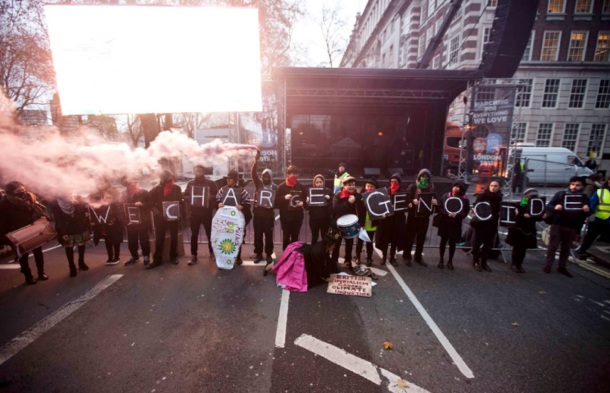
At various points during the march you called the police on us: first by complaining that the coffins we carried to commemorate the victims of environmental and climate genocide were a health hazard. Later, you called on them to kettle us during a brief die-in near BP’s headquarters so that the rest of the march could continue uninterrupted.

In case you missed it: you, the organisers of the climate march, called on the official agents of colonial and capitalist power to separate indigenous, black, and brown people from the march, portraying us as protesters against the march rather than frontline community members and soldiers for climate justice.

seperated bloc

Our peoples bear a long history of resisting colonial domination and erasure in all its forms. The banner that we held while leading the march read ‘Still fighting Co2onialism’, bearing testament not only to this long history but also to our treatment by the organisers of the march. The chants that were heard first as the march headed through the streets of the city were those charging genocide, and demanding decolonialisation as the only viable solution to climate change, ending with the traditional songs of the Sami people.

Your strategy of trying to erase us was continued well by the mainstream media, whose coverage made it appear as though we weren’t even there. You have since made no reference to your numerous and deliberate efforts to sabotage the bloc and deny our message. In fact, you have been trying to ignore us in the hope that our message will simply fizzle out, unworthy of mainstream attention.

All of this is just one of the many ways in which our communities are consistently erased as frontline fighters against climate change. Your attempts to replace the reality of the genocidal impacts of climate change on indigenous communities with bobbing animal-heads adds insult to injury – not because the protection of animals among all life forms is insignificant but because who other than frontline communities can better speak to the utter devastation of flora and fauna on their own lands.

We face an uphill battle in fighting climate change as part of the wider system that has created and enables it – capitalism and colonialism. But what happened at the London climate march is also a clear confirmation that the climate movement itself perpetuates these very oppressions.

The climate movement, in the UK and globally, will be decolonial or it will be nothing. That Sunday in London, the Indigenous communities and Wretched of the Earth bloc proved this: the first to die, the first to fight, the first to march.

we charge genocide

A movement that erases, silences and calls the police on frontline communities, those who do most of the dying and most of the resisting, is doomed to fail.

Those who seek to silence us must be held accountable – both, the executives at the top who tell their employees that the clash ‘never happened’, and their foot soldiers who pulled away the banner and tried to take down our placards.

We are angry, but we are not hopeless. We do not want saviours, we know how to fight. Accountability, therefore, does not imply an apology. Accountability is redress and just action. For too long we have been speaking, shouting and chanting, often to no avail. Your active silencing of dissenting indigenous and global south voices has contributed to yet another failed COP. But now, as one of our comrades has noted, we demand: ‘Listen when oppressed people speak’. In the lead-up to COP22 in Morocco, indigenous rights and human rights, as collective rights, must be at the forefront of any climate movement.

sami

To paraphrase Utah Phillips: The climate movement is not white, but it is being white-washed. Indigenous rights and racial justice are not a distraction. They are the heart of climate justice. There is no more time for your dirty games. The clock is ticking.


The Wretched of the Earth are: Algeria Solidarity Campaign, Argentina Solidarity Campaign, Black Dissidents, Colombia Solidarity Campaign, Environmental Justice North Africa, Global Afrikan People’s Parliament, Global Justice Forum, Indigenous Environmental Network, Kilombo U.K, London Mexico Solidarity, Movimiento Ecuador Reino Unido (MERU), Movimiento Jaguar Despierto, PARCOE, The London Latinxs, South Asia Solidarity Group, This Changes Everything UK. In solidarity: UK Tar Sands Network.

Posted in Campaign Update, Uncategorized | 3 Comments

MACF’s Uncertain Future- fails to bid for cash, Council cash slashed (?)

A group set up to advance Manchester’s climate goals has failed to even bid for money to keep itself afloat.  Meanwhile, it seems that the City Council, losing patience, has cut its support from two years to one…

Once upon a time Manchester City Council worked with “stakeholders” to create a Climate Change Action Plan.  This was back in the giddy days before the 2009 Copenhagen Climate conference.  A Plan was duly produced, that included a 41% reduction target in emissions for the whole city, and the creation of a ‘low carbon culture’ (neither is happening).  In order to mobilise the populace and stop the Plan from being seen as Just Another Council Edict, a ‘Steering Group’ was created.  Elections were to be held (they weren’t). Conferences were to be held (some crap ones were cobbled together, then that got cancelled).  Action Was To Happen – it didn’t.

The Steering Group, catchily known as the ‘MACF Stakeholder Steering Group’ never allowed anyone who wasn’t a member to attend, even to observe, #democracyfail.  The meetings were by all accounts tedious, demoralising and appallingly run.  So far, so predictable.  It quickly became apparent, even to its own membership that the Group had become a ‘stab vest’ – a nice way for the Council to be able to deflect questions about Manchester’s lack of progress towards any of its climate goals.

Fast-forward a few years – Earlier this year the MACF spun itself off as a ‘Community Interest Company’ (only one of those three words is accurate, given that nobody in the community is interested in MACF), and announced that it would be making bids to put itself on a ‘firm financial footing’. There was a big pot of European money they had their eye on, for example…

Well, informed sources tell MCFly that the Steering Group didn’t even submit a bid for it, to the dismay of people who helped them put together a (kind of) case.  Meanwhile, the City Council has apparently lost patience and has pulled the second of two years of financial support.

Intrigued, MCFly sent the steering group’s head the following

“I have heard from a couple of sources that
a) MACF did not submit a bid for European funding, and that the deadline has now passed.
b) Manchester City Council has cut the support from two years to one….
Did MACF submit a bid?  If not, why not, and where does it expect future funding to come from?
Did the Council cut funding? If so, what reasons did it give.”


1. As you correctly note MACF’s future will rely on gaining 3rd Party funding, so we’re currently spending a lot of time identifying bidding opportunities & preparing funding applications. Self-evidently part of this process is identifying opportunities where we think we might actually be successful rather than simply going after every available source of funding. Given that as a standalone entity MACF doesn’t have any track record of bidding for funding, our initial focus is bidding in partnership with other organisations who do have a successful track record of bidding to various funding bodies, including the EU.

2. There is an ongoing discussion with the Council about how they can best support MACF in its transition to becoming a standalone, independently funded entity. That being the case, I’d rather not comment on the specifics / ups & downs of that discussion at the moment.


On the first answer – well, that’s fascinating.  It raises the question of why after six years of ‘activity’ the MACF needs to band together with someone else to borrow their credibility to get some dosh.  It also raises the question of why those groups would be willing to share their credibility. I mean, (almost) everybody knows that MACF is a massive reputational risk.  Why chain yourself to a corpse, even if it is still sort of breathing?

On the second, well readers can probably read between the lines. MCFly has also sent a Freedom of Information Act request to the City Council, asking just how much money they poured into this worse-than-useless group in 2014 and 2015,  if they’ve partly pulled the plug, and if so, why.  [Why a FOIA? Because experience tells us that a straightforward requests that aren’t official and bureaucratic tend to ‘get lost’…]  When we know, we’ll let you know.
When the MACF Stakeholder Steering Group Community Interest Company (it takes you longer to say its name than it would to list its accomplishments over the last 6 years) does finally die, presumably some time in 2016, it will join other unlamented corpses in the graveyard of Manchester’s institutional response to climate change (‘Foundation’, the offset company, anyone).  Good riddance.

If and when there is a genuine ‘refresh’ in climate activity (and next year’s farcical ‘consultation’ does not count), hopefully people will learn some lessons about trust and verification. Meanwhile, the carbon accumulates, despite any fine Parisian palaver.


Posted in Manchester City Council, Steering Group | Leave a comment

What does #COP21 mean for #Manchester

James Hansen is the go-to guy for climate change. In 1981 his work put climate change on the front page of the New York Times.  In June 1988 he spoke out when other climate scientists were too cautious, too scared for their jobs, and said “It’s time to stop waffling so much and say that the evidence is pretty strong that the greenhouse effect is here.”

Here’s what he just said about Paris;

“It’s a fraud really, a fake,” he says, rubbing his head. “It’s just bullshit for them to say: ‘We’ll have a 2C warming target and then try to do a little better every five years.’ It’s just worthless words. There is no action, just promises. As long as fossil fuels appear to be the cheapest fuels out there, they will be continued to be burned.”

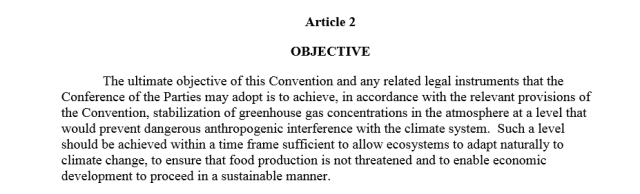
Look. There are some of us who need to be lied to, who need to believe the soothing words of our leaders.  Our leaders have been making promises about climate change since a meeting in March 1989 at the Hague.  They made more promises at the Second World Climate Conference in November 1990.  They made more promises at the 1992 “Earth Summit” – which agreed the following;

article2

They made more promises at Kyoto in 1997, more again in 2009 at Copenhagen.

All worthless words.

In Manchester, we have our own worthless words – the fine promises of the 2009 Manchester Climate Change Action Plan.  And the worthless words of a Council that promised it would have even 60 of its own councillors “carbon literate” by the end of 2014.  [And that in the context of the promise that 1 million people woul be ‘carbon literate’ by the end of 2013.]

And the worthless words of an Executive Member for the Environment who promised to start blogging, and then didn’t.

All worthless words.

Some of us need to believe, it seems.


A series of predictions for 2016

  • Generally, it will become harder to “mobilise” people now that fine promises have been made. Most people want/need to believe that our lords and masters are competent, are aware of the problems and are doing something about them.  The alternative – that we are slouching towards catastrophe as playthings of sociopaths- is too shocking, too horrible.
  • The established and new-ish groups will continue to pursue their information-deficit model of “mobilising” people.  They will retain only a small handful of those people who come to their meetings.  They will make no meaningful efforts to find out what skills their putative supporters/members have, what skills they would LIKE to have.  They will continue to organise boring top-down meetings that act as invisible filters, excluding all but the politicised, the students, and the middle-classes.
  • Manchester City Council will continue to paint itself as responsible and concerned.  It will stage a charade of a “consultation” and a “refresh” on the failed Manchester Climate Change Action Plan.  Many of those who participate will be ignorant of the roots of the Plan and the causes of its failure.  Shamefully, some of those who take part in the consultation and the circus around it will be strategically silent, since telling the truth is a crime in Manchester, and it would get them excluded from the circles that they think matter.

It doesn’t have to be this way, of course. We can rely on the Council to be unwilling to admit mistakes, or to learn from failure. That’s the nature of its bureaucratic and political ossification.

But the social movement organsiations could, in theory, be more brave, more nimble, more innovative. But they won’t be, for various reasons. Carpe the bloody diems.


UPDATE: THIS – COP-21-Paris-Climate-Conference-Summit

Posted in Manchester City Council, Signs of the Pending Ecological Debacle, Unsolicited advice | 7 Comments

Good questions about (after) sustainability

So, if there were a functioning climate movement in Manchester, it would, imho, be answering some of the questions in bold (scroll down if you want to see them).  But there isn’t. Ho-hum, #gladtobe45andchildfree.


Global Discourse special issue: ‘After sustainability – what?’
Call for Papers

Guest editor:
John Foster (j.foster@lancaster.ac.uk)

It is no longer completely out of court among thinkers and scholars concerned with environmental issues to argue that the ‘sustainability’ discourse and policy paradigm have failed, and that we are moving into a new era of much bleaker  prospects. A recent Policy Review paper in the journal Society and Natural Resources (Benson and Craig, 2014) is bluntly entitled ‘The End of Sustainability’. Authors as diverse as Clive Hamilton (2010),  Tim Mulgan (2011), Dale Jamieson (2014) and  John Foster (2015) write with the working assumption that climate change, on a scale lying unpredictably between the seriously disruptive and the catastrophic, is no longer something we must find ways of avoiding, but something we are going to have to live  with. Parallel to this recognition is the rise to prominence of the ‘anthropocene’ trope (e.g. Hamilton et al, 2015) with its defining acceptance that human beings have decisively altered the atmosphere and set in motion a mass extinction as drastic and now  inevitable as any produced by Earth-system changes over geological time.

Retrospectively, indeed, we can begin to see how impotent the sustainability model was always going to prove. Constraining immediate needs (or desires) to serve future needs, the anticipation, interpretation and measurement of which were  all to be carried out under pressure of the immediate needs and desires supposedly to be constrained, could never have offered anything but a toolkit of lead spanners, capable only of bending helplessly when any serious force was applied. No wonder we continue  to find the nuts and bolts of unsustainable living so stubbornly unshiftable.

What is then all the more striking is the complete lack of acknowledgement of this paradigm failure in mainstream political discourse. In the world of the United Nations and other international and national policy fora, less and less promising  prospects are met only by a more and more firmly fixed grin of willed optimism. The latest Monitoring Report for the EU’s Sustainable Development Strategy, for instance (Eurostat Press Office, 2015), claims that in respect of sustainable consumption and production,  demographic changes and greenhouse gas emissions, changes in headline indicators mark changes that are ‘clearly favourable’, although only willed optimism could celebrate the last of these without a glance in the direction of China or India. Meanwhile the upcoming (November-December 2015) UN Climate Change Conference in Paris (the twenty-first of these jamborees since the UN started  interesting itself in such matters) is touted, as all its predecessors since Copenhagen 2009 have been touted, as the really last last-chance saloon.

The nearest the official policy world comes to recognition that we actually won’t prevent (above all) unsustainable climate change, is in the increasing volume of talk about  ‘mitigation’ rather than prevention. But even here, denial is  plainly at work. How do you ‘mitigate’ the unavoidably tragic and disastrous? There is evidently some very serious cognitive disjuncture operating here.

This special issue of Global Discourse will seek to grapple with both the diagnosis and the prognosis of that disjuncture. We call for papers to explore a range of related questions, including:

*Where does widespread denial come from? How will it be overcome?

*What options for political and personal action will remain open in a radically degraded world? What are the conditions of habitability of such a world?

*How will economic and community life, political and social leadership and education be different in such a world?

*What will the geopolitics be? (What might what we now call a refugee ‘crisis’ look like when sub-Saharan Africa becomes uninhabitable? How could we deal with that? What is the role of defence and armaments – including nuclear armaments  – in such a world?)

*Are there any grounds for hope that don’t rest on denial?

References
Benson, M. and Craig, R. (2014) ‘The End of Sustainability’, Society and Natural Resources 27; 777-782 Eurostat Press Office (2015) ‘Is the European Union moving towards sustainable development?’ (News Release 148/2015, 1st September 2015) Foster, J. (2015) After Sustainability (Abingdon: Earthscan from Routledge) Hamilton, C. (2010) Requiem for a Species (London: Earthscan) Hamilton, C. et al. (eds.) (2015) The Anthropocene and the Global Environmental Crisis (Abingdon: Routledge) Jamieson, D. (2014) Reason in a Dark Time (Oxford: Oxford University Press) Mulgan, T. (2011) Ethics for a Broken World  (Durham: Acumen)

Submission instructions and deadlines
Abstracts of 400 words: 31st December 2015 Articles (solicited on the basis of review of abstracts): 1st May 2016
Publication: Early 2017

Instructions for authors
http://www.tandfonline.com/action/authorSubmission?journalCode=rgld20&page=instructions#.UX-WG8qSJHo
Please submit all abstracts and articles to the Guest Editor Further details:
http://www.tandfonline.com/rgld

Editor contact details: John Foster
(j.foster@lancaster.ac.uk)

Journal Aims and Scope
Global Discourse is an interdisciplinary, problem-oriented journal of applied contemporary thought operating at the intersection of politics, international relations, sociology and social policy. The journal’s  scope is broad, encouraging interrogation of current affairs with regard to core questions of distributive justice, wellbeing, cultural diversity, autonomy, sovereignty, security and recognition. Rejecting the notion that publication is the final stage in  the research process, Global Discourse seeks to foster discussion and debate between often artificially isolated disciplines and paradigms, with responses to articles encouraged and conversations continued across issues. The journal features a mix of  full-length articles, each accompanied by one or more replies, shorter essays, rapid replies, discussion pieces and book review symposia, typically consisting of three reviews and a reply by the author/s. With an international advisory editorial board consisting  of experienced, highly-cited academics, Global Discourse welcomes submissions from and on any region. Authors are encouraged to explore the international dimensions and implications of their work. With a mix of themed and general issues, symposia are  periodically deployed to examine topics as they emerge.

Posted in academia, Uncategorized | Leave a comment

Can the solutions for climate change help us fix poverty too?

Arwa Aburawa co-edited Manchester Climate Fortnightly from 2008 to 2010, and then Mancheste Climate Monthly from 2011 to mid-2013.

After that her career kinda went down hill, and she now scrapes a living as … a producer for Al Jazeera’s “Earthrise”.   She’s just produced a 25 minute programme called “Another Giant Leap: Can the solutions for climate change help us fix poverty too?”

You can see it by clicking on this link –
http://www.aljazeera.com/programmes/earthrise/2015/12/giant-leap-151202102017453.html

anothergiantleap

Can emerging economies across Asia and Africa lift hundreds of millions of people out of poverty in the next few decades without condemning the world to environmental destruction?
With more than 800 million people living in extreme poverty and many more struggling to make an honest living, it is clear that the current global economic model isn’t working for everyone. Economic growth often comes at the expense of the majority, with short-term financial gains trumping long-term sustainability. The current global obsession with economic growth, alongside the enormous over-consumption enjoyed by the wealthiest people on the planet, has brought us all to the brink of catastrophic climate change.
The global economy now sits at a crossroad.
For the first time in centuries, the global south is driving economic growth and societal change at a rate the United Nations says is “unprecedented in its speed and scale”. While the historic rise of emerging economies has improved the lives of millions, the equally rapid rise in emissions, with BRICS nations – Brazil, Russia, India, China, and South Africa – contributing around 40 percent of the world’s carbon emissions, is a path to disaster.
Earthrise presenter Ndoni Khanyile travels to Burkina Faso where farmers are embracing agroecology as a means of feeding the most vulnerable and visits villagers in Uttar Pradesh in India, who are turning to solar microgrids for energy.
Ndoni also meets leading figures such as Kumi Naidoo, the head of Greenpeace International, to talk about what’s really at stake for developing nations affected by climate change, and Jairam Ramesh, a leading economist, who insists that the environment cannot be sacrificed at the altar of economic growth.
What Ndoni discovers on this journey is that green alternatives to development do exist. This film asks if climate-change solutions used correctly could be a way to save the planet and redress inequality and poverty at the same time.

If you ever need the old unpaid job back, Arwa….

Posted in youtubes | Leave a comment

Fetish night at Bruntwood: sustainability gets VERY interesting. #Manchester #climate

Not that kind of fetish (sorry for the clickbaiting). I mean the original, anthropological meaning of “fetish” – a god that we create, then forget that we created as we come to worship it. That kind of fetish was being discussed tonight at the latest and best-I’ve-been-to meeting of the excellent “North West Sustainable Business Quarterly” meeting, held on the 24th story of Bruntwood’s City Tower (#greatviews).

The events are organised by Anthesis, hosted by Bruntwood, with scrumptious vegetarian and vegan food, locally-sourced where possible, by Good Mood Food an offshoot of the charity Manchester Mind. These evenings are free to attend and have lasted where others fell by the wayside simply because they always deliver reasonable-to-brilliant speakers and reasonable-to-brilliant discussion and networking opportunities. Now, back to the fetishes….

A chap called Mark Shayler got us thinking about where the ‘stuff’ in our offices comes from (and what our offices ARE these days, and the shrinking time from waking-to-screen (1), but I’ve digressed enough). He decided to hone in on one thing, that we all have – mobile devices, be they laptops, tablets or mobile phones. And what has made the miniaturization possible? Capacitors (think Random Access Memory, but for electricity). And what do you need to make capacitors? Columbite Tantalite (“Coltan”). And where does the coltan mostly come from? “The Democratic Republic of Congo” (“Zaire” to us fossils). And does the coltan come from nice regulated mines with a unionised workforce and health and safety inspectors? Not so much, no. Think dead gorillas and street kids who are lucky if they are big enough to wield an AK-47, because the other job prospects are even worse. So much I knew. But Shayler then went on to explain that far more than the official 14% of the world’s coltan comes from Congo – neighbouring Uganda and AngolaRwanda,  for example, export the stuff, without having any mines of their own. Anyway, from there it goes to Japan, for processing, along with coltan from North America and Australia. Then it turns into those capacitors (remember) in Taiwan, and from there goes to China to be put into the circuit boards of all the little devices we now have. And that’s when the transparency of it, such as it is, disappears, along with huge amounts of water that are needed to wash these products. (2) And then it finds its way onto the shelves of the great god “Consumers”, to be used for a year or three, or until it is unfashionable. And then, it sits forgotten in a drawer, or is ‘recycled’, earning the recycler moral absolution, at least in their own minds.

This is standard Global Value Chain/Network analysis (see this blog I did on tuna), but Shayler did it very well.

He talked within this about the perverse incentives within the Waste Electrical and Electronic Equipment recycling (doing it by weight is not so smart – the Japanese and Chinese do it better, it seems).

He then went on to talk about the huge growth of the Chinese middle-class (hundreds of millions) and the fact that the two things Britain does – design and money (i.e. financial engineering) are both eminently exportable. He made a plea (and yes, you can call it Corbynite social democratic fantasy-land if you like) for a Britain that makes stuff – he reeled of the names and achievements of relatives “now dead, along with the skills they had.”

In his talk he also gave a shout out to a chap who set up a charity called “Falling Whistles”. I defy you to read about that without getting a lump in your thoat.

Shayler closed out his talk with a frank admission that what we’ve been doing in terms of both production and consumption, and attempts to improve it, have been grossly inadequate, and that there are going to have to be some pretty fundamental changes, but that he- like anyone who’s honest- doesn’t have any road maps to get us to the sunny uplands.

Following him was a very very tall order. Somehow Tracey Rawling Church managed it, even when talking about something as ‘mundane’ as the ‘printer zoo’ (of companies with lots of different devices). She is the CSR lead for a business-to-business printer company called Kyocera, which was founded by a Japanese chap who is now a Buddhist monk. They’re moving away from selling the hardware to facilitating the exchange of information, and that’s where most of their revenue comes from these days (a fairly rapid 80/20 reversal in five years). Normally I’d fall asleep with my eyes open (and then snore) if someone used the phrase “servitised document environment”, but I find stories of companies that are big enough to survive, but nimble enough to adapt, quite fascinating (Alcoa under Paul O’Neill, for example). But she also didn’t pretend that a little efficiency nip and tuck here and there is an adequate response to the challenges we face…  Then it was over to (a slightly truncated) Q and A before discussions on tables and then networking/schmoozing.

Concepts readers of this blog might like to look into

Compulsory consumption

So, I got soaked cycling home. And the cat was angry with me for deserting it (I’m forgiven now of course). Was it worth it? I went for the food, thinking the talks would be mostly warmed-over ecological modernisation. I got a pleasant surprise tonight. Did both the speakers overrun? Yes. Normally that pisses me off, but the chair wisely let them run, even though it ate into the Q and A. Was it worth the soaking and the feline strop? Bloody hell yes.

Footnotes

  1. Today I was extolling the wonders of “Shut Up and Write” days to my two supervisors. They were both incredulous – ‘Isn’t every day shut up and write day?’ #oldskool #goodpoint

  2. On the subject of water – Saudi Arabia has finally stopped using its fossil aquifers for growing wheat. They might have clocked that’s not the smartest thing to have done, given what’s coming…

Posted in Event reports, Uncategorized | Tagged | 1 Comment