PMT #12: Hold the Date- Sat April 27th, 1pm to 5pm

Get yer diary/googlecalendar/scrap of paper out.
And put a big line through the afternoon of Saturday 27th April 2013.

From 1pm (plus travel time to the city centre) to 5pm you are going to be busy.

  • Already busy because of a wedding? Get the bride/groom and groom/bride to postpone it.
  • Already busy because of a funeral? Tell the Grim Reaper to sling his hook scythe.
  • Already busy because of City versus West Ham?  The. League. Is. Over.  Deal with it.

All will be revealed soon. It’s not illegal, immoral or fattening. But it IS good, and not to be missed.

pmtlogo

Posted in PMT | Tagged , | Leave a comment

Steering Group Elections; Statement versus official minutes #Manchester #climate

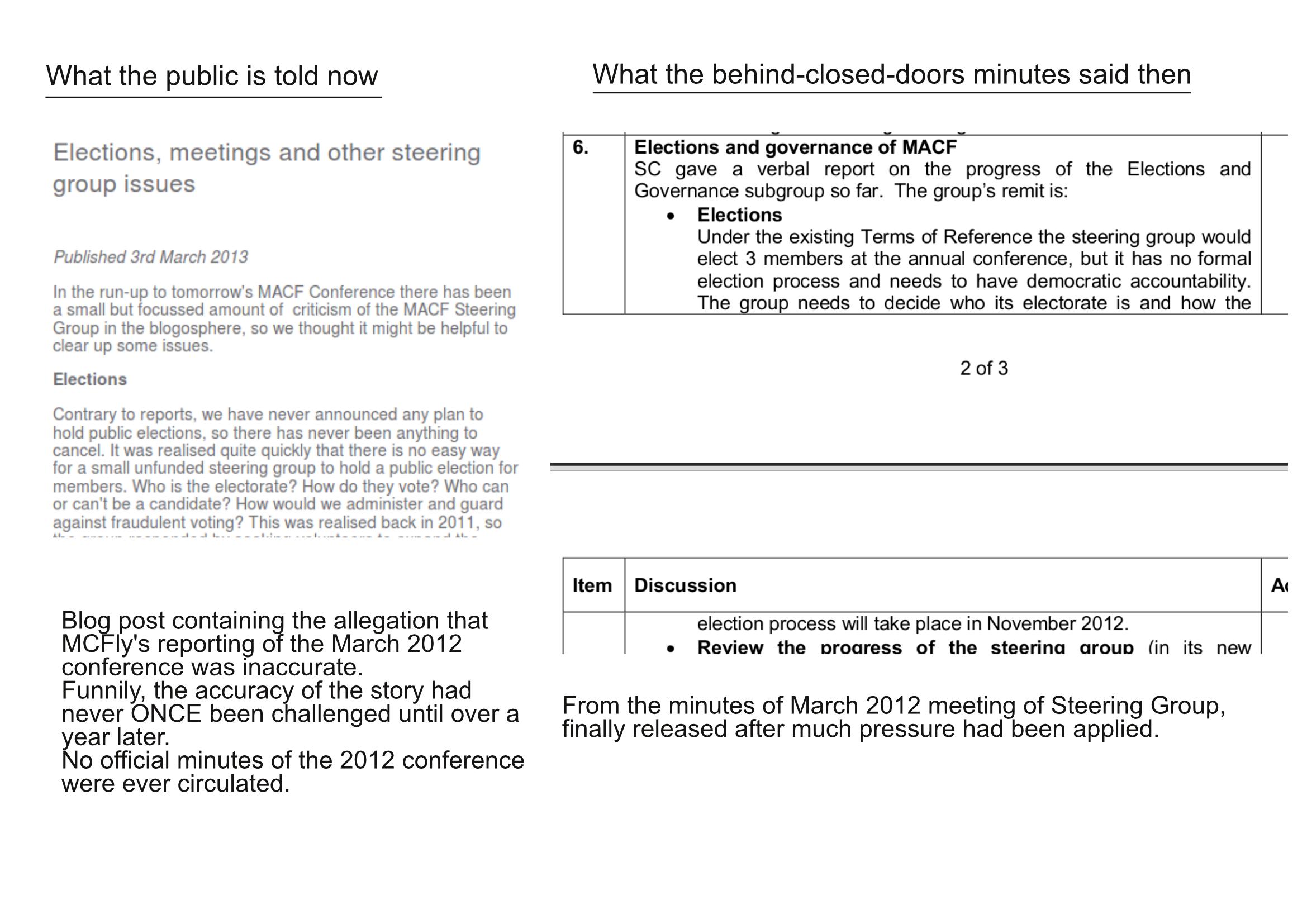
A public commitment was made to hold elections to the “Stakeholder” Steering Group on climate change, all the way back in March 2012.  Details were going to be released in November 2012, so elections could be held at the March 2013 conference.   MCFly reported it at the time.  Its report was not, for over a year, challenged.  The day before the 2013 conference, at which no elections were held, a statement (see below, left) was released. On the right you will see the official minutes of the group for March 2012.

minutes and elections-page001

For the benefit of anyone with too little time (or perhaps lacking other resources) to actually check the March 2012 minutes, here’s the rest of what was agreed.

Elections and governance of MACF
SC gave a verbal report on the progress of the Elections and Governance subgroup so far. The group’s remit is:
• Elections
Under the existing Terms of Reference the steering group would elect 3 members at the annual conference, but it has no formal election process and needs to have democratic accountability. The group needs to decide who its electorate is and how the
election process will take place in November 2012.
• Review the progress of the steering group (in its new expanded format)
There will be a review of the steering group in 6 months’ time, in order to give the new model a chance to establish.
• The reach of the steering group
What is the reach of the steering group and as part of this process, do members want to go down the route of establishing it as a legal entity?
• Terms of Reference
The conclusions of these discussions will then be set out in the updated terms of reference.
The subgroup will present a substantial report into this at the August steering group meeting.

Curiously, the August minutes – and subsequent meetings – have no such document or discussion. No updated Terms of Reference have appeared (or, if they have, they are very well hidden. They are not, for instance, where you’d expect them to be on the official website. )  They were never blogged, that’s for sure.

Simple question really – if a group can’t (won’t) even organise elections, why should anyone expect that it will ever do anything useful?

Marc Hudson
mcmonthly@gmail.com

Posted in Democratic deficit | Tagged | 1 Comment

Event Report: The Politics and Promise of Urban Food #Manchester #climate

Attention Conservation Notice: Detailed-ish account of who said what at last night’s Urban Forum event organised by the University of Manchester’s “Cities@Manchester“.
The tl;dr – some interesting things said, but to an unrepresentative audience, and with no attempt at galvanising people around some clear winnable goals.(1)

Andy Karvonen (2) of University of Manchester welcomed people and explained that the purpose of the Urban Forum is it to “have conversations” (3). Future forums are on Tues 30th April on Age-Friendly Cities and Tuesday 18th June on “Living Wages.” Both presumably at the International Anthony Burgess Foundation on Cambridge St. He handed over to the chair, Dr Carly McLachlan of the Tyndall Centre/Sustainable Consumption Institute, who moderated the discussion.

First up Debbie Ellen, an independent food researcher who works with Emerge.
She held up an onion and asked the audience if they knew what it was. Every hand went up. She then pointed out that participants on a “learn to cook” course hadn’t known. It was a useful reminder that the people in the room (about 45, all white, none in fuel poverty) were not representative of the wider population. Ms Ellen outlined some of the work that Fareshare is doing in partnership with other groups under the Real Food Wythenshawe project, around working with people in Wythenshawe around cooking, growing and eating food. She pointed out that Manchester is the fourth most deprived authority in the country (2010 indices of multiple levels of deprivation study), and offered horrifying statistics on childhood obesity in Baguley – 16.9% at reception, 28% by year 6.
For many people, she said, there’s a choice between staying warm and putting food on the table, a choice that will get harder after the benefits changes come into effect in April.
She found out that everyone in the room had a cooker, with many having a microwave. She pointed out that that many houses just have a microwave – and that many people (none in the audience) have prepayment electricity meters, compounding their limited choices.
The work that Real Food Wythenshawe will be doing over its five year life-cycle is to increase the amount of food grown, but also give people the skills to know what to do with the food that they grow.

Next up was Liz Postlethwaite. She pointed out that global population is soaring, and resources becoming scarcer. Meanwhile the three main political parties want do just keep growing (the economy), but more and more individuals and communities are thinking of innovating and (hopefully) avoiding a “Mad Max apocalypse”
Ms Postlethwaite’s main theme was on how growing food re-invigorates individuals and communities, “linking people to place and process, giving them a different understanding of time and space.” [See John Berger’s essay “Why Look at Animals” [pdf] for another example of this argument.]
She gave the example – perhaps not a popular one with the GMLEP and Chamber of Commerce – of Detroit, with its “abundant and connected spaces”.
She advocated that cities become “more circular, less linear” (in their conception of resource throughputs), Her hope was that policy makers could embrace the learning of community groups to support shared aspirations around food growing and community cohesion, and support them in what they are doing.

Graeme Sheriff of the University of Manchester asked if food was just another product, or something more. He referenced Professor Tim Lang‘s distinction between the “productionist” paradigm (domination of nature, genetic modification, the life sciences) and the “ecologically integrated” approach (paying attention to limits, citizens rather than consumers) and offered up four benefits from urban food growing

  • It offers the opportunity to rein in the global supply chain impacts
  • Improves access to food in “food deserts”
  • Reconnects and engages people and communities, increasing their willingness to engage in political processes (here he mentioned a successful effort by people in Brighton to get their council to produce a policy statement on Urban Food)
  • Improves the city.

He said that a national “Local Food Funding evaluation” had found that while the direct benefits around the first two of these were modest, the third and fourth [harder to measure?!] show wider impovements. He finished with a question – are we talking about feeding the city, or equipping the city to deal with food?

Lastly Chris Walsh of Kindling Trust (see MCFly’s passim). Kindling, which is mostly involved in “peri-urban growing” (within 25 miles of the city) has its fingers in many pies (ho ho), including the Big Dig, the Land Army, and a supporting role with Manchester Veg People.
He pointed out that there are many policy documents about city resilience that talk about solar panels and trams, but there’s rarely a mention of Cheshire (as a food-growing area) or even food production per se.
Mr Walsh said that there are indeed many good things about urban food growing, but there are better ways of growing food. Urban food growing faces many challenges – vandalism, apathy, politics, money, bureaucracy, polluted land to name but a few, with the carbon savings of window boxes and small growing sites being ambiguous at best. The barriers are formidable and “two years down the line the people are not there who started up.”
Mr Walsh said “We need an ambition and urgency that isn’t happening.” That’s for sure!

As ever, the Question and Answer session went to the people most confident in asking questions.  (Rather than getting an exhortation to overcome their fear, people could have been offered the chance to turn to someone else and have a minute to find out if the question they were thinking of asking was a good one, or could be refined or improved. ) Manfully overcoming crippling social anxiety and terror at public speaking, MCFly put to the panellists the question of – if they were the leader of AGMA for a day and could push through one change that would “stick” – what would it be?
Three panellists responded – Debbie Ellen said “an integrated approach to procurement across Greater Manchester. This would support the local food economy, increase jobs and increase resilience. We are supposed to have it already” [but it is piecemeal].

Graeme Sheriff said “A Greater Manchester strategy that joined up things, with education, the local food economy, transport (not just trams and buses, but the ability of older people to get across the street to the shops). And teeth when it came to relationships with supermarkets and takeaways.”

Chris Walsh agreed with these and advocated that public sector organisations buy local organic in-season food.

In response to a different question (on how to pay the workers growing the food in Manchester a living wage when consumers expect super-cheap food), Liz Postlethwaite made the important point that “we are living in a bubble that won’t last” – she cited an article she’d read about the “food tsunami” that is approaching (thanks to rising fuel prices, changing weather patterns etc etc.)

Other questions were on topics like the amount of contamination of brownfield sites (you wouldn’t want to eat veggies grown on land that used to be a car workshop, would you?), the opportunities that Manchester has – workforce, young people raring to go greenbelt land, the Food for Life partnership (a Good Thing), and whether there are follow-ups to see what skills have been retained after “learn to cook” classes. An excellent point, also, was made in passing – if you can get 2000 “empty” calories for 30p, then even if you know how to cook, you aren’t going to spend a pound on 300 calories of real food.

MCFly verdict: this was a significant improvement on the June 2012 Urban Forum on “sustainability”. True, the meeting was entirely white, seemingly entirely middle-class (I did a straw poll – only a couple of people in the room were living in fuel poverty. I didn’t ask about university education). That doesn’t mean it is invalid of course – many meetings hosted by MCFly (and the old “Manchester Climate Forum”) were/are just the same. But we shouldn’t ever kid ourselves that the “forums” we hold are going to hear from all voices, and you kind of hope that in future the event organisers ask people who are coming to perhaps bring someone who is directly and immediately affected by the issues being discussed. It’s a very tricky business though, for sure.

Footnotes

(1) I know, I know. I am asking a saw to drive a nail/complaining about the lack of car-chases in Proust novels.  This event was about (3).

(2) Mr Karvonen, whose book we reviewed here, did not mention he is a member of the Stakeholder Steering Group. But to be fair, other members of the panel made the same choice. Were I on the Steering Group, I would make that choice, on the basis that membership would be a reputational risk.

(3) A couple of years ago the way that academics are judged changed. It used to be simply down to which articles you could get published in which “high impact” (cough cough) journals. Now it’s about the “impact” you have on policy-makers and the “engagement” you do with “stakeholders.”

Posted in Event reports, Food | Tagged , , , , , | 1 Comment

Stop Kidding – Adopt (A Council Scrutiny Committee)

Malnourished and neglected, at risk of a complete loss of their status and usefulness. This poor beast gets minimal sunlight from the MEN and others. YOU can help. With just one hour per month, you can help put this lumbering creature back on its feet and on the path to recovery. With three hours per month of your time, you could transform its entire existence. Don’t delay – contact our direct democracy line now to adopt a Manchester Council Scrunity Committee and help reinvograte democracy.

You can help by educating and scrutinising councillors. There are currently six scrunity committees looking at communities, economy, health, neighbourhoods, finance and young people. They are all equally cute and cuddly (not at all that is) and are in desperate need of an intervention by clued up citizens who want to help them to engage on the climate change agenda.

Our Mission: Currently, climate change campaigner involvement with Manchester City Council’s six scrutiny committees is extremely haphazard. There has been intermittent involvement with the Economy Scrutiny Committee since November 2010 and with the Neighbourhoods Scrutiny Committee since late 2011. Councillors are not lobbied/educated about climate change in any systematic way. So, our mission is to use the current interest in climate change within the council to change the situation so that by mid 2013 every Scrutiny Committee has been adopted by campaigners who are highlighting the importance of climate change to their agenda, inviting stakeholders to the meetings and opening up the council to more scrutiny.

What The Adoption Involves?

Basic Package: Keep track of what the agenda is for the next meeting (have a google alert) and alert other groups to the existence of specific items, especially “environmental ones”. Attend the monthly meetings (if you can – or organise at least one person to be there) – report on it at some level, formally and informally. If you did not attend, find out from either an officer or a councillor what happened and inform others of interesting developments.

Luxury Package: You would keep tabs on the forward plan, lobbying to put items on the agenda. Co-ordinate extensive lobbying of councillors about specific issues. Blog posts critiquing specific reports, highlighting the silences and assumptions and also a careful reading of the official minutes, compared to notes taken at the time. Attend the meetings, live tweeting, instant blog posts and create a database of which councillors are particularly passionate about which issues. Commission/write reports that are then submitted to the committee for discussion, working into the policy context etc.

In exchange for your hard work and dedication to this endangered creature, you will receive:
* Spotters cards so you know who’s who
* Basic explainer, with glossary, of what the committee is all about
* Calendar of when the different groups are meeting etc
* White t-shirts with “Saving Democracy. Ask me how.”
Email mcmonthly@gmail.com with the specific scrutiny committee you are interested in saving and we will be in touch.
Please don’t delay.

Posted in Democratic deficit, Manchester City Council | Tagged | Leave a comment

#Manchester #climate nuggets March 18th 2013

Hi all,

if you ever want to get involved in the many positive things (or the occasional “negative” one) that we do/report on, you know where to find us, doncha?  mcmonthly@gmail.com

And one of us will be at the Carbon Coop AGM tonight, at the wonderful Madlab, in the Northern Quarter. Don’t be a stranger!

Arwa Aburawa and Marc Hudson

Coming up this week

Mon 4pm The Sustainability of Bio-energy seminar at University of Manchester details

Monday 18th, 6.15pm-8.15pm The Carbon Co-op AGM at MadLab, 36-40 Edge Street, Manchester M4 1HN
The AGM is open to members and non-members and will include an update on Carbon Co-op’s work to date as well as an opportunity to get involved in future projects.
Note that during the relevant segments of the AGM, only full members are eligible to vote. To attend RSVP via the event page: http://carboncoopagm.eventbrite.com/

Monday 18, 7:00pm start Fracking: a technological innovation too far?

Tuesday March 19th, 10.30-13.00 Manchester City Council Environmental Strategy Programme Board meeting.Room 1.10 One First Street Open to the public? I’m sorry, you must have mistaken this Local Authority for one that is genuinely interested in transparency and democratic engagement!

Tues 19th, 6pm Feeding the City: The Politics & Promise of Urban Food Urban Forum, International Anthony Burgess Foundation

Thurs 21st Despite the Cuts conference on Keep Britain Tidy.

Thursday 21st, 7pm ,Fuelling Manchester social, 7pm onwards @ The Black Lion, Salford. Fuelling Manchester is the ninth networking session for community renewables in Greater Manchester.  This is purely a social event, there will be no agenda and no structure just an opportunity to meet with like-minded individuals to chat, discuss and network.  Run by theCarbon Co-op in collaboration with the Kindling Trust.

Who for: Anyone involved in community renewable projects, including: water turbine co-operatives; bio-mass and woodland management enterprises; waste-to-energy projects and solar energy collectives. Directions: The Black Lion, 65 Chapel St, Salford, Lancashire M3 5BZ It’s within walking distance of Manchester Victoria or Salford Central train stations or Manchester City Centre. To book: if you would like food, please book in advance (info@communityrenewables.org.uk) otherwise just turn up or tweet us @carboncoop.

Friday 22nd, 9 to 2pm  BME and climate change conference in Manchester

Friday 22 Friends of the Earth meeting ‘Energy We Can All Afford’, Cheadle Hulme Methodist Church with local MP Mark Hunter, Donna Hume from national FoE and Lucie Newsam of Age UK Stockport on the panel.

Stories you may have missed on the MCFly website

National

One third of ministers in the UK government, including top cabinet ministers, are linked to the UK finance and energy companies fuelling climate change, a new report from the World Development Movement revealed on Mon 11th March.

Things to read while the algae grows on your fur

Carbon emissions blow right past financial crisis

Top military officer: Climate Change biggest threat to security

Posted in Weekly bulletins | Leave a comment

Polar Bear Facepalm: Climate change off the curriculum, or “Species sticks fingers in ears, says LA-LA-LA”

polarbearstupidiswinning

The quote comes from the start of this article on the Guardian website.

Hat-tip to Manchester Friends of the Earth‘s weekly digest. You can (and should!)  subscribe for free here.

Posted in education, humour | Tagged | 3 Comments

Event report: #Climate Week’s Carbon Active Activities with MEEN at #Manchester Arndale Centre

As a recent Manchester Environmental Education Network volunteer ( MEEN for short) I had heard of pupils’ enthusiasm and of their great ideas to get the message across, but this was my first encounter with the real thing.

Our Carbon Classroom was held all day Thursday and Friday on the first floor of Hallé Square and was a great success! Shoppers and passers-by were able to take part in a wide and creative range of games and activities that each of the six participating schools had designed themselves:

– a recycling sorting game,
– a lazy-o-meter measuring carbon impact,
– questionnaires about people’s behaviour,
– fantastic presentations on the effects of global warming,
– displays showing polar bears in trouble because of melting ice,
– spot the greenhouse gas emitters games,
– a poll about whether supermarkets should have fridges with doors
– a “swap shop” where the contents of your shopping basket was analysed and you were given advice on changing shopping habits to lower your carbon footprint…

You name it, we did it!
Attendees signed personal pledges and left with smiles on their faces, having learnt something new from our green ambassadors. The eagerness to talk to people and discuss the issues was obvious, although we all found it very difficult to engage the public at all. Some people only had a minute, others were clearly not interested, but still we persevered and I reckon over 150 people took part in one form or another, even the Energy & Climate Change Minister, Baroness Verma!

Pupils were also able to take part in the other activities of the day provided by other groups involved in the Carbon Literacy Project: powering a hi-fi by pedalling bikes, searching for root vegetables in a mini- garden, looking for worms in compost (not with bare hands, let me reassure you!!), making mini paper pots to plant seeds in, answering a quiz on low carbon housing, playing a giant board game invented by pupils at St Peter’s RC High School, checking out the carbon footprint of various foods, designing reusable shopping bags etc.

Above all I was personally impressed with all the pupils who made such an effort, were very engaged and knowledgeable, very well behaved and polite to everyone. Well done Heald Place Primary School, Armitage CofE Primary School, St Philip’s CofE Primary School, Abraham Moss High School, Crumpsall Lane Primary School and Levenshulme High School!

Laurence Menhinick

lowcarbonswapshop

Photo reproduced with permission from MEEN

Posted in education, Event reports | Tagged | Leave a comment

Crosspost: June as “Manchester Bike Month”? Seems like a good idea to us…

This below is a repost from Mad Cycle Lanes of Manchester.

Lots of things came out of the recent Manchester Cycle Forum including news that the Oxford Road Bus Priority consultation is now likely to be delayed till May as new details are drawn up.

However, this post is about the reaction I got to the news that there will be a cycling entry into the Manchester Day Parade on Sunday 2nd June. Cllr Kate Chappell who was chairing, suggested that, instead of just having Bike Week, Manchester should make June Manchester Bike Month.

Now, this can only work if lots of people are organising events, and whilst people have been talking about a Velo Fest and Bike Week, I have yet to see any dates for events confirmed. It would be good to coordinate all the disparate cycling groups in Manchester and pull together a really big bike festival.

So, to get the ball rolling, I’m going to make this page an unofficial diary for Manchester Bike Week/Month.

Please post comments here with details of your event, with web page links if you’ve got them. I will add the event to this page and this will also help compile a diary for the next eddition of GMCC News which I edit.

—————-

Sunday 2nd June

Manchester Day Parade – Bike Parade

Friday 7th – Saturday 15th June

NW Velofest from The Spokes

Friday 14th June

1700 All Saints Park – Manchester Naked Bike Ride

Saturday 15th June – Sunday 23rd June

Bike Week

Friday 28th June

Meet 6pm, Central Library – Manchester Critical Mass

Posted in Transport | Tagged | Leave a comment

Upcoming Event: The Sustainability of Bioenergy #manchester #climate Mon 18 March

Monday 18th March 2013
4pm to 5pm
C 5.1 Ellen Wilkinson Building

By Dr Patricia Thornley, Tyndall Centre for Climate Change Research, University of Manchester

Bioenergy has a significant role to play as part of the UK’s renewable energy future.  This presentation will consider different types of bioenergy systems (for heat, electricity and transport fuel) and examine whether or not renewable bioenergy can also be considered to be sustainable when we take into account not only the environmental, but also the social and economic dimensions of sustainability.

Biography:
Patricia Thornley is a chartered physicist with 20 years experience working in bioenergy projects in industry and academia.  She is director of the UK’s £4.5M EPSRC funded SUPERGEN Bioenergy project, which aims to bring together industry, academia and other stakeholders to focus on the challenges of developing sustainable bioenergy solutions for the UK. She is based at the Tyndall Centre for Climate Change Research at the University of Manchester and her research interests are in evaluating the environmental, social and economic impacts of bioenergy implementation, but she has particular expertise in life cycle assessment of greenhouse gas emissions and energy policy development.

All welcome

Posted in academia, Energy, Upcoming Events | Tagged | Leave a comment

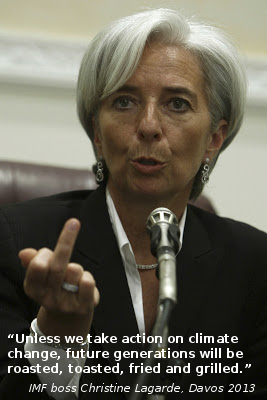
IMF boss Christine Lagarde gives future generations the finger

IMF boss Christine Lagarde was at Davos for the World Economic Forum this year.  In a q and a session she was asked about climate change implications.  She said…

christine-lagarde

Posted in humour, International | Tagged , | Leave a comment