The Energy Academy – what is it, how to get involved…

Simon Robinson of Action for Sustainable Living answers MCFly’s questions about the “Energy Academy”

What is the Energy Academy?
The aim of the Energy Academy programme is train, enthuse and support housing staff and tenants in domestic energy behavioural change, to reduce energy use and save tenants money. It has grown from an initial £10k grant from Manchester City Council working with two housing associations, to a £110k programme that has worked with around 8 housing sector organisations.

Our aim to develop capacity of organisations and residents to cascade the energy saving message to others within the community.
We’ve recruited and trained around 15-20 freelance staff to help deliver this work, providing employment to local people.
We utilise the communications materials developed for the multi-award winning RELISH project (www.relish.org) and are the UK’s first RELISH approved adopter.

What have been its concrete achievements so far?
Our main achievements have been in finding some wonderful tenants and residents who are keen to volunteer to help their friends, family and neighbours in saving energy and money. In addition to behavioural changes many tenants have also explored switching energy supplier which has saved them significant amounts on money.
We’ve trained around 30 staff and 100’s of tenants who’ve spread the message to 100’s more

What have the major challenges been?
Engaging tenants and residents on energy saving is often the poor relation of building refurbishment and improvements to infrastructure, and often ends up as an afterthought in many regeneration programmes. The result is that householders often don’t change their energy behaviour and don’t get the best out of their newly refurbished homes.
A major challenge for regeneration programmes is to recognise this at procurement stage, and reserve some money to inform and educate tenants in a meaningful way as part of the overall programme. A leaflet or energy guide achieves little with practical support.
We’re also been reminded of the challenge of bad weather and football fixtures affecting participation, as well as the need to keep paperwork to a minimum for volunteers!

What unexpected things have happened?
Its always a pleasant surprise to find staff and tenants who want to go the extra mile in helping us to assist those most in need.

What next for the project?

We’re exploring options to market Energy Academy services to a wider range of clients. We see that demand for energy saving services are likely to increase in the wake of forthcoming national changes to the benefits system. Its predicted that these benefits changes, combined with increasing energy prices, will lead to greater fuel poverty.
If AfSL can play a small part in helping those most in need, and reduce carbon emissions, then the Energy Academy will have done its job.

If people want to get involved, how can they, and what sorts of things would they be doing?
Anyone who wants to make simple changes at home to save energy and money can download our Residents’ Energy Guide from http://www.afsl.org.uk/energyacademy
We also can make use of volunteers on the Energy Academy and other projects through our new E-Team. Anyone can register on-line on www.afsl.org.uk/get-involved/volunteer/

DISCLAIMER: AfSL are acting as guinea-pigs for a MCFly project called “Activist Skills and Knowledge“, and this may have made us (subconsciously) duck asking tricky questions. If you’ve got questions for Mr Robinson, you can send them to him direct, or come to us and we will unpack the thumbscrews.

Posted in Uncategorized | Tagged | Leave a comment

Steady State #Manchester report to be launched Tuesday 20th November @ the Mechanics Institute

A report by the   group, entitled “Beyond Growth”  will be launched on the evening of Tuesday 20th November at the Mechanics Institute (103 Princess Rd).  Portions of the report, which looks at the steps Manchester needs to take in the coming years to move towards prosperity, justice and climate safety, will be available for comment in the coming weeks on the steadystatemanchester.net website.

More details to follow, but please put the date in your diaries!

Posted in Upcoming Events | Leave a comment

Youtube: #Manchester Friends of the Earth meeting October 2012

Short video about Manchester Friends of the Earth‘s regular meetings. Done largely as an experiment to see how quickly you could make a film about an event. There’s a lot still to be learnt, about things like lighting, angles and all that malarkey.
PS I’m getting a tripod. Only Paul Greengrass can do shaky-cam well!

Posted in Campaign Update, Event reports | Tagged | Leave a comment

Event Report: “Good for Nothing”

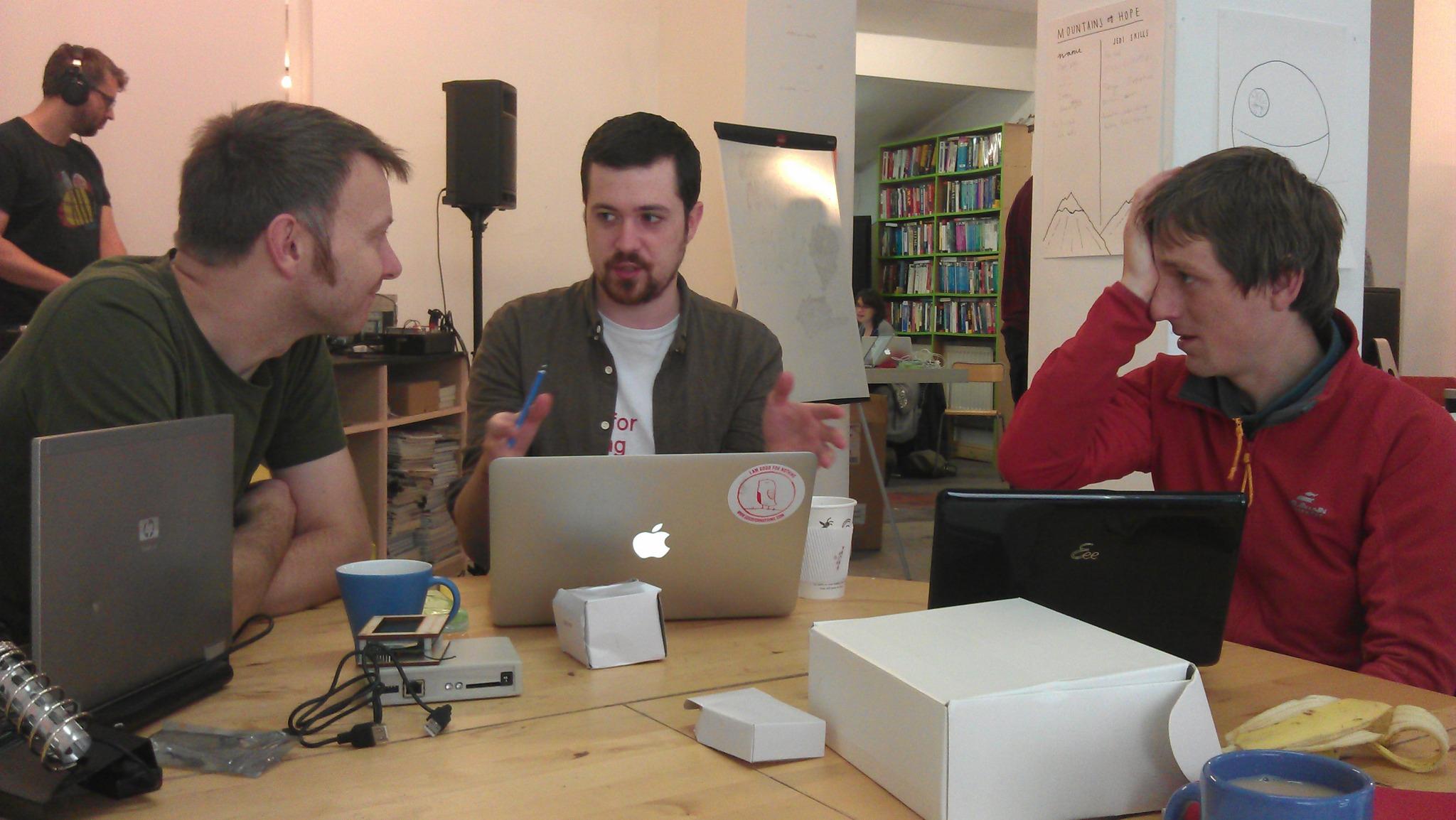
MCFly reader Jonathan Atkinson explains how Carbon Co-op got pro bono help from techies last weekend at “Madlab”. (Reposted, with permission, from here.)

Carbon Co-op were lucky enough to be one of the good causes selected for the first Good for Nothing in the North at MadLab over the weekend of 6/7th October 2012.
Blog post by Carbon Co-op project manager, Jonathan Atkinson (@lowwintersun)

The idea behind Good for Nothing is a simple one, get a whole heap of professional creatives: graphic designers, web coders, technicians and PR types in a room for a weekend and get them to devote their time, skills and expertise towards fulfilling the marketing needs of three good causes. For free. It’s been around for a number of years in London and the events regularly attract upwards of a hundred people, on the back of that they’re moving up north.

The event is curated by designer Loz Ives, coder Andy Gott and eco-designer Mark Shayler. As much as possible everything is blagged or donated, hence our weekend is fuelled by complementary Yorkshire tea, a Unicorn Grocery fruit hamper and the largest array of Tunnock’s confectionery I have ever or will ever seen – Tunnock’s products I never knew existed or were even technically possible. Proceedings take place at MadLab, a truly unique space in Manchester and ideally suited to this weekend.

FRIDAY EVENING: In 10 minute presentations we pitch our good causes to assembled marketing professionals who will choose which group to volunteer for. The other projects are Mountains of Hope, an outward bound project for disadvantaged kids and Signposts, a Manchester-based charity. Carbon Co-op are after coders to help us develop an open source energy monitor and designers to do some t-shirts and posters.

Charlie presents

19:45 The Carbon Co-op pitch is kicked off with a classic Charlie Baker presentation. Onlookers are visibly shocked/impressed at his ability to talk so quickly and yet still cover highly technical subjects and make sense. It does the trick and we get plenty of help including a coder and a game designer.

20:00 The pitches are followed by a social fuelled by complimentary Becks and the inevitable Tunnock’s.

SATURDAY

09.00 Everyone arrives, assembles and starts…

GfN

10.15 Team Carbon Co-op arrive fashionably late, burdened as we are with a severe Tunnock’s hangovers, assembled creatives are already hard at work on the three briefs.

11.00 Matt Fawcett of Carbon Co-op and Tristan Lea of Open Energy Monitors have set up a soldering station on our table. Tristan’s kit is simplicity itself, a basic circuit board on to which various bits of monitoring kit can be added as appropriate, electricity use, temperature, CO2 concentration (to measure air tightness/drafts) and humidity.

Energy Monitors

12.00 I chat to Jana Wendler, a PhD student examining utopian urban spaces. She has a side interest in gaming and play and we discuss ideas around energy usage. The basic problem is that people get quickly bored of energy monitors once the novelty wears off. Gaming, setting challenges and competitions, would be a way to keep people interested and engaged with their energy use.

13.20 We are joined from Pete, a graphic design student from Stockport, he churns out some great poster ideas though as he has just started his course he is sadly unable to take them past the concept stage – thanks anyway Pete!

13.30 Lunch and the GfN boys have laid on a spread of chilli and wraps, excellent, very filling, room for a Tunnock’s though?

14.00 Activity grows fevered as our team plot the integration of an energy monitor dashboard in the Carbon Co-op website, if only I knew what they were on about.

GFN

15.00 Day 1 presentation time: lots of ‘ooohs’ and ‘aaahs’ from the audience as we demonstrate live monitoring of temperature, humidity and electricity usage from MadLab. Some furrowed brows as an ethical dilemma arises, the GfN tea urn is consuming nearly as much energy as the creatives’ MacBook laptops and charging iPhones combined. Moral arguments ensue but the killer blow comes with, “without tea, what would we drink with our Tunnock’s?” No agreeable answer comes and the urns stay on.

16.00 Slightly fried by a day of coding and Tunnock’s, assembled creatives stumble home. I head to the Manchester Arena to see Radiohead who make complex and eloquent songs about the fact we are all completely stuffed – an excellent show, worth every penny!


SUNDAY

11.15 The Good for Nothing team have assured me that my technical skills are so precious and in demand that I should have a lie in and come in a bit later. As I arrive Team Carbon Co-op have already been at the grind stone for 2 hours. Somehow they have coped without me.

12.00 More coding, more soldering, more scribbling on flip chart paper.

12.15 A breakthrough as our VPN test server successfully integrates with the Open Energy Monitor dashboard. Yes I cry!

12.30 I’m taken aside (ie away from the important people and their important work) and given a consultation with Mark Shayler, a guy who makes his living advising corporates on sustainability issues. It’s great to get an outside perspective on Carbon Co-op messaging from a professional and Mark even works up a quick model presentation highlighting some key communication points.

13.00 Mark also helps us by recording a couple of quick videos with our coders and technical team. It’s fascinating to see the geeks struggle to articulate ideas and actions in colloquial verbal English rather than their usual text, IM and email.

13.30 More lunch, more chilli. The Mountains of Hope guy proffers a bucket of Tunnock’s, “You know you want to.” he says. I say no to Tunnock’s for the first time this weekend.

14.00 We’ve attracted more graphic designers and are having a go at some t-shirts and more posters as well as a swish new version of the energy monitor dashboard.

15.35 The big show and tell. Everyone who’s been working over the weekend assembles and we take a look at the work. Mountains of Hope have a a great new website with a hand drawn logo and Signposts have a 5 minute video presentation showcasing their work. Carbon Co-op have the building blocks for a revolutionary open energy monitor system that will allow our members to understand exactly how their houses operate and track the effect of any change and improvements they implement. Not only that but we have some gaming and challenge ideas, a new presentation and a new take on Carbon Co-op and a range of new t-shirt and poster ideas.

END OF THE WEEKEND: Good for Nothing is a great opportunity for good causes to get the kind of marketing and technical expertise that would ordinarily cost thousands of pounds. It’s not just the design work and websites you get at the end but the ideas and advice that spring from the conversations throughout the two days.

They’re planning to do another weekend in January and have a social before Christmas and I’d highly recommend you get involved, whether you’re a creative who wants to do some positive pro-bono work or a a good cause looking for some expert help.

If nothing else it’s worth it for the Tunnock’s.

Tunnocks

Posted in Event reports, inspire | Tagged , , , | Leave a comment

Upcoming Event: Breakfast at Rylands – Planes Trains and Bicycles. Tues 23rd October

This looks potentially interesting – you can book your ticket here.

Breakfast at Rylands
Sustainability, coffee, discussion.
PLANES, TRAINS AND BICYCLES.

As part of the University of Manchester’s Knowledge Exchange Hub for Environmental Sustainability, we are hosting a series of cafe events – Breakfast at Rylands. Through discussion and debate we will highlight some of the key knowledge assets and research projects related to environmental sustainability and identify some innovative solutions to the key sustainability challenges faced by city partners and others.

It’s all about the journey. As a £9 billion investment in transport infrastructure is unveiled, both as a solution for economic stimulus and as a route towards more sustainable mobility, what will transport in Britain look like in 2030 and what can current trends tell us about the way we’ll choose to move around in the future?

During 60 minutes of discussion and provocation we’ll aim to cover:

  • the continued extension of light rail systems like the Metrolink
  • Greater Manchester’s £32 million sustainable transport fund
  • the continued growth of commuter cycling
  • the transition to electric vehicles
  • plans for a Northern transport ‘hub’
  • …and, of course, the critical question of whether air transport has any place in a sustainable transport future.

Speakers:

Dr James Evans, Senior Lecturer, School of Environment and Development
David Hytch, Information Systems Director, Transport for Greater Manchester
Stephen O’Malley, Director, Stockley
Pete Abel, Love Your Bike

Programme:
8am – Arrival and breakfast
8.30 – Introductions
8.35 – Provocations
9.00 – Discussion
9.30 – Close

Posted in Transport, Upcoming Events | Leave a comment

Youtube: Dr Alice Bows talks about the ‘What’s Cooking’ report

Short video starring Dr Alice Bows of the Sustainable Consumption Institute, ahead of the presentation she gave at tonight’s Friends of the Earth meeting.

Posted in academia, youtubes | Tagged , , | Leave a comment

Platt-itudes from #Manchester City Council?

I think we can all agree that there is nothing like good firework display and a pipping hot portion of chips to enjoy Bonfire night in a windy park. However, there is a price that comes with hosting big events – one that the park itself actually pays.
In Manchester, Bonfire night events are usually held at Platt Fields park but this year the Coalition for Platt Fields Park have called a moratorium on all events and asked the Bonfire night event to be cancelled. Why? The Coalition says the park is in desperate need of time to recover from over-use which has left its show fields unable to soak up water.

“The whole of the show field has got so impacted over the last few years that it is like a non-porous clay container, no water can go through – most of the show field is now small lakes,” explains Anne Tucker, Honorary Treasurer and Volunteer Co-ordinator at Friends of Platt Fields Park. “Till the park has had some time to recover (and is effectively aerated again so as to play a part in flood control) there are so many other parks that bonfire night can take place in.”

Manchester City Council, however, say that they won’t be cancelling the Bonfire Night events at Platt Fields. Councillor Rosa Battle, Executive Member for Culture and Leisure, said: “The bonfire night event at Platt Fields Park is enjoyed by tens of thousands of people every November and there is no reason why this year should be any different. The park is in a satisfactory condition to hold this much-loved annual community event which supports our strategy of providing Manchester residents with safe, free and family-friendly displays to prevent them organising their own with the associated risks of injury and nuisance.”

The popularity of the event, however, is one of the reasons Anne Tucker states it needs to cancelled at Platt Fields and arranged at another location. “Despite the devastation wreaked on Platt Fields, they are still planning to hold bonfire night there in November – 25,000 people tramping all over it. Doesn’t the council have a duty of care to manage flooding? One of the key ways to do this is to use green open space to mitigate against so much tarmac …. all green space is essential soak away areas in cities for excess water.”

The City Council informed MCFly that there are no major events planned for Platt Fields park in the following few months after the bonfire night.
MCFly is asking follow-up questions to the Council, not least around what is “satisfactory”, who decides and on what criteria.  If case you’re wondering why a climate-focused publication is following this story, it’s because we want to examine the rhetoric-reality gap (if there is one) between a) caring for biodiversity and “green infrastructure” when there’s a conflict with other goals and b) listening to local people and what actually happens in this city.

Arwa Aburawa
mcmonthly@gmail.com
Related articles:
Manchester Mule article, July 12 2012 “Platt Fields protection group to consider the future of festivals
Posted in Biodiversity, Democratic deficit, Manchester City Council | Tagged , , | 4 Comments

Re-imagining Activism: An Open Discussion About Class and Climate Change

From the latest Manchester Climate Monthly, October 2012.

As part of our “re-imaging activism” work, we have been looking at the ways issues such as race, gender and age play out in the climate change movement in Manchester. We’ve had some interesting insights from various campaigners about the distinct advantages of getting older, the lack of mothers in the movement ,and why climate change meetings are still so white. In this issue we tackle class.

The questions: Does class still matter? Are climate change movements doing enough to engage with the working class – who, after all, will be worst hit by the impacts of climate change and the least able/prepared to deal with it? Can we really expect poorer people to make the drastic changes to their lifestyles? Should we be trying to learn from those with smaller carbon footprint (i.e the working class)? Do middle-class campaigners really represent the ideal green lifestyle? What about the richest in our society – what role do that have to play?

Catrina Pickering, Afsl:
I think that the low carbon movement often consists of fairly privileged people simply because we are lucky enough to have the luxury of being able to stop and think about the issues and then feel empowered enough to act. Although people on lower incomes by and large have lower carbon footprints, they also have less power to act and because of their relative lack of power are more likely to suffer worst from the impacts of climate change as the years roll on. The reasons why they might have less power to act could be that they feel less comfortable in more formal surroundings, have less formal education so feel less skilled or simply that they’re running so hard to just exist that there isn’t any time for anything else. All of these things are generalisations of course but I believe hold truth nonetheless.

Dave Bishop, Biodiversity campaigner:
I wonder if the labels “working class” and “middle class” are now somewhat obsolete and in need of revision? So many of my contemporaries (I’m 64) were born into conventional “working class” families and took advantage of the educational opportunities available in the 1960s and 70s and ended up in conventional “middle class” jobs (teaching, middle management etc.)… I suspect that, for sometime now, the dichotomy has not been between “middle class” and “working class” but between “skilled” and “unskilled” and in the very near future will be between “waged” and “unwaged”. I’ll end by asking the following question: Why do so many, mainly middle class people, use the term “middle class” as a pejorative?

Robbie, MCFly reader:
My impression is that where activism receives public funding, this most often involves projects in less affluent areas. It is easier for councils or other agencies to justify spending public money in those areas. In that sense, activism is engaging more working class people. If what you want to do is tackle carbon emissions, this is a bit odd, because people on low incomes have lower emissions. It’s difficult to get public money for a project that will lower the emissions of the rich, even though, from a mitigation perspective, this is where the largest carbon reductions could be achieved.

There is a similar tension where climate change funding is spent overseas. In DFID especially, low carbon development money ought to be pro-poor, so it benefits poor people more than it does others. But obviously the poorest people abroad have extremely low carbon footprints in the first place. I witnessed an agricultural development project in rural Tanzania, where new techniques were being introduced because they were low carbon. It was truly absurd. There were practically zero carbon reductions to be made there, but it still sounds good to those with money to spend, because you are supposedly tackling poverty and climate change in one go.

Phil Dodd, Moss Side Community Allotments:
The diffulculty of reaching working class, may be due a lack of knowledge of what is going on around them. As working class tend to have more family and money issues than most, climate change ranks low on their priorty lists. There’s also a need to localise meetings so the working class are more inclined to attend… I Hhve found Growing projects attract locals from all backgrounds, though a lot of effort has to be put in – contact through local residents groups helps. I’ve often found people involved in these groups are more inclined to be involved in issues related to environment.

Thanks to those who responded to the questions we put on our website for helping to make this article happen!
Arwa Aburawa mcmonthly@gmail.com

Posted in Democratic deficit | Tagged , | Leave a comment

Upcoming Event: South #Manchester Environment Forum: Thursday 18th Oct, 6.30-8.30pm

Action for Sustainable Living has a networking event coming up!

“Ever wonder about what other well kept secrets of sustainability are underway in South Manchester?  Want to tell others about what you’re doing?  Want to find out what’s going on and get involved?

“The re-launched South Manchester Environment Forum could be just the ticket.  Here’s what to expect:

6.30-6.45pm: Facilitated networking
6.45-7.00pm: Crowd mapping (find out what we’re all up to and interested in with our crowd mapping game)
7.00-7.30pm: Talk from a mystery local project followed by Q&A
7.30-8.00pm: Open Mic for anyone and everyone to pitch their projects, ideas and questions to the rest of us
8.00-8.30pm: Stick around for some (this time informal) networking

“Come one, come all to the Font Bar, 236-238 Wilmslow Road, Manchester. M14 6LE.
Thursday 18th October, 6.30-8.30pm.  Contact simon.robinson@afsl.org.uk for further information or see www.afsl.org.uk.

Disclaimer: About a year ago AfSL were on the receiving end of a rare tetchy blog post by MCFly co-editor Marc Hudson. It’s quite long, but the gist was that a series of mini-workshops is NOT a forum. A forum is a place for discussion, networking, mingling etc. This above looks rather like a forum. Of course, these things can always fall down in the execution, but it looks dead good, and MCFly would encourage people to attend.
Further Disclaimer: AfSL have agreed to be “guinea pigs” for a workshop around “Activist Skills and Knowledge”. This may have coloured my willingess to plug their event. But probably not.

Posted in Upcoming Events | Tagged , | Leave a comment

GM Climate Change Implementation Plan Delay is ‘Strategic’

Ahead of tomorrow afternoon’s “Environment” “Commission” meeting, where the Climate Change Action Plan STILL won’t be brought forward, we are putting online this article which is an expansion of a squib which appeared in the August issue of MCFly.  No satirist would dare make this stuff up, you know – too outlandish.
As we’ve previously written (see here and here), Greater Manchester’s Climate Change Implementation Plan is late. In fact, very late – it was due to be presented in March and yet it month after month it has been stalled for very unclear reasons. The Environment Commission which is the AGMA level group tasked with producing and signing it off has now announced that it will be (hopefully) finalised this December.
We spoke to Todd Holden, who is head of low carbon policy and programming at the Manchester Chamber of Commerce and also works with the GM environment team a couple of days a week, about the delay.
“We were hoping to agree the plan pretty soon but within Manchester there is the Greater Manchester Strategy which is the overall strategy for GM. At the moment that is going through a refresh – not in terms of its headline objectives but how it will achieve these.
“So, two things. This is a great opportunity to influence the GM strategy in terms of climate change and it would be premature to launch an implementation against the current GM Strategy because in four months time that will be out of date. So the implementation plan will be out of date. So we thought we’d park the implementation plan for the moment and when we release the action plan it will reflect the revised GM Strategy and so it will have a longer lifetime and it won’t be out of date as soon as we’ve released it. So that’s the rational behind that.
“Also, some of the projects listed in the implementation plan are quite sensitive and are still ideas that don’t have planning permission yet so clearly how that information is managed is quite a tricky thing to do. So that’s part of the reason for the delay – the main thing is the GM Strategy as it was just too good an opportunity to miss. It’s only a matter of a few months and it’s not stopping anything in terms of getting on with things. None of us are sat around twiddling our thumbs.”
Many readers will think that these are very reasonable reasons for delay.  But those same readers are probably also thinking ‘why not just say that in the report then, rather than leave it to journalists to ferret out the facts?  Isn’t it important to be, um, transparent?
Posted in Climate Change Action Plan, GM Climate Strategy | Tagged | Leave a comment