Event Report: Kevin Anderson tells it like it is; and it’s not pretty.

Real Clothes for the EmperorFacing the challenges of climate change

By Professor Kevin Anderson, 21 June 2012, George Begg Building, University of Manchester

Report by Laurence Menhinick

If invited to one of Professor Anderson’s lecture by a mate, press a) to listen in awe, despair and be damned, or press b) to run away and be damned … If you missed it don’t fret: you can get depressed in the comfort of your own home by watching the whole presentation on the DfID website. Alternatively there’s always the MCFly interview.

Joke aside, when viewed in details the real science is no laughing matter, for indeed the whole problematic and evidence of the +2ºC or +6ºC debate are coming at us at breakneck speed. The past 30 years or so have been spent in talking, measuring, discussing and warning us about the possibility and serious impact of a +2ºC rise – all the while carrying on as usual, and virtually doubling CO2 emissions.

The problem is that the target is in fact moving constantly because our response to the scientific data has been based on economic assumptions, emission assumptions, technological assumptions, population assumptions, North/South development and cuts assumptions… you get the drift – all virtual, academic and widely optimistic scenarii where newly industrialized nations are not even taken into account, and all blatantly designed to please economists.

But wait: apparently we still have a 5 year window to limit our impact to 2ºC.

5 years. Of limit to economic growth, drastic cuts in energy CO2 emissions, and a coordinated, worldwide, long-term commitment to walk in the same direction.

Somehow…

I can’t really see…

Err…

So we are ……….* here.

Now of course there’s always the next level we could aim for, the +4ºC with emissions peaking in 2020. (which would only require a 3.5% reduction CO2 emissions p.a.)

Sounds OK?

But the real life impact is unthinkable: + 6ºC to + 12ºC increases in temperature on the hottest days in China, Europe and the States and massive crop failures all round. And we’re not even mentioning massive human costs, sea level rise, positive feedback effects, biodiversity loss, and all the unknowns of unpredicted events this may trigger. So between the rock and the hard place, drastic emission reductions win every time.

So, what now? Well, remember this: this is all demand driven. My demands, my consumption, my lifestyle, my choices. The top 1% emitting 50% of the CO2, that’s me. The repercussions of my decisions are wider than they look. Professor Anderson still believes there is a chance to minimize climate change and we should work at it as much as possible, especially not give up. Education and leading by example he told me. I’m no saint obviously, not even a real activist yet, but I’ll do my best and a bit more. Let’s all get on with it, and actively influence who we can where we can. Urgently.

Laurence Menhinick


* insert appropriate exclamation of your choice.

Posted in academia, education, Event reports | Tagged , , , , | 2 Comments

Economy Scrutiny Committee: Green Skills and Jobs workshop #Manchester

MCFly writer Laurence Menhinick attended the Wednesday June 20th Economy Scrutiny Committee meeting [see brief report here. Full report now delayed to Saturday].  She participated in the workshop on “Green Skills and Jobs.” If  you were also in the workshop, please add your comments. If you were in another workshop, please send us a report (it doesn’t have to be as amazing as this one; you’ll get the same pay that Laurence did…)

Chaired by Cllr Suzanne Richards.
About 20 people stayed behind to this workshop, including Cllrs Hackett, Karney, Pritchard, Shone, Smitheman and Walters. Also Angela Harrington, Head of Regeneration and Eleanor Fort (Scrutiny support officer).

We were given a joint presentation from James Farr, Head of Employment at New Economy and Anne Parkes, from the Association of Greater Manchester Authorities Green Deal, concentrating on the skills and jobs specific to environmental sustainability and greening of skills across a range of sectors. The presentation was balanced between the job and training potentials for the GM area and the possible hurdles:

• “green jobs” cover a wide range of sectors, and already employs 8100 people across the GM area, including strong low-carbon sub-sectors

• The current estimates expect a 29% increase in green jobs, especially around renewables and low-carbon, but green job growth will depend on legislative, financial and market support

• There will also be a significant “greening” of existing jobs, to include low-carbon and sustainable practices, for instance in procurement, construction etc in which case re-skilling of existing staff may not create new jobs.

• However there are major hurdles relating to the uncertainties of demand levels: matching training/ apprenticeships/ re-skilling in GM will depend on a strong, definite and long-term demand on the job market in that sector (1)

•  The Green Deal (2) will be a good catalyst for new skills and qualifications training and immediate employability- with a projected £1.08bn capital investment by 2015 ( installers, supply chain jobs support, assessors) it will also boost local existing businesses.

There followed a very useful question-comments session where everyone had a say and put their concerns and views forwards. I was very impressed with the level of positive interest from council members, but this was about jobs and economic development, so very much on the public agenda. (and not so much about steady-state economics).

Cllr Smitheman was concerned with the advantages to deprived areas, even the Green Deal would be impossible to afford for very low-income households – Ms Parkes explained that the aim was to target specifically those areas and ECO subsidies would help with related costs.

Cllr Hackett highlighted the need for new technologies to be developed, and a real need to review education urgently. Mr. Farr agreed that the labour force must be shaped to fit demand and curriculums need to change and adapt.

Cllr Pritchart was wondering why the Green Deal should be of any interest when some retrofit opportunities were already offered for free and not taken on by as many people as there should be already. Ms. Parkes explained that the subsidies for these schemes were coming to an end in December 2012 and ECO would replace them. This would also concentrate on other retrofitting opportunities. However there is a need to change consumer thinking to make retrofitting a worthwhile investment.

Cllr Walters’ concerns were also regarding understanding and presenting the Green Deal to his constituents as well as making sure the curriculum could be adapted to make green options available. To which not only will the GM leaders be introduced to and engaged with the Green Deal before it is up and running, but also local schools will be influenced to upgrade their curriculum, their options and the advice offered on opportunities and apprenticeship.

A councillor (I wish I had taken his name down!) [UPDATE: It was Cllr Karney], bravely in my opinion, commented on a need to review work ethics and challenge the current economic model in order to re-distribute the work equitably. His view was that there was enough work already in GM for everyone, and that with between 1 person working very long hours and another looking for a job there was employment for two if it was shared.

A member of the public also raised the question of the definition of a green job – after all in some quarters nuclear industry was branded as “green”- but nuclear is thankfully not included in the green definition for GM.

Others highlighted the need to develop new skills, influence the curriculum and future options in schools, and to highlight local benefit to green attitudes. The question of the timescale and response to demand was raised, and also the possibility to develop manufacturing of green products in order to keep procurement local. Concerns over the negative precedent created by the demise of the PV industry following the FIT changes were also discussed and the consensus was to make sure to develop and promote the green job market and emphasize its long-term credentials.

When the committee reconvened, our group’s above discussions were condensed into 3 recommendations ( to broaden the definition of a green job & green-up all sectors, to be more creative and pro-active towards environmental jobs and not just responsive, to improve the curriculum and guidance for youngsters and engage with them with the support of local groups such as STEM) were agreed.

Of course recommendations are just a summary of the discussion, but with so many councillors attending the session I feel that everything else discussed at the workshop will be remembered and taken into account in future council discussions.

Laurence Menhinick
Footnotes
(1) One of the aims of James Farr’s department is to match college and apprenticeship training programs with current job demands and requirements. To that effect, New Economy are working towards a change in courses available so that youngsters are given useful vocational training. [ this to me was good news: if you need more surveyors, don’t train more hairdressers!]

(2) The Green Deal’s pilot trial in GM will be launched in October 2012, with a £1.3bn pa ECO (Energy Company Obligation) subsidy. The initial aim within 3 years is to improve 15000 properties and create an estimated 1000 jobs. Cllr. Karney rightly remarked that this was too modest an aim, but as Ms. Parkes explained raising a £75 million loan or increasing local authority borrowing is not an option. 15000 houses corresponds to a 2.5 % take up of the scheme, any higher for this first step would be difficult to finance.

Posted in Event reports, Manchester City Council | Tagged | 4 Comments

Upcoming Event: “Everything We Need” at Royal Exchange #Manchester

Ben Mellor, who will perform his show “Everything We Need” at the Royal Exchange Theatre on Thursday 28th, Friday 29th and Saturday 30th of June, talks to MCFly writer Roisin Weintraub about myth, art and activism.

Tell us a little about your upcoming show ‘Everything We Need’ and how it came about and the inspiration behind it

The show takes seven mythological characters or stories (The Garden of Eden, The Flood, Prometheus, Medea, Gaia, Themis, Revelations) and uses them as the inspiration for a series of spoken word monologues from contemporary characters.

The concept was inspired by an interview with Mike Hulme on ABC’s All in the Mind about his book Why We Disagree About Climate Change in which he uses the four stories of Eden, Apocalypse, Prometheus and Themis (he changed these last two to Babel and Jubilee in the book) as stories that
respectively symbolise four human responses to Climate Change (his caps); nostalgia/lamentation, apocalypse, hubris and justice.

From my own research and ideas I have added Gaia, Medea and The Flood, which represent nurture/power, despair/vengeance and retribution/salvation, respectively.

I became interested in exploring how the mythic elements of these stories can be translated into a modern idiom and used to reflect, to paraphrase John Ashton, who we are, not merely what we should do.

I developed the show during two separate short residencies at Dartington Arts last year, before completing it here in Manchester this year with the support of the Royal Exchange.

In the show you have tried to address the issues in a interpersonal fashion, Do you think it is an inability to communicate effectively on any level that causes all of people’s problems?
I wouldn’t say that ill communication causes all of peoples’ problems, but it’s certainly a factor. But it’s not just miscommunication between people that I’m trying to dramatise in this piece, it’s also the personal struggles, weaknesses and dilemmas that people encounter which inform the actions they take, or sometimes hinder them from living in the way they believe they should. This is inspired by observations of myself as much as of other people. I think that the political and personal are inextricably linked, and I’m fascinated by the role that myth and story can play in helping us to understand our motivations.

I am personally very shy of titles, but do do you consider yourself an activist?
I’m also wary of labels, and I find the ‘activist’ moniker a particulary thorny one to lay claim to. I have been on actions and demos in the past but I haven’t been very active recently. I’ve personally become disenchanted with large scale ‘anti’ demos and direct actions (though I have great respect for people who do them) and more in favour of positive, localised, community building work like the Transition Movement. That said, I think that standing up for what we’re against needs to go hand in hand with working towards what we’re for. But paradoxically I’ve found that making artistic work about these issues has meant that often I’ve been too busy writing or rehearsing to take more of an ‘activist’ role. Then there is the question of whether art is a form of activism in itself, a question I’m still debating but haven’t yet found a definitive answer to. I think the problem with labels is that as soon as you apply them to yourself, if you find yourself not doing that particular thing at any time you can become too self-critical and start negating your worth as a person because you have tied your sense of worth to that label. I don’t generally describe myself as an activist, as I feel that there are people out there working far more tirelessly and who are far more committed and self-sacrificing to certain causes than I am. But as I’ve said, those unfavourable comparisons can become damaging, and I’d like to think that a diversity of tactics and approaches should mean that people are free to chart their own course and find their own definitions for what it means to take action.

A review of “Everything We Need” will appear on this site on the evening of Thursday 28th June.

Everything We Need, runs at the Royal Exchange Theatre 28 June – 30 June 2012
Written & Performed by Ben Mellor
Directed by Cheryl Martin
Designed by Sumit Sakar
Lighting Design by Jack Dale
Sound Design & Music by Dan Steele & Leonie Higgins
Tickets
£10 Adults / £7 Concessions
0161 8339833

Posted in Upcoming Events | Tagged , | Leave a comment

Scoop (for academic groupies): Prof Frank Geels moving to Manchester

Professor Frank Geels, widely-regarded as an extremely big fish in the academic pond of “socio-technical transitions”  is to take up a place at the Sustainable Consumption Institute of the University of Manchester, MCFly has learned.

Professor Geels has reportedly given his farewells to colleagues at Sussex University, and takes up his post in Manchester this September.

He first came to prominence in 2001 as the winner of Forbes-price from the Foundation for the History of Technology (for best publication of junior scholar in history and sociology of technology). Since then he has worked at Eindhoven University and more recently at Brunel and Sussex Universities.

On his website he writes “My work is inter-disciplinary, drawing upon a background in Philosophy of Technology, and Science and Technology Studies (STS). I’ve subsequently expanded in to Evolutionary Economics (EE) and Technology Innovation Management (TIM), and have been exploring management/business studies, neo-institutional theory and cultural studies. My agenda is to create interconnections between STS, EE and TIM because they are institutionalized in such a way that they rarely share ideas. To address multi-faceted topics such as socio-technical transitions, new conceptual perspectives need to be developed by combining insights from various fields in creative ways.”

More to follow.

Marc Hudson
mcmonthly@gmail.com
Yes, we are aware that this news will only be exciting to the sorts of people who choose, on their week off from wage-slavery, to attend lunchtime seminars about innovation. But these people exist (well, one of them does, and since he’s co-editor of this MCFly, you’re reading this article.)

Posted in academia | Tagged , , , | Leave a comment

Grassroots steps to a greener, fairer and steady-state #Manchester

We (Manchester Climate Monthly editors and allies) are inviting individuals, community groups, campaigning groups and, well, everyone who believes that economic growth can’t go on to join us in creating a plan for a greener, fairer, climate-safe Manchester, within a specific framework of steady-state economics.

The plan will list things that Mancunians can do in the short-term and the medium term, the things that councils can do to help them achieve those things. It will also suggest things that councils and businesses can do.

The report will be released in October 2012, and accompanied by videos, briefing papers, public meetings and much more.

How?

We are working out the fine detail, but at a minimum;

  • There will be face-to-face meetings. The first one is on Monday 25th June, from 6pm to 9pm [drop-in! You don’t have to come for the whole thing!]) at the Friends Meeting House, 6 Mount St.
  • There will be face-to-face sessions with community groups, at churches and mosques, meetings and interviews with academics, activists etc
  • There will be a website, with surveys and invitations for comments (moderated!)
  • There will be email and web-based communications, but we are aware some of the people we most want to hear from, most want to work with, are not big internet users.

We expect that, as is the nature of these things, 80% of the work will be done by 20% of the people, but we are keen to test out our ideas about “legitimate peripheral participation” – which means people will be asked if they will do specific one-off things, and then not be blackmailed into doing more and more.

Who

Artists, activists, academics, beer-drinkers, coffee-drinkers, campaigners, cyclists through to pensioners, students, trades unionists. Basically, anyone who is willing to think about how Manchester can thrive with an economy that is improving and developing but not growing. And anyone whose version of “steady-state economics” does not include the ‘Airport City’ development, which will lock us in to high-carbon usage.

When
The report will be released in October 2012. Beyond that time, the networks that develop while writing the report, and producing the other materials, will continue to grow and learn. We explicitly welcome people who want a specific, time-limited, involvement.

What it will be
A vibrant, attractive, feasible-but-difficult set of ideas and practical steps. An accessible document, available as words, podcasts, videos, cartoons and other formats, that can be taken by anyone who do their bit towards a greener and fairer Manchester.
Chapters (with headings around health, neighbourhoods, food and so on) will always include

  1. Things we the undersigned can and will try to do
  2. Things the Council can do to make it easier for us to do those things (may involve money. Will definitely involve transparency, genuine collaboration, speed.)
  3. Things we think the Council should do

All with numbered “SMART” goals, and review dates.

What it won’t be
Just a litany of “the Council hasn’t”, “the Council should.” We don’t believe that someone else is going to solve our problems (but then again, we believe the Council could be doing much more to help us)

This is not a report that then sits on shelves, or is killed off in the committees. This is a living document that can help people and organisations answer the questions – “what can I do in Manchester?” “What are other people doing?” “What have they done well, done badly?”

Why
We have to be ready for the challenges ahead. Right now we are sleep-walking to catastrophe. We have freedom of speech, freedom of assembly, freedom of association. With those freedoms come responsibilities.

Why Now?
In November 2011, 11 signatories of an open letter offered to collaborate with the City Council on producing a report about steady-state economics and Manchester.. That collaboration has, for various reasons, not happened. Now is the time, when more and more economists are seeing the limits to growth, and growth is absent anyway, to be doing systematic new thinking about the future prosperity of the city, and its preparedness for the challenges ahead.

Questions

But isn’t there already a Manchester Climate Change Action Plan?
Yes indeed there is. That plan had many fine qualities. There were important silences in that report though. Missing words included; Permaculture, Transition towns, Peak Oil, Meat, Vegetarianism, Vegan, Democracy, Consumerism, Consultation, Catastrophe, Emergency, Equity, Fairness, Descent (as in energy descent), Inequality, Poverty, Minorities, Privilege, Rationing, Contraction and Convergence, Deprivation, Resilience, Solidarity. “Dialogue” gets one mention, in connection with the Council and … business!

And the plan assumes that economic growth can – and should – continue. We are fond of the quote by American economist Kenneth Boulding: “
Anyone who believes exponential growth can go on forever in a finite world is either a madman or an economist.” He said that a long time ago, and there are now economists – more and more of ’em – who are escaping their intellectual strait-jackets. We hope to work with some of them.
For these reasons – and others – we feel it’s right to write another plan.

Are you a front group for the Liberal Democrats, the Greens, the SWP or someone else?

No (but then, we would say that, wouldn’t we!)

If I get involved in this, will I get paid?
No

If I get involved in this, will I end up on a perpetual treadmill of meetings and commitments?
If that’s what you want, yes. If that’s what you don’t want, then no.

There will, very soon, be a website and an email address. For now, please contact mcmonthly@gmail.com if you are interested in being involved.

Posted in Climate Change Action Plan, inspire, Job Alert, Manchester City Council, Upcoming Events, volunteer opportunity | Tagged | Leave a comment

Public talk today: Prof Kevin Anderson on “How bad is the mess we are in?” 4.30pm, #Manchester

Update: See account of the event by MCFly reporter Laurence Menhinick.

Professor Kevin Anderson, deputy director of the Tyndall Centre for Climate Research will today deliver a talk entitled “The Emperor’s New Clothes“. It’s 4.30pm in room c1 at the George Begg Building, University of Manchester [click on the map below to enlarge it- it’s number 17, See further maps here.]

Earlier this week he was interviewed face-to-face by Manchester Climate Monthly (full transcript here). In response to a question about “who the emperor was and who the conmen are” he replied

Well, the conmen and women are pretty much all of us. I think there are no exceptions really – maybe the odd exception here and there, but basically we…are all relatively happy with the status quo. Or even if we’re not happy with the status quo, we’re reluctant to rock it. So I think we’re all party to a rose-tinted spectacle view of the future. We all hope – but without any reason behind it – that things will be fine, that things will turn out okay on the day. So I think we’re all party to clapping as the naked emperor walks by.
The role of myself, and others who work on a day-to-day basis in this field, is to try to open people’s eyes to the fact that the emperor is naked, that we haven’t actually made the changes we need. There’s lots of rhetoric, we hear lots and lots of good words from politicians, from companies, from individuals, from ngos. But actually when you say ‘right, let’s have a look at the action that goes alongside that’ there is a complete gap – void – between what we say we’re going to do and what we are doing. It’s relatively easy to see the gap because we can measure what is happening on the ground. And what is actually happening is our emission keep going up, day in day out, we keep investing in more fossil fuels futures, we keep building more fossil-fuel infrastructures, whether it’s airports, whether it’s new roads, whether it’s new power stations or shale gas, or whatever it might be – everything we are doing is about building and locking ourselves into a high-carbon infrastructure which will take years to replace with a more low carbon renewable infrastructure.

Why you should come

a) Kevin is a very engaging public speaker. His answers are not buried in piles of graphs and formulae (though he can supply those on request!)

b) you will learn about what is going on and also meet lots of people who are trying to DO something

Please do not worry that this is an event where you will be made to feel helpless or personally responsible for all the worries of the world.  If you can’t make it, there will be a blog about what was discussed on this site very soon.  Join the conversation!

Posted in academia, education, Upcoming Events | Tagged , | 1 Comment

Newsflash: #Manchester Economy Scrutiny Committee in “best ever” shocker

Manchester’s future – and the world’s – was discussed by a packed room of councillors, officers and members of the public this morning at Manchester Town Hall.  The Economy Scrutiny Committee (see youtube here) was joined by upwards of 20 members of the public, other councillors and members of the City Council’s Executive.

There were a series of presentations – firstly by the author of a report highlighting the “costs” of a steady-state economy approach.  After questions, four very brief presentations were made by proponents of steady-state, (these will be uploaded on this site in coming days) before further questions. The meeting then broke into workshops around Green Skills and Jobs, Green Business and Green Investment.  These workshops then fed back to the full meeting.

Recommendations that were then accepted by the Committee (i.e. will be actioned) included

  • A report reviewing the existing sustainable procurement policy (written in 2009) will be presented
  • New Economy will work with the City Council at additional measures besides “Gross Value Added” (GVA) for measuring economic well-being
  • A report on “carbon literacy” will come be presented to the ESC
  • The Council will acknowledge the finite nature of world resources
  • A recommendation will go to the other 5 scrutiny committees that they investigate climate change – perhaps in a similar method to today’s special format of the ESC
  • Manchester City Council will use its influence toe embed sustainability in the curriculum
  • A visit will be arranged to an ‘eco-house’ in Chorlton (as long as there is a reciprocal visit by environmental activists to houses in Collyhurst
  • The coming existence of a “grassroots report” is noted, and a “report will come back” to the committee (more on this on MCFly tomorrow)
  • At the suggestion of one of the signatories, a press release will be prepared by the City Council about today’s meeting.

MCFly’s INITIAL TWO CENTS. We were wrong. We thought the issue would get kicked into the long grass – “go talk to Neighbourhoods Scrutiny Committee” (which we already do). But from the get-go today, in the way the meeting was opened, through to how it was closed, it’s clear that the door is open. Does this mean that activists and citizens can sit back and let councillors and officers “get on with it”? Quite. The. Opposite.  The steady-state question, has – perfectly predictably and ‘reasonably’ – been buried.  It will take tremendous hard work, networking and good luck to get it on the agenda again.  Anyone who wants to be part of that hard work (and many hands will make it light work for each individual) should read a blog post going up at lunchtime tomorrow (Thursday 21st) on this site.

More to follow in the coming 24 hours, including a “bluffer’s guide to Ecological Economics”, and an in-depth report on today’s proceedings.

If you want to learn more, please come along next Monday, 25th June, to the Friends Meeting House, 6 Mount St. From 6pm to 9pm there is a drop-in session.  See you there!


Posted in Democratic deficit, Manchester City Council | Tagged , , | 3 Comments

Re-Imagining Activism – Climate Campaigning and Race

Why so white? Climate activism and race…

Whilst I haven’t been raised in the confessional tradition (being Muslim and all), I do have a confession to make; I am a climate campaigner who hates meetings, marches, strikes, boycotts, hugging trees, joining groups and pretty much everything else you can relate to climate activism. I hate it – all of it.

It’s too white, it’s too cliquy and I don’t want to make more friends or risk arrest. I want to be useful, to help others feel useful and build effective political pressure that could enforce things we agree are important to us all in Manchester. So, I guess I don’t fit in to the climate movement as it stands in Manchester. The problem, and it’s a big one, is that judging by the complete failure of the movement to actually influence anything, not a lot of people feel they fit into it either.

Beyond the stuff I do in my own life and the work I do for Manchester Climate Monthly, I don’t see a place for me. A place that reflects me (in the basic sense of being a Muslim women) and reflects my desire to learn and make useful links with people across the city. So what do I do? I do the logical thing and stay at the periphery where I can invest my time in things I think will reward me in various ways and stop me from getting disillusioned.

Well, that’s what I have been doing for years. However, I have also finally come to the realisation that whilst that strategy does help protect me from muppets/burnout, it isn’t changing anything. And change is what the climate movement needs- more desperately than anything.

So, the MCFly editorial team have decided that instead of dedicating this page to educating people on a ecological phrases/theory, we are going to use it as a space to re-imagine activism in Manchester.To change it so that all those who are at the periphery or even further back are willing to take a step forward and shape a new kind of activism which not only includes them, but respects the time and energies they dedicate to making Manchester a better and more climate-safe place to live.

Please send your thoughts or comments to mcmonthly@gmail.com

Posted in Democratic deficit | Tagged , , , | 1 Comment

Youtube: #Manchester City Council to discuss Steady-State Economics

On Wednesday 20th June a committee of Manchester City Council will discuss Steady-State Economics.  The meeting starts promptly at 9.15am at the Town Hall, and is open to the public. Background and critique of the report here.  Here’s a two-minute video to give you a little more orientation. And below you will find the “Economy Scrutiny Committee” spotters card and the narration to this youtube. 


The weedy twang narration is as follows –

This short video will tell you about Steady State Economics, Manchester City Council and the scrutiny committee system and how it works “on the day”.

Watching it will help you understand a crucial meeting coming up this Wednesday 20th June (yes, this Wednesday). Hope to see you there!

Steady-state economics is … the radical idea that infinite growth is impossible on a finite planet

The economist Kenneth Boulding said it best when he said- “Anyone who believes exponential growth can go on forever in a finite world is either a madman or an economist.”

Manchester City Council is the local authority for 400,000 people from Crumpsall to Wythenshawe. Its leader is Richard Leese.

It has 96 councillors. 86 of them are Labour Party, so Labour tends to gets what it wants. The reality is that there’s a small group of powerful councillors who run the show.

BUT the Scrutiny Committees are not powerless, not pointless, and – most importantly – they are open to the public. . They are groups of councillors – whose job it is, well, scrutinise, and to ensure “that decisions taken by the Council and its partners reflect the opinions, wishes and priorities of Manchester residents.”

There are six of committees; Children and Young People, Communities, Finance, Health, Neighbourhoods… and the Economy Scrutiny Committee

The committees usually meet in Manchester Town Hall. Meetings are open to the public.

The room is set out in a square table, with seats for observers at the end. The chair is at head of the table, with and his or her supporting officers. Down one side you have the Labour group. Down the other you have the Liberal Democrats opposition. Facing the chair is anyone who is presenting a report – usually some council officers and the Executive Member for that issue.

Watching all of this from the end of the room is… usually no-one. But that can change…

Posted in Manchester City Council | Tagged , , | Leave a comment

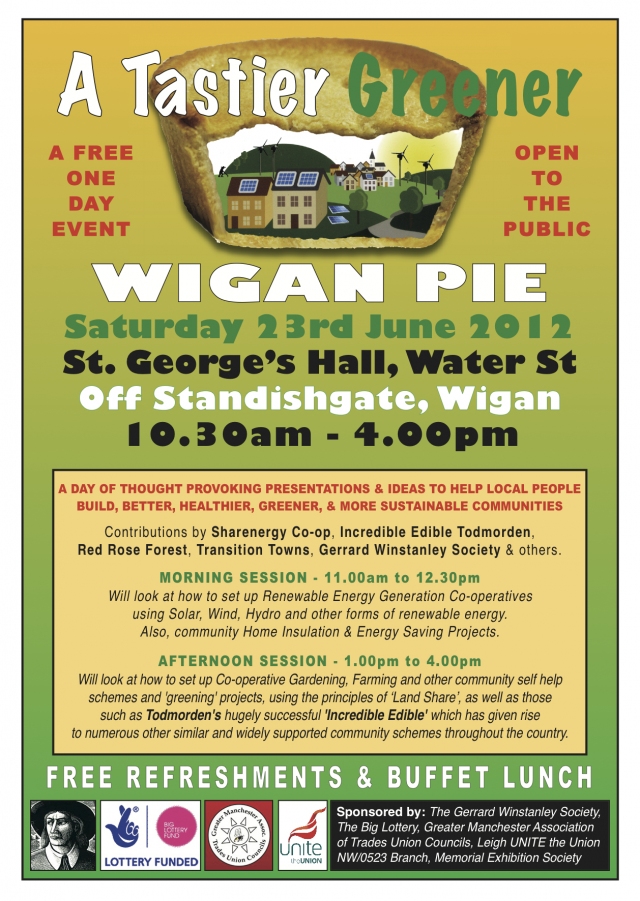
Upcoming Event: Tastier Greener Wigan Pie, June 23rd

From this website

Posted in Upcoming Events | Tagged | Leave a comment