This looks interesting! Weather (!) permitting, MCFly will cycle out there and do a report. All are welcome, btw.
As part of the Cold War/Blue Planet conference being hosted this Thursday and Friday by the Centre for the History of Science, Technology, and Medicine at the University of Manchester there will be a public lecture this Friday (29th June) 17:30 at the Imperial War Museum North.
The lecture will be given by Professor Jim Fleming of Colby College, Boston and is titled:
“Cold War Technologies for Weaponizing the Atmosphere: From Cloud Wars to Geo-Engineering” All are welcome, please circulate this notice to anyone who may be interested in attending.
MCFly attends a workshop hoping to get the Black and Minority Ethnic (BME) communities of Manchester talking about climate change.
On the 20th of June, both MCFly editors went along to the second workshop arranged by the National C ouncil for Voluntary Organisations. It was arranged for BME communities from across Greater Manchester about climate change. The day built on the previous workshop’s work exploring the implications of climate change for the BME organisation’s clients and planning their own projects. We missed the pre-lunch session because of this, but managed to make it along to hear the participants discussing their main concerns about climate change.
Quite interestingly (although not surprisingly), many of the attendees were concerned that climate change would play a hugely disruptive role in their communities. During a session designed to narrow down their concerns to three issues, conflict caused by climate change was raised repeatedly. Attendees, who work with youths and elderly people from everywhere from Pakistan to Nigeria, feared that a changing climate would cause political unrest, conflict, a rise in xenophobia, climate refugees, isolation and insecurity. The two other main concerns were a lack of information and rising costs as resources dwindle.
One attendee raised the concern that the power imbalance experienced by the BME community means that they will struggle to take the action they need to tackle climate change. It was a really interesting point and it’s a shame that more time was dedicated to exploring the issues the workshop raised. As the participants noted, we may all be on the same boat when it comes to climate change but we are all on different decks and those from disadvantaged communities will be worst affected and least prepared or able to deal with it.
Disclaimer: MCFly was invited along to this workshop by the organisers to speak about the various groups and organisations dealing with environmental issues in the city. And accepted an offered fee to do so (£150 – it will go into the same bank account as the Lush money, and be used to pay for printing, offering training sessions etc. The editors are not paid, and will continue not to be paid unless and until we announce otherwise.)
June 25th: A room fizzing of “cautious optimism”, new friendships forming. and flipcharts filling with good ideas; tonight in a room in Central Manchester the first steps were taken on a journey that can lead to a greener, fairer and climate-safe Manchester.
Just under twenty people – part of a broader number interested in preparing for the world beyond endless economic growth – came together at the Friends Meeting House, in response to a recent Council meeting at which “steady-state economics” was discussed briefly and dismissed out of hand. The people in the room, with those who could not be there, will form into teams to produce a report, to be published in late October. This report, [title to be decided, but it won’t be a gazillion miles from “Beyond Growth: prosperity, justice and climate safety for Manchester”] will lay out what is already being done in Manchester, and suggest how that activity can be massively amplified to meet the social and ecological problems we face. Fuel poverty, the loss of biodiversity, unemployment, depression, carbon emissions that remain persistently high; all these will be looked. By outlining the nature of a steady-state economy, the report will also look at the benefits of preparing now for the post-growth world, and the steps that civil society, businesses, the City Council (and other public bodies) can take in the next one to four years to be ready for it.
During the meeting, rather than sit in rows and be death-by-powerpointed, participants formed into pairs, introduced each other and identified what they wanted from the session. For several people this meant a discussion of the nature of a steady-state economy, and how the concept interacted with notions of “de-growth”, “de-coupling” and “closed loop” economy. These ideas will be explored more fully on the steadystatemanchester.net website.
Others focussed on what we would need to do to make the report – and all the other means of communication, such as youtube videos, cartoons, workshops, briefing papers etc – into a reality.
Next steps
Teams will form around topics like food, transport, education, council engagement, business, economics, etc. If you want to get involved, please email steadystatemanchester@gmail.com
One of those teams will be the “Meme Team,” tasked with dreaming up, creating and testing out metaphors, analogies, stories, slogans, jokes etc that are relevant to Manchester and talk about the need for a massive reduction in our energy usage and preparing for the challenges ahead. We already have several people keen to be involved, but need more. Please contact steadystatemanchester@gmail.com if you are interested.
If you want to get involved more peripherally, please get in touch. We want to assure you that we do NOT expect an open-ended commitment from anyone. If you have a day and a half in July, but only three hours in August, then another day or two in September, that’s great. If you can do a regular hour a week, that’s great. We WILL involve you in this process at the level you want.
What went well
People met new friends, got to mingle
Lots of ideas were generated, and concerns raised about the dangers ahead in the process
Training needs were identified
Lots of people sent their apologies (as in, genuinely wanted to be there) and also filled in the short survey online.
What didn’t go well
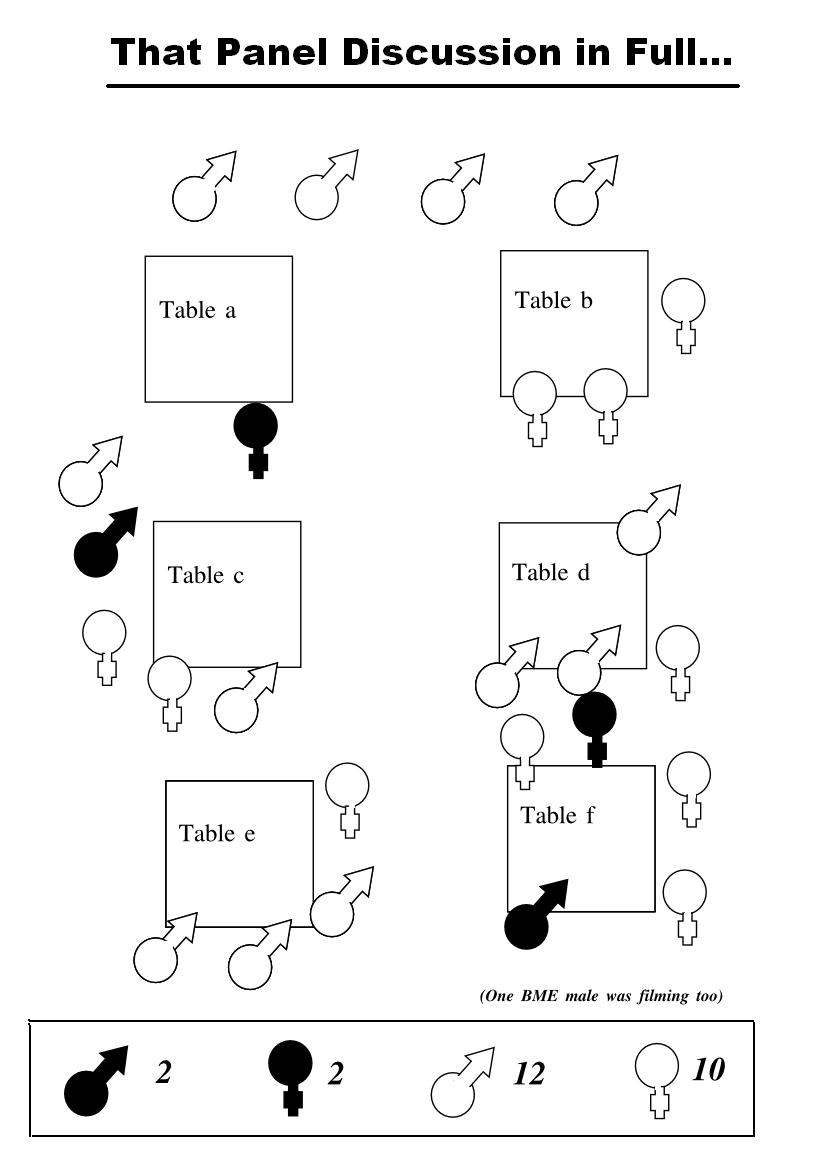
Gender and race representation were, predictably, skewed
“Next” time
More advance notice
Very specific questions being asked, alongside the opportunities to mingle and talk.
Of the flipcharts we put up, so far we’ve only typed up “What would practical solidarity with people in the Majority World look like”
Making their voices heard here (speaker tours, pen pals, video link-ups, interviews etc)
Empowering them to deal with their own problems (i.e. Not trying to save the world on their behalf)
Find another city in the south to run the process together – learn together and come up with joint demands – will create more momentum/visibility
Talking to them, finding out what they need
Skype series
Like the twinning option, practical solidarity acknowledges we are the 10% and they are the 90%, only then can progress develop.
but these below will be typed up in the coming days, and links created to pages where YOU can leave your comments.
Immediate tasks
What makes an effective group?
How can Manchester’s “eco” campaigning raise its game?
How do we radically raise the amount of food being grown ?
What does “success” look like for this project? Measured how?
Inspiring projects
How do we radically increase the numbers of people cycling?
How can we make the elephants tapdance (how do we make bureaucracies transparent and quick)
How do we make “binge-flying” as socially unacceptable as drink-driving?
Environmental Management Systems Free breakfast seminar
Friday 29th June, 8.30 – 10.30am at YHA Manchester
It will cover the following subjects:
> What is an EMS?
> Benefits of an EMS
> Key components of an EMS
> Certifying your EMS
It will be held on the 29th June 2012 at the YHA in Manchester, from 8.30 – 10.30am and it is ideally for Managers, Directors looking to implement and EMS (eg ISO 14001)
We will create a document that lists the good things already being done on climate change in Manchester, and the things that can be done in the next few years if the Council and other groups help those already taking action. And we will explain clearly why the growth economy is dead, and steady-state offers the real opportunity for local prosperity, justice and climate safety.
It’s an extremely exciting process (see the youtube and the initial flowchart), and we hope that you can get involved – at some level. If we all do a bit, and some of u do more, then the job will get done.
Best wishes, and, as ever, if you want to volunteer some time and/or energy to MCFly, get in touch with us via mcmonthly@gmail.com…
Arwa Aburawa and Marc Hudson
Coming up this week
Monday 25th June, 6pm to 9pm (drop-in) Steady-State Manchester – what next? For people who couldn’t make it to the Weds 20th meeting of the City Council to find out more. For people who were there to share their impressions. For us all to think – what do we next. How do we get the Council to help in making Manchester greener and fairer? Friends Meeting House, 6 Mount St, Manchester
Thurs 28 to Sat 30“Everything We Need” at Royal Exchange. £10/£7
“Loosely inspired by classic myth and climate change research, Everything We Need is a collection of humorous, lyrical and moving monologues from seven characters coming to terms with life changes in a changing world.” Written and performed by award-winning poet and actor Ben Mellor, directed and dramaturged by Cheryl Martin, live music from Dan Steele and Léonie Higgins, art and design by Sumit Sarkar.
Friday 29th 8.30 – 10.30am Environmental Management Systems Free breakfast seminar.
It will cover the following subjects: > What is an EMS?
> Benefits of an EMS
> Key components of an EMS
> Certifying your EMS
It will be held on the at the YHA in Manchester, and it is ideally for Managers, Directors looking to implement and EMS (eg ISO 14001) online booking form that delegates can complete as well as a relevant webpage.
Friday 29th from 1-4pm Community Action Day Fallowfield
MMU will be teaming up with the University of Manchester and Manchester City Council for a Community Action Day in Fallowfield. Each year as term ends and many students move out of their homes, Manchester City Council undertake a massive environmental operation to restore standards to the area. Both Universities, the Environmental team, the Off-campus Affairs Office and Manchester City Council have already been working together with groups of student volunteers to undertake a massive recycling project in aid of British Heart Foundation as students move out of houses. Volunteers will be involved in a range of activities from planting new plants, painting and localised clean ups. All equipment will be provided and there will be refreshments on offer at the office. We will be meeting at 12.45pm at the Manchester Student Homes office on the corner of Wilmslow Road and Moseley Road in Fallowfield, M16 6ND. If you have any questions, please get in touch with Beverley Craig, Off Campus Affairs Manager via email Beverley.craig@manchester.ac.uk
Lessons we like to pretend we have learnt
This effortless networking thing is quite effortful. And you have to read the minutes.; you really do. Paying your taxes on time is sensible, especially if you spend a goodly proportion of your free time telling Manchester City Council how to run its affairs. Ooops.
Hello everyone,
if you can get along Monday 25th to the ‘drop-in’ session about Steady-State economics, then great. It’s from 6pm to 9pm at the Friends Meeting House, Mount St (behind the Central Library).
We will be finding out what people think of the proposed “Grassroots Steps to a Greener Fairer and Steady State Manchester” report, how they would like to be involved, what they’d like to learn on the way.
If you can’t make the meeting – and there will be many many people for whom evening meetings are always a problem – then please
a) watch the youtube (below) and look at the flowchart of June to November and
b) answer this survey (only 5 questions, besides your name and email address).
The money will support the development of WeaveMCR, a place-based, social action platform. WeaveMCR will develop a common platform, in the form of an online social action platform, to bring institutions and individuals together in mutually-beneficial relationships around social innovation projects. The platform will do this by making opportunities to collaborate visible and rewarding/ recognising acts of collaboration.
The platform will function by providing social innovators with an online space to post and explain their ideas and then convene the stakeholders in Manchester who can provide the intellectual, relational or financial resource to make that project happen.
If you would like to learn more about WeaveMCR please contact James (duggan.jr@gmail.com).
MCFly says: Is this a game-changer? On its own, clearly not. Please do not write in telling us that people in Harpurhey or Gorton don’t use the internet. We know this.
Will Weave on its own create a social movement around climate change? Don’t be silly. Will it help the existing “movement” (if you look hard you can see bits of it) grow quicker than if Weave didn’t exist? Yeah, maybe. It is most definitely worth a shot…
We are going to be working with James around the steadystatemanchester.net project. Watch this space (and that space!)
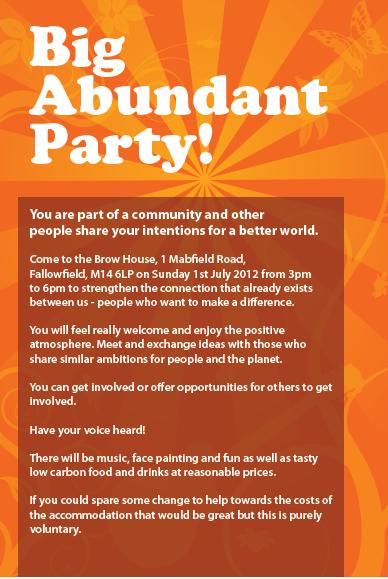
“Big Abundant Party” for Mancunians who want to act on climate change and have a great time- authentic French meals for just £2, salsa performance from ‘Ya Llegamos’, face painting, quiz, eco info and good hearted chilling and chat. Intergenerational. All welcome. RSVP if poss to guarantee your yummy food.
Date: Sunday July 1st
Time: 3 – 6pm
Venue: The Brow House, 1 Mabfield Road, Fallowfield, M14 6LP
Contact: 07712566144
Seyfang, G. and Haxeltine, A. (2012) ‘Growing Grassroots Innovations: Exploring the role of community-based social movements in sustainable energy transitions’, Environment and Planning C Vol 30(3) pp381-400doi:10.1068/c10222
Pah. I bet this is going to be another wordy academic article full of passive sentences and dense thickets of jargon; idle scribblers giving useless advice to hard-working doers. Probably written by people who never escaped the … library. Mmm. That bit is quite interesting. Fluke! Useless bloody academics in their ivory… towers… wow, hadn’t seen activist strategic needs laid out so clearly befo… They got lucky twice is all… It’s bound to disappear up its own… Wow, I need to tell Arwa and Mark about that conceptual framework. These guys are …. No, no!! Activists = Good, Academics = Parasites. Simple Worldview, Comfortable. Must defend…. Does not compute….. whrrrr [smoke comes out of author’s ears, and he cries out, falls to the ground clutching his head.]
This article, written by two Tyndall UEA academics, Gill Seyfang and Alex Haxeltine, clearly and cleverly thinks about climate campaigning (or rather “Transition Town”-ing) using lessons and frameworks from technology development – where innovations are given time to get de-bugged and supported until they can compete with the established technologies. In their terminology these experimental spaces are “niches” and therefore “strategic niche management” (SNM) is required if you’re to, um, manage your niche strategically.
Niches are variously defined in the literature, but we find the most constructive use of the term here is as follows: a protected space where suboptimally performing experiments can develop away from regime selection pressures. Niches comprise intermediary organisations and actors, which serve as ‘global carriers’ of best practice, standards, institutionalised learning, and other intermediating resources such as networking and lobbying, which are informed by, and in turn inform, concrete local projects (experiments). (p 383)
The authors immediately continue
In the SNM literature Kemp et al (1998) identify three key processes for successful niche growth and emergence: managing expectations, building social networks, and learning. (p 383)
And, in a bit more detail…
Expectation management concerns how niches present themselves to external audiences and whether they live up to the promises they make about performance and effectiveness. To best support niche emergence, expectations should be widely shared, specific, realistic and achievable.
Networking activities are claimed to best support niches when they embrace many different stakeholders, who can call on resources from their organisations to support the niche’s growth.
Learning processes are held to be most effective when they contribute not only to everyday knowledge and expertise but also to ‘second-order learning’ wherein people question the assumptions and constraints of regime systems (Kemp et al, 1998). (p 384)
This is all very commonsensical, but to have it laid out so clearly is, imho, bloody useful…
So, niches are nice, but what then? There’s not much point having a green ghetto, is there (cough cough)?
Successful niches facilitate the diffusion of innovative sociotechnical practices and systems, and theory suggests three ways by which niches can influence the regime: by enabling replication of projects within the niche, bringing about aggregative changes through many small initiatives; by enabling constituent projects to grow in scale and attract more participants; and by facilitating translation of niche ideas into mainstream settings. (p 384)
The authors make the sound point that the Transition Towns movement “does not intend to trigger a transition, but instead responds to landscape pressures at a microlevel and seeks to grow a niche of new infrastructure and practices to replace the incumbent regime when it fails to function.”
After laying out who the TTers are, and what they’ve been up to, Seyfang and Haxeltine offer up some sound advice. Yes, you can say it’s banal, but I’d rather call it obvious (in the same way that so much hindsight is; this is foresight, and precisely what I loot the Ivory Tower for…) Clippings from the two of the three headings below –
6.1 Foster realistic and achievable expectations
Managing expectations among the wider public is a vital part of SNM, but there is more to consider than branding and logos. It would be valuable to consider how TTs publically convey messages and visions about what the initiative can deliver in terms of practical opportunities for action. In addition, the majority of participants will not want to be involved as organisers, so the movement must communicate what it offers a wider, less-committed public, who may nevertheless become engaged through tangible projects offering immediate benefits. Our analysis found a lack of realistic and achievable expectations both among members (internally) and in relation to the wider public (externally), which hampers movement development and growth.
…. offering realistic and achievable goals, in order to engage participation more effectively. Additionally, if marketing efforts focus on this type of practical, local action, rather than on the enormity of the system transformation required, then community engagement is much more likely to spread beyond committed environmentalists and the movement will generate a reputation for delivering solution-oriented results. Finally, this strategy might be more successful at retaining the interest of those who initially come to meetings, but drift away because the group is stuck in an ‘awareness-raising’ phase and not attending to the needs of those who want to take action. (p 393)
6.2 Network widely outside the movement, with resourceful stakeholders.
6.3 Adopt social and experiential learning strategies
Transition initiatives aim to offer practical activities in numerous areas —such as food growing and learning skills —which are all valuable opportunities for social learning. Currently, the movement promotes educational information-giving events (which largely fail to attract audiences beyond a core of already-committed activists) as a prerequisite for action —employing a deficit model of behaviour change. But is changing minds necessary in order to change behaviour? Research on behaviour change for sustainable consumption largely rejects simplistic linear cognitive models in favour of more sophisticated approaches which consider social and psychological aspects of decision making which are familiar to marketers (meeting nontangible needs such as identity, self-expression, belonging, aspiration, and recognition) and sociological and infrastructural influences on behaviour choices (such as the configuration of systems of provision: availability, accessibility, convenience, habit and routine, inconspicuous consumption) .
In their conclusion, after admitting that technology development isn’t a perfect analogy, Seyfang and Haxeltine add
“Therefore, moving above and beyond technical and cognitive questions of information provision and behaviour change, our efforts to diffuse social movement niches must attend to these social – psychological aspects of the movement as they seek to grow and spread into wider publics: strategising how group identity is formed and maintained, how group cohesion is fostered and built, and how a sense of collective purpose is critical to ongoing participation and niche consolidation. However, such strong internal identity formation and community building might equally be an inhibiting factor to wider groups of participants who do not wish to adopt the identities offered by participation.
Consequently, an additional critical factor for niche diffusion of grassroots innovations is to carefully negotiate this element of group identity and community building and to manage the competing voices comprising the niche. In terms of theory for grassroots innovations, what is required, then, is an understanding of how identity, belonging, purpose, and sense of community underlie niche growth and the evolution of goals and priorities over time.” (p 396)
This has come along at exactly the right time, just when the first phase of the “Steady State Manchester” project is being conceptualised.
This paper will get turned into a two page bluffer’s guide, and also into a youtube (the SNM/S&M gag writes itself, after all)
PS I’ve now had a google-around and see that Strategic Niche Management is quite a cottage industry, especially Dutch-wise. Still, don’t want to edit the post above to appear jaded and knowing – this really is a good piece of work, dead useful to activists who want to reflect and use intellectual tools to reduce their organisation’s internal muppetry.
Attention Conservation Notice: MCFly co-editor Marc Hudson makes it half-way through a day-long academic seminar about climate change and social movements before finally losing his rag and invoking the law of two feet. Not of interest to casual readers. Or sentient readers. Look, it’s so tl:dr that it’s almost tl:dw. Go outside, smell the roses, have some fun. It’s later than you think!! This article will only be of interest, perhaps, to other attendees, those transfixed by bile-vitriol-and-bridge-burning, and any fool contemplating an attempt at constructive engagement with the ivory towerers.
Some muppet (1) told me it would be different this time. “Death by powerpoint will be minimised,” they said. “Sage on the stage will be minimised,” they said. “Ego-foddering will be minimised,” they said. Some muppet told me it would be different, and I – muppet that I am – muppetly listened to them.
It kicked off (after the rather nice coffee and pastries) with Dr Amanda Smith welcoming everyone. (I really must suggest an acknowledgement of greenhouse gas emissions). There was no attempt, sadly, to get us all meeting each other systematically at the outset, finding out who was in the room (with, say, a spectrum, or series of straw polls). We were told that it was a “very diverse” group, because as well as lots of academics, there were some activists (maybe three or four?) , a post-grad and even an undergrad. (4)
We did a brief mingler on our tables, and some of us had fulfilled the request to bring a photo that represents “transition” (not me – bad writer, no biscuit!) On our table the photos were of an “open space” meeting (of which more later), Garfield having a snooze (the need for sleep,/rest – burnout versus pseudo-burnout will be the subject of a future blog post) and me cheating with an advert for Monday June 25th. Amanda displayed hers which was a smoothie-making bicycle. She related how the Transition group she was part of managed to get a reasonably cheap deal, and then also realised that companies such as EDF and the Innocent Smoothie-Company (now 58% owned by Coca-Cola) had had their logos embossed on the wheels of such bikes. (5) This was a useful reminder that “sustainability” is often sold to us by corporations which, um, greenwash.
The contribution of Peter North (Liverpool) was – as best my scrawled notes, minus the extraneous commentary, say – essentially a long list of questions that anyone who has been doing this stuff (green-ish/social justice ‘activism’) for any length of time will have been asking for themselves. Perhaps a more radical solution would have been to circulate that list, given us all a chance to read it, taken a quick straw poll to find the most popular one and then had him talk about that, or have us all talk about it. As it stands, a list of questions is not so interesting. I could have read that on the tinterwebs, and saved myself the money.
Gerald Aiken‘s (Durham) presentation was absolutely superb. He pointed to the loaded nature of the phrase “community” which is used as a synonym for “good” and “pure” (I always want to say to people who throw it around in that manner that the Ku Klux Klan was a ‘community’). The term community could at one turn be used to smuggle radical proposals onto the agenda, and on the other an excuse for “neo-liberal government at a distance.” Once his presentation (which was filmed) is available, we will point readers to it.
UPDATE: Here’s the youtube wot has been put up…
He had a great quote from Iris Marion Young about people doing politics to look for belonging and then being disappointed when the group they are in falls apart, and another term “zuhanden” from Heidegger via Zygmunt Bauman, from the latter’s book “Community“, which he tells me is a must-read.
He closed with the intriguing suggestion from one of his research subjects that community might best be thought of as a verb rather than a noun (as in something that exists in action(s). I asked him if he was aware of any community group that had had a thorough and informed discussion about how it would respond when the inevitable siren-call came from the powers-that-be, the siren-call of co-optation, answered by opportunists leveraging “the movmeent brand” to get themselves the spoils of victory. Apparently not. Another one for the “to do” list then…
Someone else made a very good distinction (they were quoting someone else I think) about movements having prophets (stepping outside, holding up a mirror) and priests (“follow me, keep going”!) and saying that movements need both.
Finally, Kerry Burton (Exeter here’s her PhD on Climate Camp and other climate “activism” etc) had some very useful things to say under the title “Critical Spaces of Environmental Geopolitics” about exactly where the people involved in Climate Camp and Transition Towns come from (class, intellectual heritage etc) and what shape that gives to their ideas of “outreach” and “networking”. She also cited three academics worth following up;
Sarah Koopman “new securities” how we act together for food security etc.
David [?? Featherstone??] on the nature of the “Climate Caravan” that wended its international way to Copenhagen, riddled with unacknowledged and unresolved (unresolvable?) tensions around the very cultural capital/privilege issues that the Campers used to pride themselves on their sensitivity to.
This session was ably chaired by Jenny Pickerill, who drew out themes from each and guided the questioning well. In the Q and A Sherilyn MacGregor of Keele University made the important point that the private sphere is ignored in the focus on individual motives and social groupings – there is a silence around who is doing the physical household leg-work to make the “public sphere” activism possible.
[mental note to self: clean house more]
Here’s what I would have said if I had not (foolishly, it turned out) encouraged the chair to defer me until other people who hadn’t spoken had had a chance. Next time I’ll just barge right in. I am a white middle-class male, after all, and the universe should always bend to my will.
1) In early Climate Camp gender wasn’t, to my eyes (and yes, my eyes are male) the most interesting or difficult privilege. Rather, it was who was university-educated, had the most activist cred and the most time. Lots of people seemed to have maybe read “the tyranny of structurelessness” but thought that somehow its analysis of invisible power didn’t apply to them. Epic fail.
2) We need to make an analytic distinction between cliques, friendship networks and affinity groups or else we are going to get into no end of an analytic (and emotional) mess.
Out to Lunch and the DPD (7)
Over lunch (yummy) I flicked through a copy of Sharing for Survival: Restoring the Climate, the Commons and Society (ed Brian Davey) which I had blagged earlier and which will be reviewed in due course. I also got to hear a few people’s perspectives (esp Kerry, who had lots of hilarious and unprintable stories). This was nice. What followed wasn’t.
Allegedly there were three questions (8) for the panellists to answer, in their “eight” minute slots. Hmmm.
We had the edifying spectacle of one White Middle-Class White Male introducing 4 other White-(now) Middle-Class White Males.(9) This, in the year 2012 [I had to check].
Alan Simpson, ex-MP (who might quibble with my class-rating, if not my class-baiting) basically said “We are ill-prepared intellectually and socially for inevitable collapse. Localisation of food. Meanwhile, Germany is cool!” This took him 10 minutes.
Brian Davey (who gave me a copy of the book) basically said “the capitalists are wicked, enclosing the commons and we have to build our alternatives.” We need “lifeboat projects” -gardening, community supported agriculture, repair cafes. The political system is closed against social justice. Movements can get co-opted. Yes, a speech – as I pointed out – that could easily have been given, with a few name changes – any time in the last 15 (or 150? or 15000?) years. But it doesn’t really address the mechanics of movement-failure, does it? This took 11 minutes.
Dan Glass name-checked the deep-cover police infiltrator Mark Kennedy. Now, this is tricky. I do NOT want to minimise the horrific trauma suffered by his victims. And I hope they get some measure of justice, whatever that is in this grotesque context. But it’s a bit of a stretch to blame the failures of Climate Camp on “massive state repression.” Some people got beaten. Some people got convicted in what were, in effect, kangaroo courts, and their convictions finally overturned. I am not trying to say that “anything short of being thrown out of a helicopter into an ocean is somehow not really proper state repression”, but I do think it’s a bit of a stretch to lay the blame for Camp’s implosion at the door of an amoral thug like Mark Kennedy. But perhaps I am misunderstanding Mr Glass’s point?
He then read out stuff from a blog post/manifesto from a couple of years ago from the So We Stand website, which I am a fan of, and a ten point plan/manifesto . He pointed out that there had been [in the academic terminology, not his] “spill-over” from the camp into other movements. This speech took him 14 minutes.
Finally, Kelvin Mason of Cardiff University and Climate Camp (though to be fair he was careful to explain not-in-any-spokesman-capacity) outlined the facts of the tale of woe that was Climate Camp Cymru. He admitted its failure, but didn’t spend any time listing the reasons for this failure. Apparently the only choices are to keep plugging away on the ecological modernisation side of things, a la Friends of the Earth or the “radical” ecotage stuff. Feeble binary opposition, much? Not read the aforementioned Foucault much? This took about 12 minutes, or maybe a tad longer.
So, we started about 1.35pm. Given four times eight minute presentations, we’d be at about 2.07, right? [Buzzer noise] Nope. 2.37.
The Irony Police, Jumping the Shark and why failure is a bad thing after all
In my extensive experience, if you go straight from a panel discussion into the “questions and answers” session, the hands that go up are attached to
loud people who already knew what they were going to ‘ask’ (or speechify) and
curiously-frequently attached to male genitalia.
And so it came to pass. Three hands went up. Mine was one, and I was third to speak. I made a modest proposal for a slight change to the format.
No dice.
The chair said he was going to stick to his plan. (Hmm, well, he wasn’t sticking so much to the plan when all four of the speakers over-ran their “eight minutes” ? Perhaps too afraid to shut them up?)
My rejected suggestion was embarrassingly reformistic. I merely wanted each table to talk among itself for a couple of minutes. That might have thrown up different questions, and would have created more loose links between participants, even though were were still on the same tables we had been before lunch.)
It was pretty clear, from the evidence on offer that we were going to get the traditional tennis match between the esteemed panel and the loud men (minus me) in the audience who want to have something to say in each discussion. We were going to be condemning the women in the room to “silence” – or rather, only coming in after all the loud men had had their turn. Not the intention, but it is the predictable outcome. And we are responsible for the predictable outcomes of our actions.
So I walked. I wasn’t willing to be complicit. And bored. Anymore.
Hard to believe, but I do have some measure of compassion for the chair of that session. It’s hard to facilitate when some muppet you have never met is trying to co-facilitate. But this: You could have thrown my proposal out to the room, see what they wanted to do. Instead of, you know, deciding for yourself. If the proposal had not been accepted, then fine. But since you didn’t even put it out, and the seminar had jumped the shark, I decided to put myself out of my misery.
In an event allegedly all in celebration of polysemy (“multiple voices”), when an attempt by white middle-class male to undercut the tendency for the four middle-class white men on the panel to play comment-tennis with specific (MCWM) members of the audience is shut down by a white middle-class male, then the irony police (if they existed) would storm in and arrest everyone, yes? [Oh, and in case anyone missed it, the word “esteemed” was being used… ironically.]
If Open Space is in a box, Open Space is in a coffin
The promised “Open Space” session that I decided not to stick around for performed – unintentionally I am sure – a very useful function; as a stab-vest, a way of deferring and ghettoising the possibilities for real connection, real learning. So, young ‘uns, learn from an old man’s naivety; if the Open Space is only at the end of the day, as an add-on, watch out!
What I would have said over my shoulder as I left in response to those first two questions/statements.
“Failure is a bad thing when you fail in the same way over and over and over again. Failure you do not try to learn from is failure you are likely to repeat. Failure shrinks a movement, destroys its morale. Failure that has not been publicly and quickly learnt from destroys the credibility of the movement in the eyes of potential supporters. It is tricky to mobilise, let alone movement-build if everyone thinks you’re a muppet. Trust me on this.”
“Oh, and ‘why does this matter?’ Well, “we” are – or should be – trying to prepare for the mother of all shitstorms. If you think this is a parlour-game, an academic exercise or an opportunity for personal growth to the exclusion of effectiveness, well, good luck with that.”
“Oh and the idea that we can or should just flit from this to that, from Occupy to Greece solidarity’ to the next sexy thing of 2013? You mean, weightless po-mo activism? You mean, keep doing what we’ve been doing all along; being the SWP with dreadlocks? Yeah, that’s really working out for us, isn’t it?
Mea culpas Expectations management
I’m halfway through reading a staggeringly good academic (!!) article about this: “Growing grassroots innovations: exploring the role of community-based initiatives in governing sustainable energy transitions” by Gill Seyfang and Alex Haxeltine. Environment and Planning C: Government and Policy 2012, volume 30, pages 381-400
The key sentence is this: “In the [Strategic Niche Management] literature Kemp et al (1998) identify three key processes for successful niche growth and emergence; managing expectations, building social networks, and learning.” (emphasis added)
I expected too much. I strolled – again – into an alien subculture where they have their own rituals, their own motives and needs. And I expected there to be a match between the subject – transitions, innovations, polysemy – and the format. This was naïve of me, and on reflection, unfair on them. They are what they are. If they change it will be at a glacial pace (a 19th century glacier, not a 21st century one). That’s fine, that’s up to them. I just won’t be around to see it. I doubt they would welcome me again. More importantly, in the absence of a discussion with them about exactly what I would be letting myself in for – including an agenda and credible implementation plan – I’d not go. Life is too short, and I should be getting on with the mountains and mountains of work connected to this.
My last bit of learning? It’s that I am going to listen to wifey a bit more in future.
Marc Hudson
mcmonthly@gmail.com
(1) That muppet can now be named. Marc Hudson, whose wife absolutely and clearly warned him not to be a muppet. Dunning-Kruger, much?
(2) It was in Nottingham. The train ticket was £50 (and the Lush dosh is NOT paying towards that). Still and all, at least I got to see Nottingham. There’s ugly 60s concrete carbuncles, clonetown pedestrianised streets, some canals and even redbrick warehouses now converted into flats and yuppie drinking holes. It’s completely different from Manchester.
(3) ESRC is the Economic and Social Research Council – the money-tap from which the sociologically-minded ivory towerers greedily slurp. “We are the UK’s largest organisation for funding research on economic and social issues. We support independent, high quality research which has an impact on business, the public sector and the third sector. Our total budget for 2012/13 is £205 million. At any one time we support over 4,000 researchers and postgraduate students in academic institutions and independent research institutes.”
(4) I stifled a groan. The word ‘diverse’ really is a floating signifier, innit?
(5) I suspect Amanda, over a pint, would agree that the very middle-classness of the symbol – a fruit-drink provided by pedal power – is indicative of a certain “hidden” (4) politics of Transition Towns.
(6) Hidden not from the people who don’t feel they belong, hidden only from the eyes of the people who wonder where everyone else is…
(7) Is a new TLA. Stands for “Dreaded Panel Discussion”
(8) I didn’t write these questions – which were not put up on the powerpoint screen – down. Since none of the speakers seemed to be particularly systematic in addressing themselves to these questions, I don’t know what they were. If I find out, I will have a stab at answering them, in less than eight minutes.
(9) This gender and race imbalance would of course have been utterly utterly altered if a female – from Friends of the Earth – could have been there as planned.
Random observation I couldn’t shoe-horn in anywhere else
When asked her opinion about what she thought when she went to Oakland (California), Gertrude Stein said “There’s no there there.” That’s exactly what I felt when going to an academic conference about social movements around climate change – there’s no there there.
Our "leaders" are going to keep making empty promises. It makes them feel good. It gets the activists to act like zombie kittens. If you want to have some self-respect and perhaps make a difference (actual facts may vary), then find a functioning group that cares about your skills and knowledge - what you have, what you want.
One useful group might be www.climateemergencymanchester.net - you can email them on contact@climateemergencymanchester.net





 manchester climate monthly